
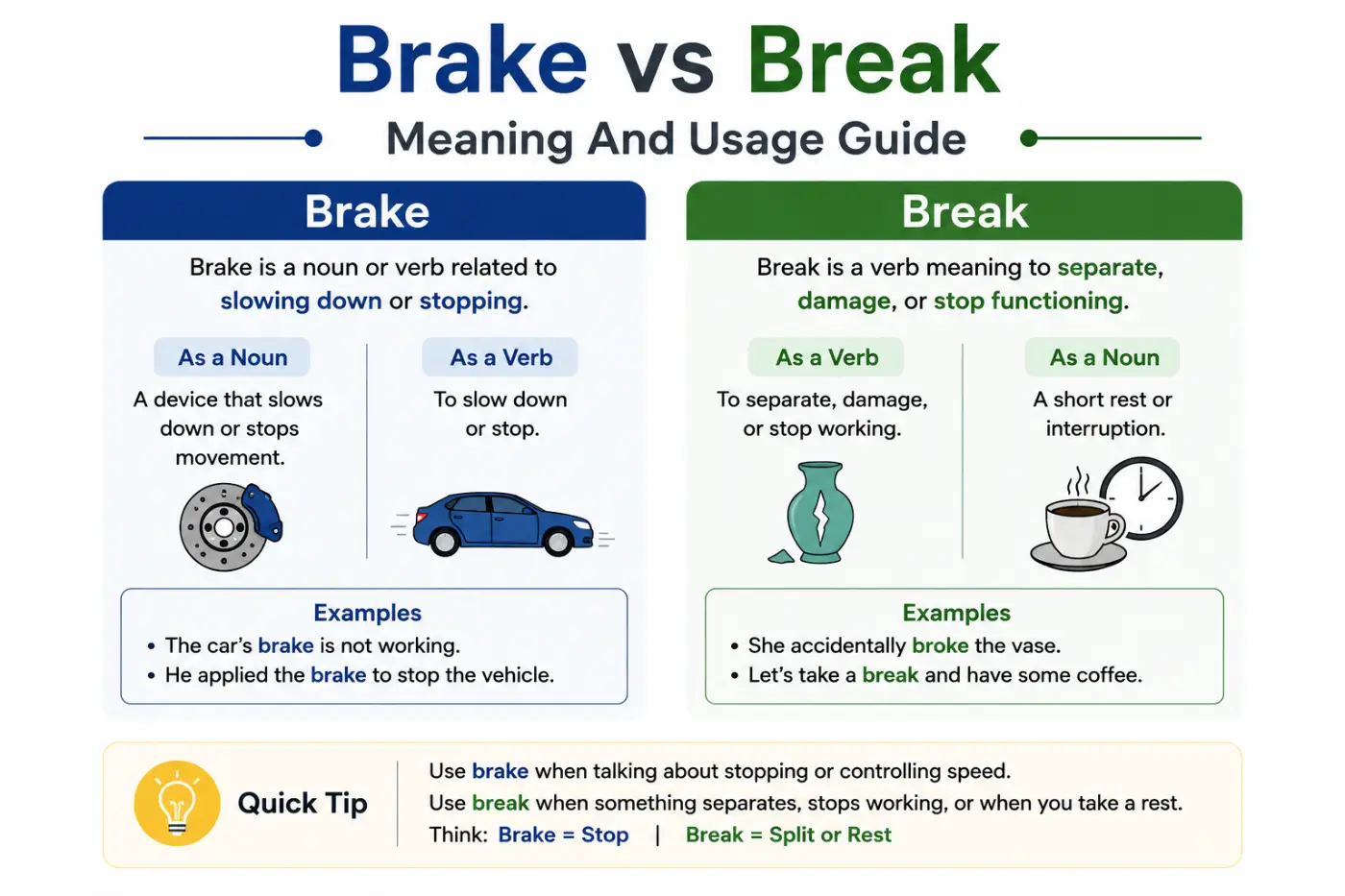
Brake vs Break is one of the most common word choices that trips up English speakers because the two words sound exactly alike in most varieties of English. The spelling gives you the clue. Brake relates mainly to stopping or slowing movement while break has a much wider range of meanings connected with damage separation interruption and rest.
The confusion gets worse because both words can work as nouns and verbs. You can brake a car or press the brakes. You can break a glass or take a break from work. Since the pronunciation doesn’t help you choose the spelling the meaning and context have to do the work.
This guide gives you a clear way to tell these words apart. You’ll learn their definitions grammar roles pronunciation word origins common expressions sentence examples and the mistakes people make most often. By the end you’ll have a simple memory rule that makes the choice almost automatic.
Short Answer
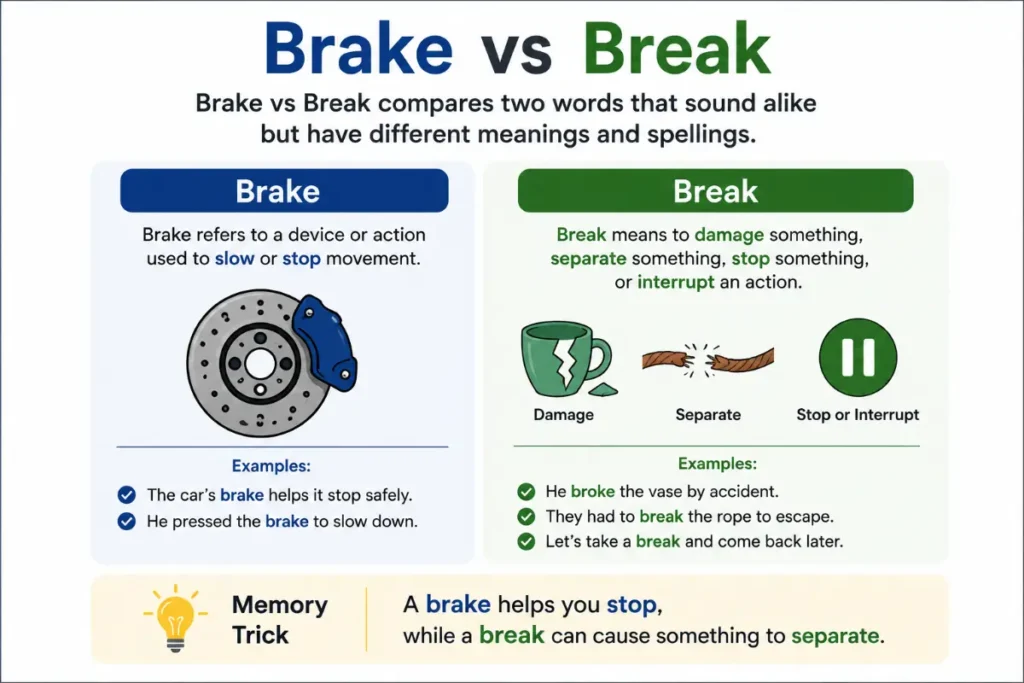
Brake vs Break compares two words that sound alike but have different meanings and spellings. Brake refers to a device or action used to slow or stop movement. Break means to damage something separate something stop something or interrupt an action. The easiest memory trick is simple: a brake helps you stop while a break can cause something to separate.
Table Of Contents
- The Main Difference.
- What Brake Means.
- What Break Means.
- Brake And Break As Verbs.
- Brake And Break As Nouns.
- Comparison Table.
- Brake In Everyday English.
- Break In Everyday English.
- Common Expressions With Brake.
- Common Expressions With Break.
- Pronunciation Guide.
- Word Origins.
- Grammar Rules.
- Real Life Examples.
- Common Mistakes.
- Memory Tips.
- Related Words.
- Professional Writing Advice.
- Key Takeaways.
- FAQs.
- Conclusion.
The Main Difference
The simplest distinction is this:
Brake is connected with stopping or slowing something that is moving.
Break is connected with damage separation interruption or stopping something temporarily.
For example:
I pressed the brake to slow the car.
I dropped the glass and broke it.
The first sentence involves controlling movement. The second involves damage.
You can also use brake as a verb:
The driver braked suddenly.
You can use break as a verb in many ways:
The child broke the toy.
She broke the silence.
They broke the rules.
He broke the news.
These meanings are completely different even though the words sound alike.
What Brake Means
A brake is a device that slows or stops a vehicle or machine. The word can also refer to the act of using such a device.
For example:
The car’s brakes need repair.
The driver pressed the brake.
The bicycle has disc brakes.
In each case the word relates to controlling movement.
As a verb brake means to slow down or stop by using a brake.
For example:
The driver braked before the intersection.
The cyclist braked when the dog ran into the road.
The train began braking as it approached the station.
The verb can describe a deliberate action. Someone or something is moving and the brake reduces that movement.
Brake As A Noun
As a noun brake refers to the mechanism or device used to slow or stop movement.
Common examples include:
Car brake.
Parking brake.
Emergency brake.
Brake pedal.
Brake system.
The plural is brakes.
For example:
The mechanic checked the brakes.
Brake As A Verb
As a verb brake means to slow or stop a moving vehicle or machine.
For example:
She braked hard when the traffic stopped.
The driver braked suddenly.
The cyclist braked before turning.
The past tense is braked.
The present participle is braking.
These forms can cause another spelling problem because braking contains one e before the ending.
Correct:
Braking.
Incorrect:
Brakeing.
What Break Means
Break has many meanings. That’s one reason it causes more confusion than brake.
The basic idea often involves separating something into pieces or causing something to stop functioning.
For example:
Be careful not to break the glass.
The branch broke during the storm.
I dropped my phone and broke the screen.
But the word goes much further than physical damage.
You can break a habit.
You can break a promise.
The meaning changes according to context.
Break As A Noun
As a noun break can mean a period of rest.
For example:
Let’s take a break.
We have a lunch break at noon.
She took a short break from studying.
It can also mean an interruption or separation.
For example:
There was a break in the music.
The storm caused a break in the power supply.
The team finally got a break in the investigation.
Break As A Verb
As a verb break has several important meanings.
It can mean to damage something:
He broke the window.
It can mean to separate something:
She broke the stick in half.
It can mean to violate a rule:
He broke the law.
It can mean to stop a habit:
She wants to break the habit of checking her phone constantly.
It can mean to interrupt:
The phone call broke my concentration.
It can mean to reveal information:
The journalist broke the story.
Because the word has so many meanings it appears constantly in everyday English.
Brake And Break As Verbs
The difference becomes especially clear when you compare their verb forms.
Brake
The verb brake relates to slowing or stopping movement.
Present:
I brake carefully.
Past:
I braked carefully.
Present participle:
I am braking carefully.
Third person:
She brakes carefully.
Break
The verb break has an irregular past tense.
Present:
I break the glass.
Past:
I broke the glass.
Past participle:
I have broken the glass.
Present participle:
I am breaking the glass.
Third person:
She breaks the glass.
Notice the different patterns.
Brake.
Braked.
Braking.
Break.
Broke.
Broken.
Breaking.
This distinction matters in both spelling and grammar.
Brake And Break As Nouns
As nouns the words have different meanings.
A brake is usually a mechanical device or system that slows or stops movement.
A break can mean rest interruption damage separation or opportunity.
Compare these examples:
The mechanic replaced the brake.
I need a break.
The first refers to a mechanical component.
The second refers to a period of rest.
You can also use break in several specialized expressions.
A break in the weather means a temporary change that provides relief.
A break in the case can mean a useful development.
A lucky break means an unexpected advantage.
A break in communication means an interruption.
None of these meanings has anything to do with vehicle braking.
Comparison Table
| Word | Part Of Speech | Main Meaning | Common Context | Example |
|---|---|---|---|---|
| brake | Noun | A device used to slow or stop movement | Cars bikes machines | The brake needs repair. |
| brake | Verb | To slow or stop a moving vehicle or machine | Driving cycling machinery | She braked before the corner. |
| break | Noun | A period of rest or an interruption | Work school sports | We took a short break. |
| break | Verb | To damage separate interrupt or violate | Everyday speech and writing | Be careful not to break the glass. |
| brakes | Noun | More than one brake or a brake system | Vehicles and machines | The brakes are worn. |
| broke | Verb | Past tense of break | Past actions | He broke the cup. |
| broken | Verb form | Past participle of break | Perfect tenses and descriptions | The window is broken. |
| braking | Verb form | Present participle of brake | Driving and machinery | The car is braking. |
Brake In Everyday English
You will most often encounter brake when people discuss vehicles.
Common phrases include:
Brake pedal refers to the pedal used to activate a vehicle’s braking system.
Brake pad refers to a component used in many braking systems.
Parking brake refers to a brake used to keep a parked vehicle from moving.
Emergency brake is a common term for a brake intended for securing a parked vehicle or providing additional stopping control.
Brake fluid is fluid used in hydraulic braking systems.
The word can also appear outside transportation.
Bicycles have brakes.
Industrial machines have braking systems.
Elevators use braking mechanisms.
Some exercise equipment uses braking resistance.
The common thread is control over movement.
Break In Everyday English
Break appears in far more everyday situations.
You might take a break at work.
You might break a promise.
When you see break in a sentence don’t automatically think about physical damage. The word has developed many figurative meanings over centuries.
Common Expressions With Brake
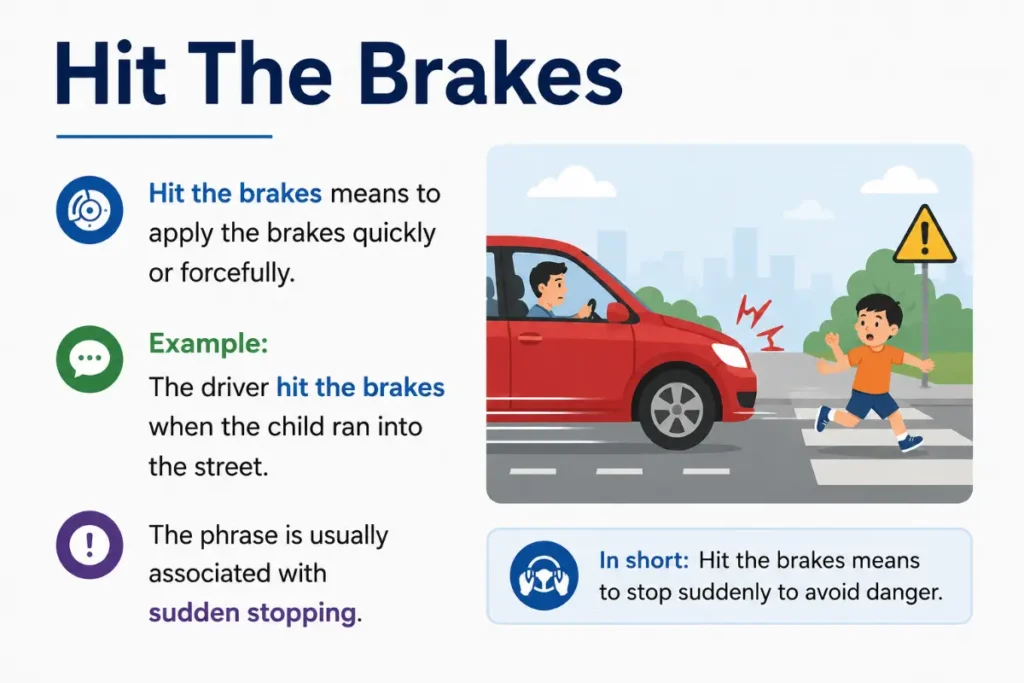
Hit The Brakes
Hit the brakes means to apply the brakes quickly or forcefully.
Example:
The driver hit the brakes when the child ran into the street.
The phrase is usually associated with sudden stopping.
Slam On The Brakes
This means to apply the brakes very suddenly and strongly.
Example:
She slammed on the brakes to avoid the collision.
Put On The Brakes
This can have a literal or figurative meaning.
Literally:
He put on the brakes before the hill.
Figuratively it can mean to slow down or stop a plan.
The company put the project on hold after the costs increased.
Brake For Something
This means to slow down or stop because of something.
Example:
The driver braked for the deer.
This expression is useful in driving contexts.
Common Expressions With Break
Take A Break
This means to stop working or doing an activity for a short period.
Example:
Let’s take a break after this meeting.
Break The Ice
This means to make people feel more comfortable in a new or awkward social situation.
Example:
He told a funny story to break the ice.
Break A Leg
This is an informal expression used to wish someone good luck before a performance.
Example:
She told the actors to break a leg before the show.
Break The News
This means to tell someone important information that may be difficult or surprising.
Example:
The doctor had to break the news to the family.
Break The Rules
This means to violate rules.
Example:
Students who break the rules may face consequences.
Break A Record
This means to perform better than the previous recorded achievement.
Example:
The athlete broke the national record.
Break Down
This phrasal verb has several meanings.
A machine can break down.
A person can break down emotionally.
You can break down a complicated idea into smaller parts.
Example:
The teacher broke down the difficult concept into three simple steps.
Pronunciation Guide
In most varieties of English brake and break are homophones. That means they have the same pronunciation but different spellings and meanings.
Both are generally pronounced like:
brayk
The vowel sound is similar to the vowel in day and make.
Because the pronunciation is the same you cannot rely on hearing the word to determine its spelling.
Context has to guide you.
If you’re talking about a car stopping you probably need brake.
If you’re talking about damage rest interruption or a change in something you probably need break.
This is a classic example of why English spelling can’t always be predicted from pronunciation.
Word Origins
The two words have different histories even though they sound alike today.
Brake developed through European languages and became associated with devices used for restraining or stopping movement. Its modern mechanical sense developed as transportation technology advanced.
Break has much older Germanic roots. It is related to words in other Germanic languages that carry the idea of splitting damaging or separating.
The words therefore come from different historical paths. Their modern pronunciation happens to be similar because English sound changes brought them together.
This is called homophony.
English contains many such pairs.
Examples include:
Pair and pear.
Sea and see.
Right and write.
Flower and flour.
Their sounds may match while their meanings and histories remain separate.
Grammar Rules
Both words can function as nouns and verbs but their grammar works differently because their meanings differ.
Using Brake As A Noun
Use an article when referring to one brake.
The brake is damaged.
Use the plural when referring to multiple brakes or the system generally.
The brakes are damaged.
Using Brake As A Verb
The verb can appear without an object.
The driver braked suddenly.
It can also appear with an adverb.
The driver braked sharply.
You can also describe what caused the braking.
She braked for the cyclist.
Using Break As A Noun
Break can be countable or part of fixed expressions.
I need a break.
We took two breaks.
The break lasted ten minutes.
Using Break As A Verb
Break can take an object.
She broke the glass.
It can also appear without an object.
The branch broke.
It can combine with prepositions and adverbs to form phrasal verbs.
The car broke down.
The children broke into laughter.
The thieves broke into the building.
These structures make break one of the most versatile verbs in English.
Real Life Examples
Driving
The driver pressed the brake when the light turned red.
The sentence refers to the device or control used to slow the vehicle.
Cycling
Always check your brakes before riding downhill.
The plural refers to the bicycle’s braking equipment.
Work
I need a break before I start the next task.
Here break means a period of rest.
School
The teacher gave the students a short break.
Again the word refers to time away from an activity.
Home
Be careful not to break that plate.
Here the verb means to damage or separate the object.
Relationships
They decided to take a break from the relationship.
Here break refers to a temporary separation.
News
The reporter broke the story early in the morning.
The verb means to publish or reveal important news before others.
Sports
The runner broke the previous record.
The verb means to surpass an established record.
Rules
He broke the rules without realizing it.
The word means violated.
Silence
Nobody spoke until she finally broke the silence.
Here break means to interrupt a period of silence.
Common Mistakes
Writing Break When You Mean Brake
Incorrect:
I pressed the break.
Correct:
I pressed the brake.
The sentence is about a vehicle control so brake is required.
Writing Brake When You Mean Break
Incorrect:
I need a brake from work.
Correct:
I need a break from work.
Here the word means rest so break is correct.
Confusing Braked And Broke
These are completely different verb forms.
Braked is the past tense of brake.
Broke is the past tense of break.
For example:
The driver braked suddenly.
The child broke the window.
Confusing Braking And Breaking
Braking describes slowing or stopping movement.
Breaking describes an action related to break.
For example:
The car is braking.
The child is breaking the toy.
The spelling difference becomes especially useful because both forms appear frequently in writing.
Confusing Brake And Break In Compound Words
Writers sometimes create incorrect expressions by replacing one word with the other.
Common correct forms include:
Brake pedal.
Brake light.
Breakthrough.
Brake and break can appear next to similar words but their meanings remain separate.
Memory Tips
The easiest trick is to connect brake with a vehicle.
Brake has an A like automobile.
That isn’t the word’s actual linguistic origin. It’s simply a memory device.
If you’re thinking about stopping a car bike or machine choose brake.
For almost everything else choose break when the meaning involves damage interruption separation rest or a figurative stopping point.
Another useful trick is:
Brake stops movement.
Break changes or interrupts something.
Picture a car approaching a red light.
You use the brake.
Now picture yourself sitting down after driving for hours.
You need a break.
The mental pictures make the distinction easier to remember.
Related Words
Several related words can help reinforce the difference.
Braking
This is the present participle of brake.
The car is braking.
Braked
This is the past tense and past participle of brake.
The driver braked suddenly.
Brakeable
This uncommon technical adjective can describe something that can be stopped or controlled by braking.
Broken
This is the past participle of break.
The window is broken.
Broke
This is the simple past tense of break.
She broke the cup.
Breakable
This adjective describes something that can easily be broken.
The box contains breakable items.
Breakage
This noun refers to damage caused by breaking.
The store recorded several cases of breakage.
Breakdown
This noun can describe mechanical failure emotional collapse or a detailed division of information.
The car suffered a breakdown.
Related Grammar And Usage Notes
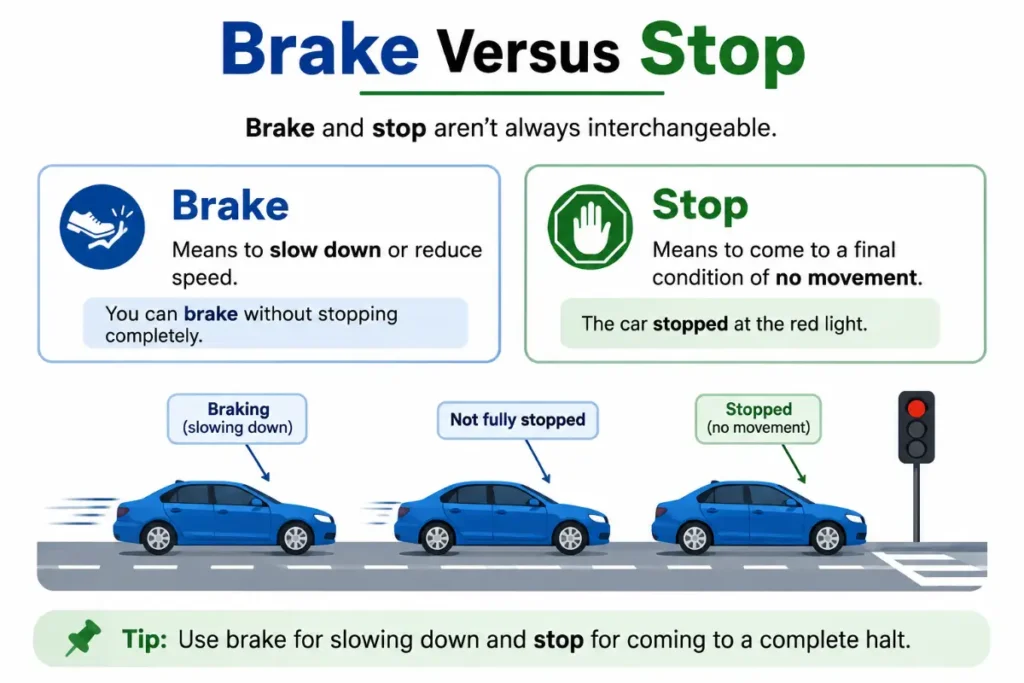
Brake Versus Stop
Brake and stop aren’t always interchangeable.
Stop focuses on the final condition of no movement.
You can brake without stopping completely.
For example:
The driver braked but continued moving slowly.
This distinction is useful in technical writing.
Break Versus Rest
Break can mean a period of rest but it isn’t always identical to rest.
A break is usually a temporary interruption of an activity.
Rest focuses more directly on recovery from effort.
For example:
I took a break from work.
I rested after the workout.
The meanings overlap but the emphasis differs.
Break Versus Pause
A pause is a temporary stop.
A break can be longer or can involve leaving an activity entirely.
For example:
The speaker paused for a moment.
The employees took a break.
Break Versus Damage
Break can mean damage but not every kind of damage involves breaking.
For example:
The storm damaged the roof.
The storm broke the window.
The first sentence gives a broad description.
The second identifies a specific kind of physical damage.
Professional Writing Advice
When editing your work check the meaning before checking the spelling.
Don’t ask only how the word sounds.
Ask what the word is doing.
If it refers to a device that slows or stops movement use brake.
If it refers to damage rest interruption separation or one of the many figurative meanings use break.
This approach works better than trying to memorize every possible phrase.
For American readers especially this distinction matters because both words are common. A spelling checker may catch many mistakes but context based editing remains valuable because a correctly spelled word can still be the wrong word.
For example:
I need a brake.
There is nothing wrong with the spelling itself. The problem is that the intended meaning is probably break.
This is a word choice error rather than a simple spelling error.
Key Takeaways
- Brake refers to a device or action used to slow or stop movement.
- Break has many meanings involving damage separation interruption rest and change.
- The two words are usually pronounced the same.
- Brake can function as a noun and verb.
- Break can also function as a noun and verb.
- Braked is the past tense of brake.
- Broke is the past tense of break.
- Braking relates to slowing movement.
- Breaking relates to the verb break.
- A useful memory trick is to associate the a in brake with automobile.
Conclusion
Brake vs Break becomes much easier once you connect each spelling with its core meaning. Brake is the word for slowing or stopping movement and for the device that makes this possible. Break is the much broader word used for damage rest interruption separation rules records habits and many other ideas. The two words sound alike but they don’t mean the same thing.
The best way to remember the difference is to picture a car at a red light. You press the brake to slow down or stop. Later you might park the car and take a break. That simple contrast gives you a reliable mental shortcut and works in everyday writing.
When you’re unsure which spelling to choose focus on the meaning instead of the sound. If you’re dealing with stopping movement choose brake. If you’re talking about rest damage interruption or separation choose break. With that distinction in mind you can avoid one of English’s most common homophone mistakes.
FAQs
What Is The Difference Between Brake And Break?
The main difference is meaning. Brake relates to slowing or stopping movement and is commonly used for vehicles and machines. Break has many meanings including damaging something taking a rest interrupting something violating a rule and separating something into pieces. The words sound alike in most English varieties but their spellings and meanings are different.
Is Brake Or Break Correct For A Car?
Use brake when you’re talking about the device or the action that slows or stops a car. For example you can press the brake or apply the brakes. You can also use the verb brake when describing the action. For example the driver braked suddenly when the traffic stopped.
Is It Take A Brake Or Take A Break?
The correct expression is take a break. It means to stop working or doing an activity for a short period. For example you might say I need to take a break after working for three hours. Take a brake would suggest taking a mechanical braking device which isn’t the intended meaning.
Is It Break Pedal Or Brake Pedal?
The correct term is brake pedal. A brake pedal is the pedal used to activate a vehicle’s braking system. The word brake is appropriate because the pedal helps slow or stop the vehicle. Break pedal is incorrect in this context because break doesn’t refer to the mechanical system that controls vehicle movement.
Is Brake And Break A Homophone?
Yes. In most standard varieties of English brake and break are homophones. They have the same pronunciation but different spellings and meanings. This is why people frequently confuse them in writing. You can’t normally hear the difference between the words. You have to use the meaning and sentence context to choose the correct spelling.
How Do You Remember Brake And Break?
Connect brake with cars bikes and stopping movement. A simple memory trick is to associate the a in brake with automobile. Use break for meanings such as damage rest interruption separation and violation. You can also remember that you press a brake but take a break.
What Is The Past Tense Of Brake?
The past tense of brake is braked. For example you can write The driver braked suddenly. Don’t confuse this with broke, which is the simple past form of break. The distinction is easy to remember when you focus on meaning. A driver braked while someone broke a window.
What Is The Past Tense Of Break?
The simple past tense of break is broke. For example She broke the glass yesterday. The past participle is broken, as in She has broken the glass. This irregular pattern is different from the regular verb brake, whose past form is braked.
Can Break Be A Noun And A Verb?
Yes. Break works as both a noun and a verb. As a noun it can mean a period of rest or an interruption. For example We took a break. As a verb it can mean to damage something or interrupt something. For example He broke the glass or The noise broke the silence.
Can Brake Be A Verb?
Yes. Brake can be a verb meaning to slow or stop a moving vehicle or machine. For example The cyclist braked before the turn. Its past tense is braked and its present participle is braking. The verb is especially common in driving cycling transportation and mechanical contexts.
Is Brake A Verb Or Noun?
Brake can be both a noun and a verb. As a noun it refers to a device or system used to slow or stop movement. As a verb it means to slow or stop by using a brake. For example The brake was damaged uses the noun while The driver braked suddenly uses the verb.

Confusing Words, Spelling & Word Choice
Claire Whitmore is a U.S.-based English editor who writes about commonly confused words, spelling differences, and word choice. Her work helps readers understand subtle distinctions between similar-looking words through simple definitions, practical examples, and modern usage guidance in both American and British English.