
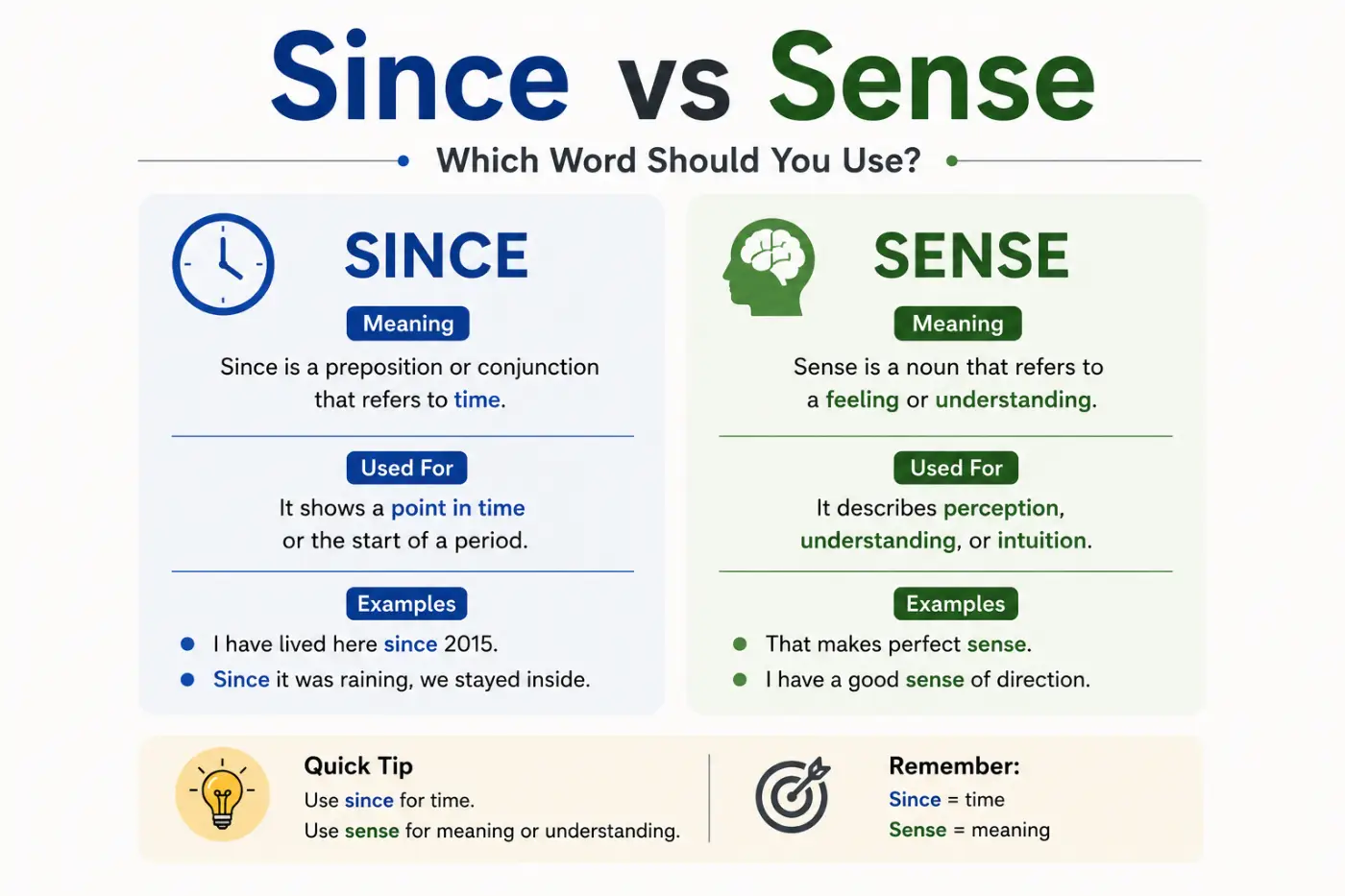
Since vs Sense is one of those English word pairs that can cause a quick pause while you’re writing. The words look different but can sound very similar in speech. The good news is that their meanings are quite different. Since usually talks about time or explains a reason while sense refers to perception meaning awareness or practical judgment.
The confusion often comes from pronunciation. In many accents the words can sound close enough that a writer may choose the wrong spelling after hearing the word rather than seeing it. Typing quickly can make the problem worse. A sentence such as That makes sense needs the noun sense, while I’ve known her since college needs the word since.
Once you focus on the job each word performs the distinction becomes much easier. This guide explains their meanings grammar rules pronunciation origins common expressions and real life usage. You’ll also learn a few memory tricks that can help you choose the right word without stopping to second guess yourself.
Short Answer
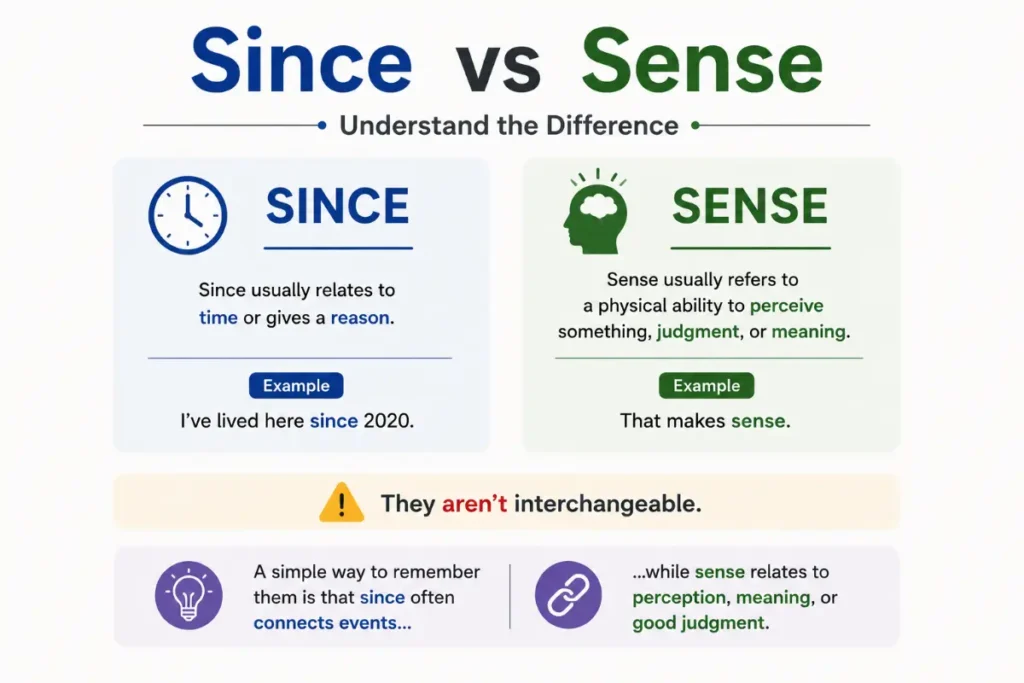
Since usually relates to time or gives a reason. Sense usually refers to a physical ability to perceive something judgment or meaning. They aren’t interchangeable. For example you can say I’ve lived here since 2020 or That makes sense. A simple way to remember them is that since often connects events while sense relates to perception meaning or good judgment.
Table Of Contents
- The Main Difference.
- What Since Means.
- What Sense Means.
- Since As A Time Word.
- Since As A Reason Word.
- Sense As A Noun.
- Sense As A Verb.
- Comparison Table.
- Grammar Rules.
- Sentence Examples.
- Common Mistakes.
- Pronunciation Guide.
- Word Origins.
- Formal And Informal Usage.
- American And British Usage.
- Related Words.
- Memory Tips.
- Professional Editing Advice.
- Key Takeaways.
- FAQs.
- Conclusion.
The Main Difference
The easiest way to separate these words is to look at their meanings. Since commonly has two major uses. It can show when something began and continued until now or another point in time. It can also introduce a reason.
Examples:
I haven’t seen him since Monday.
Since you’re already here we can start.
In the first sentence since relates to time. In the second it introduces a reason or explanation.
Sense has several related meanings. It can describe one of the body’s abilities to perceive the world. It can mean awareness or understanding. It can also mean good judgment or the meaning of something.
Examples:
The smell reached my sense of smell.
I don’t understand the sense of that sentence.
Use your common sense.
These words have different jobs. Learning those jobs is more useful than trying to memorize spelling alone.
What Since Means
Since is commonly used as a preposition conjunction or adverb.
Its most familiar meaning relates to time.
You can use it to identify the point when an action or situation started.
For example:
I’ve lived in Chicago since 2019.
This means the person started living in Chicago in 2019 and the situation continued afterward.
You can also say:
She hasn’t called since yesterday.
The word identifies yesterday as the starting point of the period being discussed.
The second major use introduces a reason.
For example:
Since you’re tired we should go home.
Here since doesn’t tell us when something happened. It means something close to because.
The sentence means that the person’s tiredness is the reason for going home.
This gives you two core meanings to remember:
Since means from a particular time.
Since can also mean because.
Context tells you which meaning applies.
What Sense Means
Sense is mainly a noun but it can also function as a verb.
As a noun it has several important meanings.
One meaning relates to the body’s ability to perceive things.
Humans traditionally have five commonly recognized senses:
Sight.
Hearing.
Smell.
Taste.
Touch.
For example:
Dogs have an excellent sense of smell.
Another meaning relates to understanding.
For example:
That explanation makes sense.
Here sense means that the explanation is logical or understandable.
The word can also describe judgment.
For example:
She has good financial sense.
This means she makes sensible financial decisions.
Sense can also mean the meaning of a word sentence or statement.
For example:
What sense does this sentence have?
The word therefore covers several ideas that share a basic connection with perception understanding meaning or judgment.
Since As A Time Word
The time related use is one of the most common functions of since.
It identifies a starting point.
For example:
I’ve worked here since June.
The sentence tells us when the period began.
The period continues to the present unless the context says otherwise.
You can use since with a specific date.
I moved here since 2020.
That sentence is not natural in standard English for the intended meaning. A better sentence is:
I’ve lived here since 2020.
You can also use since with a day.
I’ve been sick since Tuesday.
Or with an event:
We’ve known each other since college.
Or with a point in someone’s life:
She has played piano since childhood.
A useful grammar pattern is:
Present perfect plus since plus starting point.
Examples:
I have lived here since 2018.
He has worked there since January.
They have been friends since high school.
This pattern appears frequently in everyday English.
Since As A Reason Word
Since can also introduce a reason.
In this use it works much like because.
For example:
Since it’s raining we should stay inside.
The reason for staying inside is the rain.
Another example:
Since you finished early you can leave.
The reason the person can leave is that they finished early.
This use often appears at the beginning of a sentence but it can also appear later.
We can leave early since everyone has finished.
Here since introduces the reason after the main idea.
There is a small difference in tone between since and because.
Because often gives a direct and explicit reason.
Since can sound slightly softer or more natural when the reason is already known or easy to understand.
Compare:
I stayed home because I was sick.
Since I was sick I stayed home.
Both are correct. The first puts stronger emphasis on the reason. The second can sound more like a logical explanation.
Sense As A Noun
The noun sense has several common meanings.
A Physical Ability
The word can describe a faculty used to perceive the world.
For example:
My sense of hearing has improved.
The sentence refers to the ability to hear.
You can also use it in familiar expressions:
sense of smell.
sense of taste.
sense of touch.
sense of sight.
sense of hearing.
These expressions describe different ways of receiving information from the environment.
Understanding
Sense can mean understanding or logical meaning.
For example:
That doesn’t make sense.
The sentence means that something seems confusing illogical or unreasonable.
You can also say:
Now I see the sense in your argument.
Here sense means the underlying logic or value of the argument.
Meaning
Sense can refer to the meaning of a word expression or statement.
For example:
The word has several senses.
This means the word has several different meanings.
A dictionary may list several senses for the same word.
Judgment
Sense can also describe practical judgment.
For example:
He has good business sense.
She showed excellent common sense.
In these expressions the word describes the ability to make sensible decisions.
Sense As A Verb
Although many learners first encounter sense as a noun it can also work as a verb.
As a verb it can mean to detect or perceive something.
For example:
I sensed that something was wrong.
The speaker detected a problem without necessarily seeing or hearing a specific physical signal.
Another example is:
She sensed danger nearby.
The sentence means she became aware of danger.
The verb can also describe detecting an emotion or situation.
He sensed her disappointment.
They sensed tension in the room.
This verb form is especially useful when describing intuition or subtle perception.
Notice the spelling carefully.
The verb is sense.
Its past tense is sensed.
The word does not become since.
Comparison Table
| Word | Main Meaning | Part Of Speech | Common Use | Example |
|---|---|---|---|---|
| Since | From a particular time | Preposition conjunction adverb | Time | I’ve lived here since 2020. |
| Since | Because | Conjunction | Reason | Since you’re tired we should leave. |
| Sense | Physical ability | Noun | Perception | My sense of smell is strong. |
| Sense | Meaning | Noun | Language and communication | I don’t understand the sense of that sentence. |
| Sense | Judgment | Noun | Decisions and behavior | She has excellent common sense. |
| Sense | Detect or perceive | Verb | Awareness | I sensed that something had changed. |
Grammar Rules
Understanding the grammatical role makes these words much easier to separate.
Since As A Preposition
When since introduces a time point it can work as a preposition.
For example:
I’ve been here since Monday.
She has lived there since 2015.
In these sentences since comes before a noun or noun phrase that identifies a starting point.
Since As A Conjunction
Since can introduce a clause.
For example:
I’ve been happier since I changed jobs.
Here the word connects the main clause with another clause.
It can also introduce a reason:
Since you’re busy we can talk later.
Since As An Adverb
Since can sometimes stand alone as an adverb.
For example:
She left several years ago and hasn’t returned since.
Here since means from that time until now or until the relevant point in the discussion.
Sense As A Noun
The noun can appear after articles and possessive words.
For example:
a sense of humor.
my sense of direction.
her sense of responsibility.
common sense.
The word often appears in the phrase sense of followed by another noun.
Sense As A Verb
As a verb it describes detecting or becoming aware of something.
For example:
I sense trouble.
She sensed his hesitation.
They sensed an opportunity.
The verb often takes a direct object or a clause.
Sentence Examples
Examples With Since
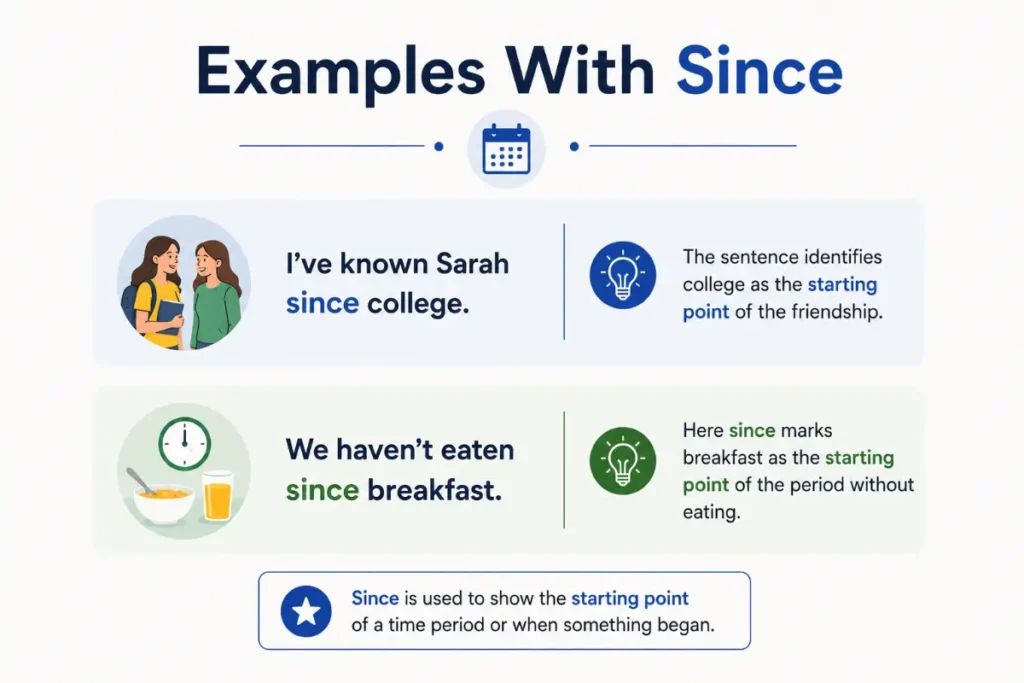
I’ve known Sarah since college.
The sentence identifies college as the starting point of the friendship.
We haven’t eaten since breakfast.
Here since marks breakfast as the starting point of the period without eating.
Since you’re already downtown we can meet there.
Here since means because.
He has worked from home since March.
The sentence describes a situation that began in March and continued afterward.
I haven’t heard from him since last week.
The word establishes the starting point of the period.
Since the store is closed we’ll come back tomorrow.
Here since introduces the reason for returning another day.
She hasn’t traveled abroad since 2022.
The word identifies 2022 as the starting point.
I’ve felt better since I started exercising.
Here since connects a change in condition with the point when it began.
Examples With Sense
That doesn’t make sense.
Here sense means logical meaning.
I have a strong sense of direction.
The word refers to an ability to understand location and navigate.
Use your common sense.
Here sense means practical judgment.
The dog has an excellent sense of smell.
The noun refers to a physical ability.
I sensed something unusual in the room.
Here sense is a verb meaning detected or became aware of.
The sentence makes sense now.
The word refers to meaning or logic.
She has a good sense of humor.
Here sense describes an ability to recognize and appreciate humor.
He has a strong sense of responsibility.
The word refers to an awareness or understanding of responsibility.
Common Mistakes
Writing Sense When You Mean Time
Incorrect:
I’ve lived here sense 2018.
Correct:
I’ve lived here since 2018.
The mistake usually happens because the two words can sound similar in speech.
Writing Since When You Mean Meaning
Incorrect:
That doesn’t make since.
Correct:
That doesn’t make sense.
The fixed expression is make sense.
It means to be logical understandable or reasonable.
Confusing Sense And Since In Speech
When two words sound similar the ear may not provide enough information to choose the spelling.
This is especially common in fast speech.
The solution is to think about meaning.
If you’re talking about time or giving a reason use since.
If you’re talking about perception meaning or judgment use sense.
Mixing Up Sense And Sensible
The word sense appears in sensible and senseless.
For example:
That was a sensible decision.
The related idea is judgment.
But don’t assume every word that sounds similar has the same grammatical role.
Writing Since Instead Of Because
Sometimes since can replace because, but not every sentence needs that substitution.
For example:
Because I was tired I went home.
Since I was tired I went home.
Both can work.
However, because is often clearer when the reason is the main point you want to emphasize.
Pronunciation Guide
In many varieties of English since and sense are pronounced very similarly.
Since is commonly pronounced /sɪns/.
Sense is commonly pronounced /sens/.
The main vowel differs in standard pronunciation.
Since has the short vowel sound found in words such as sit.
Sense has the vowel sound found in words such as send.
A simple pronunciation guide is:
Since sounds like sins.
Sense sounds like sens.
The final consonant sounds are also close.
This small vowel difference can disappear or become difficult to hear in rapid speech. That’s why spelling errors happen so often.
If you’re unsure while writing, don’t rely on pronunciation. Ask what the word means in the sentence.
Word Origins
The histories of since and sense are different.
Since comes from Old English forms connected with the idea of the time from which something has happened. Its modern meanings developed through the history of English and gradually expanded to include its use as a reason marker.
Sense entered English through Old French and ultimately traces back to Latin sensus, meaning perception or feeling. It is related to the Latin verb sentire, meaning to feel or perceive.
That Latin connection helps explain the many meanings of sense.
Physical senses involve perception.
Common sense involves judgment.
The sense of a sentence involves understanding.
Sensing danger involves detecting something.
These meanings may seem separate at first but they share the broader idea of perception or understanding.
American And British Usage
Both words are standard in American and British English.
There isn’t a major regional spelling difference between them.
American writers use since and sense.
British writers also use since and sense.
The difference between the words is therefore not an American versus British spelling issue.
That point matters because some confusing word pairs really do change spelling by region. Since and sense don’t belong to that category.
A writer in the United States should use the same forms as a writer in the United Kingdom.
Formal And Informal Usage
Both since and sense are completely standard in formal writing.
You’ll see since in academic papers legal documents business writing journalism and everyday messages.
For example:
The company has operated in the region since 1998.
You’ll also see sense in formal writing.
For example:
The findings make sense in light of previous research.
The study examined participants’ sense of social responsibility.
The choice isn’t about formality.
It’s about meaning.
One useful editing habit is to replace the questionable word with a synonym.
If because fits then since may be correct.
If meaning or judgment fits then sense may be correct.
If from followed by a time point fits then since is likely the right choice.
Related Words And Expressions
Common Sense
Common sense means practical judgment.
Example:
Use common sense before making the decision.
Sense Of Humor
A sense of humor refers to someone’s ability to recognize or appreciate humor.
Example:
She has a great sense of humor.
Sense Of Direction
A sense of direction describes someone’s ability to understand location and navigate.
Example:
I have a terrible sense of direction.
Make Sense
Make sense means to be logical or understandable.
Example:
Your explanation makes sense.
Since Then
Since then refers to the period from a past event until another relevant time.
Example:
We met in college and have stayed friends since then.
Ever Since
Ever since emphasizes that something has continued from a particular time.
Example:
I’ve loved that song ever since I first heard it.
Since Then
This phrase is especially common in storytelling.
Example:
He moved away in 2010 and hasn’t returned since then.
In A Sense
In a sense means in a particular way or from a particular point of view.
Example:
In a sense the two decisions were similar.
The Difference Between Make Sense And Make Since
This is one of the most common errors involving these words.
The correct expression is:
make sense
For example:
That explanation makes sense.
Your idea makes sense.
The plan doesn’t make sense.
Make since is incorrect in standard English when you’re trying to say that something is logical.
Why does this mistake happen?
The two words sound similar enough that a writer may choose the wrong spelling based on sound.
This is a classic example of phonological confusion. The writer knows the expression but retrieves the spelling incorrectly.
The best fix is to memorize the whole phrase rather than the individual word.
Think:
make sense equals be logical.
Once that phrase becomes familiar it becomes much harder to type the wrong form.
The Difference Between Since And Because
These words can overlap when they introduce reasons.
For example:
Since it was late we went home.
Because it was late we went home.
Both sentences communicate the same basic reason.
Still, because can be clearer when the reason needs strong emphasis.
Consider:
Why did you leave?
Because I was tired.
That answer sounds natural and direct.
You could technically use since in a longer sentence but it may not sound as direct.
Since can also create ambiguity because readers may initially interpret it as a time expression.
For example:
Since Monday I’ve been working from home.
Here the time meaning is clear.
Since you’re here we can begin.
Here the reason meaning is clear.
Context usually removes the ambiguity.
A Simple Test For Choosing The Right Word
When you hesitate between these words ask yourself one question.
Am I talking about time or a reason?
If yes use since.
Examples:
I’ve been here since noon.
Since you’re finished we can leave.
Then ask:
Am I talking about meaning perception awareness or judgment?
If yes use sense.
Examples:
That makes sense.
I lost my sense of smell.
She has good business sense.
I sensed something was wrong.
This test works because it focuses on meaning rather than spelling.
Memory Tips
A strong memory trick is to connect since with a starting point.
Think:
Since = starting time.
For example:
since Monday.
since 2020.
since childhood.
You can also connect sense with the five senses.
Think:
Sense = sight sound smell taste touch.
Then extend that idea to meaning and judgment.
If you can see hear smell taste or touch something you have a sense connected to perception.
If something is logical it makes sense.
If someone makes smart practical decisions they have good sense.
Another useful trick is the phrase:
That makes sense.
If you mean logical or understandable always choose sense.
Professional Editing Advice
When editing a sentence containing one of these words don’t start by checking the spelling. Start by checking the grammatical function.
Ask what the word is doing.
If it marks a starting point in time it is since.
If it introduces a reason it can be since.
If it describes perception meaning awareness or judgment it is sense.
If it describes detection as a verb it is also sense.
This approach is more reliable than memorizing isolated spellings.
It also helps with proofreading because many spelling errors come from choosing a correctly spelled word that doesn’t belong in the sentence.
For example:
That doesn’t make since.
The word since is spelled correctly. It is still wrong because the sentence requires sense.
This distinction is important in professional editing. Grammar and word choice aren’t only about spelling. A sentence can contain a perfectly valid word in the wrong semantic role.
Expert Tip
When two words sound similar check the sentence with a substitution.
Replace since with because.
If the sentence still makes sense then the reason meaning is probably intended.
Replace since with from followed by a time point.
If that works then the time meaning is probably intended.
For sense, try meaning, judgment, perception, or detect depending on the sentence.
This quick substitution test is often faster than checking a dictionary.
Key Takeaways
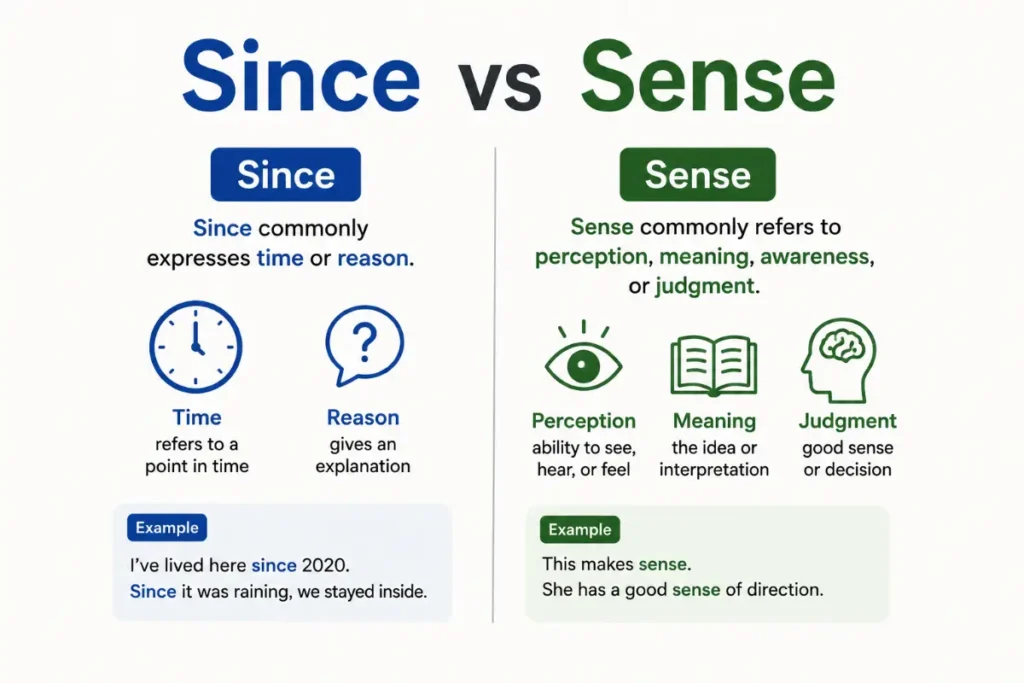
- Since commonly expresses time or reason.
- Sense commonly refers to perception meaning awareness or judgment.
- Since appears in phrases such as since Monday and since childhood.
- Since can sometimes mean because.
- Sense appears in expressions such as common sense and make sense.
- Sense can function as both a noun and a verb.
- Since and sense are standard in both American and British English.
- The words can sound similar but their meanings are different.
- If the sentence concerns a starting point use since.
- If the sentence concerns meaning perception or judgment use sense.
Conclusion
Since vs Sense becomes much easier once you connect each word with its main job. Since usually refers to a starting point in time or introduces a reason. Sense usually refers to perception meaning awareness or judgment. So you can write I’ve lived here since 2020 but That makes sense. The difference is about meaning rather than spelling alone.
If you’re unsure which word belongs in a sentence, look at the idea you’re expressing. Think of since when you’re talking about time or a reason. Think of sense when you’re talking about the five senses logical meaning practical judgment or detecting something. This simple approach works in everyday writing and formal English alike.
The best memory trick is short and practical. Since marks a starting point while sense deals with perception or meaning. When you hear the words and can’t tell them apart, don’t guess from pronunciation. Look at the sentence and ask what the word needs to mean. That habit will keep your writing accurate and natural.
FAQs
What Is The Difference Between Since And Sense?
Since usually refers to a starting point in time or introduces a reason. Sense usually refers to perception meaning awareness or judgment. For example I’ve lived here since 2020 uses the time meaning. That makes sense uses the meaning or logic sense. The words sound similar in some accents but they have different grammatical roles and meanings.
Is Since A Preposition Or Conjunction?
Since can function as both a preposition and a conjunction. In I’ve lived here since Monday it works as a preposition because it introduces a noun phrase. In I’ve been happier since I changed jobs it introduces a clause and functions as a conjunction. It can also function as an adverb in sentences such as I haven’t seen him since.
Is Sense A Noun Or A Verb?
Sense can be both a noun and a verb. As a noun it can refer to a physical ability perception meaning awareness or judgment. As a verb it can mean to detect or become aware of something. For example She has a good sense of direction uses the noun while She sensed danger uses the verb.
Why Do People Confuse Since And Sense?
People often confuse these words because their pronunciation is similar in many varieties of English. Fast speech can make the distinction even harder to hear. Writers may also rely on sound when typing and select the wrong spelling. The best solution is to focus on meaning. Time and reason usually point to since while perception meaning or judgment points to sense.
Is It Make Sense Or Make Since?
The correct expression is make sense. It means that something is logical understandable or reasonable. For example Your explanation makes sense means that the explanation is clear and logical. Make since is a common spelling mistake caused by the similar sounds of the two words. If you mean logical or understandable always use sense in this expression.
Can Since Mean Because?
Yes. Since can introduce a reason and can often be replaced by because. For example Since it was raining we stayed inside means essentially the same thing as Because it was raining we stayed inside. However since also has a time meaning so context matters. If you want to make a reason especially clear because may be the stronger choice.
What Are The Five Senses?
The five traditionally recognized human senses are sight hearing smell taste and touch. The noun sense refers to each ability to receive and process information through the body. Modern science recognizes that human perception involves additional sensory systems too. Still the five senses remain the familiar framework used in everyday English education and general discussion.
Does Since Mean Before Or After?
When since refers to time it identifies the point from which something has continued. For example I’ve lived here since 2020 means the situation began in 2020 and continued afterward. The word therefore establishes a starting point rather than simply meaning before or after. The exact time relationship depends on the tense and context of the sentence.
What Does It Mean When Something Makes Sense?
When something makes sense it is logical understandable or reasonable. For example Your explanation makes sense means the explanation is clear and follows a logical idea. The phrase can also describe a practical choice. If someone says It makes sense to leave early they mean leaving early seems like a sensible decision.
Can Sense Mean Feeling?
Yes. Sense can refer to a feeling or awareness of something. For example I had a sense that something was wrong means the speaker had an impression or intuition that something wasn’t right. The verb sense can express a similar idea. She sensed that he was nervous means she detected or became aware of his nervousness.
Is Since Formal English?
Yes. Since is completely standard in formal English. It appears in academic writing business communication journalism legal documents and professional reports. Its appropriateness depends on the meaning and sentence structure rather than formality. For example The company has operated here since 1995 is perfectly suitable for a formal report. Since is also common in everyday conversation.
Is Sense Used In Formal Writing?
Yes. Sense is common in formal writing and can refer to meaning perception judgment or awareness. For example The findings make sense in light of previous research is appropriate in academic writing. The word also appears in technical and professional expressions such as sense of responsibility, sense perception, and common sense.

Confusing Words, Spelling & Word Choice
Claire Whitmore is a U.S.-based English editor who writes about commonly confused words, spelling differences, and word choice. Her work helps readers understand subtle distinctions between similar-looking words through simple definitions, practical examples, and modern usage guidance in both American and British English.