
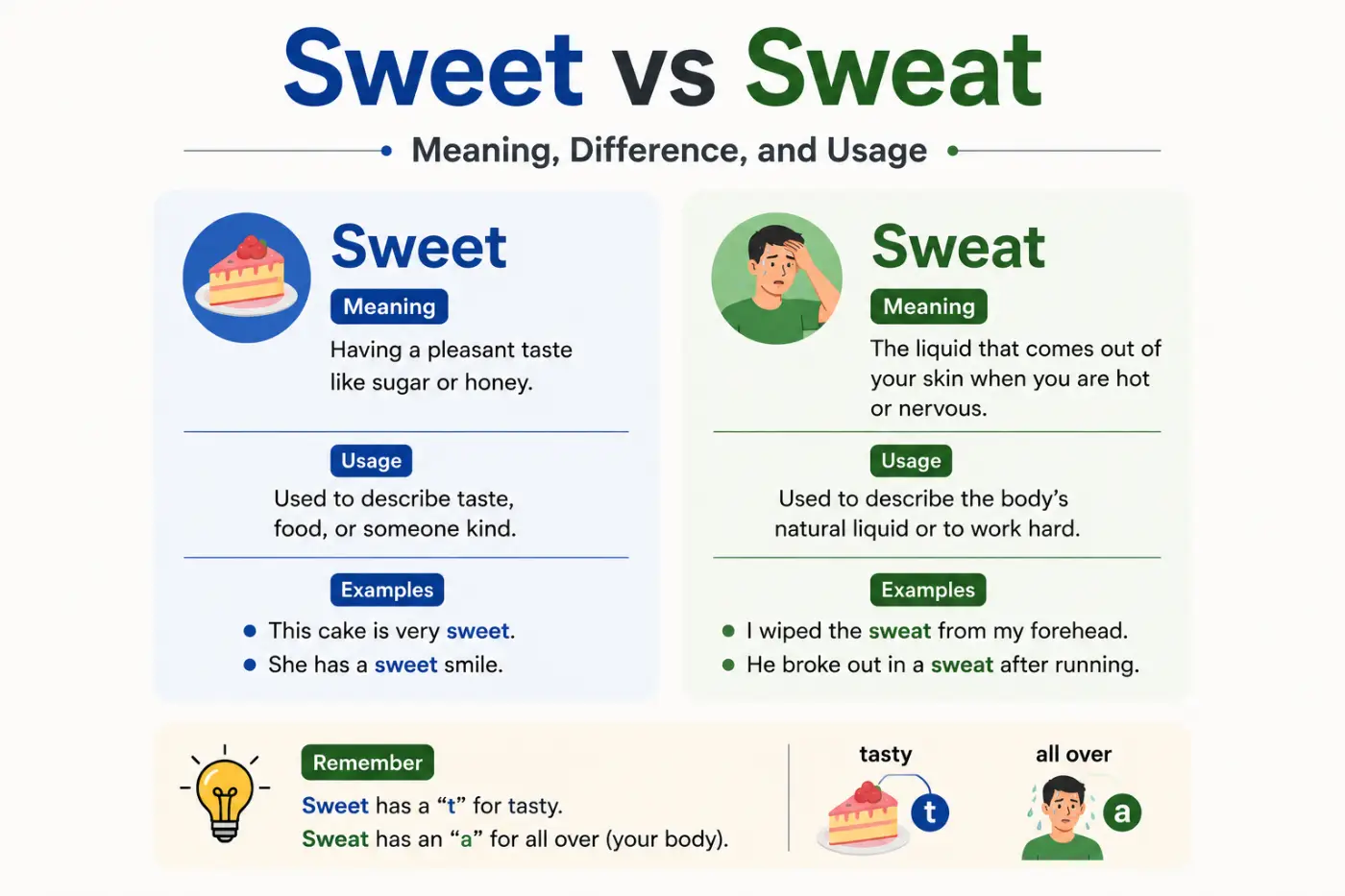
Sweet vs Sweat is a common English word confusion because the two words look and sound surprisingly similar. However, they mean completely different things. Sweet describes something pleasant such as sugar taste or a kind personality. Sweat refers to the moisture your body produces when you become hot nervous or physically active.
The confusion often comes from pronunciation. In many accents the words sound close enough to cause a quick mix up in conversation. Spelling makes the problem worse because both words contain the same basic letters in a different order. If you’re typing quickly you may know exactly what you mean but still choose the wrong word.
Once you separate their meanings the difference becomes easy to remember. This guide explains the definitions grammar pronunciation word origins sentence patterns common mistakes related expressions and practical examples. You’ll also learn a simple memory trick that can help you choose the right word without stopping to think twice.
Short Answer
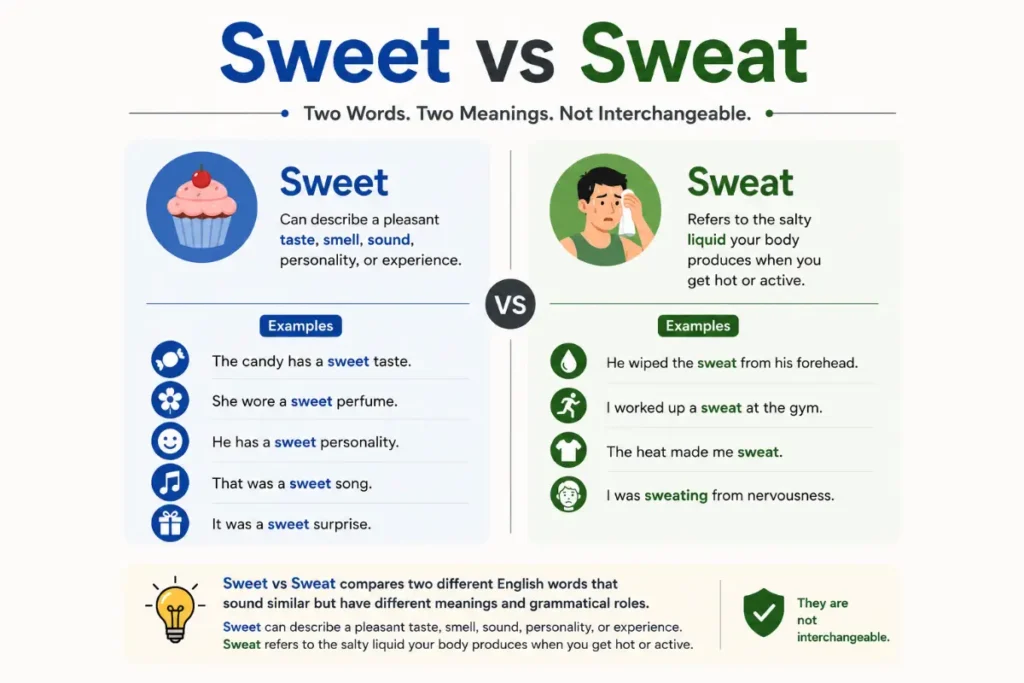
Sweet vs Sweat compares two different English words that sound similar but have different meanings and grammatical roles. Sweet can describe a pleasant taste smell sound personality or experience. Sweat refers to the salty liquid your body produces when you get hot or active. They are not interchangeable.
Table Of Contents
- The Main Difference.
- What Sweet Means.
- What Sweat Means.
- Sweet vs Sweat In A Comparison.
- How Sweet Works In A Sentence.
- How Sweat Works In A Sentence.
- Pronunciation And Sound.
- Grammar And Word Forms.
- Real Life Examples.
- Common Mistakes.
- Sweet As A Noun.
- Sweat As A Verb.
- Figurative Meanings.
- Word Origin.
- American English Usage.
- Related Words And Expressions.
- Memory Tips.
- Professional Writing Advice.
- Key Takeaways.
- FAQs.
- Conclusion.
The Main Difference
The easiest way to understand the difference is to connect each word with its main idea.
Sweet means pleasant or sugary.
Sweat means the liquid produced by your skin when your body gets hot.
For example:
The cake is sweet.
This sentence describes taste.
I started to sweat during the workout.
This sentence describes a physical response.
The words can also take different grammatical roles. Sweet is most often an adjective but can also function as a noun adverb or informal expression. Sweat can be a noun or a verb.
That difference matters because the correct word depends on both meaning and sentence structure.
What Sweet Means
Sweet has several meanings. Its most familiar meaning relates to taste.
Sugar is sweet.
The dessert tastes sweet.
The word can also describe something pleasant to smell.
She bought a sweet smelling perfume.
It can describe a pleasant sound.
She has a sweet singing voice.
It can describe a kind or caring person.
He’s a sweet child.
That was very sweet of you.
It can also describe something emotionally touching.
That was such a sweet message.
The word therefore goes far beyond food. Its central idea is often something pleasant enjoyable kind or appealing.
Sweet As A Taste
This is probably the meaning most people learn first.
Chocolate is sweet.
The tea is too sweet.
These examples describe flavor.
The opposite is usually bitter or sour, depending on the context.
A useful comparison is:
The lemon is sour.
The candy is sweet.
The two words describe different taste experiences.
Sweet As A Personality Description
When you call someone sweet, you’re usually saying that person is kind thoughtful caring or pleasant.
For example:
My neighbor is very sweet.
She gave me a sweet note after the meeting.
Here sweet doesn’t describe sugar. It describes behavior or personality.
This meaning is especially common in everyday American English.
Sweet As Something Pleasant
Sweet can describe experiences moments sounds smells memories or gestures.
That was a sweet surprise.
We shared a sweet moment.
The baby gave her a sweet smile.
The word creates a positive emotional meaning.
Sweet As A Noun
Sweet can also function as a noun.
In British English, sweets commonly means candy.
For example:
The children bought sweets at the store.
In American English, candy is usually the more natural word for this meaning.
Sweet can also refer to a sweet food or dessert in some contexts.
Sweet As An Adverb
In informal speech, sweet can work as an adverb in expressions such as:
The car looks sweet.
That sounds sweet.
Here the word means something like excellent attractive or appealing.
This usage is informal and conversational.
Sweet As An Expression
In American English, people sometimes say Sweet by itself to show approval.
For example:
A friend might tell you that your vacation was approved.
You might reply:
Sweet.
In this context, the word means something like great or excellent.
It has nothing to do with taste.
What Sweat Means
Sweat refers to the salty liquid produced by your sweat glands. Your body releases sweat as part of its natural cooling process.
For example:
I was covered in sweat after the run.
The heat made me sweat.
The word can function as both a noun and a verb.
Sweat As A Noun
As a noun, sweat refers to the liquid itself or the process associated with producing it.
For example:
There was sweat on his forehead.
She wiped the sweat from her face.
The first sentence identifies the physical substance.
The second describes removing it.
Sweat As A Verb
As a verb, sweat means to produce sweat.
For example:
I sweat a lot during summer.
He started to sweat during the exam.
She was sweating after climbing the stairs.
The verb can also have figurative meanings.
Don’t sweat it.
This means don’t worry about it.
Sweat And Physical Activity
The word often appears when talking about exercise.
I worked up a sweat at the gym.
She was sweating after the workout.
The team practiced hard and finished covered in sweat.
In these sentences the word has its literal physical meaning.
Sweat And Heat
Hot weather commonly causes sweating.
I always sweat more in humid weather.
He was sweating in the afternoon heat.
Again the meaning is physical.
Sweat And Nervousness
People can also sweat because they’re nervous anxious or embarrassed.
My palms were sweating before the interview.
He started to sweat when the teacher called on him.
This gives the word an emotional connection while keeping its basic physical meaning.
Sweet vs Sweat In A Comparison
| Feature | Sweet | Sweat |
|---|---|---|
| Main meaning | Pleasant sugary or kind | Moisture produced by the body |
| Common part of speech | Adjective | Noun and verb |
| Taste meaning | Yes | No |
| Physical meaning | Usually no | Yes |
| Personality meaning | Yes | No |
| Pronunciation | Commonly sounds like sweet | Commonly sounds like swet |
| Example | The tea is sweet. | I started to sweat. |
| Common phrase | Sweet dreams. | Don’t sweat it. |
| Opposite or contrast | Bitter or sour in taste | Dryness in a physical context |
| Common confusion | Used instead of sweat | Used instead of sweet |
The comparison shows why these words shouldn’t be treated as spelling variations. They represent different concepts.
How Sweet Works In A Sentence
Because sweet is commonly an adjective it often appears before a noun.
She bought a sweet dessert.
He has a sweet personality.
That was a sweet gesture.
It can also appear after linking verbs.
The fruit tastes sweet.
The child is sweet.
The perfume smells sweet.
These sentences describe a quality.
The word can also appear in fixed expressions.
Sweet dreams.
Sweet talk.
Sweetheart.
Sweet spot.
Sweet sixteen.
Each expression has its own meaning and shouldn’t be understood only through the literal meaning of the word.
How Sweat Works In A Sentence
Sweat can be a noun.
His shirt was soaked with sweat.
It can also be a verb.
His shirt became wet because he was sweating.
The noun often follows words such as the, some, a lot of, or drops of.
She wiped away the sweat.
He broke into a sweat.
There was sweat on his forehead.
The verb can appear in different forms.
I sweat easily.
She sweats during exercise.
He is sweating.
They were sweating.
The past form is commonly sweated.
For example:
He sweated through the interview.
However, the simple verb forms can vary in style and context. The important point for everyday writing is to recognize sweat as both a noun and a verb.
Pronunciation And Sound
The pronunciation difference is useful because the words aren’t true homophones.
Sweet is commonly pronounced /swiːt/.
It sounds like sweet with a long vowel.
Sweat is commonly pronounced /swet/.
It has a shorter vowel sound similar to the vowel in head or bed in many American accents.
The final t sound appears in both words.
The biggest difference is the vowel.
Think:
Sweet = long ee sound.
Sweat = short e sound.
This distinction can help you hear the difference in careful speech.
A Simple Sound Trick
Say these two words slowly:
Sweet.
Sweat.
Now compare them with:
Meet.
Met.
The vowel contrast is similar.
Sweet rhymes with meet.
Sweat rhymes with met.
That gives you a quick pronunciation anchor.
Grammar And Word Forms
Understanding related forms makes the distinction even clearer.
Forms Of Sweet
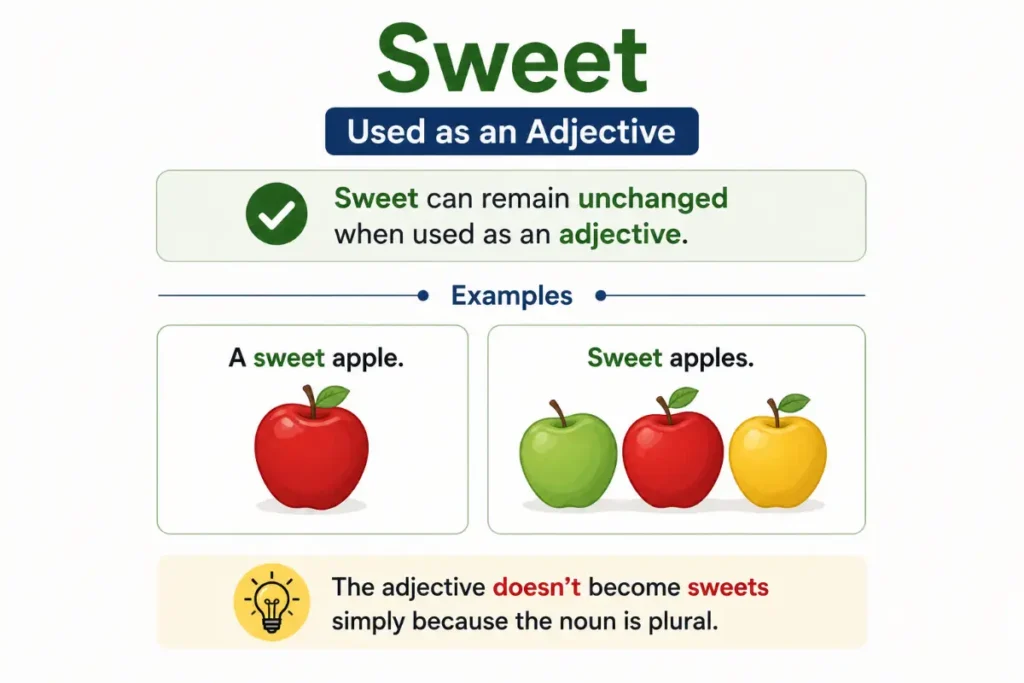
Sweet can remain unchanged when used as an adjective.
A sweet apple.
Sweet apples.
The adjective doesn’t become sweets simply because the noun is plural.
You can also form related words.
Sweetness refers to the quality of being sweet.
Sweetly is an adverb.
For example:
She smiled sweetly.
The word sweetener refers to something used to make food or drink sweeter.
Forms Of Sweat
Sweat can function as both a noun and verb.
As a noun:
The sweat was dripping from his face.
As a verb:
He was sweating heavily.
The related adjective sweaty describes something covered with or associated with sweat.
For example:
My shirt is sweaty.
The gym felt hot and sweaty.
The related noun sweatiness describes the quality of being sweaty.
These word families help show that sweet and sweat aren’t forms of the same word.
Real Life Examples
Food And Drink
The coffee is too sweet.
This means the coffee contains more sweetness than the speaker wants.
The fruit is naturally sweet.
Here sweet describes flavor.
Exercise
I was covered in sweat after the workout.
The noun refers to the moisture produced by the body.
I started to sweat after ten minutes.
The verb describes the physical action.
Personality
She’s such a sweet person.
The word describes kindness.
That was a sweet thing to do.
The word describes a thoughtful action.
Weather
I always sweat when the weather gets humid.
The verb describes a physical response to heat.
Conversation
Sweet. I’ll see you tomorrow.
Here sweet is an informal expression of approval.
Don’t sweat it.
Here sweat is part of an idiomatic expression meaning don’t worry.
Common Mistakes
Using Sweat When You Mean Sweet
Incorrect:
This cake is sweat.
Correct:
This cake is sweet.
The cake has a sugary or pleasant taste, so sweet is the correct word.
Using Sweet When You Mean Sweat
Incorrect:
I was covered in sweet after the workout.
Correct:
I was covered in sweat after the workout.
The word refers to body moisture, so sweat is required.
Confusing Sweaty With Sweet
These words are especially easy to mix up when typing quickly.
Sweaty means covered in or producing sweat.
Sweet means pleasant sugary kind or attractive.
For example:
My shirt is sweaty.
My shirt is sweet.
The first sentence makes sense in an ordinary physical situation. The second sentence would mean something very different and probably sound strange.
Writing Sweet When You Mean Sweat In An Idiom
The expression is:
Don’t sweat it.
Not:
Don’t sweet it.
The phrase means don’t worry about the problem.
Another expression is:
No sweat.
This means something is easy or not a problem.
It isn’t:
No sweet.
Confusing The Noun And Adjective
Sweet usually describes something.
Sweat usually names a substance or describes the action of producing it.
The distinction is useful:
Sweet food.
Sweat after exercise.
Once you identify the role of the word you need, the spelling becomes easier.
Sweet As A Figurative Word
English speakers use sweet in many figurative ways.
A sweet person is kind.
A sweet victory is a satisfying success.
These uses show how the word has expanded from physical taste to emotional and social qualities.
The central idea remains pleasantness.
Something can be sweet because it tastes good.
It can be sweet because it feels good.
It can be sweet because someone behaves kindly.
That flexible meaning makes sweet one of the more versatile everyday adjectives in English.
Sweat As A Figurative Word
Sweat also has several figurative uses.
The phrase sweat it means worry about something.
Don’t sweat it.
The phrase no sweat means something isn’t difficult or isn’t a problem.
No sweat. I can handle it.
The expression work up a sweat means exercise or work hard enough to begin sweating.
We worked up a sweat cleaning the garage.
The word can also describe effort.
The phrase blood sweat and tears refers to intense effort and hardship.
These expressions show that the physical idea of sweating has become a metaphor for effort stress and difficulty.
Word Origin
The two words have different histories even though their modern spellings look similar.
Sweet comes from Old English swēte, which referred to something having a pleasant taste or smell. The word has remained part of English for centuries and gradually expanded into meanings involving kindness pleasure and emotional appeal.
Sweat also has Old English roots. It is connected with the Old English word swāt, referring to perspiration.
The similarity between the words is therefore not evidence that they are related forms of the same word.
Their modern appearance simply makes them easy to confuse.
English contains many pairs that look or sound similar while having unrelated meanings. Sweet and sweat are a good example of how a small vowel difference can create a completely different word.
American English Usage
Both sweet and sweat are common in American English.
The meanings don’t change in any major way based on region.
American speakers regularly use sweet for taste personality approval and pleasant experiences.
They also use sweat for perspiration physical activity nervousness and several idiomatic expressions.
Some expressions are especially common in casual American speech.
For example:
Sweet.
No sweat.
Don’t sweat it.
These expressions are informal but widely understood.
In formal writing, the literal meanings are often more appropriate unless you’re intentionally using an idiom.
Formal And Informal Usage
Sweet is suitable in both formal and informal writing, but the exact meaning affects the tone.
A formal sentence might say:
The fruit has a naturally sweet flavor.
An informal sentence might say:
That’s so sweet of you.
Both are grammatically correct.
Sweat also works in formal and informal contexts.
Formal:
Excessive sweating can occur during intense physical activity.
Informal:
I was sweating like confused after that run.
The second sentence is conversational and expressive.
Professional writing should choose the version that fits the audience and subject.
Related Words And Expressions
Several words connect closely with sweet.
Sugary
Sugary describes something containing a lot of sugar or resembling sugar.
The drink is very sugary.
Sugared
Sugared means covered or prepared with sugar.
The strawberries were sugared.
Sweetness
Sweetness is the quality of being sweet.
The sweetness of the fruit was noticeable.
Kindly
Kindly can overlap with the social meaning of sweet when describing considerate behavior.
She kindly helped me.
Several words connect with sweat.
Perspiration
Perspiration is the more formal term for sweat.
The doctor asked about excessive perspiration.
Sweaty
Sweaty describes something covered with or producing sweat.
His shirt was sweaty.
Perspire
Perspire is a formal or neutral verb meaning to sweat.
People perspire more in hot conditions.
Moisture
Moisture is a broad term for liquid or dampness and doesn’t specifically mean sweat.
The skin loses moisture in dry weather.
Similar Sounding Words
English learners often benefit from comparing the sound patterns of related words.
Sweet sounds like meet.
Sweat sounds like met.
This contrast can help when listening.
Compare:
sweet and meet.
sweat and met.
The vowel in sweet is longer and closer to the sound in see.
The vowel in sweat is shorter and closer to the sound in bed.
The distinction may seem small, but it changes the word completely.
Memory Tips
The easiest memory trick is to connect sweet with sugar.
Both have the long ee sound.
Sweet food contains sugar.
Now connect sweat with exercise.
Sweat has the short e sound.
Exercise can make you sweat.
You can remember it like this:
Sweet is for sugar.
Sweat is for sweat glands.
Another useful trick is to connect the spelling with the meaning.
Sweet contains ee, like the long sound in see.
Sweat contains ea, but it uses the short sound found in head.
Don’t rely only on spelling. Listen to the vowel and think about the meaning.
A Simple Test
When you’re unsure which word to use, ask yourself one question:
Am I talking about something pleasant or something produced by the body?
If you’re describing taste kindness beauty sound or approval, choose sweet.
If you’re talking about perspiration exercise heat nervousness or physical effort, choose sweat.
For example:
The watermelon is sweet.
The runner is sweating.
That was sweet of her.
He wiped the sweat from his face.
The meaning makes the answer obvious.
Professional Writing Advice
A professional editor would never treat these words as simple spelling variants.
The first step is always to identify the intended meaning.
If the sentence describes a quality, sweet is probably the right choice.
If it describes perspiration or the act of producing it, sweat is probably the right choice.
Context matters more than visual similarity.
Proofreading tools can catch some mistakes, but you shouldn’t depend on software alone. A sentence such as That was very sweet of you is grammatically correct, while That was very sweat of you is not. A basic spell checker may recognize both words individually, so understanding meaning remains essential.
This is why careful editing requires more than checking spelling. Good editing considers meaning, grammar, context, tone, and the relationship between words.
When Sweet Means Excellent
In casual American English, sweet can mean excellent impressive or approved.
For example:
I got tickets to the game.
Sweet.
Here the speaker isn’t describing the tickets as sugary. The word expresses enthusiasm.
You may also hear:
That’s a sweet car.
This means the car looks impressive or attractive.
This usage is informal and conversational. It works naturally in speech and casual messages but may not fit a formal report.
When Sweat Means Worry
The phrase don’t sweat it is common in American English.
It means don’t worry about it.
For example:
Sorry I forgot to call.
Don’t sweat it.
The speaker is reassuring the other person that the mistake isn’t serious.
The phrase no sweat has a similar informal meaning.
Can you help me move this table?
No sweat.
Here sweat doesn’t refer literally to perspiration. It means the task isn’t a problem.
These expressions are useful because they show how a physical word can develop a figurative meaning.
Sweet Tooth And Related Expressions
A sweet tooth is a strong liking for sweet foods.
For example:
I have a serious sweet tooth.
This doesn’t mean your tooth is literally sweet. It describes a preference for sugary foods.
Other common expressions include:
Sweet dreams.
This is a friendly expression used when someone is going to sleep.
Sweetheart.
This can be an affectionate term for someone.
Sweet talk.
This refers to flattering or persuasive speech.
Sweet spot.
This can refer to an ideal position or point.
These expressions make sweet especially common in everyday English.
Sweat Related Expressions
Break a sweat means to begin sweating or to make a significant physical effort.
He didn’t even break a sweat during the workout.
Work up a sweat means to become sweaty through physical activity.
We worked up a sweat hiking uphill.
Don’t sweat it means don’t worry.
No sweat means no problem.
Sweat bullets is an informal expression meaning to feel extremely nervous.
I was sweating bullets before the presentation.
These expressions are common enough that English learners should recognize them even when the literal meaning doesn’t fit.
Why This Confusion Happens
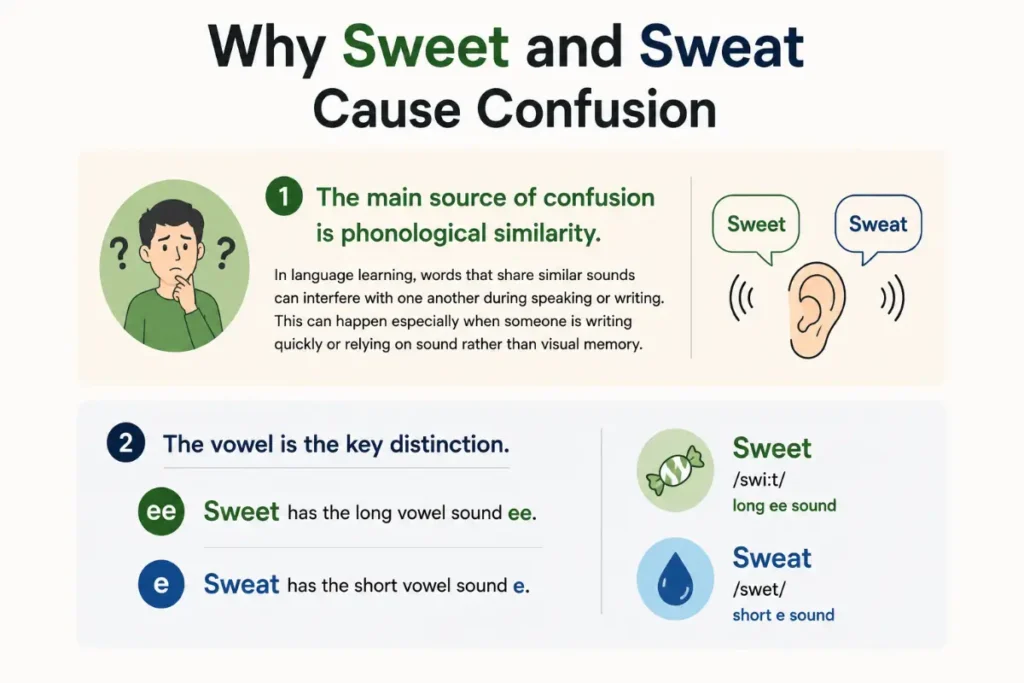
The main source of confusion is phonological similarity.
In language learning, words that share similar sounds can interfere with one another during speaking or writing. This can happen especially when someone is writing quickly or relying on sound rather than visual memory.
The vowel is the key distinction.
Sweet has the long vowel sound ee.
Sweat has the short vowel sound e.
Another factor is typing.
A writer may hear a word internally and type the wrong spelling because both forms are familiar. The brain often works faster than conscious proofreading.
That doesn’t mean the writer doesn’t know the difference. It simply means similar words can compete during language production.
Key Takeaways
- Sweet usually describes something pleasant sugary kind or appealing.
- Sweat refers to perspiration or the act of producing perspiration.
- Sweet commonly functions as an adjective.
- Sweat commonly functions as a noun and verb.
- Sweet is pronounced with a long vowel sound.
- Sweat has a short vowel sound.
- Sweet can describe taste personality sound smell or experiences.
- Sweat can describe physical activity heat nervousness effort and worry through idioms.
- The easiest memory trick is sweet for sugar and sweat for exercise.
- If you’re unsure, identify the meaning before choosing the spelling.
Conclusion
Sweet vs Sweat compares two words that look and sound similar but carry completely different meanings. Sweet describes sugary taste pleasant qualities kindness approval and other positive experiences. Sweat refers to perspiration and can also describe the act of producing it. The words can also appear in useful expressions such as sweet dreams, sweet tooth, no sweat, and don’t sweat it.
The simplest way to keep them straight is to connect sweet with sugar and sweat with exercise. Remember the vowel difference too. Sweet has the long sound found in meet, while sweat has the shorter sound found in met. Once you connect each word with its meaning, the spelling becomes much easier.
When you’re proofreading, don’t rely only on how a word looks or sounds. Ask what the sentence actually means. If you’re describing something pleasant, kind, sugary, or enjoyable, choose sweet. If you’re talking about perspiration, heat, exercise, nervousness, or physical effort, choose sweat. That quick meaning check will keep this common confusion out of your writing.
FAQs
What Is The Difference Between Sweet And Sweat?
Sweet describes something pleasant such as a sugary taste a kind personality or an enjoyable experience. Sweat refers to the liquid your body produces when you become hot active or nervous. The words also have different grammatical roles. Sweet is most often an adjective while sweat commonly works as both a noun and a verb.
Is Sweet Or Sweat The Correct Word?
Both are correct words, but they aren’t interchangeable. Use sweet for taste kindness pleasantness or approval. Use sweat for perspiration or the act of producing it. For example, The cake is sweet describes taste, while I started to sweat describes a physical response. The correct choice depends entirely on the meaning.
Are Sweet And Sweat Homophones?
No. Sweet and sweat are not true homophones because their vowel sounds are different. Sweet is commonly pronounced /swiːt/, while sweat is commonly pronounced /swet/. They can sound similar when spoken quickly, especially to language learners, but careful pronunciation reveals the difference. Sweet rhymes with meet, while sweat rhymes with met.
How Do You Remember The Difference Between Sweet And Sweat?
Connect sweet with sugar and sweat with exercise. Sweet contains the long vowel sound found in see and meet. Sweat contains the short vowel sound found in bed and met. If you’re describing taste kindness or something pleasant, choose sweet. If you’re describing perspiration or physical effort, choose sweat.
Can Sweet Be A Noun?
Yes. Sweet can function as a noun in several contexts. In British English, sweets commonly means candy. Sweet can also refer to a sweet food or dessert in some contexts. In informal speech, sweet can also be used as an expression of approval. For example, someone might respond Sweet to good news.
Can Sweat Be A Verb?
Yes. Sweat is commonly used as a verb meaning to produce perspiration. For example, I sweat a lot during summer describes the physical process. The verb also appears in expressions such as don’t sweat it, which means don’t worry about something. Sweat can therefore have both literal and figurative meanings.
What Is The Past Tense Of Sweat?
The regular past tense is sweated. For example, you can write He sweated through the workout or She sweated during the interview. The related adjective sweaty is different because it describes something covered in or associated with sweat. Understanding these forms helps prevent confusion between the noun, verb, and adjective.
What Does Sweet Mean When Someone Says Sweet?
In casual American English, sweet can express approval or enthusiasm. If someone tells you that they got tickets to your favorite concert, you might respond Sweet to mean great or excellent. This is informal usage. The same word can also describe a kind person, pleasant taste, attractive appearance, or emotionally touching moment.
What Does Dont Sweat It Mean?
Don’t sweat it is an informal expression meaning don’t worry about it. People use it to reassure someone after a small mistake or inconvenience. For example, if a friend apologizes for arriving a few minutes late, you might say Don’t sweat it. The expression uses the physical idea of sweating as a metaphor for stress or worry.
What Is A Sweet Tooth?
A sweet tooth means a strong preference for sugary foods such as candy desserts chocolate or pastries. For example, I have a sweet tooth means that the speaker enjoys sweet foods. The expression isn’t literal. It describes a person’s taste preference. It’s a common informal expression in American English.
What Does No Sweat Mean?
No sweat is an informal expression meaning no problem or something that is easy to do. For example, if someone asks for help and you can handle the task easily, you might say No sweat. The expression comes from the physical idea of effort and perspiration. It doesn’t literally mean that no sweat is present.
Why Do People Confuse Sweet And Sweat?
People often confuse the words because their spelling and pronunciation are similar. Both begin with sw and end with t, while their vowel sounds differ. Fast speech can make the distinction harder to hear. Typing quickly can also cause one familiar word to replace the other. Thinking about meaning before spelling usually prevents the mistake.

Confusing Words, Spelling & Word Choice
Claire Whitmore is a U.S.-based English editor who writes about commonly confused words, spelling differences, and word choice. Her work helps readers understand subtle distinctions between similar-looking words through simple definitions, practical examples, and modern usage guidance in both American and British English.