
Many English learners confuse bare vs bear because both words have the same pronunciation in most standard forms of English. They look different on the page but sound exactly alike. The confusion becomes stronger when you write quickly because your brain may recognize the sound before it chooses the spelling.
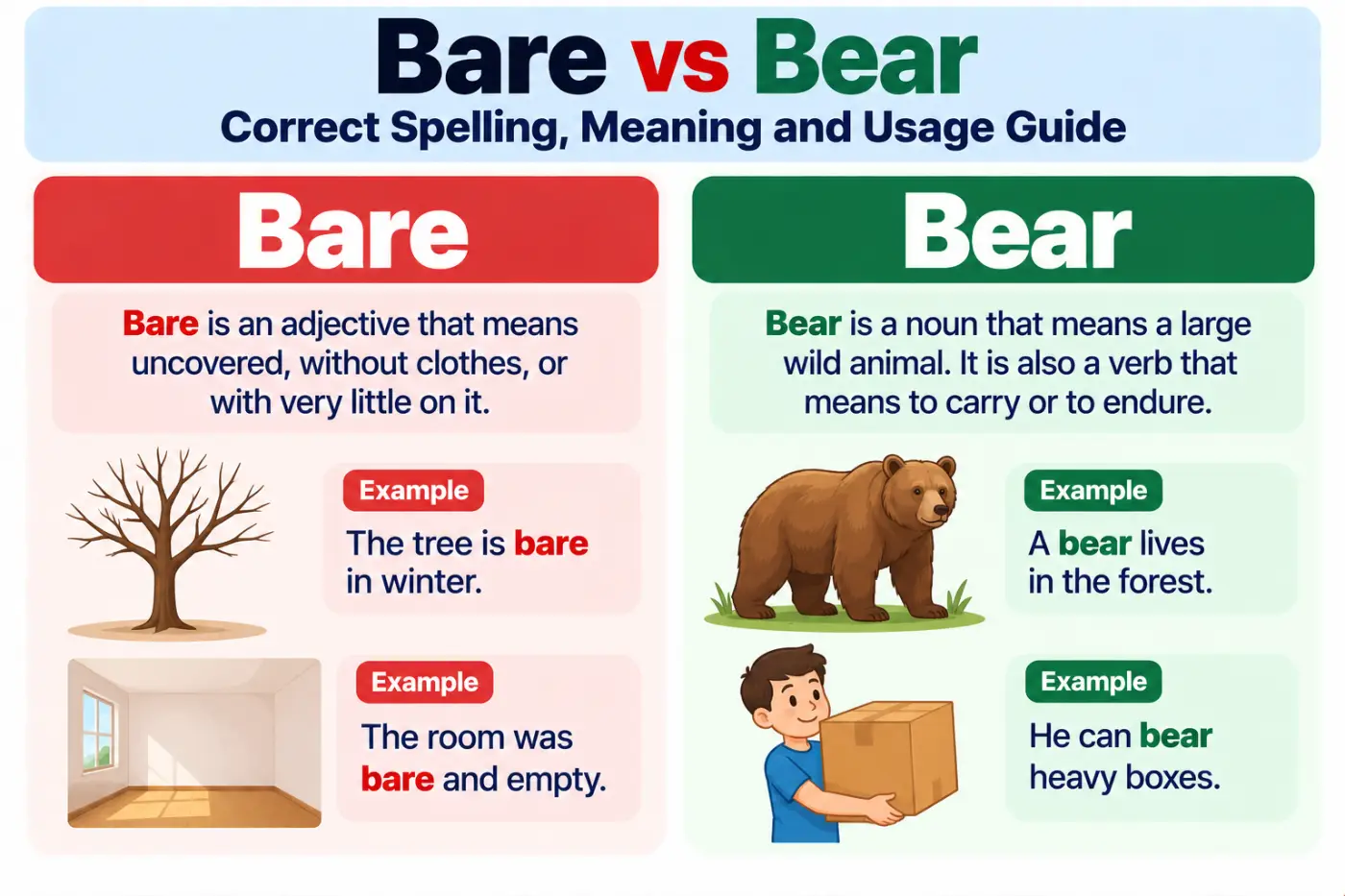
The direct answer is simple. Bare usually means uncovered, empty, or without something. Bear can mean to carry, endure, tolerate, or support something. It can also refer to the large furry animal.
These words are homophones, which means they sound alike but have different spellings and meanings. Once you connect each spelling with its core meaning, the difference becomes much easier to remember.
In this guide, you’ll learn how each word works, where each word comes from, how native speakers use them, and how to avoid common mistakes. You’ll also see practical examples from everyday conversation, professional writing, academic English, news, and literature. By the end, you should be able to choose the right word without stopping to second guess yourself.
Quick Definition
Bare describes something uncovered, empty, or lacking the usual covering or contents. Bear can mean to carry, support, tolerate, or endure something. It can also name the animal. Both words usually sound the same, but their meanings and grammatical roles are different.
Quick Answer
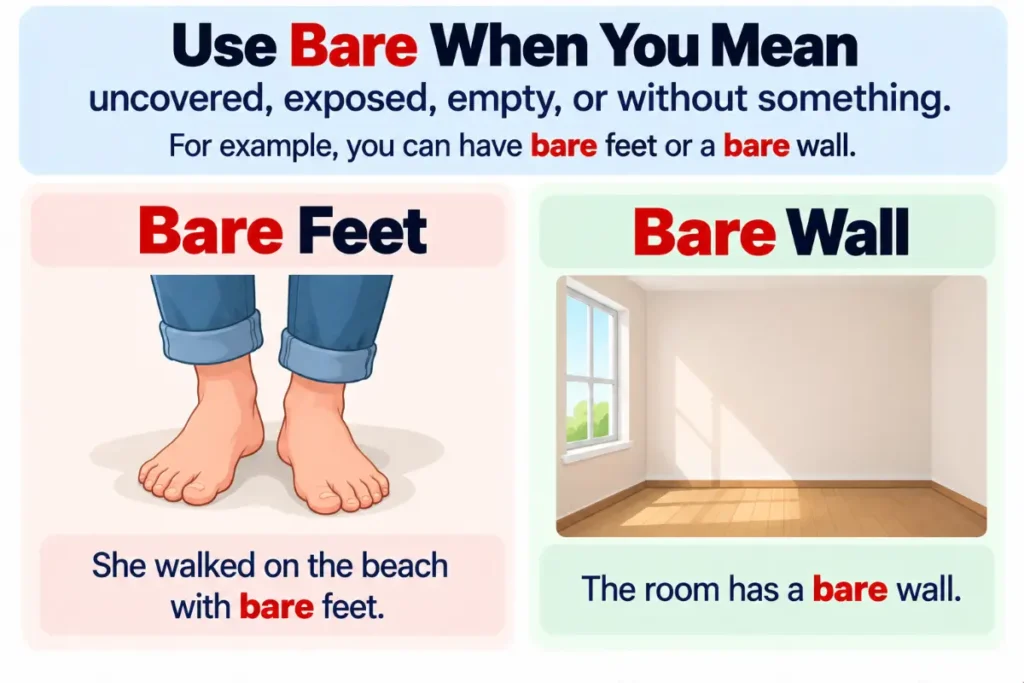
Use bare when you mean uncovered, exposed, empty, or without something. For example, you can have bare feet or a bare wall.
Use bear when you mean carry, endure, tolerate, support, or refer to the animal. For example, you can bear a difficult situation or see a bear in the woods.
Comparison Table
| Correct Form | Meaning | Part of Speech | Origin | Usage Frequency | Formality | Common Contexts | Example |
|---|---|---|---|---|---|---|---|
| Bare | Uncovered, exposed, empty, or lacking something | Adjective, verb | Old English | Very common | Neutral | Clothing, surfaces, rooms, physical exposure | He walked across the floor with bare feet. |
| Bear | Carry, endure, tolerate, support, produce, or the animal | Verb, noun | Old English | Very common | Neutral | Emotions, responsibilities, animals, costs, pressure | She couldn’t bear the pain. |
Meaning and Definition
Meaning of Bare
Bare is a real English word with several connected meanings. Its most common meaning is uncovered or not covered by the usual layer or protection.
You can have bare feet because you aren’t wearing shoes or socks. A bare wall has little or no decoration. A bare table may have nothing placed on it.
The word can also describe something that contains only the minimum amount needed. A room with bare furnishings has very little furniture. A bare minimum is the smallest amount needed to meet a requirement.
Bare can also work as a verb. To bare something means to uncover it or expose it. For example, a person might bare their teeth when angry. In this use, the word describes an action rather than a condition.
The central idea stays the same. Something becomes visible because a covering has been removed or because nothing is covering it.
Meaning of Bear
Bear has more meanings than its sound might suggest. As a verb, it can mean to carry or support something. You might bear a responsibility, bear a cost, or bear a burden.
It can also mean tolerate or endure. When someone says they can’t bear the noise, they mean they can’t tolerate it. When someone bears difficult circumstances, they endure them.
Bear can also mean give birth or produce something in certain contexts. A tree can bear fruit. A person can bear a child. A company can bear certain costs.
As a noun, bear has a completely different meaning. It refers to a large mammal such as a brown bear, black bear, or polar bear.
The verb and noun developed through different historical paths, but modern English uses the same spelling for these meanings.
Key Differences Explained
- Spelling. Bare has one r after the b. Bear places ea after the b. The different spelling reflects different word histories and meanings.
- Grammar role. Bare commonly works as an adjective and can also work as a verb. Bear commonly works as a verb and can also work as a noun.
- Meaning. Bare connects with ideas such as uncovered, exposed, empty, or lacking. Bear connects with carrying, enduring, tolerating, supporting, producing, or the animal.
- Tone. Both words are normal everyday English. Neither one sounds unusually formal or informal on its own.
- Context. The surrounding words usually make the intended meaning obvious. Bare often appears with nouns connected to surfaces, bodies, clothing, rooms, or necessities. Bear often appears with words connected to pressure, responsibility, pain, costs, or animals.
Which Spelling Is Correct
Both spellings are correct English words. The correct choice depends entirely on the meaning of the sentence.
Use bare when you mean uncovered or without something. Consider the sentence, She stood on the cold floor with bare feet. The feet are uncovered.
Use bear when you mean endure. Consider the sentence, I can’t bear the thought of losing him. The speaker means that the situation is emotionally difficult to tolerate.
Major English dictionaries such as Merriam Webster, Cambridge Dictionary, and Oxford English Dictionary recognize both words as standard English. They do not treat one spelling as a variant of the other. Instead, they define them as separate words with different meanings and histories.
A useful editor’s test is to replace the word with a simple synonym. If uncovered, exposed, or empty makes sense, choose bare. If carry, endure, tolerate, or animal makes sense, choose bear.
Sentence Examples
Here are natural examples that show how native speakers use the two words.
- She walked across the beach with bare feet.
- The apartment had bare walls and very little furniture.
- The tree had bare branches after the winter storm.
- He told the truth with his bare hands resting on the table.
- We could see the bare floor beneath the old carpet.
- I can’t bear this noise for another minute.
- She had to bear the responsibility for the decision.
- The bridge must bear the weight of heavy trucks.
- He couldn’t bear to watch his friend suffer.
- We saw a black bear near the forest.
Now consider examples where writers accidentally use finaly as a model of the kind of spelling error that happens with familiar words. The same basic lesson applies to homophones such as bare and bear. A spelling can look familiar while still carrying the wrong meaning.
- He walked outside with bare feet.
- She couldn’t bear the cold for long.
- The room was almost bare.
- The workers had to bear heavy equipment.
- A bear crossed the road near the campsite.
The key lesson is simple. Don’t choose a spelling only because it sounds right. English contains many homophones that share pronunciation while carrying different meanings.
Common Mistakes and Misspellings
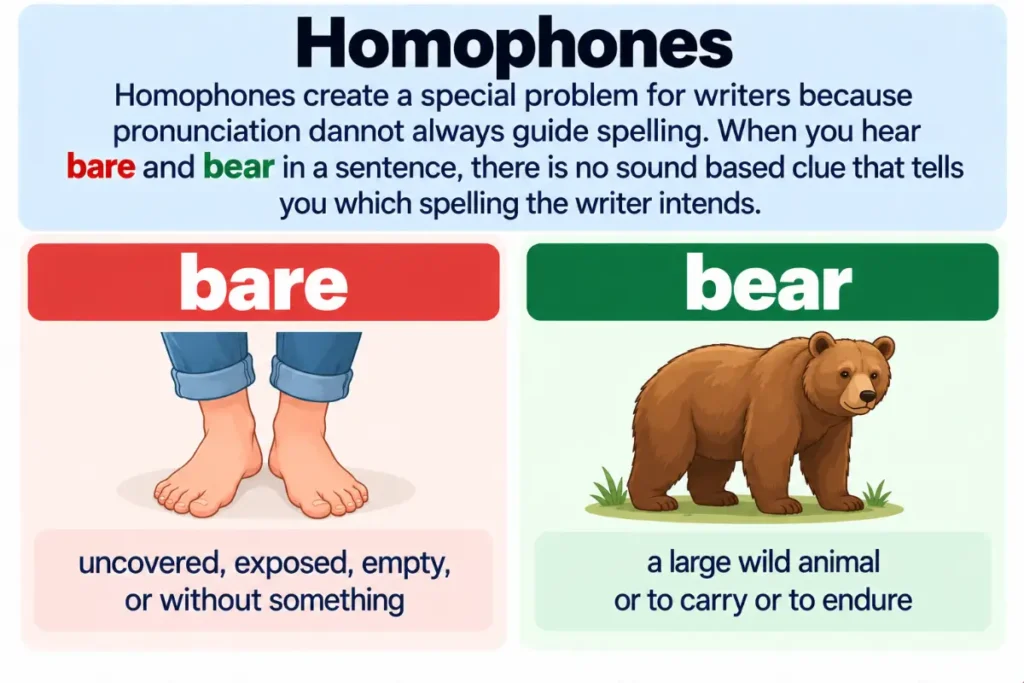
Homophones create a special problem for writers because pronunciation cannot always guide spelling. When you hear bare and bear in a sentence, there is no sound based clue that tells you which spelling the writer intends.
The first common mistake is using bare when the sentence requires the verb bear. For example, I can’t bare the pain is incorrect. The correct sentence is I can’t bear the pain.
The second mistake is using bear when the sentence describes something uncovered. The phrase bare feet is correct. Bear feet would suggest the feet of a bear.
The third mistake appears in expressions such as bear the cost. Writers sometimes choose bare because they associate the sound with something visible. However, bear means carry or accept the cost in this expression.
The fourth mistake involves the animal. If you’re talking about a large mammal, the spelling is bear.
The fifth mistake happens when people rely only on sound. This is an NLP style confusion because the brain can recognize the same phonetic pattern while the surrounding context determines the intended word. Speech gives you one signal. Meaning gives you another.
A practical solution is to pause for meaning rather than sound. Ask yourself what the word is doing in the sentence. If it describes something uncovered, choose bare. If it describes endurance, carrying, tolerance, support, or the animal, choose bear.
Pronunciation Guide
Bare and bear are usually pronounced the same way in standard American English. The IPA pronunciation is commonly represented as /ber/.
The sound is one syllable. You can think of it as sounding like bair.
The spelling difference does not create a normal pronunciation difference between these two words. This makes them homophones.
The same pattern appears in several other English word pairs. Their spellings differ while their pronunciations overlap. Context therefore plays a major role.
American speakers generally produce a vowel sound followed by an r sound. In some accents, especially accents with different treatments of r, the exact sound can vary slightly. The spelling and meaning remain unchanged.
A common learning mistake is trying to create a different pronunciation for each spelling. That usually makes the problem harder. Instead, learn the shared sound and then connect each spelling with its meaning.
For writing, meaning matters more than pronunciation. You already know how the words sound. Your real goal is choosing the spelling that matches the idea.
Etymology and Word Origin
Bare has roots in Old English. It developed from an Old English word associated with being naked, uncovered, or lacking clothing or covering. Related Germanic forms appear in other historical languages as well.
Over time, the word developed several connected uses. The idea of being uncovered expanded naturally into meanings such as empty, plain, minimal, or exposed. That is why modern English can describe bare feet, bare walls, bare branches, and the bare minimum.
Bear has a different history. The verb comes from Old English forms related to carrying or bringing. Its older sense involved carrying a physical load. English later developed broader meanings connected to enduring, supporting, producing, and tolerating.
The animal noun has a separate historical development. It comes from Old English bera and has related forms in other Germanic languages.
This history explains why the words look different even though their modern pronunciation overlaps. English spelling preserves traces of older word histories. Pronunciation has changed over centuries while spelling often retains older patterns.
Understanding etymology can help advanced learners, but you don’t need to memorize historical forms to use these words correctly. A simple meaning based rule works much faster in everyday writing.
Regional Usage
US English
American English uses both words in the same standard ways described in this guide. Bare is common in phrases such as bare feet, bare hands, bare walls, and bare minimum. Bear appears frequently in phrases involving responsibility, pain, pressure, costs, and tolerance. The animal sense is also common in everyday American speech.
UK English
British English follows the same basic distinction. Native speakers use bare for something uncovered or lacking and bear for carrying, enduring, or the animal. Some vocabulary and pronunciation details can vary between British and American English, but this spelling distinction remains stable.
Australian English
Australian English also keeps the distinction. Bare commonly describes uncovered surfaces or bodies, while bear can describe endurance, responsibility, or the animal. Australian writing does not normally use one spelling as a substitute for the other.
Canadian English
Canadian English follows the same standard spelling rules. Writers use bare for uncovered or minimal conditions and bear for carrying, enduring, tolerating, supporting, and the animal. Regional pronunciation can vary, but the spelling difference stays clear.
Grammar Rules and Part of Speech
Bare most often works as an adjective.
In The room has bare walls, bare describes the walls. In He walked with bare feet, it describes the feet.
Bare can also function as a verb. To bare something means to uncover or expose it. For example, The dog bared its teeth. Here, the word describes an action.
Bear most often works as a verb.
In She can’t bear the pain, bear means tolerate or endure. In He must bear the cost, it means accept or carry the responsibility for the cost.
Bear also works as a noun when it refers to the animal.
The placement of these words depends on their grammatical role. Bare usually comes before a noun when it functions as an adjective. Bear as a verb often follows the subject and can take an object. Bear as a noun can appear after articles such as a or the.
Punctuation does not determine the choice. Meaning and grammar do.
One useful grammar test is to identify the word’s job before choosing its spelling. Ask what the word describes or expresses. This small habit can prevent many homophone mistakes.
Real Life Usage Examples
Daily Talk
I hate walking on bare floors in winter.
I can’t bear listening to that alarm anymore.
These examples show the contrast naturally. Bare describes a physical condition. Bear expresses tolerance.
Please don’t leave the equipment on the bare floor.
The department can’t bear the additional expense this month.
The first sentence describes a surface. The second discusses financial pressure.
Academic Writing
The experiment used a bare surface as the control condition.
Some organisms cannot bear sudden changes in temperature.
Academic writing often uses both words because scientific descriptions can involve physical surfaces and the ability to tolerate conditions.
News
The storm left several hillsides bare after the vegetation was destroyed.
Officials warned residents to avoid areas where a bear had recently been seen.
News writing relies heavily on context, so readers can usually identify the intended meaning quickly.
Literature
The character stood with bare feet on the cold stone.
He could no longer bear the weight of his memories.
Literary writing often uses both words in vivid descriptions. Bare can create an image of exposure or simplicity. Bear can express emotional pressure or endurance.
Related and Confused Terms
Several words and phrases can overlap with the meanings of bear. Others can overlap with the broader idea of something happening at the end or after a long process. Learning these related terms can improve your vocabulary and help you choose more precise language.
- At last usually emphasizes that something happened after a long wait.
- Eventually describes something that happens after some time or after a series of events.
- Ultimately often refers to the final result or conclusion of a situation.
- At the end points to the final point in a period or sequence.
- Conclusively means in a way that settles an issue or proves something clearly.
- In the end commonly introduces the final result of a situation.
- Lastly usually introduces the final item in a sequence or discussion.
- Endure is closely related to one meaning of bear because both can describe continuing through something difficult.
These words aren’t interchangeable in every sentence. Strong writing depends on choosing the word that fits the exact idea.
Expert Editor Insight
As a senior editor, I would teach this distinction through meaning rather than spelling drills. Native speakers rarely stop and consciously analyze the spelling when they write. They recognize the intended meaning from context. If a sentence describes exposure, use bare. If it describes endurance, carrying, tolerance, support, or the animal, use bear. Grammar checkers and spell checkers can catch many obvious errors, but they may not catch every homophone mistake because both words are valid English words. The writer still needs to understand the sentence.
Conclusion
The difference between bare vs bear becomes simple once you focus on meaning instead of sound. Bare describes something uncovered, exposed, empty, plain, or minimal. Bear can mean carry, support, tolerate, or endure, and it can also refer to the animal.
Both words are correct English words, but they cannot normally replace each other. Their identical pronunciation makes them easy to confuse, especially when writing quickly. That confusion doesn’t mean the distinction is complicated. It simply means you need to connect each spelling with its core idea.
The easiest practical tip is to ask yourself what you mean before you write the word. If you mean uncovered or exposed, choose bare. If you mean endure, carry, tolerate, support, or the animal, choose bear. That small habit will help you choose the correct spelling with confidence.
Frequently Asked Questions
Is Bare a Real Word?
Yes. Bare is a standard English word. It commonly means uncovered, exposed, empty, plain, or lacking something. You can have bare feet, a bare wall, or a bare room. It can also function as a verb meaning to uncover or expose something. The word has been part of English for centuries and appears in everyday, academic, professional, and literary writing.
What Does Bear Mean?
Bear has several meanings. As a verb, it can mean carry, support, tolerate, endure, accept, or produce. For example, someone can bear a responsibility or bear a difficult situation. As a noun, bear refers to a large mammal. The intended meaning becomes clear from the surrounding words and sentence structure.
Bare or Bear Which Is Correct?
Both spellings are correct, but they serve different purposes. Use bare for something uncovered, exposed, empty, or minimal. Use bear for carrying, supporting, tolerating, enduring, producing, or referring to the animal. The best way to choose is to focus on the meaning rather than pronunciation because both words usually sound the same.
How Do You Pronounce Bare and Bear?
Bare and bear are normally pronounced the same way in standard American English. Both are one syllable and are commonly represented in IPA as /ber/. They are homophones. Accent differences can slightly change the exact sound, but the two words normally remain indistinguishable in ordinary speech. Their different spellings therefore depend on meaning and context.
Can Bare Start a Sentence?
Yes. Bare can start a sentence when its grammatical role allows it. For example, Bare walls made the apartment feel cold and unfinished. Here, bare functions as an adjective describing walls. The position of the word does not determine its meaning. The surrounding sentence tells you how the word functions.
What Is a Synonym of Bear?
The best synonym depends on the meaning. When bear means tolerate, possible alternatives include endure, withstand, or tolerate. When it means carry, alternatives can include support or carry. When bear refers to the animal, there is no exact everyday synonym that works in all contexts. Always choose a synonym based on the intended sense.
Why Do People Confuse Bare and Bear?
People confuse these words mainly because they are homophones. They usually sound the same even though they have different meanings and spellings. This means pronunciation cannot help you choose the correct form. Fast typing can make the problem worse because writers may select the spelling they remember first. Context based learning provides a better solution.
Is Bear Suitable for Formal Writing?
Yes. Bear is completely standard in formal English. Writers use it in professional, academic, legal, financial, and technical contexts. Phrases such as bear responsibility, bear the cost, and bear the consequences are normal. Bare is also suitable for formal writing when its meaning is appropriate. Neither word is informal simply because it is common in conversation.

Confusing Words, Spelling & Word Choice
Claire Whitmore is a U.S.-based English editor who writes about commonly confused words, spelling differences, and word choice. Her work helps readers understand subtle distinctions between similar-looking words through simple definitions, practical examples, and modern usage guidance in both American and British English.