
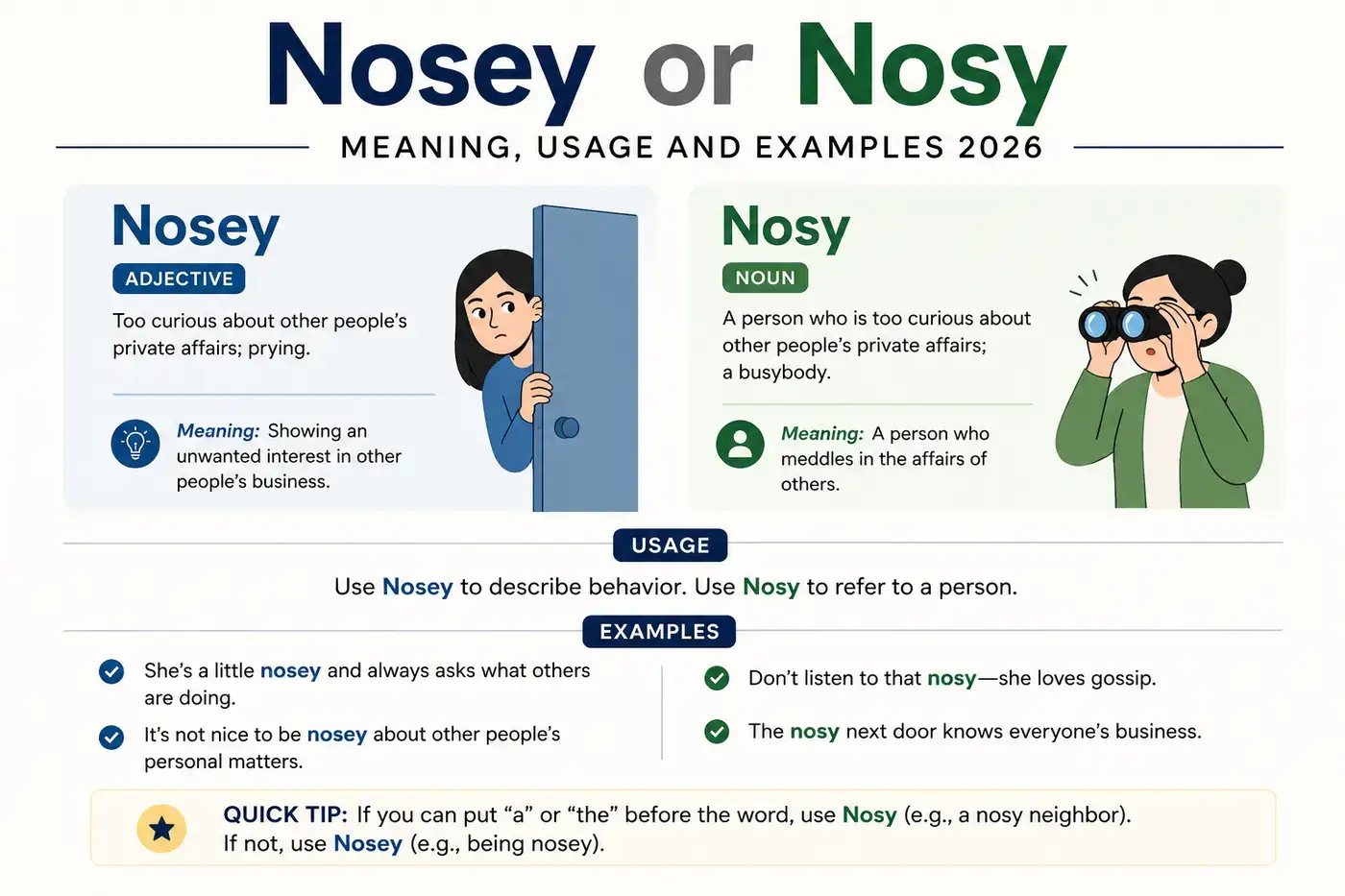
If you have ever paused over nosy vs nosey, you are not alone. Both spellings appear in English, and both can describe someone who is too interested in other people’s private business. The key point is that nosy is the usual spelling in American English, while nosey is also an established variant, especially in British English and other varieties of English.
The two forms have the same basic meaning, the same pronunciation and the same grammatical role. The main difference is spelling preference and regional usage, not meaning. That makes this word different from many common spelling pairs where one form is clearly wrong.
In this guide, you’ll learn what the word means, how to pronounce it, where each spelling is used, how it works in a sentence, and which form to choose in American writing. You’ll also see natural examples, common mistakes, related words, and simple ways to remember the preferred spelling.
Quick Answer
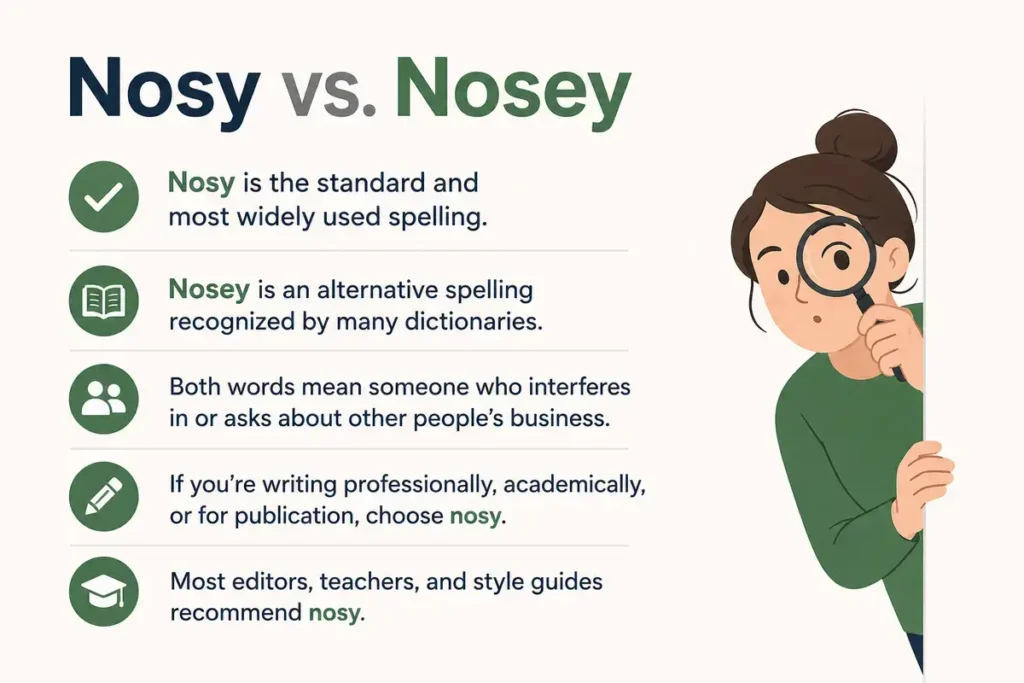
Nosy is the standard and more common spelling in American English. Nosey is also a legitimate spelling and is widely recognized, particularly in British English. Both forms mean overly curious about other people’s private affairs, and both are pronounced the same way.
Quick Answer to the Spelling Question
If you’re writing for a general American audience, use nosy. It is the spelling most readers in the United States are likely to expect.
Nosey is not simply a random misspelling. It is an established variant spelling that comes from the same word and has the same meaning. You may see it in British writing, older texts, informal communication, and personal writing.
So the practical rule is simple:
- Use nosy as your default in American English.
- Recognize nosey as a legitimate variant.
- Do not treat nosey as a spelling error in every context.
- Keep the spelling consistent within your own writing.
- Use the form that fits the variety of English you are writing for.
Comparison Table
| Form | Meaning | Part of Speech | Origin | Usage | Formality | Common Contexts | Example |
|---|---|---|---|---|---|---|---|
| nosy | Too interested in other people’s private matters | Adjective | From nose plus the suffix y | Standard and especially common in American English | Usually informal | Conversation, messages, personal writing, descriptions | My neighbor is very nosy. |
| nosey | Too interested in other people’s private matters | Adjective | Same word formation from nose plus y | Established variant, especially common in British English | Usually informal | Conversation, informal writing, descriptions | The kids were being nosey. |
The two spellings do not represent two different meanings. The distinction is mainly a matter of spelling preference and regional convention.
What Does the Word Mean
The adjective describes a person who shows too much interest in other people’s personal affairs. It often suggests that the person’s curiosity is unwanted, intrusive, or inappropriate.
For example, if someone keeps asking questions about your salary, relationship, family problems, or private conversations, you might call that person nosy.
The word usually carries a negative or mildly critical tone. It is not normally a neutral way to describe simple curiosity.
Consider these examples:
- My coworker is curious about the project.
- My coworker is nosy about my personal life.
The first sentence can sound neutral. The second suggests that the coworker’s interest has crossed a boundary.
The word can also describe actions, questions, or behavior:
- That was a pretty nosy question.
- Stop being so nosy.
- She gave me a nosy look.
- The reporter asked several nosy questions.
In each example, the idea is not simply curiosity. The person is showing more interest than the situation reasonably calls for.
Is Nosey a Real Word
Yes. Nosey is a real English spelling and should not automatically be marked as a misspelling.
This point matters because spelling tools may favor one form over another depending on their dictionary settings, language variety, or writing style. A word processor configured for American English may be more likely to prefer nosy, while another dictionary or language setting may recognize nosey without treating it as an error.
The spelling developed naturally from the noun nose, which has long been associated with prying into other people’s business. English speakers have used both spelling patterns for the adjective.
That means there is an important difference between a genuine misspelling and a recognized variant.
A misspelling is a form that does not belong to standard usage. A variant is a different established form of the same word. Nosey belongs to the second category.
Why Are There Two Spellings
The difference comes from the way English handles words formed from a base word plus a suffix.
The adjective is connected to the noun nose. The basic idea is that a person who pokes their nose into other people’s business is being overly curious.
English then forms an adjective by adding y. That gives us the idea of being characterized by or inclined toward the behavior associated with the base word.
Similar formations can be seen in words such as:
- cloudy from cloud
- rainy from rain
- dusty from dust
- messy from mess
- noisy from noise
The spelling of nosy is shorter than nosey because it removes the final e before adding y. English spelling does this in some word formations, although it does not follow one perfectly predictable rule in every case.
As a result, both spellings have developed in real English use.
Key Differences Explained
The two forms are extremely close, but a few practical differences are worth knowing.
Spelling
The most visible difference is the letter e.
Nosy contains four letters.
Nosey contains five letters.
The pronunciation does not change because of that extra letter.
Meaning
Both forms mean the same thing. They describe someone who is too interested in the private affairs of other people.
There is no standard meaning that belongs only to one spelling.
Grammar
Both forms function as adjectives.
You can place them before a noun:
She asked a nosy question.
You can also use them after a linking verb:
He is nosy.
The same patterns work with nosey.
Pronunciation
Both spellings are normally pronounced the same way. The extra e in nosey does not create an additional syllable.
The word has two syllables and rhymes closely with words such as cozy and rosy.
Formality
The word itself is generally informal. Calling someone nosy can sound critical or personal, so it is not always the best choice in a formal report.
In professional writing, a more neutral expression such as overly curious, intrusive, or too interested in private matters may communicate the idea more carefully.
Regional Usage
American English strongly favors nosy in ordinary writing. British English commonly recognizes nosey as well, and you can encounter both forms across English speaking regions.
The regional distinction is useful, but it should not be treated as an absolute rule. English spelling varies among individual writers, publishers, dictionaries, and style systems.
Standard and Nonstandard Usage
Neither spelling should be treated as automatically nonstandard. Nosy is the safer default for American English, while nosey remains an established variant.
This is why simply labeling nosey as wrong can give readers misleading advice.
Which Form Should You Use
For American English, nosy is the best default.
If you are writing an email, blog post, school assignment, workplace message, or general article for readers in the United States, nosy will usually look more familiar.
For example:
My neighbor is getting a little nosy.
Don’t ask such nosy questions.
The reporter was accused of being too nosy.
If you are writing for a British audience, nosey may feel more natural to some readers, although nosy is still recognizable.
The important editorial point is consistency. If a publication uses a particular house style, follow that style. If no style guide has been specified and the audience is primarily American, choose nosy.
Sentence Examples
Here are ten natural examples showing how the word works in everyday English.
- My sister gets nosy whenever I start talking about my dating life.
- I don’t want to sound nosy, but did you get the job?
- The neighbors were being nosy and asking questions about the new family.
- That is a little too nosy for a workplace conversation.
- He asked a nosy question about how much the house cost.
- Please don’t be nosy about things that don’t concern you.
- She laughed and said her curiosity was getting nosy.
- The students became nosy when they saw the teacher carrying a locked box.
- Some online comments can become nosy when people demand private information.
- The editor removed the nosy question because it was not relevant to the story.
These examples show an important feature of the word. It often appears in situations where curiosity crosses a social boundary.
Common Mistakes and Misspellings
The main confusion involves the two established spellings, but several related errors can also appear.
Treating Nosey as Always Wrong
Incorrect assumption:
Nosey is always a misspelling.
Better understanding:
Nosey is an established variant spelling.
For American writing, nosy is the safer default. Still, seeing nosey does not automatically mean the writer made a spelling mistake.
Using Nosy as a Noun
Incorrect:
He is a nosy.
Correct:
He is nosy.
The word is an adjective, so it normally describes a person, question, comment, or behavior.
If you need a noun, use a related expression such as a nosy person or a busybody.
Confusing Curiosity With Intrusiveness
Not every curious person is nosy.
Someone can ask a question because they genuinely want to learn. The adjective usually suggests that the curiosity is excessive or inappropriate.
For example:
She was curious about the new project.
This sounds neutral.
She was nosy about the manager’s private life.
This suggests unwanted interest.
Using the Word in Formal Situations Without Considering Tone
Calling a colleague nosy can sound blunt or insulting.
In a formal complaint, for example, you might write:
The questions focused on personal information that was not relevant to the matter.
That wording is more neutral than:
The interviewer was nosy.
The second sentence may be accurate in casual conversation, but the first is more suitable for formal communication.
Changing the Pronunciation Because of the Spelling
Some readers may assume that nosey should sound different because it contains the word nose.
It does not.
Both spellings normally have the same pronunciation. The extra e is a spelling difference, not a pronunciation difference.
Pronunciation Guide
Both spellings are pronounced approximately:
/ˈnoʊzi/
An easy pronunciation guide is:
NOH zee
The stress falls on the first syllable.
You can divide the sound into two parts:
- noh
- zee
The pronunciation is the same in nosy and nosey.
A common mistake is to pronounce nosey as if it had a separate pronunciation based on the noun nose. In normal English, that does not happen.
The ending sounds like the zee sound in words such as easy and cozy.
Because the word is informal, you are more likely to hear it in casual conversations than in formal speeches or academic writing.
Etymology and Word Origin
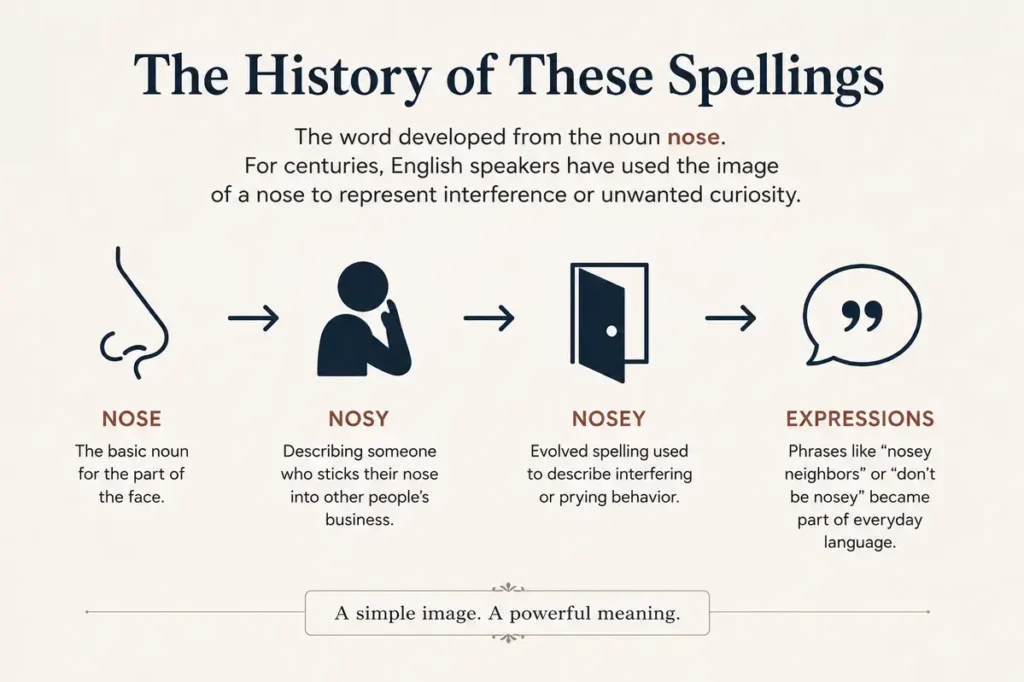
The word comes from nose, with the suffix y added to create an adjective.
The connection is easy to understand. English has long used the idea of putting one’s nose into something as a metaphor for interfering or becoming involved in matters that are not one’s business.
That idea eventually produced the adjective used to describe a person who takes too much interest in other people’s affairs.
The spelling variation developed within English usage rather than representing two unrelated words. The forms therefore share the same basic meaning and grammatical function.
The historical connection with nose also explains why many people naturally spell the adjective nosey. The visible base word remains intact in that version. At the same time, nosy follows a shorter spelling pattern that is now especially familiar in American English.
Regional Usage
Regional spelling is one of the most useful ways to understand the difference.
American English
Nosy is the usual choice in American English.
If you are writing for a US audience, especially in a school assignment, article, workplace message, or general publication, nosy is the most straightforward spelling.
Examples include:
Don’t be nosy.
That’s a very nosy question.
My neighbor is becoming nosy.
American readers will also understand nosey, but it may look less familiar than nosy.
British English
British English recognizes nosey as an established spelling. Nosy is also understandable and appears in English usage.
The difference therefore does not create a major communication problem. A British reader will generally understand either spelling from context.
If you are following a British publication’s style, use the spelling preferred by that publication.
Australian English
Australian English can reflect the same broader variation found in other English varieties. Both spellings can be understood, while the preferred form may depend on the dictionary, publication, or writer.
There is no need to assign a completely different meaning to the two forms.
Canadian English
Canadian English also recognizes both spellings. In general writing, the choice can depend on the writer’s preferred spelling system and the style of the publication.
For a broad North American audience, nosy is a clear and familiar choice.
Grammar Rules and Part of Speech
The word is an adjective.
An adjective describes a noun or gives information about a person, thing, action, or situation.
You can use it directly before a noun:
He asked a nosy question.
She has a nosy neighbor.
That was a nosy comment.
You can also use it after a linking verb:
He is nosy.
They became nosy after hearing the rumor.
She seemed nosy during the interview.
The word can be modified by adverbs that show degree:
He is very nosy.
She was a little nosy.
They became extremely nosy.
It can also appear with comparative language:
He is nosier than his brother.
She became even nosier after hearing the news.
The comparative form changes the spelling in the usual way. The final y changes to i before er:
nosy → nosier
The superlative is:
nosy → nosiest
For example:
He is the nosiest person in the office.
This spelling pattern is useful because it shows that the adjective behaves like other words ending in consonant plus y.
Real Life Usage Examples
Daily Conversation
The word is common in casual conversation because it describes a familiar social behavior.
Why are you asking so many questions? You’re being nosy.
I don’t mean to be nosy, but are you moving?
The tone can range from playful to critical. Friends may use the word jokingly, while strangers may find it rude.
Email and Workplace Communication
The word can appear in informal workplace communication, especially among coworkers who know each other well.
Sorry if I’m being nosy, but are you leaving the company?
That question felt a little nosy, so I decided not to answer.
In formal workplace writing, a neutral description is often better. Instead of labeling a person, describe the behavior that caused the problem.
Academic Writing
The word is less common in formal academic prose because it is conversational and carries a judgment about someone’s behavior.
An academic writer might use:
intrusive questioning
or:
excessive interest in private information
Instead of:
nosy questioning
The informal adjective is still grammatically correct, but the surrounding style matters.
News and Journalism
News writing may use the word in quotations, human interest stories, opinion writing, or descriptions of informal behavior.
For example:
The host joked that the audience was getting nosy about the actor’s personal life.
In straight news reporting, writers generally favor precise and neutral wording when describing sensitive personal matters.
Literature and Storytelling
The word works naturally in dialogue and character descriptions.
Mrs. Carter was a nosy neighbor who always knew what everyone was doing.
It can quickly communicate a character trait without requiring a long explanation.
Related and Confused Terms
Several words are closely connected to the meaning of nosy, but they are not exact replacements in every sentence.
Curious
Curious usually means wanting to know or learn something. It can be positive, neutral, or negative.
I was curious about the new restaurant.
This does not imply that the curiosity is inappropriate.
Inquisitive
Inquisitive means interested in learning or asking questions. It often sounds more positive or formal than nosy.
She is an inquisitive student who asks thoughtful questions.
Intrusive
Intrusive describes behavior that enters someone’s private space, affairs, or personal life without permission.
The interviewer asked several intrusive questions.
This word is often stronger and more formal.
Meddlesome
Meddlesome describes someone who interferes in other people’s affairs.
His meddlesome behavior caused problems between the two families.
The focus is more on interference than curiosity.
Prying
Prying describes an unwanted attempt to discover private information.
She asked several prying questions.
It is one of the closest alternatives when the focus is on trying to uncover information.
Busybody
A busybody is a person who takes too much interest in other people’s affairs. It is a noun rather than an adjective.
Everyone in the neighborhood knew that he was a busybody.
Snoopy
Snoopy can mean overly curious or interested in private matters. It is informal and often playful.
My little brother is snoopy about my phone.
It can sound lighter than nosy in some contexts.
Curious about someone’s business
This phrase can describe unwanted interest without directly labeling someone.
He is always curious about other people’s business.
The expression can sound less direct than calling someone nosy.
How to Choose the Right Form
If you are writing for American readers and want the most familiar spelling, choose nosy.
A simple decision process can help:
- Identify your audience.
- If your audience is primarily American, use nosy.
- If you are following British English or a specific publication style, check that style’s preferred form.
- Remember that nosey is an established variant rather than automatically treating it as a typo.
- Keep your spelling consistent throughout the document.
Consistency matters in edited writing. If a publication uses nosy, changing between nosy and nosey without a reason can make the text look careless even though both forms are recognized.
When to Use a More Neutral Word
The adjective can sound judgmental because it suggests that someone’s curiosity has crossed a social line.
That is fine in casual speech:
You’re being nosy.
But a formal situation may call for a softer or more precise expression.
For example:
Your questions are quite personal.
Or:
The discussion included questions about private matters.
Or:
The interview involved intrusive questions about the employee’s family.
These alternatives describe the behavior without using a direct personal label.
The right choice depends on the tone you need. Casual conversation allows more direct language. Professional, academic, legal, and sensitive communication often benefits from neutral wording.
Nosey Or Nosy Expert Language Insight
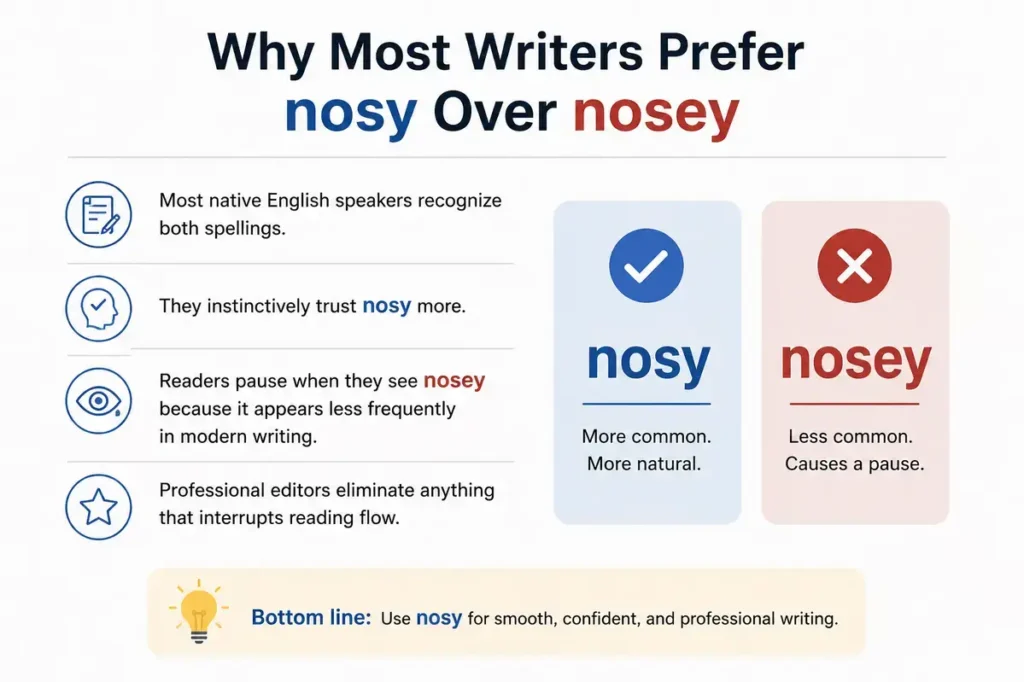
An experienced editor will normally treat nosy as the preferred spelling for American English and recognize nosey as a legitimate variant rather than correcting it automatically. The bigger editorial issue is tone. Because the word can sound critical, editors look at the relationship between the speakers, the purpose of the sentence, and the level of formality. Spelling software may also flag one version based on its selected language dictionary, so a warning does not always mean the other form is universally wrong.
Memory Tip
A simple way to remember the American spelling is to think of nosy as the shorter form.
Nose is the noun.
Nosy is the adjective.
You can remember it as:
Someone who sticks their nose into other people’s business can be nosy.
If you are writing for an American audience, that shorter spelling is the easiest default.
Final Takeaway
The key point about nosy vs nosey is that both spellings are established, but they are not equally common in every variety of English. Nosy is the usual choice for American English, while nosey remains a recognized variant, especially in British usage. Both forms mean overly interested in another person’s private affairs, and both are pronounced the same way.
For everyday American writing, nosy is the simplest choice. If you encounter nosey, don’t automatically assume it is a typo. Think of it as a legitimate spelling variant, then consider the audience and style of the text.
A useful editing trick is to remember that nosy is the shorter American default. Keep that form consistent throughout your writing unless a specific style guide calls for another spelling.
FAQs
Is nosey a correct spelling?
Yes. Nosey is an established English spelling. It has the same meaning and pronunciation as nosy and functions as an adjective. The main difference is regional and stylistic preference. American English generally favors nosy, while nosey is also widely recognized, particularly in British English and other varieties.
Which is correct nosy or nosey?
Both spellings are recognized, so this is not a case where one form is always correct and the other is always wrong. For American English, nosy is the preferred default. Nosey is an established variant. If you are writing for a specific publication, use its preferred spelling consistently.
What does nosy mean?
The adjective describes someone who shows too much interest in other people’s private affairs. It often suggests that the person’s curiosity is unwanted or inappropriate. For example, asking a friend about a new hobby can be simple curiosity, but repeatedly asking about private family problems may be described as nosy.
How do you pronounce nosy?
The word is usually pronounced /ˈnoʊzi/, or approximately NOH zee. It has two syllables with stress on the first syllable. The spelling nosey has the same pronunciation. The extra e in that spelling does not create another sound or syllable.
Can nosy start a sentence?
Yes. Since it is an adjective, it can begin a sentence when it describes the subject that follows. For example, you can write, Nosy questions can make people uncomfortable. Starting the sentence with the adjective does not create a grammar problem.
What is a synonym for nosy?
Useful alternatives include prying, intrusive, inquisitive, curious, meddlesome, and snoopy. These words are not exact substitutes in every situation. Curious can be neutral or positive, while prying and intrusive usually emphasize unwanted interest in private information.
Why do people confuse nosy and nosey?
The confusion is natural because the word comes from nose, and nosey keeps the original spelling of that noun visible. English also contains many words that form adjectives by adding y while keeping the base word recognizable. Both spellings have therefore developed in real usage.
Is nosy appropriate in formal writing?
It can be grammatically correct in formal writing, but it may sound too personal or judgmental for some contexts. In professional or academic work, phrases such as intrusive questions, excessive personal interest, or questions about private matters may communicate the idea more neutrally.

Confusing Words, Spelling & Word Choice
Claire Whitmore is a U.S.-based English editor who writes about commonly confused words, spelling differences, and word choice. Her work helps readers understand subtle distinctions between similar-looking words through simple definitions, practical examples, and modern usage guidance in both American and British English.