
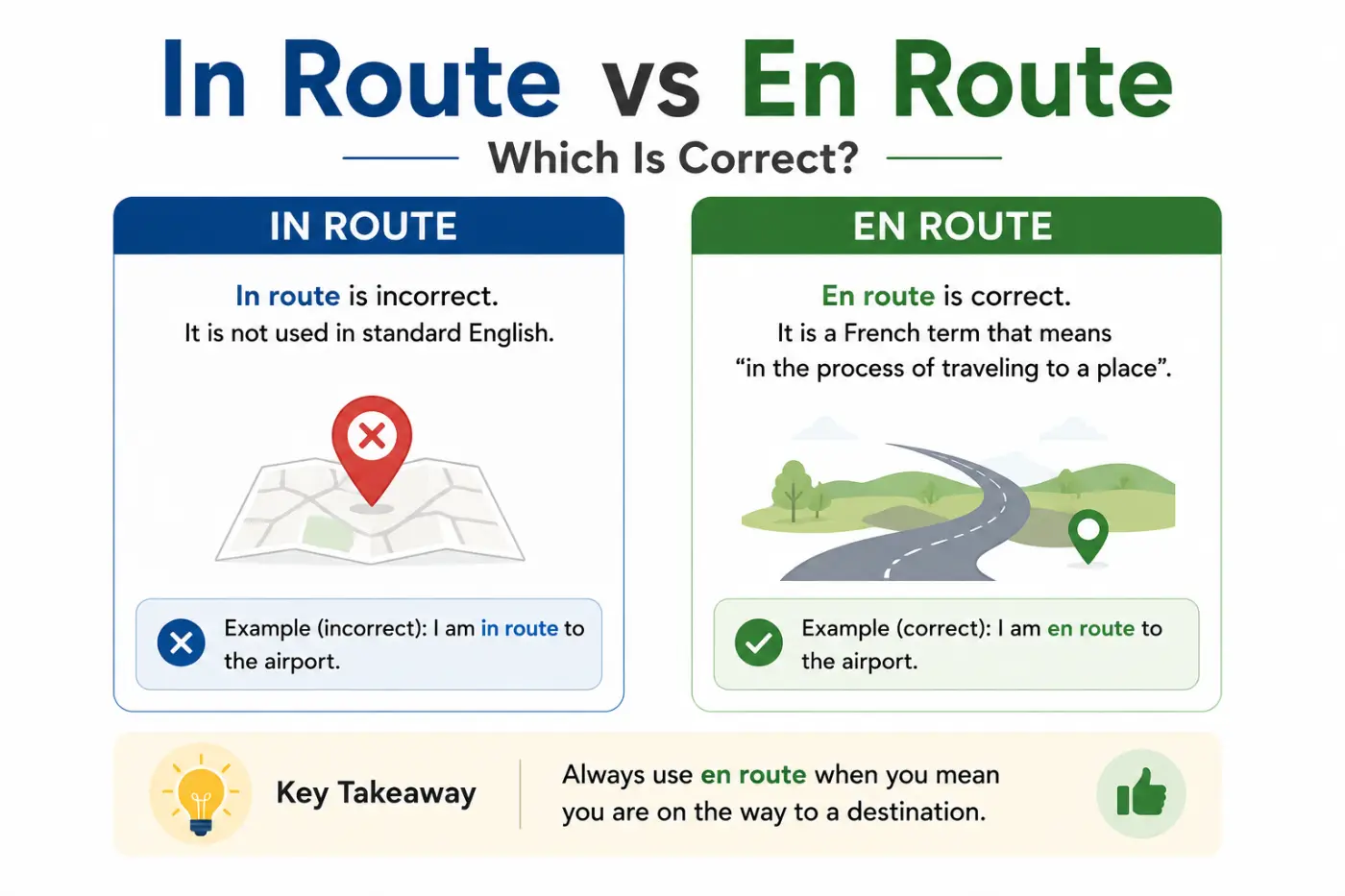
in route vs en route can be confusing because both expressions contain familiar English words and both can appear to describe movement. The standard expression for saying that someone is on the way is en route. For example, you can say, The package is en route to your home.
The confusion exists partly because English speakers naturally use the preposition in with many expressions about location and movement. We say in transit, in the car, in town, and in motion. It can therefore feel logical to create the expression in route. However, en route is an established expression that entered English from French and has a long history of use.
The phrase is especially common in travel updates, shipping notices, workplace communication, journalism, and ordinary conversation. You’ll learn what en route means, why it is preferred, how to pronounce it, how it behaves grammatically, where in route may appear, and how to choose the right expression without second guessing yourself.
Short Answer
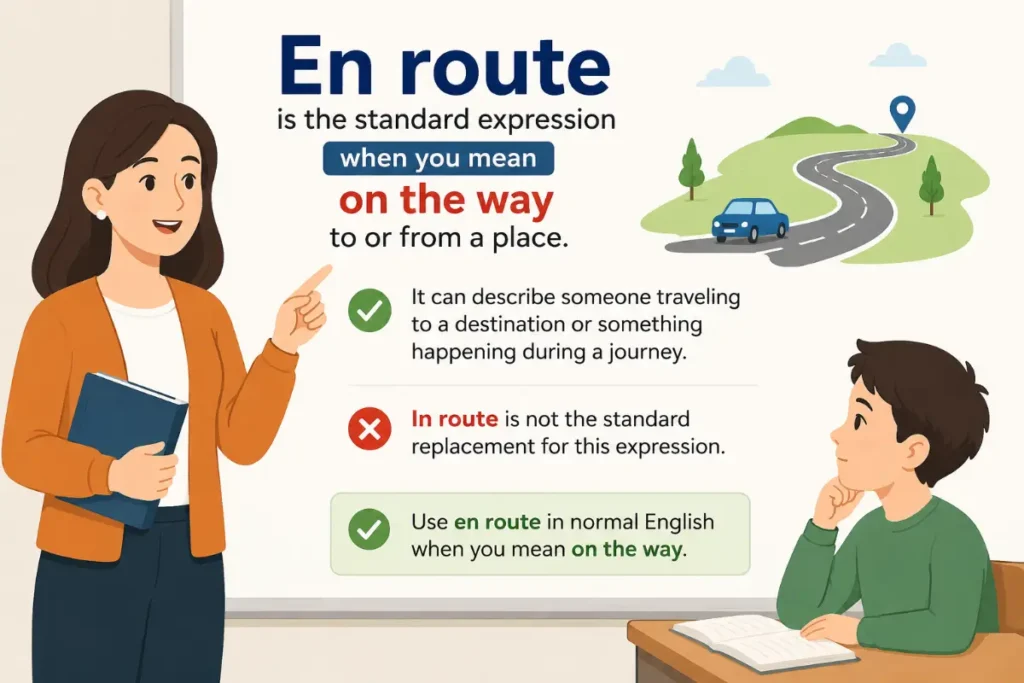
The standard English expression is en route, meaning on the way to a destination or in the process of going somewhere. In route is not the usual standard expression in American English when you mean on the way. It can appear in some regional or specialized contexts, but it should not replace en route in polished general writing.
Table of Contents
- Quick Answer
- Meaning of Each Expression
- Why En Route Is the Standard Choice
- Comparison Table
- Grammar and Sentence Structure
- Pronunciation Guide
- Examples in Everyday English
- Common Mistakes
- Regional Usage
- Formal and Informal Writing
- Similar Expressions
- Memory Tips
- Expert Editor Insight
- FAQs
- Key Takeaways
- Conclusion
Meaning of Each Expression
Meaning of En Route
En route is a fixed expression that means on the way or along the way to a destination.
If someone says, The driver is en route, the meaning is that the driver is on the way.
If someone says, Your order is en route to Chicago, the meaning is that the order is currently being transported toward Chicago.
The expression can describe people, vehicles, packages, documents, emergency responders, messages, or almost anything else that is moving toward a destination.
For example:
The ambulance is en route.
The shipment is en route to the warehouse.
We are en route to the airport.
The documents are en route to the office.
The expression can also describe something that happens during a journey.
We stopped for coffee en route to the coast.
Here the phrase means during the journey to the coast.
The word route itself refers to a path or way from one place to another. En gives the expression its French structure. Together they form an established phrase that English speakers have used for a long time.
Meaning of In Route
In route is not the standard general English expression for on the way.
A reader may understand it because the individual words are familiar. Context often makes the intended meaning clear. Still, understanding an expression does not automatically make that expression standard or preferred.
In some technical, regional, or specialized contexts, you may encounter in route. For example, certain organizations or industries may use their own terminology. That does not make it the normal choice for general American English.
If your meaning is on the way or traveling toward a destination, en route is the safer and more established choice.
This distinction matters most in professional and polished writing. A business email, academic paper, customer message, article, report, or formal notice should normally use en route when that is the intended meaning.
Why En Route Is the Standard Choice
The main reason is simple. En route is an established English phrase borrowed from French. English has many expressions that retain words or structures from other languages.
You probably already use some of them without thinking about their origins. Words such as ballet, café, genre, résumé, and entrepreneur entered English through French. En route belongs to the same broad history of language contact.
The phrase became established in English as a way to describe movement along a route or toward a destination.
Its meaning is now familiar enough that native English speakers generally recognize it as a normal expression.
The spelling also matters. En route consists of two separate words. It is not normally written as one word.
Correct:
We are en route to the hotel.
Incorrect:
We are enroute to the hotel.
Another common issue is pronunciation. Some speakers pronounce it as though it were a fully English phrase. Others preserve a more French influenced pronunciation. Both English and French influenced pronunciations can be heard in modern speech, but the spelling remains en route.
Comparison Table
| Expression | Standard General English | Meaning | Grammar | Origin | Common Context | Example |
|---|---|---|---|---|---|---|
| En route | Yes | On the way or along the way | Adverbial phrase | French | Travel shipping communication journalism | The package is en route. |
| In route | Not the usual standard expression for this meaning | May be understood as being in a route or pathway | Context dependent | English word combination | Regional or specialized usage | The phrase may appear in specialized writing. |
| On the way | Yes | Traveling toward a destination or approaching an event | Prepositional phrase | Native English expression | Everyday conversation | I am on the way home. |
| In transit | Yes | Being transported from one place to another | Prepositional phrase | Latin based vocabulary through English | Shipping travel logistics | Your order is in transit. |
Grammar and Sentence Structure
En route functions as an adverbial expression. In simple terms, it tells the reader where someone or something is in relation to a journey.
It can appear after a verb.
The team is en route.
The package is en route.
The doctor is en route.
It can also appear before a destination.
The team is en route to the stadium.
The package is en route to the customer.
The doctor is en route to the hospital.
The most useful pattern is:
be + en route + to + destination
For example:
She is en route to the airport.
They are en route to the meeting.
The shipment is en route to New York.
You can also use the phrase to describe something that happened during a journey.
We stopped en route to the beach.
He called me en route to work.
The travelers found a small restaurant en route to the village.
In these sentences, en route tells us that the action happened during the trip.
Can En Route Stand Alone?
Yes.
You can say:
The driver is en route.
The package is en route.
The rescue team is en route.
The phrase does not always need a destination after it. The listener can understand that the person or thing is currently traveling toward a destination.
Does En Route Need To?
Not always.
If the destination is given, to is normally used.
She is en route to Boston.
If the destination is already understood, you can stop after en route.
She called while she was en route.
That sentence means she called while she was traveling.
Can En Route Start a Sentence?
Yes.
For example:
En route to the airport, we stopped for breakfast.
This construction is perfectly natural. The phrase introduces information about the journey.
You can also write:
En route to the conference, the speaker reviewed her notes.
The phrase does not need to appear at the end of a sentence.
Pronunciation Guide
En route has two commonly heard pronunciation patterns in English.
A French influenced pronunciation is close to:
ahn ROOT
An English influenced pronunciation may sound closer to:
en ROOT
The second part receives the main stress. The final word sounds like the English word route.
In American English, both an English influenced pronunciation and a pronunciation closer to French can be encountered. The important point for ordinary communication is that the phrase is recognizable as en route.
The pronunciation does not turn in route into an alternative spelling. The two expressions are separate questions of wording and usage.
If you are learning the phrase, focus first on recognizing its meaning and standard spelling. Then practice saying it naturally in a complete sentence.
For example:
The package is en route.
The phrase should sound like one smooth expression rather than three strongly separated words.
Real Life Examples
Daily Conversation
People often use en route when talking about travel.
- I’m en route to the store, so I can pick up some milk.
This means the speaker is already traveling toward the store.
- We were en route when the weather suddenly changed.
Here the phrase means the people were already on their journey.
Text Messages
The expression also works in short messages.
- I’m en route. See you soon.
This is concise and natural.
- Your package is en route now.
This sounds like a shipping update.
Workplace Communication
Professional communication often uses the phrase because it gives a clear status update.
- The technician is en route to your location.
This tells the customer that the technician has started traveling.
- The signed documents are en route to our main office.
This explains that the documents are currently being transported.
Academic Writing
En route is less common in highly technical academic prose than simpler expressions such as during the journey. Still, it can appear naturally when discussing travel or movement.
- The researchers collected additional observations en route to the field site.
The phrase tells the reader that the observations were collected during the journey.
- Several samples were damaged en route to the laboratory.
This indicates that the damage occurred during transportation.
News Writing
News reports often use the expression when describing emergency responses or travel.
- Emergency crews were en route to the scene when the second call came in.
- The aircraft was en route to Denver when the crew reported the issue.
The expression works well in these contexts because it communicates movement quickly.
Storytelling
Writers can also use the phrase to describe movement within a story.
- En route to the old house, Maya noticed a strange light in the distance.
- The travelers stopped at a quiet village en route to the mountains.
The phrase helps keep the focus on the journey without adding unnecessary words.
Common Mistakes
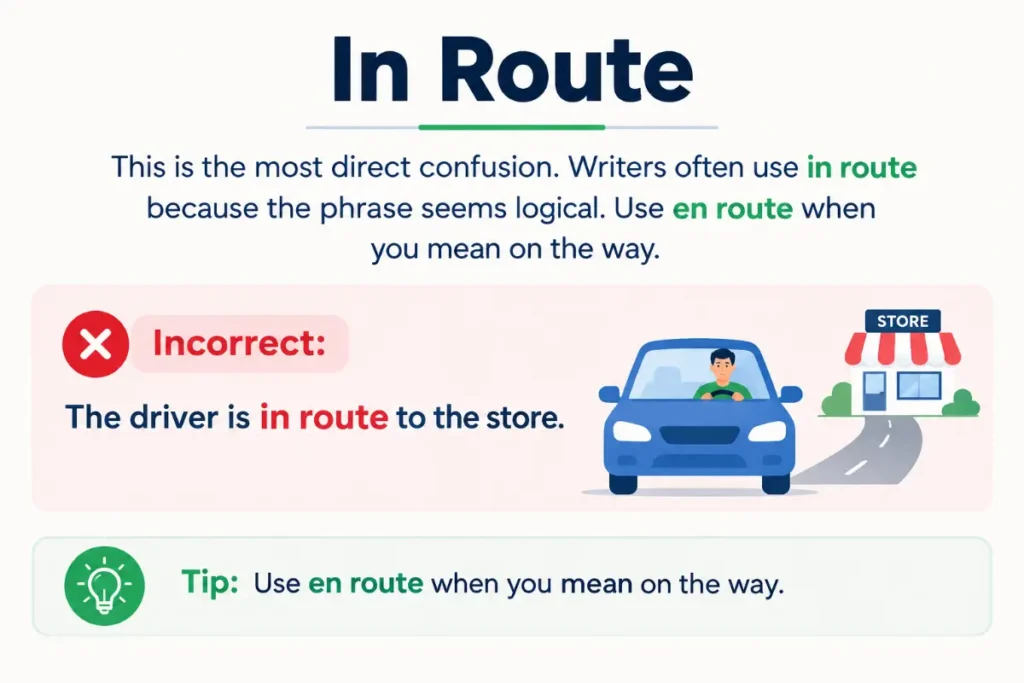
Writing In Route Instead of En Route
Incorrect:
The driver is in route to the office.
Preferred:
The driver is en route to the office.
The mistake happens because in is an extremely common English preposition. Speakers naturally use it with many location and movement expressions. However, fixed expressions do not always follow the most obvious word pattern.
Writing Enroute as One Word
Enroute is a common spelling error.
Correct:
The package is en route.
Incorrect:
The package is enroute.
The standard expression contains two words.
Using En Rout
Some writers accidentally drop the final e from route.
Correct:
We are en route.
Incorrect:
We are en rout.
The word route is part of the established phrase and should keep its standard spelling.
Adding Unnecessary Punctuation
Writers sometimes place a hyphen inside the expression.
The standard phrase is written as two words:
en route
It does not normally need a hyphen.
Confusing En Route With On Route
On route can occur in certain contexts where route is being used literally as a noun or modifier. However, it does not replace en route in the ordinary expression meaning on the way.
For everyday American English, these are clearer:
We are en route to the airport.
We are on the way to the airport.
Both communicate the intended idea naturally.
Regional Usage
American English
American English uses en route as the established expression for someone or something traveling toward a destination. It appears in everyday speech, workplace messages, shipping updates, journalism, and formal writing.
In route may be understood in context, but it is not the usual standard replacement for en route.
American speakers also commonly use on the way in casual conversation.
For example:
I’m on the way home.
That sentence may sound more relaxed than:
I’m en route home.
When a destination follows, en route to is especially natural.
British English
British English also uses en route as the standard expression. There is no major British spelling change that turns it into in route.
British speakers may use on the way or on route in particular constructions, but en route remains an established expression with the meaning of being on a journey or along a route.
Australian English
Australian English uses en route as well. The phrase can appear in travel writing, workplace communication, news reports, and everyday speech.
There is no standard Australian spelling that changes en route to in route.
Canadian English
Canadian English follows the same general pattern. En route is a recognized expression meaning on the way or during a journey.
Canadian writers can also use on the way or in transit depending on the context and level of formality.
Formal and Informal Usage
En route works in both formal and informal contexts.
In casual speech, on the way is often more conversational.
For example:
I’m on the way.
En route can sound slightly more polished or concise.
I’m en route.
Neither expression is automatically better in every situation. The right choice depends on the tone and context.
In professional communication, en route is especially useful for status updates.
The technician is en route.
The shipment is en route to the distribution center.
The documents are en route to our legal department.
In formal writing, the phrase is completely acceptable. It is not slang, and it does not make a sentence informal.
However, clarity should always come first. If your audience may not recognize the phrase, on the way or in transit may be easier to understand.
En Route Versus On The Way
En route and on the way are close in meaning, but they can have slightly different tones.
On the way is extremely common in everyday American English.
I’m on the way.
En route is a little more compact and can sound more formal or status oriented.
I’m en route.
Both can describe physical movement.
The difference becomes more noticeable in professional settings.
The technician is en route.
This sounds like a clear status update.
The technician is on the way.
This sounds more conversational and customer friendly.
Neither expression is inherently wrong. Choose based on the audience and the tone you need.
En Route Versus In Transit
These expressions overlap, especially when talking about packages and transportation.
En route means on the way or traveling toward a destination.
In transit usually emphasizes that something is being transported from one location to another.
For example:
The package is en route to my house.
The package is in transit.
The first sentence gives a destination. The second focuses on the transportation status.
In transit is particularly common in logistics and shipping language.
En route is broader. It can describe people, vehicles, packages, documents, and other moving things.
En Route Versus Eventually
These expressions should not be confused.
En route describes movement during a journey.
Eventually describes something that happens after some time.
For example:
We were en route to the airport.
This tells us where we were during the trip.
We eventually reached the airport.
This tells us that the arrival happened after some time.
The two expressions can appear together.
We were en route to the airport and eventually arrived just before the flight closed.
They perform different grammatical jobs.
En Route Versus Along The Way
Along the way describes something that happens during a journey or process.
For example:
We stopped for lunch along the way.
En route can express a similar idea.
We stopped for lunch en route to the coast.
The second sentence gives the destination directly. That can make the journey easier to picture.
Along the way is more conversational. En route is more compact and can fit naturally into formal or professional writing.
Word Origin
En route comes from French. The French expression literally relates to being on the route or on the way.
English borrowed the expression and gradually incorporated it into ordinary English vocabulary.
The borrowing is not unusual. English has absorbed thousands of words and expressions from French over centuries. Some have become so familiar that speakers barely think about their foreign origin.
En route remains recognizable as a French expression because of its spelling and structure. Still, it functions naturally inside English sentences.
This is why treating en route as a fixed expression is useful. Trying to rebuild it using English prepositions can lead to forms such as in route that sound logical but do not match the established phrase.
Memory Tips
The easiest way to remember the expression is to connect en route with on the way.
Think:
en route = on the way
When you mean that someone has started traveling toward a destination, en route is the standard expression.
You can also remember the phrase as a fixed pair. Avoid changing en into in simply because in feels more familiar.
Another useful trick is to memorize one complete sentence:
The package is en route.
Once that sentence feels natural, you can adapt it easily.
The driver is en route.
The doctor is en route.
The team is en route.
The documents are en route.
This approach is often easier than memorizing an abstract grammar rule.
Professional Writing Tips
When editing professional English, check the meaning before choosing the expression.
If you mean that someone or something is traveling toward a destination, en route is a strong standard choice.
If you want a very simple conversational expression, on the way may be better.
If you are talking about transportation or shipping status, in transit may be more precise.
For example:
The order is en route to the customer.
The order is in transit.
The customer service team can understand both, but the second sentence emphasizes transportation status while the first emphasizes movement toward the destination.
Avoid changing an established expression just because another preposition feels familiar. Fixed phrases often have meanings and structures that cannot be predicted word by word.
Similar Expressions
On The Way
This is the most common everyday alternative. It means that someone or something is traveling toward a destination or approaching a place or event.
In Transit
This refers to something being transported from one place to another. It is common in shipping and logistics.
Along The Way
This usually describes something happening during a journey or process.
On The Route
This can refer more literally to a particular route. It does not always mean exactly the same thing as en route.
During The Journey
This is a plain English alternative that clearly refers to something happening while traveling.
Heading To
This means moving toward a destination.
I’m heading to the airport.
On The Road
This commonly means traveling by road or spending time traveling.
In Motion
This means moving rather than being stationary. It is broader than en route and does not necessarily involve a destination.
Expert Editor Insight
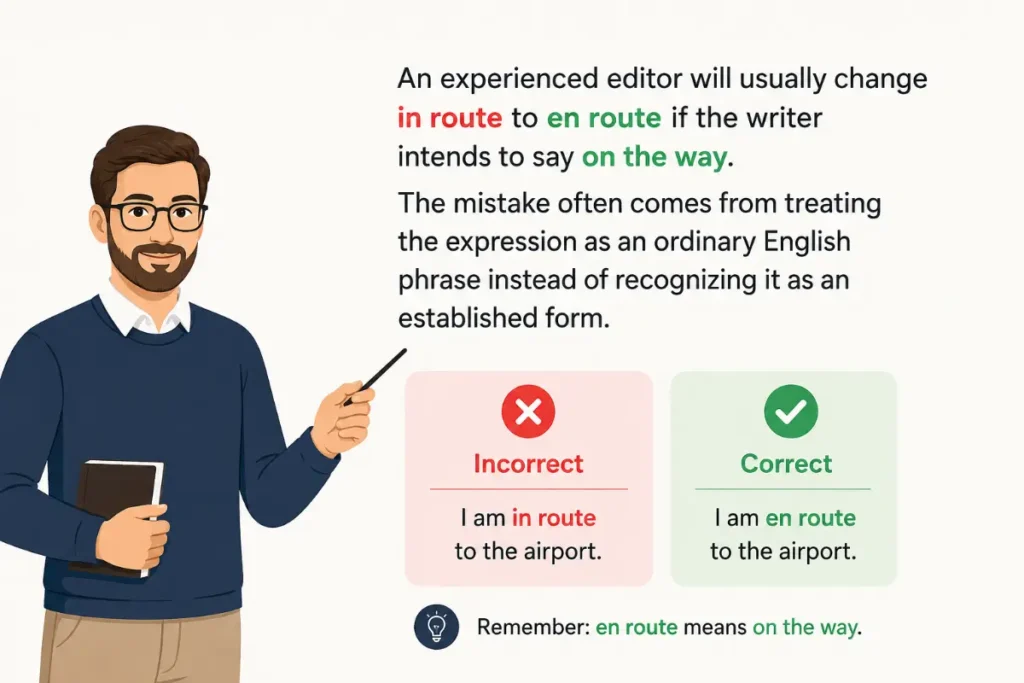
An experienced editor would normally change in route to en route when the intended meaning is on the way. The confusion is understandable because English uses in in many expressions involving location and movement. Still, en route is an established phrase rather than a combination that speakers freely rebuild. Professional proofreading tools may flag in route when context suggests en route, but a good editor checks the meaning and sentence structure instead of accepting every automated suggestion blindly.
Key Takeaways
- En route is the standard expression meaning on the way or along the way.
- In route is not the usual general English expression for this meaning.
- En route comes from French and has become established in English.
- The standard spelling is two separate words.
- En route can describe people, vehicles, packages, documents, and other moving things.
- The common structure is en route to plus a destination.
- On the way is a natural everyday alternative.
- In transit is especially useful when discussing transportation or shipping.
- En route is acceptable in both formal and informal writing.
- If you mean on the way, remember the simple connection: en route means on the way.
Conclusion
in route vs en route has a clear answer. En route is the standard expression when you mean on the way or traveling toward a destination. The phrase can describe a person heading somewhere, a package being delivered, a vehicle traveling, or an event happening during a journey. In route may be understood in context, but it is not the usual general English choice.
The confusion comes from English preposition patterns. Since in appears in many expressions about location and movement, in route can seem perfectly logical. However, en route is an established phrase with French origins and a long history in English.
For an easy memory trick, connect en route with on the way. If you mean that someone or something is currently traveling toward a destination, use en route. That small habit will keep your writing clear and natural.
FAQs
Is en route or in route correct?
En route is the standard expression when you mean on the way or traveling toward a destination. In route can appear in some specialized or regional contexts, but it is not the usual general English choice for this meaning. In polished American English, use en route for clear and conventional wording.
What does en route mean?
En route means on the way or along the way to a destination. It can describe people, vehicles, packages, documents, or other things that are moving. For example, The driver is en route to the office means that the driver is currently traveling toward the office.
Is in route grammatically wrong?
In route is not normally the standard phrase for on the way in general American English. The individual words are grammatical in other constructions, but that does not make them the established expression. If your intended meaning is that someone or something is traveling toward a destination, en route is the conventional choice.
Can you say en route to a place?
Yes. En route to is one of the most common patterns. You can say, We are en route to the airport, or The package is en route to the customer. The phrase can also stand alone when the destination is already understood, as in The driver is en route.
Is en route formal English?
En route is appropriate in formal and informal English. It can appear in professional emails, reports, journalism, travel updates, academic writing, and everyday conversation. In casual American speech, on the way is often more common. En route can sound concise and slightly more polished without being overly formal.
How do you pronounce en route?
En route has both English influenced and French influenced pronunciations. The final word is pronounced like route. The main stress falls on route. In ordinary American English, you may hear a pronunciation that sounds close to an English reading of the spelling as well as a pronunciation closer to the French original.
Is en route one word?
No. The standard expression is written as two words: en route. Enroute is a common spelling mistake. When you use the phrase in professional, academic, or published writing, keep the two words separate.
What is another way to say en route?
Common alternatives include on the way, in transit, along the way, during the journey, and heading to. The best option depends on the context. On the way is especially natural in casual conversation. In transit works well for shipping and transportation. En route is concise and broadly useful.
Can en route start a sentence?
Yes. En route can start a sentence when it introduces information about a journey. For example, En route to the airport, we stopped for breakfast. The phrase works as an introductory adverbial expression and can appear at the beginning, middle, or end of a sentence.
Why do people say in route?
People may say in route because in is a very common English preposition and appears in many expressions related to location and movement. The phrase may therefore feel logical even though en route is the established expression. Regional habits and specialized terminology can also influence what speakers hear or use.

Confusing Words, Spelling & Word Choice
Claire Whitmore is a U.S.-based English editor who writes about commonly confused words, spelling differences, and word choice. Her work helps readers understand subtle distinctions between similar-looking words through simple definitions, practical examples, and modern usage guidance in both American and British English.