
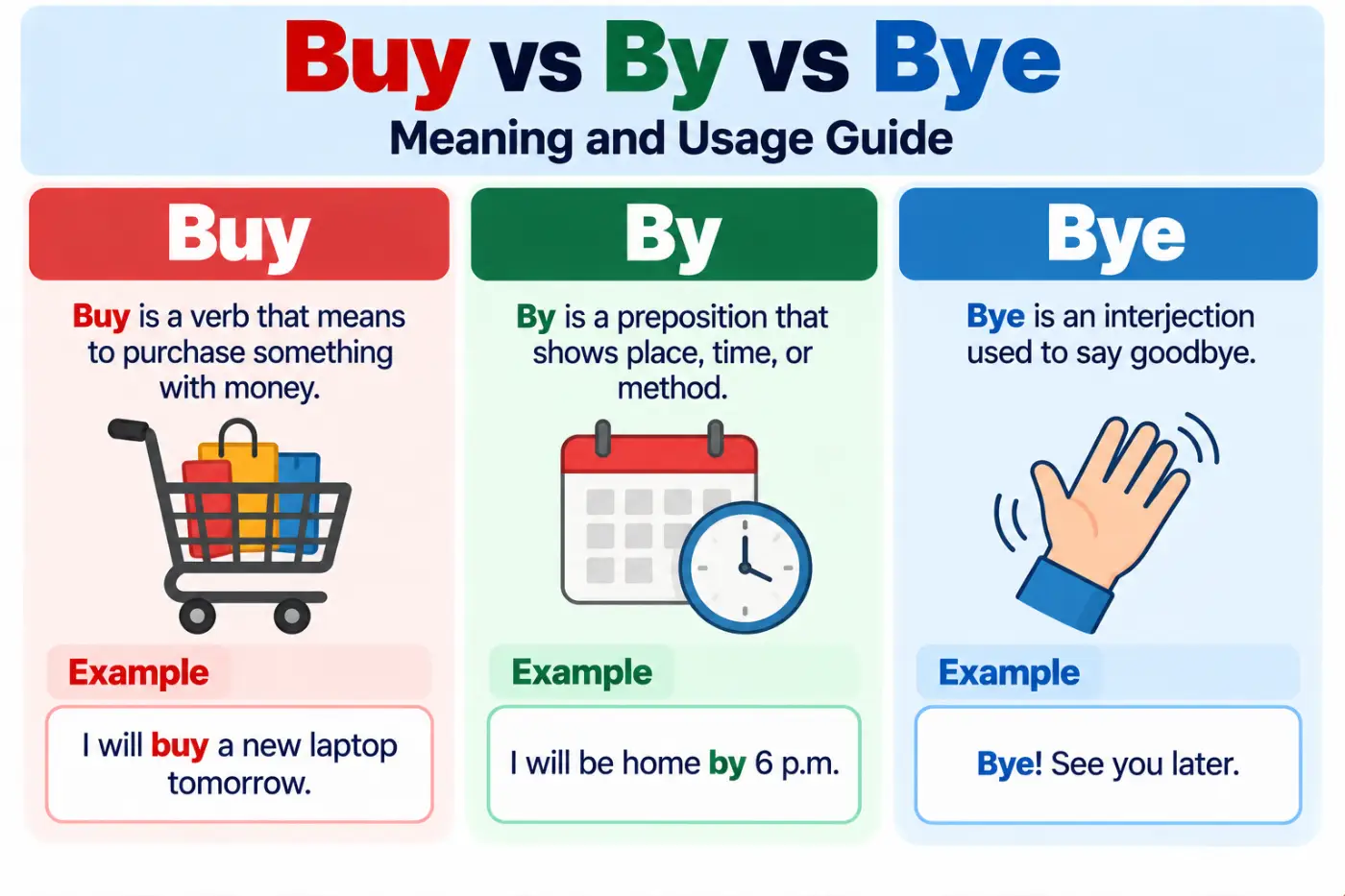
Buy vs by vs bye can confuse even strong English speakers because all three words sound exactly the same. The spelling changes because each word has a different meaning and grammar role. The quick answer is simple. Buy relates to purchasing something. By usually shows a person who does an action, a method, a place, or a deadline. Bye is used when someone leaves or says goodbye.
This confusion happens because English has many homophones. Homophones sound alike but have different spellings and meanings. When you hear one of these words in conversation, you cannot always know which spelling belongs on the page.
The good news is that you only need a few simple rules to tell them apart. This guide explains the meaning of each word, its grammar role, pronunciation, history, common mistakes, and everyday usage. You will also see natural examples from conversations, emails, academic writing, news, and literature. By the end, choosing the right word should feel almost automatic.
Quick Definition
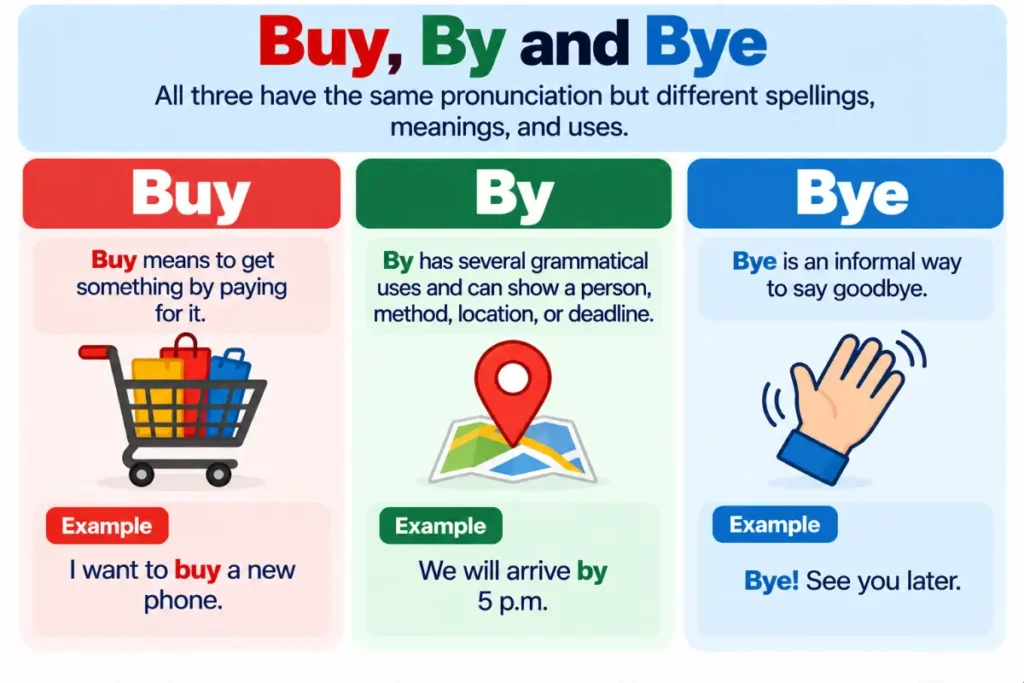
Buy means to get something by paying for it. By has several grammatical uses and can show a person, method, location, or deadline. Bye is an informal way to say goodbye. All three have the same pronunciation but different spellings, meanings, and uses.
Quick Answer
Use buy when you are talking about purchasing something. Use bye when you are saying goodbye or referring to a departure.
Comparison Table
| Correct Form | Meaning | Part of Speech | Origin | Usage Frequency | Formality | Common Contexts | Example |
|---|---|---|---|---|---|---|---|
| Buy | Get something by paying for it | Verb and noun | Old English bycgan | Very common | Neutral | Shopping and business | I need to buy a new phone. |
| By | Near or beside; through a method; before a time; done by someone | Preposition and adverb | Old English bī | Extremely common | Neutral | Time place method agent and passive sentences | Please finish the work by Friday. |
| Bye | A way to say goodbye; a departure | Interjection and noun | Developed from by and goodbye | Common | Informal | Conversations messages and departures | She waved and said bye. |
Meaning and Definition
Meaning of Buy
Buy is a verb that means to get something in exchange for money. It can describe a simple purchase such as buying food or a more serious financial decision such as buying a house.
For example, you might buy a book from a store. You might buy a ticket for a concert. You might buy supplies for your business.
The word can also work as a noun in informal English. In that use, a buy means something that someone purchased or something considered a good purchase.
For example, a shopper might say that a particular jacket was a great buy.
The central idea stays the same. Money or another form of payment changes hands so someone receives a product or service.
Meaning of By
By is one of the most flexible small words in English. It commonly works as a preposition and can express several different relationships.
It can show who performed an action.
The novel was written by Jane Austen.
It can show a deadline.
Please submit the form by Monday.
It can show a location near something.
She sat by the window.
It can show a method or means.
We traveled by train.
It can also describe movement past something.
He walked by without saying anything.
Because by has so many meanings, context usually tells you which meaning applies.
Meaning of Bye
Bye is mainly used as an informal way to say goodbye. You might say it when ending a phone call, leaving a friend’s house, or finishing a casual conversation.
Bye can also appear as a noun in sports and competitions. A participant receives a bye when they move forward without playing a particular round.
For example, the top seeded player received a bye in the first round.
In ordinary conversation, however, the most common meaning is simply a friendly farewell.
Key Differences Explained
- Spelling. Buy, by, and bye have different spellings even though they sound the same.
- Grammar role. Buy usually works as a verb. By usually works as a preposition or adverb. Bye commonly works as an interjection and can also work as a noun.
- Meaning. Buy concerns purchasing. By expresses relationships involving time, place, method, movement, or the person performing an action. Bye expresses departure or farewell.
- Tone. Buy and by are normal in both casual and formal English. Bye is more conversational and usually sounds friendly and informal.
- Context. The surrounding words make the correct spelling clear. If money changes hands, choose buy. If you are showing a relationship such as time or method, choose by. If someone is leaving, choose bye.
Which Spelling Is Correct
All three spellings are correct. The right choice depends on the meaning of the sentence.
You should not treat these words as alternative spellings of one word. They are separate words with different histories and grammatical functions. Dictionaries list them independently for this reason.
A useful editing principle is to identify the meaning first and the spelling second. Ask yourself what the sentence is trying to say. If the idea involves purchasing something, use buy. If someone is leaving, bye may be the right choice.
This approach works better than trying to remember the spelling from sound alone because all three words have the same pronunciation.
Sentence Examples
Here are natural examples that show how each word works.
- I need to buy some groceries after work.
- She plans to buy a new laptop next month.
- We decided to buy tickets online.
- He wants to buy a birthday gift for his sister.
- Did you buy the shoes you liked?
- Please send the report by email.
- We need to finish this project by Friday.
- The café is by the main entrance.
- She traveled by bus because it was cheaper.
- The painting was created by a local artist.
Here are examples of the common misspelling finaly style problem applied to this word group. The issue occurs when writers choose a form based only on sound.
- I want to buy a new computer.
- I want to by a new computer.
- She said buy and walked away.
- She said by and walked away.
- He waved and said by.
The second and fourth examples show how confusing the forms can become when sound controls spelling. The meaning must control the spelling.
Common Mistakes and Misspellings
Using By When You Mean Buy
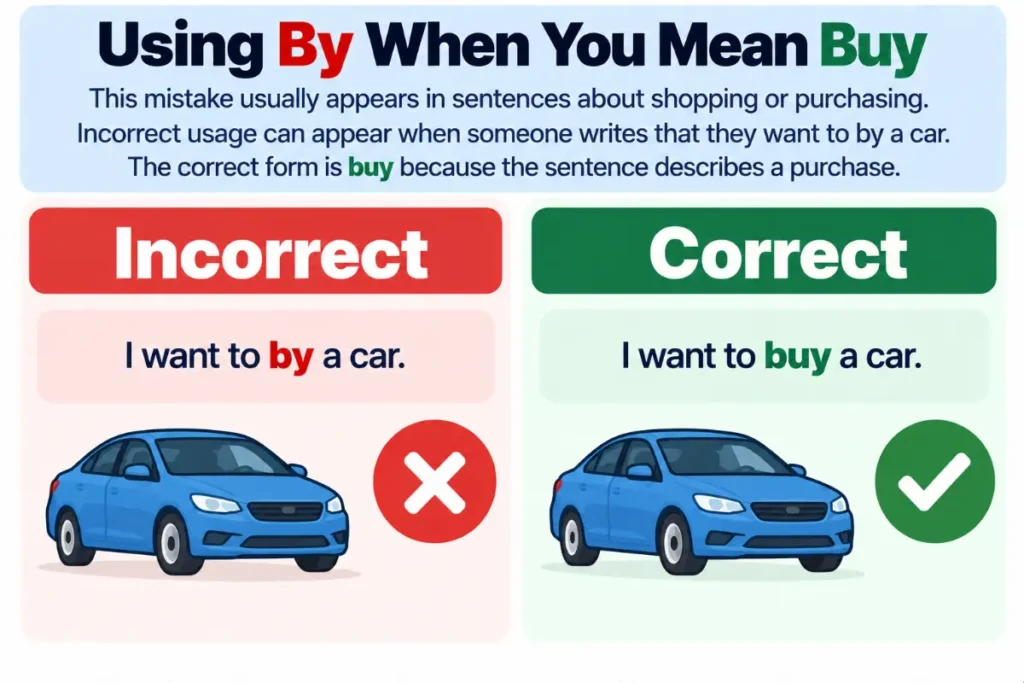
This mistake usually appears in sentences about shopping or purchasing.
Incorrect usage can appear when someone writes that they want to by a car. The correct form is buy because the sentence describes a purchase.
The easiest test is to replace the word with purchase. If purchase makes sense, buy is almost certainly the right choice.
Using Buy When You Mean By
This mistake often appears before a deadline.
For example, someone might write that they need to finish the project buy Friday. The correct form is by Friday because the word expresses a deadline.
Try replacing by with before or no later than. If the meaning still works, by is likely correct.
Using By Instead of Bye
This error often appears in casual messages.
A person may type by when they mean goodbye. The correct spelling is bye.
Think about the context. If someone is leaving or ending a conversation, bye fits.
Using Bye in a Formal Sentence
Bye is not grammatically wrong in every context. However, it has a casual tone.
A formal business letter normally uses a more professional closing. Casual messages between friends can use bye naturally.
Choosing the Word From Sound Alone
This is the biggest source of confusion. Since all three forms sound alike, pronunciation cannot tell you the spelling.
This is a classic homophone problem. English contains many such pairs and groups. The brain often recognizes sound faster than spelling, especially during fast typing. That creates a strong NLP confusion pattern where one familiar spelling can appear in place of another.
Pronunciation Guide
The pronunciation of all three words is the same in standard English.
Buy: /baɪ/.
By: /baɪ/.
Bye: /baɪ/.
Each word has one syllable.
An easy audio style spelling is bye or bai.
The vowel sound is the same sound you hear in words such as sky, try, fly, and high.
This creates the central challenge. You cannot hear the spelling difference. You have to understand the meaning from context.
Native speakers usually process these words quickly because the surrounding sentence provides enough information. When writing, however, you must choose the correct written form yourself.
Etymology and Word Origin
The history of these words helps explain why they look different today.
Buy comes from Old English bycgan, which meant to acquire something by payment or exchange. Over centuries, the spelling and pronunciation changed as English developed. Modern English eventually settled on buy.
By has a different history. It comes from Old English bī, a word connected with meanings such as near, beside, and by means of. Its modern uses grew from these older relationships.
Bye developed later as a shortened form connected with expressions used when people parted. The familiar farewell bye became established in English as an informal way to say goodbye.
The three words therefore have separate histories even though their modern pronunciation became identical.
This is a useful reminder that English spelling does not always follow pronunciation in a simple way. Historical changes, sound changes, borrowed words, and older spelling patterns all shaped modern English.
Regional Usage
US English
American English uses buy, by, and bye in the same basic ways described in this guide. The spelling difference is standard across American dictionaries and educational writing. Bye is especially common in casual speech and text messages.
UK English
British English also distinguishes clearly between the three forms. Buy refers to purchasing. By covers several prepositional meanings. Bye is the usual informal farewell. British speakers may use bye in the same everyday situations as American speakers.
Australian English
Australian English follows the same standard distinction. The three words have the same basic meanings and pronunciation. Informal conversations commonly use bye when people part.
Canadian English
Canadian English also uses the standard spellings buy, by, and bye. Writers should choose the form based on meaning rather than pronunciation. The distinction remains consistent in both casual and formal Canadian English.
Grammar Rules and Part of Speech
Buy as a Verb
Buy most often functions as a verb.
I will buy some milk.
She bought a new dress.
They are buying a house.
The verb changes form depending on tense. The common forms are buy, buys, bought, and buying.
Buy can take a direct object.
I bought a book.
Here book receives the action of buying.
Buy as a Noun
Buy can also work as a noun in informal English.
That jacket was a great buy.
Here buy refers to something that was purchased or viewed as a good purchase.
By as a Preposition
By has several important prepositional uses.
It can identify the person who performs an action.
The song was written by her.
It can show a deadline.
Finish the assignment by tomorrow.
It can show location.
He stood by the door.
It can show a method.
We went by train.
It can show movement past something.
She walked by the house.
By as an Adverb
By can also work as an adverb when it means past or nearby.
He walked by.
She passed by without stopping.
The exact grammatical role depends on the sentence.
Bye as a Noun
Bye can also function as a noun.
The team received a bye in the first round.
In this context, bye has nothing to do with saying goodbye. It refers to an automatic advance in a competition.
Real Life Usage Examples
Daily Talk
I need to buy some bread before dinner.
Bye. I will call you later.
These examples show the most common everyday meanings. One involves purchasing while the other involves leaving.
Please send the completed document by Friday.
I need to buy a replacement charger before the trip.
Email writing often uses by to express deadlines. Buy appears when someone discusses purchases.
Academic Writing
The research team was supported by several institutions.
The university decided to buy new laboratory equipment.
Academic writing frequently uses by in passive constructions. Buy appears when the subject makes a purchasing decision.
News
The company plans to buy a smaller competitor.
The new policy must be approved by the end of the month.
News writing commonly uses both words because reporting often involves business actions and deadlines.
Literature
The traveler passed by the old house.
She whispered bye before leaving the room.
Literary writing can use all three forms depending on the scene and intended meaning
These terms are not replacements for buy or by. They belong to different grammatical and semantic categories. However, they can appear in related sentences and may help you understand context.
Expert Editor Insight
As a senior editor would tell you, sound is the wrong tool for solving this spelling problem. Meaning is the better guide. Native speakers often choose the correct form almost automatically because context activates the right word. Editing software can also flag some errors, but a spelling checker may miss a wrong homophone when the word itself is spelled correctly. For example, both buy and by are correctly spelled words. Only the sentence meaning reveals the mistake. My practical tip is to pause and ask one question. Am I purchasing something, describing a relationship such as time or method, or saying goodbye? That quick check catches most errors.
Conclusion
Buy vs by vs bye becomes much easier once you connect each spelling with its meaning. Buy refers to purchasing something. By usually shows relationships involving time, place, method, movement, or the person performing an action. Bye is mainly used as an informal farewell.
The key challenge comes from pronunciation because all three words sound the same. You cannot solve the problem by listening alone. Instead, look at the sentence and identify the idea. If money changes hands, choose buy. If you are showing a deadline, method, location, or agent, choose by.
A simple memory trick can save you from most mistakes.
Frequently Asked Questions
Is Buy a Real Word?
Yes. Buy is a standard English word that usually works as a verb meaning to get something by paying for it. It can also work as a noun in informal contexts when someone describes a purchase as a good buy. The past tense is bought. For example, you can say that you want to buy a new phone or that you bought one yesterday.
What Does By Mean?
By is a common English preposition and adverb with several meanings. It can show the person who performs an action, a deadline, a location, a method, or movement past something. For example, the book was written by an author, the work is due by Friday, and we traveled by train. Context determines the exact meaning.
Buy vs By vs Bye Which Is Correct?
All three are correct words, but they serve different purposes. Buy relates to purchasing. By usually expresses a relationship involving time, place, method, movement, or the person performing an action. Bye usually expresses farewell. The spelling depends on the meaning you want to communicate. Because all three sound the same, context matters more than pronunciation.
How Do You Pronounce Buy By and Bye?
Buy, by, and bye have the same standard pronunciation, /baɪ/. Each word has one syllable. The sound is similar to the vowel sound in sky, try, fly, and high. Since pronunciation cannot distinguish these words, writers need to rely on meaning and sentence context when choosing the correct spelling.
Can By Start a Sentence?
Yes. By can start a sentence when its grammatical role supports that position. For example, you can write, By Friday, we need to finish the project. You can also begin a sentence with a phrase such as By working together, we solved the problem. Starting with by is completely acceptable in both everyday and formal writing.
What Is a Synonym for Bye?
The closest common synonym for bye is goodbye. Other expressions include farewell, see you, see you later, and take care. The best choice depends on the situation and tone. Bye sounds casual and friendly. Goodbye works in a wider range of situations and can sound more neutral or slightly more formal.
Why Do People Confuse Buy By and Bye?
People confuse these words mainly because they are homophones. They share the same pronunciation but have different spellings and meanings. Fast typing can make the problem worse because people often write the sound they hear in their head. Familiarity with sentence context and a simple meaning check can prevent most errors.
Is Bye Appropriate in Formal Writing?
Bye is usually more suitable for casual communication than formal writing. You might use it in a friendly email or personal message. In formal communication, writers often choose a professional closing instead. The word itself is not incorrect. The main issue is tone. Always consider your audience and the level of formality expected in the situation.

Confusing Words, Spelling & Word Choice
Claire Whitmore is a U.S.-based English editor who writes about commonly confused words, spelling differences, and word choice. Her work helps readers understand subtle distinctions between similar-looking words through simple definitions, practical examples, and modern usage guidance in both American and British English.