
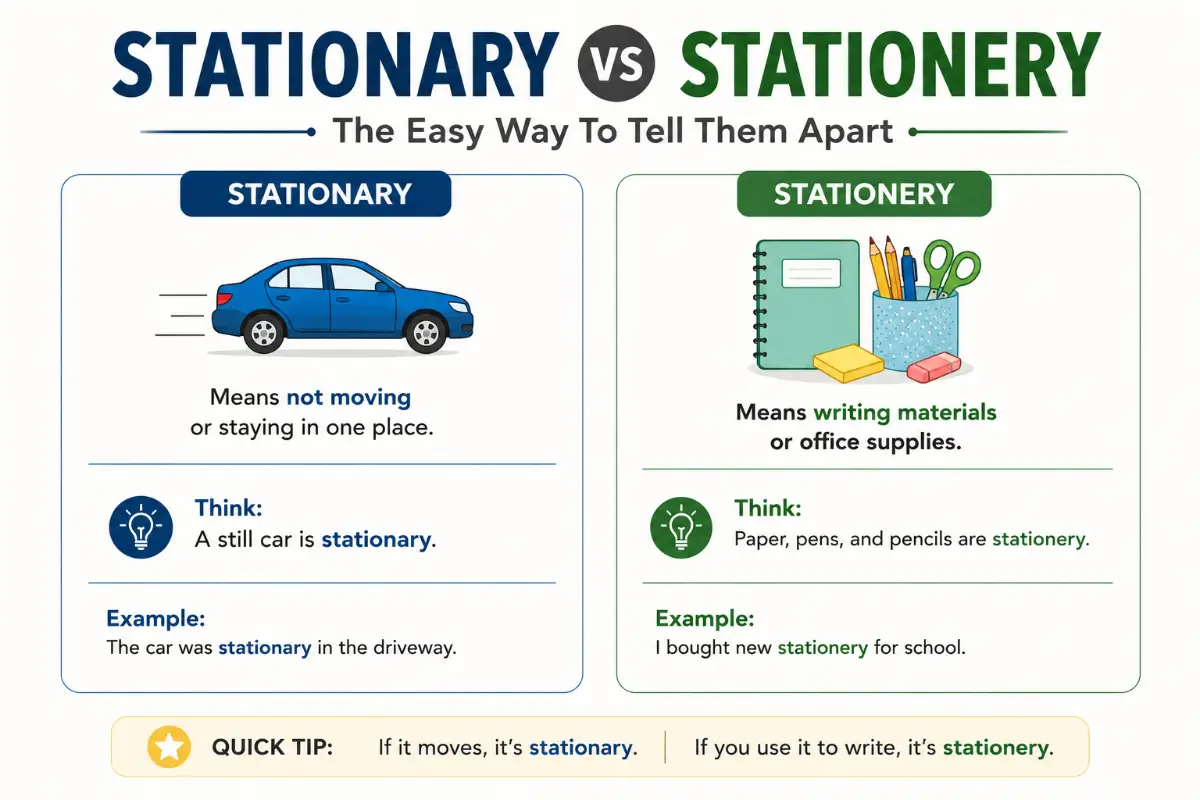
Stationary vs stationery is one of the most common spelling and word usage problems in English. The two words sound exactly alike in standard pronunciation but they have completely different meanings and grammatical roles.
The quick answer is simple. Stationary means staying still or not moving. Stationery means writing materials such as paper envelopes pens and other supplies. Merriam Webster defines stationary as an adjective meaning fixed or immobile while stationery is a noun referring to writing materials or letter paper.
The confusion makes sense because only one letter separates the two spellings. That small difference can change the meaning of an entire sentence.
Short Answer
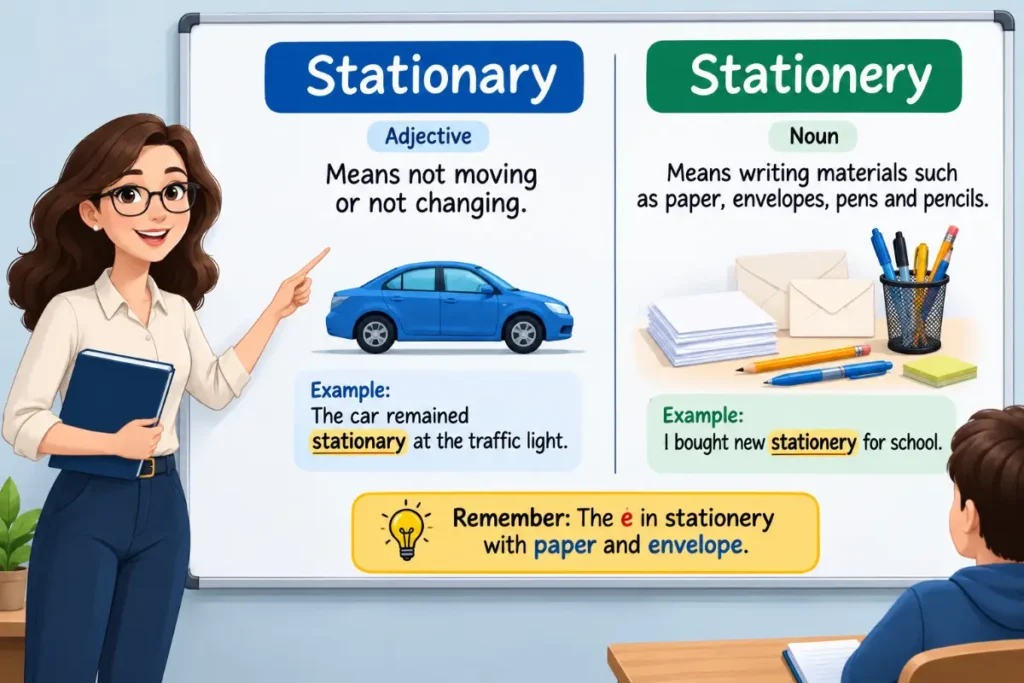
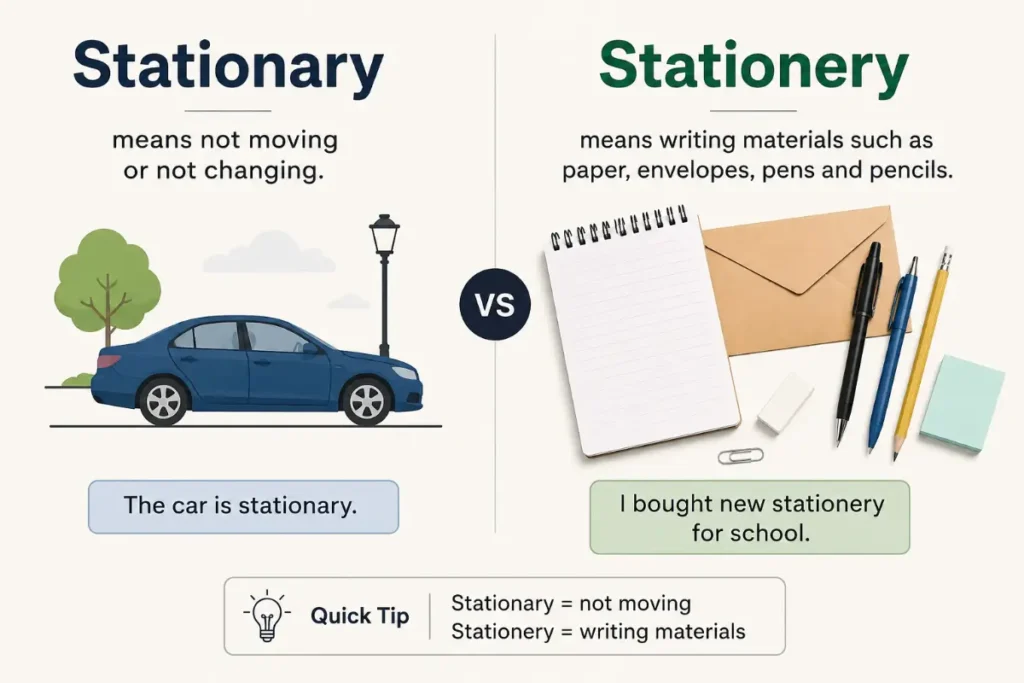
Stationary is an adjective that means not moving or not changing. Stationery is a noun that means writing materials such as paper envelopes pens and pencils. They are homophones because they have the same pronunciation but different spellings meanings and grammatical functions. Remember the e in stationery with paper and envelope.
Table Of Contents
- Quick answer to the difference.
- Comparison of stationary and stationery.
- Meaning of stationary.
- Meaning of stationery.
- The key difference between the words.
- Why stationary and stationery sound the same.
- How to remember the spelling.
- Grammar rules for stationary.
- Grammar rules for stationery.
- Examples of stationary in sentences.
- Examples of stationery in sentences.
- Common mistakes.
- Pronunciation guide.
- Word origins and history.
- American and British usage.
- Professional writing guidance.
- Related words and confusing terms.
- Memory tricks.
- Frequently asked questions.
- Key takeaways.
- Conclusion.
Quick Answer To Stationary vs Stationery
If you need the answer right now remember this:
Stationary means still.
Stationery means writing materials.
That is the central distinction.
A stationary object doesn’t move.
A stationery item helps you write or communicate.
For example:
The bus remained stationary for ten minutes.
She ordered personalized stationery for her business.
Merriam Webster gives stationary the meaning of being fixed in position or unchanging in condition. It defines stationery as materials such as paper pens and ink used for writing or typing and also as letter paper with matching envelopes.
If you’re talking about movement think stationary.
If you’re talking about paper or writing supplies think stationery.
Stationary And Stationery Comparison
| Feature | Stationary | Stationery |
|---|---|---|
| Main meaning | Not moving or not changing | Writing materials |
| Part of speech | Adjective | Noun |
| Pronunciation | Same as stationery | Same as stationary |
| Refers to | Position movement or condition | Paper envelopes pens pencils and writing supplies |
| Example | The car was stationary. | I bought new stationery. |
| Common context | Traffic vehicles objects science conditions | Letters offices schools invitations businesses |
| Spelling clue | Contains A | Contains E |
| Related word | Station | Stationer |
| Formality | Standard English | Standard English |
| Common mistake | Used for writing materials | Used to mean not moving |
The table reveals the most important point. These words don’t represent two spellings of the same meaning. They are separate words with separate grammatical jobs.
What Does Stationary Mean
Stationary means not moving.
It can describe something that remains in one position instead of changing location. It can also describe something that stays unchanged in condition or level.
Cambridge defines stationary as not moving or not changing. Its examples include a stationary car and a stationary rate of inflation.
For example:
The truck was stationary outside the building.
The word stationary tells us that the truck wasn’t moving.
You can also describe a person as stationary:
The runner stood stationary near the starting line.
In that sentence the person is remaining in place.
The word can describe physical movement but its meaning isn’t limited to physical objects.
For example:
The population remained stationary for several years.
Here stationary means unchanged rather than physically motionless.
Merriam Webster gives the related sense of an unchanged condition.
Stationary As An Adjective
Stationary is an adjective.
That means it modifies a noun.
Examples include:
A stationary machine.
A stationary target.
The adjective gives information about the condition or position of the noun.
Compare these:
The car is stationary.
The car is expensive.
In each sentence the adjective describes the car.
Common Meanings Of Stationary
The word has two closely related modern meanings.
- Not moving from a position.
- Not changing in condition or level.
The first meaning is the one you’ll encounter most often in ordinary conversation.
For example:
The elevator remained stationary.
The second meaning appears more often in technical academic scientific or economic writing.
For example:
The temperature remained stationary throughout the experiment.
The inflation rate remained stationary during the period studied.
In these contexts the word means that something remained stable or unchanged.
What Does Stationery Mean
Stationery is a noun that refers to materials used for writing.
These materials can include paper envelopes pens pencils notebooks letterheads and similar office or writing supplies.
Cambridge defines stationery as things needed for writing such as paper pens pencils and envelopes. It also gives a more specific meaning involving good quality writing paper and matching envelopes.
Merriam Webster similarly defines stationery as writing or typing materials and as letter paper often accompanied by matching envelopes.
For example:
I bought new stationery for my office.
The word stationery refers to the writing materials.
Another example:
The company ordered personalized stationery.
Here the stationery might include letterhead envelopes and other printed paper carrying the company’s name or branding.
Stationery As A Noun
Stationery is normally an uncountable noun.
You usually don’t say:
I bought three stationeries.
Instead you say:
I bought three sets of stationery.
I ordered new stationery.
We need more stationery.
This grammatical difference helps separate the word from many ordinary count nouns.
You can count individual pieces of stationery by naming the item.
For example:
I bought five envelopes.
She ordered twenty sheets of stationery.
He purchased three notebooks.
The word stationery itself normally refers to the category or collection of writing materials.
The Key Difference Between Stationary And Stationery
The easiest distinction is:
Stationary describes a lack of movement.
Stationery describes writing materials.
The difference is only one letter but the meanings are far apart.
Think about these two sentences:
The bicycle is stationary.
The desk is covered with stationery.
The first sentence tells you that the bicycle isn’t moving.
The second tells you that the desk has writing materials on it.
The words also belong to different parts of speech.
Stationary is an adjective.
Stationery is a noun.
That grammatical difference gives you another useful way to identify the correct spelling.
If the word describes something then stationary is likely the right choice.
If the word names writing materials then stationery is the right choice.
Why Stationary And Stationery Sound The Same
Stationary and stationery are homophones. A homophone is a word that sounds the same as another word but has a different meaning or spelling.
Both words are commonly pronounced with three syllables:
STAY shuh ner ee
Cambridge gives the pronunciation of stationary and stationery in both British and American English. The pronunciation is essentially the same despite the different spellings.
That shared pronunciation creates the spelling problem.
When you hear the word you can’t tell which spelling the speaker means.
You have to use context.
For example:
The train remained stationary.
The word must mean not moving because a train cannot be described as writing material.
Now consider:
She bought some stationery.
The context clearly points to paper or writing supplies.
This is why homophones can be tricky. Your ears give you the sound but your understanding of the sentence gives you the spelling.
How To Remember Stationary
The easiest memory trick is to connect stationary with stillness.
Think of something standing still at a station.
Stationary equals staying still.
The letter a can also help you remember the word through the idea of at rest.
This isn’t the historical origin of the spelling. It’s simply a memory device.
For example:
The car was stationary.
The car was staying still.
Both ideas point in the same direction.
Another helpful connection is station.
A station is a fixed place.
Something stationary stays fixed.
Again this is a memory aid rather than a complete etymological explanation.
How To Remember Stationery
For stationery think about paper.
Both paper and stationery contain the letter e near the end.
Merriam Webster specifically recommends remembering the er in paper when spelling stationery.
You can also connect it with envelope.
Stationery has an e.
Envelope begins with e.
This gives you a simple mental picture:
Stationery belongs with envelopes.
So when you’re writing about paper envelopes pens or letterheads choose stationery.
A Simple Memory Sentence
If you want one sentence to remember the difference try this:
The stationary car sat beside the stationery store.
The first word describes the car because it isn’t moving.
The second word describes the writing materials sold by the store.
Another version is:
The stationary train passed a stationery shop.
The train is stationary.
The shop sells stationery.
Once you see both words working in the same sentence the distinction becomes much easier to remember.
Grammar Rules For Stationary
Because stationary is an adjective it normally appears next to or near the noun it describes.
Examples:
The stationary vehicle blocked the lane.
The vehicle remained stationary.
The machine was stationary during the inspection.
The adjective can appear before a noun:
A stationary object.
It can also appear after a linking verb:
The object is stationary.
The object remained stationary.
This is standard adjective behavior.
Stationary With Linking Verbs
You will often see stationary after verbs such as:
- Be.
- Remain.
- Stay.
- Become.
- Seem.
Examples:
The car remained stationary.
The patient stayed stationary during the scan.
The equipment was stationary.
The object seemed stationary from a distance.
The word describes the subject rather than naming an object.
Stationary Does Not Mean Permanent
One subtle point matters here. Something can be stationary for a short time. A car can be stationary at a red light and moving again thirty seconds later. So stationary doesn’t automatically mean permanent. It simply describes the lack of movement or change during the relevant period.
For example:
The bus was stationary for five minutes.
The bus later continued its journey.
There is no contradiction.
Grammar Rules For Stationery
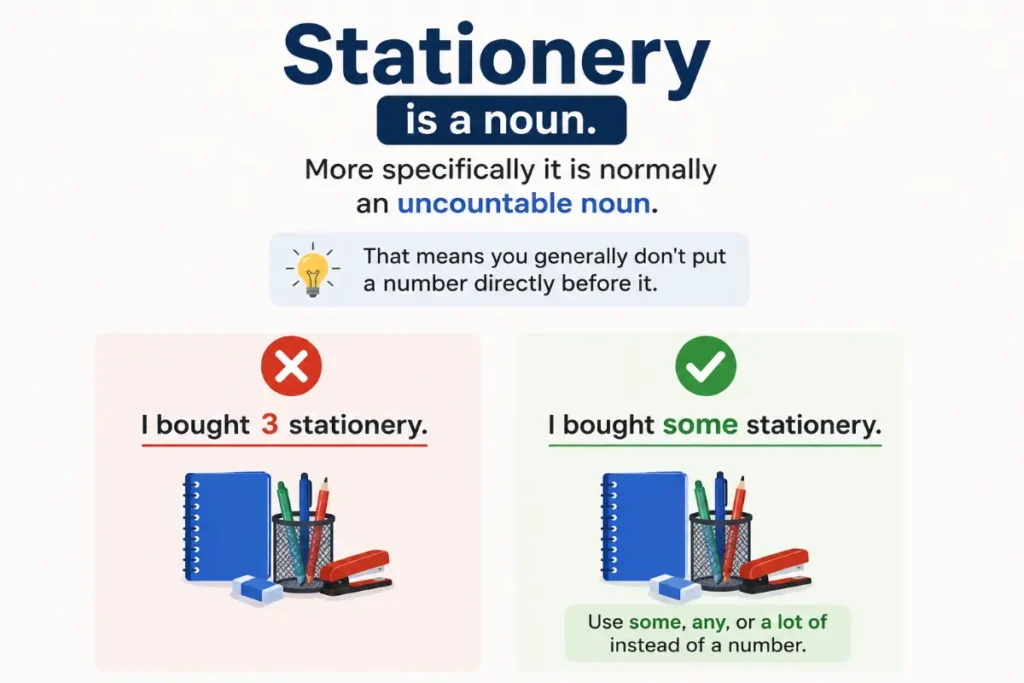
Stationery is a noun. More specifically it is normally an uncountable noun. That means you generally don’t put a number directly before it.
Incorrect:
I bought three stationeries.
Better:
I bought several stationery items.
I bought some stationery.
The correct choice depends on what you’re counting.
Stationery With Articles
Because stationery is generally uncountable you can say:
I bought some stationery.
I need more stationery.
The stationery is on my desk.
We ordered new stationery.
You don’t normally say a stationery when referring to writing materials as a category. However a stationery store is perfectly correct because stationery is functioning as a noun modifier before store.
For example:
There is a stationery store near my office.
Here store is the main noun.
Stationery tells us what the store sells.
Stationery Store Or Stationary Store
The correct phrase for a store that sells writing supplies is:
Stationery store.
Not:
Stationary store.
The difference matters because stationary store could theoretically describe a store that doesn’t move.
That isn’t the intended meaning.
Cambridge gives stationery store as an example of the noun in American English.
For example:
I bought pens at the stationery store.
This means the store sells writing materials.
Stationery In Business Writing
Stationery has a strong connection with professional communication.
Businesses often use branded stationery that includes a company name logo address contact information or other identifying details.
Common examples include:
- Letterhead.
- Envelopes.
- Business cards.
- Notepaper.
- Thank you cards.
- Company forms.
- Printed correspondence materials.
However the exact meaning can vary by context.
In traditional usage stationery often centers on paper writing materials and related supplies.
In modern office language the term can cover a broader collection of writing and communication materials.
For example:
The company redesigned its stationery.
This might refer to branded letterhead envelopes and other printed materials.
Real Life Examples Of Stationary
Here are natural examples showing how stationary works in everyday English.
Example 1
The car remained stationary at the intersection.
The word describes the car’s lack of movement.
Example 2
The train was stationary for several minutes.
The train wasn’t moving during that period.
Example 3
Keep the camera stationary while taking the picture.
The camera should remain still.
Example 4
The cyclist was stationary at the red light.
The cyclist had stopped moving.
Example 5
The machine must remain stationary during the test.
The machine needs to stay in one position.
Example 6
The boat appeared stationary from the shore.
The boat seemed not to be moving from the observer’s viewpoint.
Example 7
The population remained stationary during the study.
Here the word means unchanged rather than physically still.
Example 8
The temperature stayed stationary throughout the experiment.
The temperature did not change significantly during the relevant period.
Example 9
The vehicle became stationary after the driver applied the brakes.
The vehicle stopped moving.
Example 10
A stationary object can still experience forces.
The object isn’t moving but physical forces may still act on it.
These examples show that stationary isn’t limited to cars and trains. It can describe physical position as well as an unchanged state.
Real Life Examples Of Stationery
Now compare examples using stationery.
Example 1
I bought new stationery for my home office.
The word refers to writing materials.
Example 2
She ordered personalized stationery for her wedding.
The stationery may include printed paper and matching envelopes.
Example 3
The office needs more stationery.
The sentence refers to writing and office supplies.
Example 4
He keeps his stationery in the top drawer.
The drawer contains writing materials.
Example 5
The company printed new stationery with its updated logo.
The word refers to branded paper and related correspondence materials.
Example 6
She chose elegant stationery for her invitations.
The stationery refers to the paper and related materials used for the invitations.
Example 7
The children received colorful stationery for school.
The word refers to writing supplies.
Example 8
The stationery shop sells notebooks pens and envelopes.
The shop sells writing materials.
Example 9
I keep extra stationery beside my printer.
The speaker keeps writing supplies nearby.
Example 10
The letter was printed on company stationery.
The paper carries the company’s identity or branding.
The pattern stays consistent. If you’re talking about writing materials choose stationery.
Common Mistakes With Stationary And Stationery
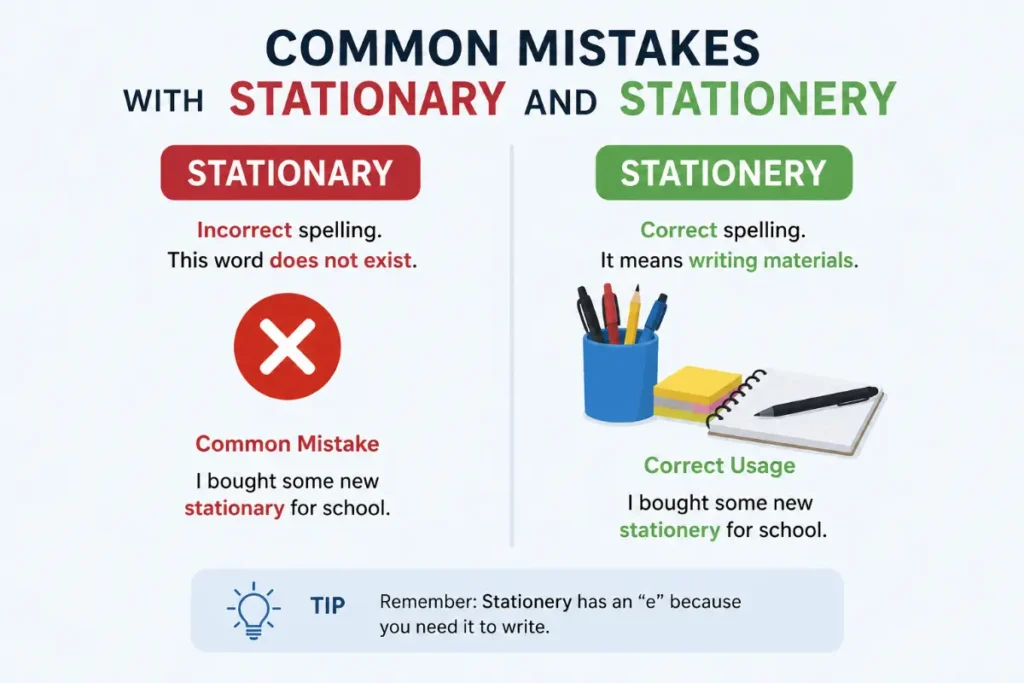
The most common error is swapping the final letters.
Someone may write:
I bought new stationary.
when they mean writing paper.
The correct sentence is:
I bought new stationery.
Another common mistake happens in descriptions of vehicles.
Someone may write:
The car remained stationery.
The correct sentence is:
The car remained stationary.
These errors happen because pronunciation doesn’t help.
You need to identify the meaning first.
Mistake With A Stationery Car
A phrase such as stationery car is normally wrong if you mean a car that isn’t moving.
Write:
stationary car
The adjective describes the car’s position.
Mistake With Stationary Supplies
If you mean pens paper and envelopes don’t write: stationary supplies Write stationery supplies The supplies are writing materials.
Mistake With Stationary Store
If the business sells paper pens envelopes and office supplies write: stationery store The word describes the type of products sold.
Why People Confuse These Words
The confusion has several causes. First the words are homophones. Second their spellings differ by only one vowel. Third both words are connected historically to the word station. Fourth stationery is less predictable from pronunciation because the final ery doesn’t immediately reveal its meaning. Fifth modern speakers don’t always encounter the word stationer which would make the connection easier. That last point is especially useful.
Stationer And Stationery
A stationer is a person or business that sells stationery. This word helps explain the spelling of stationery. Historically the meaning was broader. A stationer was associated with bookselling publishing and the sale of writing materials. Merriam Webster still records older senses involving booksellers and publishers. Today the word stationer is less common in everyday American conversation than stationery. You may encounter it in phrases such as: A local stationer. A specialist stationer. A luxury stationer.
A stationery shop.
The important spelling connection is:
stationer has an e.
stationery has an e.
That shared e can help you remember the writing related word.
Pronunciation Guide
The two words are pronounced alike. Cambridge gives both forms with essentially the same pronunciation in British and American English. A simple pronunciation guide is:
STAY shuh ner ee
The word has three syllables.
STAY
shuh
ner ee
The first syllable receives the main stress. Because the pronunciation is the same you cannot solve this spelling problem by listening alone. You need context. This is exactly what makes stationary and stationery homophones.
American And British English Usage
The meanings and spellings of these two words remain essentially the same in American and British English.
Stationary means not moving or not changing.
Stationery means writing materials.
There is no major American versus British spelling difference like the one found in words such as color and colour.
Formal And Informal Usage
Both words are standard English.
Stationary is common in everyday descriptions.
For example:
The car is stationary.
It also appears in technical writing.
For example:
The study examines stationary populations.
Stationery is common in everyday and professional writing.
For example:
We need more stationery for the office.
It also appears in business and design contexts.
For example:
The company redesigned its corporate stationery.
Neither word is inherently informal.
The important issue is choosing the right word for the intended meaning.
Professional Writing Tips
When editing professional content always check the meaning before checking the spelling.
Ask yourself:
- Is the sentence describing something that doesn’t move?
Choose stationary.
- Is the sentence describing paper writing materials or related supplies?
Choose stationery.
- Is the sentence describing a business that sells writing supplies?
Use stationery store.
- Is the sentence describing an object that stays in one position?
Use stationary object.
This simple meaning first approach is more reliable than trying to remember the letters in isolation.
A professional editor also looks at the surrounding words.
Phrases such as stationary vehicle, stationary object, and stationary position strongly point toward the adjective.
Phrases such as stationery supplies, stationery store, and company stationery point toward the noun.
Context acts like a built in spelling guide.
Key Takeaways
- Stationary means not moving or not changing.
- Stationery means writing materials such as paper envelopes pens and pencils.
- Stationary is an adjective.
- Stationery is a noun.
- The two words are homophones because they share the same pronunciation.
- Think of stationary as staying still.
- Think of stationery as writing materials.
- Remember the e in stationery with paper or envelope.
- Stationery store is the correct phrase for a store that sells writing supplies.
- Stationary store would suggest a store that stays in one place rather than a store selling writing materials.
- Both spellings are standard in American and British English.
- The words have related historical roots but developed different meanings.
Conclusion
The difference between stationary vs stationery becomes simple once you connect each spelling with its meaning.
Stationary means still or unchanged. It is an adjective that describes something that stays in one position or remains stable.
Stationery means writing materials. It is a noun that refers to paper envelopes pens pencils letterheads and related supplies. The spelling trick is easy to remember. Think stationary for staying still. Think stationery for writing materials. The e in stationery can remind you of paper and envelope
Frequently Asked Questions
What is the difference between stationary and stationery?
Stationary means not moving or not changing while stationery means writing materials such as paper envelopes pens and pencils. Stationary is an adjective while stationery is a noun. They sound the same but have different spellings meanings and grammatical functions.
Is stationery paper or stationary paper?
The correct spelling is stationery paper when you mean paper used for writing letters or other correspondence. Stationary means still or unmoving and doesn’t describe writing paper. A useful memory trick is to associate the e in stationery with paper and envelope.
Is it a stationery store or stationary store?
The correct phrase is stationery store when you mean a store that sells writing supplies. Stationary means not moving so stationary store would have a completely different meaning. Cambridge gives stationery store as an American English example.
Is stationery a noun or adjective?
Stationery is a noun. It normally refers to writing materials such as paper envelopes pens pencils and similar supplies. It is generally an uncountable noun so you normally say some stationery or a set of stationery rather than a stationery when referring to the materials themselves.
Is stationary an adjective or noun?
Stationary is primarily an adjective in modern standard English. It describes something that isn’t moving or something that remains unchanged. For example you can say a stationary vehicle or the vehicle remained stationary. Merriam Webster defines it as fixed or immobile and also gives an unchanged condition as a related sense.
Why are stationary and stationery pronounced the same?
The two words are homophones because their spellings developed differently while their modern pronunciations became identical. Their shared pronunciation means listeners cannot determine the spelling from sound alone. Writers need to rely on meaning and context to choose the correct form.
How can I remember stationary and stationery?
Remember stationary means staying still. For stationery think of paper and envelope because stationery contains the same important e sound pattern associated with those writing related words. Merriam Webster also recommends connecting the er in stationery with the er in paper.
What is the origin of stationery?
Stationery comes from stationer which historically referred to a bookseller and later to someone who sold paper writing materials and related goods. Merriam Webster dates stationery in its modern sense to 1727 while Etymonline traces it to the phrase stationery wares and the word stationer.
What is the origin of stationary?
Stationary comes through Anglo Latin stationarius and ultimately relates to Latin statio meaning a standing place position or post. Etymonline records the late fourteenth century form stacionarie with the sense of having no apparent motion. Merriam Webster dates its first known use in the relevant modern word family to the fifteenth century.
Can stationary mean unchanged?
Yes. Although stationary most commonly describes something that isn’t moving it can also describe something that remains unchanged in condition level or quantity. Merriam Webster includes this sense and gives examples involving stationary populations.
What is the plural of stationery?
Stationery is generally an uncountable noun when it means writing materials as a category so it doesn’t normally have a plural form in that sense. Instead say pieces of stationery, sets of stationery, packs of stationery, or name the individual items such as envelopes, pens, and sheets of paper.

Confusing Words, Spelling & Word Choice
Claire Whitmore is a U.S.-based English editor who writes about commonly confused words, spelling differences, and word choice. Her work helps readers understand subtle distinctions between similar-looking words through simple definitions, practical examples, and modern usage guidance in both American and British English.