
Who vs whom is one of those grammar questions that can make an otherwise confident writer pause. You may know exactly what you want to say but still wonder which pronoun belongs in the sentence.
That sounds straightforward until real sentences become longer. Prepositions can complicate the choice. Relative clauses can hide the grammatical role. Everyday speech can also blur the traditional distinction because American English speakers commonly use who in places where formal grammar traditionally calls for whom. Major language references recognize this difference between traditional grammar and actual usage.
This guide explains the difference in plain English. You’ll learn how to identify subjects and objects how to use the pronouns in questions and relative clauses when whom sounds natural and when who is the better choice. You’ll also get practical examples memory tricks common mistakes and professional writing advice.
Short Answer
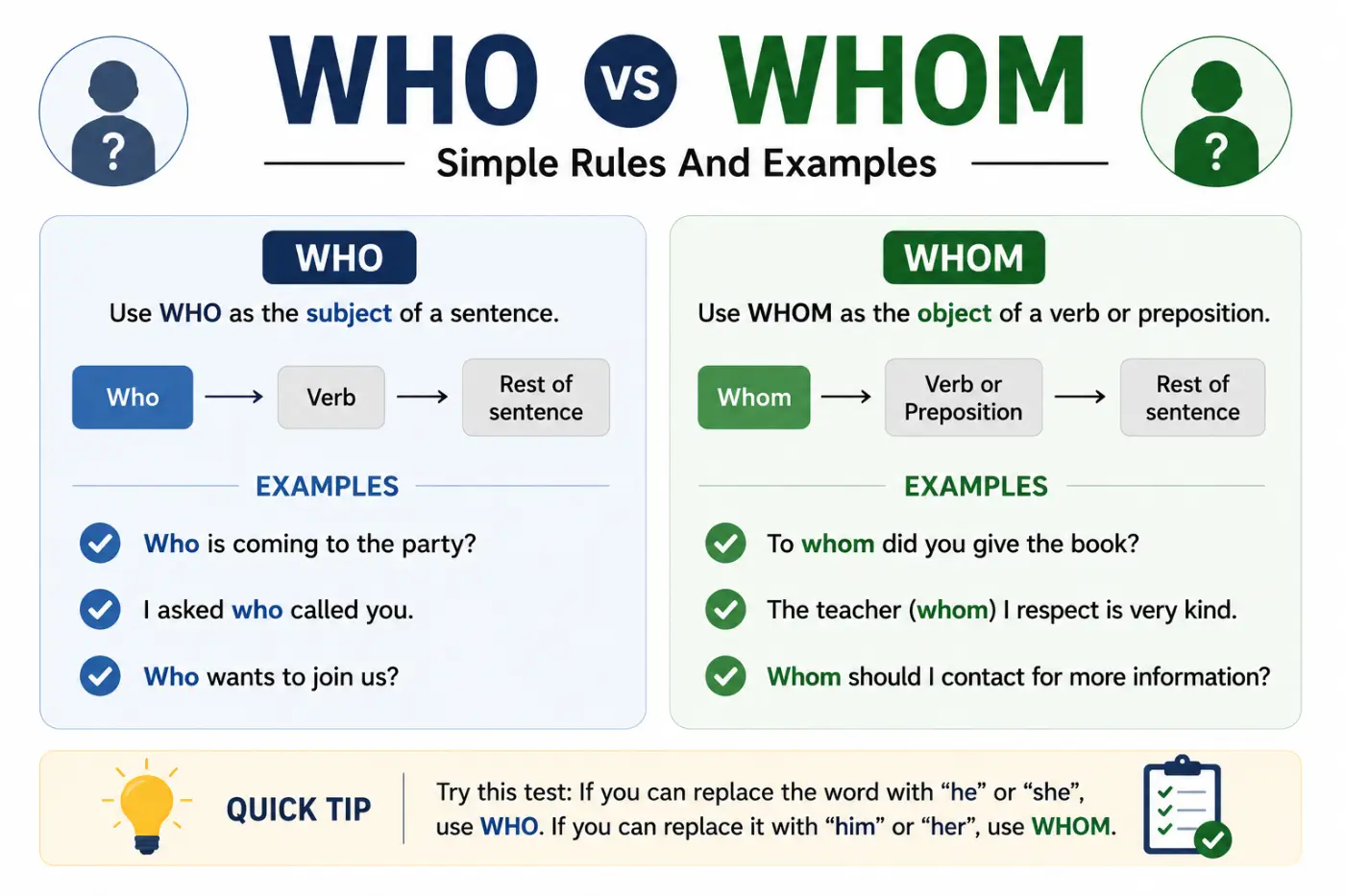
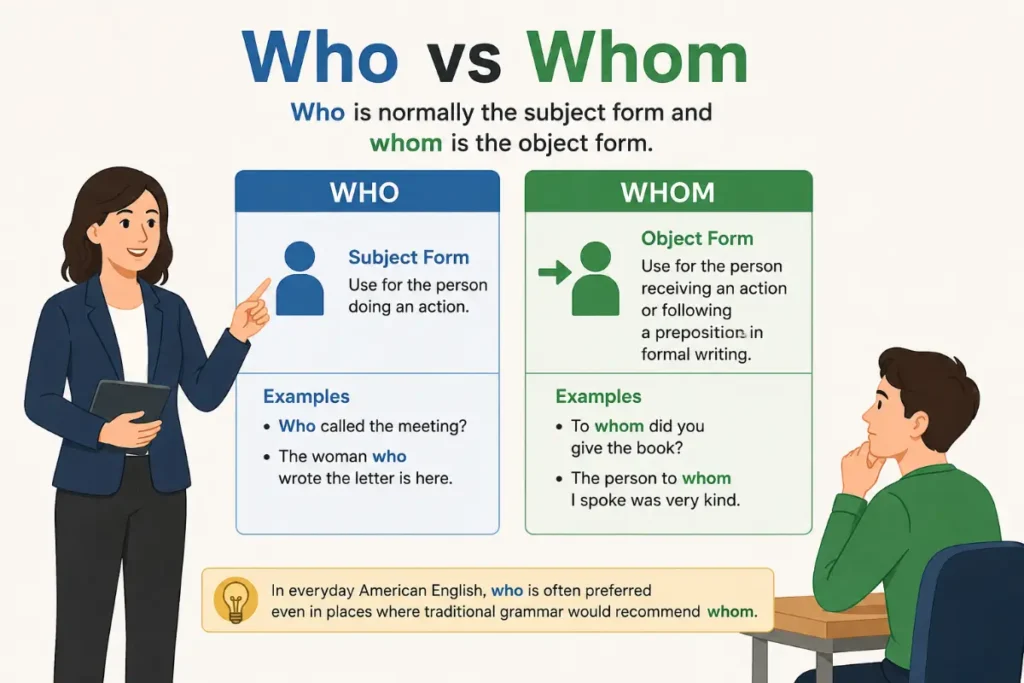
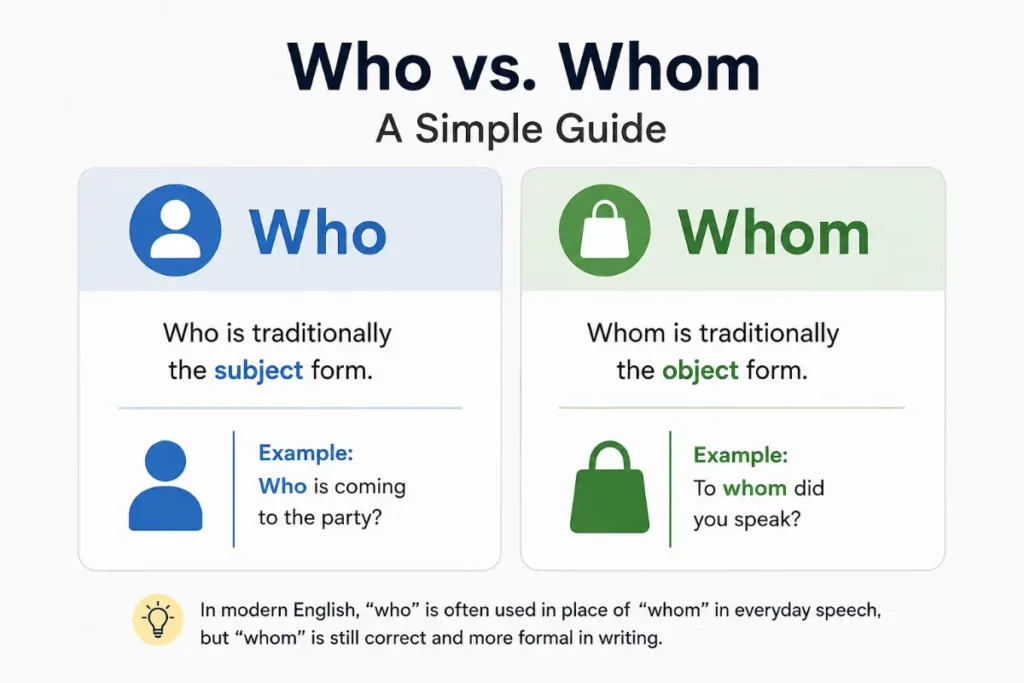
Who is normally the subject form and whom is the object form. Use who for the person doing an action and whom for the person receiving an action or following a preposition in formal writing. In everyday American English who is often preferred even in places where traditional grammar would recommend whom.
Table Of Contents
- What Who Means
- What Whom Means
- The Main Grammar Rule
- The Fastest Way To Choose
- Who In Questions
- Whom In Questions
- Who In Relative Clauses
- Whom In Relative Clauses
- Prepositions And Whom
- Who In Everyday American English
- Formal And Informal Usage
- Who And Whom In Professional Writing
- Common Mistakes
- Tricky Sentences
- Memory Tricks
- Pronunciation
- Word Origin
- Related Pronouns
- Real Life Examples
- Expert Grammar Guidance
- Frequently Asked Questions
- Key Takeaways
- Conclusion
What Who Means
Who is a pronoun used to refer to a person or people.
It can function as an interrogative pronoun when you ask a question.
For example:
Who opened the door?
The question asks for the identity of the person who performed the action.
Who called this morning?
Again the unknown person is performing the action.
Who can also function as a relative pronoun.
The woman who called left a message.
Here who refers to the woman and acts as the subject of called.
Cambridge Dictionary explains that who is used as a question word and as a relative pronoun for people.
The easiest way to think about who is this.
Who usually stands for he she they or another subject pronoun.
Compare:
He called me.
Who called me?
The structure matches.
That gives you a powerful test that works in many sentences.
What Whom Means
Whom is the objective form of who.
It refers to a person who receives an action or follows a preposition in formal grammar.
Compare these sentences.
She called him.
Whom did she call?
The person being called is not performing the action. That person receives the action.
Merriam Webster defines whom as the objective case of who and notes that it is traditionally used as the object of a verb or a preceding preposition.
You can think of the relationship like this.
Who equals he or she or they.
Whom equals him or her or them.
That comparison solves a surprising number of grammar questions.
The Main Grammar Rule
The traditional rule is based on grammatical case.
Who is the subject form.
Whom is the object form.
Look at these examples.
Who helped Sarah?
The unknown person performed the action of helping. Therefore who is the subject.
Whom did Sarah help?
Sarah performed the action. The unknown person received the action. Therefore whom is the object.
The same pattern appears with many verbs.
Who invited you?
Whom did you invite?
Who saw the accident?
Whom did you see?
Who contacted the manager?
Whom did the manager contact?
The difference becomes clear when you identify the person doing the action.
The Fastest Way To Choose
The easiest practical test is to replace the pronoun with he or him or she or her or they or them.
If he fits use who.
If him fits use whom.
For example:
Who called?
Test it.
He called.
That works. So who is right.
Now consider:
Whom did you call?
Test it.
You called him.
That works. So whom is the traditional grammatical choice.
Try another one.
Who sent the email?
She sent the email.
Therefore use who.
Now:
Whom did the editor hire?
The editor hired him.
Therefore whom is the traditional choice.
This replacement test is much easier than trying to memorize complicated grammar terminology.
Who In Questions
Who commonly appears at the beginning of questions when the person being identified is the subject.
Consider:
Who broke the window?
The answer might be:
James broke the window.
James performs the action. That makes the unknown person the subject.
Another example is:
Who made this cake?
The answer could be:
My sister made it.
The person performs the action of making.
Use who.
Here are more examples.
- Who called the office?
- Who wrote this letter?
- Who knows the answer?
- Who opened the gate?
- Who wants coffee?
- Who organized the event?
- Who left the package outside?
- Who told you the news?
- Who lives next door?
- Who made that decision?
In each sentence the person represented by who performs the main action.
Cambridge notes that when who is the subject of a question the sentence follows subject plus verb order without requiring an auxiliary in the usual way.
Compare:
Who called?
with:
Who did you call?
The first person performs the action.
The second person receives the action.
That small difference explains the change from who to whom in traditional grammar.
Whom In Questions
Whom appears when the person is the object of the verb.
For example:
Whom did you invite?
The subject is you.
The verb is invite.
The person receiving the action is represented by whom.
You can rewrite the sentence as:
You invited him.
The him test confirms the traditional choice.
Other examples include:
Whom are you calling?
Whom did the teacher praise?
In formal writing these constructions are grammatically traditional.
However modern American English often favors who in ordinary speech.
Merriam Webster notes that whom can sound stiff or unnatural in everyday communication and that who is standard in many situations where traditional grammar would prescribe whom.
That distinction is important.
Grammar rules describe structure.
Real language also reflects usage.
A strong editor understands both.
Who In Relative Clauses
Who commonly introduces a relative clause about a person when that person is the subject of the clause.
Consider:
The woman who called me is my neighbor.
The relative clause is:
who called me
The woman performs the action of calling.
So who is correct.
Another example:
The teacher who helped me was patient.
The teacher performed the action of helping.
Again who is the subject.
Here are more examples.
- I met a man who works at the library.
- She knows someone who can fix the computer.
- The student who won the award gave a speech.
- We thanked the nurse who helped us.
- The manager who approved the request called later.
- I spoke with the writer who created the article.
- The doctor who treated my father was kind.
- They hired an assistant who speaks Spanish.
The pattern remains consistent.
If the relative pronoun performs the action inside the clause use who.
Whom In Relative Clauses
Use whom when the person is the object inside the relative clause in formal grammar.
Consider:
The woman whom I met yesterday is a lawyer.
The clause is:
whom I met yesterday
The subject is I.
The verb is met.
The person receiving the action is the woman.
You can test it by rewriting the clause:
I met her yesterday.
Because her works the traditional form is whom.
More examples include:
The man whom we hired starts Monday.
The student whom the teacher praised smiled.
The person whom I contacted never replied.
The doctor whom she consulted recommended another test.
The editor whom they selected had years of experience.
In everyday American English many speakers would replace whom with who.
For example:
The person who I contacted never replied.
This version is extremely common and widely accepted in ordinary usage. Merriam Webster specifically notes that speakers and reputable writers often use who as an object even though traditional grammar prefers whom.
Prepositions And Whom
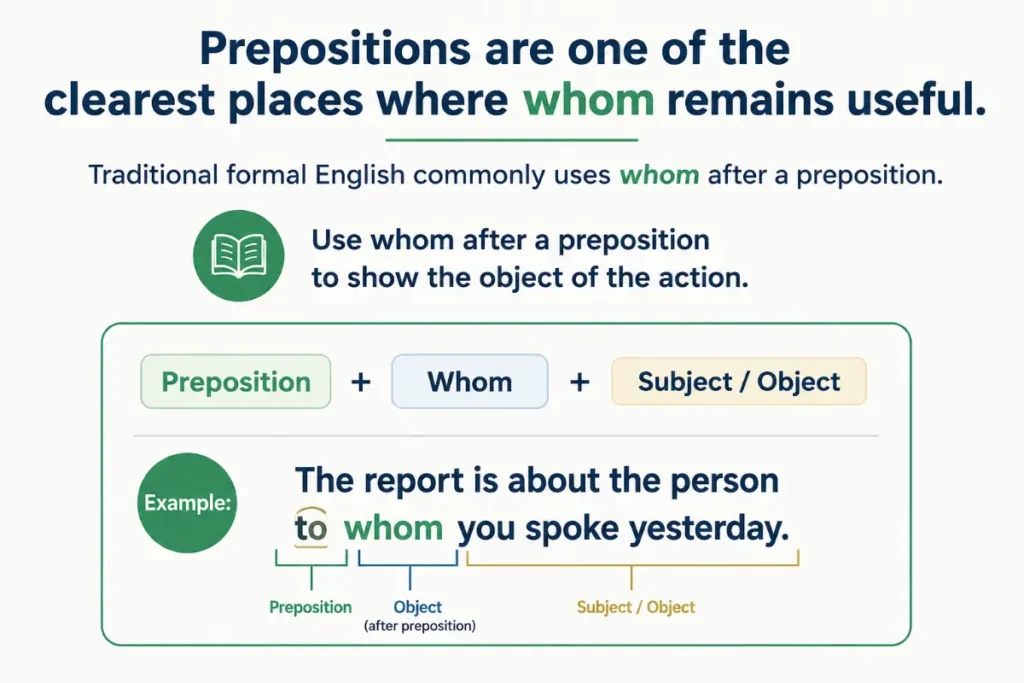
Prepositions are one of the clearest places where whom remains useful. Traditional formal English commonly uses whom after a preposition.
Examples include:
To whom did you send the letter?
With whom did you speak?
For whom was the gift intended?
From whom did you receive the message?
About whom are they talking?
The grammar is straightforward because the preposition requires an object.
You would say:
I spoke with him.
Not:
I spoke with he.
So the formal question becomes:
With whom did you speak?
Cambridge explains that whom is commonly used after prepositions in formal styles. It also notes that speakers often avoid this formal construction in ordinary conversation.
That gives us two common versions.
With whom did you speak?
Who did you speak with?
The first sounds formal.
The second sounds natural in everyday American English.
Both communicate the same basic meaning.
When The Preposition Comes At The End
English allows a preposition to appear at the end of a sentence.
This is called a stranded preposition.
For example:
Who did you speak with?
This sentence is normal English.
A more formal version is:
With whom did you speak?
You don’t need to force the preposition to the beginning simply because you want to sound educated.
In most everyday writing the first sentence sounds more natural.
Merriam Webster notes that constructions such as who did you speak to are standard even though traditional grammar may prefer to whom did you speak.
The choice depends on audience tone and purpose.
Who And Whom In Everyday American English
American English has moved strongly toward who in ordinary speech. That change doesn’t mean speakers have forgotten grammar. It reflects a broader pattern in English. Some older case distinctions have weakened over time.
The contrast between he and him remains strong.
But the contrast between who and whom is much less consistent in casual language.
You may hear:
Who did you invite?
far more often than:
Whom did you invite?
The first sounds relaxed and conversational.
The second sounds formal.
Both are understandable.
For most everyday American communication who is often the better stylistic choice when whom would sound forced.
Merriam Webster describes whom as having a distinctly formal feel and explains that who is standard in many ordinary constructions.
This is one of the most important points for modern writers.
Don’t treat every sentence as a grammar examination.
Write for the reader.
Formal And Informal Usage
The choice often reflects register.
Formal writing may favor whom.
Conversational writing often favors who.
Compare these pairs.
To whom should I address the letter?
Who should I address the letter to?
The first sounds formal.
The second sounds natural.
Another pair:
With whom were you traveling?
Who were you traveling with?
Again the first has a formal tone.
The second sounds conversational.
There are situations where the formal version makes sense.
A legal document may use whom.
A formal invitation may use whom.
An academic paper may use whom when the formal structure fits.
A casual email usually doesn’t need it.
The key is not to confuse formal grammar with better writing. A sentence can be grammatically traditional and still sound unnatural for its context.
Who And Whom In Professional Writing
Professional writers should think about clarity first.
Suppose you’re writing:
Please let me know whom I should contact.
This is grammatically traditional and sounds polished.
You could also write:
Please let me know who I should contact.
The second version is common in modern American English and sounds less formal.
Now consider:
To whom it may concern.
This is a fixed formal expression. It remains common in letters and formal correspondence.
Replacing it with:
To who it may concern.
would sound incorrect and awkward.
This shows why memorizing a single rule is not enough. English contains established phrases that have their own usage patterns.
A good editor recognizes those patterns.
Who vs Whom In Complex Sentences
Long sentences can make the choice difficult because the pronoun may sit far away from the verb that determines its grammatical role.
Consider:
Who do you think will win the election?
The correct traditional analysis uses who because the pronoun is the subject of will win.
The sentence contains another verb.
Do you think
That extra verb can make the sentence look confusing.
Simplify it:
Who will win the election?
Now the answer is obvious.
The same method works in complicated sentences.
Find the clause that contains the pronoun.
Then identify its subject and verb.
Ask what role the pronoun plays in that clause.
This is much more reliable than judging the word by its position in the full sentence.
Who vs Whom In Indirect Questions
Indirect questions create another common source of confusion.
Consider:
I don’t know who called.
The pronoun is the subject of called.
So who is correct.
Now consider:
I don’t know whom she called.
The pronoun is the object of called.
Traditional grammar therefore uses whom.
The same pattern appears in direct and indirect questions.
Direct:
Who called?
Indirect:
I don’t know who called.
Direct:
Whom did she call?
Indirect:
I don’t know whom she called.
Cambridge gives examples of both direct and indirect uses and identifies whom as the object form used in formal styles.
Tricky Sentences
Some sentences deserve closer attention.
Consider:
Who do you think called?
Many writers mistakenly change who to whom because they see do you think before the pronoun.
But remove the extra phrase.
Who called?
That makes the role obvious.
The pronoun is the subject of called.
So who is correct.
Now consider:
Whom do you think she called?
Remove the extra phrase.
She called whom?
The pronoun is the object.
Traditional grammar therefore favors whom.
This technique is called stripping away the surrounding material. It lets you see the basic clause hidden inside a longer sentence.
Another Tricky Example
Consider:
Who did you say won the race?
At first glance who appears after did you say.
That might tempt you to choose whom.
But the underlying clause is:
Who won the race?
The person represented by who performed the action of winning.
Therefore who is correct.
Now compare:
Whom did you say the coach selected?
The underlying clause is:
The coach selected whom?
The person represented by the pronoun receives the action.
Traditional grammar therefore favors whom.
This method is especially helpful for writers who struggle with long relative clauses and indirect questions.
Memory Tricks
The simplest memory trick is the he and him test.
If you can replace the word with he use who.
If you can replace it with him use whom.
For example:
Who called?
He called.
So use who.
Whom did you call?
I called him.
So use whom.
You can expand the trick to other pronouns.
She becomes who.
Her becomes whom.
They becomes who.
Them becomes whom.
Another useful memory phrase is:
Who does. Whom receives.
It isn’t a complete grammar lesson but it captures the central distinction.
Pronunciation
Who is pronounced /huː/ in standard English.
It sounds like hoo.
Whom is pronounced /huːm/.
The main difference is the final m sound.
Say them slowly.
Who
Whom
The pronunciation makes the grammatical relationship easier to hear in some sentences.
However pronunciation doesn’t tell you the grammatical role. You still need to examine the sentence.
Word Origin
The difference between who and whom has deep historical roots.
Merriam Webster traces whom to Middle English and Old English hwām, the dative form of hwā, meaning who. Its first known use dates to before the twelfth century.
The modern distinction reflects an older case system in English.
Earlier stages of English had more grammatical case forms than modern English does. Over time many of those distinctions disappeared.
English still preserves several important pronoun contrasts.
Consider:
I and me.
He and him.
She and her.
They and them.
Who and whom.
The last pair has weakened more than the others in everyday speech.
That historical change helps explain why whom can sound formal today.
Who And Whom Compared With Other Pronouns
The easiest way to understand the distinction is to compare it with familiar personal pronouns.
| Subject | Object |
|---|---|
| I | me |
| he | him |
| she | her |
| we | us |
| they | them |
| who | whom |
The pattern becomes much clearer.
We say:
She called him.
Not:
Her called he.
Likewise traditional grammar gives us:
Who called whom?
The first pronoun performs the action.
The second receives it.
This is one of the cleanest examples of grammatical case in modern English.
Who And Whom In Relative Clauses With Prepositions
Consider:
The person with whom I worked was helpful.
Here whom follows the preposition with.
The sentence sounds formal.
A conversational version would be:
The person who I worked with was helpful.
An even more relaxed version could be:
The person I worked with was helpful.
English gives writers several options.
The first emphasizes formal grammatical structure.
The second sounds natural in everyday American English.
The third removes the relative pronoun entirely because the meaning remains clear.
That flexibility is one reason English can feel confusing. The language allows several structures for the same basic idea.
When Whom Sounds Natural
Although whom can sound formal it hasn’t disappeared.
It remains natural in several contexts.
- To whom it may concern is a familiar formal expression.
- With whom works naturally in formal writing.
- For whom often appears in polished prose.
- Whomsoever and related formal forms can appear in legal or highly formal language.
- Formal relative clauses may retain whom for grammatical precision.
Cambridge specifically notes that whom is more common in writing than speaking and appears especially in formal styles.
When Who Is Better
Use who when it is the subject.
Also consider who when the traditional object form would sound stiff in ordinary American English.
For example:
Who did you talk to?
This sounds natural.
To whom did you talk?
This sounds formal.
Neither sentence is mysterious to a fluent reader. The difference is primarily grammatical formality and register.
In a casual email the first version is usually the better choice.
In a formal letter the second may fit better.
Good writing isn’t about showing that you know an obscure rule. It is about making the sentence sound right for its audience.
Common Mistakes
Using Whom For Every Person
Some writers believe whom sounds more educated so they insert it wherever a person is mentioned.
That doesn’t work.
Consider:
Whom called you?
This is incorrect in traditional grammar because the person represented by the pronoun performs the action.
The correct form is:
Who called you?
Don’t choose whom simply because the sentence sounds formal.
Using Who In Every Sentence
The opposite mistake is also common.
Some writers assume whom has disappeared completely.
That isn’t accurate.
Whom remains standard in formal structures and after prepositions.
For example:
To whom did you send the letter?
is a valid formal construction.
Confusing Subject And Object
This is the central mistake.
Writers often look only at the position of the pronoun.
Instead look at its grammatical role.
Ask:
Who performs the action?
Who receives the action?
That distinction matters more than where the word appears.
Choosing By Sound Alone
Sometimes a sentence sounds natural with who even though formal grammar traditionally recommends whom.
That happens because everyday English has changed.
Sound can tell you how natural a sentence feels but it doesn’t always tell you the traditional grammatical analysis.
For careful editing check both grammar and register.
Adding Whom After A Preposition Automatically
A preposition often makes whom appropriate in formal English.
But don’t assume every sentence needs a formal rewrite.
Compare:
Who are you talking to?
To whom are you talking?
The first is natural in ordinary conversation.
The second is formal.
Both have a place.
Who vs Whom In Modern Usage
The traditional rule remains useful but modern usage has changed the balance.
Cambridge says whom is used as the object form in formal styles and notes that it isn’t commonly used in speech.
Merriam Webster goes further by pointing out that who is widely used as an object by speakers and reputable writers.
This means modern English has two overlapping systems.
The traditional system preserves the subject and object distinction.
The everyday system often uses who for both roles.
You can see this in ordinary conversation.
Who did you see?
Most American speakers would find this completely natural.
Whom did you see?
This is grammatically traditional but noticeably formal.
That doesn’t make the second sentence wrong. It simply gives it a different tone.
Professional Editing Advice
When editing a sentence involving who or whom, don’t make the decision mechanically.
First identify the grammatical role.
Second consider the register.
Third consider the audience.
Fourth read the sentence aloud.
If the sentence is formal and the object form fits naturally then whom can add precision.
If the sentence is conversational and whom sounds stiff then who may be the better editorial choice.
For example:
The candidate whom we interviewed was impressive.
This is polished and traditional.
The candidate who we interviewed was impressive.
This is common and natural in American English.
The candidate we interviewed was impressive.
This is even more concise.
All three communicate the same basic idea.
The best choice depends on context.
Related Grammar And Usage Notes
Whoever
Whoever generally means any person who or no matter who.
Example:
Whoever arrives first can choose a seat.
The pronoun is the subject of arrives.
Whomever
Whomever is the traditional object form of whoever.
Example:
Choose whomever you prefer.
However modern usage often favors whoever even in object positions. Merriam Webster notes that whoever is more common in both positions in actual usage.
Whose
Whose expresses possession.
Example:
Whose jacket is this?
It isn’t interchangeable with who or whom.
Cambridge identifies whose as a word used to ask about possession and to introduce relative clauses showing possession.
Who’s
Who’s is a contraction of who is or who has.
For example:
Who’s coming to dinner?
means:
Who is coming to dinner?
Don’t confuse it with whose.
That
In some relative clauses that can replace who or whom.
For example:
The person who called me left.
can become:
The person that called me left.
In some contexts the relative pronoun can also disappear.
The person I called answered.
This flexibility gives English writers several ways to avoid an awkward whom.
Real Life Examples
Everyday Conversation
Who called while I was away?
The unknown person performed the action.
Who are you going with?
This is a normal conversational construction. Traditional formal grammar could prefer whom after with but everyday American English strongly favors who here.
Workplace Communication
Please tell me whom I should contact.
This works well in formal professional writing.
A more conversational version is:
Please tell me who I should contact.
Both are widely understood.
Academic Writing
The researcher who conducted the study published the results.
The researcher received the action of interviewing in the relative clause.
Formal Correspondence
To whom it may concern.
This is a traditional fixed expression.
Casual Email
Who should I send this to?
This sounds natural and direct.
Formal Report
The consultant to whom we assigned the project completed it early.
This is more formal than the conversational:
The consultant who we assigned the project to completed it early.
How To Check A Difficult Sentence
When you’re unsure about a sentence follow these steps.
- Find the clause containing who or whom.
- Identify the verb associated with the pronoun.
- Ask who performs the action.
- If the pronoun performs the action choose who.
- If the pronoun receives the action choose whom in traditional formal grammar.
- Check for a preposition.
- Consider the tone of the sentence.
- Read the sentence aloud.
- If whom sounds unnecessarily stiff in ordinary American English consider rewriting the sentence.
- Choose the version that gives the reader the clearest and most natural sentence.
This method works better than memorizing dozens of isolated examples.
Expert Language Insight
The most useful lesson is that who and whom are not simply two words competing for the same position.
They represent grammatical roles.
Who traditionally marks the subject.
Whom traditionally marks the object.
That distinction remains valuable because it helps you understand sentence structure.
At the same time language doesn’t stand still.
Modern English has weakened the distinction in ordinary communication. Major dictionaries and grammar references recognize that who frequently appears where traditional grammar would use whom.
That is why good editing requires judgment.
If a student asks which form is grammatically traditional the answer is clear.
If a legal writer asks which form fits a formal document the answer may change again.
Grammar gives you the structure.
Context tells you how to apply it.
Key Takeaways
- Who is traditionally the subject form.
- Whom is traditionally the object form.
- Use who when the person performs the action.
- Use whom when the person receives the action in formal traditional grammar.
- The he or him test is the fastest practical way to decide.
- Use whom after a preposition in formal structures such as to whom and with whom.
- Everyday American English often uses who instead of whom.
- Who is usually more natural in casual conversation.
- Whom remains useful in formal writing and established expressions.
- Always consider grammatical role audience tone and context together.
Conclusion
The central rule behind who vs whom is simple once you focus on sentence roles. Who traditionally represents the person performing the action. Whom traditionally represents the person receiving the action. mUse the he or him test when you’re unsure. If he or she or they fits then choose who. If him or her or them fits then traditional grammar calls for whom.
Still modern American English gives writers more flexibility than older grammar rules suggest. Who is now widely used as an object in ordinary speech and writing. Whom remains useful when the tone is formal or when a traditional grammatical structure fits naturally.
Frequently Asked Questions
What is the main difference between who and whom?
Who is traditionally the subject form and whom is traditionally the object form. Use who for the person performing an action and whom for the person receiving an action. In modern American English who is also widely used as an object in everyday speech and writing.
How can I quickly tell who and whom apart?
Use the he or him test. If you can replace the pronoun with he or she or they then choose who. If him or her or them fits then traditional grammar calls for whom. For example Who called? becomes He called while Whom did you call? becomes I called him.
Is whom still grammatically correct?
Yes. Whom remains a grammatically recognized object form and is especially common in formal writing and after prepositions. However everyday American English often uses who instead. The choice depends on grammatical role as well as tone and context.
Should I say who did you call or whom did you call?
Both forms occur in modern English. Whom did you call? follows the traditional subject and object distinction because the person receives the action. Who did you call? is extremely common in everyday American English and is accepted by major usage references.
Is who always the subject?
No. Traditional grammar treats who as the subject form but modern English often uses who as an object too. For example Who did you see? is common and accepted in ordinary usage. In careful formal grammar whom did you see preserves the traditional object form.
Should I use whom after a preposition?
In formal writing whom is traditionally preferred after a preposition. Examples include with whom, for whom, and to whom. In everyday American English speakers often move the preposition to the end and use who, as in Who did you speak with? Cambridge recognizes this difference in formality.
Is who or whom correct in relative clauses?
It depends on the role of the pronoun inside the relative clause. Use who when the person performs the action, as in the woman who called. Traditional grammar uses whom when the person receives the action, as in the woman whom I called. Modern English often uses who in the second structure too.
What is the difference between who and whose?
Who identifies a person. Whose expresses possession. For example Who owns this car? asks for the person’s identity while Whose car is this? asks who the car belongs to. Who’s is different again because it is a contraction of who is or who has.
Is whom more formal than who?
Yes. Whom generally has a more formal tone in modern American English. It remains useful in formal writing and fixed expressions such as to whom it may concern. In everyday speech many people prefer who because it sounds more natural and less stiff.
Why does whom sound old fashioned?
English has gradually lost many of its older case distinctions. Whom survives as an object form but speakers use it much less often than who. As a result whom can sound formal or old fashioned in casual conversation even though it remains grammatically valid. Merriam Webster records this shift in modern usage.
Is who did you speak to grammatically correct?
Yes. Who did you speak to? is a normal modern English sentence and is especially natural in conversation. Traditional formal grammar may prefer To whom did you speak? Both structures are understood. The first is usually the better choice when the goal is relaxed and natural American English.
What is the easiest rule for who vs whom?
Remember who does and whom receives. If the person performs the action choose who. If the person receives the action choose whom in traditional grammar. Then consider the level of formality because modern English frequently uses who for objects in everyday communication.

English Grammar & Usage
Nathan Holloway is an American grammar writer and language researcher who specializes in English grammar, sentence structure, verb usage, and common writing mistakes. He enjoys breaking down confusing grammar rules into practical explanations with clear examples, making English easier for students, professionals, and everyday writers.