
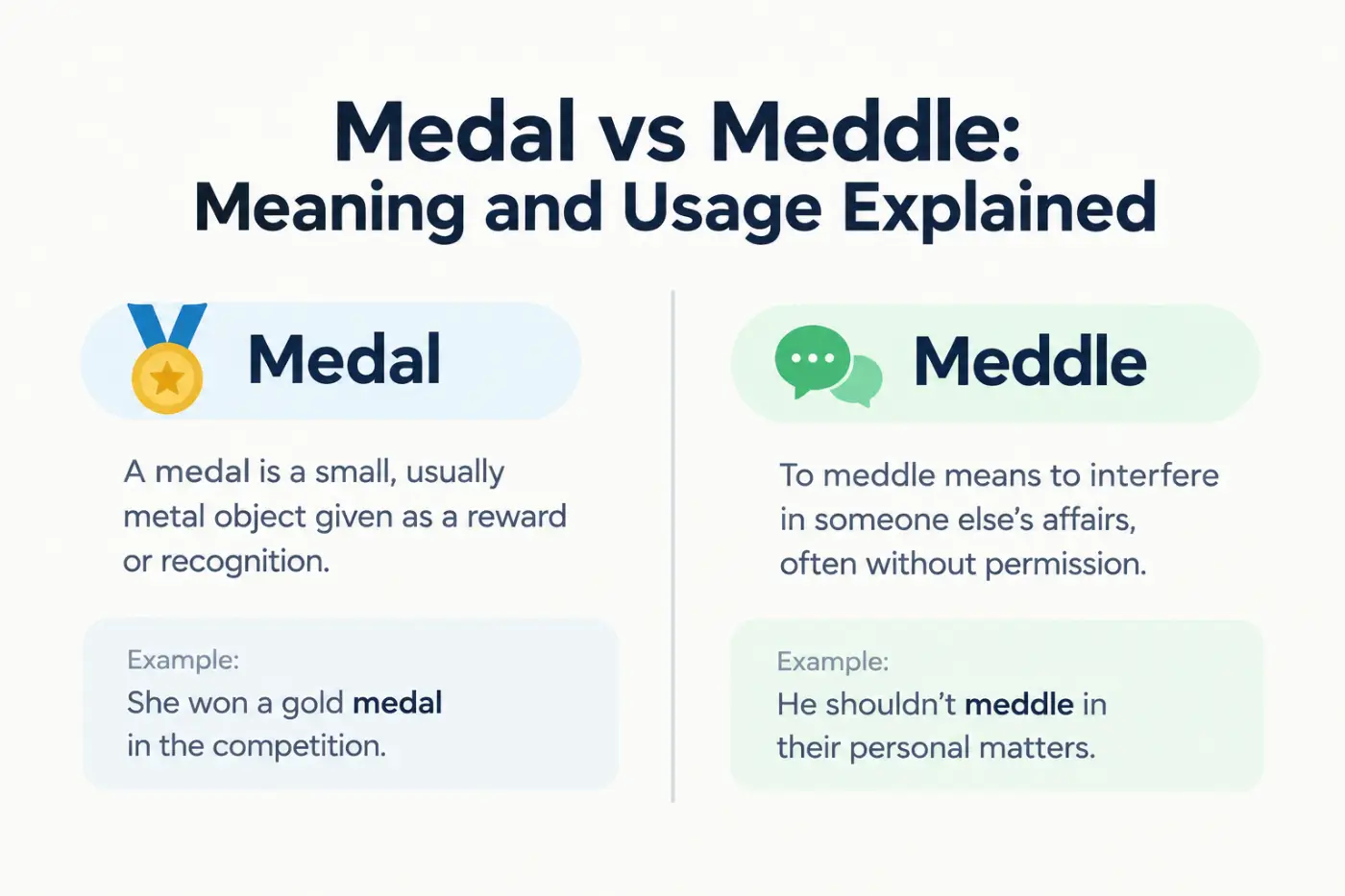
Medal vs meddle can confuse English learners because both words begin with the same three letters and have similar spelling patterns. Their meanings, grammatical roles, and pronunciations are different. Medal refers to an award or commemorative object. Meddle describes unwanted interference in a situation or another person’s affairs.
The difference becomes much easier once you connect each word with a familiar situation. An athlete might receive a medal after winning a race. A curious neighbor might meddle in a family disagreement. One word represents recognition. The other describes interference.
This guide explains the difference in plain American English. You will learn how to use each word correctly, how to pronounce them, where they came from, common mistakes to avoid, and simple ways to remember which word belongs in a sentence.
Short Answer
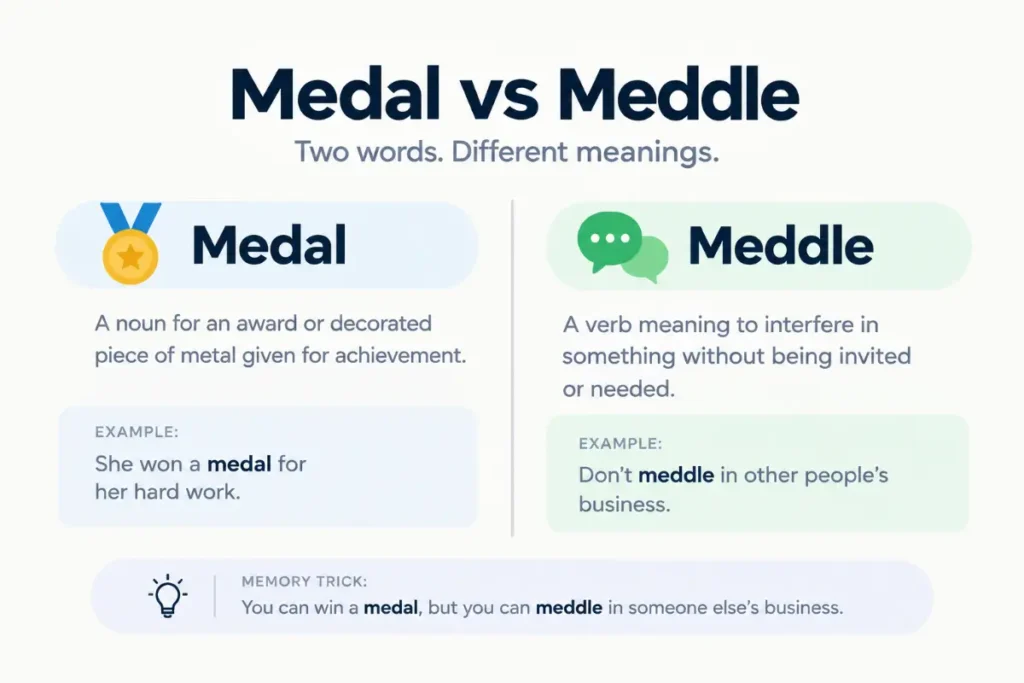
Medal vs meddle compares two words that sound different and have completely different meanings. Medal is a noun for an award or decorated piece of metal given for achievement. Meddle is a verb meaning to interfere in something without being invited or needed. The easiest memory trick is simple: you can win a medal, but you can meddle in someone else’s business.
Table of Contents
- The basic difference.
- What medal means.
- What meddle means.
- Medal and meddle pronunciation.
- Medal vs meddle in a comparison.
- How to use medal in a sentence.
- How to use meddle in a sentence.
- Medal as a verb.
- Common mistakes.
- Memory tips.
- Related words and expressions.
- American and British English usage.
- Formal and informal usage.
- Professional writing tips.
- Frequently asked questions.
- Key takeaways.
- Conclusion.
The Basic Difference
The simplest way to remember the difference is this.
Medal is mainly a noun. It names an object that represents an achievement, honor, victory, or distinction.
Meddle is a verb. It describes interfering in something that does not concern you or that you should leave alone.
Consider these two sentences.
Maria won a gold medal.
The word medal identifies the award Maria received.
Maria told her brother not to meddle in her personal affairs.
The word meddle describes unwanted interference.
The two words belong to different grammatical categories in their most common uses. That difference provides a useful clue when you are unsure which spelling fits your sentence.
What Medal Means
A medal is a usually flat piece of metal made to honor a person or commemorate an event. Medals often carry an image, inscription, symbol, or design.
Athletes receive medals at sporting competitions. Military personnel can receive medals for service or acts of bravery. Organizations can award medals for academic, artistic, scientific, or public achievements.
Here are a few common examples.
The swimmer received a gold medal.
This means the swimmer earned an award for outstanding performance.
His grandfather kept his military medals in a wooden box.
Here medal refers to physical awards connected with military service.
The museum displayed a medal from the nineteenth century.
In this sentence, the medal has historical and commemorative value.
The word can also describe the award itself rather than the physical object. For example, someone might say that an athlete won a medal even when the main focus is the achievement rather than the piece of metal.
Common Types of Medals
Medals appear in many settings.
- Gold medal. This commonly represents first place in a competition.
- Silver medal. This commonly represents second place.
- Bronze medal. This commonly represents third place.
- Military medal. This recognizes military service or a particular achievement.
- Commemorative medal. This marks an important event or occasion.
- Academic medal. This recognizes outstanding academic performance.
- Honor medal. This recognizes exceptional achievement or service.
The exact meaning of a medal depends on the institution or event that awards it.
What Meddle Means
Meddle means to interfere in something without having a useful reason, proper authority, or invitation.
The word often carries a negative feeling. Someone who meddles usually gets involved in matters that are not their responsibility.
For example.
Don’t meddle in their marriage.
The speaker is telling someone to stay out of another couple’s personal relationship.
He always meddles in office politics.
This suggests that he gets involved in workplace matters that do not require his involvement.
My aunt means well, but she tends to meddle.
The sentence suggests that the aunt may have good intentions while still interfering too much.
Meddle can also describe interference with an activity, process, or system.
The technician warned us not to meddle with the equipment.
Here the word means to interfere with or tamper with something.
Common Patterns With Meddle
It often appears with the preposition in.
meddle in someone’s affairs
meddle in someone’s business
It can also appear with with.
meddle with the settings
meddle with the machine
The choice depends on the situation. Meddle in commonly refers to interference in people’s affairs or situations. Meddle with often refers to interfering with an object, system, arrangement, or process.
Medal vs Meddle in a Comparison
| Word | Common part of speech | Main meaning | Typical use | Example |
|---|---|---|---|---|
| Medal | Noun | An award or commemorative object | Achievements and honors | She won a medal. |
| Medal | Verb | To win or earn a medal | Sports and competitions | He medaled at the championship. |
| Meddle | Verb | To interfere unnecessarily | Personal affairs and situations | Don’t meddle in their dispute. |
| Meddle | Verb | To interfere with something | Objects and systems | Don’t meddle with the controls. |
The central distinction is simple. A medal is connected with achievement. Meddle is connected with interference.
Medal vs Meddle Pronunciation
Pronunciation provides another useful clue.
Medal is commonly pronounced /ˈmedəl/.
The first syllable receives the main stress. The second syllable has a relaxed vowel sound.
Meddle is commonly pronounced /ˈmedəl/ as well.
In standard American English the two words are typically pronounced the same. That makes them homophones in common speech.
This point explains why spelling causes trouble. You may hear someone say the word without knowing which spelling they mean. Context then becomes essential.
For example.
She won a medal.
The context of winning an award makes the spelling clear.
Don’t meddle in my business.
The context of unwanted interference makes the other spelling clear.
Because the words can sound identical in everyday American pronunciation, learning the meaning and grammar of each word is more useful than trying to hear a difference that may not exist.
How to Use Medal in a Sentence
Use medal when you are talking about an award or an achievement represented by an award.
The runner won a gold medal.
The sentence says that the runner achieved first place or received a gold award.
She proudly wore her medal after the ceremony.
Here the word refers to the physical object given to her.
The coach congratulated every athlete who earned a medal.
The word refers to recognition earned through competition.
His medal hangs above his desk.
This sentence focuses on the physical award.
Medal as a Verb
Medal can also function as a verb in American English. In this use it means to win or earn a medal in a competition.
The young swimmer medaled in two events.
The sentence means the swimmer earned medals in two events.
She hopes to medal at the national championships.
This means she hopes to earn a medal at the competition.
This use is especially common in sports reporting and sports conversations. The noun remains much more familiar to most speakers.
When used as a verb, medal can take forms such as medaled and medaling.
The team medaled three times.
Several athletes are medaling in different events.
Some style guides and publications may use different preferences for verb forms. In American English, medaled and medaling are widely used.
How to Use Meddle in a Sentence
Use meddle when someone interferes in something that does not require their involvement.
Please don’t meddle in my personal life.
The speaker wants the other person to stay out of private matters.
Her parents tried not to meddle in her career decisions.
The sentence suggests that the parents avoided unnecessary interference.
He has a habit of meddling in other people’s arguments.
The word describes repeated interference.
Don’t meddle with the settings unless you know what they do.
Here the word refers to interfering with a system or arrangement.
Meddle often suggests that the interference creates problems or crosses a boundary. The word can describe someone who means well but still causes trouble by getting involved.
Why These Words Are Easy to Confuse
The spelling creates the first problem. Both words begin with med and contain a similar vowel pattern.
The pronunciation creates an even bigger problem. In common American English pronunciation, medal and meddle are homophones. They sound alike even though they have different spellings and meanings.
Context solves the problem.
If the sentence involves an award, competition, honor, or achievement, use medal.
If the sentence involves interference, unnecessary involvement, or tampering, use meddle.
Compare these examples.
The athlete received a medal.
This involves recognition.
The athlete told the reporter not to meddle in his private life.
This involves interference.
The surrounding words usually make the intended meaning obvious.
Common Mistakes
Many spelling mistakes happen because writers choose the word based only on sound. Since medal and meddle can sound identical, that strategy fails.
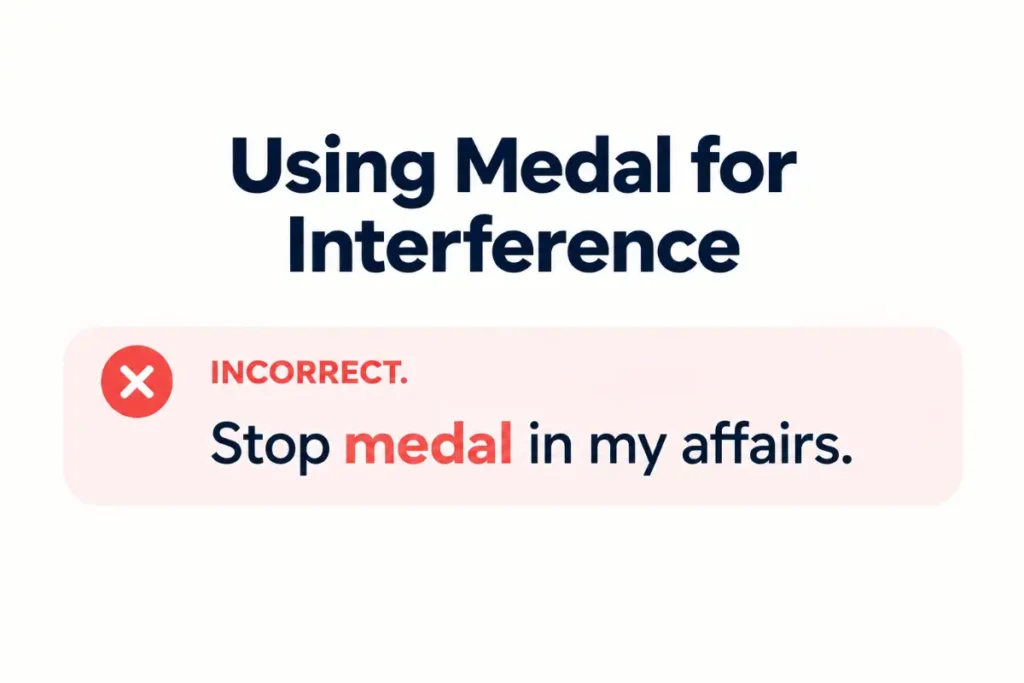
Using Medal for Interference
Incorrect.
Stop medal in my affairs.
Correct.
Stop meddling in my affairs.
Meddle is the verb that describes interference. Its present participle is meddling.
Using Meddle for an Award
Incorrect.
She won a silver meddle.
Correct.
She won a silver medal.
Medal is the word for the award.
Confusing Meddle With Meddling
The base verb is meddle.
The present participle and gerund form is meddling.
Correct examples include.
Don’t meddle in their relationship.
He keeps meddling in their relationship.
The spelling changes because the final e drops before the ing ending.
Confusing Meddle With Mix Up
Meddle does not simply mean to make a mistake or become confused.
If someone accidentally puts two documents in the wrong order, you might say they mixed them up.
If someone deliberately or unnecessarily interferes with the documents, you might say they meddled with them.
That distinction matters because meddle often carries an idea of inappropriate involvement.
Memory Tips
A good memory trick can make the difference stick.
Think of a medal as something you make a memory with after an achievement. The words do not share an exact spelling pattern, but the association can help you remember that medal relates to recognition.
For meddle, think of someone who cannot leave things alone. A meddling person keeps getting involved.
You can also remember this short contrast.
Medal means award.
Meddle means interfere.
Another useful clue is grammar.
If you can put a before the word, medal may fit.
a medal
If you can put to before the word, meddle may fit.
to meddle
This is not a universal grammar test for every sentence, but it works well for the basic distinction.
Related Words and Expressions
Understanding related words can strengthen your vocabulary.
Medal
Words associated with medal include award, prize, honor, decoration, trophy, distinction, and achievement.
These words do not all mean exactly the same thing.
A trophy is usually a larger physical award. A prize can be money, an object, or another form of recognition. A medal is specifically a decorated piece of metal or the honor represented by it.
Meddle
Words related to meddle include interfere, intrude, intervene, tamper, butt in, and interfere unnecessarily.
These words also differ slightly.
Interfere is broader and can describe many kinds of unwanted involvement.
Intrude often suggests entering someone’s private space or affairs.
Tamper often means interfering with something in a way that could damage or alter it.
Butt in is informal and often describes interrupting or inserting yourself into a conversation or situation.
Meddling
Meddling is the noun or participle form associated with meddle.
His meddling caused more problems.
Here meddling functions as a noun.
She was tired of her brother’s meddling.
Again, the word describes unwanted interference.
American and British English Usage
Medal and meddle have the same core meanings in American and British English.
The pronunciation can vary slightly by regional accent, but many speakers in both varieties pronounce the two words alike.
The verb medal is also used in sports contexts in both varieties of English. Sports writers may use it to describe an athlete who wins a medal.
The spelling does not normally change between American and British English.
That makes this pair different from words such as color and colour. You do not need a separate American spelling for medal or meddle.
Formal and Informal Usage
Medal is neutral and appropriate in casual, academic, journalistic, and professional writing.
The university awarded her a medal for academic excellence.
Meddle is also standard English, but it can sound critical because it often describes unwanted behavior.
Employees should not meddle with security settings without authorization.
In casual speech, people may use expressions such as butt in or stick your nose into something to express a similar idea.
Meddle works well in formal writing when you need to describe inappropriate interference clearly.
For example.
The committee should not meddle in matters outside its authority.
The wording is firm without sounding excessively informal.
Professional Writing Tips
Professional writers should choose the word based on meaning rather than pronunciation.
When discussing awards, use medal.
The researcher received a medal for outstanding contributions to science.
When discussing interference, use meddle.
Managers should avoid meddling in decisions that belong to individual departments.
Context also matters in business writing. Meddle can sound judgmental, so consider the strength of the statement before using it.
If you need a neutral tone, interfere or become involved may sometimes work better.
Compare these sentences.
The director meddled in the team’s internal decisions.
This sounds critical.
The director became involved in the team’s internal decisions.
This sounds more neutral.
The best word depends on the writer’s intended meaning and tone.
Real Life Examples
Real situations make the distinction easier to remember.
Sports
Jordan won a bronze medal in the swimming competition.
The word medal refers to the award Jordan earned.
The coach told the media not to meddle in the athlete’s private affairs.
The word meddle refers to unwanted involvement.
Family
Grandma proudly displayed her medal from a community race.
The medal represents an achievement.
My relatives should not meddle in our financial decisions.
The speaker wants relatives to stay out of a private matter.
Workplace
The employee received a medal for years of public service.
The medal represents recognition.
A manager should not meddle in every minor decision.
The word describes unnecessary interference.
Technology
The museum displayed a medal created for an early technology exhibition.
The word names a commemorative object.
Don’t meddle with the network settings.
The word means to interfere with the settings.
Education
The student earned a medal for academic excellence.
The medal represents achievement.
Parents should guide their children without meddling in every school decision.
The sentence distinguishes helpful support from excessive interference.
Similar Confusing Word Pairs
English contains many words that sound alike or look similar but have different meanings.
Medal and meddle are homophones in common American pronunciation.
Other familiar examples include principal and principle, stationary and stationery, affect and effect, and accept and except.
The solution is the same in each case. Learn the meaning and grammatical function instead of relying only on sound.
For medal and meddle, the contrast is especially straightforward.
Medal connects to achievement.
Meddle connects to interference.
Once that association becomes familiar, the spelling becomes much easier.
A Quick Grammar Test
When you are unsure which word belongs in a sentence, try replacing it with a simpler word.
If the replacement is award, use medal.
She won an award.
Therefore.
She won a medal.
If the replacement is interfere, use meddle.
Don’t interfere in their affairs.
Therefore.
Don’t meddle in their affairs.
This substitution method works because it focuses on meaning instead of sound.
You can also look at the word’s role in the sentence.
If it names an object or honor, medal is likely correct.
If it describes an action involving unwanted interference, meddle is likely correct.
How to Choose the Right Word Quickly
When writing quickly, ask yourself one simple question.
Are you talking about an achievement or interference.
For an achievement, choose medal.
For interference, choose meddle.
Then check the grammar.
A medal works as a noun.
To meddle works as a verb.
This two step check takes only a moment and prevents most errors.
Key Takeaways
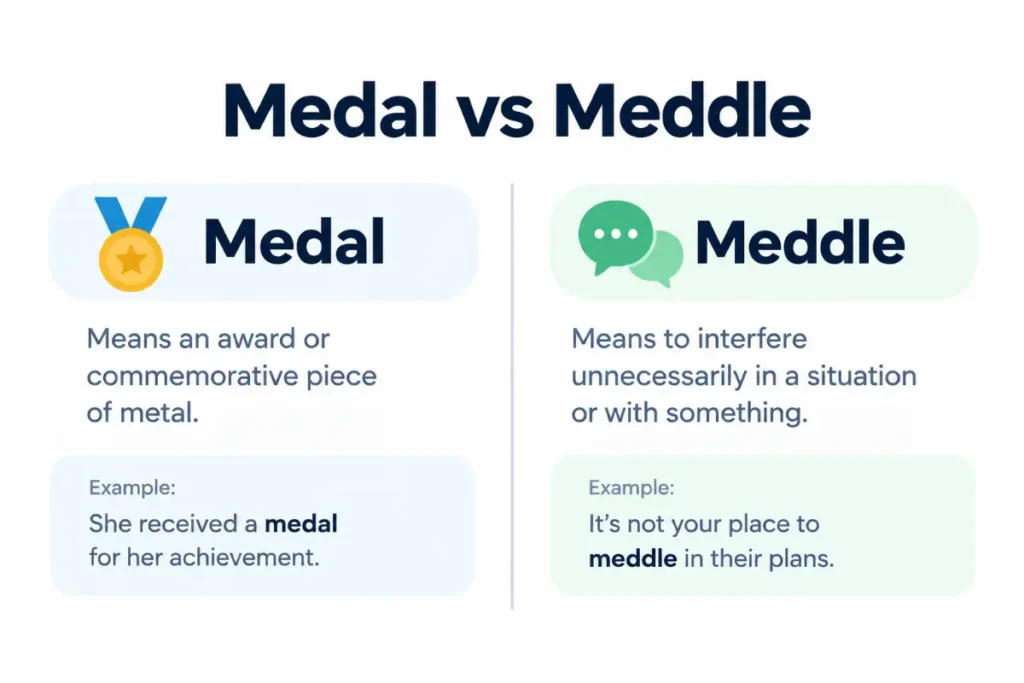
- Medal means an award or commemorative piece of metal.
- Meddle means to interfere unnecessarily in a situation or with something.
- The two words are commonly pronounced alike in American English.
- Medal is mainly a noun but can also work as a verb in sports writing.
- Meddle is a verb.
- Use meddle in for interference in people’s affairs or situations.
- Use meddle with for interference with objects, systems, or processes.
- Use context to choose the correct spelling when the words sound alike.
- Remember the simple connection: medal relates to achievement and meddle relates to interference.
Conclusion
Medal vs meddle becomes easy once you connect each word with its meaning. A medal is an award that recognizes achievement. Meddle means to interfere in something without a good reason or proper role. Although the two words commonly sound alike in American English, their meanings are miles apart.
The best way to remember the distinction is to focus on the situation. If someone wins an award, that person receives a medal. If someone gets involved in another person’s affairs without being invited, that person may be meddling. Grammar provides another useful clue because medal usually acts as a noun while meddle acts as a verb.
Keep the core contrast in mind and you will rarely confuse these words again. Think achievement when you see medal and interference when you see meddle. That simple association gives you the right spelling and meaning in most everyday writing.
Frequently Asked Questions
What is the difference between medal and meddle?
Medal means an award or commemorative piece of metal. Meddle means to interfere in something that is not your responsibility or that does not require your involvement. They can sound the same in American English but have different spellings and meanings.
Are medal and meddle homophones?
Yes. In common American English pronunciation, medal and meddle are pronounced alike or extremely similarly. Their different meanings come from their spelling and context.
Is medal a noun or a verb?
Medal is most commonly a noun. It can also function as a verb in sports contexts. For example, an athlete can medal at a championship, meaning the athlete earns a medal.
Is meddle always negative?
Meddle usually has a negative meaning because it suggests unnecessary or unwanted interference. Someone can have good intentions and still meddle, but the word usually signals that the involvement crosses a boundary.
What does meddle in mean?
Meddle in means to interfere in a situation or another person’s affairs. Common examples include meddling in family matters, meddling in a dispute, and meddling in someone’s personal life.
What does meddle with mean?
Meddle with means to interfere with an object, system, arrangement, or process. For example, a technician might tell someone not to meddle with machine settings.
Can you say someone meddled with a machine?
Yes. Meddled with is correct when someone interferes with a machine, device, system, or similar object.
Can you say someone meddled in a relationship?
Yes. Meddled in is natural when someone interferes in another person’s relationship or private affairs.
What is the correct spelling for a sports award?
The correct spelling is medal. For example, an athlete can win a gold medal, silver medal, or bronze medal.
What is the difference between meddle and interfere?
Meddle and interfere are close in meaning. Meddle often suggests unnecessary involvement and can sound more critical. Interfere is broader and can describe many kinds of unwanted involvement.
Is medal spelled differently in British English?
No. The standard spelling is medal in both American and British English. The word has the same basic meaning in both varieties.
Is meddle a formal word?
Yes. Meddle is a standard English verb and can appear in formal writing. It often has a critical tone because it describes inappropriate or unnecessary interference.

Confusing Words, Spelling & Word Choice
Claire Whitmore is a U.S.-based English editor who writes about commonly confused words, spelling differences, and word choice. Her work helps readers understand subtle distinctions between similar-looking words through simple definitions, practical examples, and modern usage guidance in both American and British English.