
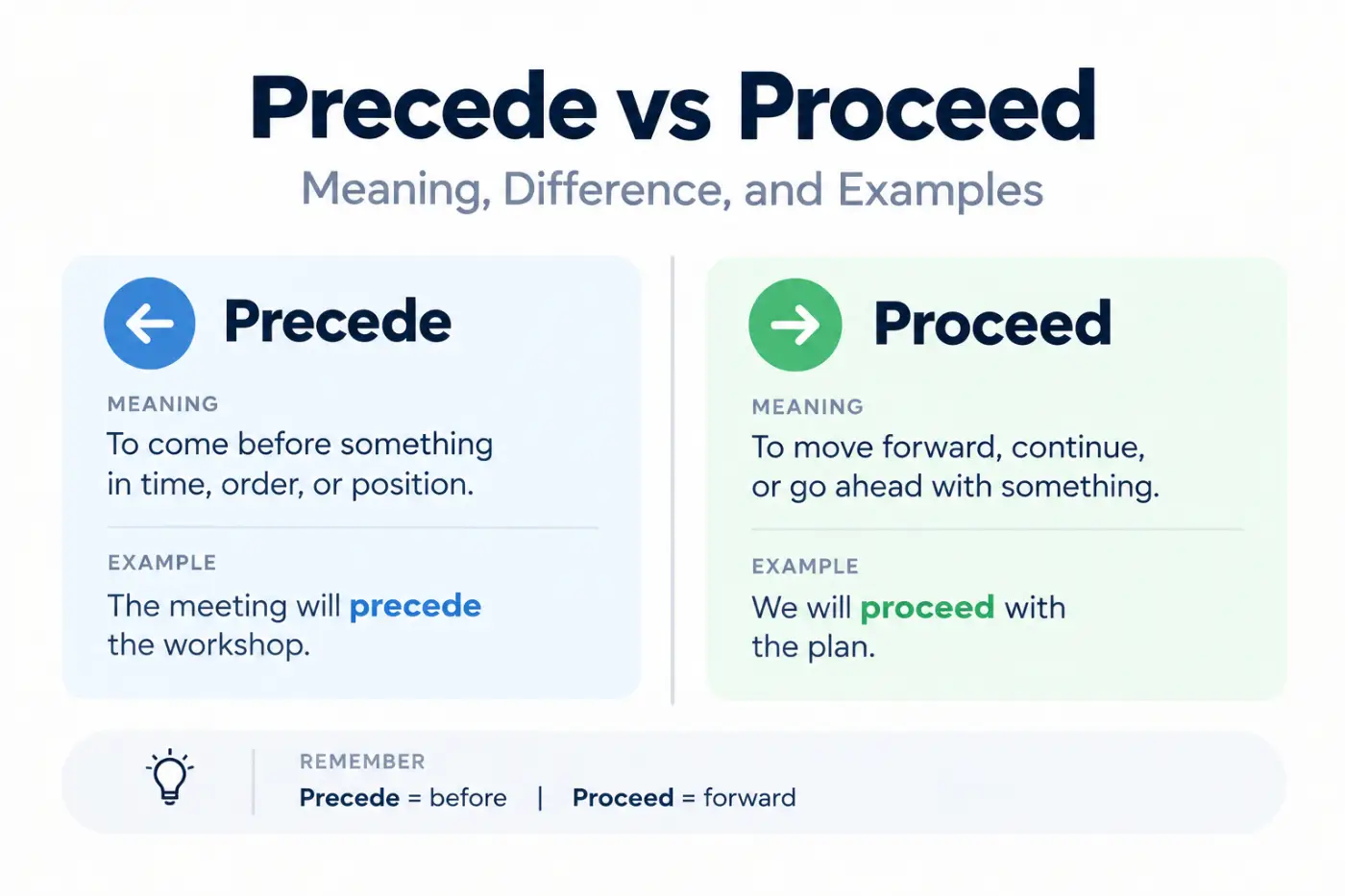
Precede vs proceed can be confusing because both words contain the same ending and both relate to movement or order. They also sound very similar. The key difference is direction. Precede describes something that comes before another thing. Proceed describes movement or action that continues forward.
Precede comes from a Latin root connected with going before. Proceed comes from a Latin root connected with going forward. That distinction still shapes their modern meanings. Once you connect each word with its basic direction, the difference becomes much easier to remember.
These words appear often in school writing, workplace communication, legal documents, instructions, news reports, and everyday conversation. Knowing the difference helps you write with precision. A single wrong word can change the meaning of an otherwise clear sentence.
Short Answer
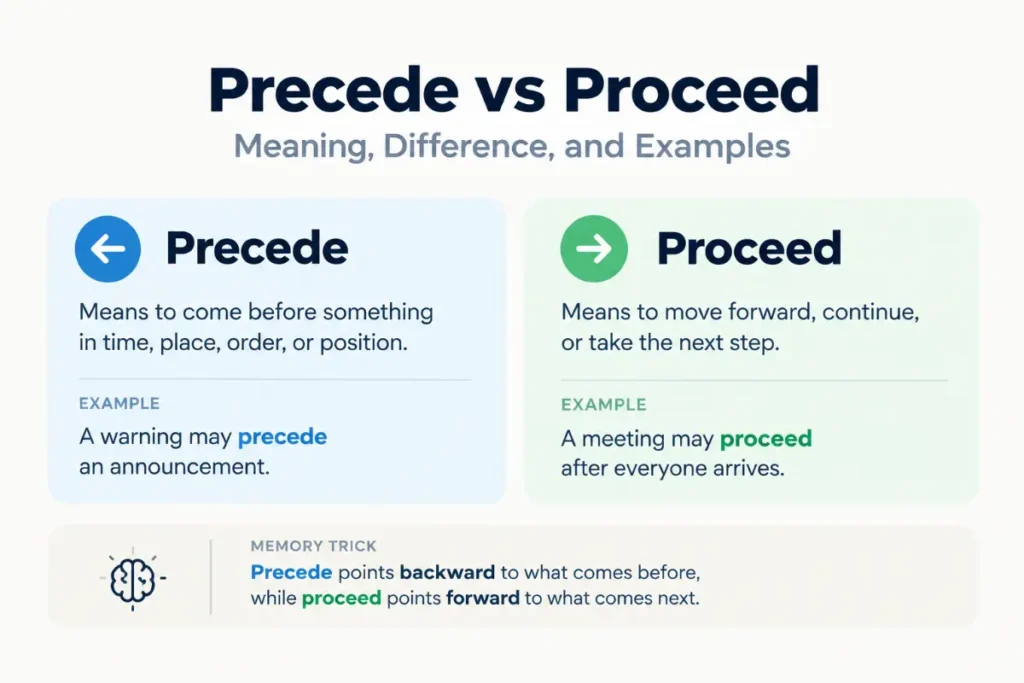
Precede means to come before something in time, place, order, or position. Proceed means to move forward, continue, or take the next step. For example, a warning may precede an announcement, while a meeting may proceed after everyone arrives. The easiest memory trick is simple: precede points backward to what comes before, while proceed points forward to what comes next.
Table of Contents
- What Precede Means.
- What Proceed Means.
- Precede vs Proceed.
- How to Use Precede Correctly.
- How to Use Proceed Correctly.
- Pronunciation Differences.
- Grammar Patterns to Remember.
- Real Life Examples.
- Common Mistakes.
- Memory Tips.
- Related Words and Expressions.
- Professional Writing Tips.
- Frequently Asked Questions.
- Key Takeaways.
- Conclusion.
What Precede Means
Precede is a verb that means to come before something else. The thing that comes first precedes the thing that comes later. The relationship can involve time, physical position, order, rank, or sequence.
Consider this sentence.
The introduction precedes the main discussion. The introduction comes first. The main discussion comes after it. Therefore, the introduction precedes the discussion.
The word can also describe events.
A brief warning preceded the storm.
The warning happened before the storm. The sentence doesn’t necessarily say that the warning caused the storm. It only establishes the order of events.
Precede can also describe physical position.
A small sign precedes the entrance to the building.
The sign appears before the entrance as someone approaches it.
Another common use involves order in a list or sequence.
Chapter three precedes chapter four.
Chapter three comes before chapter four.
The same idea applies to people and positions.
A former director preceded the current director.
This means the former director held the position before the current director.
Precede Focuses On What Comes Before
The central idea behind precede is simple.
Something precedes another thing when it comes first.
You can think about a line of people. The person standing at the front precedes the people behind them. You can also think about a timeline. An earlier event precedes a later event.
Here are several examples.
The opening remarks preceded the ceremony.
The opening remarks came first.
A short silence preceded the announcement.
The silence happened before the announcement.
The letter preceded the phone call.
The letter came before the phone call.
The blue section precedes the green section.
The blue section appears first in the sequence.
The previous manager preceded her in the role.
The previous manager held the role before she did.
In each example, the word describes something that comes before another thing.
What Proceed Means
Proceed is a verb with several related meanings. Its main idea is to move forward or continue.
You can proceed with an activity.
Please proceed with the application.
This means continue with the application.
You can proceed to a place or stage.
After checking in, guests may proceed to the second floor.
This means they may move to the second floor.
You can proceed after a pause or interruption.
The meeting will proceed after lunch.
This means the meeting will continue after lunch.
Proceed can also describe action after someone receives permission or reaches a decision.
You may proceed with the purchase.
This means you may continue and complete the purchase.
Another common structure is proceed to plus a verb.
The speaker proceeded to explain the new policy.
The speaker continued by explaining the new policy.
This construction often appears in formal writing. However, it also works in everyday speech.
Proceed Focuses On Moving Forward
The central idea behind proceed is forward movement.
That movement can be physical or figurative.
A person can proceed down a road. A team can proceed with a project. A discussion can proceed after a break. A legal case can proceed through the court system.
The word doesn’t always mean physical movement.
The company decided to proceed with the plan.
Nobody is necessarily walking anywhere. The company is continuing with an action.
This makes proceed especially useful when you want to describe the next stage of a process.
Precede vs Proceed
Precede vs proceed becomes much easier when you focus on the direction each word expresses.
| Word | Core meaning | Main idea | Common pattern | Example |
|---|---|---|---|---|
| Precede | Come before | Earlier position or time | precede something | The speech preceded the dinner. |
| Proceed | Move forward or continue | Next action or stage | proceed with something | We proceeded with the plan. |
| Proceed | Move to a place or stage | Forward movement | proceed to something | Please proceed to the lobby. |
| Proceed | Continue after an event | Ongoing action | proceed after something | The meeting proceeded after the break. |
The easiest distinction is this.
Precede looks at what comes first.
Proceed looks at what happens next.
Suppose a ceremony begins with a speech and ends with dinner. The speech precedes the dinner. Once the speech finishes, the guests proceed to dinner.
That single example shows both words working together.
A Simple Direction Test
Ask yourself one question.
Am I talking about something that comes before something else, or am I talking about moving forward or continuing?
If the answer points to something earlier, use precede.
If the answer points to continued action or forward movement, use proceed.
For example.
The storm preceded the power outage.
The storm came first.
The crew proceeded with repairs.
The crew continued with the repairs.
This test works in most everyday situations.
How to Use Precede Correctly
Precede normally takes an object. In other words, you usually say what comes before what.
The title precedes the article.
The title comes before the article.
The announcement preceded the decision.
The announcement came before the decision.
A short introduction preceded the lecture.
The introduction came before the lecture.
Precede can also appear in passive constructions.
The announcement was preceded by a short delay.
A short delay came before the announcement.
This pattern appears frequently in formal writing.
The meal was preceded by a brief presentation.
The presentation happened first.
The ceremony was preceded by a moment of silence.
The moment of silence happened first.
Precede In Time
Precede often describes chronological order.
The discovery preceded the invention.
The discovery happened first.
Her resignation preceded the leadership change.
Her resignation happened first.
The warning preceded the accident.
The warning happened first.
Notice that precede doesn’t automatically indicate cause. If one event precedes another, that only tells you the order unless the sentence gives additional information about cause.
This distinction matters in careful writing.
Precede In Space
Precede can describe physical position.
A narrow hallway precedes the main entrance.
The hallway comes before the entrance as someone moves through the building.
A row of trees precedes the parking area.
The trees appear before the parking area.
This use is less common than the time and sequence meanings, but it is completely correct.
How to Use Proceed Correctly
Proceed works in several useful grammatical patterns.
Proceed With
Use proceed with something when you mean continue an activity or action.
We decided to proceed with the renovation.
The team proceeded with the investigation.
You can proceed with your application.
The board agreed to proceed with the proposal.
This pattern is common in business and professional writing.
Proceed To
Use proceed to when someone moves to a place or stage.
Please proceed to the front desk.
The guests proceeded to the dining room.
After the introduction, the speaker proceeded to the next topic.
The last example has a slightly different sense. The speaker moves from one stage of a discussion to another.
Proceed From
Proceed from can mean to originate from or to move from a particular place.
The trail proceeds from the village toward the lake.
The discussion proceeded from a basic question.
This structure is less common in everyday conversation but can appear in formal writing.
Proceed After
Proceed after describes continuing following an event or condition.
The team proceeded after receiving approval.
The hearing proceeded after the judge returned.
The work proceeded after the equipment arrived.
The phrase makes the sequence clear without using precede.
Pronunciation Differences
Precede and proceed have very similar sounds. The difference appears mainly in the first syllable.
Precede is commonly pronounced /prɪˈsiːd/.
Proceed is commonly pronounced /proʊˈsiːd/.
Both words have stress on the second syllable.
The ending sounds the same. The first vowel sound creates the main distinction.
This similarity explains why people sometimes confuse the words when they hear them rather than see them in writing.
It also helps to remember that proceed begins with the sound associated with pro. That connection can remind you of forward movement.
Precede begins with a different first vowel sound and connects with the idea of coming before.
Grammar Patterns to Remember
The grammar around these words provides another useful clue.
Precede usually connects two things in an order.
Something precedes something else.
For example.
The question preceded the answer.
The question came first.
Proceed often connects a person or group with an action or destination.
Someone proceeds with something.
Someone proceeds after something.
For example.
The team proceeded with the work.
The team continued the work.
These patterns make the difference easier to recognize when you’re writing quickly.
Real Life Examples
The best way to understand confusing words is to see them in natural situations.
Everyday Conversation
A short introduction preceded the meal.
The introduction happened before the meal.
Please proceed to the checkout area.
The listener should move to the checkout area.
The announcement preceded the change in schedule.
The announcement came first.
We can proceed with the plan now.
We can continue with the plan.
Workplace Writing
The review meeting preceded the final decision.
The review meeting happened before the final decision.
Once the manager approves the request, we can proceed with the project.
The team can continue the project after approval.
The initial assessment preceded the recommendation.
The assessment came first.
The department decided to proceed with the revised policy.
The department decided to continue with the revised policy.
Academic Writing
The experiment preceded the final analysis.
The experiment happened before the analysis.
The researcher then proceeded to examine the results.
The researcher moved to the next stage of the work.
A literature review often precedes the research method section.
The literature review appears first.
Travel Situations
After security screening, passengers may proceed to the gate.
Passengers should move to the gate.
A narrow path precedes the main trail.
The narrow path comes before the main trail.
Formal Situations
The hearing proceeded after the court received the required documents.
The hearing continued after the documents arrived.
The current policy was preceded by several years of discussion.
The discussion happened before the current policy.
A Practical Sentence Comparison
Seeing the two words side by side can make the distinction stick.
The introduction preceded the presentation.
The presentation proceeded after the introduction.
The warning preceded the storm.
The rescue operation proceeded after the storm passed.
The opening remarks preceded the discussion.
The discussion proceeded for another hour.
The first word establishes what came before. The second describes what continued or moved forward.
Common Mistakes
People often confuse these words because their spelling looks similar. The most common errors come from replacing one word with the other without checking the meaning.
Mistake One
Incorrect meaning.
Please precede with the application.
The intended meaning is to continue with the application. Proceed is the correct choice.
Correct sentence.
Please proceed with the application.
Mistake Two
Incorrect meaning.
The speech proceeded the ceremony.
The intended meaning is that the speech came before the ceremony. Precede is correct.
Correct sentence.
The speech preceded the ceremony.
Mistake Three
Incorrect Pattern
We will precede with the next step.
The phrase describes continuing to the next step. Proceed fits the meaning.
Correct sentence.
We will proceed with the next step.
Mistake Four
Incorrect Direction
The introduction proceeded the main section.
If the introduction comes before the main section, use precede.
Correct sentence.
The introduction preceded the main section.
Mistake Five
Confusing Proceed With Proceeds
Proceeds is related to proceed but often works as a noun.
The proceeds from the sale went to charity.
Here, proceeds means money received from a sale or event.
Proceed is the verb.
The organizers decided to proceed with the sale.
These words look closely related because they are. Their grammatical roles and meanings differ.
Memory Tips
A good memory trick should work when you’re writing under pressure.
Think Before And Forward
Precede means before.
Proceed means forward.
The first part of each word can serve as your mental cue.
Precede points to something that comes first.
Proceed points to the next step.
Think Of A Sequence
Imagine a numbered line.
Something at the beginning precedes something later in the line.
Once you move along the line, you proceed.
This mental picture works for time, events, instructions, and physical movement.
Use The Before Test
Replace the word with comes before.
If the sentence still makes sense, precede may be the right choice.
The ceremony was preceded by a speech.
The speech came before the ceremony.
Use The Continue Test
Replace the word with continue or move forward.
If that meaning works, proceed is probably correct.
We proceeded with the meeting.
We continued with the meeting.
These two quick tests can prevent most mistakes.
Related Words and Expressions
Understanding related words can strengthen your command of both terms.
Preceding
Preceding is the adjective or participle form of precede. It means coming before.
The preceding paragraph explains the main idea.
The paragraph before it explains the main idea.
The preceding year brought major changes.
The previous year brought major changes.
Proceeding
Proceeding can describe an action or process that is taking place. It can also refer to a formal legal or official process.
The proceedings continued after lunch.
The official process continued after lunch.
Proceeding can also function as the present participle of proceed.
The team is proceeding with the review.
The team is continuing with the review.
Previous
Previous means earlier or existing before something else.
The previous chapter introduced the topic.
This word often overlaps with preceding but isn’t interchangeable in every sentence.
Precede And Predecessor
A predecessor is a person who held a role before another person.
Her predecessor introduced the policy.
The predecessor came before the current person in the role.
This connection can help you remember precede.
Proceed And Procedure
Procedure refers to an established way of doing something. Proceed describes moving forward with an action.
The procedure explains the steps.
The team proceeds through those steps.
Professional Writing Tips
In professional writing, precision matters more than impressive vocabulary. Precede and proceed are useful because they express sequence and continuation clearly.
Use precede when you need to establish order.
The review preceded the approval.
Use proceed when you need to describe continuation.
The team proceeded with implementation.
Avoid using proceed simply because it sounds formal. In many cases, continue is clearer.
We proceeded with the meeting.
We continued the meeting.
Both sentences can work. The second one may sound more natural in everyday communication.
Proceed is especially useful when an action involves moving to a new stage.
The committee reviewed the proposal and proceeded to a vote.
That sentence gives the reader a clear sense of progression.
Precede is especially useful when explaining timelines.
The policy change was preceded by months of discussion.
That sentence immediately tells the reader what happened first.
Formal And Informal Usage
Both words work in American English. Proceed tends to appear more often in formal instructions and professional settings.
You might hear proceed in signs or official directions.
Please proceed to the next room.
You may proceed when ready.
Precede appears frequently in formal explanations of sequence.
The event was preceded by a short reception.
The current policy was preceded by several revisions.
In casual conversation, speakers often use simpler alternatives.
Instead of saying the meeting was preceded by a short discussion, someone might say a short discussion came before the meeting.
Instead of saying we proceeded with the work, someone might say we continued the work.
Neither choice is wrong. The best word depends on the tone and context.
American And British English
Precede and proceed are standard words in both American English and British English. Their core meanings remain the same.
The main difference isn’t regional meaning. It is context and style.
American writers use both words in academic, professional, legal, and everyday contexts. British writers do the same.
The spelling also remains the same.
So you don’t need to choose a different word based on American or British English.
Word Origins
The history of these words explains why they look so similar.
Precede comes from Latin roots associated with going before. The English word developed through French and Latin influences.
Proceed comes from Latin roots associated with moving forward or advancing.
Both words therefore contain an underlying idea of movement. The difference lies in the direction.
Precede points to what comes before.
Proceed points toward continued movement or action.
You don’t need to memorize the Latin roots to use the words correctly. Still, the history provides a useful explanation for their related forms.
Precede vs Proceed In Everyday Decision Making
When you’re unsure which word belongs in a sentence, don’t focus on spelling first. Focus on the action.
Ask what the sentence is trying to say.
If one event happened first, use precede.
If an instruction tells someone to continue, use proceed.
For example.
The safety briefing preceded the flight.
The safety briefing came first.
After the briefing, passengers proceeded to the aircraft.
Passengers moved forward to the aircraft.
This approach works because it connects the word with the meaning rather than with appearance.
When Both Words Appear Together
You can use both words in the same passage without confusion.
The introduction preceded the main presentation. After the introduction, the speaker proceeded to explain the findings.
The warning preceded the announcement. After the announcement, the staff proceeded with the evacuation.
The review preceded the vote. Once the review ended, the committee proceeded to vote.
These examples show a natural sequence.
First something precedes.
Then someone proceeds.
That pattern can become an easy mental model.
Key Takeaways
- Precede means to come before something in time, place, order, or sequence.
- Proceed means to move forward, continue, or take the next step.
- Use precede when the sentence focuses on what happened first.
- Use proceed when the sentence focuses on continued action or forward movement.
- Precede commonly takes an object. For example, the announcement preceded the meeting.
- Proceed commonly appears with with, to, or after. For example, the team proceeded with the project.
- Preceding means coming before.
- Proceeding can describe an ongoing action or a formal process.
- Proceeds is a noun that commonly means money received from a sale or activity.
- The simplest memory trick is before for precede and forward for proceed.
Conclusion
Precede vs proceed becomes much easier once you focus on direction. Precede means something comes before another thing. Proceed means someone or something moves forward, continues, or advances to the next stage.
Use precede when you’re describing order. Use proceed when you’re describing continuation or forward movement. The two words may look and sound similar, but their jobs are different.
When you’re unsure, use the simplest test. If you can replace the word with comes before, choose precede. If you can replace it with continues or moves forward, choose proceed. That small distinction will help you use both words accurately in everyday speech, academic writing, and professional communication.
Frequently Asked Questions
What is the difference between precede and proceed?
Precede means to come before something. Proceed means to move forward, continue, or take the next step. In simple terms, precede points to what comes first, while proceed points to what comes next.
Is it proceed or precede with a plan?
Use proceed with a plan. The phrase means to continue or move forward with the plan.
For example.
We decided to proceed with the plan.
Precede with a plan would not express the intended meaning.
Does precede mean before?
Yes. Precede means to come before something in time, order, position, or sequence.
For example.
The introduction preceded the main discussion.
The introduction came before the discussion.
Does proceed mean continue?
Yes. Proceed can mean continue with an activity or action.
For example.
The team proceeded with the work.
The team continued with the work.
Can proceed mean go forward?
Yes. Proceed can describe forward movement. It can refer to physical movement or progress toward a new stage.
For example.
Passengers should proceed to the gate.
The passengers should move to the gate.
What does preceded by mean?
Preceded by means that something came before another thing.
For example.
The speech was preceded by a moment of silence.
The moment of silence happened first.
What does proceed to mean?
Proceed to can mean move to a place or move to the next stage of an activity.
For example.
Please proceed to the reception desk.
It can also introduce a later action.
The speaker proceeded to discuss the results.
Are precede and proceed pronounced the same?
No. They are very similar but have different first vowel sounds. Precede is commonly pronounced /prɪˈsiːd/. Proceed is commonly pronounced /proʊˈsiːd/. Both have stress on the second syllable.
Is precede a transitive verb?
Yes. Precede commonly takes a direct object.
The introduction precedes the discussion.
The discussion is the object of precedes.
Is proceed a transitive verb?
Proceed is commonly used without a direct object. It often appears with structures such as proceed with, proceed to, or proceed after.
The team proceeded with the project.
The guests proceeded to the dining room.
What is the noun form related to proceed?
One important noun is proceeds. It usually refers to money received from a sale, event, or activity.
The proceeds from the fundraiser supported the local shelter.
Don’t confuse this noun with the verb proceed.
What is the adjective form related to precede?
Preceding is commonly used as an adjective meaning coming before.
The preceding paragraph provides more context.
It can also function as a participle in verb constructions.

Confusing Words, Spelling & Word Choice
Claire Whitmore is a U.S.-based English editor who writes about commonly confused words, spelling differences, and word choice. Her work helps readers understand subtle distinctions between similar-looking words through simple definitions, practical examples, and modern usage guidance in both American and British English.