
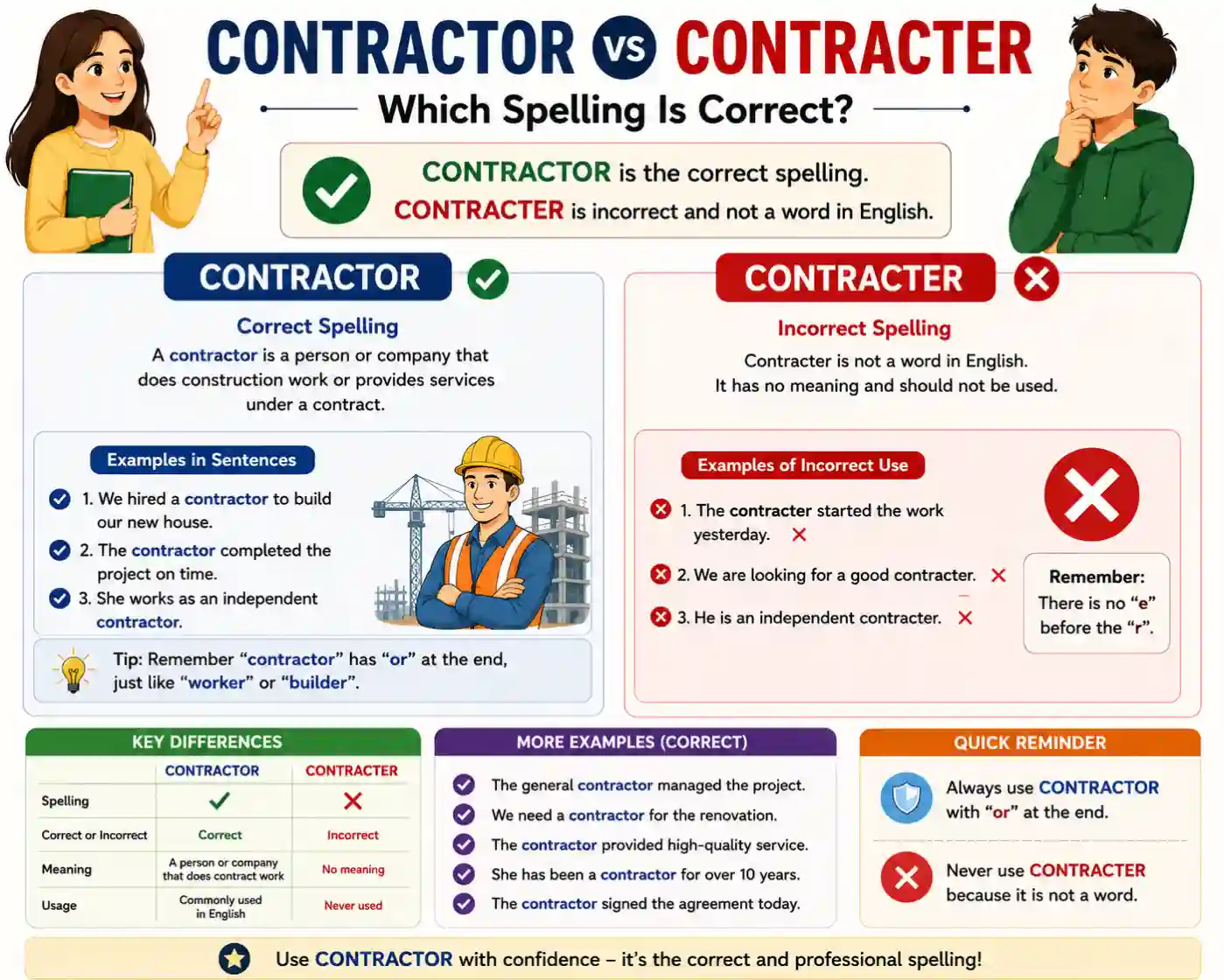
If you’ve ever hesitated over contractor or contracter, the correct spelling in standard modern English is contractor. The word refers to a person or company hired to perform work, provide services, or complete a project under an agreement. Contracter is not the normal spelling used for that meaning.
The confusion is easy to understand because both forms sound almost identical when spoken quickly. The ending can also feel uncertain because English has many words with different agent endings, and the pronunciation doesn’t always make the spelling obvious.
The good news is that the rule is simple once you connect the noun to its base word. This guide explains what the standard form means, how to pronounce it, why the other spelling causes trouble, how the word works grammatically, and how to use it naturally in everyday, workplace, academic, and formal writing.
Quick Answer
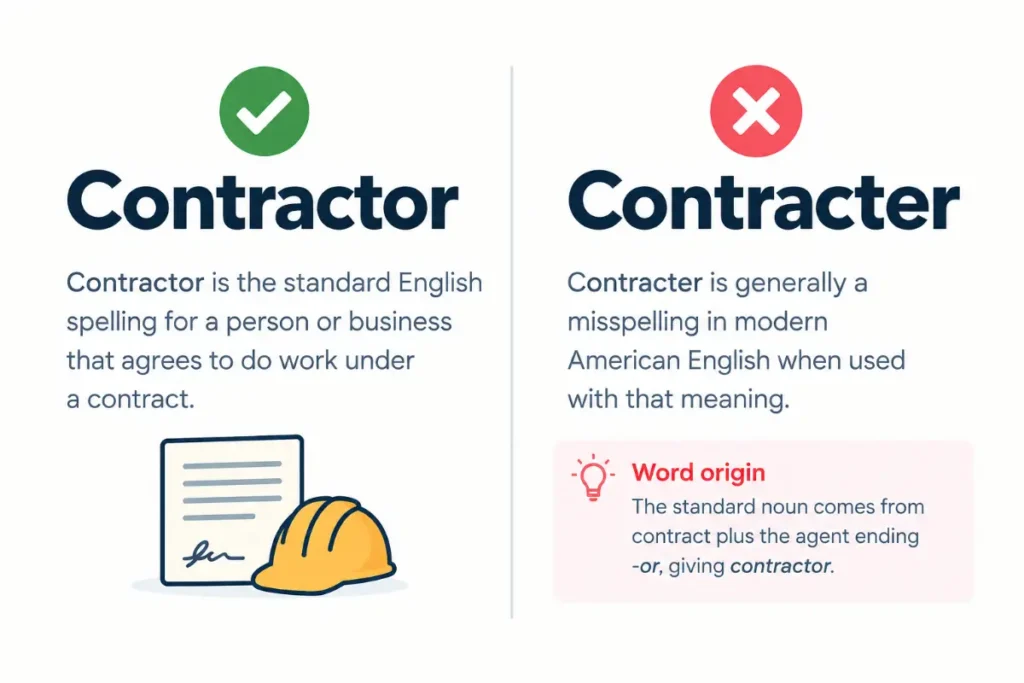
Contractor is the standard English spelling for a person or business that agrees to do work under a contract. Contracter is generally a misspelling in modern American English when used with that meaning. The standard noun comes from contract plus the agent ending -or, giving contractor.
Meaning and Definition
A contractor is a person, company, or business that agrees to perform a service or complete a defined piece of work, usually under the terms of a contract.
The word is especially common in fields such as construction, home improvement, engineering, consulting, information technology, manufacturing, and professional services. A contractor may work directly for a customer, for another company, or as part of a larger project.
For example, a homeowner might hire a contractor to remodel a kitchen. A company might bring in a software contractor to work on a specialized project. A government agency might hire a contractor to provide maintenance, transportation, or technical services.
The noun can refer to an individual or an organization:
- Individual: The contractor arrived early to inspect the property.
- Business: The contractor submitted a proposal for the project.
- Company: The construction contractor hired several subcontractors.
The word can also appear in combinations such as general contractor, independent contractor, building contractor, electrical contractor, and government contractor.
Meaning of the Nonstandard Form
Contracter is usually a spelling error when someone intends the standard English noun for a person or business working under a contract.
The mistake often comes from the way the word sounds. A writer may hear the final unstressed syllable and assume that the spelling should mirror the sound more directly. That leads to contracter instead of contractor.
There is no reason to treat the two spellings as equal alternatives in normal professional English. For contracts, business documents, resumes, reports, invoices, websites, school assignments, and formal correspondence, contractor is the form to use.
A strange or unfamiliar source can sometimes contain unusual spellings, historical forms, names, or language interference. Such an occurrence does not establish a spelling as the preferred form in present-day standard American English.
Meaning of the Standard Form
The standard noun contractor identifies someone who contracts to do something.
Its meaning can be broad. It doesn’t necessarily describe a construction worker. A contractor may provide physical labor, professional expertise, technical support, consulting services, or other work.
For example:
The company hired an independent contractor to update its website.
Here, the person isn’t necessarily a builder or tradesperson. The term simply describes the person’s working arrangement.
Key Differences Explained
The main distinction between the two forms is straightforward.
- Spelling: The standard spelling uses -or, not -er.
- Meaning: In normal English, the intended meaning is the same concept associated with someone who contracts to perform work.
- Grammar: The standard form is a noun.
- Pronunciation: The final syllable is weak, so the spoken form doesn’t strongly reveal the spelling.
- Formality: Contractor is appropriate in both everyday and formal writing.
- Context: It is widely used in business, construction, government, technology, and professional services.
- Regional usage: The standard spelling remains contractor across major varieties of English.
- Editing: A professional editor would normally change contracter to contractor when the intended meaning is the standard occupation or business term.
This is a useful example of a broader English spelling issue: pronunciation alone isn’t always enough to predict the correct letters. The written form often depends on the history and structure of the word.
Comparison Table
| Form | Status | Meaning | Part of Speech | Standard Usage | Example |
|---|---|---|---|---|---|
| Contractor | Standard modern English | A person or business hired to perform contracted work | Noun | Common in professional and everyday writing | The contractor finished the renovation. |
| Contracter | Generally nonstandard for this meaning | Usually intended to mean a contractor | Noun form in attempted usage | Commonly treated as a misspelling | The contractor finished the renovation. |
The table shows why the choice is not really a matter of style. In normal modern English, the first form is the established spelling readers expect.
Which Form Is Correct
Contractor is the correct standard form.
The easiest way to remember it is to start with contract. Add the agent-forming ending -or, and you get contractor.
This pattern makes sense because English uses several agent nouns ending in -or. Examples include actor, operator, translator, administrator, and investigator. It also uses -er in many other words, which can make the spelling choice feel unpredictable. English spelling reflects word history and established usage, not a single rule that applies perfectly to every word.
For formal writing, the safest editorial decision is simple: use contractor consistently.
That applies to:
- Business proposals
- Service agreements
- Job descriptions
- Resumes
- Invoices
- Reports
- Academic assignments
- News writing
- Company websites
- Government documents
- Emails
- Professional profiles
A spelling checker may catch the nonstandard form, but you shouldn’t rely entirely on software. Human writers and editors still need to recognize the underlying word and its intended meaning.
Sentence Examples
Here are natural examples showing how the standard form works in different settings.
- Everyday conversation: We need to call the contractor because the kitchen cabinet is still loose.
- Text message: The contractor said he’ll be here around nine.
- Workplace communication: Please send the contractor the updated project schedule.
- Business writing: The company selected a contractor after reviewing several proposals.
- Construction: Our contractor recommended replacing the damaged roof.
- Technology: The company hired an independent contractor to maintain its software system.
- Academic writing: The study examines how public agencies manage relationships with private contractors.
- Formal writing: The contractor must complete the work according to the terms of the agreement.
- Social conversation: My neighbor knows a good contractor who does bathroom renovations.
- Online communication: We’re looking for a licensed contractor for a small home repair project.
Examples in Professional Contexts
The word is especially common in workplace communication because organizations often distinguish employees from outside service providers.
Consider these examples:
The contractor will provide weekly progress reports.
The project manager met with the contractor to discuss the revised timeline.
Each contractor must follow the company’s safety procedures while working on site.
These sentences show that the noun can fit naturally into both ordinary business language and formal documentation.
Examples With Common Modifiers
Several expressions appear frequently in real-world English.
General contractor usually refers to the main party responsible for coordinating a construction project.
Independent contractor generally refers to someone who provides services independently rather than functioning as a regular employee.
Government contractor describes a person or company performing work under a government contract.
Subcontractor refers to a party hired by a primary contractor to handle part of a larger project.
Common Mistakes and Misspellings
The most frequent errors usually come from sound, spelling patterns, or rushed typing.
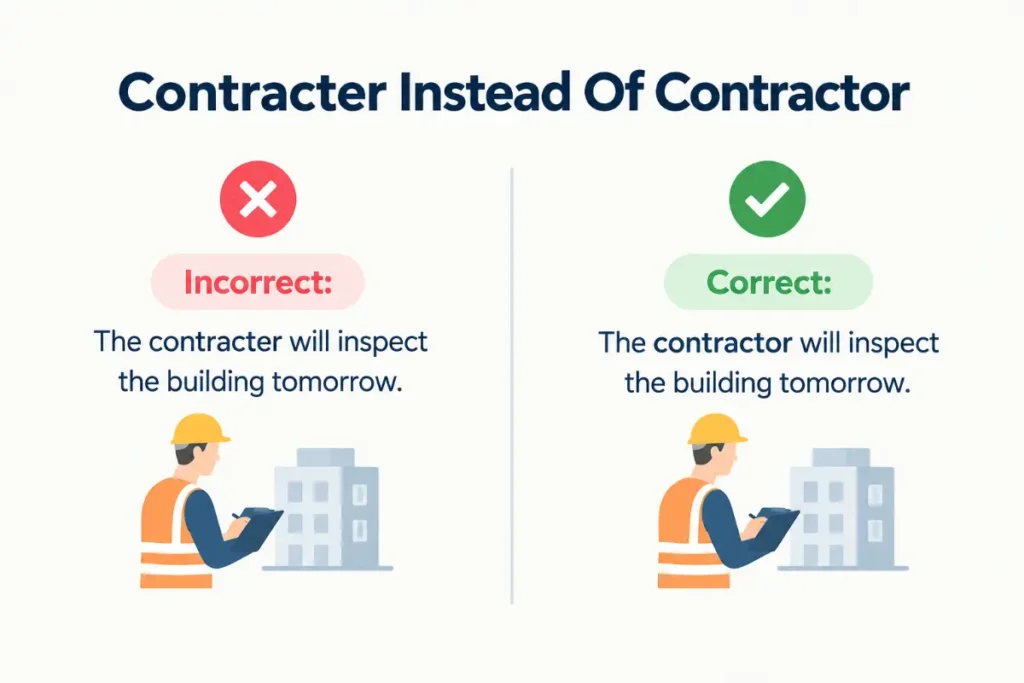
Contracter Instead of Contractor
Incorrect: The contracter will inspect the building tomorrow.
Correct: The contractor will inspect the building tomorrow.
The final syllable sounds weak in natural speech, so some writers choose -er because it feels familiar. The established spelling uses -or.
Contrator
Incorrect: We hired a contrator for the renovation.
Correct: We hired a contractor for the renovation.
This is usually a simple typing error caused by dropping the second c. Because the word is often typed quickly, missing letters can slip through spellcheck in unusual contexts.
Contracteror
Incorrect: The contracteror submitted the proposal.
Correct: The contractor submitted the proposal.
This form appears when a writer becomes uncertain about the ending and adds extra letters. It is not a standard English spelling.
Contracter Company
Incorrect: We contacted a local contracter company.
Correct: We contacted a local contractor company.
The problem remains the same even when the word appears inside a larger phrase. Changing the sentence structure doesn’t make the spelling acceptable.
Contractor’s Confusion With Contract
Some writers also confuse the noun contractor with the noun contract.
A contract is an agreement. A contractor is the person or business that performs work under an agreement.
For example:
We signed the contract with the contractor.
The two words are closely related, but they do different jobs in the sentence.
Pronunciation Guide
The standard noun is commonly pronounced:
IPA: /kənˈtræk.tər/
An easy pronunciation guide is:
kuhn TRAK ter
The stress falls on the second syllable:
con TRACT or
There are three practical sound units:
- con
- tract
- or
The final -or is weak, which is one reason the spelling can be harder to identify from speech alone.
A common pronunciation mistake is to give every syllable equal force. Native speakers generally put the strongest stress on the middle syllable.
You may also hear slight differences across English varieties, especially in the sound of the final syllable. Those differences don’t change the standard spelling.
The key point is this: the word’s pronunciation may sound close to an -er ending in casual speech, but that does not mean the written form changes.
Etymology and Word Origin
The noun comes from the word contract, which ultimately traces to Latin roots connected with the idea of drawing or bringing things together.
In English, contract developed into several related uses. It can refer to an agreement between parties, and it can also function as a verb meaning to enter into an agreement or make something smaller or tighter depending on context.
The noun contractor is formed from contract with the agent suffix -or. In English, this type of formation creates a noun for a person or entity associated with an action.
That structure is helpful for spelling because it connects the modern word directly to its base:
contract + or = contractor
Understanding the structure is often more useful than trying to memorize isolated letters. Once you recognize the word as an agent noun built from contract, the standard spelling becomes easier to recall.
Regional Usage
American English
In American English, contractor is the normal standard spelling. It appears across construction, business, government, consulting, technology, and many other fields.
The word is common enough that most readers will immediately recognize it. In professional writing, there is little reason to use the nonstandard contracter form.
American usage also frequently includes phrases such as independent contractor, general contractor, and contractor agreement.
British English
British English also uses contractor as the standard spelling.
Some vocabulary and legal terminology can differ between the United States and the United Kingdom, but this particular spelling does not normally create a US versus UK difference. British readers generally expect contractor as well.
Australian English
Australian English likewise uses contractor in standard usage. The word is common in construction, business, trades, and government contexts.
There is no meaningful regional spelling distinction that would make contracter the preferred Australian form.
Canadian English
Canadian English also follows the standard spelling contractor.
As with British and Australian English, the alternative spelling isn’t a normal regional variant. For a broad international audience, contractor is therefore the safest and most widely recognized choice.
Grammar Rules and Part of Speech
The word contractor functions primarily as a noun.
A noun names a person, place, thing, or concept. Here, the noun identifies a person or organization that performs work under a contract.
Singular Form
The contractor is waiting outside.
The singular noun refers to one person or one business entity.
Plural Form
The plural is:
contractors
Several contractors submitted bids for the project.
Notice that the plural is formed normally by adding -s.
Possessive Form
For one contractor, use:
contractor’s
The contractor’s estimate was higher than expected.
For multiple contractors, use:
contractors’
The contractors’ meeting starts at noon.
The apostrophe changes depending on whether the owner is singular or plural.
Common Sentence Positions
The noun can appear in several grammatical roles.
Subject:
The contractor arrived on time.
Object:
We called the contractor this morning.
Object of a preposition:
She spoke with the contractor about the repairs.
Noun modifier:
The contractor payment was delayed.
In the last example, the noun contractor helps describe another noun. English often uses nouns this way in professional phrases.
Adjective Use
Contractor is not normally an adjective in the strict grammatical sense, but English often places nouns before other nouns as modifiers. That’s why phrases such as contractor insurance, contractor license, or contractor services are understandable and common.
The exact phrasing can vary based on the business or industry, but the noun itself remains contractor.
Real Life Usage Examples
Daily Conversation
People often use the word casually when talking about home repairs, renovations, or service providers.
We’re meeting the contractor after work to discuss the new bathroom layout.
My brother recommended a contractor who specializes in older houses.
These examples show that the term isn’t limited to formal business writing. It works naturally in ordinary conversation.
Email and Workplace Communication
Professional messages often use the term to identify an outside worker or service provider.
Please confirm that the contractor received the updated specifications.
The contractor requested an extension because the materials arrived late.
In workplace writing, clarity matters more than decorative vocabulary. Using the established spelling helps readers understand the message without interruption.
Academic Writing
In academic and research writing, the noun often appears in discussions of labor, procurement, public administration, economics, management, or organizational structure.
The agency evaluated the performance of its external contractors.
Researchers examined the relationship between public institutions and private contractors.
The tone is more formal, but the spelling remains unchanged.
News and Journalism
Journalistic writing often uses the word in reports about construction projects, infrastructure, public spending, disputes, or corporate operations.
The contractor completed the bridge repairs ahead of schedule.
Officials said the contractor would face penalties for missing the deadline.
The term is useful because it identifies a specific role without requiring a long description.
Literature and Storytelling
In storytelling, the word can quickly establish a character’s occupation or role.
The contractor stood in the doorway, studying the damaged ceiling.
She had worked as a contractor for years before opening her own firm.
Literary writing may be more descriptive, but the underlying word remains the same.
Related and Confused Terms
Several words are closely connected to this topic.
Contract
A contract is an agreement between parties that creates defined obligations or terms.
We signed the contract on Monday.
The agreement is the document or arrangement. The contractor is the person or business connected with carrying out the work.
Contracting
Contracting can refer to the act or process of working under contracts, hiring outside providers, or entering into contractual arrangements.
The company is contracting with several local firms.
The meaning depends on the larger sentence.
Subcontractor
A subcontractor is hired by another contractor to perform part of a project.
For example, a general contractor may hire an electrical subcontractor for wiring work.
Employee
An employee normally works within an employment relationship and is generally subject to the employer’s rules and payroll arrangements.
An independent contractor may have a different legal and business relationship with the client.
Vendor
A vendor typically sells goods or services. A contractor may also be a vendor in some settings, but the terms aren’t always interchangeable.
Consultant
A consultant generally provides specialized advice or expertise. A contractor can provide consulting services, but not every contractor is a consultant.
Supplier
A supplier mainly provides products, materials, or resources. A contractor usually performs or manages a defined service or scope of work.
General Contractor
A general contractor is commonly the main party coordinating a construction project and arranging work performed by subcontractors and other providers.
Understanding these related terms helps prevent another common problem: using a broad business term when a more precise role is intended.
Why the Spelling Is Easy to Confuse
The spelling problem has a simple phonetic cause. In ordinary speech, the last part of contractor is unstressed and reduced. That can make the ending sound less distinct than it looks on the page.
English also contains many nouns ending in -er, particularly names for people who perform actions:
- Teacher
- Worker
- Driver
- Writer
- Manager
Because -er is so productive, it can feel natural to extend that pattern to another occupation or role.
At the same time, English uses -or in many established words:
- Actor
- Editor
- Operator
- Director
- Instructor
- Translator
The important lesson is that English spelling isn’t always predictable from sound alone. Familiar suffix patterns can guide you, but established word forms still have to be learned and recognized.
For this particular word, connecting it to contract is the strongest memory aid.
How to Remember the Correct Spelling
A simple memory trick is:
Contract comes before contractor.
Start with:
contract
Then add:
or
That gives:
contractor
You can also think of the word as describing someone who works through a contract. The spelling keeps the visible o in the agent ending.
Another useful strategy is to memorize the common pair:
contract and contractor
You already know how to spell contract. Keeping the base word visible makes the final form much easier to reconstruct.
This method is more reliable than trying to remember the ending by sound.
Professional Writing Tips
In professional writing, consistency is often more valuable than complexity. Use contractor the same way you would use any established industry term, and keep the surrounding sentence simple.
Pay particular attention to the word in documents that may be copied, reviewed, or legally interpreted. These include proposals, statements of work, project reports, invoices, vendor records, policies, and employment-related materials.
A useful editing habit is to read the sentence once for meaning and once for spelling. On the second pass, look closely at words that contain familiar endings but may not follow the spelling pattern you expect.
For example:
The contractor submitted a revised estimate.
The sentence is clear, grammatical, and standard.
Compare it with:
The contracter submitted a revised estimate.
A reader may understand the sentence immediately, but the spelling error can make the document look less polished and may undermine confidence in the surrounding text.
Expert Editor Insight
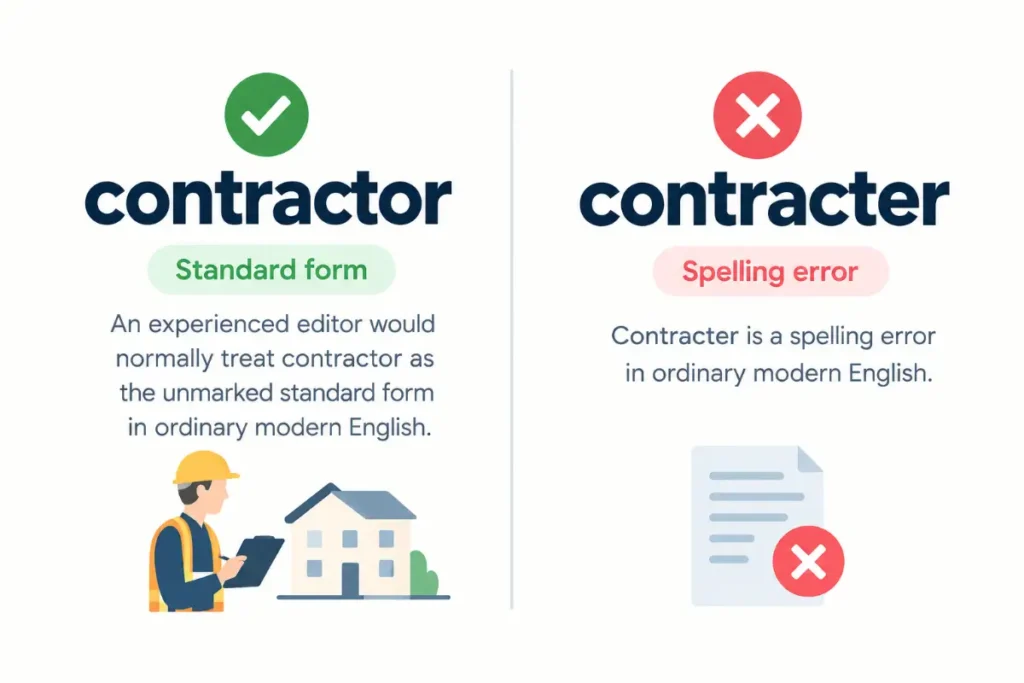
An experienced editor would normally treat contractor as the unmarked standard form and contracter as a spelling error in ordinary modern English. The confusion happens mainly because the weak final sound does not clearly signal the letters on the page. Professional editors therefore check the word against its established form and its base contract, rather than relying only on pronunciation. Spellcheckers may catch the mistake, but context and human review still matter, especially in polished business or legal writing.
Conclusion
When comparing contractor or contracter, choose contractor for standard modern English. It is the established noun for a person or business that performs work under a contract, and it is the form readers expect in professional and everyday writing.
The spelling is easy to remember because it grows directly from the word contract with the agent ending -or. The alternative spelling usually comes from hearing the weak final syllable and guessing the letters from sound.
For a simple editing rule, remember this pair: contract → contractor. Keeping that base word in mind will help you avoid the common error in emails, reports, schoolwork, business documents, and formal writing.
FAQs
Is contracter a real English word?
In ordinary modern American English, contracter is not the standard spelling for a person or company that performs work under a contract. Most uses of that form are best understood as misspellings of contractor. Unusual historical, specialized, or non-English appearances can occur, but they don’t make the spelling appropriate for normal professional English.
What does contractor mean?
A contractor is a person or business that agrees to perform a service or complete specific work under an agreement. The term is common in construction, consulting, technology, government work, and other industries. It can describe an individual or an organization, and it often appears in phrases such as independent contractor and general contractor.
Which spelling should I use in formal writing?
Use contractor in formal writing. It is the established standard form expected in professional documents, reports, proposals, academic work, business emails, and official communication. The alternative spelling can distract readers and may be marked as an error by spelling or grammar software. There is normally no stylistic advantage to using the nonstandard form.
How do you pronounce contractor?
The common American pronunciation is /kənˈtræk.tər/, roughly kuhn TRAK ter. The strongest stress falls on the second syllable. The final syllable is weak, which helps explain why some writers incorrectly spell the ending with -er. The pronunciation can vary slightly across English accents, but the standard written form remains the same.
Can contractor start a sentence?
Yes. Contractor can easily begin a sentence when it functions as the subject of the sentence. For example, “Contractor delays affected the project schedule.” Starting with the noun is grammatically normal. The key issue is not sentence position but making sure the noun is used with the intended meaning and spelled in its standard form.
What is a synonym for contractor?
The best alternative depends on context. Possible related terms include service provider, consultant, builder, vendor, or subcontractor, but these words aren’t exact substitutes in every sentence. A contractor may have duties that overlap with these roles, yet each term can carry a more specific meaning in business or professional settings.
Why do people misspell contractor?
People often misspell the word because the final syllable is unstressed in speech and can sound like an -er ending. English also contains many agent nouns ending in -er, so the spelling pattern feels familiar. The strongest way to avoid the mistake is to connect the word to its base form contract and remember the established -or ending.
Is contractor appropriate in professional writing?
Yes. Contractor is completely appropriate in professional writing and is widely used in business, construction, government, technical, academic, and legal contexts. It works in both formal and informal sentences. Just make sure the term accurately describes the relationship involved. In documents concerning work status, specific legal definitions can matter, so context should guide the terminology.

English Grammar & Usage
Nathan Holloway is an American grammar writer and language researcher who specializes in English grammar, sentence structure, verb usage, and common writing mistakes. He enjoys breaking down confusing grammar rules into practical explanations with clear examples, making English easier for students, professionals, and everyday writers.