
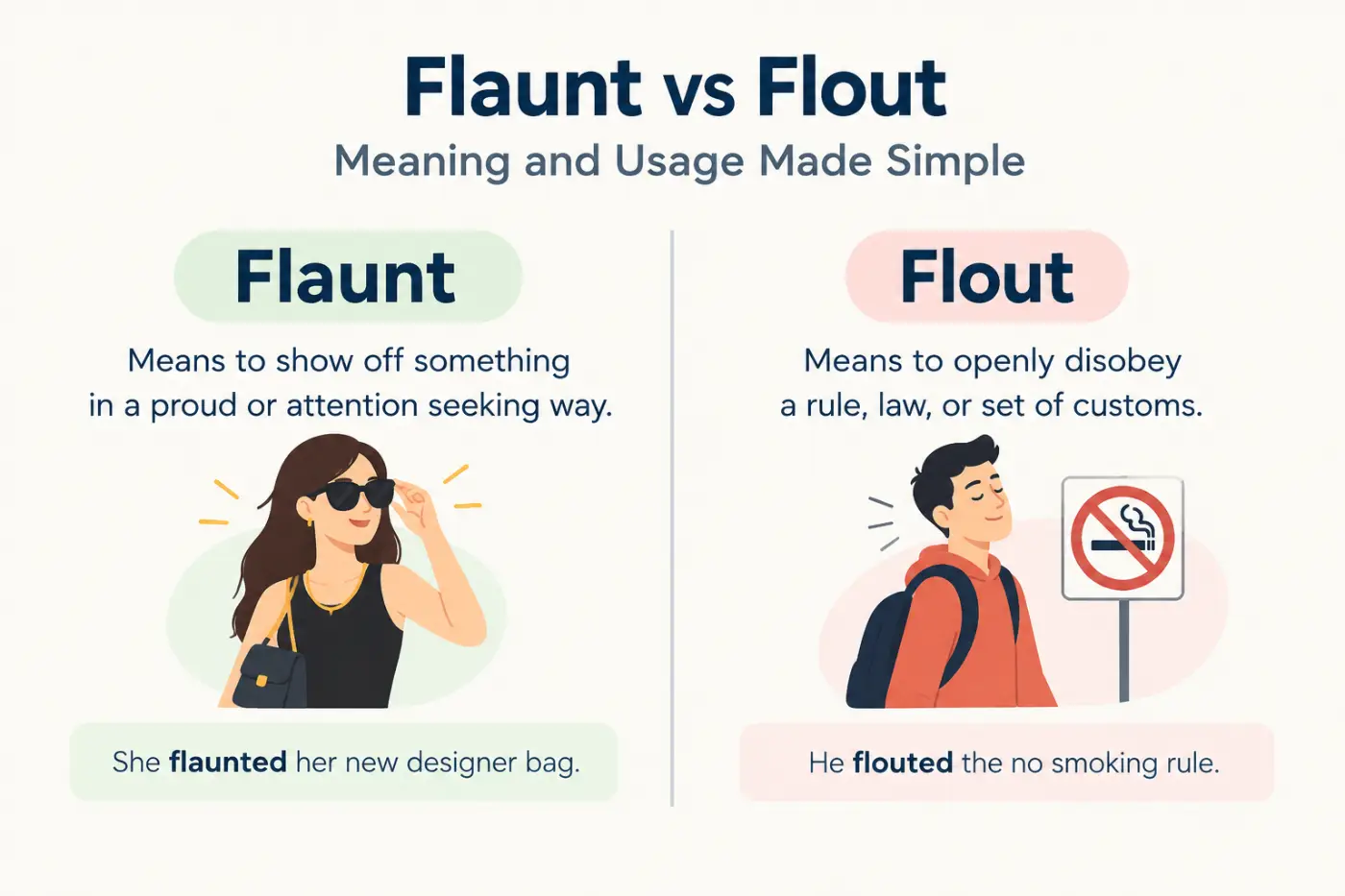
Flaunt vs flout is a common English word comparison because the two words sound similar but have completely different meanings. Flaunt usually involves showing something off while flout involves ignoring something that should be respected or followed.
The confusion often appears in writing because both words can describe deliberate and noticeable behavior. A person can flaunt wealth by displaying an expensive watch. That same person can flout a workplace rule by ignoring it in front of everyone.
Once you connect each word with its core idea the difference becomes easy to remember. Flaunt is about showing. Flout is about breaking or ignoring. This guide explains the meanings grammar pronunciation origins examples common mistakes and practical ways to choose the right word.
Short Answer
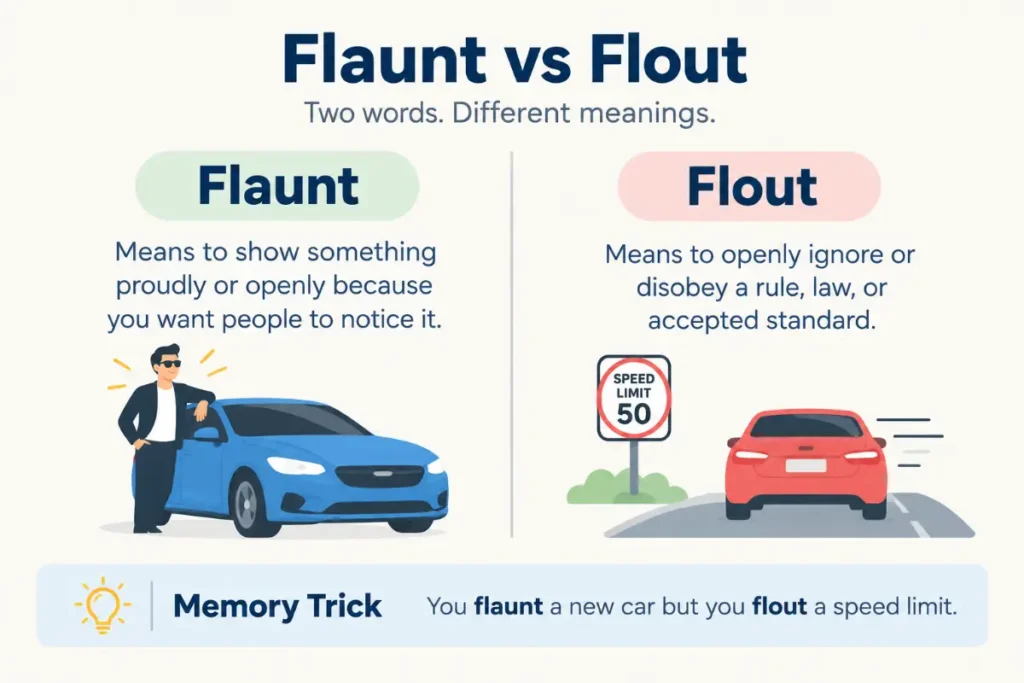
Flaunt means to show something proudly or openly because you want people to notice it. Flout means to openly ignore or disobey a rule law or accepted standard. The easiest memory trick is simple. You flaunt a new car but you flout a speed limit.
Table of Contents
- The Basic Difference.
- What Flaunt Means.
- What Flout Means.
- Flaunt vs Flout in Context.
- Comparison Table.
- How to Use Flaunt Correctly.
- How to Use Flout Correctly.
- Pronunciation and Word Forms.
- Word Origins.
- Real Life Examples.
- Common Mistakes.
- Memory Tips.
- Related Usage Notes.
- Professional Writing Tips.
- Frequently Asked Questions.
- Key Takeaways.
- Conclusion.
The Basic Difference
The simplest distinction is this.
Flaunt means to display something in a noticeable and often proud way.
Flout means to ignore or disobey a rule law agreement standard or expectation openly.
The two words can describe intentional behavior but the objects of that behavior differ.
You can flaunt something you possess.
You can flout something you are expected to follow.
Consider these examples.
She flaunted her new designer handbag.
The driver flouted the parking restrictions.
In the first sentence the woman displays something because she wants people to notice it. In the second sentence the driver ignores a rule.
That distinction works in most everyday situations.
A useful formula is:
Flaunt equals show off.
Flout equals ignore a rule.
What Flaunt Means
Flaunt is a verb that means to display something openly and noticeably. The display often suggests pride vanity confidence or a desire to attract attention.
The object can be a physical possession such as a car or piece of jewelry. It can also be an achievement quality privilege or personal advantage.
For example:
He flaunted his expensive watch at the party.
The athlete flaunted her championship medal.
She likes to flaunt her knowledge during meetings.
In each sentence the person makes something noticeable.
Flaunt often carries a negative tone because showing something off can appear boastful. However the word does not always express strong criticism. Context determines the attitude.
Someone might say:
She proudly flaunted her new wedding ring.
That sentence can sound positive or playful.
Another person might say:
He constantly flaunts his wealth.
That version sounds more critical because it suggests excessive showing off.
Flaunt can also describe behavior that deliberately draws attention.
The celebrity flaunted her new look on social media.
The company flaunted its success after reaching a major sales milestone.
The central idea remains the same. Something is being displayed in a way that attracts attention.
What Flout Means
Flout means to openly ignore or disobey a rule law agreement principle or accepted standard.
The word usually suggests deliberate disregard.
For example:
The company flouted environmental regulations.
He flouted the building rules by making unauthorized changes.
Several employees flouted the safety policy.
Notice that each sentence involves something that people are expected to follow.
You do not normally flout a new car or a promotion. You flout a regulation or a rule.
Flout can also apply to social expectations and accepted standards.
The politician flouted traditional expectations about formal dress.
The organization flouted industry standards.
The player flouted the team agreement.
The word often has a serious tone because it can imply disrespect toward authority or accepted standards.
That makes flout especially common in news reports legal writing business writing and formal discussions.
Flaunt vs Flout in Context
The best way to understand the distinction is to place both words in similar situations.
Imagine someone buys an expensive sports car.
If that person drives it around town hoping everyone will notice it they might flaunt the car.
Now imagine that same person parks it in a restricted area despite a clear parking rule. They might flout the parking restriction.
The object changes from something being displayed to something being disobeyed.
Consider another example involving clothing.
She flaunted her new designer dress.
Here the dress is being displayed.
She flouted the office dress code.
Here the dress code is being ignored.
The difference becomes even clearer with social media.
He flaunted his vacation photos online.
The focus is on showing something.
He flouted the platform rules by posting prohibited material.
The focus is on ignoring a rule.
This simple contrast can help you make the right choice quickly.
Comparison Table
| Word | Core meaning | Typical object | Common tone | Example |
|---|---|---|---|---|
| Flaunt | Show something openly and noticeably | Possessions achievements qualities or advantages | Often boastful but can be neutral | She flaunted her new car. |
| Flout | Openly ignore or disobey | Rules laws standards agreements or expectations | Usually negative | They flouted the safety rules. |
The most useful question is not how the words sound. Ask what the person is doing.
Are they showing something.
Use flaunt.
Are they ignoring something they should follow.
Use flout.
How to Use Flaunt Correctly
Flaunt normally works as a transitive verb. That means it usually takes an object.
You can flaunt something.
Examples include:
He flaunted his wealth.
She flaunted her new phone.
They flaunted their success.
The athlete flaunted his trophy.
You can also use flaunt with abstract nouns.
She flaunted her confidence.
He flaunted his influence.
The company flaunted its achievements.
The manager flaunted his authority.
These examples still contain the basic idea of making something noticeable.
Flaunt can also appear in different verb forms.
She flaunts her expensive clothes.
He flaunted his success.
They are flaunting their new lifestyle.
The company has flaunted its recent achievements.
The grammatical form changes but the central meaning remains stable.
Flaunt does not mean simply possess.
If someone owns an expensive watch but never shows it to anyone you would not normally say they flaunt it.
The word suggests visible or deliberate display.
How to Use Flout Correctly
Flout also works as a transitive verb.
You flout a rule.
You flout a regulation.
Examples include:
The company flouted federal regulations.
The driver flouted the traffic laws.
The employee flouted the safety policy.
The organization flouted industry standards.
The word can also describe disregard for social conventions.
He flouted social expectations by refusing to follow the traditional dress code.
The artist flouted convention with an unusual exhibition.
In these examples there is an established expectation or standard that someone deliberately ignores.
Flout is generally stronger than simply saying ignore.
If someone accidentally forgets a rule you would not usually describe that action as flouting it. Flout often suggests conscious and visible disregard.
Pronunciation and Word Forms
Flaunt and flout are pronounced differently even though they look and sound similar.
Flaunt is pronounced with a sound similar to the word haunt after the initial consonant. Its vowel sound forms a diphthong.
Flout uses a similar vowel sound to the word out.
For American English speakers the distinction is clear when spoken carefully.
The common forms are straightforward.
Flaunt.
Flaunts.
Flaunted.
Flaunting.
Flout.
Flouts.
Flouted.
Flouting.
Both words are regular verbs.
Neither word changes its spelling in an unusual way when you move between present past and participle forms.
The similarity between their pronunciation is one reason learners sometimes confuse them. Context provides the strongest clue.
Word Origins
The history of these words helps explain why they developed such different meanings.
Flaunt has a long history connected with displaying or making something conspicuous. Over time it became strongly associated with showing something in a proud or boastful way.
Flout has a different history. It developed around the idea of treating something with contempt or acting in open disregard of a rule or convention.
Their histories do not make them interchangeable.
English contains many word pairs that sound alike or almost alike while carrying different meanings. Flaunt and flout belong to this broader group of easily confused words.
Learning the meaning of each word is more useful than trying to memorize their historical development.
Real Life Examples
Real world examples make the difference easier to recognize.
Money and Possessions
He flaunted his new sports car outside the restaurant.
The sentence focuses on the car being displayed.
The businessman flaunted his expensive watch during the interview.
Again the person wants attention directed toward a possession.
The wealthy couple flaunted their luxury vacation online.
The focus remains on public display.
Rules and Laws
The driver flouted the speed limit.
The company flouted workplace safety regulations.
The contractor flouted the terms of the agreement.
The organization flouted federal requirements.
In each example the person or organization ignores something they are expected to follow.
Workplace Situations
She flaunted her promotion by constantly reminding coworkers about her new position.
The employee flouted the company policy on confidential information.
The manager flaunted his industry award during the presentation.
The department flouted its own hiring standards.
These examples show how the two words can appear naturally in the same general setting while serving completely different purposes.
School Situations
The student flaunted his academic award.
The student flouted the school rule against using phones during exams.
The first sentence concerns public display.
The second concerns disregard for a rule.
Social Situations
She flaunted her new engagement ring.
He flouted the invitation rules by bringing several unregistered guests.
Again the first sentence involves showing something. The second involves ignoring an expectation.
Common Mistakes
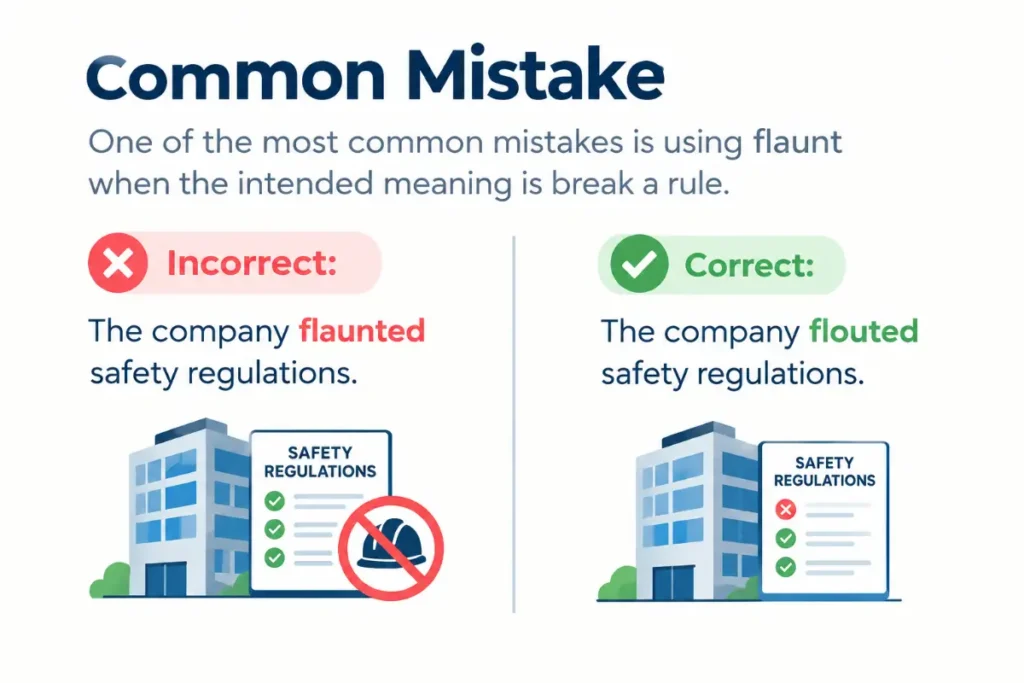
One of the most common mistakes is using flaunt when the intended meaning is break a rule.
Incorrect:
The company flaunted safety regulations.
Correct:
The company flouted safety regulations.
The first sentence suggests that the company displayed the regulations proudly. That is probably not the intended meaning.
Another common mistake is using flout for possessions.
Incorrect:
She flouted her new handbag.
Correct:
She flaunted her new handbag.
The handbag is being displayed rather than disobeyed.
A third mistake happens when writers focus too heavily on pronunciation.
Because the words sound similar some people choose one based on how familiar it feels.
That approach can cause errors.
Instead ask one simple question.
Is something being shown or is something being ignored.
Showing points to flaunt.
Ignoring points to flout.
Another mistake involves accidental behavior.
Suppose an employee forgets to wear protective equipment because they misunderstood a new policy.
Calling that action flouting the policy may overstate the situation. Flout usually suggests intentional disregard.
Memory Tips
The easiest memory trick connects flaunt with showing off.
Flaunt starts with F.
Think of F as showing off your Finery or your Fortune.
That association is not a formal language rule. It is simply a memory device.
For flout think about rules going out the window.
Flout sounds close to out.
A person who flouts a rule acts as though the rule is out of the way.
Another useful trick is to remember two short sentences.
I flaunt my new car.
I flout the law.
The first sentence involves a possession.
The second involves a rule.
You can also use this mental test.
If the noun is something you can display proudly then flaunt is often the right choice.
If the noun is something you are expected to obey then flout is often the right choice.
These tricks work because they connect each word to a clear mental picture.
Related Usage Notes
Flaunt and flout are not synonyms.
They also do not function as interchangeable alternatives in formal writing.
The distinction matters because replacing one with the other can completely change the meaning of a sentence.
Compare these two sentences.
The company flaunted its achievements.
The company flouted industry standards.
The first says the company displayed its achievements.
The second says the company ignored accepted standards.
Both sentences may describe the same company but they communicate different actions.
Another useful distinction involves the word flaunt and the phrase show off.
Show off is more conversational.
Flaunt is often more precise when the writer wants to emphasize deliberate public display.
For example:
He showed off his new car.
He flaunted his new car.
Both sentences communicate a similar idea. The second can sound slightly more deliberate or critical depending on context.
Flout has fewer everyday alternatives.
You can often replace it with openly disregard or deliberately ignore.
For example:
They flouted the regulations.
They openly disregarded the regulations.
The second version is more direct but also less compact.
In professional writing flout can be useful because it expresses deliberate disregard in a single word.
Formal And Informal Usage
Flaunt appears comfortably in everyday speech journalism marketing commentary and casual writing.
People commonly use it when talking about money fashion achievements possessions and social media.
For example:
She loves to flaunt her new clothes.
That sounds natural in everyday American English.
Flout appears more often in formal contexts.
You are likely to see it in legal reporting government documents business writing academic prose and serious news coverage.
For example:
The company was accused of flouting federal regulations.
That sentence sounds formal and precise.
This difference does not mean flout is unsuitable for everyday conversation. It simply appears less often because ordinary speakers usually choose simpler expressions such as ignore or break.
Professional Writing Tips
Strong professional writing depends on precise word choice.
When describing public display use flaunt only when the context supports the idea of deliberate visibility or attention.
For example:
The brand flaunted its record breaking sales figures.
That sentence suggests the company deliberately highlighted its success.
When describing noncompliance use flout.
For example:
The contractor flouted the required safety standards.
That sentence clearly communicates disregard for an established requirement.
Avoid using flout simply because you want a sophisticated sounding alternative to ignore. The stronger word should match the intended meaning.
Also consider tone.
Flaunt can sound judgmental because it may suggest vanity.
Flout can sound serious because it may suggest deliberate noncompliance.
Good writers use both words with that difference in mind.
American And British English
Flaunt and flout are standard English words in both American and British English.
Their core meanings remain essentially the same.
American speakers use flaunt to describe public display and flout to describe disregard for rules or conventions.
British speakers follow the same basic distinction.
There is no major regional difference that changes the fundamental rule.
That makes the pair relatively straightforward for international English learners.
The bigger challenge comes from individual writing habits rather than regional grammar.
Similar Confusing Words
English has many word pairs that cause confusion because they look or sound similar.
Accept and except are often confused because of their spelling and pronunciation.
Affect and effect cause problems because they can have related meanings and different grammatical roles.
Compliment and complement sound alike but refer to different ideas.
Principal and principle have different meanings despite their similar pronunciation.
Flaunt and flout belong to the same broad category of commonly confused words.
The best strategy is not to memorize long lists.
Learn the central meaning of each word and practice it in a short sentence.
For this pair remember:
Flaunt means display.
Flout means disregard.
That distinction handles most everyday cases.
When Flaunt Can Sound Negative
Flaunt does not automatically mean that someone is behaving badly.
Context determines the emotional tone.
Consider:
She proudly flaunted her championship medal.
This can sound celebratory.
Now consider:
He flaunted his wealth while his coworkers struggled financially.
The second sentence sounds critical.
The difference comes from context and social judgment.
Flaunt often suggests that the display is unnecessary or excessive. Still the word itself does not always carry strong condemnation.
This matters in professional writing because tone can change the reader’s interpretation.
If you want a neutral description use display or show.
If you want to suggest noticeable or boastful display use flaunt.
When Flout Suggests Intentional Disregard
Flout is stronger than simply saying someone failed to follow a rule.
The word often suggests that the person knew about the rule and chose to disregard it.
For example:
The driver accidentally exceeded the speed limit.
That does not necessarily mean the driver flouted the speed limit.
But:
The driver repeatedly ignored the posted speed limit despite several warnings.
That behavior can reasonably be described as flouting the law or traffic rules.
The difference comes down to deliberate disregard.
This distinction matters in legal reporting and professional communication because strong wording should match the evidence.
How To Choose The Right Word Quickly
When you are writing and need to choose between the two words use a three step mental check.
- Identify the action.
Ask what the person is doing.
- Identify the object.
Is the person displaying something or disregarding something.
- Match the word.
Choose flaunt for public display.
Choose flout for deliberate disregard.
For example:
She ______ her new diamond necklace.
A necklace can be displayed. The answer is flaunted.
They ______ the building regulations.
Regulations must be followed. The answer is flouted.
He ______ his promotion during every conversation.
A promotion can be displayed as an achievement. The answer is flaunted.
The company ______ environmental laws.
Laws must be obeyed. The answer is flouted.
This method works faster than trying to remember abstract definitions.
Key Takeaways
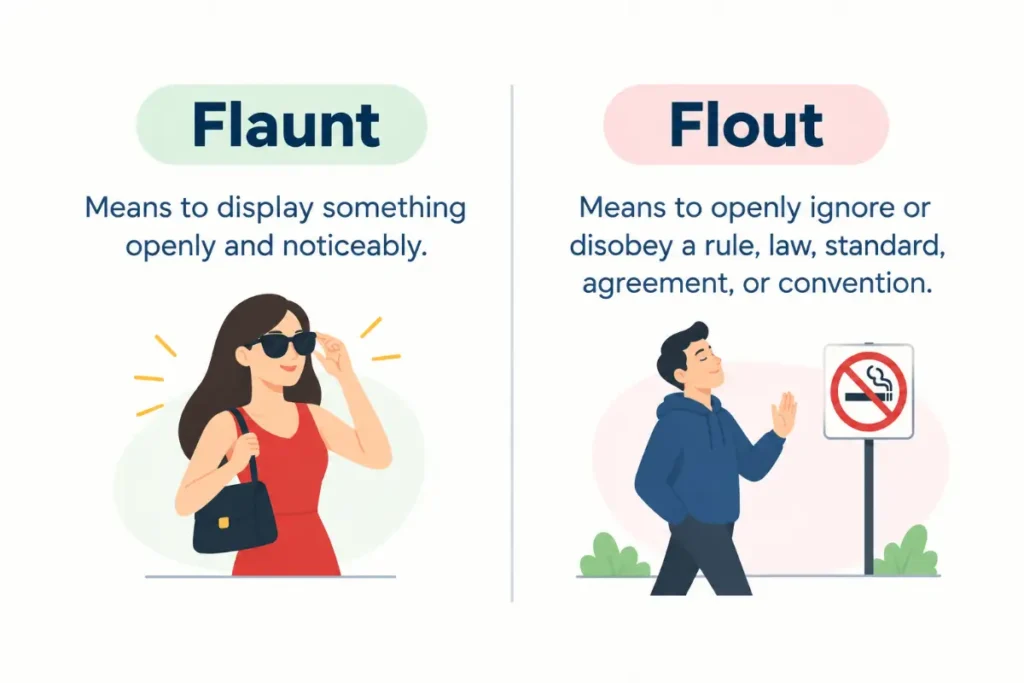
- Flaunt means to display something openly and noticeably.
- Flout means to openly ignore or disobey a rule law standard agreement or convention.
- You can flaunt possessions achievements qualities or advantages.
- You can flout laws regulations rules standards and expectations.
- Flaunt often suggests showing off but its tone depends on context.
- Flout usually suggests deliberate disregard.
- The simplest memory trick is show versus ignore.
- You flaunt a new car.
- You flout a speed limit.
- Both words are standard in American and British English.
Conclusion
Flaunt vs flout becomes much easier once you focus on the action rather than the similar spelling. Flaunt describes visible display while flout describes open disregard. That single distinction will help you choose the correct word in most situations.
When you want to describe someone proudly displaying a possession achievement or advantage use flaunt. When you want to describe someone deliberately ignoring a rule law standard or convention use flout. If you can replace the word with show off then flaunt is probably right. If you can replace it with deliberately ignore then flout is probably right.
Keep the two ideas separate and the confusion disappears. You flaunt what you want people to notice. You flout what you are expected to respect or follow.
Frequently Asked Questions
What is the difference between flaunt and flout?
Flaunt means to display something openly and noticeably. Flout means to openly ignore or disobey a rule law agreement standard or convention. In simple terms you flaunt a possession and flout a rule.
Is it flaunt or flout the rules?
The correct expression is flout the rules. Rules are followed or ignored. They are not normally something a person flaunts.
Is it flaunt or flout the law?
The correct expression is flout the law. A person who deliberately disregards a law can be described as flouting it.
Can you flaunt an achievement?
Yes. You can flaunt an achievement when you display it proudly or prominently to attract attention. The word can suggest pride or boastfulness depending on the context.
Can you flout a regulation?
Yes. Flout commonly appears with words such as regulation law rule standard requirement convention and agreement.
Are flaunt and flout pronounced the same?
No. They have similar sounds but different pronunciations. Their spelling and vowel patterns distinguish them when spoken carefully.
Is flaunt always negative?
No. Flaunt can sound positive neutral playful or negative depending on context. It often suggests showing something off but the surrounding language determines the attitude.
Is flout a formal word?
Flout is commonly used in formal writing such as legal reporting business writing journalism and discussions about rules or regulations. In casual conversation people often use ignore or break instead.
Can a person flout social conventions?
Yes. Flout can describe deliberate disregard for social conventions accepted behavior traditions or expectations.
What is an easy way to remember flaunt and flout?
Remember that flaunt means show off while flout means ignore or disobey. You flaunt your new car but you flout a parking rule.
Which word should I use for breaking a rule?
Use flout when you want to emphasize open or deliberate disregard. For a simple everyday statement break or ignore may sound more natural.
Why do people confuse flaunt and flout?
The words look and sound similar. Their meanings are different enough that replacing one with the other can change the meaning of a sentence completely.

English Grammar & Usage
Nathan Holloway is an American grammar writer and language researcher who specializes in English grammar, sentence structure, verb usage, and common writing mistakes. He enjoys breaking down confusing grammar rules into practical explanations with clear examples, making English easier for students, professionals, and everyday writers.