
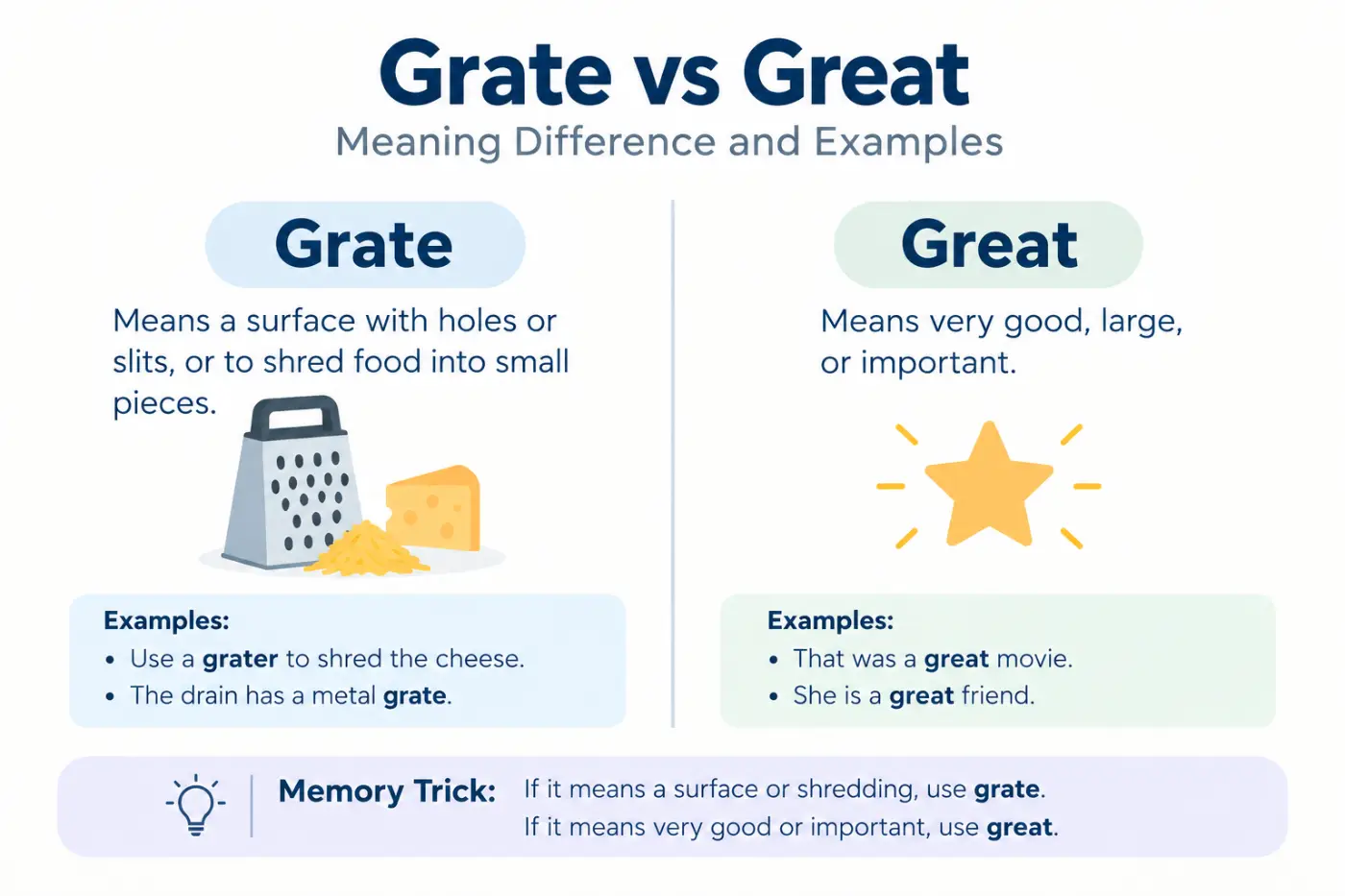
Grate vs great can confuse even strong English speakers because both words usually have the same pronunciation in American English. Their spelling and meanings are completely different. Grate can describe a metal framework or the action of shredding something with a grater. It can also describe something that irritates you. Great usually describes something excellent large important or impressive.
The confusion becomes more common in writing because English contains many homophones. These are words that sound alike but have different spellings and meanings. When you hear someone say either word you need the surrounding sentence to understand the intended meaning. When you write the word you need to choose the spelling that matches the meaning.
This guide explains the difference clearly and gives you practical examples you can use in everyday American English. You will also learn how to pronounce both words how to avoid common spelling mistakes and how to remember which word belongs in a sentence.
Short Answer
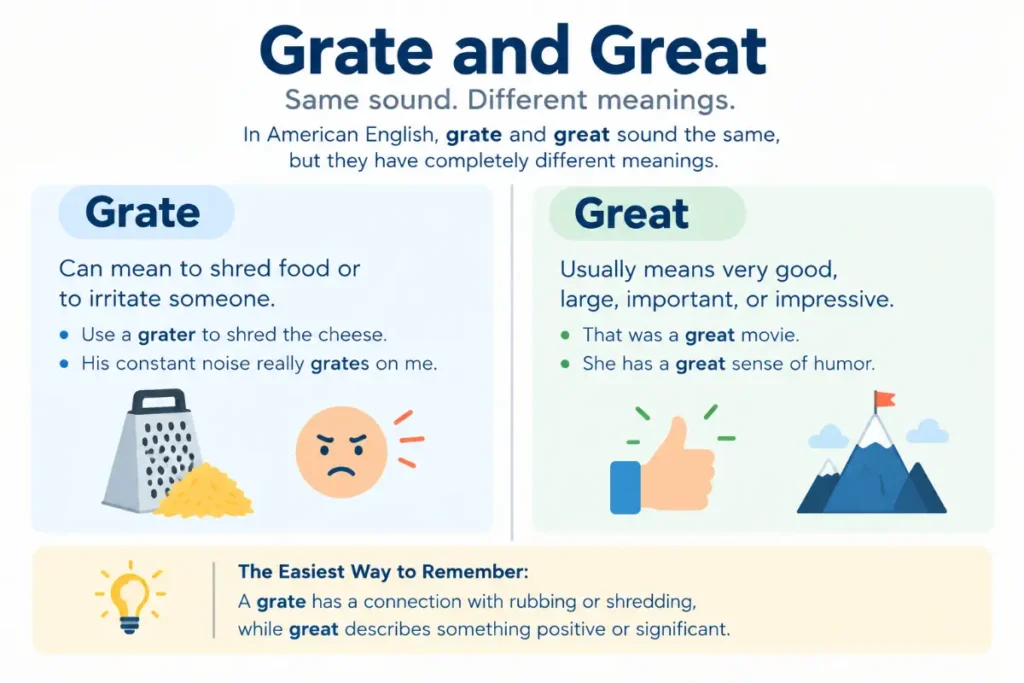
Grate and great sound the same in American English but they have completely different meanings. Grate can mean to shred food or to irritate someone. Great usually means very good large important or impressive. The easiest way to remember the difference is simple. A grate has a connection with rubbing or shredding while great describes something positive or significant.
Table Of Contents
- What grate means.
- What great means.
- Grate or great in simple terms.
- How to pronounce both words.
- The main differences.
- How grate works as a verb.
- How grate works as a noun.
- How great works as an adjective.
- Real life examples.
- Common mistakes.
- Memory tips.
- Related words and expressions.
- American and British English usage.
- Professional writing tips.
- Frequently asked questions.
- Key takeaways.
- Conclusion.
What Grate Means
Grate has several related meanings. The exact meaning depends on how you use it in a sentence.
As a verb grate can mean to shred food into small pieces. You can grate cheese over pasta. You can grate carrots for a salad.
Grate can also mean to irritate or annoy someone. If a person’s constant complaining grates on you then their behavior bothers you. This use often appears in more formal or descriptive writing.
As a noun grate usually refers to a framework made from metal bars or similar material. A fireplace grate holds wood or coal above the floor of the fireplace. A drain grate covers an opening and allows water to pass through.
The word therefore connects to physical rubbing and irritation in several of its uses. You can rub food against a grater. A rough sound can grate on your ears. An annoying behavior can grate on your patience.
Consider these examples.
- Please grate the cheese before you serve the pasta.
This sentence uses grate as a verb meaning to shred food into small pieces.
- The loud music began to grate on my nerves.
Here grate means to irritate or annoy.
- Leaves covered the drain grate after the storm.
In this sentence grate is a noun referring to a structure that covers a drain.
These meanings are different but easy to connect once you understand the basic idea behind the word.
What Great Means
Great is an adjective with several common meanings. The most familiar meaning is very good or excellent.
You might say that a movie was great because you enjoyed it. You might describe a meal as great because it tasted excellent and You could tell a friend that they did a great job after they completed something successfully.
Great can also mean large in size or amount. For example a great crowd means a large crowd. This meaning appears more often in formal or literary language than in casual American conversation.
The word can also describe importance or significance. A great leader is an important or highly respected leader. Great historical events are events that had a major effect on society.
Great can describe ability or achievement too. A great athlete performs at an exceptional level. A great writer produces work that has lasting value.
Great also appears in many established expressions. The Great Lakes refers to the five large freshwater lakes in North America. Great Britain refers to the island containing England Scotland and Wales.
Consider these examples.
- That was a great movie.
Great means excellent.
- She did a great job on the presentation.
Great describes the quality of the work.
Grate or Great In Simple Terms
The simplest distinction is this.
| Word | Part of Speech | Common Meaning | Example |
|---|---|---|---|
| Grate | Verb | Shred food | Grate the cheese. |
| Grate | Verb | Irritate | His complaints grate on me. |
| Grate | Noun | Metal framework | The fireplace has a metal grate. |
| Great | Adjective | Excellent | That restaurant is great. |
| Great | Adjective | Large or significant | A great number of people attended. |
| Great | Adjective | Exceptional | She is a great teacher. |
The key point is that the words are not interchangeable. You cannot replace great with grate simply because they sound alike.
If you mean excellent then use great.
If you mean a metal framework that covers an opening then use grate.
How To Pronounce Both Words
In standard American English grate and great are homophones. They normally have the same pronunciation.
Both words begin with the same consonant sound and contain the same long vowel sound. They also end with the same consonant sound.
The spelling creates the difference on the page but not in ordinary speech.
This creates a common problem in writing. Someone might hear a sentence and know exactly what the speaker means but choose the wrong spelling when writing it.
Context solves the problem.
If someone says they need to grate cheese then the food preparation meaning makes the correct spelling obvious.
If someone says they had a great dinner then the positive meaning makes the spelling clear.
The Main Differences
The biggest difference between grate and great is meaning.
Great normally expresses a positive quality. It can mean excellent impressive large important or exceptional.
Grate usually relates to rubbing shredding irritation or a physical framework.
The two words also have different grammatical roles.
Great is most commonly an adjective. It modifies a noun.
For example.
- She had a great idea.
- They watched a great show.
- He is a great teacher.
Grate can function as both a verb and a noun.
As a verb it can describe an action.
- Grate the carrots.
- The sound began to grate on me.
As a noun it identifies an object.
- The drain grate was blocked.
This grammatical difference provides another useful clue. If you need an adjective to describe something as excellent then great is almost certainly the word you need.
How Grate Works As A Verb
The first major verb meaning of grate involves shredding food.
A grater has a rough surface with small sharp openings. When you move food across that surface the food breaks into smaller pieces.
Common foods you can grate include cheese carrots potatoes ginger garlic chocolate and vegetables.
Here are some practical examples.
- Grate the cheese over the soup.
The verb tells someone to shred the cheese.
- She grated fresh ginger into the sauce.
The action involves reducing ginger into small pieces.
- He grated a carrot for the salad.
Again the word describes the process of shredding food.
Grate has another verb meaning that involves irritation.
When something grates on you it annoys you or creates an unpleasant reaction.
- His constant interruptions grate on me.
The interruptions irritate the speaker.
- Her harsh tone began to grate on everyone.
The tone became increasingly annoying.
- The repetitive noise grated on my nerves.
The noise caused irritation.
Notice the common pattern with this meaning. Grate often appears with on.
The phrase grate on someone means to irritate that person.
You would not normally say something great on your nerves when you mean irritation. Great has a different meaning.
How Grate Works As A Noun
As a noun grate usually refers to a framework with openings.
You might see a grate over a drain on a sidewalk. You might find a grate inside a fireplace.
Examples include.
- Water flowed through the storm drain grate.
- The fireplace grate held the burning logs.
- A metal grate covered the opening.
The word describes the object itself rather than an action.
A useful related word is grater. A grater is a kitchen tool used to grate food.
The relationship is easy to remember.
A grater helps you grate food.
That connection can help you avoid confusing grate with great.
How Great Works As An Adjective
Great has a much broader everyday role.
The most common meaning is excellent.
You might say.
- That was a great meal.
- You gave a great presentation.
- We had a great time.
- She is a great friend.
In each example great expresses approval or a positive judgment.
Great can also describe something impressive.
- They built a great structure.
- He showed great courage.
- The team achieved a great result.
It can describe size or quantity in certain contexts.
- A great number of people attended.
- The project required a great deal of effort.
It can also describe historical importance.
- Abraham Lincoln is often described as a great American leader.
- The museum celebrates great achievements in science.
The exact meaning depends on context. Still the word remains an adjective in these examples.
Real Life Examples
Seeing the words in realistic situations makes the distinction easier to remember.
Imagine you are cooking dinner. You take a block of cheese and use a kitchen tool to turn it into small pieces.
You would say.
- Grate the cheese before adding it to the pasta.
Now imagine you taste the finished meal and love it.
You would say.
- This pasta is great.
The first sentence describes an action. The second describes quality.
Now imagine your neighbor plays the same loud song every morning.
You might say.
- That noise really grates on me.
Now imagine you are walking down the street and notice a metal cover over a drain.
You could say.
- The drain grate is loose.
These examples show why pronunciation alone cannot tell you the spelling. Meaning provides the answer.
Common Mistakes
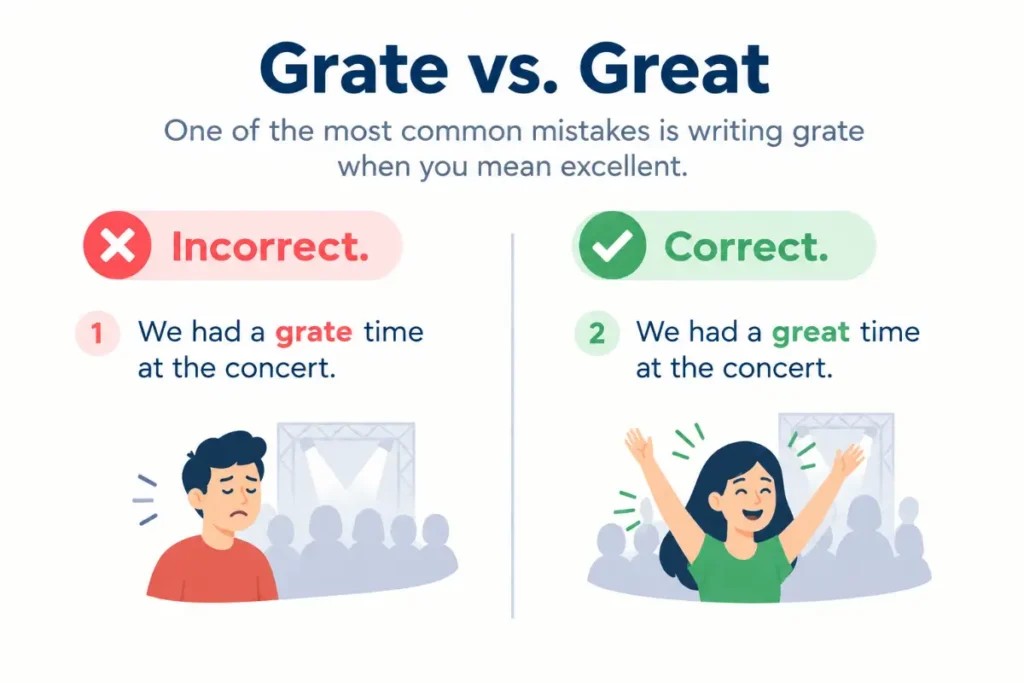
One of the most common mistakes is writing grate when you mean excellent.
Incorrect.
- We had a grate time at the concert.
Correct.
- We had a great time at the concert.
The phrase great time is extremely common. The adjective describes an enjoyable experience.
Another common mistake occurs when someone writes great when they mean shred.
Incorrect.
- Great the cheese over the soup.
Correct.
- Grate the cheese over the soup.
A third mistake occurs with the expression grate on.
Incorrect.
- His attitude really greats on me.
Correct.
- His attitude really grates on me.
The verb changes to grates because the subject attitude is singular.
Another mistake appears when writers confuse grate with grater.
A grater is the kitchen tool. Grate is the action.
For example.
- I used a grater to grate the cheese.
This sentence uses both words correctly.
You would not normally say that you used a grate to grate cheese because a grate usually refers to a framework or similar structure rather than a kitchen grater.
Memory Tips
A good memory trick can save you from spelling mistakes.
Think about the letter A in grate.
The word grate connects naturally with grate and grater in the kitchen. You can grate cheese with a grater.
Think about great as the positive word.
When something is excellent you want to call it great.
Another useful trick is to connect grate with irritation.
A rough sound can grate on your ears. An annoying habit can grate on your nerves. Both ideas involve an unpleasant rubbing sensation.
You can also remember the difference through a simple sentence.
Grate the cheese because it is great.
The sentence places both words together and gives each one a different job.
This method works because you create a clear mental connection instead of trying to memorize two isolated spellings.
Related Grammar And Usage Notes
English contains many homophones that create similar problems.
Words such as their there and they’re sound alike in most varieties of American English. Their meanings and grammatical roles differ.
To two and too create another familiar problem.
Your and you’re also sound similar in many contexts but perform different grammatical functions.
Grate and great belong to the same broad category of spelling confusion. The difference becomes easier when you focus on meaning instead of sound.
Great is an adjective.
Grate can be a verb or a noun.
This grammatical distinction gives you a strong shortcut.
If the word describes a noun as excellent then great is the natural choice.
If the word identifies a metal framework then grate is the natural choice.
Professional writers should pay close attention to these distinctions because spelling errors can change the meaning of a sentence.
A reader may understand what you intended but still see the mistake immediately. In professional communication such errors can make otherwise strong writing look careless.
Formal And Informal Usage
Great is extremely common in everyday American English.
People regularly use it in casual conversations.
- Great idea.
- Great job.
- Great question.
- Great to see you.
It also appears in professional communication. However the word can become vague if you use it too often.
Instead of saying that every result was great you can choose a more precise adjective.
Excellent can express a high level of quality.
Effective can describe something that works well.
Impressive can describe something that creates admiration.
Successful can describe an outcome that achieves its goal.
Grate has more specific uses.
The food preparation meaning appears frequently in recipes and cooking instructions.
The irritation meaning often appears in descriptive or formal writing.
The noun meaning appears in construction home maintenance plumbing architecture and other practical contexts.
American And British English Usage
The basic distinction between grate and great remains the same in American and British English.
Both varieties use grate for meanings connected with shredding irritation and metal frameworks.
Both use great for meanings such as excellent large important and impressive.
Pronunciation can vary slightly between accents. However these two words commonly remain homophones.
Spelling therefore continues to carry the main distinction.
This makes the pair a useful example of why English spelling cannot always be predicted from pronunciation.
A person learning English may hear the same sound but encounter two different written forms. The surrounding meaning provides the clue.
Professional Writing Tips
When proofreading your work do not rely only on how a sentence sounds.
Read the sentence for meaning.
Ask yourself what the word needs to communicate.
If you are describing quality use great.
If you are describing shredding use grate.
You can also replace the word temporarily with a synonym.
If you can replace it with excellent then great is probably correct.
If you can replace it with shred then grate is correct.
This synonym test works well during proofreading because it focuses on meaning rather than sound.
Common Expressions With Great
It appears in many everyday phrases.
Great job expresses strong approval.
Great deal can mean a large amount. It can also refer to a good bargain depending on context.
For example.
- She spent a great deal of time studying.
Greatest is the superlative form of great.
For example.
- That was one of the greatest performances of his career.
Greater is the comparative form.
For example.
- This approach offers greater flexibility.
These forms are related to great rather than grate.
Common Expressions With Grate
Grate appears in several useful expressions.
Grate on someone means to irritate that person.
For example.
- His constant criticism grates on his coworkers.
Grate against something can describe physical rubbing or friction.
For example.
- The metal parts grated against each other.
A grate can also appear in practical descriptions.
For example.
- Leaves blocked the drain grate.
These uses all preserve the core idea of rubbing irritation or a framework.
Why These Words Are Easy To Confuse
English spelling often preserves historical patterns that do not match modern pronunciation perfectly.
That is one reason learners can hear a sound and still face several possible spellings.
Grate and great are especially confusing because they have almost identical written forms as well. Only one letter separates them.
That small spelling difference carries a completely different meaning.
The solution is not to memorize pronunciation. You already know that the words sound alike.
Instead focus on the role the word plays in the sentence.
Meaning comes first.
Grammar comes next.
Spelling follows from those two clues.
This approach also helps with many other confusing English words.
A Quick Decision Test
When you are unsure about the spelling ask yourself one question.
What do I mean?
If the answer is excellent then choose great.
If the answer is large or significant then choose great.
You can make the test even faster.
Great means good or significant.
Grate means shred irritate or framework.
Once this distinction becomes automatic you will rarely confuse the two.
Grate or Great In Everyday Writing
The phrase grate or great often appears in searches because people hear the words before they see them in writing.
Voice conversations do not reveal spelling. Written communication does.
Suppose someone tells you that they had a great weekend. You hear the sound but context tells you the intended meaning.
Suppose someone asks you to grate a carrot. Again context gives you the answer.
This is why spelling questions often require more than pronunciation knowledge.
A strong writer pays attention to the meaning of the complete sentence.
That habit improves accuracy far beyond this one pair of words.
Key Takeaways
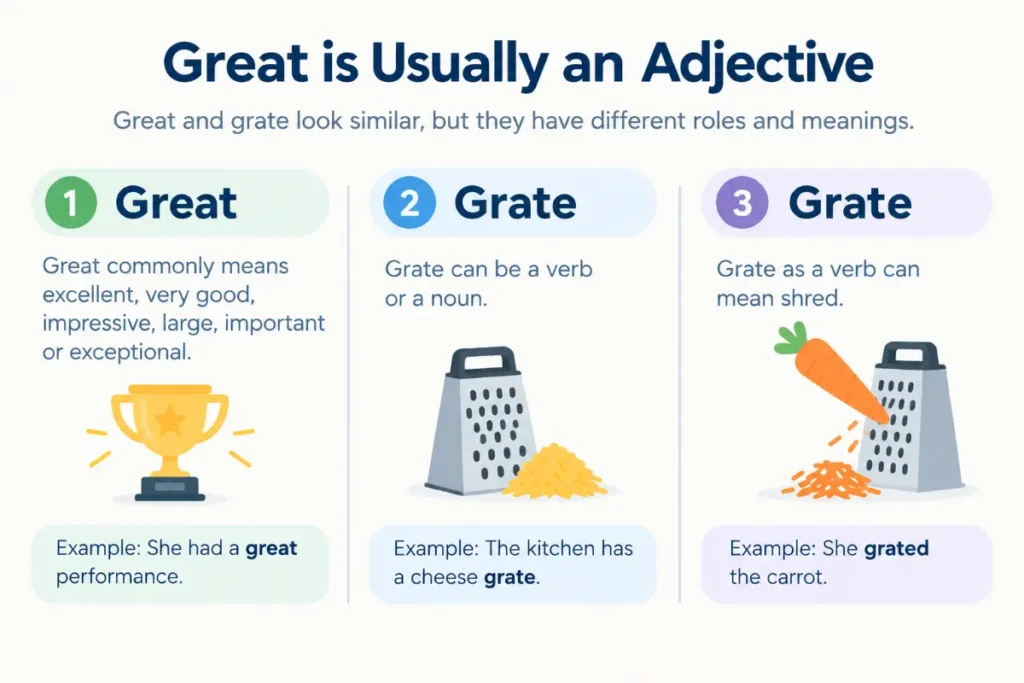
- Great is usually an adjective.
- Great commonly means excellent very good impressive large important or exceptional.
- Grate can be a verb or a noun.
- Grate as a verb can mean shred.
- Grate as a verb can mean irritate.
- Grate as a noun can mean a metal framework that covers or supports an opening.
- Grate and great are normally pronounced the same in American English.
- Context determines which spelling makes sense.
- Use great for positive descriptions such as great job and great idea.
- Use grate for actions such as grate the cheese and expressions such as grate on my nerves.
Conclusion
Grate or great becomes easy to distinguish once you connect each spelling with its meaning. Great describes something excellent impressive large important or exceptional. Grate describes shredding irritation or a framework such as a drain grate.
The pronunciation can make these words tricky because they sound the same in American English. That does not make them interchangeable. When you write them focus on the meaning first and then choose the spelling that matches it.
Remember one simple rule. Great is associated with something good or significant. Grate is associated with shredding irritation or a physical framework. With that distinction in mind you can use both words confidently and avoid one of the most common homophone spelling mistakes in English.
Frequently Asked Questions
Is grate or great correct for excellent?
Great is correct when you mean excellent very good impressive or enjoyable.
For example.
That was a great performance.
You should not use grate in this context.
Are grate and great pronounced the same?
Yes. In standard American English they are normally homophones. They have the same pronunciation but different meanings and spellings.
What does grate mean?
Grate can mean to shred food. It can also mean to irritate someone. As a noun it can refer to a framework made from bars or similar material.
What does great mean?
Great usually means very good excellent impressive large important or exceptional. The exact meaning depends on the context.
Is it grate cheese or great cheese?
Grate cheese is the correct phrase when you mean to shred cheese.
Great cheese is also grammatically correct but it has a different meaning. It describes cheese that you consider excellent.
Is it a grate or great time?
The correct expression is a great time.
Great describes the experience as enjoyable.
What does grate on me mean?
Grate on me means irritate me or annoy me.
For example.
His constant complaining really grates on me.
Is grate a noun or a verb?
Grate can be both.
As a verb it can mean shred or irritate.
As a noun it can refer to a metal framework that covers or supports an opening.
Is grater related to grate?
Yes. A grater is a tool used to grate food. The relationship between the two words can help you remember the spelling.
Can great mean large?
Yes. Great can mean large or considerable in certain contexts. This meaning is more formal in many modern American English sentences.
Why do grate and great sound the same?
They developed different spellings and meanings but commonly share the same pronunciation in modern American English. This makes them homophones.
How can I remember the difference between grate or great?
Connect great with excellent and grate with shredding irritation or a metal framework. You can also remember the sentence Grate the cheese because it is great.

English Grammar & Usage
Nathan Holloway is an American grammar writer and language researcher who specializes in English grammar, sentence structure, verb usage, and common writing mistakes. He enjoys breaking down confusing grammar rules into practical explanations with clear examples, making English easier for students, professionals, and everyday writers.