
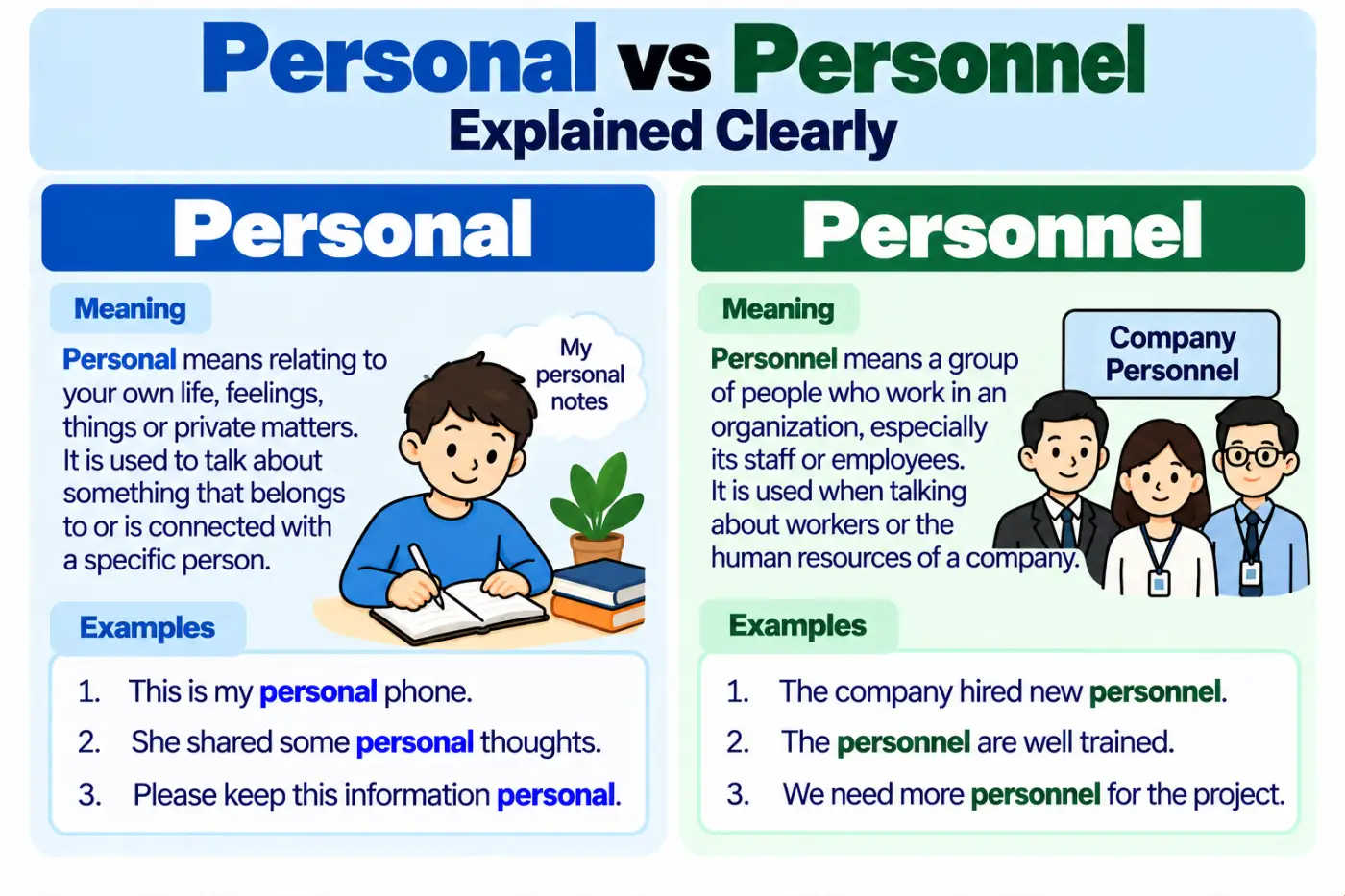
Personal vs personnel can be confusing because the two words share the same beginning and sound similar. They are not interchangeable. Personal is usually an adjective that describes something connected to an individual or private life. Personnel is a noun that refers to employees or members of an organization.
The easiest way to see the difference is to think about the focus of the sentence. If you are talking about one person’s belongings, opinions, choices, experiences, or private matters, personal is usually the right word. If you are talking about employees as a group or a department that handles employee matters, personnel is the word you need.
This distinction matters in everyday English and professional writing. A small spelling difference can change the meaning of a sentence completely. Once you connect personal with an individual and personnel with employees, the difference becomes much easier to remember.
Short Answer
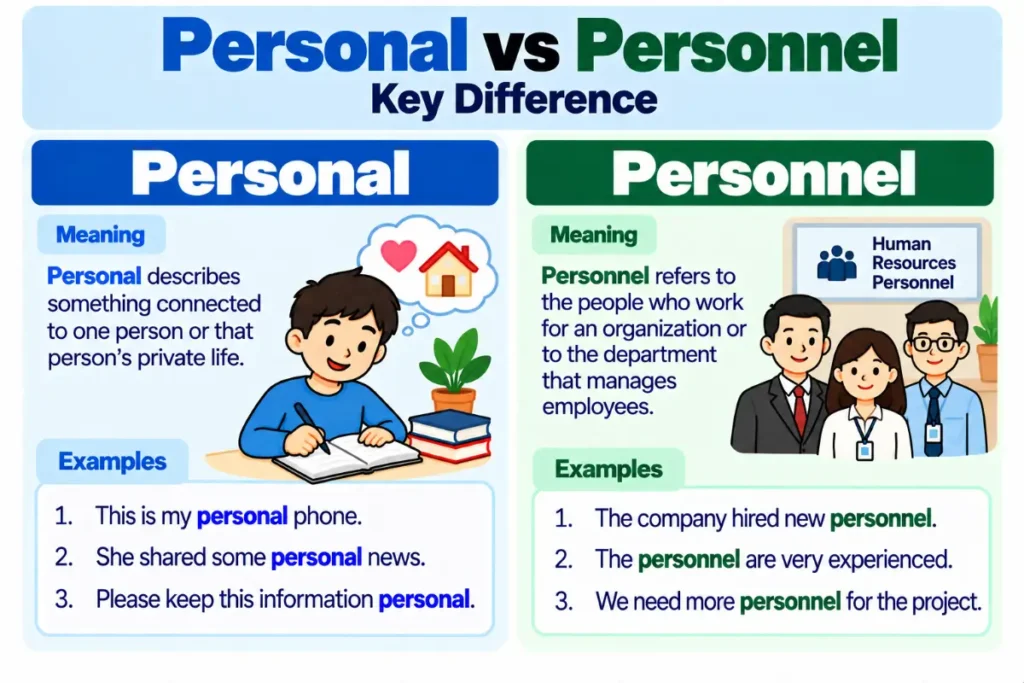
Personal describes something connected to one person or that person’s private life. Personnel refers to the people who work for an organization or to the department that manages employees. For example, personal information belongs to an individual, while personnel may include everyone working at a company. The two words look similar but they have different meanings and grammatical roles.
Table of Contents
- What personal means.
- What personnel means.
- The main difference between personal and personnel.
- Personal as an adjective.
- Personnel as a noun.
- How to use personal correctly.
- How to use personnel correctly.
- Personal vs personnel in the workplace.
- Personal information and personnel information.
- Personal file and personnel file.
- Personal and personnel pronunciation.
- Common mistakes.
- Memory tips.
- Similar words that cause confusion.
- Professional writing tips.
- Real life examples.
- Related usage notes.
- Frequently asked questions.
- Key takeaways.
- Conclusion.
What Personal Means
Personal is mainly an adjective. It describes something connected to a particular person. It can also describe something private or related to someone’s individual life. Cambridge defines it as relating or belonging to a single or particular person and also uses it for matters connected with someone’s private life.
Consider these examples.
- I keep my personal documents in a locked drawer.
The documents belong to one individual. That makes personal the correct adjective.
- She shared her personal opinion during the meeting.
The opinion belongs to her as an individual. Personal describes the source of the opinion.
- He left his personal belongings in the car.
The belongings belong to him rather than to a group or organization.
- We should keep personal matters out of the meeting.
Here personal refers to private matters connected with individual lives.
Personal can also describe something designed for one person.
- I use a personal computer at home.
- She applied for a personal loan.
- He hired a personal trainer.
In each case personal points toward an individual rather than a group.
The word can also describe something done directly by a person.
- The manager gave the customer personal attention.
- The president made a personal appearance at the event.
- I want to offer my personal thanks.
The central idea remains the same. Personal connects the subject to an individual.
What Personnel Means
Personnel is a noun. It usually refers to the people who work for an organization. It can describe employees in a company as well as members of military organizations or other groups. Cambridge defines personnel as the people employed in a company organization or armed force.
For example.
- The hospital needs more medical personnel.
Personnel means the people working in the hospital in this context.
- Only authorized personnel may enter this area.
Authorized personnel means employees or other approved people who have permission to enter.
- The company hired additional personnel.
Personnel means additional workers or employees.
Personnel has another important meaning. It can refer to the department or function within an organization that handles employee matters. Cambridge and Oxford both recognize this use.
For example.
- Please contact personnel about your benefits.
Here personnel refers to the employee related department or function.
- She works in personnel.
The sentence means that she works in the department that handles employee matters.
- The personnel manager reviewed the records.
The personnel manager handles employee related responsibilities.
In modern American workplaces, human resources or HR is often used for this department. Personnel remains correct and is still common in formal expressions and established workplace language.
The Main Difference Between Personal And Personnel
The clearest difference is simple.
Personal relates to one person or that person’s private life.
Personnel refers to employees or an employee related department.
The two words also have different grammatical roles.
| Word | Main part of speech | Main meaning | Example |
|---|---|---|---|
| Personal | Adjective | Connected to an individual | This is my personal opinion. |
| Personnel | Noun | Employees or employee department | The personnel arrived early. |
Think of the words as belonging to two different categories.
Personal describes.
Personnel names people or an employee related function.
That grammatical difference helps prevent many mistakes.
You would say personal information because information is being described as belonging to or concerning an individual.
You would say personnel department because the department handles employee matters.
Personal As An Adjective
Personal works as an adjective in most everyday uses. It comes before a noun and gives more information about that noun.
Common combinations include personal information, personal opinion, personal experience, personal choice, personal belongings, personal responsibility, personal life, personal account, personal decision, and personal preference.
Consider how naturally the word fits these sentences.
- Please protect your personal information.
- That is my personal preference.
- She spoke from personal experience.
- He accepted personal responsibility for the mistake.
- I need some personal time.
- They discussed the issue in a personal meeting.
- She keeps her personal belongings at home.
- He gave a personal response to the letter.
Personal does not normally mean employees. That is one of the most important points to remember.
For example, this sentence is incorrect if you mean employees.
The company needs more personal.
The correct sentence is.
The company needs more personnel.
Personal needs a noun when it functions as an adjective.
You could say.
The company needs more personal assistance.
The company needs more personal support.
In those examples personal describes assistance and support.
Personnel As A Noun
Personnel functions as a noun. It normally refers to a group of workers.
This explains why you can write sentences such as these.
- The personnel are ready.
- The personnel were informed about the change.
- The company needs additional personnel.
- Security personnel checked the building.
- Medical personnel treated the injured passengers.
Oxford identifies personnel as a plural noun for people who work for an organization or armed force. It also recognizes a separate uncountable use for the department dealing with employees.
In American English, personnel is commonly treated as a collective group noun. The exact verb choice can depend on the sentence and style. When personnel clearly means individual workers, a plural verb can sound natural.
For example.
The personnel are waiting outside.
When personnel means an organizational department, singular agreement can also appear.
Personnel is reviewing the policy.
The difference comes from the meaning intended in the sentence.
How To Use Personal Correctly
Use personal when the noun after it relates to an individual.
Personal information means information about a particular person.
Personal belongings means belongings owned or carried by an individual.
The word can also describe something that is private.
For example.
She doesn’t discuss her personal life at work.
The adjective does not necessarily mean the information belongs physically to someone. It can simply mean that the matter concerns that person’s private life.
Personal can also describe a direct action.
For example.
The director gave the customer personal attention.
The director personally became involved rather than leaving the matter entirely to someone else.
How To Use Personnel Correctly
Use personnel when you mean employees or workers as a group.
Here are several common combinations.
- Company personnel.
- Office personnel.
- Medical personnel.
- Security personnel.
- Military personnel.
- Emergency personnel.
- Technical personnel.
- Administrative personnel.
- Support personnel.
- Sales personnel.
These expressions are common in professional and institutional writing. Oxford lists examples such as sales personnel, technical personnel, medical personnel, security personnel, and military personnel.
Personnel can also refer to the employee management department.
For example.
- Contact personnel for more information.
- She works in personnel.
- The personnel manager handled the request.
- The personnel department maintains employee records.
Modern organizations often use HR or human resources for this function. Still, personnel appears in many established expressions and remains a standard English word.
Personal Vs Personnel In The Workplace
The workplace is where this confusion appears most often.
Imagine a company has 200 employees. Those employees are personnel.
Now imagine an employee has a private phone number. That phone number is personal information.
The distinction becomes clear when you compare the two.
The company hired additional personnel.
The company protects employees’ personal information.
The first sentence concerns workers.
The second concerns information connected to individual employees.
Here are more examples.
- The hospital needs additional medical personnel.
Medical personnel means doctors, nurses, technicians, and other workers involved in medical services.
- Employees must protect personal information.
Personal information means information that relates to an individual.
- The personnel manager reviewed the employee records.
Personnel refers to the employee management function.
- The manager respected the employee’s personal concerns.
Personal refers to matters connected with that individual.
- Security personnel entered the building.
Personnel refers to security workers.
- The guard kept his personal belongings in a locker.
Personal describes belongings owned by the guard.
A useful rule is to ask what the word describes or names. If it describes something connected to an individual, use personal. If it names workers as a group, use personnel.
Personal Information And Personnel Information
Both words are not automatically interchangeable.
Personal information refers broadly to information connected with an identifiable person or individual. Depending on the context, this can include contact details, identification information, financial information, preferences, or other information associated with a person.
Personnel information usually has a narrower workplace meaning. It can refer to information kept about employees.
For example.
The company must protect employees’ personal information.
This sentence focuses on information belonging to or concerning individuals.
The personnel records contain information about employee training.
Here personnel describes records connected with the organization’s employees.
The key difference is context.
Personal points to the individual.
Personnel points to employees as an organizational group or to the employee management function.
Personal File And Personnel File
These expressions can also create confusion.
A personal file may mean a file containing someone’s private documents. The exact meaning depends on context.
A personnel file usually means an employee record maintained by an organization.
For example.
The employee’s personnel file contains records of training and performance.
Here personnel refers to the employee related function.
The employee stored a personal file on the computer.
Here personal means the file belongs to the individual.
In professional writing, personnel file is the clearer choice when discussing an official employee record.
Personal And Personnel Pronunciation
The two words look similar and begin with the same letters, but their pronunciation differs.
Personal is pronounced with three syllables in standard American English. Cambridge gives the US pronunciation as /ˈpɝː.sə.nəl/.
Personnel has three syllables as well, but the stress falls later in the word. Cambridge gives the US pronunciation as /ˌpɝː.səˈnel/.
The difference in stress can help you recognize the words when speaking.
Personal has stronger stress near the beginning.
Personnel has its strongest stress on the final syllable.
That final stressed sound is one of the easiest clues.
If you hear a word that ends with a clearly stressed sound like nel and the context concerns workers, personnel is likely the intended word.
Why These Words Get Confused
The confusion is understandable.
Both words begin with person.
Both can appear in professional settings.
The spelling difference is small, but the meaning difference is large.
Personal developed as an adjective connected with an individual. Personnel entered English through French and developed as a noun for people employed in an organization. Oxford traces personnel to French and notes its early nineteenth century origin.
That history explains why the words look related. They are related in form and ultimately connected to the idea of people, but modern English gives them different jobs.
Common Mistakes
Several mistakes appear repeatedly in writing.
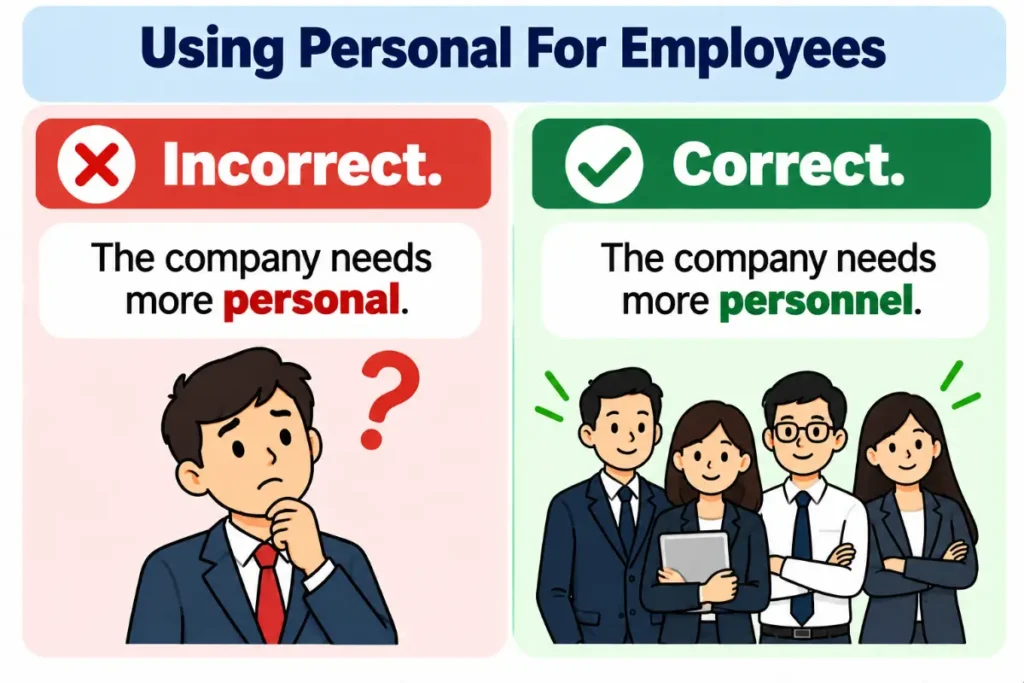
Using Personal For Employees
Incorrect.
The company needs more personal.
Correct.
The company needs more personnel.
Personnel is the noun that refers to employees.
Using Personnel Before A Private Matter
Incorrect.
I need to discuss a personnel problem in my family.
If the intended meaning is a private problem affecting an individual, personal is normally the better choice.
Correct.
I need to discuss a personal problem.
Confusing Personnel With Personal Information
Incorrect.
Please protect your personnel information.
If you mean information about an individual, personal information is the standard expression.
Correct.
Please protect your personal information.
Using Personnel As An Adjective
Personnel is normally a noun.
You should not treat it as a general adjective meaning private or individual.
For example, you would not write personnel opinion to mean someone’s own opinion.
The natural phrase is personal opinion.
Treating Personal And Personnel As Interchangeable
They are not interchangeable.
Compare these sentences.
She shared her personal opinion.
The personnel shared their opinions.
The first sentence describes an individual opinion.
The second sentence refers to employees or workers.
Memory Tips
A simple memory trick can make this distinction stick.
Think of personal as person plus al.
It describes something connected to a person.
Think of personnel as people at work.
The ending sounds different too. Personal has its strongest stress near the beginning. Personnel has its strongest stress near the end.
You can also use a simple question.
Is the word describing something belonging to one person.
Use personal.
Is the word referring to workers or an employee department.
Use personnel.
Try this mental test.
Personal belongs with private life.
Personnel belongs with workplace people.
That single contrast solves most cases.
Another useful connection is this.
Personal opinion.
Personnel department.
Personal belongings.
Personnel manager.
Personal experience.
Personnel records.
After seeing these pairs several times, the spelling starts to feel natural.
Similar Words That Cause Confusion
Personal and personnel are not the only English words that look alike but perform different jobs.
Person
Person is a noun that refers to an individual human being.
One person joined the meeting.
Personnel
Personnel is a noun that refers to employees or an employee related department.
The personnel arrived before the event.
Personally
Personally is an adverb.
It can mean in one’s own view or directly by oneself.
Personally, I prefer the first option.
Personality
Personality refers to the characteristic patterns of behavior and qualities associated with a person.
Her personality is friendly and calm.
Personable
Personable is an adjective meaning pleasant and easy to meet or deal with.
The receptionist was friendly and personable.
These words share a common root or related form, but their meanings and grammatical roles differ.
Professional Writing Tips
Correct word choice matters more in professional writing because small errors can change meaning.
When writing about employees, personnel can be useful in formal contexts.
For example.
The company needs qualified technical personnel.
The facility has trained emergency personnel on site.
Only authorized personnel may enter the restricted area.
When writing about individual employees, personal may be more appropriate.
For example.
Employees must update their personal information.
Each employee has personal responsibility for protecting account details.
The manager respected the employee’s personal concerns.
In modern workplace writing, staff, employees, workers, and human resources can sometimes sound more natural than personnel. The best choice depends on the sentence and the level of formality.
Personnel is especially common in institutional, military, medical, technical, and administrative contexts. Cambridge lists combinations such as medical personnel, security personnel, military personnel, and technical personnel.
Real Life Examples
Seeing the words in realistic sentences makes the difference easier to apply.
Office Example
The company hired five new personnel.
This means the company hired five new workers. In ordinary American workplace writing, five new employees or five new staff members may sound more natural, but personnel is grammatically possible when referring to workers as a group.
Privacy Example
Employees should never share personal information without permission.
Personal describes information connected to individual people.
Hospital Example
Emergency personnel arrived within minutes.
Personnel means the emergency workers who responded.
Family Example
She took a personal day to deal with a family matter.
Personal describes a matter connected to her private life.
Security Example
Only authorized personnel can enter the laboratory.
Personnel refers to people who have permission to enter.
Opinion Example
That is my personal opinion.
Personal describes the opinion as belonging to the speaker.
Human Resources Example
Please contact personnel if you need help with your employee records.
Personnel refers to the department or function responsible for employee matters.
Military Example
Military personnel received additional training.
Personnel refers to members of the military.
School Example
School personnel must follow the safety policy.
Personnel refers to employees and workers at the school.
Individual Responsibility Example
Every employee has a personal responsibility to protect confidential information.
Personal describes responsibility connected to each individual employee.
Related Usage Notes
Personal can appear in many common phrases.
Personal preference refers to something an individual prefers.
Personnel also appears in established phrases.
Personnel department refers to the department responsible for employee matters.
Military personnel refers to members of the military.
Medical personnel refers to workers who provide medical care or services.
Security personnel refers to workers responsible for security.
Emergency personnel refers to workers who respond to emergencies.
Technical personnel refers to workers with specialized technical skills.
Authorized personnel refers to people who have permission to enter or perform a particular task.
These combinations are worth learning as complete phrases. They make word choice faster and reduce spelling mistakes.
Personal Vs Personnel In American English
Both words are standard in American English.
Personal is extremely common in everyday speech and writing. It appears in phrases related to privacy, opinions, belongings, choices, experiences, and individual actions.
Personnel is more strongly associated with formal, professional, institutional, and organizational contexts.
American English also commonly uses HR or human resources for the department responsible for employees. Personnel is still standard and appears in phrases such as personnel department and personnel manager. Cambridge recognizes both the employee group meaning and the department meaning.
The main distinction does not change across standard American and British English. The words keep their separate meanings.
Formal And Informal Usage
Personal works comfortably in formal and informal English.
You might say.
That is my personal opinion.
Please protect your personal information.
I need some personal time.
Personnel has a more formal sound in many contexts.
For casual conversation, Americans often say employees or staff.
For example.
We need more employees.
We need more staff.
In a formal report, you might see.
The organization requires additional personnel.
This does not make personnel more correct than employees. It simply reflects a different register and context.
Grammar Details Worth Remembering
Personal is an adjective.
That means it normally modifies a noun.
Personal information.
Personal choice.
Personnel is a noun.
It can function as the subject or object of a sentence.
Personnel arrived at the scene.
The manager contacted personnel.
Personnel can also be part of a compound expression.
Personnel records.
The grammatical difference gives you another reliable test.
If you need a word to describe a noun connected with one person, personal is likely correct.
If you need a noun meaning employees or an employee department, personnel is likely correct.
A Quick Correction Test
When you are unsure, replace the word mentally.
If you can replace it with individual or private, personal probably fits.
For example.
Personal opinion.
Individual opinion.
Personal information.
Private information.
Personal belongings.
Individual belongings.
The exact replacement will not always sound natural, but the basic meaning can guide you.
If you can replace the word with employees or workers, personnel probably fits.
For example.
Medical personnel.
Medical workers.
Security personnel.
Security workers.
Military personnel.
Military members.
Again, these replacements are memory tools rather than strict synonyms in every context.
Key Takeaways
- Personal is mainly an adjective.
- Personal describes something connected to an individual.
- Personal can also refer to private matters or individual experiences.
- Personnel is a noun.
- Personnel commonly means employees or workers as a group.
- Personnel can also refer to an employee related department.
- Personal information concerns an individual.
- Personnel records usually concern employees within an organization.
- Personal has stronger stress near the beginning.
- Personnel has stronger stress on the final syllable.
- In casual American English, employees or staff may sometimes sound more natural than personnel.
- The simplest memory rule is person for personal and people at work for personnel.
Conclusion
Personal vs personnel becomes much easier once you focus on the central meaning of each word. Personal describes something connected to an individual or private life. Personnel refers to employees or to the organizational function that handles employee matters. The words look alike because they share a related form, but they perform different grammatical jobs.
Use personal for phrases such as personal opinion, personal information, personal experience, personal belongings, and personal responsibility. Use personnel for phrases such as medical personnel, security personnel, military personnel, personnel department, and personnel manager. When you connect personal with the individual and personnel with the workforce, the spelling and meaning become much easier to recall.
The best test is simple. Ask yourself if you are describing something connected to one person or naming a group of workers. If you are describing an individual matter, choose personal. If you are talking about employees or an employee related department, choose personnel. Once that distinction becomes familiar, this common word pair stops being a spelling trap.
Frequently Asked Questions
Is personal or personnel correct for employees?
Personnel is correct when you mean employees or workers as a group. Personal is an adjective describing something connected to an individual.
What is the difference between personal vs personnel?
Personal describes something related to one person or private life. Personnel is a noun referring to employees or an employee related department. The words have different meanings and grammatical roles.
Is personnel singular or plural?
Personnel can refer to a group of people and is commonly treated as a plural noun in that use. Oxford also identifies a department use that can take singular or plural agreement depending on the intended meaning and style.
Is personnel a formal word?
Yes. Personnel is standard English and is especially common in professional institutional military medical technical and administrative contexts. In casual American English, employees or staff may sound more natural in some sentences.
Can personal mean employees?
No. Personal does not normally mean employees. It is mainly an adjective describing something connected with an individual or private life.
What does personnel mean at work?
At work, personnel can mean the employees of an organization. It can also mean the department or function that handles employee matters.
Is personal information or personnel information correct?
Personal information is the usual expression when you mean information connected with an individual. Personnel information can be used in specific workplace contexts for information about employees.
Is it personal file or personnel file?
Personnel file is normally used for an official employee record maintained by an organization. Personal file can mean a file belonging to an individual or containing private material depending on context.
How do you pronounce personal?
In standard American English, personal has the pronunciation /ˈpɝː.sə.nəl/. Its strongest stress falls near the beginning.
How do you pronounce personnel?
In standard American English, personnel is pronounced /ˌpɝː.səˈnel/. Its strongest stress falls on the final syllable.
Is personnel the same as human resources?
Not exactly. Personnel can refer to employees or to the department handling employee matters. Human resources usually refers to the organizational function responsible for managing employees. The terms can overlap when referring to the department.
What is an easy way to remember the difference?
Think of personal as connected to one person. Think of personnel as connected to people at work. Personal describes something. Personnel names workers or an employee related department.

Confusing Words, Spelling & Word Choice
Claire Whitmore is a U.S.-based English editor who writes about commonly confused words, spelling differences, and word choice. Her work helps readers understand subtle distinctions between similar-looking words through simple definitions, practical examples, and modern usage guidance in both American and British English.