
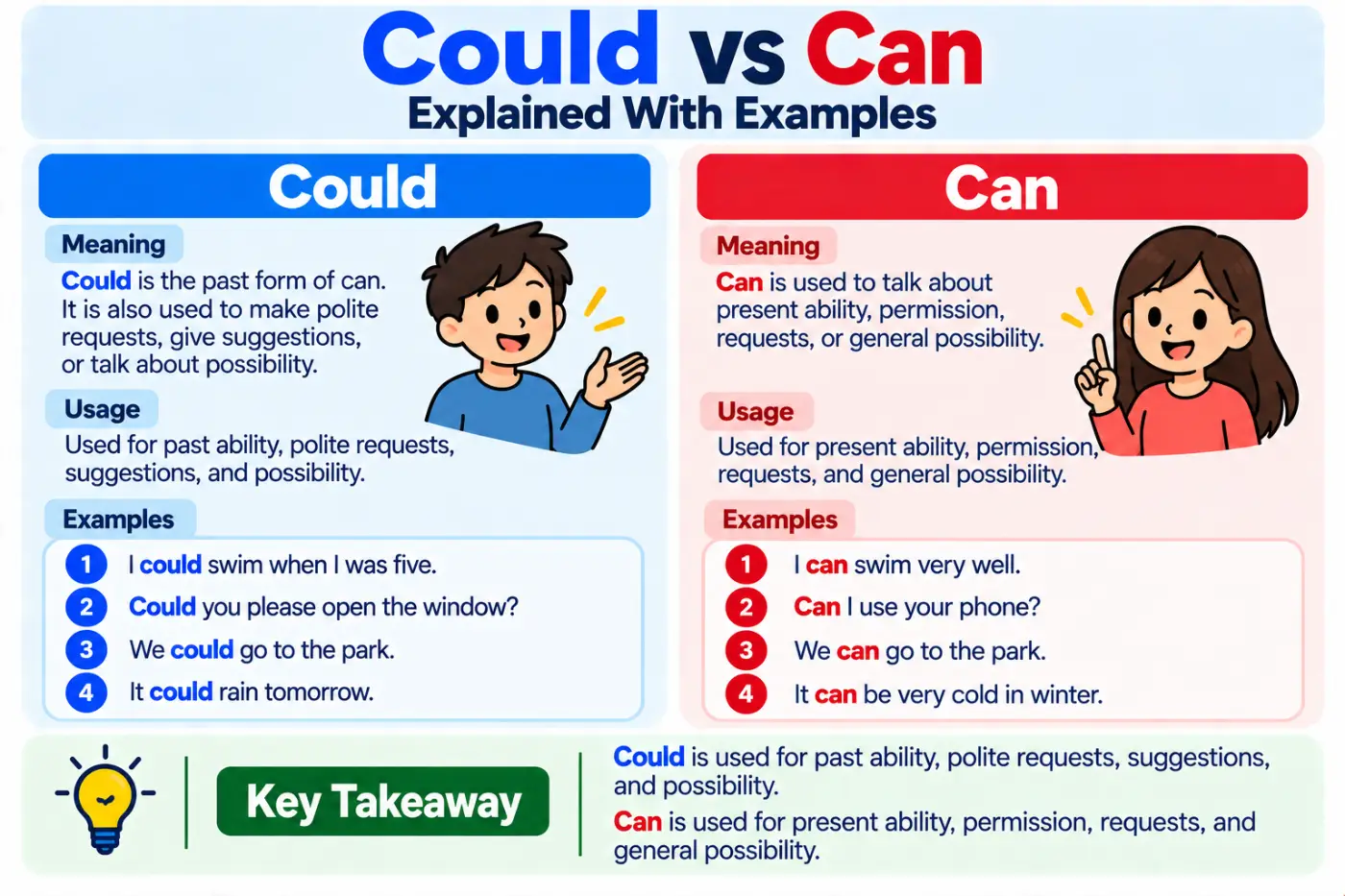
Could vs can often confuses English learners because both words talk about ability, possibility, and requests. The difference becomes much clearer when you focus on time, certainty, and politeness. Can usually sounds more direct and certain. Could often moves the meaning into the past or makes a statement softer and less certain.
Native speakers use both words constantly in everyday conversation. You might say that you can swim, that you could swim when you were younger, or that you could help someone tomorrow. The words look similar because they belong to the same family of modal verbs, but they don’t always perform the same grammatical job.
The key is to look at the meaning of the sentence instead of memorizing one simple rule. Once you understand how these modal verbs work with ability, permission, possibility, requests, and suggestions, the difference becomes much easier to recognize and use naturally.
Short Answer
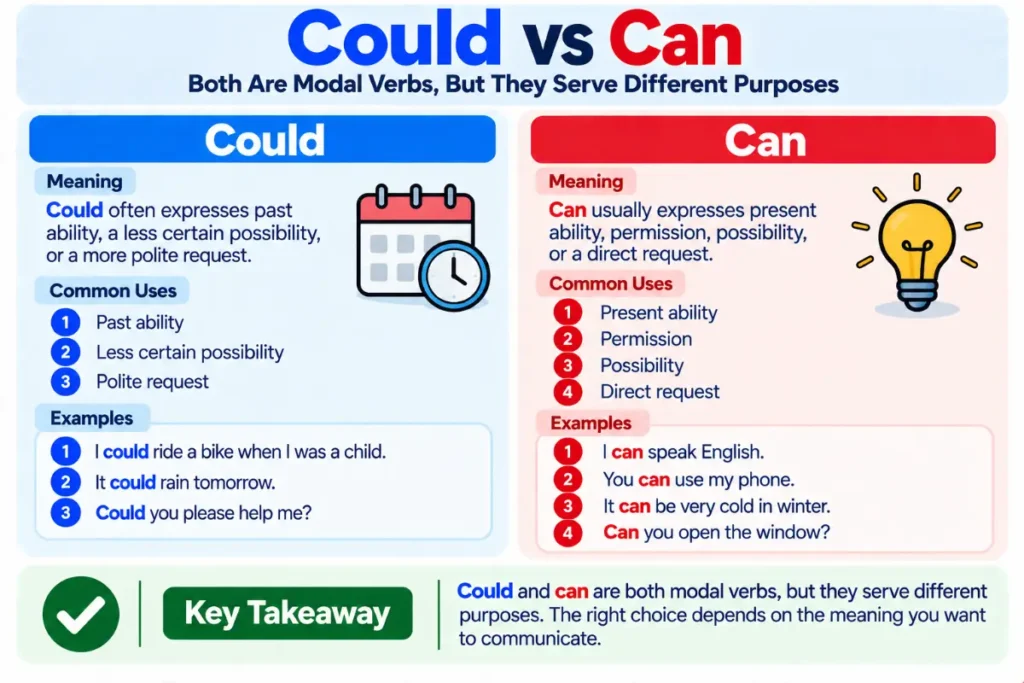
Could and can are both modal verbs, but they serve different purposes. Can usually expresses present ability, permission, possibility, or a direct request. Could often expresses past ability, a less certain possibility, or a more polite request. The right choice depends on the meaning you want to communicate.
Table Of Contents
- What Can Means.
- What Could Means.
- The Main Difference Between Can And Could.
- Can For Present Ability.
- Could For Past Ability.
- Can For Permission.
- Could For Polite Requests.
- Can And Could For Possibility.
- Could For Suggestions.
- Can And Could In Questions.
- Could Have And Can Have.
- Could And Can In Professional Writing.
- Pronunciation Of Can And Could.
- Common Mistakes.
- Real Life Examples.
- Memory Tips.
- Related Grammar Notes.
- Frequently Asked Questions.
- Key Takeaways.
- Conclusion.
What Can Means
Can is a modal verb that commonly expresses present ability. It tells the reader or listener that someone has the skill or capacity to do something.
For example:
I can drive.
This sentence means the speaker has the ability to drive.
She can speak Spanish.
This tells us that she has the ability to speak Spanish.
Can can also express permission.
You can leave early today.
Here can means that someone has permission to leave.
Can can also express general possibility.
It can get very cold here in winter.
The sentence describes something that is possible or can happen under certain conditions.
Can also appears in direct requests.
Can you help me?
This is a normal and very common request in American English.
Because can has several uses, you need to look at the context. The same word can communicate ability, permission, possibility, or a request.
What Could Means
Could is also a modal verb. It has several important uses, including past ability, possibility, polite requests, and suggestions.
For past ability, could describes something someone had the ability to do in the past.
When I was younger I could run five miles without stopping.
The speaker had that ability at an earlier time.
Could can also express possibility.
We could have rain this afternoon.
This means rain is possible.
Could also make a request sound more polite or less direct.
Could you send me the report?
This request sounds more formal and softer than a direct request with can.
Could can also introduce a suggestion.
We could meet after work.
The speaker suggests one possible plan.
So could doesn’t have one single meaning. Context determines its function.
The Main Difference Between Can And Could
The central distinction becomes easier when you compare their most common uses.
| Use | Can | Could |
|---|---|---|
| Present ability | Yes | Usually not |
| Past general ability | No | Yes |
| Permission | Common | Possible and more formal |
| Direct request | Common | More polite |
| Possibility | General or realistic possibility | Possible but often less certain |
| Suggestion | Less common | Common |
| Conditional situation | Sometimes | Common |
| Past opportunity | No | Yes |
Consider these examples.
I can swim.
The speaker has the ability now.
I could swim when I was six.
The speaker had the ability in the past.
Can you open the window?
This is a direct request.
Could you open the window?
This is a more polite request.
It can happen.
The speaker presents the event as a real possibility.
It could happen.
The speaker presents the event as one possible outcome.
The difference isn’t always about right versus wrong. In many situations both forms are grammatically correct, but they create a different tone or meaning.
Can For Present Ability
Use can when you want to describe an ability that someone has now.
I can cook.
Maria can play the piano.
My brother can fix computers.
We can finish the project today.
In each sentence, can connects the subject with a current ability or capacity.
Can also describe skills that remain true over time.
Dogs can swim.
Birds can fly.
Some plants can survive with very little water.
These statements describe general abilities rather than one specific event.
Remember that can is followed by the base form of the verb.
Correct:
She can drive.
Incorrect:
She can drives.
Correct:
He can speak English.
Incorrect:
He can speaks English.
Modal verbs such as can and could don’t take the third person singular ending. You don’t add s to the verb that follows them.
Could For Past Ability
Use could when you describe a general ability that someone had in the past.
I could read when I was four.
She could dance beautifully as a child.
We could see the mountains from our old house.
These examples describe abilities that existed at an earlier time.
This use works especially well when you describe something that was generally possible over a period of time.
When I was a teenager I could stay awake all night.
The speaker describes a past ability.
For one specific successful event in the past, English often uses was able to instead of could.
Compare these sentences.
When I was young I could swim very well.
This describes a general past ability.
Yesterday I was able to swim across the lake.
This describes one particular successful event.
Could can sometimes describe a specific past opportunity in context, but was able to often gives a clearer meaning when the sentence focuses on successfully completing one particular action.
Can For Permission
It commonly expresses permission in everyday American English.
Can I use your phone?
Can we leave now?
You can sit here.
You can borrow my book.
These sentences are normal in casual conversation.
Some people were taught that may should always replace can for permission. Modern English doesn’t support such a strict rule. Can is widely used to ask for and give permission.
May can sound more formal.
May I come in?
Can sounds more conversational.
Can I come in?
Both are standard English. The choice depends largely on tone and context.
Could For Polite Requests
It often makes a request sound more polite and less direct.
Could you help me with this form?
Could you send me the details?
These forms work well in professional conversations, customer service situations, and polite everyday interactions.
The important point is that could does not necessarily mean the request concerns the past.
For example:
Could you call me tomorrow?
The call is in the future. Could simply makes the request more polite.
This is one of the most common areas of confusion for English learners. People sometimes assume that could always refers to past time. It doesn’t.
Can also make polite requests.
Can you send me the file?
This is completely natural.
Could usually sounds a little softer.
Could you send me the file?
Neither sentence is wrong. The speaker chooses could when they want a gentler tone.
Can And Could For Possibility
Both modal verbs can express possibility, but they don’t always communicate the same idea.
Can often describes general or realistic possibility.
Accidents can happen.
This means accidents are possible in general.
It can get noisy near the airport.
The sentence describes something that can happen under certain conditions.
Could often presents a specific possibility.
It could rain tonight.
The speaker considers rain one possible outcome.
She could be at home.
The speaker thinks being at home is one possible explanation.
Could often sounds less certain than can when both words describe a specific situation.
Compare:
This plan can work.
The speaker sees the plan as capable of working.
This plan could work.
The speaker sees success as one possible outcome.
The difference can be subtle. Context and tone matter.
Could For Suggestions
Could is useful when you want to offer an option without making it sound like an order.
We could take the train.
You could talk to your manager.
You could try restarting the computer.
They could meet us after lunch.
These sentences present possible choices.
This makes could especially useful when giving advice.
Compare:
You can talk to your manager.
This can mean the person has permission or ability to talk to the manager.
You could talk to your manager.
This sounds like a suggestion.
That small change can affect the tone significantly.
Can And Could In Questions
Both can and could appear in questions. The choice depends on the intended meaning.
For present ability:
Can you swim?
For past ability:
Could you swim when you were five?
For a direct request:
Can you help me?
For a more polite request:
Could you help me?
For possibility:
Could this be the right answer?
Questions with could often sound more tentative or polite. Questions with can tend to sound more direct.
Could Have And Can Have
Could have is important because it can refer to a past possibility or an unrealized opportunity.
She could have won the race.
This means she had a possibility of winning but didn’t win.
We could have arrived earlier.
This means arriving earlier was possible but didn’t happen.
Could have can also express a missed opportunity.
You could have told me sooner.
The speaker means that the person had the opportunity to tell them earlier but didn’t do it.
Can have has a different pattern.
In ordinary modern English, can have is not normally used to express the same past possibility that could have expresses.
For example:
She could have missed the train.
This can mean that missing the train is a possible explanation.
She can have missed the train.
This isn’t the normal choice for that meaning in standard American English.
For present perfect possibility, may have or might have often works better.
She may have missed the train.
She might have missed the train.
This distinction helps prevent awkward modal combinations.
Could And Can In Professional Writing
Both forms appear in professional communication. The best choice depends on the purpose and tone of the sentence.
Use can when you want to state an ability or practical possibility clearly.
Our team can complete the review by Friday.
Use could when you want to present an option or make a request sound less direct.
Could you review the attached document by Friday?
Could can also help soften suggestions.
We could schedule a follow up meeting next week.
This sounds less forceful than telling someone what they should do.
Still, don’t use could simply because it sounds more professional. Clear writing usually comes from choosing the modal verb that matches your intended meaning.
Pronunciation Of Can And Could
Can and could have different vowel sounds.
Can is commonly pronounced with a short vowel in stressed speech. In natural conversation, the word often becomes weaker when it isn’t emphasized.
For example:
I can help.
In ordinary speech, can may sound much less prominent than the main verb.
Could has the vowel sound found in words such as good and book.
The final d in could is written but isn’t pronounced as a separate sound.
So the spelling can look misleading to learners.
Pronunciation also changes with stress. When speakers emphasize can, they usually pronounce it more clearly than they do in an unstressed position.
This is one reason listening practice matters. Written grammar rules don’t always show you how modal verbs sound in everyday speech.
Common Mistakes
Using Can For Every Past Ability
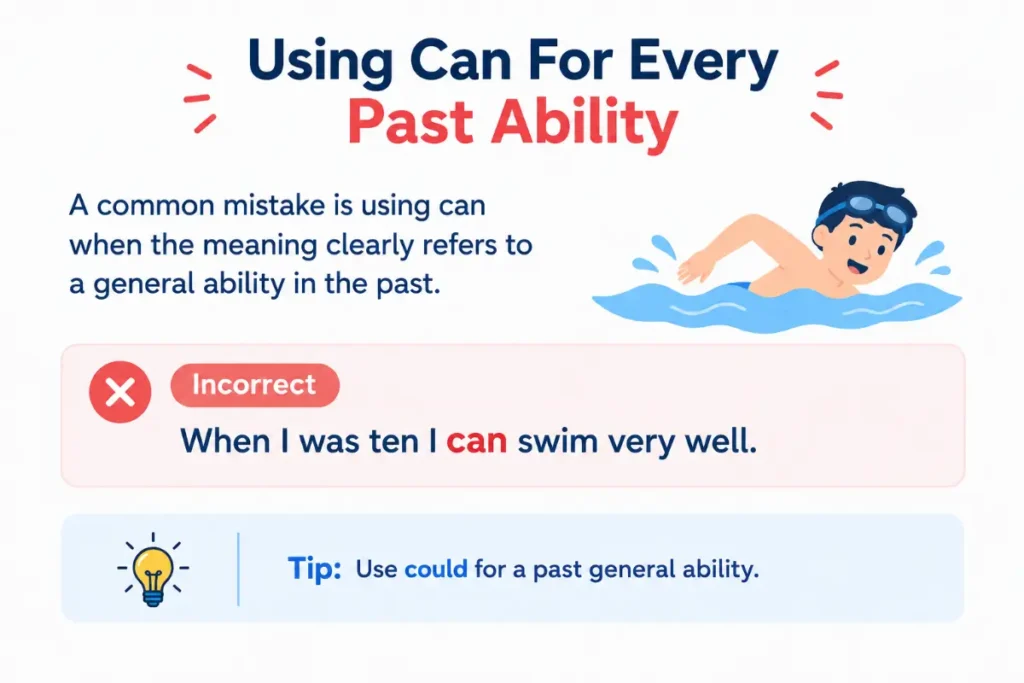
A common mistake is using can when the meaning clearly refers to a general ability in the past.
Incorrect:
When I was ten I can swim very well.
Correct:
When I was ten I could swim very well.
The past time expression requires a form that fits past meaning.
Adding S After Can Or Could
Modal verbs don’t take an s in the third person singular.
Incorrect:
She can sings.
Correct:
She can sing.
Incorrect:
He could drives.
Correct:
He could drive.
Always use the base form after can and could.
Using Could Only For The Past
Could doesn’t always refer to past time.
Could you help me?
This is a present request.
It could rain tonight.
This describes a future possibility.
You could try this method.
This is a suggestion.
So don’t automatically translate could as a past form.
Treating Can And Could As Exact Equivalents
They overlap in some situations, but they don’t always carry the same meaning.
Can you help me?
This is a direct request.
Could you help me?
This request sounds more polite and less direct.
The grammar is similar, but the tone changes.
Using Can Instead Of Could For A Suggestion
Consider:
You can call your doctor.
This can sound like permission or a statement about ability.
You could call your doctor.
This clearly sounds like advice.
The second sentence usually works better when you want to offer an option.
Real Life Examples
The easiest way to understand these modal verbs is to see them in everyday situations.
At Work
Can you finish this report today?
The speaker makes a direct request.
Could you finish this report today?
The speaker makes a softer request.
We can finish the report today.
The team has the ability or capacity to finish it.
We could finish the report today.
Finishing today is one possible option.
At Home
Can I use your laptop?
This asks for permission.
Could I use your laptop?
This asks for permission in a more polite way.
I can cook dinner tonight.
The speaker has the ability or willingness to do it.
We could order dinner instead.
The speaker suggests another option.
At School
Can you solve this problem?
The teacher asks about present ability.
Could you solve problems like this when you were younger?
The question refers to past ability.
You could ask your teacher for help.
The sentence gives advice.
While Traveling
Can we check in now?
This asks about permission or possibility.
Could we check in early?
This sounds like a polite request.
The train can get crowded in the evening.
The sentence describes a general possibility.
The train could be delayed today.
The speaker considers a delay one possible outcome.
Memory Tips
A few simple associations can make the difference easier to remember.
Think of can as the word of current ability and direct possibility.
I can do it.
Think of could as the word that often adds distance. That distance might come from past time, uncertainty, politeness, or a suggested option.
I could do it when I was younger.
It could happen.
Could you help me?
You could try again.
Another useful trick is to ask yourself what the sentence is doing.
If you’re talking about a skill you have now, can often fits.
If you’re talking about a general skill you had in the past, could often fits.
Related Grammar Notes
Can and could belong to the group called modal verbs. Other common modal verbs include may, might, must, should, and will.
Modal verbs have special grammar rules.
They don’t take an s after he, she, or it.
She can drive.
Not:
She cans drive.
They also take the base form of the main verb.
He could help.
Not:
He could helps.
Modal verbs don’t normally use do or does to form questions.
Correct:
Can you swim?
Incorrect:
Do you can swim?
The same pattern applies to could.
Correct:
Could she help us?
Incorrect:
Does she could help us?
Can and could also don’t normally take to before the main verb.
Correct:
I can swim.
Incorrect:
I can to swim.
Correct:
She could help.
Incorrect:
She could to help.
These rules make modal verbs different from many ordinary English verbs.
Can With Be
Can can combine with be to express ability or possibility.
It can be difficult.
She can be very helpful.
This can be expensive.
Could works in similar structures when the speaker wants to present a possibility or conditional idea.
It could be difficult.
She could be very helpful.
This could be expensive.
The difference often comes down to certainty and context.
Can With Not
The negative form of can is cannot or can’t.
I cannot stay.
I can’t stay.
Cannot is common in formal writing. Can’t is very common in everyday conversation.
Could becomes could not or couldn’t.
I could not hear you.
I couldn’t hear you.
The meaning depends on the context.
I couldn’t swim when I was three.
This describes a lack of past ability.
I couldn’t hear the speaker.
This can describe a particular situation in the past.
Can And Could With Questions About Ability
When asking about current ability, can is usually the natural choice.
Can you drive?
When asking about past ability, could is usually natural.
Could you drive when you were seventeen?
When asking someone to perform an action, the same words can function as requests.
Can you drive me home?
Could you drive me home?
The first is direct. The second is more polite.
Can Or Could For Requests
Both words work for requests, so the choice often depends on the tone you want.
Can you pass the salt?
This is completely natural among friends and family.
Could you pass the salt?
This sounds slightly more polite or careful.
In a workplace setting, both can work.
Can you send me the invoice?
Could you send me the invoice?
Could can soften the request, but you don’t need to use it every time you want to sound professional. A clear can request can still be polite when you use a friendly tone.
Can Or Could For Possibility
The difference becomes clearer when you compare general possibility with a particular possibility.
Technology can fail.
This describes something that can happen in general.
The system could fail tonight.
This describes one possible event.
Another example:
This road can be dangerous in winter.
This describes a general condition.
This road could be dangerous tonight because of the ice.
This focuses on a specific possibility.
The distinction isn’t an absolute mathematical rule. Context can change the strength of the speaker’s claim. Still, general possibility versus specific possibility is a useful starting point.
Can Or Could For Permission
It is very common for everyday permission.
Can I sit here?
Can I borrow this book?
Could can also ask for permission and often sounds more polite.
Could I sit here?
May is another option in formal situations.
May I sit here?
The three forms can sound different in tone. Can is casual and direct. Could is polite and softer. May is more formal.
Key Takeaways
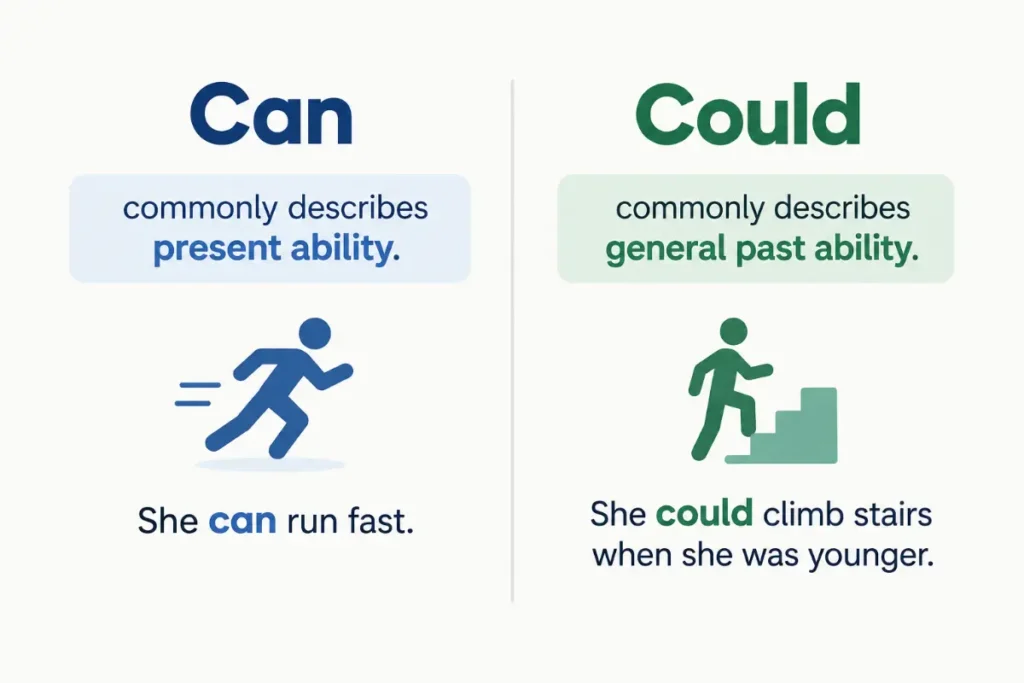
- Can commonly describes present ability.
- Could commonly describes general past ability.
- Can is common for direct requests.
- Could often makes a request softer and more polite.
- Can can describe general possibility.
- Could can describe a specific or less certain possibility.
- Could often introduces a suggestion.
- Both words are followed by the base form of the main verb.
- Neither word takes an s after he, she, or it.
- Could doesn’t always refer to the past.
- Can is common for everyday permission.
- Context determines the exact meaning.
Conclusion
Could vs can becomes much easier when you connect each word with its main function. Can commonly expresses present ability, permission, general possibility, and direct requests. Could commonly expresses past general ability, possibility, polite requests, and suggestions.
The most useful habit is to think about what you want the sentence to communicate. If you’re talking about an ability you have now, can is often the natural choice. If you’re talking about a general ability in the past, could usually fits.
Once you stop treating these words as simple interchangeable forms, their differences become much clearer. Listen to how native speakers use them in real conversations and pay attention to the meaning behind each choice. With regular practice, choosing between them will start to feel natural rather than like a grammar test.
Frequently Asked Questions
Is Could The Past Tense Of Can?
Could is traditionally described as the past form of can, but that description doesn’t cover all of its modern uses. Could can express past ability, but it also expresses polite requests, possibilities, suggestions, and hypothetical situations.
Is Can Or Could More Polite?
Could generally sounds more polite or less direct when you make a request. For example, Could you help me? usually sounds softer than Can you help me? Both are grammatically correct and common.
Can I Use Could For Present Situations?
Yes. Could can describe present or future possibilities, suggestions, and requests. Could you help me? is a present request. It could rain tonight describes a future possibility.
Can I Use Can For Past Ability?
Not when you’re describing a general ability that existed in the past. Use could instead.
When I was younger I could run five miles.
For one specific successful event, was able to often gives a clearer meaning.
Which Is Correct Can You Or Could You?
Both are correct. Can you is more direct. Could you usually sounds more polite or less forceful.
Is Could More Uncertain Than Can?
Could often expresses a possibility that isn’t certain. Can can describe general possibility or capability. In a specific situation, could often makes the possibility sound more tentative.
Can Could Be Used For Permission?
Yes. Could can ask for permission in a polite way.
Could I leave early today?
Can I leave early today?
Can Could Be Used For Advice?
Yes. Could is especially useful for suggestions.
You could speak with your teacher.
It presents one possible action rather than giving a direct command.
Can And Could Follow The Same Verb Form?
Yes. Both modal verbs take the base form of the main verb.
She can sing.
She could sing.
Don’t add s or to before the main verb.
Can Could Describe Future Possibility?
Yes. Could can describe a future possibility.
We could go tomorrow.
Can can also describe future ability or practical possibility.
We can go tomorrow.
The meaning depends on context.
Should I Use Can Or Could In Formal Writing?
Choose the word that matches your intended meaning. Could often works well for polite requests and tentative suggestions. Can works well for clear statements about ability and practical possibility.

English Grammar & Usage
Nathan Holloway is an American grammar writer and language researcher who specializes in English grammar, sentence structure, verb usage, and common writing mistakes. He enjoys breaking down confusing grammar rules into practical explanations with clear examples, making English easier for students, professionals, and everyday writers.