
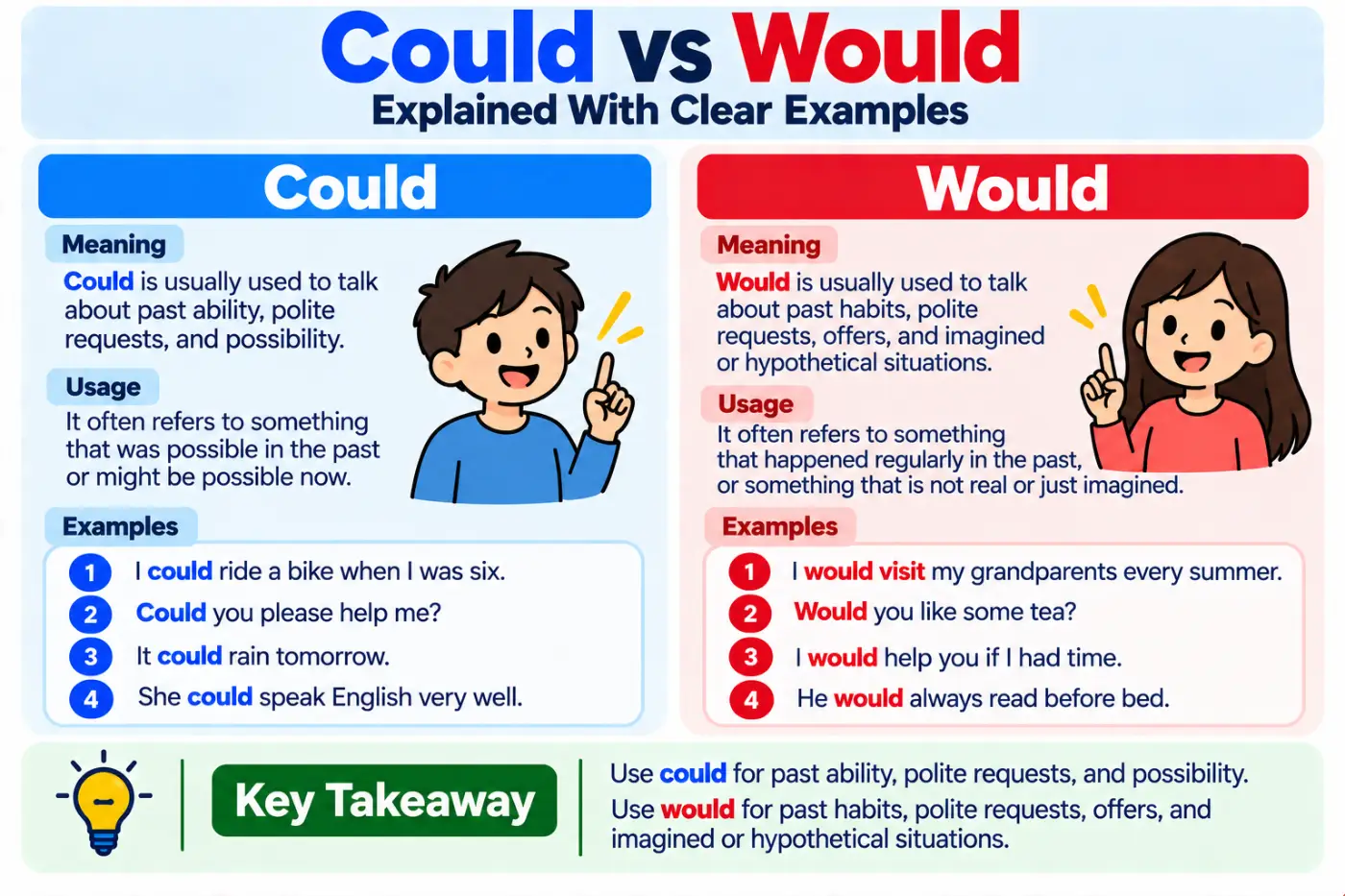
Could vs would becomes much easier once you focus on the meaning behind each modal verb. Could commonly connects to ability, possibility, permission, and polite requests. Would commonly connects to willingness, preferences, imagined results, polite offers, and repeated past actions.
Both words are modal verbs. They work with the base form of another verb and help speakers show ideas that ordinary verb forms cannot express as clearly. For example, you can say that someone could help you to describe a possible action. You can say that someone would help you to describe willingness or a likely result under a particular condition.
The tricky part comes from sentences where both choices seem possible. English speakers often use these words in different ways depending on the situation and the speaker’s intended meaning. Once you understand those differences, you can choose the right word without memorizing dozens of isolated rules.
Short Answer
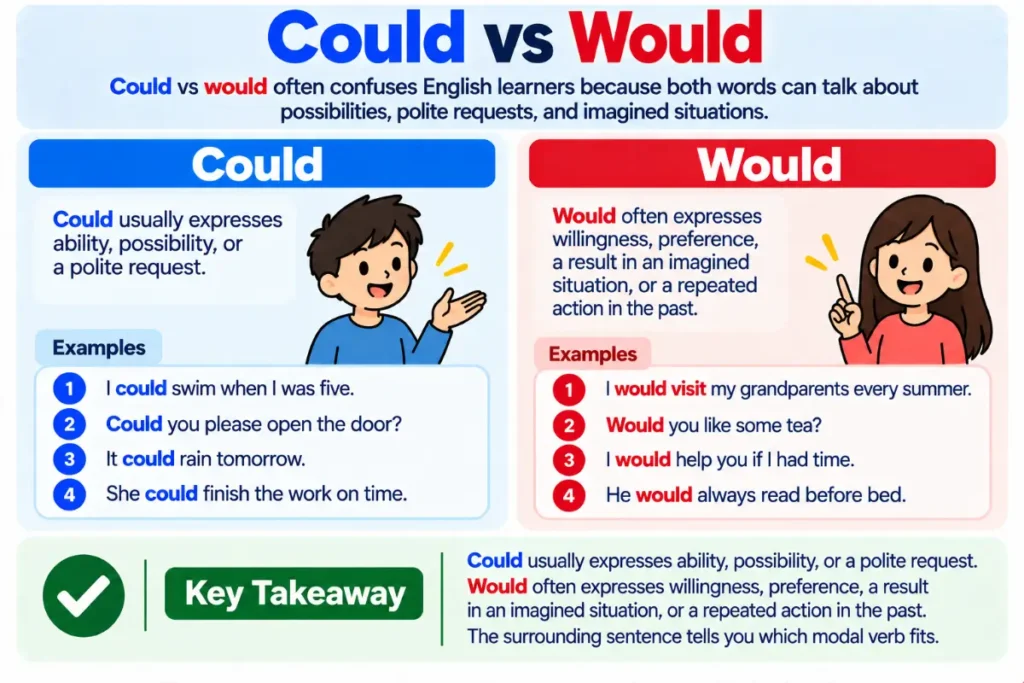
Could vs would often confuses English learners because both words can talk about possibilities, polite requests, and imagined situations. Could usually expresses ability, possibility, or a polite request. Would often expresses willingness, preference, a result in an imagined situation, or a repeated action in the past. The surrounding sentence tells you which modal verb fits.
Table Of Contents
- What Could Means.
- What Would Means.
- The Main Difference Between Could And Would.
- Could For Past Ability.
- Could For Present And Future Possibility.
- Could For Permission.
- Could For Polite Requests.
- Would For Willingness.
- Would For Preferences.
- Would In Conditional Sentences.
- Would For Repeated Past Actions.
- Could And Would In Questions.
- Could And Would In Offers.
- Could And Would With If Clauses.
- Common Mistakes.
- Memory Tips.
- Related Grammar Notes.
- Professional Writing Tips.
- Key Takeaways.
What Could Means
Could is the past form of can in several common grammatical uses. However, could has developed uses that do not simply describe the past. It can describe present possibility, future possibility, polite requests, suggestions, and permission.
The central idea behind could is often possibility or ability.
Consider these examples.
I could swim when I was six.
This sentence describes an ability that existed in the past. The speaker had the ability to swim at that age.
We could go to the park after dinner.
This sentence presents a possible plan. It does not say that the plan will definitely happen.
Could you open the window?
Here could makes a request sound polite. The speaker is not asking about physical ability. The sentence functions as a courteous request.
You could try restarting the computer.
Here could introduces a suggestion. The speaker believes restarting the computer is one possible solution.
That could be the answer.
Here could expresses possibility. The speaker thinks the answer is possible but does not present it as certain.
Could therefore covers several related meanings. Context determines the exact meaning.
What Would Means
Would has several important uses. It can describe willingness, imagined situations, preferences, polite requests, repeated past actions, and future events viewed from a past point in time.
The central ideas behind would often involve a condition, choice, willingness, preference, or imagined result.
Consider these examples.
I would help you.
This can express willingness. The speaker is saying that helping is something they are prepared to do.
I would buy that house if I had enough money.
This describes an imagined situation. The speaker does not currently have enough money but explains what they would do under that condition.
I would like some coffee.
This expresses a polite preference or desire.
Would you close the door?
This is a polite request.
When we were children, we would visit our grandparents every summer.
Here would describes a repeated action in the past.
Would also appears when speakers report future events from a past viewpoint.
She said she would call later.
At the time she spoke, the call was still in the future. The speaker is now reporting that earlier expectation.
The Main Difference Between Could And Would
The easiest way to understand could and would is to focus on the idea each word adds to the sentence.
Could often asks you to think about possibility or ability.
Would often asks you to think about willingness, choice, preference, or an imagined result.
Compare these sentences.
I could help you.
I would help you.
The first sentence can mean that helping is possible. It may suggest that the speaker has the ability or opportunity to help.
The second sentence usually focuses on willingness. It suggests that the speaker is prepared or willing to help.
Now compare another pair.
We could go to Chicago.
We would go to Chicago.
The first sentence suggests that going to Chicago is one possible option.
The second sentence usually needs more context. It can describe an imagined result.
We would go to Chicago if we had more time.
Now the meaning becomes clear. The speaker is imagining a situation and describing the result.
This distinction helps in everyday conversation. When you want to talk about what is possible, could often fits. When you want to talk about what someone would choose, want, or do under a condition, would often fits.
Could For Past Ability
One of the most common uses of could is past ability.
When someone had a general ability in the past, could works naturally.
I could read simple books when I was five.
She could play the piano as a child.
He could run five miles without getting tired.
They could speak French when they lived in Paris.
These sentences describe abilities that existed during an earlier period.
There is an important detail here. Could usually works well for general past ability. When you describe one specific successful action, English often uses was able to or managed to instead.
For example.
I could swim when I was young.
This describes general ability.
I was able to swim across the lake yesterday.
This describes a specific successful event.
The difference can seem small, but it matters in careful writing. Native speakers may use could in some specific situations, especially when the context makes the meaning clear. Still, was able to is often the safer choice when you want to emphasize that a particular action actually happened successfully.
Could For Present And Future Possibility
Could can describe something that may happen now or later.
It could rain tonight.
The meeting could finish early.
She could arrive before noon.
That could cause a problem.
These sentences do not say that the event will happen. They present it as one possible outcome.
This makes could useful when you want to avoid sounding too certain.
Compare these statements.
The package will arrive tomorrow.
The package could arrive tomorrow.
The first sentence expresses a stronger expectation or prediction. The second presents tomorrow as one possible delivery time.
Could also make suggestions sound less forceful.
You could ask your manager.
You could take the earlier train.
You could check the instructions again.
In these examples, could gives the listener an option rather than a direct command.
Could For Permission
Could can also refer to permission. This use is common in polite questions.
Could I leave early today?
Could we use this room?
Could I borrow your pen?
Could she join us?
These questions ask for permission in a polite way.
Notice the difference between could and could not in statements about permission.
You could leave after five.
This can mean permission was available.
You couldn’t enter the building without an identification card.
This can mean entry was not permitted.
In casual conversation, can is also extremely common for permission.
Can I sit here?
Could I sit here?
Both can be correct. Could simply sounds more polite or more cautious in many situations.
Could For Polite Requests
Could is one of the most useful words for making requests politely.
Could you send me the file?
Could you speak more slowly?
Could you check this sentence?
Could you give me a minute?
The speaker is not asking about the listener’s ability in a literal sense. The sentence functions as a polite request.
This is why the response to Could you help me? is often Yes or Sure rather than Yes I can. The grammatical form comes from the older idea of ability, but the modern conversational function is a request.
Could can also soften suggestions.
Could we meet tomorrow instead?
Could we try another approach?
Could you consider moving the deadline?
These forms sound less direct than commands such as Meet tomorrow or Move the deadline.
Would For Willingness
Would often expresses willingness.
I would help if I could.
She would gladly join us.
He would do anything for his family.
They would be happy to assist.
In these sentences, would points toward a person’s willingness or readiness to act.
Compare these two sentences.
I could help you.
I would help you.
The first may mean that help is possible.
The second may mean that the speaker is willing to help.
That distinction becomes especially clear in conditional sentences.
I could help you if I had more time.
This says helping is possible under the stated condition.
I would help you if I had more time.
This says helping is the action the speaker would choose under that condition.
Both sentences can be grammatically correct while communicating different ideas.
Would For Preferences
Would often appears in polite expressions of preference.
I would like some tea.
I would like to speak with the manager.
We would like more information.
She would rather stay home.
The expression would like is especially common in polite American English.
I want some coffee.
I would like some coffee.
The second sentence sounds more polite and less direct.
Would rather also expresses preference.
I would rather walk.
He would rather wait.
They would rather eat at home.
When you use would rather with another person, the structure changes slightly.
I would rather you stayed here.
She would rather he called tomorrow.
These sentences express a preferred action or situation.
Would In Conditional Sentences
Would plays a major role in conditional sentences. It often introduces the result that someone imagines under a particular condition.
If I had more money, I would travel more.
If she studied harder, she would improve.
If we left now, we would arrive before dinner.
If he knew the answer, he would tell us.
The basic pattern is often.
If plus past form followed by would plus base verb.
The past form in these sentences does not always describe past time. Instead, it can create distance from reality and show that the situation is imagined, unlikely, or not currently true.
For example.
If I had a million dollars, I would buy a house by the ocean.
The speaker is not describing a past event. The sentence describes an imagined present or future situation.
This point causes many mistakes because learners sometimes assume that every past form refers to past time. In conditional grammar, the past form can serve a different purpose.
Would For Repeated Past Actions
Would can describe actions that happened repeatedly in the past.
When I was young, my father would read to me every night.
Every summer, we would visit the same beach.
After dinner, Grandma would tell us stories.
During college, they would meet at the library every Friday.
This use resembles used to.
When I was young, I would play outside every evening.
When I was young, I used to play outside every evening.
Both can describe repeated past actions.
However, would usually works best when the sentence already establishes a past context. It also focuses on repeated actions rather than past states.
For example.
When I lived in New York, I would walk to work every morning.
This works naturally because walking is a repeated action.
I would know the answer.
This does not normally mean I knew the answer in the past. Would does not generally replace used to when describing a past state.
A better sentence would be.
I used to know the answer.
This distinction helps prevent awkward uses of would in past narratives.
Could And Would In Questions
Both words can make questions polite, but they do different jobs.
Could you help me?
This is a polite request.
Would you help me?
This can also be a request, but it can place more focus on willingness.
Could I borrow your car?
This asks for permission.
Would you like some coffee?
This offers something or asks about preference.
Could you like some coffee? is not correct for this meaning.
The contrast becomes clearer when you compare could I with would you.
Could I sit here?
The speaker asks for permission.
Would you sit here?
The speaker asks about the listener’s willingness or asks them to take a particular action.
The two modal verbs therefore cannot simply replace each other.
Could And Would In Offers
Would is especially common in polite offers.
Would you like some water?
Would you like to sit down?
Would you like me to call you later?
Would you like another piece of cake?
The expression would like is one of the most useful structures for polite offers and requests.
Could can also appear in offers.
I could make some coffee.
We could order dinner.
I could drive you home.
These sentences usually present an option. The speaker is saying that an action is possible and may be offering to do it.
Compare these examples.
Would you like some coffee?
I could make some coffee.
The first asks about the other person’s preference.
The second presents an available option.
Could And Would With If Clauses
Could and would can both appear with if clauses, but they usually contribute different meanings.
If I had more time, I could learn another language.
This means learning another language would be possible if the condition changed.
If I had more time, I would learn another language.
This means learning another language is the action the speaker would choose under that condition.
The contrast is subtle but useful.
Could focuses on possibility or ability.
Would focuses on the imagined result or intended action.
Consider another example.
If we had enough money, we could buy a new car.
This says buying a new car would be possible.
If we had enough money, we would buy a new car.
This says buying the car is what we would choose to do.
The first sentence answers the idea of What would be possible.
The second answers the idea of What would we do.
This simple question can help you choose the right modal verb.
Could vs Would In Everyday Conversation
In everyday speech, the difference becomes easier when you listen for the speaker’s purpose.
Imagine your friend says the restaurant is closed.
You could say.
We could try the place across the street.
You are suggesting a possible solution.
Now imagine your friend asks what you would do if the restaurant were closed.
You could say.
I would try the place across the street.
You are describing the action you would choose.
The same basic idea appears in many conversations.
I could call him.
This means calling him is possible.
I would call him.
This can mean calling him is the action you would choose or are willing to take.
You could ask Sarah.
This gives a suggestion.
You would ask Sarah.
This can describe the choice someone makes in a particular situation.
The surrounding context does a lot of work.
Could For Suggestions
Could is a gentle way to suggest an action.
You could save the document first.
You could ask for more time.
We could meet on Friday.
She could try a different approach.
This style works well in professional communication because it gives the other person room to decide.
Compare these sentences.
Send the document again.
You could send the document again.
The first is a direct command.
The second presents an option.
This does not mean could always sounds weak. In the right context, it can be firm enough while still sounding respectful.
Would For Polite Language
Would is common in polite and professional English.
I would appreciate your help.
I would like to request a copy.
Would you mind checking this?
Would you be available tomorrow?
These structures create distance and soften the request.
Would you mind closing the door?
A natural answer is No because No means the person does not mind doing it.
Would you mind helping me?
No.
This can confuse learners because the word no may sound negative. The response actually means the person does not object.
You can avoid confusion by saying Sure or Of course.
Pronunciation And Spoken English
Could and would are usually pronounced with a clear initial consonant sound followed by a reduced vowel sound in ordinary speech.
In careful speech, learners may pronounce every part too strongly. Native speakers often use shorter and more connected forms in conversation.
Could is commonly pronounced with the same vowel sound found in good and book.
Would uses the same general vowel quality.
The final consonant in could is silent. This means the word does not end with the sound represented by the final letter d.
Would also has a silent l.
These spelling patterns can cause pronunciation mistakes because English spelling does not always show pronunciation directly.
Learners should pay attention to the sound rather than trying to pronounce every written letter.
Could And Would In Formal Writing
Both modal verbs work well in formal writing. The key is choosing the one that matches your intended meaning.
Could is useful when discussing possibilities, recommendations, potential outcomes, or polite requests.
The proposed change could reduce costs.
The committee could review the policy next month.
Would is useful when discussing hypothetical results, preferences, expected actions, or polite statements.
The change would reduce costs if the company adopted the new system.
We would appreciate your response.
In professional writing, precise modal choices matter because they show the strength of a claim.
Could often leaves room for uncertainty.
Would often connects an outcome to a condition or expresses a particular intention.
Common Mistakes
Using Could When You Mean Willingness
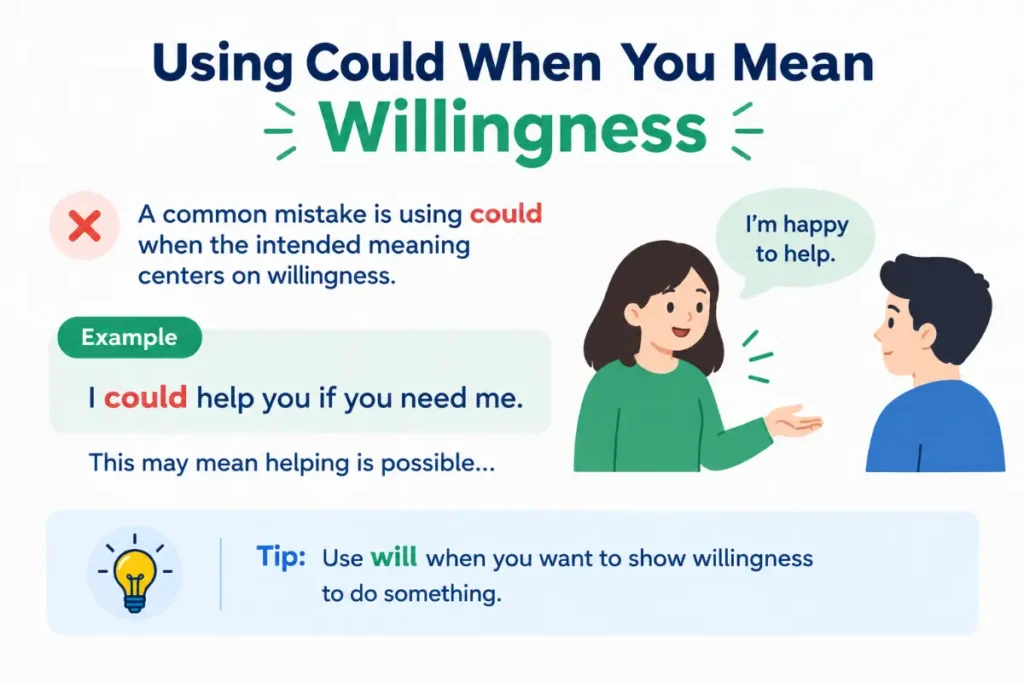
A common mistake is using could when the intended meaning centers on willingness.
I could help you if you need me.
This may mean helping is possible.
I would help you if you needed me.
This emphasizes willingness in the imagined situation.
The first sentence focuses more on possibility. The second focuses more on willingness or choice.
Using Would For General Possibility
Another mistake is using would when could fits better.
It would rain tonight.
This sentence can sound unnatural if you simply mean rain is possible.
It could rain tonight.
This clearly expresses possibility.
Would needs a suitable context or condition to express an imagined result.
Using Would After Every If Clause
Learners sometimes put would immediately after every if.
If I would have more money, I would travel.
For a standard hypothetical present or future condition, this is usually incorrect.
A natural version is.
If I had more money, I would travel.
The if clause normally uses the appropriate conditional form while would appears in the result clause.
Confusing Could Have And Would Have
Could have and would have also express different ideas.
I could have won.
This means winning was possible.
I would have won if I had trained harder.
This describes an imagined result under a condition.
Compare these sentences.
She could have called me.
She would have called me if she had known.
The first says calling was possible.
The second gives a condition that explains the imagined action.
Treating Could As Only Past Tense
Could can refer to the past, but it can also refer to present and future possibilities.
I could swim when I was young.
This is past ability.
We could go tomorrow.
This is future possibility.
Could you help me?
This is a present polite request.
The meaning comes from context rather than the word alone.
Treating Would As Only Future Tense
Would can also describe past habits and imagined situations.
Every Sunday, we would visit our grandparents.
This describes a repeated past action.
I would buy it if it were cheaper.
This describes an imagined choice.
She said she would arrive later.
This describes a future event viewed from a past point.
Memory Tips
A simple memory trick can make these modal verbs easier.
Think of could as the word of possibility.
Could means something can happen under the right circumstances. It can also describe ability or make a request polite.
Think of would as the word of choice or imagined result.
Would often tells you what someone wants, prefers, agrees to do, or imagines doing under a condition.
Try these quick mental questions.
Could asks.
Is it possible.
Is someone able to do it.
Am I asking politely.
Would asks.
Is this what someone would choose.
Is this something someone is willing to do.
Is this an imagined result.
Is this a polite offer.
For example.
I could go.
Ask yourself if going is possible.
I would go.
Ask yourself if going is the choice the speaker would make.
This technique works better than memorizing a long list of rules because it connects grammar to meaning.
Related Grammar Notes
Could Have
Could have plus a past participle often expresses past possibility or an unrealized possibility.
I could have missed the train.
This can mean missing the train was possible.
You could have told me earlier.
This can express a missed opportunity or criticism.
She could have won the competition.
This means winning was possible but did not happen.
Would Have
Would have plus a past participle often describes an imagined past result.
I would have helped you.
She would have come if you had invited her.
They would have stayed longer if they had known.
The structure often appears in third conditional sentences.
If I had known, I would have called.
The if clause describes an unreal past condition. The would have clause describes the imagined result.
Could Be
Could be expresses possibility.
He could be at home.
That could be true.
This could be the right answer.
Would Be
Would be often describes an imagined or conditional state.
That would be helpful.
It would be easier with more time.
This would be a better option for some users.
The phrase would be frequently appears in professional and academic writing because it allows writers to describe possible consequences without stating them as facts.
Could And Can
Could and can both express ability and possibility, but they do not always carry the same tone.
I can help you.
I could help you.
The first often sounds more direct and certain.
The second can sound more tentative or conditional.
Can also make direct requests.
Can you help me?
Could you help me?
Both are natural. Could usually sounds more polite.
Would And Will
Would is closely related to will.
I will call you tonight.
This expresses a future intention or prediction.
I would call you if I had the number.
This describes an imagined action under a condition.
She said she would call.
This reports a future action from a past viewpoint.
Understanding will and would also helps clarify conditional grammar.
Professional Writing Tips
Modal verbs can change the strength of a professional statement.
Consider these examples.
The change will reduce costs.
The change could reduce costs.
The change would reduce costs if the company adopted the proposal.
These sentences do not make the same claim.
Will presents the reduction as an expected or intended result.
Could presents it as a possibility.
Would connects the result to a condition.
This distinction matters in reports, business communication, academic writing, technical documents, and formal recommendations.
Use the strongest modal that your evidence supports. If you only know that something is possible, could is safer than will. If you are describing a conditional result, would may be more accurate.
Precision makes professional writing stronger.
Could And Would In American English
American English uses both modal verbs in the same major grammatical patterns found across standard English.
Could is common in polite requests.
Could you send that again?
Would is common in offers and preferences.
Would you like some coffee?
Both are normal in professional and casual American conversation.
British English also uses these forms extensively. The main differences learners notice usually come from tone, regional vocabulary, or conversational habits rather than a major grammatical difference in the basic rules for could and would.
For American readers, the safest approach is to learn the meaning and structure rather than trying to memorize a regional rule.
A Practical Comparison
The table gives you a quick reference, but context still matters. Modal verbs do not have only one meaning.
Real Life Examples
At Work
Could you send me the updated report?
This is a polite request.
We could discuss the issue tomorrow.
This suggests a possible plan.
I would be happy to review the document.
This expresses willingness.
The new process could reduce errors.
This presents a possible benefit.
The new process would reduce errors if everyone followed the instructions.
This describes a conditional result.
At Home
Could you turn down the television?
This is a polite request.
We could order pizza tonight.
This suggests an option.
I would rather cook at home.
This expresses preference.
While Making Plans
We could visit the museum tomorrow.
The museum could be crowded.
I would go earlier if I were you.
The first sentence gives an option.
The second describes a possibility.
The third gives advice by describing the action the speaker would choose.
During A Problem
Could the battery be dead?
This asks about a possible explanation.
We could replace the battery.
This suggests a possible solution.
I would replace it if the charger didn’t work.
This describes the action the speaker would choose under a condition.
How To Choose The Right Word
When you are unsure, stop and identify the intended meaning.
If you mean ability, think about could.
I could read before I started school.
If you mean possibility, think about could.
We could arrive late.
If you mean permission, think about could.
Could I use your phone?
If you mean a polite request, think about could or would depending on the structure.
Could you help me?
Would you help me?
If you mean willingness, would often fits.
I would help if I had the time.
If you mean preference, would often fits.
I would rather stay home.
If you mean an imagined result, would usually fits.
I would travel more if I had more vacation time.
This approach turns the choice into a meaning question rather than a memorization exercise.
Why The Difference Can Feel Confusing
The confusion exists partly because both words can make language less direct.
Could can make a statement sound tentative.
Would can make a statement sound conditional or polite.
Both can therefore appear in situations where the speaker wants to soften what they say.
Consider these examples.
Could you help me?
Would you help me?
Both can function as polite requests. Yet the first commonly sounds like a straightforward request for assistance, while the second can place more attention on willingness.
Now compare.
We could leave early.
We would leave early if the meeting ended soon.
The first presents an option.
The second connects the action to a condition.
The key is not simply politeness. Look at the meaning underneath the sentence.
Could Or Would For Advice
Could is usually the better choice when you want to offer an option.
You could speak with your teacher.
You could save a copy first.
You could try again tomorrow.
Would can work when advice describes the action the speaker thinks they would choose.
I would speak with your teacher first.
I would save a copy before editing the file.
I would try again tomorrow.
These sentences sound more personal. The speaker is effectively saying this is what I would do.
That gives could and would different tones in advice.
Could presents an option.
Would presents a personal recommendation.
Could Or Would For Predictions
Could is useful when the outcome is possible but uncertain.
The road could be busy tonight.
The price could increase next month.
The meeting could take longer than expected.
Would usually needs a condition or another context.
The road would be busy if there were an accident.
The price would increase if demand rose.
The meeting would take longer if more people joined.
This difference helps writers avoid making claims that sound stronger than the evidence supports.
Could Or Would For Requests
Both forms can create polite requests.
Could you check this sentence?
Would you check this sentence?
The first is extremely common and direct while still polite.
The second also works and can emphasize willingness.
Would you mind checking this sentence?
This is another common structure.
Notice that would mind has a special meaning. The question asks if the person objects to doing something.
Would you mind opening the window?
A natural response is No or Not at all.
Understanding the full expression matters more than trying to translate each word separately.
Could Or Would For Hypothetical Situations
Could and would often work together in hypothetical sentences because they answer different questions.
If I had enough money, I could buy the car.
This means buying the car would be possible.
If I had enough money, I would buy the car.
This means buying the car is what the speaker would choose.
You can even use both in one sentence.
If I had enough money, I could buy the car, but I would probably choose a smaller one.
Here could describes possibility while would describes choice.
This is one of the clearest examples of how the two modal verbs can appear in the same context without having the same meaning.
Key Takeaways
- Could often expresses past ability.
- Could can express present or future possibility.
- Could commonly makes requests more polite.
- Could can ask for permission.
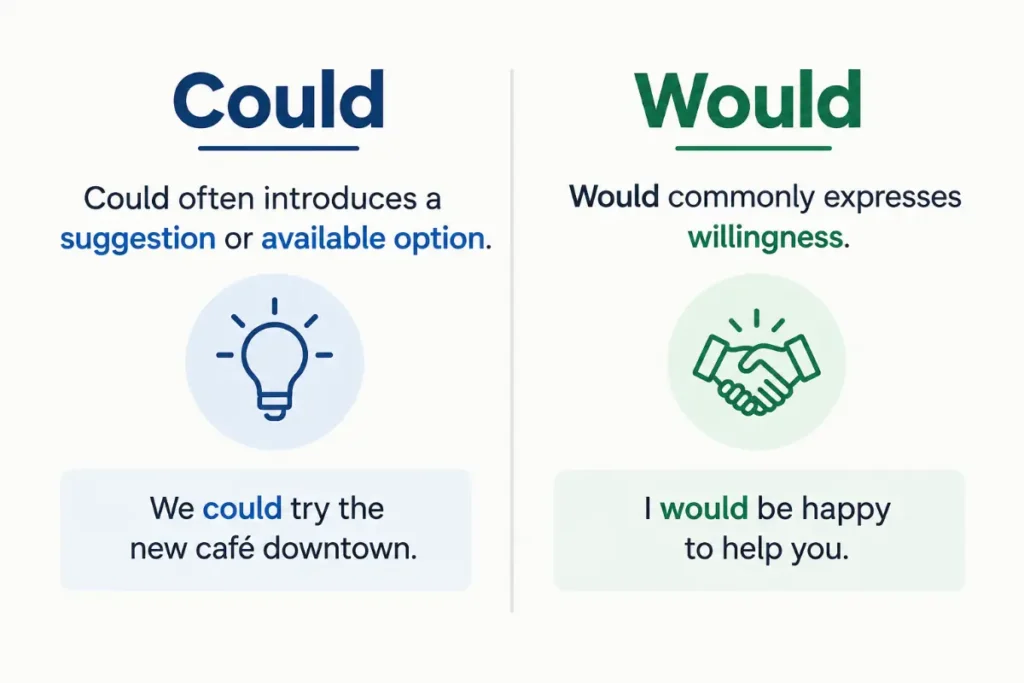
- Could often introduces a suggestion or available option.
- Would commonly expresses willingness.
- Would expresses preferences with forms such as would like and would rather.
- Would commonly appears in conditional result clauses.
- Would can describe repeated actions in the past.
- Could often focuses on what is possible.
- Would often focuses on what someone chooses or what happens under an imagined condition.
- Context determines the exact meaning.
Conclusion
Could vs would becomes much clearer when you focus on meaning instead of treating both words as interchangeable forms. Could commonly expresses ability, possibility, permission, suggestions, and polite requests. Would commonly expresses willingness, preference, imagined results, polite offers, and repeated past actions.
The most useful distinction is simple. Could often presents something as possible or available. Would often presents a choice, willingness, preference, or result connected to a condition. That difference explains why sentences such as I could help and I would help can both be correct while communicating different ideas.
With regular practice, you won’t need to stop and memorize a rule every time you use these modal verbs. Ask yourself what you mean first. If the idea is possibility or ability, could often fits. If the idea is choice, willingness, preference, or an imagined result, would often fits.
Frequently Asked Questions
Is could or would more polite?
Both can sound polite. Could is especially common for polite requests such as Could you help me? Would is also polite and often appears in offers or questions about willingness such as Would you like some coffee?
Can I use could and would in the same sentence?
Yes. They can appear together when they express different meanings.
If I had more time, I could study more, but I would rather spend the evening with my family.
Could expresses possibility while would expresses preference.
Is could the past tense of can?
Could is traditionally described as the past form of can, especially when it expresses past ability. However, could also has present and future uses involving possibility, permission, suggestions, and polite requests.
Is would the past tense of will?
Would is closely related to will and can function as its past form in reported speech.
She said she would call me.
However, would also has other uses, including conditional sentences, preferences, polite requests, and repeated past actions.
Should I say could you or would you?
Both can be correct.
Could you help me?
Would you help me?
Could you is a very common polite request. Would you can focus more on willingness and also works as a polite request.
What is the difference between could have and would have?
Could have usually describes a past possibility or missed possibility.
I could have won.
Would have usually describes an imagined past result.
I would have won if I had trained harder.
The first focuses on possibility. The second focuses on a conditional result.
Is could more uncertain than would?
Often yes, but the exact meaning depends on context. Could frequently presents something as possible without claiming certainty. Would often presents an imagined result, intended action, preference, or expected action under a stated context.
Can would describe past habits?
Yes. Would can describe repeated actions in the past.
Every summer, we would visit our grandparents.
It works especially well when the surrounding sentence already establishes a past period.
Can could describe future events?
Yes. Could can express future possibility.
We could meet tomorrow.
This means meeting tomorrow is one possible plan.
Can would be used without if?
Yes. Would does not always need an if clause.
I would like some tea.
She said she would call.
When I was young, we would visit the lake every summer.
These sentences use would for preference, reported future action, and repeated past action.
What is the easiest way to remember could and would?
Think of could as possibility and would as choice or imagined result.
If the sentence asks what is possible, could often works.
If the sentence asks what someone would choose, want, or do under a condition, would often works.

English Grammar & Usage
Nathan Holloway is an American grammar writer and language researcher who specializes in English grammar, sentence structure, verb usage, and common writing mistakes. He enjoys breaking down confusing grammar rules into practical explanations with clear examples, making English easier for students, professionals, and everyday writers.