
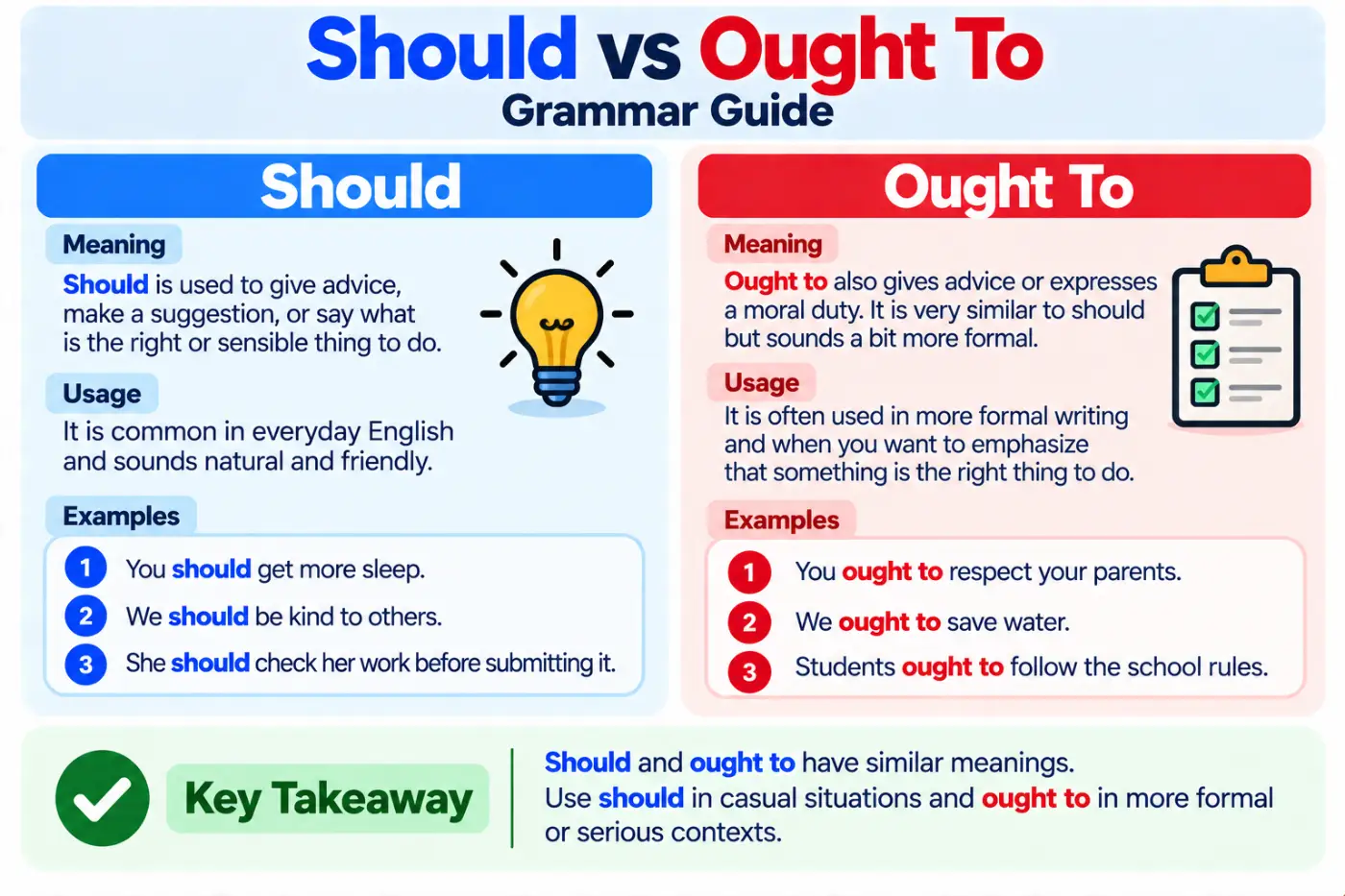
Should vs ought to can confuse English learners because both forms can express advice, expectation, duty, and a sense that something is the right thing to do. In many sentences, you can replace one with the other without changing the basic meaning. The difference usually comes from tone, frequency, and sentence structure rather than a completely different meaning.
For everyday American English, should is usually the natural choice. You will hear it in conversations, emails, instructions, classroom discussions, workplace communication, and ordinary advice. Ought to still appears in English and remains grammatically correct, but speakers use it less often in casual American conversation.
The key is simple. Use should as your normal choice for advice and expectations. Use ought to when you want the same general idea with a slightly more formal, traditional, or deliberate tone. As you read more English, you will see both forms and recognize why a writer chose one over the other.
Short Answer
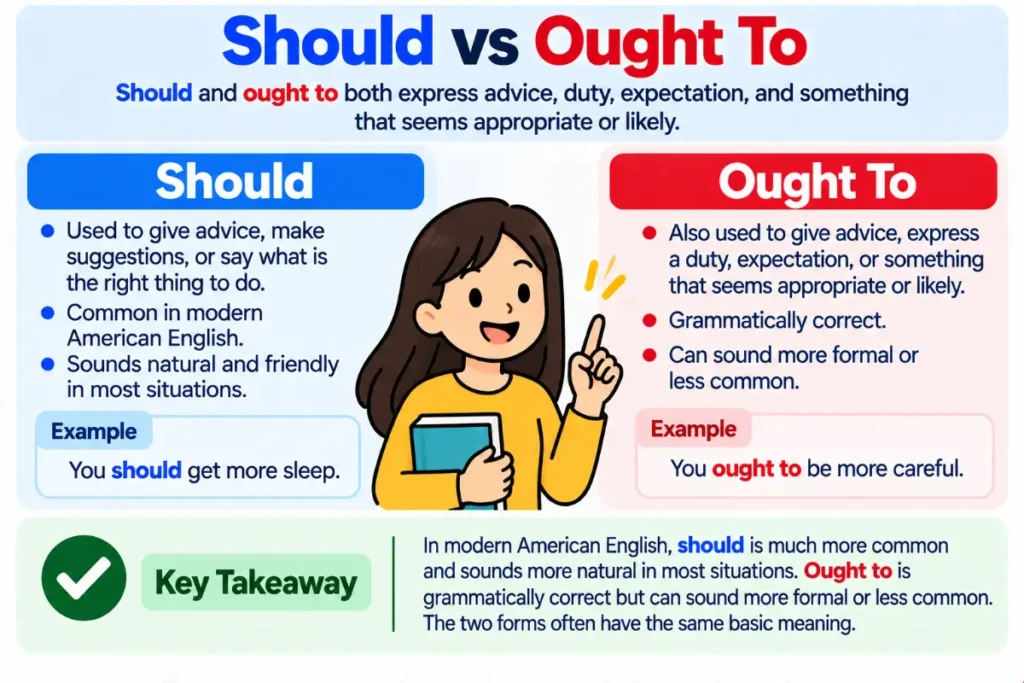
Should and ought to both express advice, duty, expectation, and something that seems appropriate or likely. In modern American English, should is much more common and sounds more natural in most situations. Ought to is grammatically correct but can sound more formal or less common. The two forms often have the same basic meaning.
Table Of Contents
- What should means.
- What ought to means.
- Should vs ought to in everyday English.
- The main grammar difference.
- Advice and recommendations.
- Duty and responsibility.
- Expectations and probability.
- Questions with should and ought to.
- Negative forms.
- Past situations.
- American English and British English.
- Formal and informal usage.
- Pronunciation and sentence rhythm.
- Common mistakes.
- Real life examples.
- Memory tips.
- Related grammar notes.
- Frequently asked questions.
- Key takeaways.
- Conclusion.
What Should Means
Should is a modal verb. English speakers use it to express advice, expectation, responsibility, probability, and what they consider appropriate.
The basic structure is:
Subject + should + base verb.
For example:
- You should call your mother.
- We should leave early.
- She should study for the test.
- They should check the address.
- He should apologize.
Notice that the verb after should stays in its base form. You do not say should goes, should went, or should to go.
The correct forms are:
- She should go home.
- He should call the office.
- They should arrive soon.
Should does not take to before the main verb. This point separates it clearly from ought to.
Should can also express expectation.
For example:
- The package should arrive tomorrow.
- The meeting should finish by noon.
- Your brother should be home soon.
In these examples, should does not give direct advice. It expresses an expected result based on the available information.
Should can also describe a moral or practical responsibility.
For example:
- People should follow the rules.
- Drivers should slow down near schools.
- We should respect other people’s time.
The meaning depends on context. The same word can express advice, expectation, responsibility, or a reasonable prediction.
What Ought To Means
Ought to is also used to express advice, duty, expectation, and something that seems appropriate or likely.
Its basic structure is:
Subject + ought to + base verb.
For example:
- You ought to call your mother.
- We ought to leave early.
- She ought to study for the test.
- They ought to check the address.
- He ought to apologize.
The meaning often matches should.
Compare these sentences:
You should call your mother.
You ought to call your mother.
Both sentences advise the person to make the call. The first sounds more common in everyday American English. The second can sound more formal, traditional, or deliberate.
Ought to can also express expectation.
For example:
The package ought to arrive tomorrow.
The meeting ought to finish by noon.
Your brother ought to be home soon.
Again, the meaning is close to should.
One useful point is that ought contains an unusual grammar feature. Modern speakers normally treat ought to as a fixed modal like expression. Unlike ordinary verbs, it does not behave exactly like a normal verb in every sentence pattern.
For example, you say:
She ought to leave.
You do not say:
She ought leaves.
You also do not normally add another modal before it.
Ought to therefore has a fixed grammatical pattern that learners should remember as one unit.
Should vs Ought To In Everyday English
Should vs ought to often comes down to naturalness and frequency.
Both forms can give advice:
You should get some rest.
You ought to get some rest.
Both can describe an expected result:
The train should arrive soon.
The train ought to arrive soon.
Both can express responsibility:
We should help our neighbors.
We ought to help our neighbors.
The difference becomes clearer when you listen to modern American conversation. Should appears much more often in ordinary speech. Ought to is less common and can sound somewhat formal or old fashioned in some contexts.
That does not make ought to incorrect. It simply means that should is usually the safer everyday choice for American English.
Here is a practical comparison.
| Use | Should | Ought to |
|---|---|---|
| Advice | Very common | Correct but less common |
| Duty | Very common | Correct and sometimes formal |
| Expectation | Very common | Correct but less common |
| Probability | Common | Possible in suitable contexts |
| Casual conversation | Very natural | Less common |
| Formal writing | Very natural | Can sound deliberate |
| Questions | Very common | Less common |
| Negative form | Should not or shouldn’t | Ought not to |
| Past advice | Should have | Ought to have |
| American English | Strongly preferred in everyday use | Less frequent |
The table shows the general pattern rather than an absolute rule. Context can change the tone.
The Main Grammar Difference
The biggest structural difference is easy to remember.
Should takes a base verb directly.
You should go.
You should wait.
Ought requires to before the base verb.
You ought to go.
You ought to wait.
This difference matters because learners sometimes transfer the grammar of one form to the other.
These sentences are correct:
She should leave now.
She ought to leave now.
These are incorrect:
She should to leave now.
She ought leave now.
The simplest memory rule is this:
Should goes directly to the verb.
Ought needs to before the verb.
This rule remains consistent in ordinary affirmative sentences.
Advice And Recommendations
Both forms can tell someone what you think they should do.
For example:
You should drink more water.
You ought to drink more water.
The difference is mainly tone. Should sounds more natural and direct in most modern American conversations. Ought to can give the advice a slightly stronger sense of duty or appropriateness.
Consider this situation.
A friend looks exhausted after working all night.
You might say:
You should get some sleep.
That sounds natural and friendly.
You could also say:
You ought to get some sleep.
This is grammatical, but it may sound more deliberate. Depending on the speaker and situation, it can carry a stronger sense that the person really needs to act.
Ought to can therefore feel slightly more connected to what is proper or advisable. Still, the difference is not large enough to create a completely different meaning in most everyday examples.
Duty And Responsibility
Should and ought to can both describe a responsibility.
For example:
Employees should follow company policies.
Employees ought to follow company policies.
People should treat others with respect.
People ought to treat others with respect.
Students should complete their assignments on time.
Students ought to complete their assignments on time.
The second form can sometimes sound more like a statement about what is morally or socially proper.
That distinction becomes useful in careful writing.
Suppose you are discussing basic responsibility:
Parents should support their children.
This sounds natural and neutral.
Now suppose you want a slightly more formal tone:
People ought to consider the effects of their actions.
Ought to can fit well in this kind of sentence.
Still, writers should not force ought to into every formal sentence. Should works perfectly well in professional, academic, and serious writing.
Expectations And Probability
Should can describe something that you expect to happen.
For example:
The bus should arrive in ten minutes.
The doctor should call this afternoon.
The store should open at nine.
The results should be available tomorrow.
Here, should does not mean that someone has a duty to make the event happen. Instead, it expresses a reasonable expectation.
Ought to can express the same idea.
The bus ought to arrive in ten minutes.
The doctor ought to call this afternoon.
The store ought to open at nine.
The results ought to be available tomorrow.
Again, should usually sounds more natural in American English.
The strength of the prediction also depends on context. Should often means that the speaker expects something based on normal conditions, information, or a schedule. It does not guarantee that the event will happen.
If a train normally arrives at 8:00 and the schedule remains unchanged, you might say:
The train should arrive at eight.
You are making a reasonable expectation rather than promising the result.
Questions With Should And Ought To
Should appears naturally in questions.
For example:
Should I call her?
Should I bring anything?
These questions ask for advice, permission in some contexts, or the best course of action.
Ought to can also appear in questions, but the structure sounds less natural in modern everyday American English.
For example:
Ought I to call her?
Ought he to apply for the job?
These forms are grammatically possible, but they can sound formal, old fashioned, or literary. Most American speakers would normally choose should instead.
You may encounter ought to questions in older writing, formal British English, or carefully crafted prose. That does not make the construction wrong. It simply makes it less common for everyday conversation.
For learners, should is the practical choice.
Negative Forms
The negative form of should is should not.
The common contraction is shouldn’t.
For example:
You should not ignore the warning.
You shouldn’t ignore the warning.
We should not arrive late.
We shouldn’t arrive late.
The negative form of ought to is normally ought not to.
For example:
You ought not to ignore the warning.
We ought not to arrive late.
The contraction oughtn’t exists, but it is uncommon in modern American English. Many speakers avoid it because it sounds formal or unnatural.
For that reason, learners will usually find these forms more natural:
You shouldn’t do that.
You ought not to do that.
The meaning can be similar, but the first sentence is much more common.
Another important point is meaning. Should not can mean that an action is unwise, inappropriate, or expected not to happen.
For example:
You shouldn’t drive when you’re too tired.
The speaker advises against the action.
Now consider:
The package shouldn’t arrive before Friday.
Here, shouldn’t expresses an expectation that the package will not arrive before Friday.
Context tells you which meaning applies.
Past Situations
Should can refer to past situations with should have followed by a past participle.
For example:
You should have called me.
She should have studied harder.
They should have arrived by now.
We should have left earlier.
These forms often express regret, criticism, or an action that was expected but did not happen.
Ought to can express the same idea with ought to have.
For example:
You ought to have called me.
She ought to have studied harder.
They ought to have arrived by now.
We ought to have left earlier.
The meaning is usually close to the corresponding should have form.
However, should have is far more common in everyday American English.
Compare:
You should have told me.
You ought to have told me.
The first sounds natural in ordinary conversation. The second is correct but may sound more formal or emphatic.
Past expectation works in a similar way.
The package should have arrived by now.
The package ought to have arrived by now.
Both sentences suggest that the speaker expected the package to arrive before the present moment.
American English And British English
American and British English both use should and ought to. The main difference involves frequency and style rather than a basic difference in grammar.
American speakers commonly use should for advice, responsibility, expectation, and recommendations.
British English also uses should very often. Ought to remains more visible in British English than it does in everyday American speech, although it is not unusual or exclusive to British English.
This means you do not need to treat ought to as a British only expression.
It is valid English in the United States.
Still, an American learner who wants a natural everyday expression will usually choose should.
For example:
You should talk to your teacher.
This sounds completely normal in American English.
You ought to talk to your teacher.
This is also correct, but it can sound more formal or deliberate.
Regional variation also matters. Individual speakers have different preferences. Some people use ought to regularly, while others rarely use it.
Formal And Informal Usage
Should works across a wide range of situations.
You can use it with friends:
You can use it at work:
We should review the report before the meeting.
You can use it in academic writing:
Students should consider the evidence carefully.
You can use it in professional guidance:
Applicants should submit the completed form by Friday.
Ought to also works in many of these settings, but it may create a different tone.
For example:
Applicants ought to submit the completed form by Friday.
This is grammatically correct. It may sound more formal and can suggest a stronger sense of expected conduct.
The key point is that formal writing does not require ought to. Should remains a strong and natural choice for professional and academic English.
Pronunciation And Sentence Rhythm
Should is pronounced with a short vowel sound followed by the sound at the end of could and would. The letter l is not pronounced.
Ought has one syllable and also contains a silent gh. The word sounds like the common word thought without the initial th sound.
The word to in ought to is normally pronounced weakly in connected speech. This makes the full expression flow quickly in natural conversation.
Learners sometimes focus too much on spelling. Instead, pay attention to how the expression sounds inside a full sentence.
For example:
You should go.
You ought to go.
The second sentence has an extra grammatical word. That small difference can make ought to feel longer and slightly more formal.
Clear pronunciation matters most in conversation. In writing, the bigger issue is choosing the form that fits the tone and grammar of the sentence.
Common Mistakes
Using To After Should
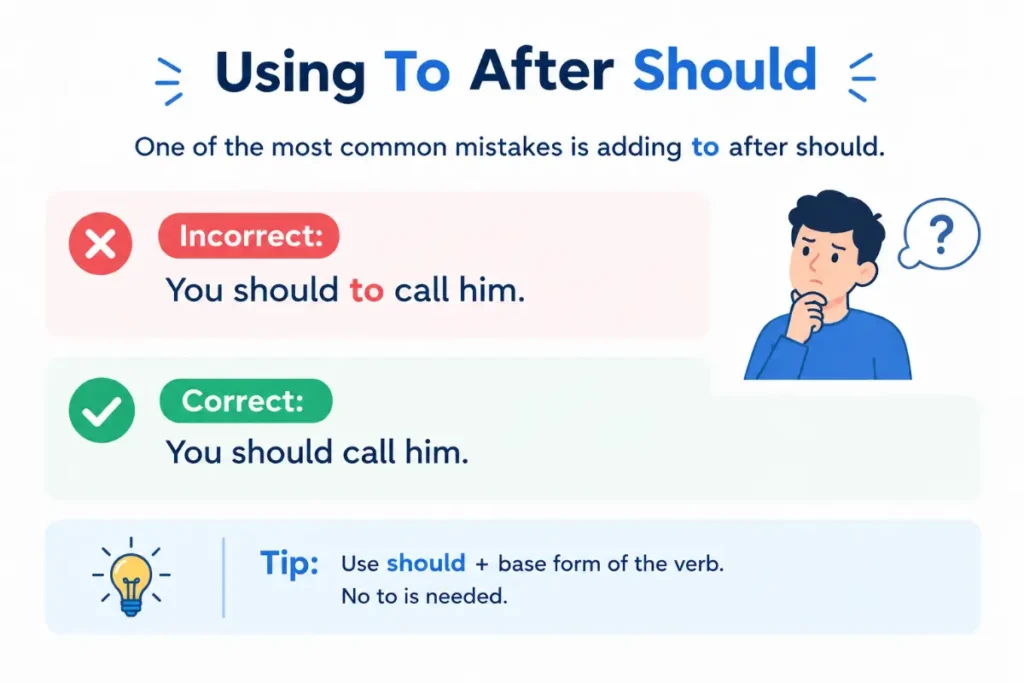
One of the most common mistakes is adding to after should.
Incorrect:
You should to call him.
Correct:
You should call him.
Remember that should goes directly before the base verb.
Removing To After Ought
Learners sometimes copy the pattern of should and remove to from ought.
Incorrect:
You ought call him.
Correct:
You ought to call him.
Ought normally requires to before the main verb.
Treating Should Like A Past Tense
Should has a historical connection with shall, but modern English does not use should simply as the past form of shall.
For example:
I should call her.
This sentence usually expresses advice, expectation, or another modal meaning. It does not automatically mean that the calling happened in the past.
For past situations, context or a form such as should have called provides the necessary meaning.
Using Ought To In Every Formal Sentence
Ought to is not a requirement for formal English.
Some learners assume that ought to sounds more educated or professional. That can lead to unnatural writing.
Should is completely acceptable in formal English.
For example:
Employees should follow safety procedures.
This sentence is clear and professional.
There is no need to replace should with ought to simply to make the sentence sound formal.
Using Oughtn’t Too Often
Oughtn’t is grammatically possible, but it is uncommon in modern American English.
Instead of:
You oughtn’t to worry.
Most speakers would naturally say:
You shouldn’t worry.
Or:
You ought not to worry.
The second version keeps ought to while avoiding the uncommon contraction.
Confusing Advice With Certainty
Should does not always mean an action is certain.
Consider:
The package should arrive tomorrow.
This means the speaker expects it to arrive tomorrow. It does not guarantee the result.
Likewise:
She should be home by now.
This expresses an expectation based on available information.
The context determines how strong that expectation is.
Real Life Examples
At Home
You should clean the kitchen before the guests arrive.
The speaker gives practical advice.
You ought to clean the kitchen before the guests arrive.
The same basic advice sounds slightly more deliberate.
At Work
You should check the figures before sending the report.
The sentence gives sensible professional advice.
You ought to check the figures before sending the report.
This version is correct but sounds somewhat more formal.
At School
Students should read the instructions carefully.
The sentence gives a general recommendation.
Students ought to read the instructions carefully.
The meaning stays similar, but the tone can sound more serious or traditional.
With Friends
You should try that restaurant.
This sounds natural and friendly.
You ought to try that restaurant.
This is also correct, but it may sound more deliberate depending on the speaker.
For Expectations
The delivery should arrive this afternoon.
The speaker expects the delivery to arrive.
The delivery ought to arrive this afternoon.
The speaker expresses a similar expectation using a less common form.
For Responsibility
We should help our neighbors.
The speaker presents helping as a reasonable responsibility.
We ought to help our neighbors.
The sentence can place slightly more emphasis on duty or what is morally appropriate.
For Past Regret
I should have listened to you.
The speaker regrets not listening.
I ought to have listened to you.
The meaning is similar, but the second sentence sounds less common in everyday American conversation.
Memory Tips
A good memory trick can make this grammar much easier.
Think of should as the everyday advice word.
If you are talking to a friend, coworker, student, or family member, should will usually feel natural.
Think of ought to as the more deliberate alternative.
It can express the same basic idea while giving the sentence a more formal, traditional, or duty focused tone.
For grammar, remember one simple pattern:
Should + base verb.
Ought to + base verb.
You should go.
You ought to go.
Another useful trick is to remember the missing word.
Should needs no to.
Ought needs to.
That single distinction prevents many common grammar errors.
For questions, remember that should is the normal choice.
Should I go?
Should she call?
For negative sentences, remember:
Should not.
Ought not to.
For past situations:
Should have.
Ought to have.
These four patterns cover a large part of everyday usage.
Related Grammar Notes
Should belongs to the group of modal verbs. Other common modal verbs include can, could, may, might, must, shall, and will.
Modal verbs have special grammar patterns.
They generally do not take the same verb endings that ordinary verbs take.
For example:
He should go.
Not:
He should goes.
Should also does not normally use do support in ordinary statements.
You do not say:
He does should go.
Instead, say:
He should go.
Questions work directly with should:
Should he go?
Negative sentences work directly with should:
He should not go.
Ought to behaves differently because to appears between ought and the main verb.
You can think of ought to as a fixed modal expression rather than treating ought as an ordinary verb.
Another useful comparison involves must.
Must can express strong obligation:
You must wear a seat belt.
Should normally expresses advice or a less forceful expectation:
You should wear a seat belt.
Ought to can sometimes sit close to should in strength:
You ought to wear a seat belt.
The exact force depends on context and the speaker’s intention.
Should can also express what is expected to happen.
For example:
The results should be ready soon.
Must does not usually express the same ordinary expectation in this context.
This shows why modal verbs cannot always be swapped freely. Each one has its own range of meanings and typical uses.
Should And Ought To In Professional Writing
Professional writing benefits from clear and direct modal choices.
Should is often the best option when you want a sentence that readers can understand quickly.
For example:
Managers should review the document before approval.
Employees should report errors promptly.
Customers should keep their receipts.
These sentences are direct and easy to process.
Ought to can work when the writer wants to emphasize responsibility or expected conduct.
For example:
Managers ought to consider the long term effects of the decision.
This sounds more reflective than a simple instruction.
Still, the difference should not be exaggerated. Both forms can appear in serious writing. The writer’s tone and purpose matter more than the form alone.
Should And Ought To In Advice
Advice can range from gentle suggestions to strong recommendations.
Should often provides a balanced middle ground.
You should back up your files.
You should arrive early for the interview.
These sentences can sound firm without automatically sounding commanding.
Ought to can add a sense of proper action.
You ought to back up your files.
You ought to arrive early for the interview.
The meaning remains close, but the tone may feel more deliberate.
If your goal is natural American conversation, should will usually be the better choice.
Should And Ought To For Moral Judgment
Both forms can express ideas about what people should do based on moral or social expectations.
For example:
People should keep their promises.
People ought to keep their promises.
The first sounds neutral and common.
The second can sound more philosophical or formal.
Writers sometimes choose ought to when discussing principles, duties, or ethical expectations. Still, should can express these ideas just as clearly.
Context does most of the work.
How Strong Are Should And Ought To
Neither should nor ought to normally carries the same force as must.
Compare these sentences:
You should wear a helmet.
You must wear a helmet.
The first two generally communicate advice or a strong recommendation. Must communicates a stronger requirement.
This distinction helps prevent overstatement.
If a rule requires an action, must may be appropriate.
If you are recommending an action, should or ought to may fit better.
The exact strength also depends on tone and situation. A parent telling a child that the child should clean the room may sound much stronger than the same words used casually between friends.
When Should Sounds Better
Should usually works better when you want natural everyday American English.
Use it for:
- Friendly advice.
- Workplace recommendations.
- Classroom guidance.
- Practical suggestions.
- Questions about what to do.
- Expected events.
- Common professional instructions.
- Past regret with have.
Examples include:
You should ask for help.
Should I send the email now?
The meeting should end soon.
You should have told me earlier.
These patterns are common and easy for readers to understand.
When Ought To Can Work Well
Ought to works well when you want to express duty, propriety, expectation, or a more deliberate tone.
Examples include:
We ought to respect the agreement.
You ought to consider the consequences.
They ought to arrive soon.
People ought to treat one another fairly.
The form is especially useful when its slightly formal tone supports the writing.
The mistake is not using ought to. The mistake is using it simply because you think it is always more sophisticated.
Clear writing usually beats fancy wording.
Key Takeaways
- Should and ought to can both express advice, duty, expectation, and appropriateness.
- Should is much more common in everyday American English.
- Ought to is grammatically correct but can sound more formal, traditional, or deliberate.
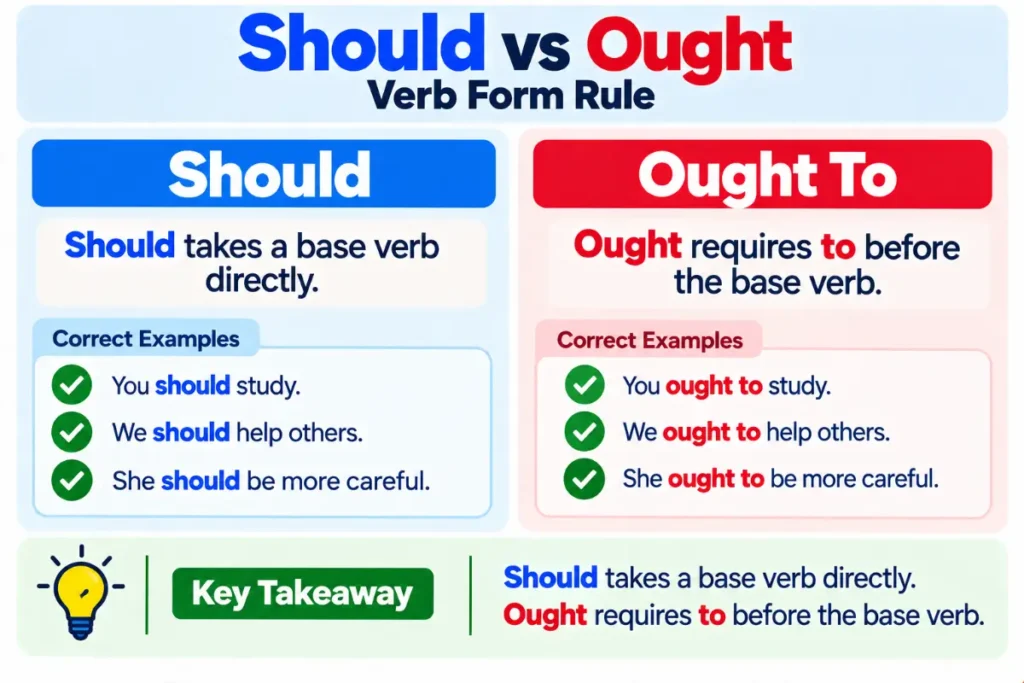
- Should takes a base verb directly.
- Ought requires to before the base verb.
- Say you should go.
- Say you ought to go.
- For questions, should is usually the natural choice.
- For negative sentences, use should not or shouldn’t.
- The usual negative form of ought to is ought not to.
- For past situations, use should have or ought to have.
- Should works well in both casual and professional writing.
- Ought to can emphasize duty or what seems proper.
- Neither form normally expresses an obligation as strong as must.
- When you want natural everyday American English, should is usually the easiest choice.
Conclusion
Should vs ought to is mainly a question of meaning, grammar, frequency, and tone. Both forms can express advice, duty, expectation, and what seems appropriate. In most modern American English situations, should sounds more natural and appears more often.
The grammar difference is easy to remember. Should takes the base verb directly, while ought takes to before the base verb. That gives you two simple patterns: you should go and you ought to go. Once you remember this structure, many common mistakes disappear.
For everyday communication, professional writing, questions, and practical advice, should will usually serve you well. Ought to remains a correct and useful option when you want to express duty or expectation with a slightly more formal or traditional tone. The best choice depends on the sentence, audience, and tone you want to create.
Frequently Asked Questions
Is should or ought to more common in American English?
Should is much more common in everyday American English. Ought to remains correct but appears less often in casual conversation.
Are should and ought to interchangeable?
They are interchangeable in many sentences involving advice, duty, and expectation. Their tone and frequency can differ, so the choice can affect how natural the sentence sounds.
Is ought to grammatically correct?
Yes. Ought to is a standard English construction. It can express advice, duty, expectation, and related meanings.
Can I say should to?
No. Should takes the base verb directly.
Say:
You should go.
Do not say:
You should to go.
Can I say ought without to?
In ordinary modern usage, use ought to before the main verb.
Say:
You ought to go.
Do not say:
You ought go.
Is should more informal than ought to?
Should is more common in casual speech and also works well in formal writing. Ought to can sound more formal, traditional, or deliberate.
Should I use should in professional writing?
Yes. Should is completely appropriate in professional writing. It is clear, common, and flexible.
Is ought to more common in British English?
Ought to remains more common and more noticeable in British English than in everyday American speech. It is not limited to British English.
Can I use ought to for past situations?
Yes. Use ought to have followed by a past participle.
For example:
You ought to have called me.
What is the negative form of ought to?
The standard negative form is ought not to.
For example:
You ought not to ignore the warning.
The contraction oughtn’t exists but is uncommon in modern American English.
Can should express probability?
Yes. Should can express a reasonable expectation.
For example:
The train should arrive soon.
The sentence means the speaker expects the train to arrive soon.
Can ought to express probability?
Yes. Ought to can also express expectation.
For example:
The train ought to arrive soon.
The meaning is close to the version with should, although the expression is less common in everyday American English.

English Grammar & Usage
Nathan Holloway is an American grammar writer and language researcher who specializes in English grammar, sentence structure, verb usage, and common writing mistakes. He enjoys breaking down confusing grammar rules into practical explanations with clear examples, making English easier for students, professionals, and everyday writers.