
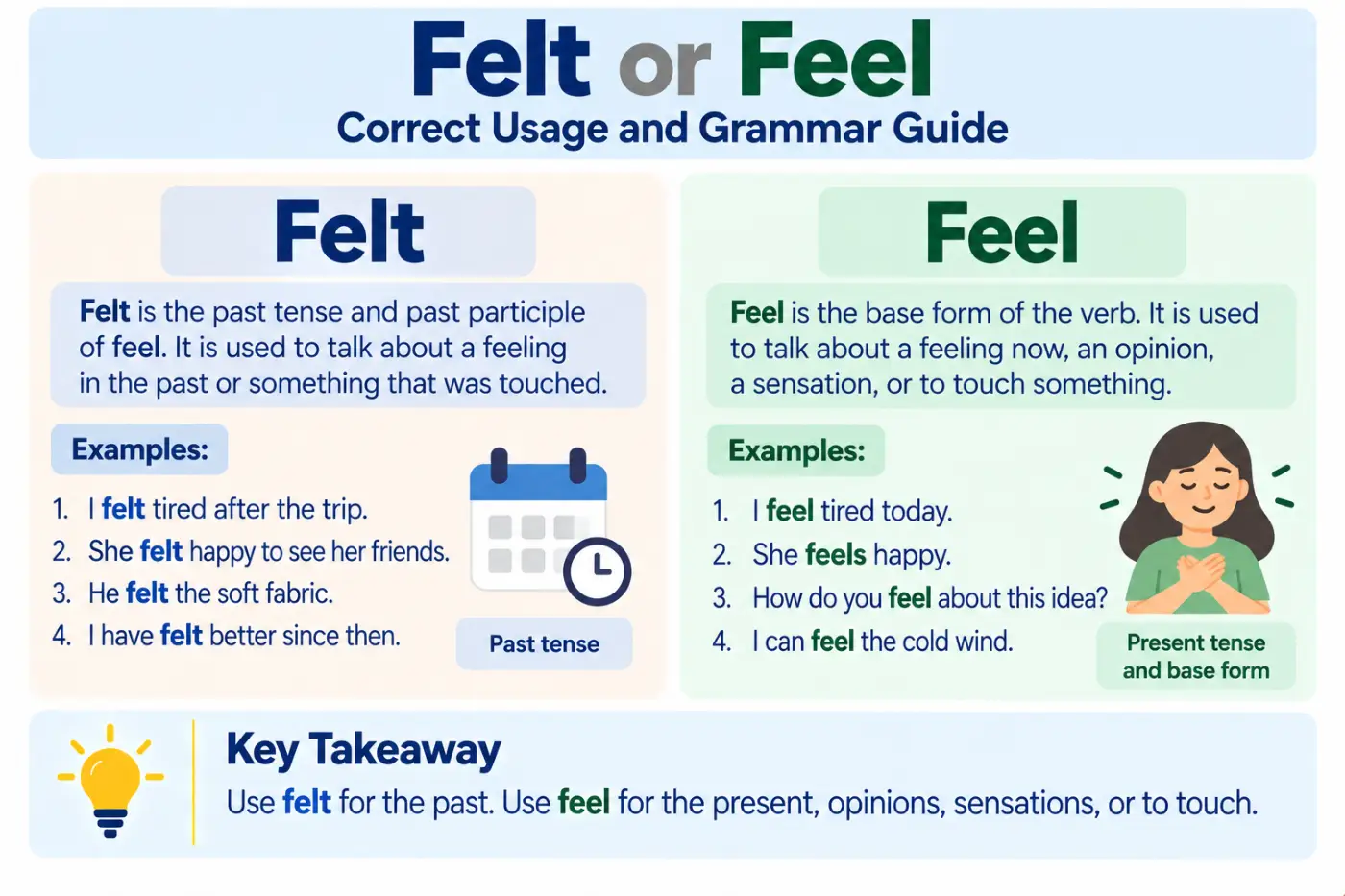
felt or feel can be confusing because both forms come from the same verb and describe sensations, emotions, opinions, or physical experiences. The key difference is tense. Feel is used for the present, while felt is used for the past and as the past participle after certain helping verbs.
The choice becomes easier once you look at the time of the action. If you’re talking about how you feel right now, use the present form. If you’re describing an experience that already happened, use the past form. For example, I feel nervous describes your current emotion, while I felt nervous before the interview describes an earlier experience.
This distinction also matters in questions, negative sentences, perfect tenses, and everyday expressions. You’ll see how native speakers use both forms naturally in conversation, school writing, workplace communication, and more formal English. You’ll also learn common errors such as using felt after did and using feel when a past tense verb is required.
Short Answer
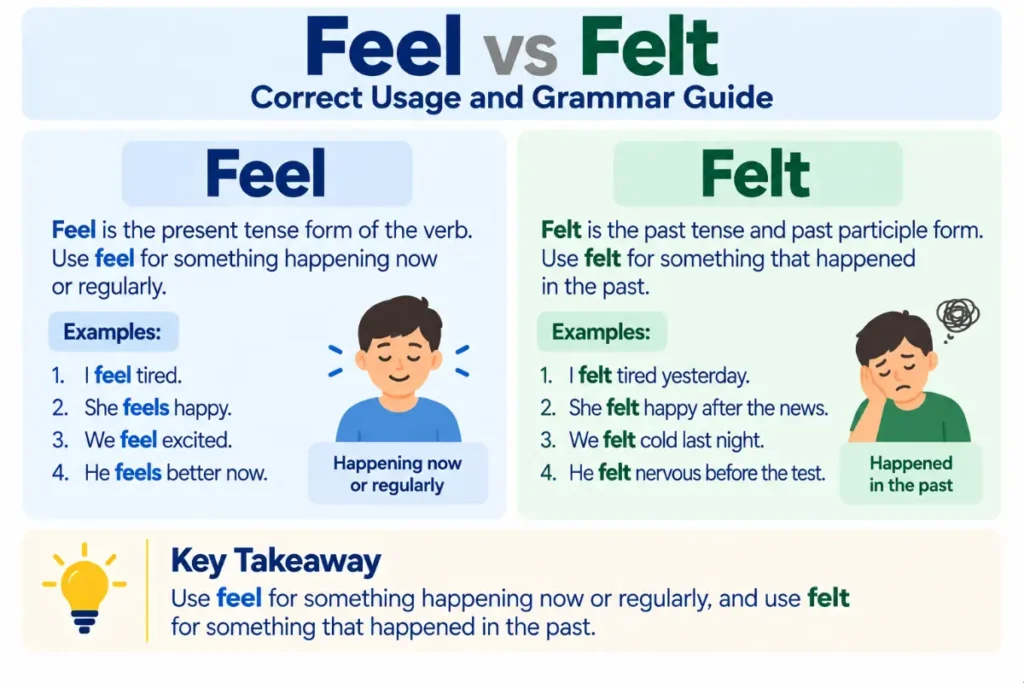
Feel is the present tense form of the verb. Felt is the past tense and past participle form. Use feel for something happening now or regularly, and use felt for something that happened in the past. For example, I feel tired describes your current state, while I felt tired describes a past state.
Table of Contents
- Quick Grammar Rule
- What Feel Means
- What Felt Means
- The Main Difference Between The Two Forms
- Present Tense Usage
- Past Tense Usage
- Feel After Helping Verbs
- Felt After Helping Verbs
- Comparison Table
- Sentence Examples
- Common Mistakes
- Pronunciation
- Grammar Patterns
- Real Life Usage
- Similar Words And Expressions
- American And British English
- Etymology And Word Origin
- Memory Tips
- Expert Editor Insight
- FAQs
- Key Takeaways
- Conclusion
Quick Grammar Rule
Feel is the present form of the irregular verb feel. Felt is its simple past form and past participle.
Use feel for something true now or something that happens regularly.
I feel happy today.
Use felt for something that happened before now.
I felt happy yesterday.
Because feel is an irregular verb, you don’t form its past tense by adding ed. The past form changes from feel to felt.
What Feel Means
Feel is a verb with several related meanings. At its core, it describes experiencing something through your emotions, body, senses, or personal judgment.
You can feel a physical sensation.
I feel the cold air on my face.
You can feel an emotion.
I feel excited about the trip.
You can describe your general condition.
I feel tired today.
You can also use feel when expressing an opinion.
I feel that this decision is reasonable.
The word can therefore describe much more than physical touch. It connects to personal experience and perception.
Feel can also describe the act of touching something to discover its texture or condition.
Feel the fabric before you buy it.
In this sentence the verb describes a deliberate physical action.
The meaning comes from context. The grammar remains straightforward because feel is the present form when it describes something happening now or something that generally happens.
What Felt Means
Felt is the simple past form of feel and also its past participle.
Use it when the experience belongs to a completed or earlier period.
I felt sick yesterday.
She felt nervous before the exam.
They felt happy after hearing the news.
Felt can describe physical sensations, emotions, opinions, and experiences just like feel. The difference is mainly grammatical time.
For example:
I feel better now.
I felt better after taking a short rest.
The first sentence describes the speaker’s current condition. The second places the improvement in the past.
Felt also appears with helping verbs in perfect constructions.
I have felt this way before.
She had felt nervous earlier.
In these sentences felt is the past participle rather than the simple past.
The Main Difference Between The Two Forms
The biggest difference is tense.
Feel normally refers to the present. Felt normally refers to the past or appears as the past participle in perfect constructions.
Consider this pair.
I feel tired.
I felt tired.
The first sentence says the speaker is tired now. The second says the speaker experienced tiredness at an earlier time.
The same pattern works with emotions.
She feels confident.
She felt confident.
It also works with physical sensations.
My hands feel cold.
My hands felt cold.
The meaning of the verb stays similar. The time changes.
This makes tense the first thing you should check. Ask yourself when the experience happened. If it is happening now, the present form usually fits. If it happened earlier, the past form usually fits.
Present Tense Usage
Feel is commonly used when describing a current experience.
I feel nervous.
I feel much better now.
Do you feel okay?
How do you feel today?
It can also describe repeated or general experiences.
I feel tired after long meetings.
Some people feel anxious before public speaking.
Feel can appear with different subjects.
I feel happy.
You feel happy.
We feel happy.
They feel happy.
With third person singular subjects, the present form becomes feels.
He feels happy.
She feels tired.
The dog feels cold.
This creates an important distinction between feel and feels. Feel itself is not used with he or she in a simple present affirmative sentence.
Incorrect:
She feel tired.
Correct:
She feels tired.
However, after does the base form returns.
Does she feel tired?
Not:
Does she feels tired?
The helping verb does carries the present tense marking.
Past Tense Usage
Felt is used when the experience happened in the past.
I felt nervous before the presentation.
She felt better after lunch.
We felt excited when the results arrived.
It works with all subjects because the simple past form does not change according to the subject.
I felt.
You felt.
He felt.
She felt.
We felt.
They felt.
That makes felt simpler than the present tense pattern.
Compare:
I feel tired.
She feels tired.
They feel tired.
But in the past:
I felt tired.
She felt tired.
They felt tired.
The verb stays the same.
Felt can also appear with a specific past time.
I felt sick yesterday.
He felt nervous before the interview.
They felt disappointed last week.
You can also use it when the past time is understood from context.
I felt terrible after the argument.
The listener understands that the feeling belonged to an earlier event.
Comparison Table
| Form | Tense or Function | Meaning | Subject Pattern | Example | Common Use |
|---|---|---|---|---|---|
| Feel | Present | Experience something now or regularly | I, you, we, they | I feel happy today. | Current feelings and general experiences |
| Feels | Present | Experiences something now or regularly | He, she, it | She feels tired. | Third person singular |
| Felt | Simple past | Experienced something before now | All subjects | I felt nervous yesterday. | Past experiences |
| Felt | Past participle | Used with have, has, or had | Depends on auxiliary | I have felt this before. | Perfect constructions |
Feel After Helping Verbs
One of the most common grammar rules involves helping verbs such as do, does, and did.
After do or does use the base form feel.
Do you feel better?
Does she feel sick?
Does he feel ready?
Do they feel confident?
After did, use feel rather than felt.
Did you feel nervous?
Not:
Did you felt nervous?
This mistake happens because did already shows past tense. Adding felt creates two past tense markers in the same verb phrase.
The same principle applies to other irregular verbs.
Did you go?
Not:
Did you went?
Did you see him?
Not:
Did you saw him?
Did you feel better?
Not:
Did you felt better?
The helping verb did handles the past tense. The main verb stays in its base form.
Felt After Helping Verbs
Felt is used after have, has, and had when forming perfect tenses.
I have felt this before.
She has felt nervous about the test.
They had felt uncertain about the decision.
Here felt is the past participle.
The present perfect uses have or has plus felt.
I have felt.
You have felt.
She has felt.
The past perfect uses had plus felt.
I had felt.
They had felt.
The distinction between simple past and perfect forms can become clearer with time expressions.
I felt tired yesterday.
I have felt tired lately.
The first sentence points to a completed past experience. The second connects a past experience with the present period.
Negative Sentences
Negative sentences follow the same auxiliary rule.
For present simple statements:
I don’t feel well.
She doesn’t feel well.
They don’t feel ready.
For past simple statements:
I didn’t feel well.
She didn’t feel well.
They didn’t feel ready.
Notice the important difference.
Correct:
I didn’t feel well.
Incorrect:
I didn’t felt well.
After didn’t the main verb returns to its base form.
This is one of the most useful rules to remember. Whenever did or didn’t appears as the auxiliary, use feel rather than felt.
Questions
Questions follow the same pattern.
Present questions use do or does.
Do you feel tired?
Does she feel nervous?
Does he feel better now?
Past questions use did.
Did you feel tired?
Did he feel better yesterday?
The rule is consistent. The auxiliary carries the tense and the main verb stays in its base form.
This makes the structure easy to recognize once you start looking for the helping verb.
Feelings And Emotions
Feel is extremely common when discussing emotions.
I feel happy.
I feel sad.
These sentences describe the speaker’s current emotional state.
For past emotions use felt.
I felt happy when I saw my family.
She felt nervous before the interview.
He felt disappointed after the loss.
You can also use feel to express an opinion.
I feel that we should wait.
She feels that the plan needs more work.
In these sentences feel means something close to think or believe. The exact meaning depends on context.
Physical Sensations
Feel also describes physical experiences.
I feel cold.
My hands feel warm.
The fabric feels soft.
This medicine makes me feel sleepy.
The floor feels wet.
The past form changes the time.
I felt cold last night.
The fabric felt soft.
The floor felt wet.
This use is common in daily conversation because people constantly describe how their bodies and surroundings seem to them.
Feel As A Linking Verb
Feel can act as a linking verb when it connects the subject with a description of its condition.
I feel tired.
She feels happy.
The room feels cold.
The idea feels strange.
In these sentences feel does not describe an action like touching something. Instead it connects the subject to an adjective that describes a condition or impression.
This is why you normally say:
I feel bad.
Rather than:
I feel badly.
In the first sentence bad describes the speaker’s condition. In certain contexts badly can have a different grammatical meaning because it functions as an adverb. The choice depends on what you intend to say.
Feel As A Physical Action
Feel can also describe touching something.
She felt the wall.
He felt the fabric.
Here the verb describes a physical action performed through touch.
The difference between these uses becomes clear through context.
I feel tired.
This describes a condition.
I feel the fabric.
This describes an action.
The past form works in the same way.
I felt tired.
I felt the fabric.
Common Mistakes
Mistake One
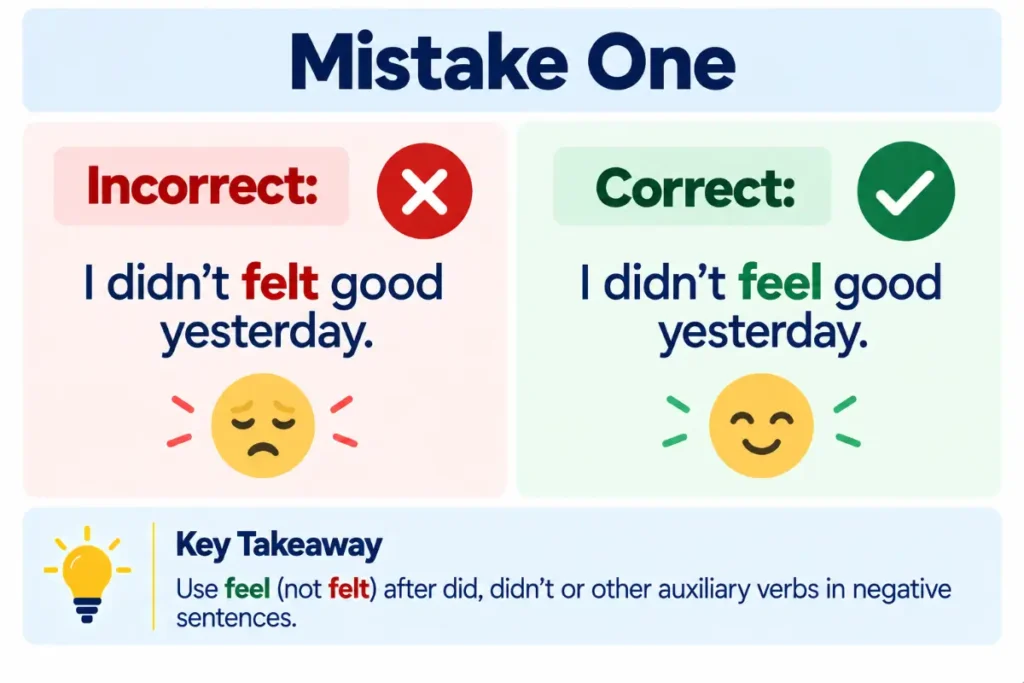
Incorrect: I didn’t felt good yesterday.
Correct: I didn’t feel good yesterday.
The auxiliary didn’t already shows the past tense. The main verb must remain in its base form.
Mistake Two
Incorrect: Did you felt nervous?
Correct: Did you feel nervous?
Again, did carries the past tense.
Mistake Three
Incorrect: She feel happy today.
Correct: She feels happy today.
In a simple present affirmative sentence, she requires the third person singular form feels.
Mistake Four
Incorrect: She felt happy yesterday and now she felt better.
Correct: She felt happy yesterday and now she feels better.
The first feeling belongs to the past. The second describes the current state.
Mistake Five
Incorrect: I have feel this before.
Correct: I have felt this before.
After have the past participle felt is required.
These errors usually happen because English uses different verb forms depending on the auxiliary. Learning the pattern is more useful than memorizing isolated sentences.
Pronunciation
Feel and felt have different vowel sounds.
Feel is pronounced /fiːl/. The vowel is long and sounds like the vowel in words such as see and green.
Felt is pronounced /fɛlt/. The vowel is shorter and similar to the vowel sound in bed.
Feel has one syllable.
Felt also has one syllable.
The final consonant cluster in felt can be challenging for some English learners. Make sure the final t sound is present in careful speech.
The two words are easy to distinguish when spoken naturally because their vowel sounds differ.
Grammar Patterns You Should Know
Several common structures use this verb.
Feel Like
Feel like can mean experience a desire or have the impression that something is true.
I feel like eating pizza.
She feels like taking a walk.
It can also introduce a clause.
I feel like something is wrong.
The past form works in the same way.
I felt like going home.
He felt like something was missing.
Feel Better
Feel better is a common expression used for improvement.
I feel better now.
She felt better after resting.
It often appears when discussing health mood or emotional recovery.
Feel Good
Feel good commonly describes a positive physical or emotional state.
I feel good today.
I felt good after finishing the project.
The phrase can also describe satisfaction.
I feel good about our decision.
Feel Bad
Feel bad can describe sadness guilt discomfort or another negative state.
I feel bad about what happened.
She felt bad after the argument.
The exact meaning comes from context.
Feel Free
Feel free is a polite expression that means you are welcome or have permission.
The phrase is especially common in workplace and customer communication.
Real Life Usage Examples
Daily Conversation
I feel tired after work.
She felt much better after taking a short break.
These examples show how naturally the verb appears in ordinary speech. The first describes the present. The second describes an earlier experience.
Workplace Communication
I feel confident about the presentation.
We felt relieved after the client approved the proposal.
The first sentence describes a current professional opinion or emotional state. The second refers to a completed event.
School Writing
Students often feel nervous before major exams.
I felt more confident after reviewing the chapter.
Both forms can work in school writing. The correct choice depends on the time being discussed.
Academic Writing
Participants reported that they felt more comfortable after the second session.
The researcher may conclude that participants feel more confident when they receive clear instructions.
Academic writing often uses felt to report past observations and feel to describe general findings or conclusions.
Email Communication
I feel confident that we can finish the project on time.
We felt that the revised schedule would work better for everyone.
The choice depends on the time of the opinion or experience.
Storytelling
He felt a sudden chill as he opened the door.
She feels a strange sense of peace whenever she visits the old house.
Stories often move between past and present forms depending on the narrative style.
American And British English
The forms feel and felt are standard in both American and British English. There is no major regional spelling difference between them.
American speakers commonly use both forms in everyday conversation.
I feel tired.
I felt tired yesterday.
British speakers use the same grammar.
I feel tired.
I felt tired yesterday.
Australian and Canadian English also follow the same basic pattern.
Regional differences may affect pronunciation or preferred expressions in some contexts, but the tense distinction remains the same.
You do not need a different spelling for American or British English.
Formal And Informal Usage
Both forms are suitable for formal and informal English. The words themselves are not casual or slang.
In conversation you might say:
I feel pretty tired today.
In a professional setting you could write:
I feel confident that the proposed schedule is realistic.
The grammar stays the same. What changes is the surrounding vocabulary and level of detail.
Felt also works naturally in formal writing.
The participants felt more comfortable after receiving additional information.
There is no need to replace feel or felt with a more complicated verb simply to sound professional. Clear language usually works better.
Similar Words And Expressions
Several words and phrases overlap with feel or describe related ideas.
Sense
Sense can refer to becoming aware of something through the senses or intuition.
I sensed that something was wrong.
Experience
Experience emphasizes going through an event or situation.
She experienced strong emotions during the event.
Believe
Believe often describes an opinion or personal conviction.
I believe this is the right choice.
Feel can sometimes express a similar opinion but may sound more personal.
Think
Think describes an opinion or mental judgment.
I think the plan will work.
Feel can express a personal impression or emotional judgment.
Notice
Notice means becoming aware of something.
I noticed a change in his voice.
Perceive
Perceive is more formal and means to become aware of or interpret something.
The audience perceived the speech as sincere.
Touch
Touch refers specifically to physical contact.
She touched the fabric.
Feel can describe touching but has many broader meanings.
Emotion
Emotion is a noun referring to a feeling such as happiness sadness anger or fear.
The word feel is commonly used to describe experiencing such emotions.
Feel Or Felt In Reported Speech
Reported speech can create confusion because the tense may shift depending on the reporting verb and context.
Direct speech:
She said, I feel tired.
Reported speech:
She said that she felt tired.
The original present form can shift to the past form because the reporting verb said is in the past.
However, tense does not always have to shift if the statement remains true or the speaker wants to preserve the original time reference.
For example:
She said that she feels tired.
This can suggest that she still feels tired now.
The exact choice depends on meaning and context. Grammar provides patterns, but real communication also depends on what the speaker wants the reader to understand about time.
Feel And Felt With Time Expressions
Time expressions can make the correct choice easier.
Present expressions often pair naturally with feel.
I feel better now.
I feel nervous at the moment.
Past expressions often pair naturally with felt.
I felt better yesterday.
I felt nervous before the interview.
Perfect constructions can connect earlier experiences with the present.
I have felt tired lately.
I have felt much better since Monday.
Looking at the time expression can help you identify the tense before you choose the verb form.
Memory Tips
The simplest memory trick is to connect the forms with time.
Feel equals now.
Felt equals before now.
For questions remember:
Did + feel.
Never use the past form immediately after did.
Did you feel better?
For perfect tenses remember:
Have or has + felt.
I have felt better.
She has felt better.
For third person present statements remember:
He or she + feels.
She feels happy.
He feels tired.
These four patterns cover a large share of everyday situations.
Why English Uses Felt Instead Of Feeled
Feel is an irregular verb. Its past form is felt rather than feeled.
English contains many irregular verbs whose past forms do not follow the common ed pattern.
Go becomes went.
See becomes saw.
Take becomes took.
Feel becomes felt.
The form felt has been part of the verb’s historical development for a very long time. You cannot reliably create it by applying the regular past tense rule.
That means learners need to remember felt as the established past form.
Feeled is not the standard past form of feel.
Etymology And Word Origin
Feel has a long history in English. It comes from Old English roots associated with perceiving through the senses and experiencing something internally.
The modern verb developed through historical changes in English pronunciation and spelling. Its past form felt belongs to the same old Germanic verb family.
The irregular relationship between feel and felt reflects the broader history of English. Many common verbs preserve older patterns that do not follow the regular ed ending used by newer or regular verbs.
This history explains why you should learn feel and felt as related forms rather than expecting a regular past tense such as feeled.
Professional Writing Tips
When editing a sentence with this verb, start by locating the time reference.
If the sentence describes the current situation, check for feel or feels.
If it describes a completed past experience, check for felt.
Then read the sentence aloud. This final step can reveal awkward tense changes that may be difficult to notice when you only look at individual words.
A strong editor also checks meaning. Sometimes the tense is technically possible but changes the intended time reference.
For example:
I felt better.
I feel better.
These sentences differ by only one letter but communicate different information about the speaker’s current state.
Expert Editor Insight
A professional editor doesn’t choose between these forms by looking only at the word itself. The surrounding sentence tells you the correct tense. First identify the subject, then look for a helping verb, and finally establish the time reference. If did or didn’t appears, use the base form feel. If have, has, or had appears, use the past participle felt. This simple three step check catches most errors without making grammar feel complicated.
Key Takeaways
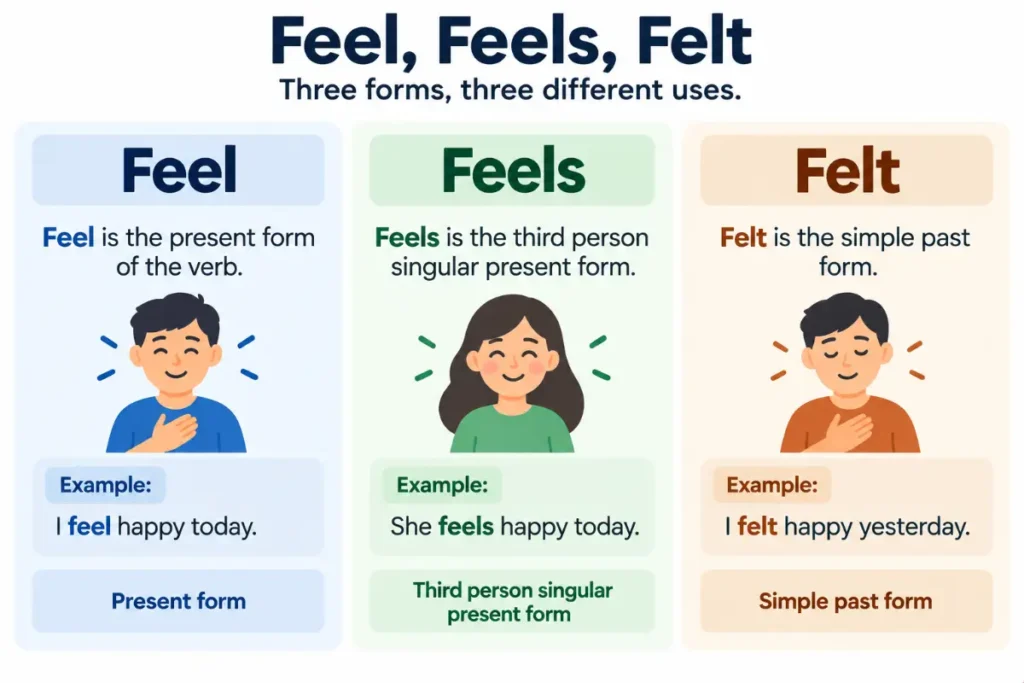
- Feel is the present form of the verb.
- Feels is the third person singular present form.
- Felt is the simple past form.
- Felt is also the past participle.
- Use feel for current or repeated experiences.
- Use felt for completed past experiences.
- After did or didn’t use feel.
- After have, has, or had use felt.
- Do not use feeled as the standard past form.
- The correct form depends on tense, subject, helping verbs, and context.
Conclusion
felt or feel becomes easy to choose once you focus on time and sentence structure. Feel is the present form, while felt is the past form and past participle. If you’re describing something happening now, use feel or feels based on the subject. If you’re describing an earlier experience, use felt.
The helping verb also gives you a strong clue. After did or didn’t use feel, while have, has, and had normally take felt. This rule explains common sentences such as Did you feel better? and I have felt this way before.
For quick proofreading, first find the helping verb and then ask when the experience happened. That small habit catches most errors and helps you choose the right form without second guessing yourself.
FAQs
Is felt the past tense of feel?
Yes. Felt is the simple past form of feel. It is also the past participle used with have, has, and had. For example, I feel tired describes the present, while I felt tired describes the past. You can also say I have felt tired recently, where felt functions as the past participle.
What is the difference between feel and felt?
Feel is generally the present form, while felt is the past form and past participle. Use feel for a current or repeated experience and felt for an earlier experience. For example, I feel happy describes your current emotion. I felt happy describes an emotion you experienced at an earlier time.
Is it correct to say I felt good?
Yes. I felt good is grammatically correct when you are describing a positive past physical or emotional state. For example, I felt good after exercising. You can use I feel good for a current state. The choice depends mainly on the time of the experience.
Should I say did you feel or did you felt?
The correct form is did you feel. The auxiliary did already marks the question as past tense, so the main verb must remain in its base form. Say Did you feel better? Do not say Did you felt better? The same rule applies to other verbs after did.
Can I say I have felt?
Yes. I have felt is correct and uses the present perfect tense. It connects a past experience with the present period. For example, I have felt tired lately means tiredness has occurred during a recent period that relates to now. The same structure works with many adjectives and experiences.
Is feel an irregular verb?
Yes. Feel is an irregular verb because its past form does not follow the regular ed pattern. Its main forms are feel in the base and present form, feels for third person singular present, felt for simple past, and felt as the past participle. You should learn these forms together.
Why is feeled incorrect?
Feeled is not the standard past form of feel. Feel is an irregular verb and its established past form is felt. English has many irregular verbs that do not take the regular ed ending. Learning felt as the past form will help you avoid this common mistake.
Can feel mean think?
Yes. Feel can sometimes express an opinion or personal judgment. For example, I feel that we should wait can mean I believe or think that we should wait. The word often adds a personal or emotional quality to the statement. The exact meaning depends on the surrounding context.
Is I feel badly correct?
I feel bad is normally the natural choice when bad describes your condition or emotion. Feel acts as a linking verb in that structure. Feel badly can have a different meaning in contexts where badly functions as an adverb. For ordinary statements about your condition, I feel bad is usually the intended form.
Do feel and felt have the same pronunciation?
No. Feel and felt have different vowel sounds. Feel has a long vowel sound represented in IPA as /fiːl/. Felt uses /fɛlt/. Both words have one syllable. The vowel difference helps listeners distinguish the present form from the past form in normal speech.

English Grammar & Usage
Nathan Holloway is an American grammar writer and language researcher who specializes in English grammar, sentence structure, verb usage, and common writing mistakes. He enjoys breaking down confusing grammar rules into practical explanations with clear examples, making English easier for students, professionals, and everyday writers.