
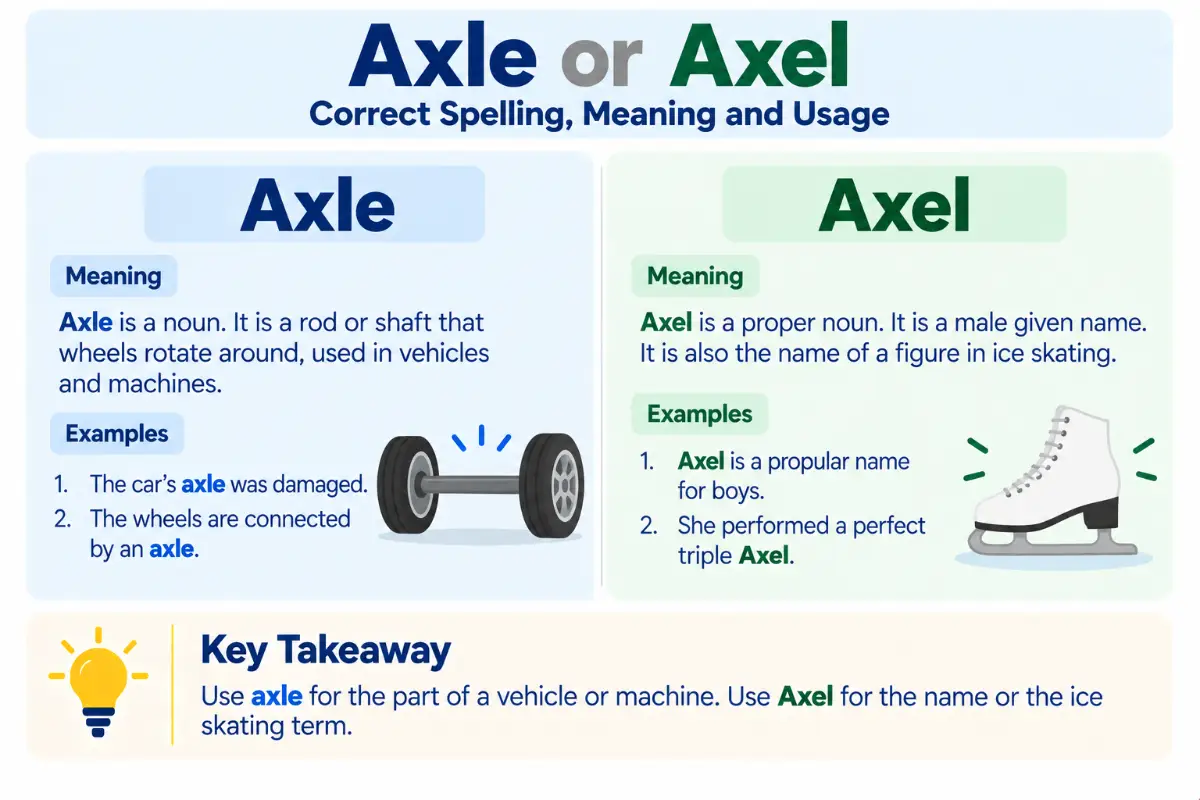
Axle or Axel can cause a surprisingly simple spelling problem. If you mean the mechanical shaft that connects or supports rotating wheels, the correct English word is axle. Axel is generally a personal name rather than the standard spelling of that mechanical term. The two forms can sound similar, so the confusion usually appears when someone hears the word first and has to write it later.
The word axle appears in everyday discussions about cars bicycles trucks carts machinery and engineering. It refers to an important mechanical component that helps wheels rotate and carry loads. Axel, on the other hand, commonly appears as a given name and can have its own history and cultural associations.
The distinction becomes easy once you connect each spelling with its meaning. This guide explains the definitions, pronunciation, word origins, mechanical use, common mistakes, regional usage, sentence examples and memory tricks. It also shows why one small letter can change the word entirely.
Short Answer
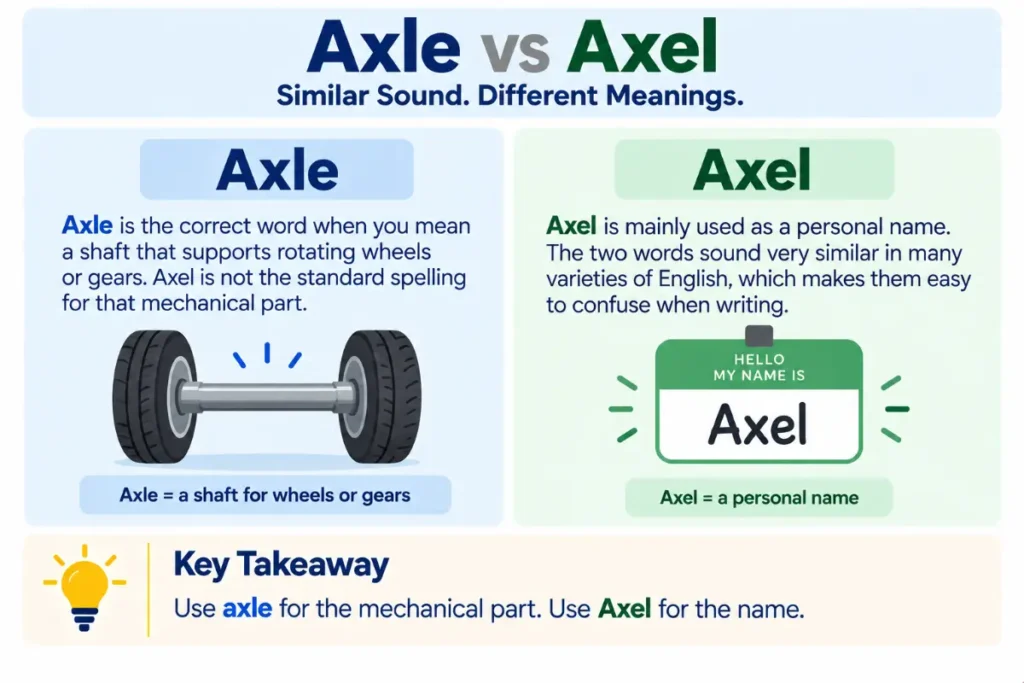
Axle is the correct word when you mean a shaft that supports rotating wheels or gears. Axel is not the standard spelling for that mechanical part. Axel is mainly used as a personal name. The two words sound very similar in many varieties of English, which makes them easy to confuse when writing.
Table of Contents
- Quick Answer
- Meaning of Each Word
- Axle in Mechanical Language
- Axel as a Personal Name
- The Main Difference
- Comparison Table
- How to Use Axle Correctly
- Common Mistakes
- Pronunciation
- Word Origins
- American English and British English
- Real Life Examples
- Related Mechanical Terms
- Memory Tips
- Professional Writing Tips
- Frequently Asked Questions
- Key Takeaways
- Conclusion
Meaning of Each Word
What Does Axle Mean
An axle is a mechanical shaft or rod that supports rotating wheels or other rotating components. In vehicles, an axle forms part of the system that connects the wheels and allows them to rotate while supporting the vehicle or carrying driving forces.
The exact design depends on the machine. Some axles remain stationary while wheels rotate around them. Other axle systems rotate with the wheels and can transmit power from the engine or motor.
You can find axles in many places.
Cars use axle systems as part of their wheel and drivetrain assemblies.
Bicycles use axles at the centers of their wheels.
Trailers use axles to support their wheels and carry weight.
Farm equipment uses axle assemblies to support and move heavy machinery.
Industrial machines can also contain shafts and axle like components designed for rotation and load support.
The important idea is mechanical. An axle belongs to the world of machines wheels and movement.
What Does Axel Mean
Axel is most commonly a personal name. It is used as a masculine given name in several languages and cultures.
For example:
Axel moved to New York last year.
I met Axel at the conference.
Axel plays guitar in a local band.
In these sentences Axel identifies a person. It does not refer to a vehicle component.
You may also encounter Axel as part of a surname, fictional character name, business name, place name or other proper noun. Capitalization can help because personal names normally begin with a capital letter.
The crucial point is that Axel is not the standard English spelling of the mechanical word.
Axle in Mechanical Language
An axle is more than a simple metal rod. In mechanical engineering, axle designs vary according to the vehicle or machine and the job the component must perform. In a basic cart, an axle can support two wheels and allow them to rotate. The vehicle may have front and rear axle assemblies that work with suspension, steering, brakes, wheels and drivetrain components.
A distinction between an axle and a related shaft can also matter in technical writing. Engineers use the words according to the function and design of the component rather than simply treating every rotating metal rod as an axle.
For ordinary English writing, you usually don’t need to explain those engineering details. If you’re describing the part that belongs to a vehicle or wheel assembly, axle is the spelling you need.
For example:
The mechanic inspected the rear axle.
The trailer has a damaged axle.
The bicycle needs a new rear axle.
The axle supports the wheels.
These examples use the word in its standard mechanical sense.
Axel as a Personal Name
Axel is a legitimate name. Unlike a simple spelling error, it has an established use as a personal name.
You might see it in names such as Axel Johnson or Axel Peterson. In a sentence, capitalization makes the distinction obvious.
For example:
Axel called me after work.
Here the word refers to a person.
This creates an interesting situation for spellcheckers. A writing program may recognize Axel as a name while also recognizing axle as a mechanical term. Context determines which form makes sense.
If you’re writing about a person named Axel, don’t change the spelling to axle. Proper names should retain their established spelling.
For example:
Correct: Axel joined the meeting.
Incorrect: Axle joined the meeting.
The second sentence changes the person’s name into a mechanical term.
The Main Difference
The difference is primarily meaning and spelling.
- Axle refers to a mechanical component. It is associated with wheels, vehicles, machines and rotating systems.
- Axel is usually a personal name. It identifies a person and is normally capitalized.
- Axle is a common noun. It can appear with articles and other determiners such as an axle, the axle and this axle.
- Axel is normally a proper noun. It generally appears with a capital letter when used as a person’s name.
- The pronunciation can be very similar. This makes the confusion more common in speech based spelling.
- The spelling carries the meaning. The final letter separates the mechanical term from the common personal name.
This is a classic example of why listening alone isn’t always enough for English spelling. Two words can sound alike or almost alike while having completely different meanings.
Comparison Table
| Word | Meaning | Part of Speech | Typical Capitalization | Main Context | Example |
|---|---|---|---|---|---|
| Axle | A shaft or rod associated with supporting rotating wheels or transmitting motion | Noun | Lowercase | Vehicles machinery bicycles trailers engineering | The mechanic replaced the axle. |
| Axel | A personal name | Proper noun | Capitalized | Names people characters and surnames | Axel arrived early. |
How to Use Axle Correctly
The word works as a noun. You can use it as the subject or object of a sentence and combine it with adjectives that describe its position condition or function.
Here are some common patterns.
Singular Use
The axle is damaged.
The axle supports the wheels.
A broken axle can stop the vehicle from moving safely.
The word takes the singular article a or an depending on the surrounding grammar. Since axle begins with a vowel sound you say an axle.
For example:
The mechanic inspected an axle.
Plural Use
The plural is axles.
The truck has two axles.
The manufacturer produces heavy duty axles.
Several axles were inspected before the equipment was shipped.
The spelling changes by adding s. The pronunciation of the plural ending follows normal English rules.
Possessive Use
You can also use the possessive form.
The axle’s condition was poor.
The axle’s position affects the design.
The truck’s rear axle needs repair.
In technical writing, possessive constructions can be useful when explaining the relationship between a component and its characteristics.
Common Mistakes
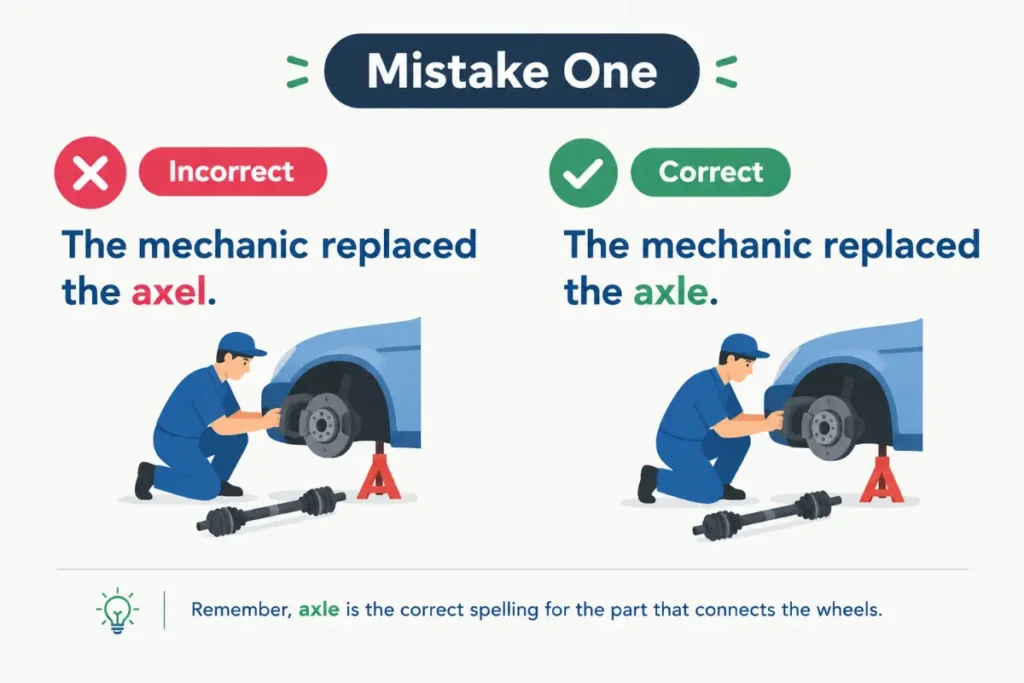
Mistake One
Incorrect: The mechanic replaced the axel.
Correct: The mechanic replaced the axle.
The context clearly refers to a vehicle component. The mechanical word uses axle.
Mistake Two
Incorrect: The car has a damaged axel.
Correct: The car has a damaged axle.
The spelling error often happens because the writer remembers the sound but not the written form.
Mistake Three
Incorrect: Axle is coming to dinner tonight.
Correct: Axel is coming to dinner tonight.
Here the sentence refers to a person. The name Axel needs the capital letter and the spelling associated with the name.
Mistake Four
Incorrect: The truck has two Axel.
Correct: The truck has two axles.
The mechanical noun has the plural form axles.
Mistake Five
Incorrect: The engineer checked an axel before testing the machine.
Correct: The engineer checked an axle before testing the machine.
The surrounding words provide a strong semantic clue. Engineer, machine and testing all point toward the mechanical meaning.
Why This Spelling Confusion Happens
The main problem is sound based spelling. If you hear a word without seeing it written down, you may try to reproduce the spelling from memory. English makes that difficult because similar sounds can correspond to different letters.
Another factor is familiarity. Axel is a recognizable personal name, while some people encounter the mechanical word less often in everyday writing. A person who knows several people named Axel may naturally think of that spelling first.
Typing habits can also contribute. People often write quickly and rely on phonetic memory. A small spelling difference can slip through if the writer doesn’t reread the sentence.
Context usually solves the problem.
If you’re talking about a car, wheel, trailer or machine, think mechanical component.
If you’re talking about a person, think personal name.
That simple semantic check can prevent the error.
Pronunciation
In many varieties of English, axle and Axel have the same or nearly the same pronunciation. The main sound is often represented as /ˈæk.səl/.
The word has two syllables. The stress falls on the first syllable.
Because the pronunciation is so similar, you cannot always hear the spelling difference. This is one reason the words can be confused.
The word axle contains the letter x followed by l. The x represents the familiar consonant sound heard in words such as axis and maximum. The final e does not create a separate vowel sound.
Axel as a name can have pronunciation differences depending on the language and the person’s preference. In English contexts it is often pronounced similarly to the mechanical word.
If you are referring to a specific person named Axel, use the pronunciation that person uses. Names can have personal or regional pronunciation preferences.
Word Origins
The mechanical word axle has a long history in English and other Germanic languages. It is related to older Germanic forms associated with an axle or axis.
The broader word family connects with the idea of an axis or central line around which something turns. This makes sense mechanically because an axle is closely connected with rotating wheels.
The English word axis also comes from an older classical root and shares a broader conceptual connection with rotation and a central line. However, axle and axis are not interchangeable in ordinary mechanical writing.
Axel as a personal name has a separate history. It is associated with names found in Scandinavian and Germanic language traditions and is also used in other countries today.
The similarity between the modern forms is therefore not a reason to treat them as alternative spellings. They have different uses and histories.
American English
American English uses axle as the standard spelling for the mechanical component.
You will commonly see it in automotive writing, repair manuals, bicycle discussions, engineering texts and everyday conversations about vehicles.
Examples include:
The rear axle needs inspection.
The vehicle has a solid rear axle.
The axle connects the wheel assembly to the vehicle system.
Axel is also used in American English as a personal name.
The two forms can therefore appear in the same language without competing as standard spellings of the same word.
British English
British English also uses axle for the mechanical component.
A British driver might say:
The rear axle needs repair.
A British writer may also use Axel as a personal name.
The spelling of the mechanical term does not change to Axel in standard British English. The difference remains semantic rather than regional.
Australian English
Australian English follows the same basic distinction.
Axle is the standard mechanical term, while Axel can function as a personal name.
The context remains the easiest guide. Discussions involving cars, trailers, machinery and wheels normally require the mechanical spelling.
Canadian English
Canadian English also uses axle for the mechanical component. And Canadian writing may use the word in automotive, transportation, manufacturing and engineering contexts. Axel remains available as a personal name.
There is no major Canadian spelling variation that turns Axel into the standard mechanical term.
Real Life Examples
Daily Conversation
The car’s rear axle needs to be checked.
That old trailer has a bent axle.
Both sentences refer to mechanical components. The word fits naturally into ordinary conversations about vehicles and repairs.
Workplace Communication
The technician inspected the axle before returning the vehicle to the customer.
Please record the axle condition in the maintenance report.
These examples show how the word appears in practical workplace communication.
Academic Writing
The study examines the forces acting on a rotating axle.
The researchers measured stress across the axle during testing.
Technical and academic writing often uses the word alongside terms such as force, rotation, load, stress and torque.
News Writing
The truck was taken off the road after an axle problem was discovered.
Officials reported that the damaged axle contributed to the mechanical failure.
News writing uses the term when explaining transportation incidents or mechanical conditions.
Storytelling
The old cart stopped when its axle broke.
He crouched beside the wagon and examined the damaged axle.
In storytelling the word helps describe physical objects and mechanical problems without requiring technical detail.
Related Mechanical Terms
Several words often appear alongside axle. Understanding them can help you use the term more accurately.
Wheel
A wheel is the circular component that rotates around an axle or forms part of a wheel assembly.
Shaft
A shaft is a mechanical component designed to transmit rotational motion or torque. Some shafts resemble axles but their functions can differ.
Hub
The hub is the central part of a wheel where the wheel connects to the axle or related assembly.
Bearing
A bearing supports relative motion and reduces friction between moving components. Wheel assemblies often use bearings around an axle.
Spindle
A spindle is a rotating component that can support or carry another component. Its exact role depends on the machine.
Differential
A differential is a drivetrain mechanism that allows wheels connected to the same axle system to rotate at different speeds when needed.
Drivetrain
The drivetrain includes the mechanical components that transfer power from the engine or motor to the wheels.
Suspension
The suspension system connects the vehicle body to the wheels and helps manage movement caused by road surfaces. It works alongside wheel and axle components.
These terms can appear together in automotive and mechanical writing but they don’t mean the same thing.
Axle Types And Common Contexts
The word can appear in several mechanical contexts.
Front Axle
A front axle is associated with the front wheels of a vehicle. Its exact design depends on the vehicle’s steering and drivetrain arrangement.
Rear Axle
A rear axle is associated with the rear wheel assembly. In some vehicles it can also be part of the system that transfers power to the rear wheels.
Solid Axle
A solid axle connects the wheel assemblies through a rigid structure. This design is common in certain vehicle and equipment applications.
Live Axle
A live axle is an axle that can transmit driving power to the wheels. The term is common in automotive discussions.
Dead Axle
A dead axle supports a load but doesn’t normally transmit driving power to the wheels it carries.
These technical categories show why context matters. The basic word stays the same while the specific design and function can vary.
Memory Tips
The easiest memory trick is to connect the spelling with the object.
Think of the mechanical term as axle with an l for load.
An axle carries or supports loads in many mechanical applications.
You can also remember this simple contrast.
Axle means machine.
Axel means name.
For example:
The axle broke.
Axel called.
The first sentence concerns machinery. The second concerns a person.
Another useful trick is to look at capitalization. A capital A in Axel may signal a person’s name, although capitalization alone doesn’t prove meaning because Axel can appear at the beginning of a sentence.
The best method combines spelling and context rather than relying on capitalization alone.
Professional Writing Tips
If you’re writing a technical document, don’t rely only on spellcheck. Read the sentence for meaning.
A spellchecker may recognize both axle and Axel as legitimate entries because both forms exist in English usage. The software may not know which one you intended unless the surrounding context gives it enough information.
For technical writing, check the noun against the subject.
If the sentence discusses wheels, vehicles, machinery or rotating components, axle is usually the word you need.
If the sentence identifies a person, preserve the person’s name exactly as intended.
This is especially important in manuals, repair records, academic papers and business documents. A single letter can change the meaning of the sentence.
An editor should also check capitalization. Mechanical terms such as axle normally use lowercase letters unless they begin a sentence. Personal names such as Axel normally use an initial capital letter.
Axle or Axel in Technical Writing
Technical writing requires extra care because precision matters. A mechanic, engineer or technician expects component names to remain consistent throughout a document.
Suppose a repair report says:
The axel was damaged.
A reader may understand the intended meaning from context, but the spelling still needs correction. In a professional document, standard terminology matters because repair instructions and component descriptions need to be clear.
The correct sentence is:
The axle was damaged.
If the document discusses several components, consistency becomes even more important.
The front axle was inspected.
The rear axle was replaced.
Both examples use the standard mechanical term.
Axle or Axel in Names
Names should always be treated separately from ordinary vocabulary.
If a person’s legal or established name is Axel, keep it as Axel.
For example:
Axel works at the repair shop.
The sentence could be confusing if the writer accidentally changed the name to axle. The context might reveal the intended meaning, but changing someone’s name is still an error.
The same principle applies to fictional characters, businesses and other proper names. A name should not be changed simply because another word has a similar pronunciation.
Similar Spelling Pairs
English contains many pairs that create confusion because their spellings or sounds are similar.
Examples include:
Accept and except.
Affect and effect.
Advice and advise.
Principal and principle.
Stationary and stationery.
Brake and break.
Axle and Axel fit the same general learning pattern. The key is not simply memorizing spelling. You should connect each form with its meaning and grammatical role.
For this pair the distinction is particularly easy because the meanings belong to completely different categories.
One describes a mechanical component.
The other normally identifies a person.
Key Takeaways
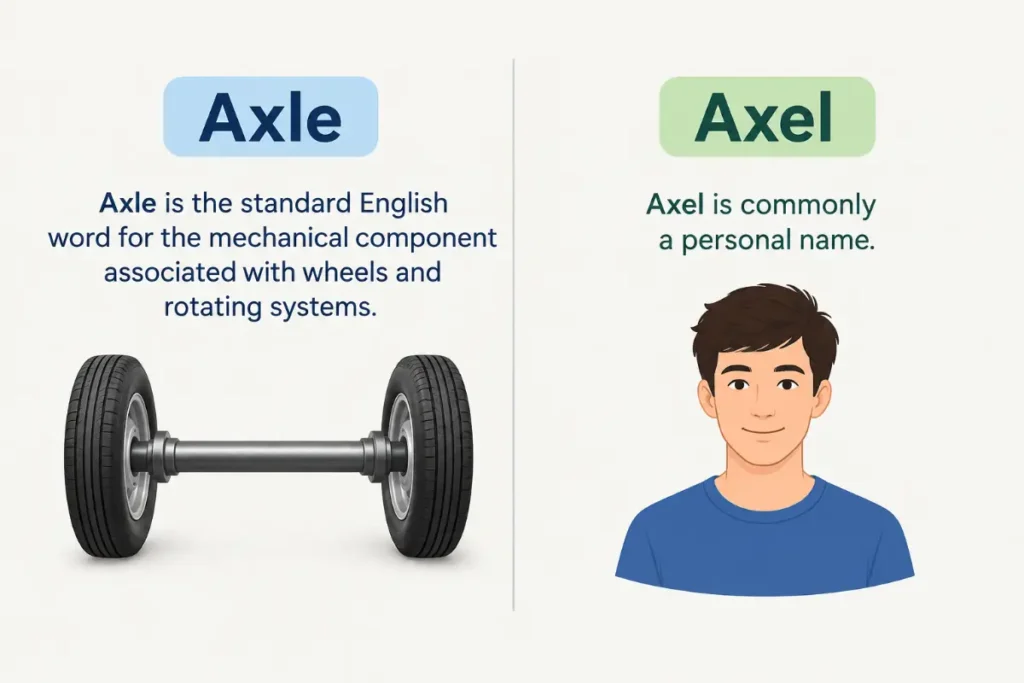
- Axle is the standard English word for the mechanical component associated with wheels and rotating systems.
- Axel is commonly a personal name.
- The two forms can sound the same or very similar in English.
- Context usually makes the intended meaning clear.
- Use axle when discussing cars, bicycles, trailers, machinery and wheel assemblies.
- Use Axel when referring to a person whose name is spelled that way.
- The plural of axle is axles.
- Axle is a noun rather than a standard verb.
- In technical writing, standard spelling matters because component names need to remain precise.
- A simple memory trick is machine equals axle and name equals Axel.
Conclusion
Axle or Axel becomes easy to distinguish once you connect each spelling with its meaning. Axle is the standard mechanical noun used for a component associated with wheels, vehicles, machinery and rotating systems. Axel is most commonly a personal name.
The pronunciation can make the two forms confusing because they may sound alike or nearly alike. That is why context matters. If the sentence mentions a car, trailer, bicycle, wheel or machine, the mechanical spelling is the natural choice. If the sentence identifies a person, use the person’s established name.
For a quick memory trick, think machine when you see axle and name when you see Axel. That simple connection will help you choose the right form without second guessing yourself.
Frequently Asked Questions
Is Axel a correct spelling of the mechanical part?
No. Axel is generally used as a personal name rather than the standard English term for the mechanical component. If you’re talking about the shaft or rod associated with rotating wheels, use axle. The difference is small in writing but meaningful in context.
Is axle a name?
Axle is not normally used as a standard personal name in English. It is primarily a common noun referring to a mechanical component. Axel is the form more commonly recognized as a personal name.
Why are axle and Axel confused?
The two forms are commonly confused because their pronunciation can be the same or very similar. A person who hears the word before seeing it written may choose the familiar spelling Axel. Context provides the best clue. Cars, wheels and machines point to axle, while a person’s identity points to Axel.
How do you pronounce axle?
Axle is commonly pronounced with two syllables and stress on the first syllable. Its pronunciation is often represented in IPA as /ˈæk.səl/. The final e does not produce a separate vowel sound. Axel may have a similar pronunciation in English, especially when used as a personal name.
What is the plural of axle?
The plural is axles. For example, you can write the truck has two axles. The plural form follows the normal English pattern of adding s to the singular noun. The word continues to refer to mechanical components associated with wheels or rotating systems.
Can Axel be used as a person’s name?
Yes. Axel is an established personal name. It appears in different countries and language communities and can also occur as part of surnames or fictional character names. If someone has the name Axel, keep that spelling even when it sounds similar to the mechanical word axle.
Is axle used in British English?
Yes. Axle is standard in British English for the mechanical component associated with wheels and vehicles. British English does not normally replace axle with Axel. Axel can appear separately as a personal name.
What is the easiest way to remember the difference?
Think of axle as the machine word and Axel as the name. You can also connect the l in axle with load because an axle can support loads in mechanical systems. Then remember that a person named Axel uses the spelling with e at the end.
Is axle a noun or a verb?
Axle is a noun. It names a mechanical component. It can appear as a singular noun such as an axle or as a plural noun such as axles.
What is the difference between an axle and a shaft?
An axle generally refers to a component associated with supporting rotating wheels or related mechanical loads. A shaft is a broader mechanical term for a component that transmits rotational motion or torque. Some components can perform overlapping functions, so engineers distinguish them based on their design and role.

Confusing Words, Spelling & Word Choice
Claire Whitmore is a U.S.-based English editor who writes about commonly confused words, spelling differences, and word choice. Her work helps readers understand subtle distinctions between similar-looking words through simple definitions, practical examples, and modern usage guidance in both American and British English.