
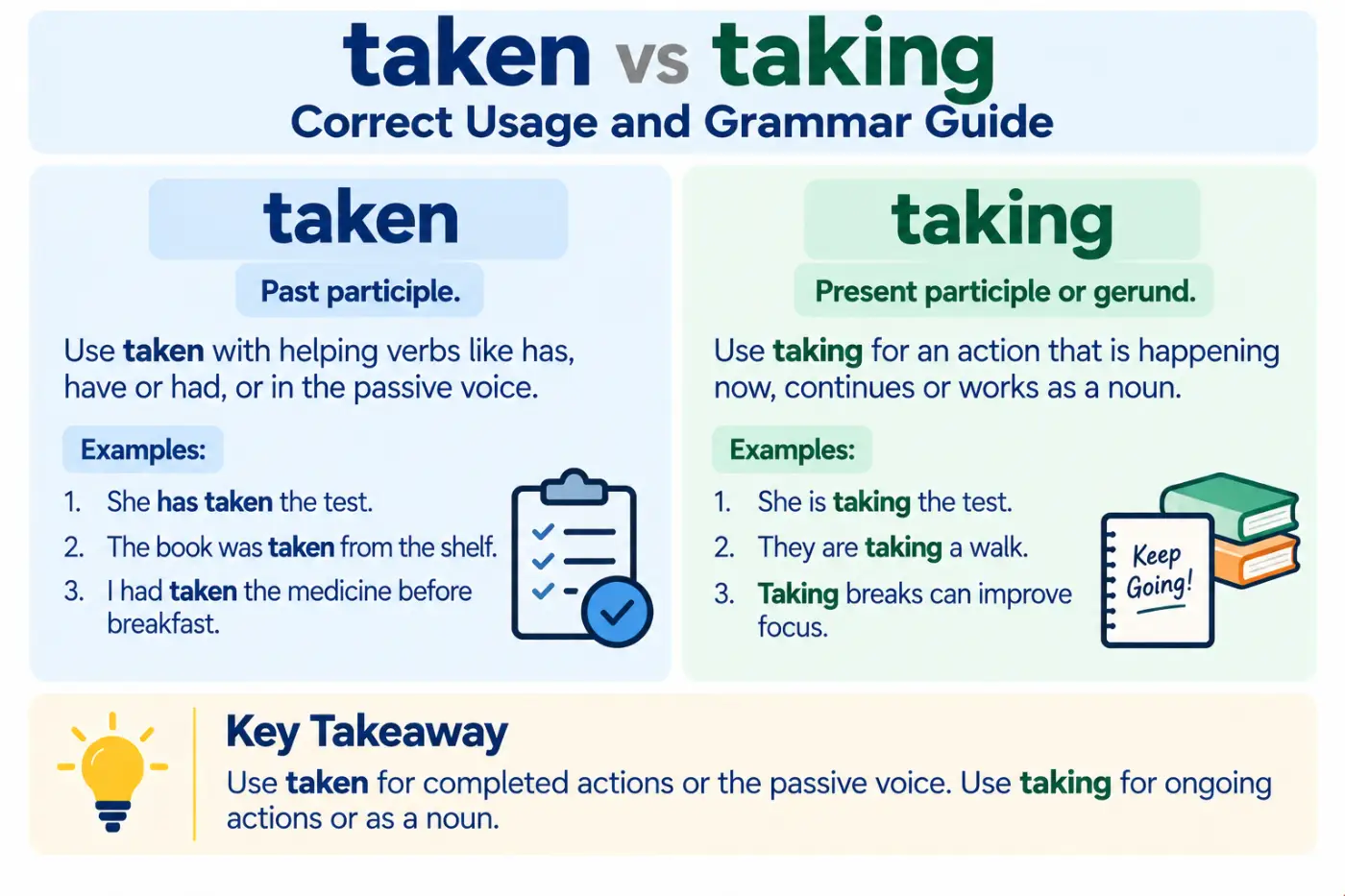
taken vs taking can be confusing because both forms come from the same verb but they appear in very different sentence structures. The simple answer is that taken usually shows a completed action or a state that results from an action while taking usually describes an action happening now or the activity of doing something.
The difference becomes clearer when you look at the verb take across its main forms. Take is the base form. Took is the simple past form. Taken is the past participle. Taking is the present participle and gerund form. Each form has its own grammatical purpose so replacing one with another can change the meaning or make a sentence grammatically incorrect.
You’ll often see these forms in everyday phrases such as taking a break, taking a test, has taken the book, and was taking the train. Once you understand the role of helping verbs and sentence structure, choosing the right form becomes much easier. The goal isn’t to memorize dozens of isolated examples. It’s to recognize the pattern behind them.
Short Answer
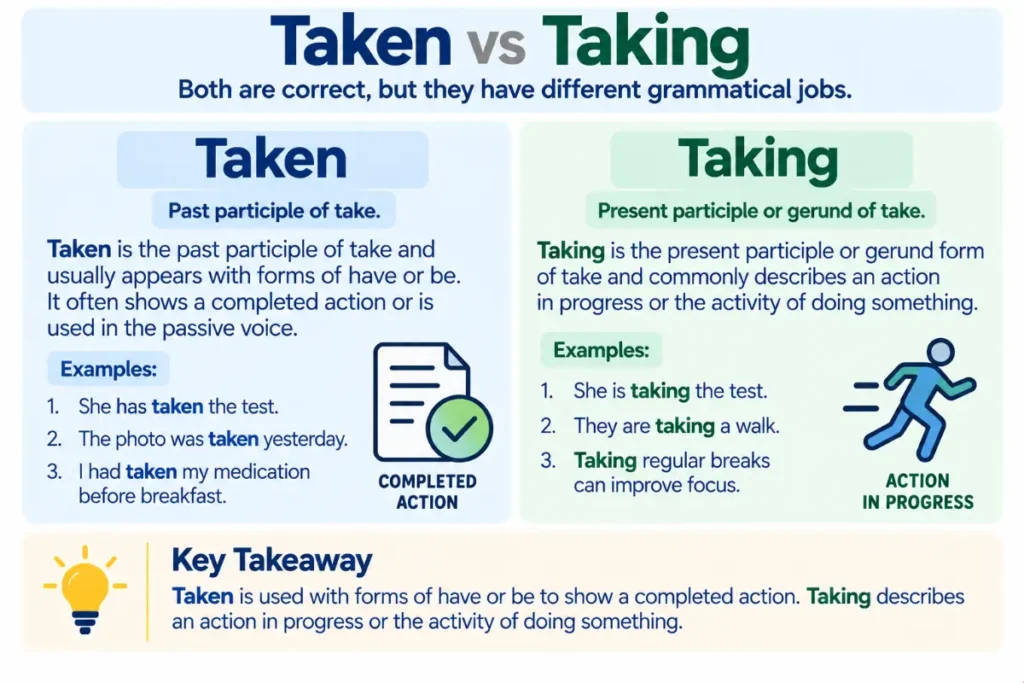
Taken and taking are both correct English words but they have different grammatical jobs. Taken is the past participle of take and usually appears with forms of have or be. Taking is the present participle or gerund form of take and commonly describes an action in progress or the activity of doing something.
Table of Contents
- Quick Answer
- Meaning of Take
- Meaning of Taken
- Meaning of Taking
- Main Difference
- Grammar Rules
- How Taken Works in Sentences
- How Taking Works in Sentences
- Comparison Table
- Sentence Examples
- Common Mistakes
- Pronunciation
- Word Origin
- American and British Usage
- Related Words and Expressions
- Real Life Usage
- Memory Tips
- Professional Writing Tips
- FAQs
- Key Takeaways
- Conclusion
Meaning of Take
Before comparing the two forms, it helps to understand the base verb take.
Take is an irregular English verb with many meanings. It can mean to move something from one place to another, accept something, receive something, consume something, spend time, use transportation, or perform an action.
For example:
I take the bus to work.
Please take this book with you.
She takes a short break at noon.
We take photos during our trips.
The verb is extremely flexible. Its meaning changes according to the noun or phrase that follows it.
Take also appears in many common expressions. You can take a shower, take a seat, take a test, take a chance, take a look, take notes, take responsibility, or take care of something.
Because take is irregular, its past forms don’t follow a simple ed pattern.
The main forms are:
- Take as the base form.
- Takes as the third person singular present form.
- Took as the simple past form.
- Taken as the past participle.
- Taking as the present participle and gerund.
Understanding these five forms makes the comparison much easier.
Meaning of Taken
Taken is the past participle of take.
A past participle usually doesn’t work alone as the main past tense of an irregular verb. Instead, it commonly appears with helping verbs such as have, has, had, or forms of be.
For example:
I have taken the test.
She has taken my advice.
They had taken the wrong road.
In these examples, taken connects with a helping verb to form a perfect tense.
Taken can also appear in passive constructions.
The book was taken from the shelf.
The photos were taken yesterday.
Here taken is part of the passive voice.
The word can also describe a state or condition.
The seat is taken.
In this sentence, taken tells us that someone already occupies the seat.
Taken can therefore communicate several related ideas. It may show that an action has been completed, that something has been affected by an action, or that something is no longer available.
The exact meaning comes from the sentence around it.
Meaning of Taking
Taking is the present participle and gerund form of take.
As a present participle, it commonly appears with forms of be to show an action in progress.
I am taking a class.
She is taking a shower.
They are taking the train.
We were taking notes.
The action is presented as ongoing at a particular time.
Taking can also function as a gerund. A gerund looks like a verb form ending in ing but functions as a noun.
For example:
Taking notes helps me remember information.
Taking regular breaks can improve concentration.
I enjoy taking photographs.
In these examples, taking refers to an activity rather than simply describing an action in progress.
This distinction is useful because the same form can perform different grammatical jobs.
Main Difference
The easiest way to understand the difference is to focus on time and grammar.
Taken is a past participle. It normally needs a helping verb in standard perfect or passive constructions.
Taking is an ing form. It can describe an action in progress or function as a noun representing an activity.
Compare these sentences:
She has taken the test.
She is taking the test.
The first sentence tells us that the test has already been completed. The second tells us that the person is currently doing the test.
Another comparison makes the difference even clearer:
They had taken the wrong train.
They were taking the wrong train.
The first describes a completed choice before another past point. The second describes an action that was in progress.
The words come from the same verb but they don’t perform the same grammatical function.
Comparison Table
| Form | Grammar Role | Main Use | Example | Meaning |
|---|---|---|---|---|
| Take | Base verb | Present tense and infinitive structures | I take the bus. | Regular or general action |
| Takes | Third person singular present | Present tense with he she or it | She takes the bus. | Regular or repeated action |
| Took | Simple past | Completed past action | He took the bus. | Action completed in the past |
| Taken | Past participle | Perfect tenses and passive voice | She has taken the bus. | Completed action or passive state |
| Taking | Present participle or gerund | Ongoing action or activity | She is taking the bus. | Action in progress or activity |
Grammar Rules for Taken
Taken usually appears after a form of have in perfect constructions.
The present perfect uses have or has plus the past participle.
I have taken the course.
She has taken the course.
The past perfect uses had plus the past participle.
They had taken the course before starting the job.
The future perfect uses will have plus the past participle.
By next month I will have taken all the required classes.
Taken also appears in passive constructions.
The package was taken to the office.
The documents were taken from the cabinet.
The form of be changes according to tense while taken remains the past participle.
You should not normally use taken alone as the simple past form.
Incorrect:
I taken the book yesterday.
Correct:
I took the book yesterday.
The reason is simple. Yesterday calls for the simple past in this sentence, so took is needed.
Another common error is using taken without a helping verb.
Incorrect:
She taken my phone.
Correct:
She took my phone.
Or:
She has taken my phone.
The first corrected sentence uses simple past. The second uses the present perfect.
Grammar Rules for Taking
Taking commonly appears with a form of be when you want to show an action in progress.
I am taking a course.
He is taking a break.
They are taking photographs.
We were taking notes.
You can also use taking as a gerund.
Taking notes is useful.
I enjoy taking walks.
Taking care of a pet requires time.
In these sentences the ing form behaves like a noun.
Taking can also appear after certain verbs.
I enjoy taking pictures.
She avoided taking the wrong road.
They considered taking a taxi.
The choice of verb determines the structure that follows.
Taking also appears after prepositions.
She is interested in taking the course.
He talked about taking a new job.
They left without taking their bags.
This pattern is worth remembering. After a preposition, an ing form is commonly used when the next word represents an activity.
When to Use Taken
Use taken when the grammar calls for a past participle.
One of the strongest clues is a form of have.
- I have taken the medicine.
- She has taken the exam.
- They had taken the wrong turn.
- We will have taken the required course by Friday.
Another clue is passive voice.
- The picture was taken in Chicago.
- The money was taken from the drawer.
- Several steps were taken to solve the problem.
- The seat has been taken.
Taken can also appear as an adjective in certain contexts.
The opportunity is already taken.
The seat is taken.
The phrase taken seriously is another common construction.
His advice should be taken seriously.
Here taken forms part of a passive expression.
When to Use Taking
Use taking when you want to describe an action in progress.
I am taking a class this semester.
She is taking a break.
They are taking notes.
He was taking a photograph.
Taking also works when you describe an activity as a noun.
Taking short breaks can help you stay focused.
She enjoys taking long walks.
Another common use appears in instructions and descriptions.
Taking the train is usually faster.
Taking responsibility is part of becoming a good leader.
In each case the ing form refers to an activity or action.
Sentence Examples
Here are ten examples that show the forms in realistic situations.
- I have taken the required training.
Taken is the past participle used with have. The sentence describes something completed.
- She is taking an English class this semester.
Taking appears with is to describe an activity currently in progress.
- They had taken the wrong exit before they realized the mistake.
Had taken creates the past perfect and shows that one past action happened before another.
- He was taking notes during the meeting.
Was taking shows an action that was happening at a particular time in the past.
- The photograph was taken last summer.
Was taken forms the passive voice and focuses on the photograph rather than the person who took it.
- Taking notes helps me remember important details.
Taking functions as a gerund and acts as the subject of the sentence.
- She has taken several courses in business.
Has taken expresses completed experiences or actions connected to the present.
- We are taking the train tomorrow morning.
Are taking describes a planned or expected activity.
- The manager has taken responsibility for the mistake.
Has taken uses the perfect construction and describes a completed action.
- I enjoy taking pictures when I travel.
Taking functions as a gerund after enjoy.
Common Mistakes
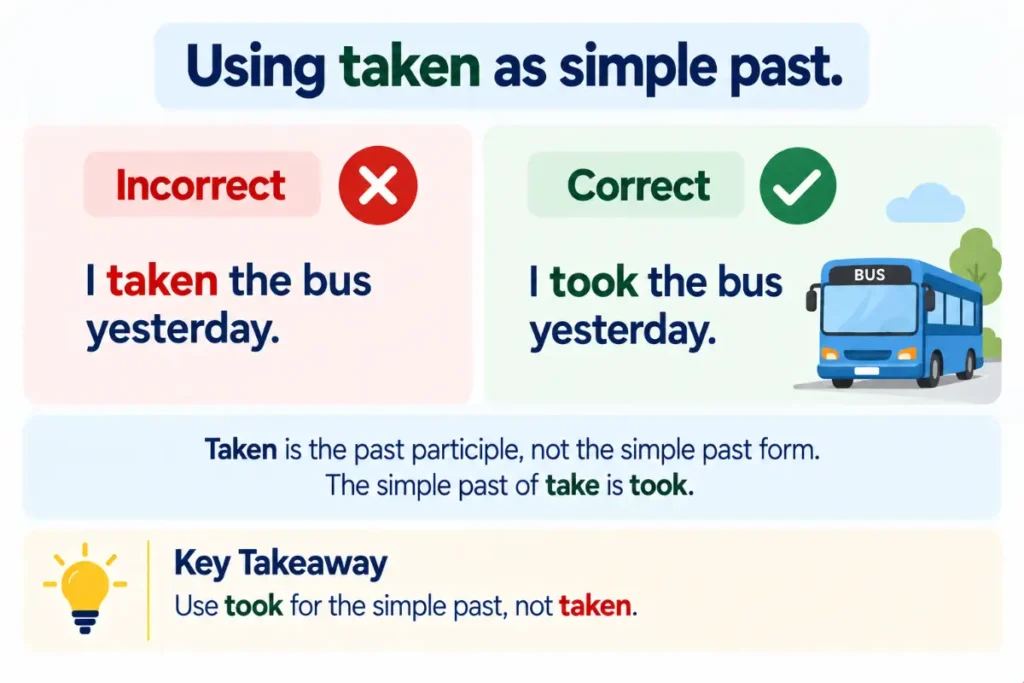
- Using taken as simple past.
Incorrect: I taken the bus yesterday.
Correct: I took the bus yesterday.
The simple past of take is took. Taken is the past participle.
- Using taking after have.
Incorrect: She has taking the test.
Correct: She has taken the test.
After have or has you need the past participle taken.
- Using taken after be for an ongoing action.
Incorrect: He is taken a class.
Correct: He is taking a class.
The progressive structure uses be plus the ing form.
- Confusing completed and ongoing actions.
She has taken the test means the test is completed.
She is taking the test means the action is happening now.
Choosing the wrong form can change the entire meaning.
- Using the wrong form after a preposition.
Incorrect: They talked about taken the train.
Correct: They talked about taking the train.
After about in this structure the activity is expressed with taking.
Pronunciation Guide
The pronunciation of the two forms is different enough to notice in normal speech.
Taken is commonly pronounced /ˈteɪkən/.
It has two syllables with the main stress on the first syllable.
Taking is commonly pronounced /ˈteɪkɪŋ/.
It also has two syllables with the main stress on the first syllable.
The first part sounds similar because both forms come from take. The ending creates the main difference.
Taken ends with an unstressed schwa sound followed by n.
Taking ends with the ing sound.
A common learner mistake is to pronounce the final syllable too strongly in taken. In natural American English the second syllable is usually unstressed.
Another mistake is treating taking as if it had the same ending as taken. Listen for the final sound when practicing them.
Word Origin
Take is an old English verb with a long history. It entered English through Old Norse and became established in Middle English. Its history helps explain why its past forms are irregular rather than following the regular ed pattern.
The modern forms developed within this long history of English usage. Take became the base form. Took became the simple past. Taken developed as the past participle. Taking developed through the regular addition of the ing ending.
The irregular relationship between take, took, and taken is common in English. Similar patterns appear in verbs such as sing, sang, sung and drink, drank, drunk.
Understanding that history isn’t necessary for everyday grammar, but it explains why you can’t simply create the past forms by adding ed.
American English
American English uses all of these forms in the same basic grammatical ways.
You’ll commonly hear phrases such as taking a break, taking a class, taking a test, has taken responsibility, and has taken the opportunity.
American English doesn’t use a different spelling for the forms. The key distinction remains grammatical.
For example:
I am taking a course.
I have taken a course.
The first presents the activity as ongoing. The second presents the course as completed.
British English
British English follows the same basic grammar.
Taken is the past participle and taking is the present participle or gerund.
Examples include:
She has taken the train.
She is taking the train.
There is no major British spelling difference involving these forms.
Some expressions involving take may differ in frequency between regions, but the underlying verb forms remain the same.
Australian English
Australian English also uses the standard forms take, took, taken, and taking.
The grammatical distinction is the same. A speaker may say:
I have taken the course.
Or:
I am taking the course.
The regional variety doesn’t change the basic rule.
Canadian English
Canadian English follows the same standard pattern.
Taken works as a past participle while taking works as a present participle or gerund.
Writers in Canada can use both forms in formal and informal communication without treating either as a regional variant.
Formal and Informal Usage
Both forms are suitable for formal and informal English.
You can use taken in a professional report.
The company has taken several steps to improve workplace safety.
You can use taking in an academic paper.
Taking regular measurements improves the accuracy of the experiment.
You can also use both forms in casual conversation.
I’ve taken care of it.
I’m taking a break.
The difference isn’t about formality. It’s about grammar and meaning.
This is useful because learners sometimes search for a more formal alternative when the real issue is simply choosing the correct verb form.
Related Words and Expressions
- Take. This is the base form and appears in general present tense sentences and infinitive structures.
- Takes. This is the third person singular present form.
- Took. This is the simple past form.
- Taken. This is the past participle.
- Taking. This is the present participle and gerund.
- Taker. This noun can describe someone who takes something or a person who accepts an opportunity or risk depending on context.
- Takeaway. This noun can refer to a main lesson or food prepared for consumption elsewhere.
- Intake. This noun refers to the amount of something taken into the body or a group of people accepted into an organization or program.
The word family is broad because take is one of the most flexible verbs in English.
Common Expressions With Take
Learning common expressions can make the different forms easier to recognize.
Take a break.
I need to take a break.
Take a seat.
Please take a seat.
Take a test.
She is taking a test.
Take responsibility.
He has taken responsibility.
Take care.
Take care on your way home.
They took part in the event.
Take notes.
Students were taking notes.
Notice how the form changes according to the grammar of the sentence.
Real Life Usage Examples
Daily Conversation
People use these forms constantly in ordinary speech.
- I’m taking a break right now.
This describes an activity happening at the present time.
- I’ve taken care of everything.
This shows that the speaker has completed a task.
Workplace Communication
These forms are also common at work.
- We are taking steps to improve customer service.
The action is presented as ongoing.
- The manager has taken responsibility for the issue.
The action is presented as completed.
Academic Writing
Academic writing uses both forms naturally.
- Students taking the course must complete the final assignment.
Here taking describes students who are enrolled in the course.
- Researchers have taken several factors into account.
Here taken appears after have and forms the present perfect.
News Writing
Journalists often use these forms when reporting events.
- Officials have taken action after the incident.
The action has already occurred.
- Rescue workers are taking part in the search.
The activity is ongoing.
Storytelling
Narrative writing uses the forms to show sequence and action.
- She had taken the letter before anyone noticed.
The past perfect establishes an earlier action.
- He was taking the old road when he heard a strange sound.
The progressive form presents the action as ongoing when another event occurred.
Memory Tips
A few simple patterns can save you a lot of confusion.
- Have plus taken.
Think:
I have taken.
She has taken.
They had taken.
If you see have, has, or had in a perfect construction, taken is usually the form you need.
- Be plus taking for an ongoing action.
Think:
I am taking.
She is taking.
They were taking.
The helping verb be plus taking creates the progressive form.
- Yesterday plus took.
If you are describing a completed action at a specific past time, took is often the right form.
I took the bus yesterday.
- Activity as a noun plus taking.
Taking can function as a gerund.
Taking regular breaks can improve focus.
- Remember the verb family.
Take.
Took.
Taken.
Taking.
Don’t treat these forms as random spellings. They are different grammatical forms of one irregular verb.
Professional Writing Tips
An experienced editor doesn’t choose between these forms based only on what sounds familiar. The surrounding grammar provides the strongest clue.
First look for a helping verb. If you see have, has, or had in a perfect construction, check for the past participle. That usually points to taken.
Next look for am, is, are, was, or were. If the sentence describes an action in progress, the ing form taking is normally required.
Then consider the time reference. A sentence about a completed event yesterday may need took rather than either of these forms.
For example:
I took the test yesterday.
I am taking the test.
These three sentences describe different situations. The first uses simple past. The second uses present perfect. The third uses present progressive.
This is a better editing strategy than trying to memorize isolated phrases.
Why Learners Confuse These Forms
The confusion often comes from the fact that all three forms belong to one familiar verb.
Take has an irregular past form, took, while its past participle is taken. Then the ing form follows a more predictable pattern and becomes taking.
Learners may also rely too heavily on translation. A single word in one language can correspond to several English verb forms. That makes it tempting to choose the form that feels closest to the intended meaning without checking the English sentence structure.
Another source of confusion is spoken English. In fast speech, helping verbs such as have, has, am, and are may become less prominent. A learner may focus on the main verb and miss the grammatical signal provided by the auxiliary.
The solution is to listen for the whole verb phrase.
I have taken.
She is taking.
They had taken.
We were taking.
The helping verb often tells you which form belongs next.
Grammar Pattern Cheat Sheet
You can use these patterns as a quick reference.
- Have or has plus taken.
She has taken the exam.
- Had plus taken.
She had taken the exam before lunch.
3. Taking as a subject.
Taking the exam requires preparation.
4. Taking after a preposition.
They talked about taking the exam.
5. Took for simple past.
She took the exam yesterday.
These patterns cover a large part of ordinary usage.
Key Takeaways
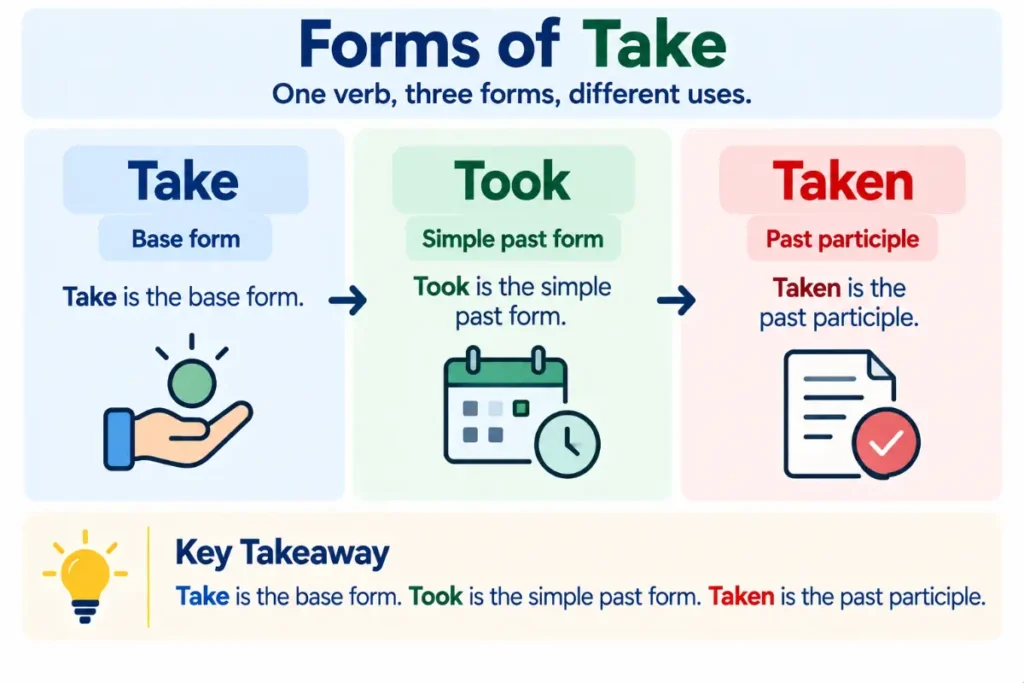
- Take is the base form.
- Took is the simple past form.
- Taken is the past participle.
- Taking is the present participle and gerund form.
- Have, has, and had commonly appear with taken in perfect constructions.
- Am, is, are, was, and were commonly appear with taking in progressive constructions.
- Taken can also appear in passive sentences.
- Taking can function as a noun when it acts as a gerund.
- Neither form is more formal or informal by itself.
- The surrounding grammar should guide your choice.
Conclusion
taken vs taking becomes much easier once you stop treating the two forms as interchangeable versions of take. Taken is the past participle and commonly appears after have, has, or had or in passive constructions. Taking is the present participle and commonly describes an action in progress or functions as a gerund that names an activity.
The quickest test is to examine the helping verb and the sentence meaning. Have or has often points to taken while am, is, or are often points to taking when the action is ongoing. If you need simple past for a completed past event, remember that the correct form is took.
Keep the complete verb family in mind: take, took, taken, and taking. Once that pattern becomes familiar, the choice starts to feel natural rather than something you have to stop and calculate every time.
FAQs
Is taken the past tense of take?
Taken is not the simple past form of take. The simple past is took. Taken is the past participle. It normally appears with helping verbs such as have, has, or had in perfect constructions or with forms of be in passive constructions. For example, She took the book yesterday uses simple past, while She has taken the book uses the past participle.
Is taking a present tense form?
Taking is the present participle form of take. It commonly appears with forms of be to create progressive tenses, such as I am taking a class. It can also function as a gerund and act like a noun, as in Taking notes helps me remember information. The form itself doesn’t always mean that the action is happening right now.
What is the difference between taken and taking?
The main difference is grammatical function. Taken is the past participle and commonly appears with have or forms of be. Taking is the present participle or gerund and commonly appears with forms of be to describe an ongoing action or functions as a noun. The surrounding verb phrase usually tells you which form you need.
Is it correct to say I have taking?
No. The standard form is I have taken. After have in a perfect construction, English requires the past participle. Since taken is the past participle of take, it follows have. I am taking is also correct, but it uses a different structure because am is followed by the present participle taking.
Is it correct to say I am taken?
I am taken can be grammatically correct but usually has a different meaning from I am taking. For example, I am taking a class means the speaker is participating in a class. I am taken may mean the speaker has been carried somewhere or may describe an emotional response in a specific context. The sentence context determines the meaning.
Can taking function as a noun?
Yes. Taking can function as a gerund. A gerund has the form of an ing verb but performs a noun role. For example, Taking notes helps students remember information. Here taking notes is the subject of the sentence. The form can also appear after certain verbs and prepositions when the activity itself is being discussed.
Should I use took or taken for a past event?
Use took for the simple past and taken when the grammar requires a past participle. For example, I took the train yesterday uses simple past. I have taken the train uses present perfect. The choice depends on the structure of the sentence rather than simply on the fact that the action happened in the past.
Is taking more informal than taken?
No. Neither form is inherently more informal. Both are standard English forms used in casual speech, professional writing, academic work, journalism, and formal documents. The difference is grammatical rather than stylistic. Taking usually describes an ongoing action or activity, while taken commonly works as a past participle or part of a passive construction.
Can taken appear without have?
Yes. Taken can appear without have in passive constructions and some adjective like uses. For example, The picture was taken yesterday uses was rather than have. You can also say The seat is taken. However, you generally cannot use taken by itself as the simple past form of take.
How do you remember the forms of take?
A simple sequence is Take, took, taken, taking. Think of took as the simple past, taken as the past participle, and taking as the ing form. Then look at the helping verb. Have or has usually points toward taken in perfect constructions. Am, is, are, was, or were can point toward taking when the sentence describes an ongoing action.

English Grammar & Usage
Nathan Holloway is an American grammar writer and language researcher who specializes in English grammar, sentence structure, verb usage, and common writing mistakes. He enjoys breaking down confusing grammar rules into practical explanations with clear examples, making English easier for students, professionals, and everyday writers.