
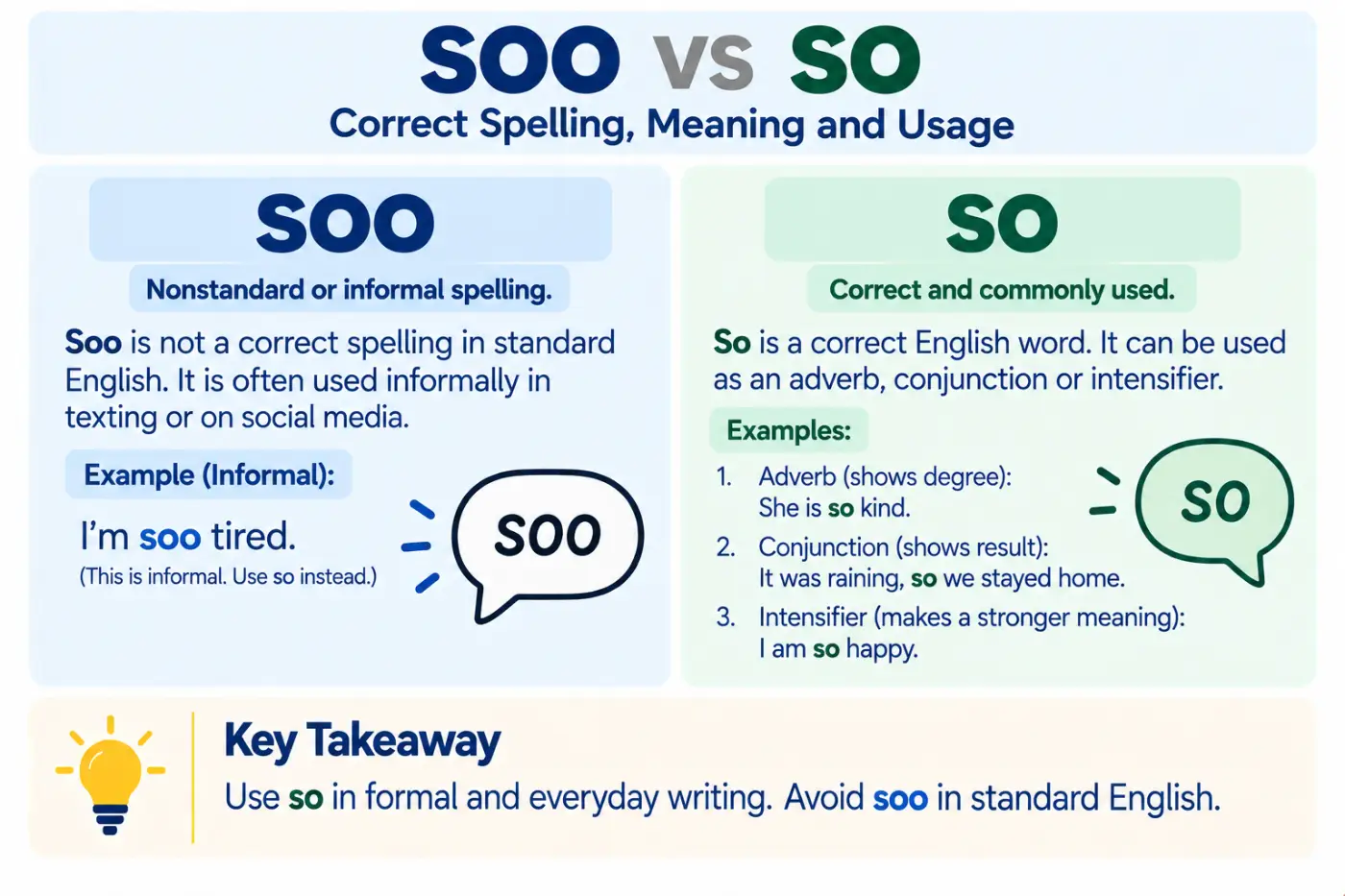
Soo vs so is a common search because the two forms look almost identical and can sound similar when spoken. The standard English spelling is so. The spelling soo is usually an informal internet form that people use to exaggerate the sound or show extra emotion.
The confusion often comes from digital communication. When people text or post online, they sometimes repeat letters to make a word feel longer, stronger, cuter, funnier, or more emotional. You may see someone write something like Soo cute or I’m soo tired. Readers usually understand the intended meaning, but that spelling does not make soo a standard alternative to so.
The difference matters most when you are writing school assignments, professional emails, articles, applications, or other polished content. This guide explains the meaning and grammar of so, the informal role of soo, pronunciation, sentence patterns, common mistakes, regional usage, and simple memory tips. By the end, you’ll know exactly which form to choose in standard English and why.
Short Answer
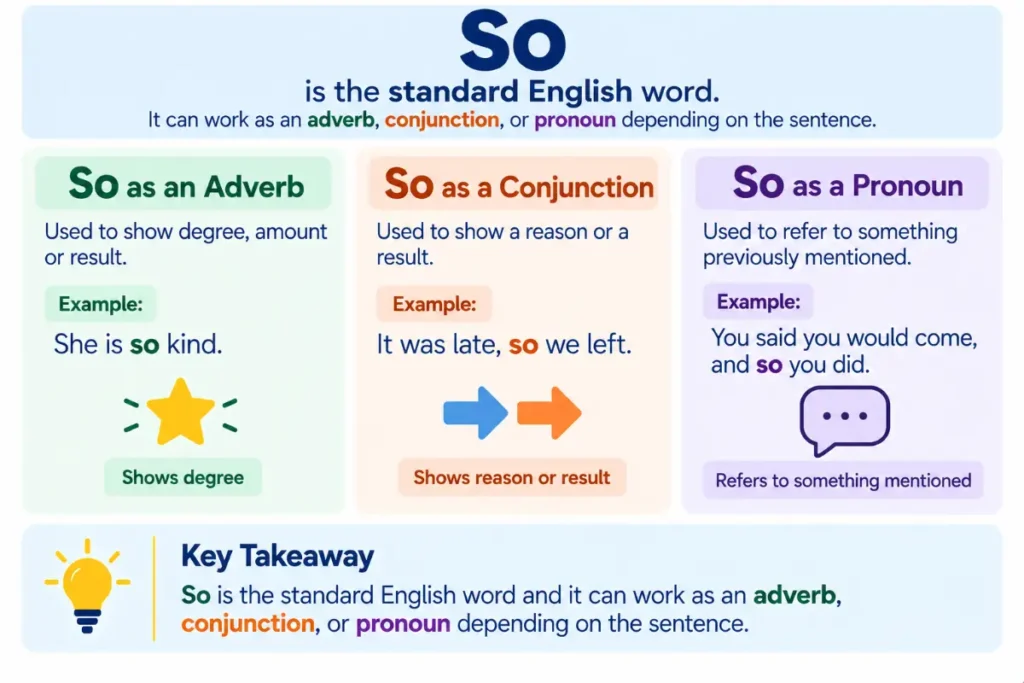
So is the standard English word. It can work as an adverb, conjunction, or pronoun depending on the sentence. Soo is generally not a standard English spelling of the word. People may use it informally online to stretch the sound for emphasis, emotion, or humor, but standard writing calls for so.
Table of Contents
- Quick grammar answer.
- Meaning of so.
- What soo means online.
- Key differences.
- Grammar rules.
- Common sentence patterns.
- Comparison table.
- Pronunciation.
- Common mistakes.
- Formal and informal usage.
- American and British English.
- Related words and expressions.
- Real life examples.
- Memory tips.
- Expert editor insight.
- FAQs.
- Key takeaways.
- Conclusion.
Quick Grammar Answer
Use so in standard English.
It is a very common word with several grammatical functions. It can show degree, result, agreement, purpose, or connection between ideas.
For example:
She is so happy.
I was tired, so I went home.
I think so.
The spelling soo usually appears as an informal internet variation. It can represent an intentionally stretched pronunciation in casual digital writing, but it is not the normal spelling you should use in standard English.
If you are writing for school, work, publication, or any situation where standard English matters, choose so.
Meaning of So
So is one of the most useful short words in English. Its meaning changes according to its position and function in a sentence.
So As An Adverb
So commonly works as an adverb meaning to a high degree or to such an extent.
For example:
The movie was so good.
She was so excited.
That test was so difficult.
In these sentences so strengthens the adjective that follows it. It tells the reader or listener that the quality is present to a notable degree.
You can also use so with adverbs.
He ran so quickly that nobody could catch him.
She spoke so quietly that I could barely hear her.
This use is extremely common in everyday American English.
So To Show A Result
So can connect one idea with a result.
I was tired, so I went to bed.
It started raining, so we stayed inside.
The store was closed, so we came back later.
Here so means something close to therefore or as a result. It connects a cause with what happened afterward.
So In Agreement
So can also express agreement.
I love this song.
So do I.
I’m tired.
So am I.
This construction is different from simply using so as an intensifier. Here it refers back to an earlier statement and shows that another person shares the same situation.
So Meaning In This Way
So can sometimes refer to something already mentioned.
If you think so, tell me.
I hope so.
I suppose so.
In these examples so avoids repeating a longer idea.
For instance:
Do you think she will come?
I hope so.
The word so represents the idea that she will come.
So For Purpose
So can introduce a purpose clause.
I left early so I could catch the train.
She saved money so she could buy a new laptop.
We spoke quietly so the baby wouldn’t wake up.
In these examples so connects an action with its intended purpose.
What Soo Means Online
Soo usually appears in informal digital communication. It can represent a stretched version of so.
For example:
Soo cute.
I’m soo tired.
That was soo funny.
The writer normally intends the same basic meaning as so but adds another letter to create extra emphasis.
This is similar to other forms of expressive spelling. People sometimes write Noooo instead of No or Yessss instead of Yes. The additional letters aren’t necessarily intended as standard spelling. They show emotion or imitate the way someone might stretch a sound in speech.
The same idea can explain soo.
If someone writes Soo cute, the extra o may suggest stronger enthusiasm than the ordinary spelling. The writer may want the sentence to sound playful or dramatic.
That does not mean soo should replace so in standard writing.
Think of it as a digital style choice rather than a new standard English word.
Key Differences
- Standard spelling. So is the standard English spelling. Soo is generally an informal expressive variation.
- Dictionary status. So has established grammatical functions and dictionary meanings. Soo does not normally function as a standard spelling of the same word.
- Purpose. So communicates meaning through ordinary grammar. Soo may communicate meaning plus emotional emphasis.
- Formality. So works in casual conversation and formal writing. Soo belongs mainly to informal digital communication when used as an expressive spelling.
- Pronunciation. The ordinary word so is pronounced with a long o sound. Soo can represent an intentionally stretched version of that sound in informal writing.
- Grammar. So has several established grammatical roles. Soo does not replace those standard grammatical functions.
- Audience. Most readers understand soo in casual online contexts. Professional readers generally expect the standard spelling so.
- Editing. If you are proofreading formal content, change soo to so unless the unusual spelling is intentionally part of dialogue or a quoted message.
Comparison Table
| Form | Standard English | Main Meaning | Grammar Role | Typical Context | Formality | Example |
|---|---|---|---|---|---|---|
| So | Yes | To a high degree, therefore, in this way, or in agreement | Adverb, conjunction, pronoun | Conversation, school, work, publishing | All levels | She was so happy. |
| Soo | No as a standard spelling of so | Usually an exaggerated or playful version of so | Expressive spelling rather than standard grammar | Texting, social media, informal messages | Very informal | Soo cute! |
Why People Write Soo
The extra letter is usually intentional rather than random.
Digital writing has its own expressive habits. Since text removes many features of face to face communication such as tone of voice, facial expression, and gesture, writers sometimes stretch letters to communicate emotion.
Consider the difference between these forms:
So cute.
Soo cute.
Sooo cute.
The first looks neutral. The second feels more expressive. The third can feel even more exaggerated.
This kind of spelling can act almost like a visual version of vocal lengthening. If someone says a word with an unusually long vowel sound, a writer may imitate that effect by adding letters.
This practice appears in many informal online conversations. It is especially common in messages, comments, captions, fandom communities, and playful conversations.
However, expressive spelling depends heavily on context. The same form that looks playful in a text message can look like a spelling error in an essay.
Grammar Rules For So
So has several important grammatical uses. Understanding them helps you see why the word cannot simply be replaced by an informal spelling.
So With Adjectives
Use so before an adjective to express a strong degree.
She is so kind.
That house is so beautiful.
The lesson was so easy.
The pattern is:
so + adjective
You can use this structure in both casual and formal contexts, although formal writing may sometimes prefer more precise wording.
So With Adverbs
So can also modify an adverb.
He drives so carefully.
She answered so quickly.
They worked so efficiently.
The pattern is:
so + adverb
Again, so strengthens the word that follows it.
So With A Result
Use so to connect a cause with a result.
I missed the bus, so I walked home.
The weather was cold, so we stayed inside.
She studied hard, so she passed the exam.
The basic pattern is:
cause + so + result
This is one of the most common uses in everyday English.
So That
So that can introduce a purpose or result clause.
I wrote it down so that I wouldn’t forget.
He spoke slowly so that everyone could understand him.
They left early so that they could avoid traffic.
In casual speech, speakers sometimes leave out that.
I wrote it down so I wouldn’t forget.
Both patterns are common.
So Do I
So can also appear in agreement structures.
I like coffee.
So do I.
She works here.
So does he.
The auxiliary changes according to the subject.
This use is especially useful for avoiding repetition.
So In Formal Writing
So is completely acceptable in formal English. The word itself is not informal.
You can find it naturally in academic writing, business communication, reports, essays, journalism, and professional correspondence.
For example:
The sample was too small, so the researchers collected additional data.
The company received several complaints, so management reviewed the process.
These sentences are clear and grammatical.
Still, formal writing often benefits from precise connections between ideas. Depending on the sentence, therefore, consequently, thus, or as a result may provide a more specific relationship.
That does not make so wrong. It simply means that different connectors can create different tones and levels of precision.
So In Informal Writing
So is extremely common in everyday speech and casual writing.
You may hear:
So what?
So what happened?
I think so.
So do I.
That was so funny.
Soo can appear in these environments too, but only as an expressive spelling.
For example:
That was soo funny.
The writer is probably emphasizing the word. In a casual message between friends this may feel perfectly natural. In a school essay it would usually look like a spelling mistake.
Pronunciation Guide
The standard word so is pronounced /soʊ/ in American English.
It has one syllable and contains the long o diphthong found in words such as go and no.
The sound begins with an s and moves into a rounded vowel.
A simple pronunciation guide is close to the sound of the word found in go, but with an s at the beginning.
The spelling soo can suggest a longer version of this sound in informal writing. It does not normally represent a different standard English pronunciation.
This distinction matters. English spelling does not usually work by adding letters every time a speaker stretches a sound.
For example, someone might say:
That was soooo good.
The extra letters visually represent emotional emphasis. They are not a standard spelling rule.
Word Origin
So has a long history in English and is connected with related forms found in earlier Germanic languages.
The word has served several grammatical purposes for centuries. Its uses include expressing degree, consequence, manner, agreement, and reference to something previously mentioned.
Because so is such an old and flexible word, its modern meanings developed across different grammatical patterns rather than coming from one single modern usage.
The expressive spelling soo is much more recent in comparison. It belongs to the broader habit of modifying written words online to imitate speech, emotion, or emphasis.
This difference in history helps explain why so is a standard lexical item while soo is generally treated as an informal spelling variation.
American English
American English uses so as the standard spelling.
The word appears constantly in conversation and writing. Its grammatical functions are the same ones described above.
Soo may appear in American social media posts, text messages, comments, or informal conversations. Its use generally signals emphasis or playfulness rather than a regional spelling rule.
For school, workplace, and professional writing, use so.
British English
British English also uses so as the standard spelling.
There is no major British spelling rule that makes soo a standard alternative. A British speaker may use soo online for the same expressive reason as an American speaker.
The grammatical uses of so remain broadly the same across both varieties.
Australian English
Australian English follows the same standard spelling.
So is the normal form in formal and informal writing. Soo may occur in casual digital communication as an expressive spelling but does not represent a standard Australian spelling difference.
Canadian English
Canadian English also uses so as the standard form.
The additional o in soo does not represent a recognized Canadian spelling rule. If you are writing a Canadian school assignment, report, article, or professional email, standard English calls for so.
Common Mistakes
Mistake One
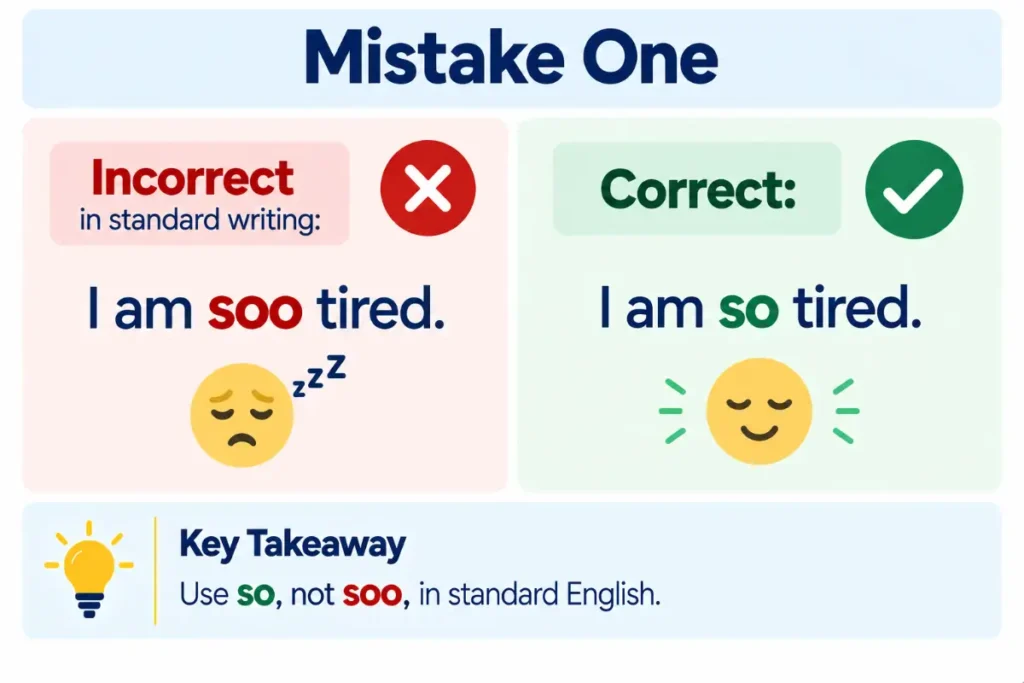
Incorrect in standard writing: I am soo tired.
Correct: I am so tired.
The extra o is unnecessary in standard spelling. If the writer intentionally wants an expressive online tone, the unusual spelling can appear in casual communication.
Mistake Two
Incorrect: The movie was soo good that I watched it twice.
Correct: The movie was so good that I watched it twice.
Here so is part of a standard degree construction.
Mistake Three
Incorrect: I was late, soo I called my manager.
Correct: I was late, so I called my manager.
In this sentence so connects the cause with the result. The expressive spelling does not belong in standard writing.
Mistake Four
Incorrect: I think soo.
Correct: I think so.
Here so refers to an idea already mentioned. The extra o changes the visual style but adds no grammatical meaning.
Mistake Five
Incorrect: She worked soo hard that she finished early.
Correct: She worked so hard that she finished early.
The standard pattern is so plus an adjective or adverb followed by a result clause.
Real Life Examples
Daily Conversation
Example: That restaurant was so good.
Here so increases the strength of the adjective good. The speaker isn’t simply saying the restaurant was good. The word adds emphasis.
Example: I was tired, so I went home.
Here so introduces the result of being tired.
Text Messages
Example: I’m so happy for you.
This is completely standard even though it appears in a casual message.
Example: Soo cute!
Here the extra letter is expressive. The writer may be trying to make the message feel warmer or more excited.
Workplace Communication
Example: The meeting ended early, so I finished the report.
So connects two related events in a clear way.
Example: The client was so pleased with the result that they requested another project.
Here so creates a degree and result construction.
Academic Writing
Example: The sample size was small, so the researchers repeated the experiment.
The word creates a clear cause and result relationship.
Example: The temperature was so high that the equipment required additional cooling.
This is a standard degree and result construction suitable for formal writing.
News Writing
Example: Heavy rain caused flooding, so officials closed several roads.
The word creates a direct connection between the reported cause and result.
Example: The team played so well that the final score surprised many spectators.
So can add emphasis while maintaining a straightforward news style.
Storytelling
Example: She was so nervous that she could barely speak.
The construction helps communicate the intensity of the emotion.
Example: He heard the noise, so he turned around.
The short connector keeps the story moving naturally.
When Soo Can Be Intentional
Not every unusual spelling is automatically a mistake.
Suppose someone writes a fictional character who says:
Soo, what are we doing tonight?
In this case the writer may be using the spelling as part of dialogue or character voice. The meaning may depend on the intended pronunciation and context.
Another example is a social media caption:
Sooo excited for tomorrow.
The writer is clearly stretching the word to show excitement.
The key question is purpose.
If the unusual spelling is deliberate and the context is casual, it may be expressive. If the goal is standard English, use so.
This distinction matters for editors. Good editing does not simply remove every unusual form. An editor first asks what the writer is trying to communicate.
Formality And Context
The choice between the two forms is mostly a question of standard spelling versus expressive spelling.
Use so for:
- School assignments.
- College papers.
- Job applications.
- Business emails.
- Professional reports.
- Articles.
- Formal letters.
- Academic work.
- Published content.
- Standard proofreading.
An expressive form such as soo may fit:
- Text messages.
- Social media comments.
- Casual captions.
- Playful dialogue.
- Informal online communities.
- Character voice.
Even in informal writing, you do not have to use the unusual form. Standard so works perfectly well in casual conversation too.
Similar Words And Expressions
Understanding related expressions can help you choose the right word.
Very
Very can intensify an adjective.
She is very tired.
So can also intensify an adjective.
She is so tired.
The two are similar, but they don’t always behave the same way in a sentence.
Too
Too can mean more than is wanted or needed.
The bag is too heavy.
So usually expresses degree without automatically suggesting excess.
The bag is so heavy.
Therefore
Therefore can express a result.
It was raining. Therefore, we stayed inside.
So can express the same basic relationship in a more conversational way.
It was raining, so we stayed inside.
Thus
Thus can indicate a result or conclusion and often sounds more formal.
The roads were closed, thus delaying the delivery.
So generally feels more natural in ordinary conversation.
As A Result
As a result clearly signals consequence.
The machine broke. As a result, production stopped.
So provides a shorter and more conversational connection.
The machine broke, so production stopped.
Such
Such can also express degree but follows a different grammatical pattern.
It was such a beautiful day.
Compare:
It was so beautiful.
The grammar is different even though both structures can express strong feeling.
Therefore And So
These words can overlap in meaning but differ in style and sentence structure. So often connects two clauses directly while therefore can function as a sentence adverb.
For example:
The road was closed, so we took another route.
The road was closed. Therefore, we took another route.
Both communicate a result, but the structure and tone differ.
Very And So
Very usually strengthens an adjective or adverb without necessarily pointing toward a result.
She is very tired.
So often appears in structures that lead to a consequence.
She is so tired that she went straight to bed.
This difference becomes especially useful in careful writing.
Memory Tips
The easiest way to remember the standard spelling is simple.
Think of so as the normal dictionary form.
If you want to make the word look more emotional in a text message, you may see people stretch it as soo or even sooo. That extra letter is a style choice rather than a standard spelling rule.
Another useful test is to imagine the word in a school essay.
If the sentence is:
The results were soo surprising.
It looks unfinished or misspelled.
Change it to:
The results were so surprising.
Now the sentence fits standard written English.
You can also remember this rule:
Standard English uses so. Extra letters usually signal expression.
That one idea covers most situations.
Related Grammar Notes
The word so often appears in useful grammar patterns.
So And That
She was so tired that she fell asleep.
The pattern is:
so + adjective + that + result
So Much
I have so much work today.
Here much modifies an uncountable noun.
So Many
There were so many people at the event.
Here many modifies a plural count noun.
So Little
We had so little time.
Little modifies an uncountable noun.
So Few
There were so few seats available.
Few modifies a plural count noun.
These structures show how flexible so can be. It is not merely a casual intensifier. It plays several important roles in English grammar.
Expert Editor Insight
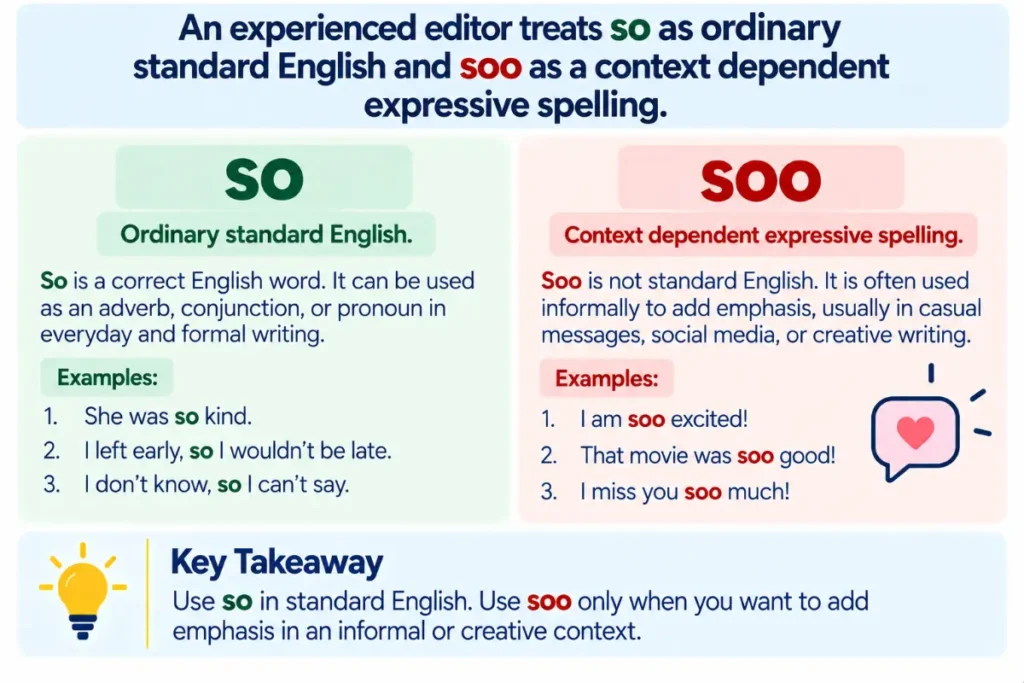
An experienced editor treats so as ordinary standard English and soo as a context dependent expressive spelling. The key is to preserve the writer’s intended voice without confusing informal style with standard grammar. If soo appears in an essay, report, business email, or polished article, it will usually need correction. If it appears in intentional dialogue or a playful social post, the extra letter may be doing useful stylistic work. Context should guide the edit.
Key Takeaways
- So is the standard English spelling.
- Soo is usually an informal expressive spelling.
- So can function as an adverb, conjunction, or pronoun depending on context.
- So can express degree, result, agreement, purpose, or reference to an earlier idea.
- Extra letters in informal writing can show emotion or emphasis.
- Use standard so in school, professional, academic, and published writing.
- Soo can be intentional in casual messages, social media, or creative dialogue.
- The spelling choice depends on your purpose and audience.
Conclusion
Soo vs so has a straightforward answer for standard English. So is the correct and established spelling for the common word. It works in many grammatical structures and can express degree, result, agreement, purpose, and reference. Soo is generally an informal expressive spelling used to stretch the sound or add emotion.
You may see the extra o in texts, captions, comments, and playful conversations. That doesn’t make it the standard form. In school work, professional communication, academic writing, and polished content, use so.
The easiest memory trick is to treat so as the normal form and extra letters as optional digital expression. If you want clear standard English, keep it simple: use so.
FAQs
Is soo a correct English word?
Soo is not normally the standard spelling of the common English word so. You may see it in informal online writing where people add letters to stretch a sound or show emotion. In standard writing, use so. If soo appears in intentional dialogue, branding, a username, or another special context, its status depends on that specific use.
Which form should I use in formal writing?
Use so. It is the standard English spelling and works naturally in academic papers, school assignments, professional emails, reports, applications, and published writing. An extra o can make the word look like a typo unless the writer intentionally uses expressive spelling. For polished content, standard spelling is the safer and clearer choice.
Why do people write soo online?
People often add letters online to show emotion or imitate the way a sound is stretched in speech. Writing soo can make a message feel playful, dramatic, excited, or affectionate. Similar patterns appear in words such as noooo and yessss. These spellings communicate tone visually, but they do not replace standard spelling in formal English.
Is soo a different pronunciation of so?
Usually not. In informal writing, soo often represents a stretched version of the ordinary sound of so. The writer may intend a longer vowel to express emotion. It is better understood as expressive spelling rather than a separate standard pronunciation. In standard English, so remains the normal written form.
Can I use soo in a text message?
Yes, if you intentionally want an informal and expressive tone. A message such as Soo cute can communicate enthusiasm or affection. The extra letter can make the word feel more animated. Still, it is optional. Standard so is also completely natural in text messages and is the better choice when you want clear conventional spelling.
Is so used in American English?
Yes. So is extremely common in American English and serves several grammatical functions. It can express degree, introduce a result, show agreement, refer to an earlier idea, or introduce purpose. The spelling does not change in American English. Soo may appear in casual digital communication but is not a standard American spelling variant.
Is so also correct in British English?
Yes. British English uses so as the standard form as well. There is no major British spelling rule that changes the word to soo. British speakers may use expressive spellings online for the same reasons as American speakers, but standard writing uses so.
Can soo appear in published writing?
It can appear if the unusual spelling has a deliberate purpose. For example, a novelist may use it in dialogue to create a particular voice. A social media post may also use it for emphasis. However, if you are using standard prose and the spelling has no stylistic purpose, so is the appropriate form.

Confusing Words, Spelling & Word Choice
Claire Whitmore is a U.S.-based English editor who writes about commonly confused words, spelling differences, and word choice. Her work helps readers understand subtle distinctions between similar-looking words through simple definitions, practical examples, and modern usage guidance in both American and British English.