
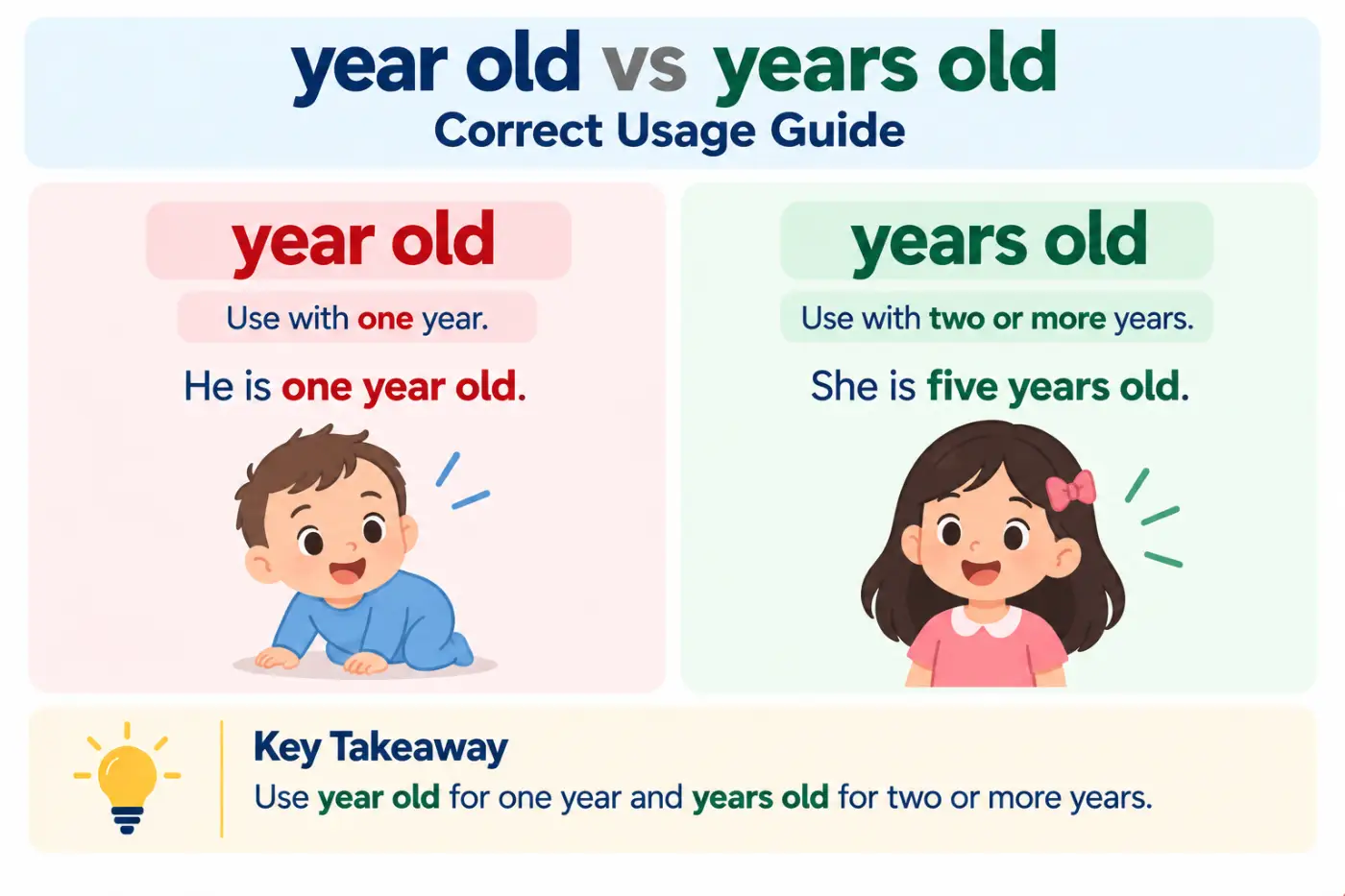
The choice between year old vs years old can seem surprisingly tricky because both forms describe age. The good news is that the rule is simple once you look at the position of the phrase in a sentence. Use the singular form before a noun when the entire age expression works as an adjective. Use the plural form after a linking verb when you simply state someone’s age.
For example, you can say She is six years old. You can also say She is a six year old child. The meaning is almost the same, but the grammar changes because the age phrase has a different job in each sentence. This is the point that causes most mistakes. Writers often see a number followed by age and assume the word year should always be plural.
English treats age expressions much like other compound modifiers. Once you understand that pattern you can handle phrases such as a three year old puppy, a ten year old car, and a twenty year old building with confidence. You will also learn how hyphens work in these expressions, how the rule applies to numbers, what happens with words such as one, and which forms sound most natural in American English.
Short Answer
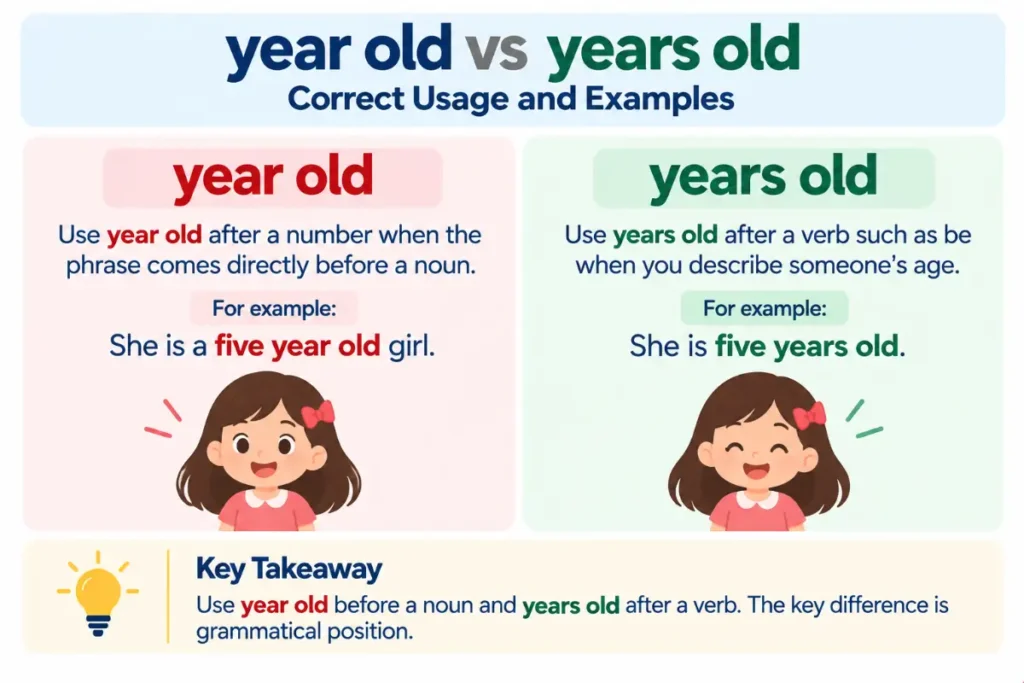
Use year old after a number when the phrase comes directly before a noun. For example: She is a five year old girl. Use years old after a verb such as be when you describe someone’s age. For example: She is five years old. The key difference is grammatical position.
Table of Contents
- Quick Rule.
- Why The Forms Change.
- The Core Grammar Difference.
- Using The Singular Form Before A Noun.
- Using The Plural Form After A Verb.
- The Role Of Hyphens.
- Comparison Table.
- Sentence Examples.
- Common Mistakes.
- Questions And Negative Sentences.
- Age Expressions With Numbers.
- American And British English.
- Formal And Informal Usage.
- Related Age Expressions.
- Memory Tips.
- Expert Editor Insight.
- FAQs.
- Key Takeaways.
- Conclusion.
Quick Rule
The easiest rule is this:
Before a noun: use a singular form such as five year old and normally hyphenate the complete modifier as five year old.
After a verb: use a plural form such as five years old.
Compare these sentences:
She has a five year old daughter.
Her daughter is five years old.
The first phrase describes daughter. The second phrase tells us the daughter’s age.
Why The Forms Change
The difference has nothing to do with the person’s actual age. A five year old child and a child who is five years old are describing the same age.
The difference comes from grammar.
In the first sentence the age expression is placed before a noun and acts as a compound adjective. English commonly keeps the measurement word in the singular inside this kind of compound modifier.
In the second sentence the phrase follows the verb and functions as a normal age expression. Since the person has an age of five years the noun year is plural.
This pattern appears with many measurements.
Consider these examples:
- A five mile walk.
- The walk is five miles long.
- A three hour meeting.
- The meeting lasted three hours.
- A ten pound package.
- The package weighs ten pounds.
The same basic grammar pattern appears with age.
A five year old student.
The student is five years old.
Once you recognize the structure you don’t have to memorize every phrase separately.
The Core Grammar Difference
The most useful distinction is between a compound modifier and a normal noun phrase.
When an age expression comes before a noun and describes that noun it becomes a compound modifier.
For example:
A seven year old boy.
The phrase seven year old tells us what kind of boy we mean. Because the words work together as one modifier the measurement noun stays singular.
When the age expression follows a verb such as is, was, or will be it normally uses the plural form.
For example:
The boy is seven years old.
Here years is an ordinary plural noun. The sentence states the boy’s age rather than using the age expression as a modifier before another noun.
This distinction also explains why the two forms cannot simply be swapped.
You would not normally write:
The boy is seven year old.
You would also not normally write:
A seven years old boy.
The first needs the plural form because the age follows the verb. The second needs the singular form because the compound modifier comes before boy.
Using The Singular Form Before A Noun
When an age expression directly modifies a noun it normally uses the singular form of year.
Examples include:
A two year old child.
A four year old dog.
A nine year old student.
A fifteen year old car.
A thirty year old building.
A fifty year old tradition.
Notice something important. The number can be greater than one but year remains singular inside the compound modifier.
That may feel strange at first. After all a child who is four has lived for four years. Yet English grammar treats the entire phrase four year old as one descriptive unit before the noun.
This pattern is not limited to people.
You can describe:
A ten year old laptop.
A twenty year old tree.
A three year old business.
A hundred year old house.
A six year old law.
The same structure applies because the age expression is functioning as a modifier.
Why The Singular Form Works
English often uses a singular measurement noun when the measurement becomes part of a compound modifier.
Compare:
A five year old company.
A five year plan.
The singular form makes the measurement behave like part of one descriptive phrase.
This is a useful general grammar pattern. Learning it gives you more than one answer to one age question. It helps you understand many measurement expressions in English.
Using The Plural Form After A Verb
When you state someone’s age after a verb you normally use years.
Examples include:
She is eight years old.
My brother is twenty years old.
The building is fifty years old.
The dog is three years old.
The company is ten years old.
The tree is more than one hundred years old.
The plural form appears because the expression refers directly to a number of years.
The verb can change the tense without changing the basic pattern.
She was eight years old.
She will be eight years old next month.
The age number can also change.
He is four years old.
He is forty years old.
In each case the normal form after the verb is years old.
The Role Of Hyphens
Hyphens are an important part of this grammar question.
When an age expression comes directly before a noun and works as a compound modifier many style guides use hyphens between the words.
For example:
A five year old boy.
A five year old boy.
In plain text the intended grammatical structure is clearer when written as a hyphenated compound.
A five year old boy.
By contrast you don’t normally hyphenate the phrase when it follows the verb.
She is five years old.
The reason is simple. In the first sentence the words function together as one modifier before boy. In the second sentence the phrase is a normal predicate expression.
The distinction can be seen clearly here:
He is a ten year old student.
He is ten years old.
In polished writing the first sentence is normally written with hyphens:
He is a ten year old student.
The second remains:
He is ten years old.
This rule applies to many compound measurements.
A two hour class.
A two hour class.
The class lasts two hours.
A six mile hike.
The hike is six miles long.
The hyphen helps readers see that the words belong together as one modifier.
Comparison Table
| Structure | Correct Pattern | Grammatical Function | Example | Why It Works |
|---|---|---|---|---|
| Before a noun | five year old | Compound modifier | A five year old child | The age phrase describes the noun |
| After a linking verb | five years old | Age expression | The child is five years old | The phrase states the age |
| Before a noun with one | one year old | Compound modifier | A one year old baby | Singular year is already required |
| After a linking verb with one | one year old | Age expression | The baby is one year old | One takes the singular noun |
| Before a noun with two or more | ten year old | Compound modifier | A ten year old car | The measurement stays singular inside the modifier |
| After a linking verb with two or more | ten years old | Age expression | The car is ten years old | The noun is normally plural |
Sentence Examples
Here are examples that show how the pattern works in real writing.
- She is seven years old.
The age comes after the verb is, so years is plural. - She is a seven year old student.
The age phrase comes before student and describes the noun. - My son is three years old.
This directly states his current age. - My son has a three year old cousin.
The age phrase modifies cousin. - We bought a twenty year old house.
The age describes the house. - The house is twenty years old.
The phrase now states the house’s age. - He drives a fifteen year old car.
The age phrase modifies car. - His car is fifteen years old.
The age follows the linking verb. - They adopted a two year old dog.
The age describes dog. - The dog is two years old.
The sentence states the dog’s age.
The meaning stays closely related in each pair. Only the grammatical structure changes.
Common Mistakes
Mistake One
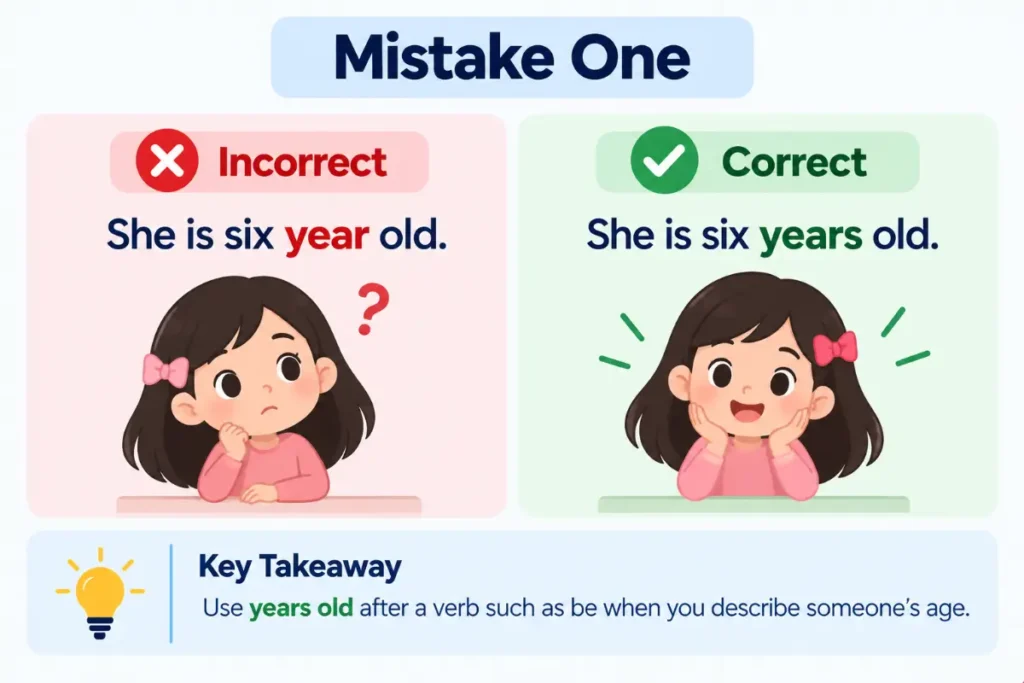
Incorrect: She is six year old.
Correct: She is six years old.
The phrase follows the verb is, so years should be plural.
Mistake Two
Incorrect: She is a six years old girl.
Correct: She is a six year old girl.
The age expression comes before girl and acts as one modifier. Use singular year.
Mistake Three
Incorrect: He bought a ten years old car.
Correct: He bought a ten year old car.
The age phrase describes car. The singular form belongs inside the compound modifier.
Mistake Four
Incorrect: The building is fifty year old.
Correct: The building is fifty years old.
The phrase follows is and directly states the building’s age.
Mistake Five
Incorrect: My daughter is a one years old child.
Correct: My daughter is a one year old child.
Even though the age is expressed with a number phrase before a noun the measurement remains singular.
These errors often happen because writers focus on the number instead of the grammatical position of the age expression. Look at what comes immediately after the phrase. If it modifies a noun use the compound modifier pattern. If it follows a linking verb and tells the age use the ordinary age phrase.
Questions And Negative Sentences
The same rule works in questions.
Ask:
How old is your daughter?
You can answer:
She is six years old.
If you use the age expression before a noun you can say:
She is a six year old girl.
The same distinction works in negative sentences.
She isn’t six years old yet.
She doesn’t have a six year old daughter.
The first sentence states someone’s age. The second uses the age phrase to describe daughter.
Questions can also contain the compound form:
Do you have a three year old son?
Is that a ten year old building?
In these sentences the age phrase directly modifies the noun that follows.
Age Expressions With Numbers
Numbers create another area of confusion.
With one the noun is singular in both structures.
The baby is one year old.
She has a one year old baby.
With numbers greater than one the distinction becomes more visible.
The baby is two years old.
She has a two year old baby.
The same pattern continues:
He is twelve years old.
He has a twelve year old brother.
She is twenty years old.
She has a twenty year old sister.
The number itself does not determine the form. The grammatical position determines it.
That is the key idea to remember.
Written Numbers And Numerals
Both written numbers and numerals can appear in age expressions.
She is five years old.
She is 5 years old.
A five year old child.
A 5 year old child.
Style preferences can vary. In formal writing many publications follow a house style for numbers. The grammar pattern remains the same.
American English Usage
American English follows the same core distinction.
Use the plural form when the age comes after a verb.
The child is six years old.
Use the singular form when the age phrase directly modifies a noun.
The six year old child smiled.
In polished American writing the compound modifier is generally hyphenated:
The six year old child smiled.
American style guides commonly use hyphens to connect words that work together as a compound modifier before a noun.
The rule is not a special American invention. It reflects a broader English grammar pattern that appears across major English varieties.
British English Usage
British English follows the same grammatical distinction.
You can write:
The child is six years old.
You can also write:
The six year old child smiled.
The spelling and basic grammar do not change simply because the variety of English changes.
Some punctuation and style preferences may vary between publications. The central distinction between an age expression after a verb and an age phrase before a noun remains stable.
Australian English Usage
Australian English also uses the same basic structure.
For example:
The student is ten years old.
The ten year old student won the prize.
There is no standard Australian version that changes the grammar into a different age pattern. Writers should still consider the style rules used by their school, employer, publisher, or organization.
Canadian English Usage
Canadian English follows the same pattern as American and British English.
The dog is four years old.
The four year old dog is friendly.
The important point is that this is a grammar structure rather than a regional spelling difference. The distinction remains useful across English varieties.
Formal And Informal Usage
These age expressions work in both casual and formal English.
In conversation you might say:
My daughter is five years old.
That’s a five year old laptop.
In professional writing you might say:
The study included children who were six years old.
The program was designed for six year old children.
The second example is grammatically possible but many editors would prefer a cleaner construction such as:
The program was designed for children who were six years old.
That version avoids a long compound modifier and can be easier to read.
In formal writing clarity should guide your choice. Compound modifiers are useful, but they can become heavy when they contain several words.
When The Compound Form Feels Awkward
Sometimes the age phrase is grammatically correct but not the clearest option.
Compare:
The report examined the behavior of twenty five year old participants.
The report examined participants who were twenty five years old.
The second version can be easier to process because the reader doesn’t have to unpack a long compound modifier.
This matters in academic and professional writing. Grammar is not only about avoiding mistakes. Good editing also considers rhythm, clarity, and ease of reading.
If the modifier becomes crowded you can rewrite the sentence.
Instead of:
The organization surveyed one hundred twenty year old workers.
You might write:
The organization surveyed workers who were twenty years old.
The rewrite makes the relationship between the age and the people immediately clear.
Memory Tips
The best memory trick is to ask one question:
Is the age describing a noun that comes next?
If yes use the singular form inside the compound modifier.
A ten year old student.
If no and you’re simply stating someone’s age after a verb use the plural form.
The student is ten years old.
Another useful trick is to think of the age phrase as a measurement.
Before a noun:
A five mile walk.
After the verb:
The walk is five miles long.
Age follows the same pattern:
A five year old child.
The child is five years old.
This connection makes the rule easier to remember because you’re learning a general English structure rather than a single isolated grammar fact.
Related Grammar And Usage Notes
Age As A Noun
Age itself is a noun.
For example:
Her age is difficult to guess.
What is your age?
In everyday American English people often prefer the more natural question:
How old are you?
Old As An Adjective
Old is an adjective that describes age.
For example:
The building is old.
The car is twenty years old.
The word old describes the subject. The phrase twenty years gives a specific measurement of age.
How Old Questions
The natural question is:
How old is your brother?
The answer can be:
He is twelve years old.
You can also identify him with a compound modifier:
He is a twelve year old boy.
These are different structures describing the same age.
Age And Approximation
English can also express approximate age.
She is about ten years old.
He is nearly twenty years old.
The building is more than one hundred years old.
A nearly ten year old building.
The same grammar principle continues to apply when the age phrase appears before a noun.
Related Age Expressions
Several expressions appear frequently with age.
- At age ten. This identifies a particular point in someone’s life. For example: She started playing piano at age ten.
- At ten years old. This describes the person’s age at the time of an event. For example: He moved to the city at ten years old.
- A ten year old. This can work as a noun in informal and standard usage when the context clearly identifies a person or thing by age.
- Ten years of age. This is more formal and often appears in official or legal writing.
- A child aged ten. This structure is common in British and formal writing.
- Ten year old child. This is a compound modifier before child and normally uses hyphens in polished writing.
- Ten years old. This is the standard predicate form after a linking verb.
- Ten year old. This form belongs inside a compound modifier when it directly describes a noun.
These expressions overlap in meaning but differ in style and grammatical structure.
Professional Writing Tips
Good age writing depends on structure more than memorization.
First identify the noun being described. If the age phrase comes immediately before that noun use the singular measurement form.
Next check punctuation. When the complete age phrase acts as a compound modifier before a noun hyphens normally make the relationship clearer.
Then read the sentence aloud. If the phrase follows is, was, or another linking verb and simply states age you will normally need the plural form.
Finally look at readability. A grammatically correct compound modifier isn’t always the clearest choice. If the phrase becomes long or awkward rewrite the sentence.
For example:
The twenty five year old experienced researcher presented the findings.
This is grammatically workable, but a smoother version may be:
The researcher who was twenty five years old presented the findings.
The best choice depends on the context and the surrounding sentence.
Expert Editor Insight
An experienced editor doesn’t memorize age expressions one by one. The editor first identifies the grammatical job of the phrase. If the age expression comes before a noun and works as a compound modifier the measurement stays singular and the words are normally hyphenated. If the expression follows a linking verb and states age the measurement is normally plural. Grammar tools may flag missing hyphens or an incorrect plural form, but understanding the structure lets you spot the problem before software does.
Key Takeaways
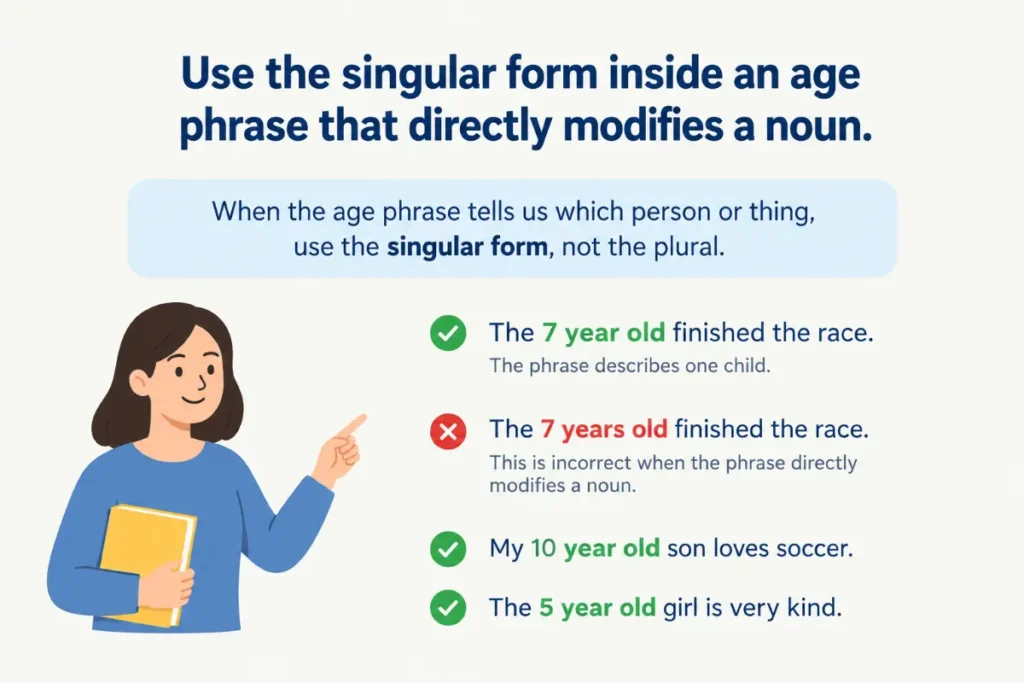
- Use the singular form inside an age phrase that directly modifies a noun.
- Use the plural form when stating age after a linking verb.
- The compound modifier normally takes hyphens in polished writing.
- One year old is singular in both common structures because one takes a singular noun.
- Numbers greater than one normally take years after a verb.
- Numbers greater than one still use singular year inside a compound modifier.
- The same basic rule works in American, British, Australian, and Canadian English.
- If the compound modifier becomes too long, rewrite the sentence for clarity.
Conclusion
The choice between year old vs years old becomes much easier once you focus on sentence structure. Use the singular form when the age phrase comes before a noun and acts as a compound modifier. Use the plural form when you state someone’s age after a linking verb. For example, write a seven year old child in the first structure and The child is seven years old in the second.
The number itself isn’t the main issue. Grammar decides the form. A phrase before a noun behaves differently from an age expression that follows a verb. Hyphens also help show that an age phrase before a noun works as one modifier.
For a quick memory trick, ask what comes after the age phrase. If it describes a noun use singular year. If it states age after a verb use years for numbers above one. This simple check will prevent most age related grammar mistakes.
FAQs
Is year old grammatically correct?
Yes. The singular form is correct when it appears inside a compound modifier before a noun. For example, you can write a five year old child. In polished writing the complete modifier is normally hyphenated. The singular form is also correct after one when stating age, as in She is one year old.
Is years old grammatically correct?
Yes. Years old is the normal form when you state someone’s age after a linking verb such as is, was, or will be. For example, He is ten years old. The plural years is used because the phrase describes a period containing ten years rather than functioning as a compound modifier before a noun.
What is the basic rule for year old vs years old?
The basic rule is based on grammatical position. Before a noun use the singular form inside a compound modifier, as in a six year old child. After a linking verb use the plural form for numbers above one, as in The child is six years old. This distinction applies across common English varieties.
Should I write five year old or five years old?
Both can be correct, but they belong in different structures. Write five years old when stating age after a verb, as in She is five years old. Write five year old when the phrase directly modifies a noun, as in a five year old child. The first states age while the second describes a noun.
Does year old need hyphens?
When an age expression comes before a noun and works as one compound modifier, hyphens normally connect the words. For example, a ten year old car becomes a ten year old car when correctly punctuated. When the phrase follows a verb, don’t use those compound modifier hyphens: The car is ten years old.
Can I say a two years old child?
No. Standard English uses the singular measurement inside the compound modifier. The natural form is a two year old child. The plural form belongs in a sentence such as The child is two years old. The number two doesn’t change the compound modifier into a plural phrase.
Is year old one word?
No. The words remain separate. When the phrase modifies a noun it normally functions as a hyphenated compound modifier. For example, a three year old dog is written with the words connected by hyphens. After a verb the phrase is written as separate words: The dog is three years old.
Why does English use singular year before a noun?
English commonly uses singular measurement nouns inside compound modifiers. This makes the entire measurement function as one descriptive unit. The same pattern appears in expressions such as a five mile walk and a three hour meeting. Age expressions follow that pattern, so a five year old child uses singular year.
Is the rule different in American and British English?
The core grammar rule is the same in American and British English. Both varieties use the singular form inside a compound modifier and the plural form when stating age after a verb. Style preferences for punctuation and numbers can vary between publications, but the central grammar distinction remains the same.
How do I write age in formal writing?
Choose the structure that makes the sentence easiest to understand. Use the compound form when it is concise and clear, and use a clause such as children who were ten years old when a longer modifier becomes difficult to read. In formal writing accuracy matters, but clarity matters too.

English Grammar & Usage
Nathan Holloway is an American grammar writer and language researcher who specializes in English grammar, sentence structure, verb usage, and common writing mistakes. He enjoys breaking down confusing grammar rules into practical explanations with clear examples, making English easier for students, professionals, and everyday writers.