
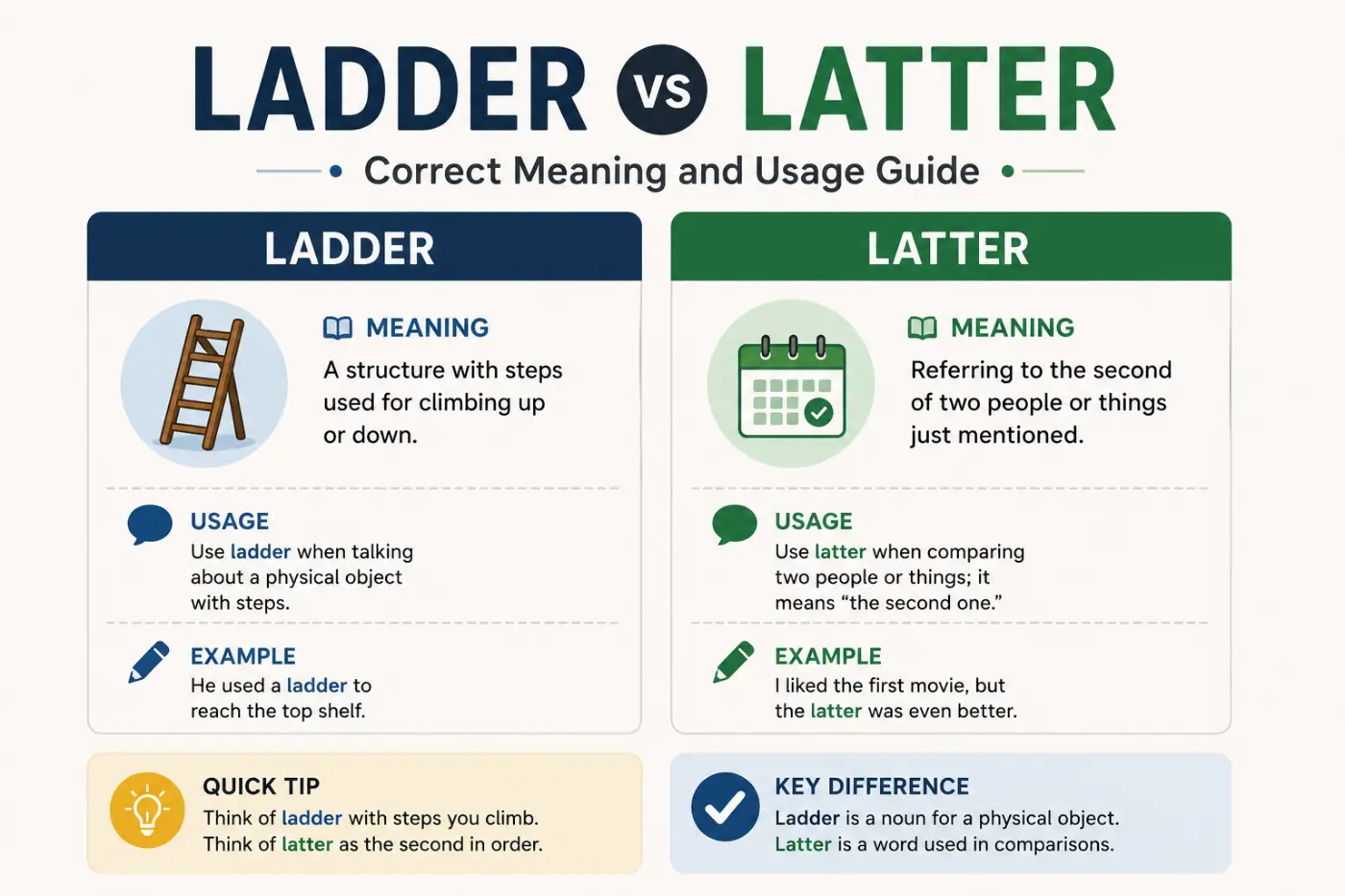
Latter or ladder is a common English confusion because the two words sound the same for many speakers. The spelling is different and so is the meaning. Latter refers to the second of two things or people already mentioned, while ladder is a structure with steps or rungs that people use to climb.
The confusion becomes even easier to understand when you hear the words in conversation. Since they are commonly pronounced alike, you cannot always tell which word someone means from sound alone. You have to use the surrounding sentence and the meaning being expressed. This makes the pair a classic example of homophones.
The good news is that the difference is easy to remember once you connect each spelling to a clear mental picture. This guide explains both words in simple English, shows how they work in sentences, covers pronunciation and grammar, and gives you practical ways to avoid mixing them up in school, work, conversation, and formal writing.
Short Answer
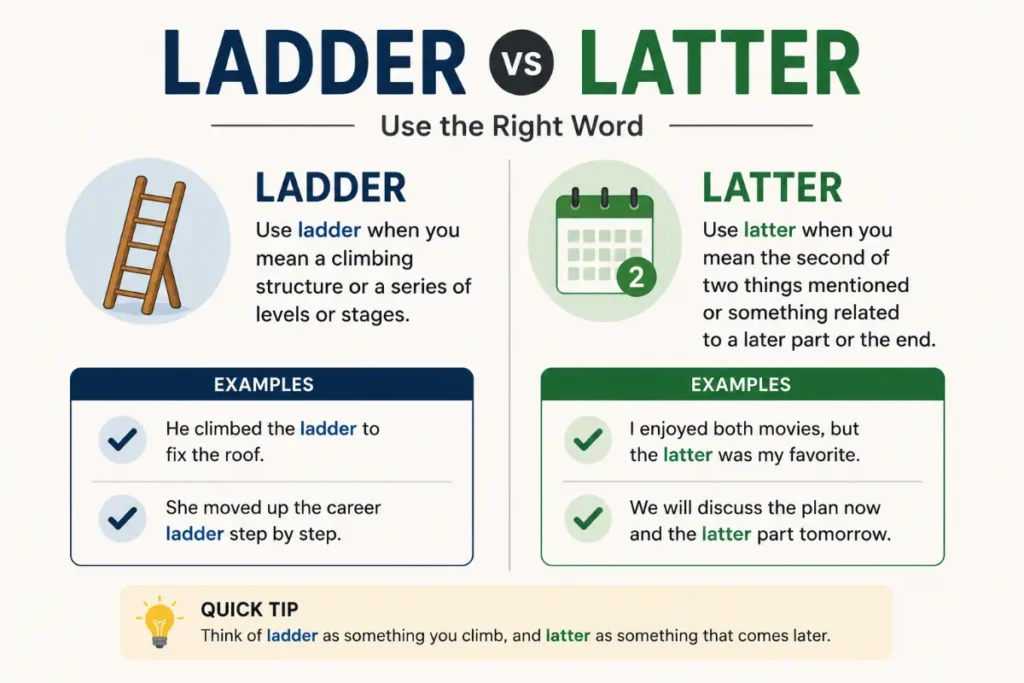
Latter and ladder are different words with different meanings. Latter refers to the second of two people or things mentioned, while ladder is a piece of equipment used for climbing. They sound alike in many varieties of English but their meanings, spellings, and grammar are completely different.
Table of Contents
- Quick Answer
- What Latter Means
- What Ladder Means
- Latter or Ladder Compared
- Why These Words Get Confused
- How To Use Latter Correctly
- How To Use Ladder Correctly
- Pronunciation Guide
- Grammar Rules
- Sentence Examples
- Common Mistakes
- Word Origins
- American And British Usage
- Related Words
- Memory Tips
- Real Life Usage
- Expert Editor Insight
- FAQs
- Key Takeaways
- Conclusion
What Latter Means
Latter is mainly used when you have already mentioned two people, things, choices, or ideas and want to refer to the second one.
For example:
Maria and James applied for the position. The latter had more experience.
The word latter refers to James because James was mentioned second.
This gives you the simplest definition:
Latter means the second of two things or people previously mentioned.
Latter is usually a pronoun or adjective depending on how it functions in a sentence. It belongs to a formal style of English and appears often in essays, reports, articles, academic writing, and careful professional communication.
Consider another example:
The company considered quality and price. The latter became the deciding factor.
Here latter means price because price was the second item mentioned.
The word does not normally refer to the last item in a long list. That point matters because many learners assume latter simply means last.
Traditionally and most precisely, latter contrasts with former when two things have been introduced.
The former means the first.
The latter means the second.
For example:
The manager discussed cost and efficiency. The former was a major concern, while the latter affected the final decision.
Former refers to cost. Latter refers to efficiency.
This pair provides one of the easiest ways to understand the word.
What Ladder Means
Ladder is a completely different word.
A ladder is a structure made with two long sides and horizontal rungs between them. People use ladders to climb up or down.
For example:
He climbed the ladder to reach the roof.
The word can also be used in a figurative sense. In that use, ladder describes a series of stages through which someone can move toward a higher position.
You might hear:
She worked her way up the corporate ladder.
The corporate ladder is not a physical object. It represents levels of status or responsibility within an organization.
Another example is:
He hopes to climb the social ladder.
Here ladder represents movement from one social level to another.
Ladder is normally a noun, although English also uses it as a verb in some contexts.
For example:
The stockings laddered after catching on the rough edge.
This verb use is more specialized and is less common in everyday American English than the noun.
The important point for the comparison is simple. A ladder has rungs and helps someone climb. Latter has nothing to do with climbing.
Latter or Ladder Compared
| Word | Meaning | Part of Speech | Pronunciation | Common Context | Example |
|---|---|---|---|---|---|
| Latter | The second of two people or things mentioned | Pronoun or adjective | Usually /ˈlætər/ | Formal writing comparisons essays reports | I prefer tea to coffee because the latter is too bitter. |
| Ladder | A structure used for climbing or a figurative series of levels | Noun and sometimes verb | Usually /ˈlædər/ | Home repair work construction careers | He placed the ladder against the wall. |
The words may sound identical for many American speakers, but their spelling and meaning give them completely different jobs.
One refers to position in a discussion. The other usually refers to an object or a series of levels.
Why These Words Get Confused
The biggest reason is pronunciation.
In many forms of American English, latter and ladder are pronounced the same or nearly the same. The middle consonant can be pronounced with a sound that makes the distinction disappear to the ear.
That means someone saying either word aloud may give you no useful spelling clue.
The written forms are different, though.
Latter contains tt.
Ladder contains dd.
This is where context becomes your best friend.
Imagine someone says:
I climbed the latter.
That sentence sounds odd because climbing normally involves a ladder. If the speaker says:
I chose the latter.
The meaning becomes clear. The person is selecting the second of two choices.
Another source of confusion is the similarity between latter and later. Both relate to ideas involving time or order, but they aren’t interchangeable.
Later usually refers to a time that comes after another time.
Latter refers to the second of two things already mentioned.
Consider these examples:
I’ll call you later.
I prefer the latter option.
The first sentence deals with time. The second deals with choice or order.
This distinction is worth learning because later and latter are often confused alongside ladder.
How To Use Latter Correctly
The safest way to use latter is when you have exactly two things or people in mind.
Start by mentioning the two items.
Then use former for the first and latter for the second.
For example:
The course covers grammar and pronunciation. The former focuses on sentence structure, while the latter focuses on speech.
Grammar appears first, so it is the former.
Pronunciation appears second, so it is the latter.
Another example:
John and David applied for the scholarship. The latter submitted his application first.
David is the second person mentioned, so latter refers to David.
Latter Refers To The Second Of Two
This is the central grammar rule.
If you mention A and B, then:
Former = A.
Latter = B.
Think of the pair as a simple sequence.
First item → former.
Second item → latter.
This works especially well in formal writing.
Latter Does Not Simply Mean Last
This is one of the most common mistakes.
Suppose you mention five books.
The books were novels, biographies, essays, poems, and plays.
Calling the fifth book the latter would not follow the traditional precise use of the word. Latter is most safely used for the second of two items.
If you need to refer to the final item in a larger list, use last, final, or another phrase that clearly expresses the intended meaning.
Latter Usually Refers Backward
The reader should normally be able to identify the two choices from the previous part of the sentence or paragraph.
For example:
The company can reduce costs or increase production. The latter may require new equipment.
The reader knows that latter refers to increasing production.
This backward reference is called anaphoric reference in linguistics. The word depends on earlier information to establish its meaning.
That is why latter can feel vague if the writer introduces too many ideas before using it.
How To Use Ladder Correctly
Ladder is much more concrete.
The most common meaning is a piece of equipment that lets someone climb to a higher or lower position.
For example:
The painter carried a ladder into the garage.
Please hold the ladder while I climb.
He left the ladder outside after cleaning the windows.
The word is also common in construction, maintenance, gardening, home repair, and emergency work.
You can use several familiar phrases with ladder.
Step ladder refers to a self supporting ladder with steps.
Extension ladder refers to a ladder that can be extended to reach greater heights.
Climb the ladder means physically moving upward on a ladder.
The word also appears in figurative expressions.
The Career Ladder
The career ladder describes progress through levels of employment or responsibility.
She started as an assistant and gradually climbed the career ladder.
No physical ladder exists. The phrase creates a picture of moving upward from one level to another.
The Corporate Ladder
The corporate ladder refers to levels of rank within a company.
He hopes to move up the corporate ladder over the next few years.
Again, the word represents stages rather than a physical object.
The Social Ladder
The social ladder describes levels of social position or status.
The novel follows a young man trying to climb the social ladder.
This figurative use is common in journalism, essays, and storytelling.
Pronunciation Guide
Latter and ladder are commonly pronounced alike in American English.
A typical pronunciation is represented as:
Latter: /ˈlætər/
Ladder: /ˈlædər/
The difference shown in the IPA comes from the middle consonant. In many American accents, however, both words can sound extremely similar because the middle consonant may be realized with the American English flap sound.
An easy pronunciation guide is:
Latter: LAT er.
Ladder: LAD er.
The first syllable carries the main stress in both words.
Because the pronunciation can overlap so strongly, spelling and context matter more than sound.
This is a useful example of why English spelling cannot always be predicted from pronunciation. Two words can sound alike while carrying completely different meanings.
If you’re practicing these words aloud, say them in sentences instead of repeating them in isolation.
I chose the latter.
I climbed the ladder.
The surrounding meaning makes the distinction much easier to remember.
Grammar Rules
Latter As An Adjective
Latter can modify a noun.
The latter option is more affordable.
Here latter describes option.
It tells the reader that this is the second option previously mentioned.
Latter As A Pronoun
Latter can stand alone.
I considered tea and coffee. I chose the latter.
Here latter replaces coffee.
The reader already knows what the word refers to.
Former And Latter
Former and latter work as a pair when you need to distinguish two previously mentioned items.
The store sells fresh and frozen food. The former is more popular.
Former refers to fresh food.
The latter is easier to store.
Latter refers to frozen food.
This structure is common in formal writing because it avoids repeating the same nouns.
Latter In Formal Writing
Latter is grammatically correct and fully acceptable in formal writing. However, it should be used with care.
If the reader has to search through a long paragraph to discover what latter refers to, the sentence becomes harder to follow.
A clear writer makes the two choices obvious.
Less clear:
Several researchers discussed education, technology, public health, economics, and social policy. The latter became the main focus.
The reader may wonder what latter refers to because too many possible items are involved.
Clearer:
The researchers discussed economics and social policy. The latter became the main focus.
Now the reference is obvious.
Ladder As A Noun
Ladder is normally a countable noun.
You can say:
a ladder
two ladders
the ladder
several ladders
It can take ordinary determiners and adjectives.
The old ladder looked unsafe.
We bought a new aluminum ladder.
Ladder As A Verb
Ladder can also function as a verb in specialized usage.
For example:
The fabric laddered after it caught on a sharp edge.
This use is more limited than the everyday noun.
Sentence Examples
Here are natural examples using latter.
- The two plans look promising, but I prefer the latter.Latter refers to the second plan mentioned.
- The manager discussed cost and quality. The latter was the main concern.Latter refers to quality.
- Sarah and Emma attended the meeting, but the latter spoke first.Latter refers to Emma.
- The school offers online and in person classes. The latter require students to attend campus.Latter refers to in person classes.
- We considered driving and taking the train. The latter was cheaper.Latter refers to taking the train.
- The article compares traditional and modern teaching methods, with greater attention given to the latter.Latter refers to modern teaching methods.
- The restaurant serves vegetarian and seafood dishes. The latter are especially popular on weekends.Latter refers to seafood dishes.
- He had two choices and eventually selected the latter.Latter refers to the second choice.
- The proposal focuses on speed and accuracy. The latter is more important for this project.Latter refers to accuracy.
- The author contrasts fear and courage before showing how the latter changes the main character.Latter refers to courage.
Now look at examples using ladder.
- He climbed the ladder to reach the second floor.
- Please move the ladder away from the doorway.
- The painter carried a ladder into the room.
- She bought a small step ladder for the kitchen.
- The worker checked the ladder before climbing it.
- He hopes to climb the corporate ladder.
- She worked hard to move up the career ladder.
- The children watched their father place the ladder against the wall.
- The gardener used a ladder to trim the tall branches.
- The novel follows a character trying to climb the social ladder.
The context makes the meaning immediately clear in every example.
Common Mistakes
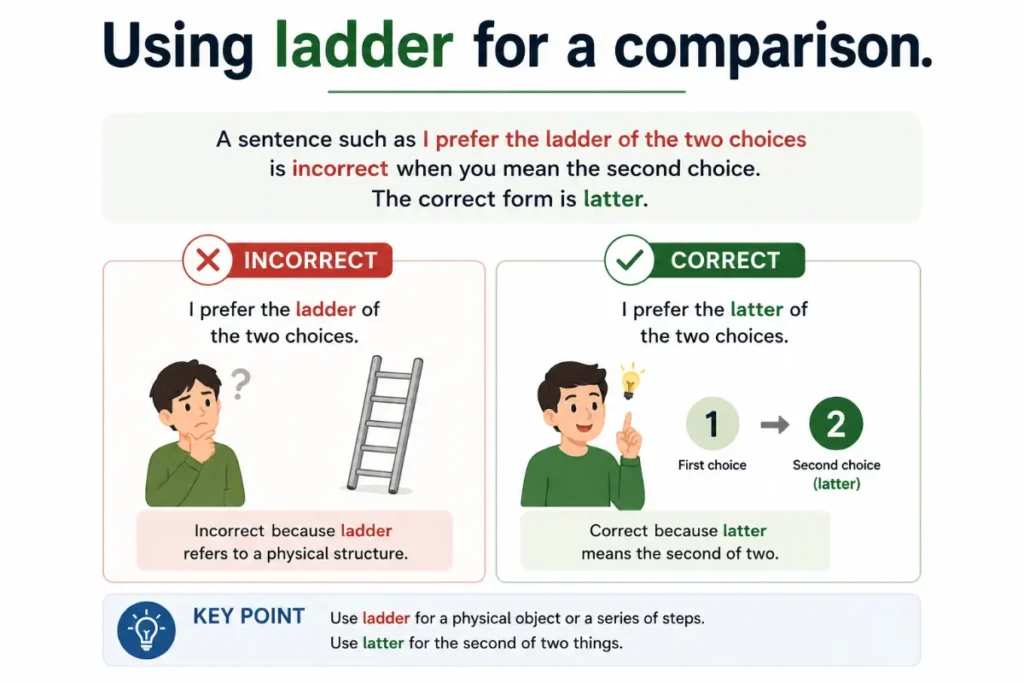
Using Ladder For A Choice
Incorrect:
I prefer the ladder of the two options.
Correct:
I prefer the latter of the two options.
The word for the second choice is latter.
Using Latter For A Physical Object
Incorrect:
He climbed the latter to reach the roof.
Correct:
He climbed the ladder to reach the roof.
A physical climbing structure is a ladder.
Confusing Latter With Later
Incorrect:
I’ll call you latter.
Correct:
I’ll call you later.
Later refers to a future time. Latter refers to the second of two previously mentioned things.
Using Latter For Any Final Item
Some writers use latter to mean the final item in a long list.
That can make the sentence unclear and may conflict with traditional usage.
Use latter most safely when comparing two items.
Forgetting The Double Letter Pattern
The spelling itself provides a useful clue.
Latter has double t.
Ladder has double d.
You can associate the double d in ladder with the repeated sound or visual idea of its rungs and sides. For latter, remember that it belongs with former as a comparison pair.
Word Origins
The two words have separate histories even though they sound alike in many modern accents.
Latter is related to the Old English word lætra which was the comparative form connected with late. Over time, the word developed the specialized sense of referring to the second of two things mentioned.
The same historical family is connected with the broader idea of something coming later in a sequence.
Ladder has a different origin. It comes from Old English hlæder and related Germanic forms referring to a climbing structure. The word has remained connected to the physical object used for moving upward.
Their different histories help explain why they have different spellings and meanings despite their similar pronunciation today.
English contains many pairs like this. Words can develop along separate historical paths and eventually become homophones because pronunciation changes over time.
American And British Usage
American English
Both words are standard in American English.
Latter is common in formal and academic writing, especially when comparing two choices or ideas.
Ladder is an everyday noun used for physical climbing equipment and in figurative phrases such as career ladder and corporate ladder.
American speakers may pronounce the two words very similarly or identically in ordinary conversation.
British English
British English also uses both words with the same basic meanings.
Latter refers to the second of two things previously mentioned.
Ladder refers to the climbing structure.
The spelling distinction remains the same.
Australian English
Australian English uses both words in the same general way. There is no major regional spelling change that turns one into the other.
Canadian English
Canadian English also maintains the same distinction. Latter belongs to the language of comparison and ladder refers mainly to a physical or figurative climbing structure.
The main challenge across these varieties is pronunciation rather than vocabulary.
Related Words
Former
Former is the natural partner of latter. When two things are mentioned, former refers to the first.
Tea and coffee were available. I chose the former.
Later
Later refers to a time that comes after another time.
I’ll finish it later.
It should not be confused with latter.
Last
Last can refer to the final item in a sequence.
She was the last person to leave.
Unlike latter, last can naturally refer to the final item in a group larger than two.
Final
Final means last in a series or ending a process.
The final exam is next week.
It is often a better choice than latter when discussing the end of a longer sequence.
Second
Second can refer directly to the item that comes after the first.
The second option is cheaper.
This is often clearer than latter when the reader might struggle to identify the reference.
Rung
A rung is one of the horizontal steps on a ladder.
He placed his foot on the lowest rung.
Staircase
A staircase is a fixed set of steps used for moving between levels in a building.
Unlike a ladder, it is usually a permanent architectural feature.
Climb
Climb means to move upward or downward using hands feet or both.
You can climb a ladder, climb stairs, or climb a mountain.
Memory Tips
The easiest way to remember the difference is to build two separate mental pictures.
For latter, picture two choices.
A and B.
Latter means B.
For ladder, picture a physical object with rungs.
If you can climb it, you need ladder.
There is another useful trick.
Remember the pair:
former and latter.
Former comes first.
Latter comes second.
This gives you a reliable rule without relying on pronunciation.
For ladder, think about the letter d as part of the physical shape. You can imagine the two d letters as two sides of the ladder with rungs between them. It isn’t a linguistic rule, but visual memory tricks can make spelling much easier.
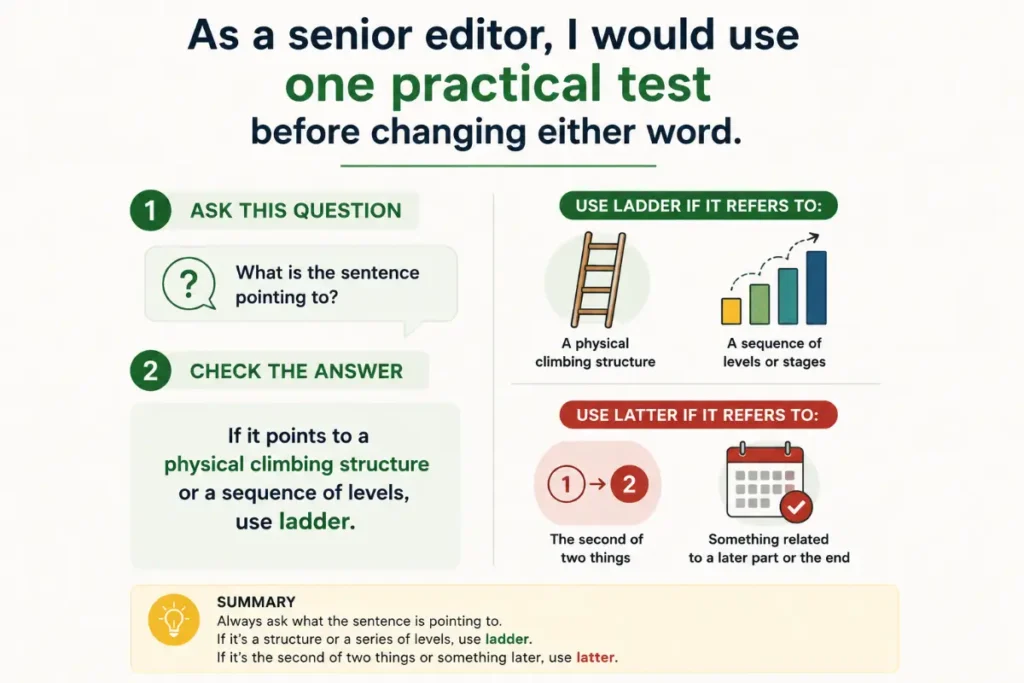
You can also test yourself with a simple question.
Am I talking about the second of two things or something I can climb?
If you mean the second of two things, choose latter.
If you mean something you climb, choose ladder.
Real Life Usage
Everyday Conversation
Latter is less common in casual speech because people often prefer clearer phrases such as the second one.
For example:
Do you want pizza or pasta?
A natural response is:
I’ll take the second one.
In formal writing, however, you might see:
I prefer the latter.
Ladder is extremely common in ordinary conversation.
Can you hold the ladder?
Where did you put the ladder?
These sentences sound completely natural.
Workplace Communication
Latter can be useful in professional writing when comparing two choices.
We can focus on speed or accuracy. The latter is more important for this project.
In a casual workplace conversation, someone might simply say:
The second option is better.
Ladder can appear in workplace safety instructions, construction discussions, maintenance tasks, and career language.
Please inspect the ladder before use.
She has moved several steps up the corporate ladder.
Academic Writing
Latter is especially useful in academic writing because writers often compare two theories, methods, arguments, or findings.
The study compares qualitative and quantitative methods. The latter relies heavily on numerical data.
The word creates a concise connection to the second item.
Still, clarity should come first. If a reader could misunderstand the reference, repeating the noun is often better.
News Writing
News articles may use latter when discussing two previously mentioned positions.
The mayor proposed two solutions. The latter received stronger support from the council.
Ladder can appear in stories about construction, home safety, accidents, sports, or social mobility.
The company has created a new path for workers to move up the career ladder.
Literature And Storytelling
Latter is more common in analytical writing about literature than in dialogue.
A critic might write:
The novel contrasts isolation and community, with the latter becoming central to the ending.
Ladder can have strong symbolic value in storytelling.
A character climbing a ladder can represent ambition, progress, escape, or social advancement.
When To Avoid Latter
Latter is useful but it isn’t always the clearest choice.
If your audience is young or the writing is very conversational, the second one may be easier to understand.
Compare:
I prefer the latter.
I prefer the second one.
Both can be correct when two options have just been mentioned. The second sentence is more direct for many readers.
You should also avoid latter when the reader cannot easily identify the two items.
For example:
The company discussed pricing, hiring, technology, customer service, and marketing. The latter needs improvement.
The reference is unclear because several items appear in the sentence.
A better sentence would name the item directly.
The company discussed several areas, but marketing needs improvement.
Good editing isn’t just about grammatical correctness. It’s also about reducing the mental work required from the reader.
Latter In Formal Writing
Latter is perfectly acceptable in formal writing when used precisely.
It can help avoid unnecessary repetition.
Instead of writing:
The report compares remote work and office work. Office work requires more commuting.
You could write:
The report compares remote work and office work. The latter requires more commuting.
That said, repetition is not always a problem. If using latter makes the sentence less clear, repeat the noun.
Clarity beats elegance.
This is especially useful advice for students. Some writers assume formal writing must use complicated vocabulary. It doesn’t. A clear sentence with the exact noun can be stronger than a polished sentence that makes the reader stop and figure out what latter refers to.
Expert Editor Insight
An experienced editor looks at reference before style. Latter is correct and useful, but only when the reader can instantly identify the second of two previously mentioned items. In a short comparison it can make writing concise and polished. In a long paragraph with several nouns it can create unnecessary confusion. Ladder is much easier because its physical meaning is concrete. My practical editing tip is to replace latter with the second one during proofreading. If the meaning becomes clearer, your original sentence may need a little more context.
Key Takeaways
- Latter means the second of two things or people previously mentioned.
- Ladder usually means a structure with rungs used for climbing.
- The two words can sound identical in many American accents.
- Former and latter form a useful pair. Former refers to the first and latter refers to the second.
- Later refers to time and should not be confused with latter.
- Latter works especially well in formal writing when the reference is clear.
- Ladder can be used literally for climbing equipment and figuratively for levels of career or social progress.
- If latter makes a sentence difficult to understand, use the second one or repeat the noun.
Conclusion
Latter or ladder becomes much easier once you separate the meanings. Latter refers to the second of two people or things already mentioned, while ladder refers to a physical climbing structure or a figurative series of levels. The words can sound alike in many accents, but their spelling and meaning are completely different.
Remember former and latter as a pair. Former points to the first item and latter points to the second. For ladder, picture a set of rungs that you can climb.
When proofreading, ask yourself on e simple question. Am I talking about the second of two choices or something used for climbing? That quick check will usually lead you to the right word.
FAQs
What is the difference between latter and ladder?
Latter and ladder are different words with different meanings. Latter refers to the second of two people or things already mentioned. Ladder usually refers to a structure with rungs that people climb. The two words can sound alike in American English, which causes confusion. Context and spelling tell you which word belongs in a sentence.
Is latter the same as last?
No. Latter traditionally refers to the second of two things mentioned. Last refers to the final item in a sequence and can apply to a group containing more than two items. If you mention two choices, latter can identify the second. If you mention five choices and mean number five, last or final is usually clearer.
Is ladder and latter a homophone pair?
They can be homophones in many varieties of English, especially American English. A homophone is a word that has the same pronunciation as another word but a different meaning or spelling. In many American accents, the middle consonants in these two words are pronounced so similarly that the words sound identical in ordinary speech.
Can latter refer to more than two things?
The traditional and clearest use of latter is for the second of two things or people mentioned. Some modern writing uses the term more loosely, but that can create ambiguity. If you have a list containing several items, it’s better to use second, last, final, or the specific noun instead. Clear reference is more valuable than forcing a formal word.
What is the difference between latter and later?
Later refers to a time that comes after another time. Latter refers to the second of two things or people mentioned. For example, I’ll call you later refers to future time. I chose the latter refers to the second option. The words look similar, but they serve different grammatical and semantic purposes.
What is the opposite of latter?
The natural counterpart of latter is former. When two people or things are mentioned, former refers to the first and latter refers to the second. For example, if a sentence mentions cats and dogs in that order, cats are the former and dogs are the latter. This former and latter pairing is especially common in formal writing.
How do you remember the spelling of ladder?
Think about the physical structure. A ladder has rungs and is something you climb. The spelling contains double d. For latter, remember the pair former and latter. Former means the first of two while latter means the second. Keeping these two memory pictures separate makes the spelling much easier to recall.
Is latter common in everyday American English?
Latter is understood in American English but can sound more formal than ordinary conversational alternatives. In casual speech, people often say the second one instead. Latter appears more naturally in essays, reports, academic writing, professional documents, journalism, and careful explanations. Ladder, by contrast, is a very common everyday word because it names a familiar physical object.
Can ladder be used figuratively?
Yes. Ladder can describe a series of levels that someone moves through. Common examples include the career ladder, corporate ladder, and social ladder. In these expressions, the ladder is symbolic rather than physical. The basic image remains the same: someone moves upward from one level to another. This figurative use is well established in English.
Which word should I use in formal writing?
Use latter when you mean the second of two previously mentioned items. Use ladder when you mean a climbing structure or a figurative series of levels. In formal writing, always make the reference clear. If the reader could struggle to identify what latter means, repeating the noun or using the second one may produce a stronger sentence.

Confusing Words, Spelling & Word Choice
Claire Whitmore is a U.S.-based English editor who writes about commonly confused words, spelling differences, and word choice. Her work helps readers understand subtle distinctions between similar-looking words through simple definitions, practical examples, and modern usage guidance in both American and British English.