
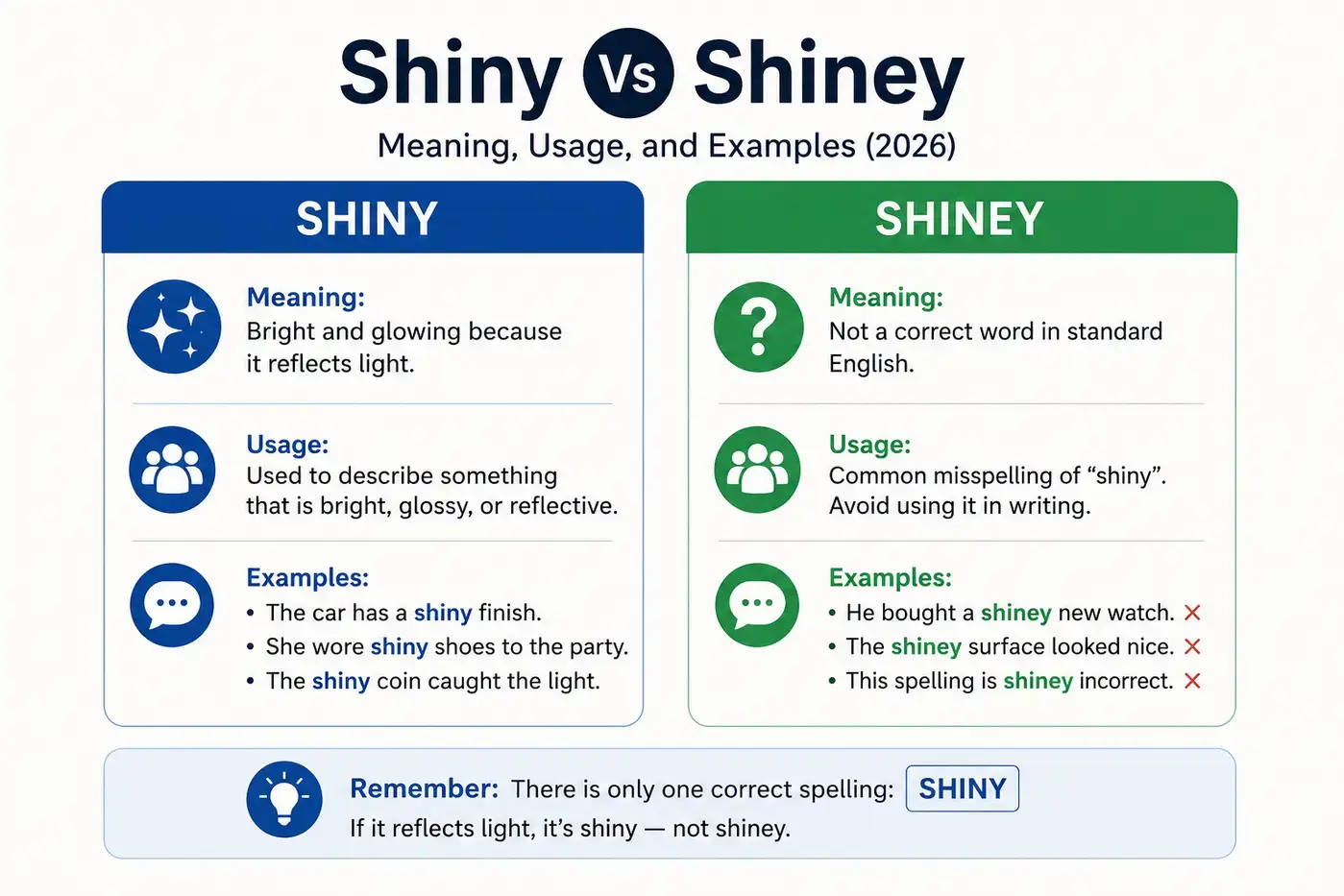
If you’ve ever paused over shiny or shiney while writing a sentence you’ve run into a very common English spelling problem. The correct form is shiny. The spelling shiney is incorrect in standard English because the word comes from shine and drops the final e before taking the adjective ending y.
The confusion is easy to understand. The base word is shine, and English has many words that keep their final e when an ending is added. That can make shiney look reasonable at first glance. The problem is that English spelling has several different patterns for forming adjectives, and this particular pattern removes the silent e.
Once you know that rule the spelling becomes much easier. This guide explains the meaning and grammar of the correct form, shows how it sounds, explains its connection to shine, and gives natural examples from everyday English. You’ll also learn the difference between shiny, shining, polished, glossy, bright, and related words so you can choose the expression that fits your sentence.
Short Answer
Shiny is the correct standard spelling. Shiney is a common misspelling that adds an unnecessary e before the y. Shiny is an adjective meaning bright, polished, reflective, or giving off light. The spelling follows the common English pattern in which shine changes to shiny by dropping the final e before adding y.
Table of Contents
- Quick Answer
- Meaning and Definition
- Why The Correct Spelling Is Shiny
- Key Differences
- Grammar and Word Forms
- Sentence Examples
- Common Spelling Mistakes
- Pronunciation Guide
- Word Origin
- Regional Usage
- Real Life Usage
- Similar Words and Expressions
- Memory Tips
- Expert Editor Insight
- FAQs
- Key Takeaways
- Conclusion
Quick Answer
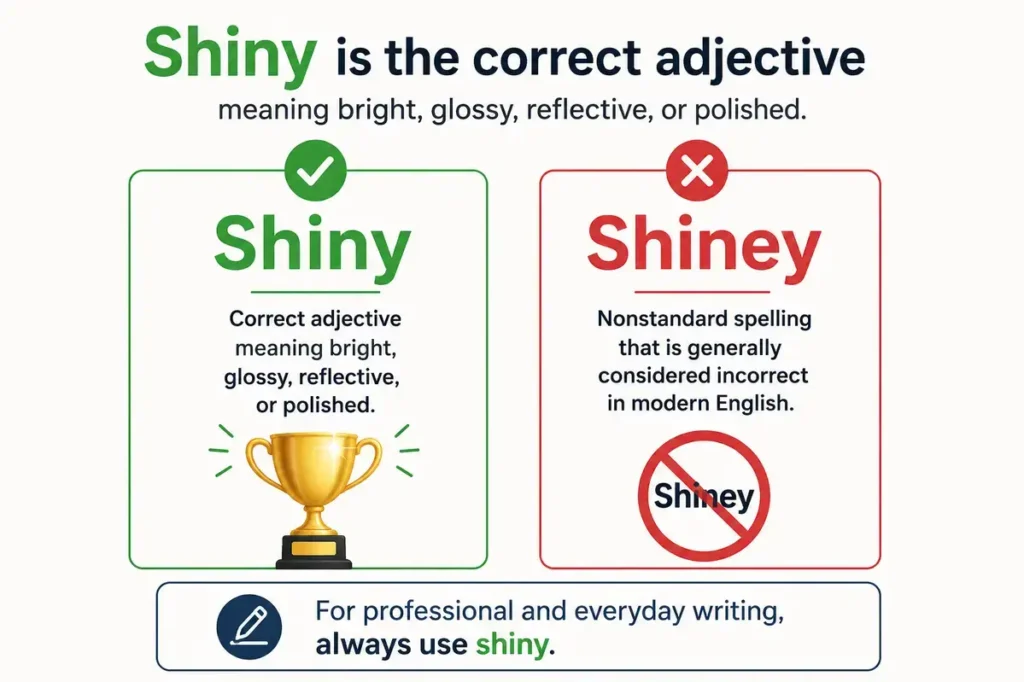
The standard spelling is shiny. Shiney is a spelling error rather than a standard alternative.
The word shiny describes something that reflects light or has a bright polished appearance. You can use it for physical objects such as shoes metal floors or jewelry. You can also use it more loosely for something that looks new attractive or attention grabbing.
Comparison Table
| Form | Correctness | Meaning | Part of Speech | Word Formation | Formality | Common Contexts | Example |
|---|---|---|---|---|---|---|---|
| Shiny | Standard | Bright or reflective | Adjective | Shine plus y with final e removed | Neutral | Objects clothing surfaces hair descriptions | She bought a shiny new bag. |
| Shiney | Incorrect in standard English | Intended meaning is usually shiny | Nonstandard spelling | Incorrectly keeps the final e | Not recommended | Typing mistakes informal errors drafts | The word should be spelled shiny. |
Meaning and Definition
Meaning Of The Incorrect Form
Shiney is generally a misspelling of shiny. It does not have a separate standard meaning in ordinary English.
People often produce this spelling because they start with shine and then add y without changing the base word. That approach feels logical because shine is already a familiar word.
For example someone may think:
shine + y = shiney.
But English spelling does not always allow a word to keep its final silent e before a suffix or ending. In this case the correct form removes the e.
shine + y = shiny.
You may see shiney in comments social media posts text messages or quickly written drafts. Its presence in informal writing doesn’t make it an accepted spelling.
A proper name username fictional word or brand could theoretically use Shiney as a chosen name. That would be a special use rather than evidence that it is the standard English adjective.
For normal writing use shiny.
Meaning Of The Correct Form
Shiny is an adjective. It describes something that reflects a noticeable amount of light or has a bright smooth polished appearance.
A shiny surface can reflect light strongly.
The table is shiny.
Her shoes are shiny.
The new car has a shiny finish.
The word can also describe something that looks new or attractive.
He bought a shiny new laptop.
That example has a slightly broader meaning. The laptop may literally have a reflective surface but shiny new can also suggest something fresh appealing or exciting.
Shiny can describe many different things.
Examples
Shiny shoes.
Shiny hair.
The exact meaning depends on context. Usually the central idea is visible brightness or a surface that catches and reflects light.
Why The Correct Spelling Is Shiny
The main spelling rule is simple.
When shine becomes shiny the final silent e is removed before the y is added.
The base word is:
shine
The adjective is:
shiny
Not:
shiney
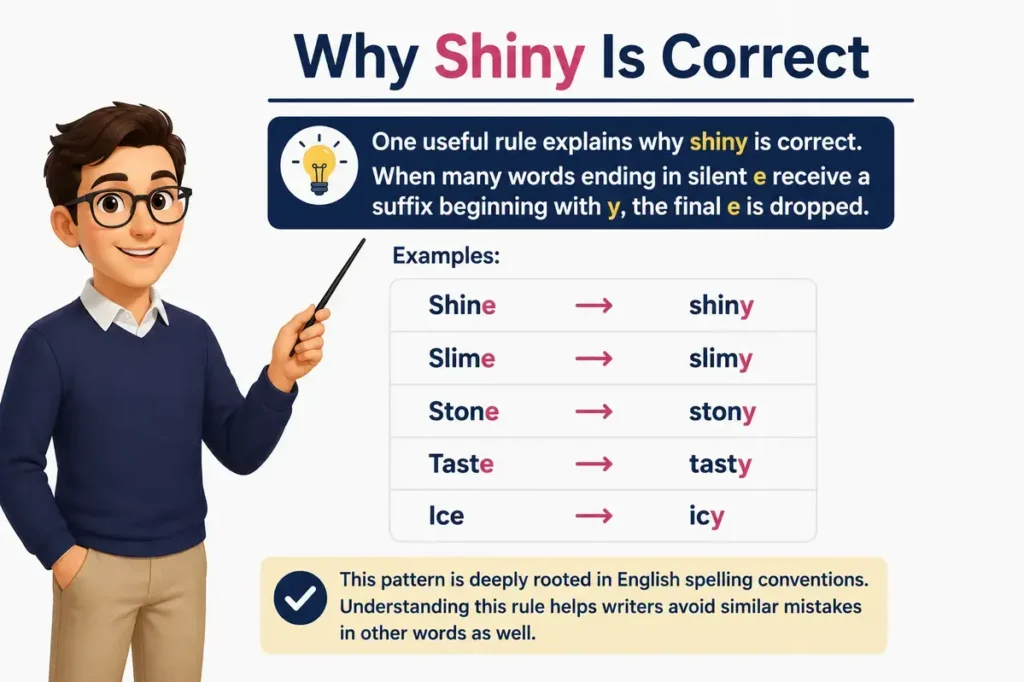
This follows a broader English spelling pattern. Many words ending in a silent e drop that e when a suffix beginning with a vowel is added.
For example:
noise becomes noisy.
ice becomes icy.
spice becomes spicy.
mess becomes messy.
shine becomes shiny.
The spelling pattern isn’t completely universal across English. English has many exceptions and historical spellings. Still it provides a useful guide for this particular word.
The important detail is that the e in shine is silent. It helps signal the long vowel sound in the base word but it does not remain in the adjective.
Compare the two forms aloud.
shine.
shiny.
The pronunciation changes slightly because the ending changes. The spelling also changes because the final e no longer serves the same purpose.
This is why writing shiney is tempting but incorrect.
Key Differences
- Spelling. Shiny is the standard spelling. Shiney incorrectly keeps the final e from shine.
- Meaning. Shiny has an established meaning related to brightness reflection or polished appearance. Shiney normally represents an intended use of the same word rather than a different meaning.
- Grammar. Shiny is an adjective. It describes a noun.
- Word formation. Shiny comes from shine with the final e removed before y is added.
- Pronunciation. The two spellings are normally intended to represent the same spoken word. The extra e in the incorrect form does not create a useful pronunciation difference.
- Formality. Shiny works naturally in casual professional academic and descriptive writing.
- Context. It can describe physical appearance and can sometimes be used figuratively.
- Regional usage. American British Canadian and Australian English use shiny as the standard form.
The central lesson is easy to remember. The correct adjective does not carry the final e from shine.
Grammar And Word Forms
Shiny is an adjective. Its main job is to describe a noun.
You can place it before a noun.
She wore shiny shoes.
The child found a shiny coin.
They bought shiny wrapping paper.
You can also use it after a linking verb.
The floor looks shiny.
Her hair is shiny.
The surface became shiny after polishing.
The adjective can describe a physical quality or appearance.
The metal is shiny.
It can also appear in a more figurative expression.
The company launched a shiny new product.
Here shiny does more than describe literal reflection. It can suggest something that looks new attractive or impressive.
Comparative And Superlative Forms
Shiny can take comparative and superlative forms.
Shinier means more shiny.
Shiniest means the most shiny.
For example:
This floor is shinier than the old one.
That was the shiniest car in the parking lot.
Notice another spelling change.
Shiny becomes shinier.
The y changes to i before the comparative ending.
Shiny becomes shiniest.
Again the final e does not return.
Shiny And Shining
Both words are related but they aren’t identical.
Shiny usually describes a surface or appearance.
She has shiny hair.
Shining often describes something that is actively giving off or reflecting light.
The sun is shining.
The stars were shining above us.
A surface can be shiny without actively producing light.
A polished shoe is shiny because it reflects light. It isn’t producing its own light.
That distinction can make your writing more precise.
Shiny And Shine
Shine can be a verb or a noun.
As a verb it can mean to give off light or reflect light.
The moon shines brightly.
As a noun it can refer to brightness or polish.
The shoes have a nice shine.
Shiny is the adjective that describes something with that quality.
The shoes are shiny.
This relationship is useful because it helps you understand the word family rather than memorizing the spelling in isolation.
Sentence Examples
Here are natural examples showing how the standard adjective works.
- The children were excited about the shiny new toys.
This sentence describes the toys as bright or attractive and emphasizes their new appearance.
- She polished the table until it looked shiny.
Here shiny describes the appearance of the table after polishing.
- I found a shiny coin under the couch.
The adjective suggests that the coin catches or reflects light.
- His black shoes looked shiny after he polished them.
The word describes the polished surface of the shoes.
- The store had shiny decorations hanging near the entrance.
The decorations had a bright reflective appearance.
- She wrapped the gift in shiny silver paper.
Here shiny describes the surface of the wrapping paper.
- The car looked especially shiny after the wash.
The word describes the clean reflective finish of the car.
- The leaves were green and shiny after the rain.
The adjective describes how the wet leaves reflected light.
- He bought a shiny new watch for his birthday.
Shiny describes the watch as bright or polished while new adds another quality.
- The kitchen floor became shiny after we cleaned it.
The word describes the surface after cleaning.
These examples show why context matters. Shiny usually describes something you can see. It gives the reader a quick visual impression without requiring a long explanation.
Common Spelling Mistakes
Writing Shiney
Incorrect: The car looks shiney.
Correct: The car looks shiny.
This is the main mistake. Writers often keep the final e from shine and then add y.
Writing Shiney New
Incorrect: She bought a shiney new phone.
Correct: She bought a shiny new phone.
The phrase shiny new is especially common because shiny can suggest something attractive and new.
Confusing Shiny With Shining
These words are related but they have different uses.
Shiny: The floor is shiny.
Shining: The sun is shining.
The first describes appearance. The second commonly describes an ongoing action involving light.
Using Shine As An Adjective
Some learners may write:
The shoes are shine.
That isn’t standard English.
Use shiny when you need an adjective.
The shoes are shiny.
Adding The Final E Again
A writer who remembers that the base word is shine may consciously add the e and create shiney.
This is a classic spelling pattern problem. Knowing the base word is helpful but you also need to know what happens when the ending is added.
Pronunciation Guide
The standard pronunciation of shiny is commonly represented in IPA as /ˈʃaɪni/.
An easy pronunciation guide for American English is:
SHY nee
The word has two syllables.
SHY nee
The first syllable receives the main stress.
The beginning sound is the same sound heard in words such as shoe and shop. The vowel in the first syllable is the long i sound found in shine.
The second syllable contains a short unstressed vowel followed by the n sound and the final ee sound.
A common mistake is trying to pronounce the extra e in the incorrect spelling. Since shiney is not the standard spelling the extra e has no useful role in the normal pronunciation.
The easiest approach is to learn the spoken form together with the correct written form.
Shiny = SHY nee.
That connection can help prevent the spelling mistake.
Word Origin
Shiny comes from the verb shine.
The history of shine reaches far back into the development of English. The word belongs to an old Germanic word family associated with brightness light and shining.
Modern English uses shine as the basic verb.
The adjective shiny developed from this word family to describe something having the appearance or quality of shine.
This gives us a useful family of related forms.
Shine can be a verb or noun.
Shiny is an adjective.
Shining can function as an adjective or a participial form of the verb.
Shone is a past form of shine in one common pronunciation pattern.
Shininess is the noun describing the quality of being shiny.
Understanding this word family helps explain both meaning and spelling.
The adjective does not simply keep the entire spelling of the verb and add y. English spelling adjusts the base form by removing the final silent e.
Regional Usage
American English
Shiny is the standard spelling in American English. It appears frequently in descriptions of clothing surfaces objects vehicles hair jewelry and other things that reflect light.
American writers also use shiny figuratively in phrases such as shiny new idea or shiny new product. In those expressions the word can suggest something that looks fresh attractive or exciting.
The spelling remains shiny in both casual and formal writing.
British English
British English also uses shiny as the standard form. There is no major British spelling variation that changes shiny to shiney.
The meaning remains the same. British speakers can use the word to describe reflective surfaces polished objects or something that looks bright and new.
Australian English
Australian English follows the same standard spelling.
Shiny works naturally in everyday descriptions and written English. Shiney may appear as an individual spelling mistake but it isn’t a standard Australian alternative.
Canadian English
Canadian English also uses shiny.
There is no meaningful Canadian spelling difference for this word. Writers should use shiny in school work professional documents published material and ordinary communication.
Across these major varieties of English the standard spelling stays the same.
Formal And Informal Usage
Shiny is a normal everyday adjective. It isn’t slang and it doesn’t belong only to casual speech.
You can use it in a simple conversation.
Your shoes are really shiny.
You can also use it in professional writing.
The product has a shiny exterior finish.
In technical writing a more precise term may sometimes be better. For example glossy reflective polished or lustrous can describe specific visual qualities more accurately.
Still shiny is perfectly acceptable when the general idea of brightness or reflection is enough.
The word can also take on a slightly playful tone in phrases such as shiny new toy or shiny new idea. That depends on context.
In professional writing be aware of the implied tone.
A phrase like shiny new software can sound informal or even slightly skeptical. A phrase like shiny metal surface is simply descriptive.
Good word choice depends on the meaning you want the reader to take away.
Real Life Usage Examples
Daily Conversation
Shiny appears naturally in everyday speech.
Your new shoes are really shiny.
I found a shiny button on the floor.
These sentences are simple and visual. The reader or listener immediately understands the physical quality being described.
Workplace Communication
The word can appear in professional descriptions.
The package has a shiny outer surface.
The new design uses shiny materials around the display.
In workplace writing shiny is useful when the physical appearance of an object matters.
Academic Writing
Academic writing can also use the word when describing visible properties.
The researchers observed a shiny layer forming on the surface.
The sample developed a shiny appearance after treatment.
In technical contexts the writer may choose more exact terms if the surface properties need scientific precision.
News Writing
News and feature writing may use shiny in descriptive passages.
The newly restored building stood beneath the bright lights with a shiny glass exterior.
The company unveiled a shiny new electric vehicle at the event.
The second example shows a more conversational style often used in feature writing.
Literature And Storytelling
Shiny can create a strong visual image in storytelling.
A shiny silver coin rested at the bottom of the old drawer.
The children stared at the shiny lights across the water.
The word works well in descriptive writing because it gives the reader an immediate visual cue.
Similar Words And Expressions
Glossy
Glossy describes a smooth surface that reflects light. It often works well for magazines photographs paint packaging and hair.
Glossy can sound more specific than shiny when talking about a smooth polished finish.
Polished
Polished can mean physically made smooth and bright. It can also describe a person’s presentation or work quality.
He wore polished shoes.
The report was polished and professional.
Reflective
Reflective means capable of reflecting light or another form of energy.
The road signs use reflective material.
This term is more technical than shiny in many contexts.
Bright
Bright describes strong light or vivid color. Something can be bright without being shiny.
The room was bright.
The shirt was bright yellow.
Lustrous
Lustrous means having a soft attractive shine. It often appears in descriptions of hair fabric pearls or other valued surfaces.
Her hair looked lustrous in the sunlight.
Sparkling
Sparkling suggests small bright flashes of reflected or emitted light.
The water was sparkling in the morning sun.
It creates a more vivid image than shiny.
Gleaming
Gleaming describes something that shines brightly often because it has been cleaned or polished.
The newly washed car was gleaming.
Shimmering
Shimmering describes light that seems to move or change across a surface.
The lake was shimmering in the sunlight.
These words overlap but they aren’t exact replacements. Shiny is the broad everyday choice. The alternatives can add a more specific visual quality.
Shiny Or Shining
The difference between shiny and shining deserves special attention because learners often confuse them.
Shiny describes a quality or appearance.
The floor is shiny.
Shining commonly describes an action or something producing or reflecting light.
The sun is shining.
You can also use shining as an adjective.
She has a shining smile.
The distinction becomes clearer when you ask what the sentence is doing.
If you’re describing how something looks you may need shiny.
If you’re describing an ongoing display of light you may need shining.
Compare these examples.
The polished car is shiny.
The sun is shining on the car.
The first sentence describes the surface. The second describes what the light is doing.
Shiny Or Glossy
Shiny and glossy overlap but glossy often suggests a smooth surface designed to reflect light.
You might describe a magazine cover as glossy.
You might describe a newly polished floor as shiny.
Both can work in some situations.
The choice depends on the visual detail you want.
Glossy often feels more specific and polished. Shiny is more general and conversational.
If you’re writing for a broad audience shiny is often the simplest choice.
If you’re describing a surface finish in detail glossy may be more precise.
Memory Tips
The easiest way to remember the spelling is to start with the base word and remove the silent e.
Shine → shiny.
Don’t write:
Shine + y = shiney.
Instead remember:
Shine → remove e → shin → add y → shiny.
You can also connect shiny with other words that follow a similar pattern.
Noise becomes noisy.
Ice becomes icy.
Spice becomes spicy.
Shine becomes shiny.
These examples create a useful mental pattern.
Another trick is to remember that the e in shine helps create the long i sound. Once y becomes part of the word the final e is no longer needed.
You don’t need to memorize a complicated spelling rule. Just remember this practical sequence:
Shine loses e before y.
That is enough for everyday writing.
Related Grammar Notes
The word shiny can be modified by adverbs.
Very shiny.
Extremely shiny.
Quite shiny.
Remarkably shiny.
You can also compare two objects.
This surface is shinier than that one.
And you can identify the strongest degree among several.
That is the shiniest table in the room.
The spelling changes in the comparative and superlative forms.
Shiny.
Shinier.
Shiniest.
The y changes to i before the comparative and superlative endings.
This gives you another useful spelling pattern to remember.
Shiny As A Predicate Adjective
Shiny can appear after linking verbs such as look seem become and be.
The shoes look shiny.
The surface seems shiny.
The floor became shiny.
The metal is shiny.
In each sentence shiny describes the subject.
Shiny Before A Noun
It can also appear directly before a noun.
A shiny car.
A shiny jacket.
This is the most straightforward adjective position.
Figurative Uses
Although shiny usually describes physical appearance it can also have a figurative meaning.
A company might promote a shiny new product.
A person might call an idea a shiny new solution.
In these expressions shiny suggests something that looks appealing or exciting because it is new.
The phrase shiny new can sometimes carry a playful or skeptical tone.
For example:
Everyone wanted the shiny new gadget.
The writer may be suggesting that people are attracted to the gadget mainly because it is new and attractive.
This figurative use is common in informal American English.
Still the literal meaning remains the foundation. Something shiny catches attention because of its bright or reflective appearance.
Common Questions About The Spelling
One reason this word causes trouble is that English learners often assume every adjective formed from a word ending in e keeps that e.
That assumption doesn’t work here.
English spelling has several suffix rules and many historical exceptions. The best approach isn’t to memorize every possible rule at once. Learn common word families and watch how the spelling changes.
For this word the pattern is stable.
Shine becomes shiny.
That is the form you should use in standard writing.
If your spellchecker flags shiney it is identifying the same problem. The correction should be shiny.
Expert Editor Insight
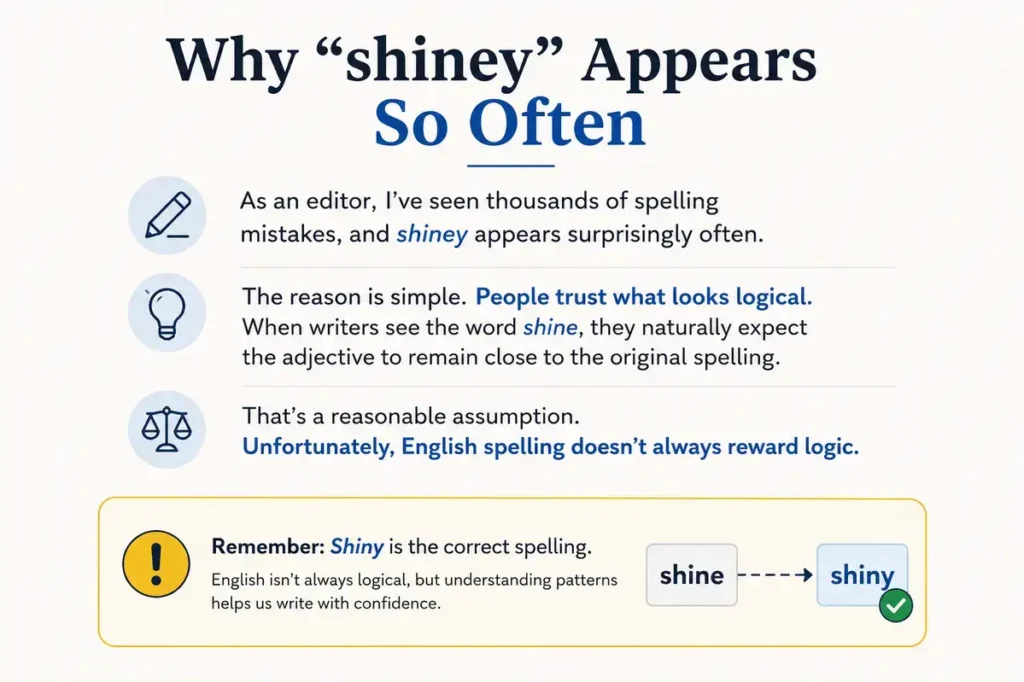
An experienced editor would correct shiney to shiny immediately in standard English because the extra e serves no purpose in the adjective. The mistake is easy to understand because writers naturally connect the adjective with the base word shine. The best editing habit is to check what happens when an ending is added rather than copying the entire base word mechanically. If the adjective is built from shine plus y remember that the silent e drops out. That small spelling check prevents the most common error without requiring you to memorize a long list of rules.
Key Takeaways
- Shiny is the correct standard spelling.
- Shiney is a common spelling mistake.
- Shiny is an adjective.
- It usually describes something bright reflective or polished.
- The word comes from shine with the final silent e removed before y is added.
- Shiny and shining are related but have different grammatical uses.
- The comparative form is shinier.
- The superlative form is shiniest.
- American British Canadian and Australian English use shiny as the standard spelling.
- The easiest memory trick is shine becomes shiny.
Conclusion
Shiny or shiney has a clear answer. Shiny is the correct spelling while shiney is a common mistake. The correct form describes something bright reflective polished or visually bright. It works naturally as an adjective in everyday conversation as well as professional and descriptive writing.
The spelling becomes easier once you connect it with the base word shine. English removes the final silent e before the y is added, giving us shiny rather than shiney. The same word family also gives us related forms such as shinier shiniest shining and shininess.
For a quick memory trick think shine loses e before y. If you remember that small pattern you can avoid the most common spelling error and confidently use shiny whenever you need to describe something bright or reflective.
FAQs
Is shiney a correct spelling?
No. Shiney is not the standard spelling of the adjective. The correct form is shiny. The mistake happens because writers often take the base word shine and add y without removing the final silent e. In standard American English and other major varieties of English use shiny when you mean bright reflective or polished in appearance.
What does shiny mean?
Shiny is an adjective that describes something with a bright or reflective surface. A shiny object may reflect a noticeable amount of light because it is naturally smooth or has been polished. The word can describe shoes metal jewelry paper hair floors cars and many other things. It can also suggest something new or attractive in figurative expressions.
Why is it shiny and not shiney?
The spelling changes because the final silent e in shine is removed before the adjective ending y is added. The resulting form is shiny. This pattern appears in other English words such as noise becoming noisy and ice becoming icy. Remembering the base word is useful but you also need to remember that the final e disappears.
How do you pronounce shiny?
Shiny is commonly pronounced /ˈʃaɪni/. A simple American English pronunciation guide is SHY nee. It has two syllables with the main stress on the first syllable. The first part has the same long i sound heard in shine. The spelling shiney does not represent a different standard pronunciation and should not be used as an alternative spelling.
Can shiny describe a person?
Yes but the meaning depends on context. Shiny can literally describe a physical feature such as shiny hair or skin. It can also appear in playful or figurative descriptions. If you’re describing someone’s personality or character however words such as cheerful attractive polished or confident may communicate the intended meaning more clearly.
What is the difference between shiny and shining?
Shiny usually describes an appearance or surface quality. Shining commonly describes something giving off or reflecting light or an action that is happening. You can say The floor is shiny because of its polished surface. You can say The sun is shining because the sun is actively producing light. The two words are related but serve different purposes.
What is the comparative form of shiny?
The comparative form is shinier. The superlative form is shiniest. For example you can say This car is shinier than the old one. You can also say That was the shiniest car at the show. Notice that the y changes to i before the comparative and superlative endings. The final e from shine does not return.
Is shiny suitable for formal writing?
Yes. Shiny is a normal standard adjective and can appear in formal writing when it accurately describes something. In technical writing you may sometimes prefer a more precise word such as reflective or glossy. The choice depends on your subject. Shiny is not informal by itself. It simply has a broad everyday meaning that may be less precise in specialized contexts.
Is shiny the same as glossy?
Not always. Shiny is a broad term for something that reflects noticeable light. Glossy often describes a smooth polished surface with a particular type of finish. A magazine cover can be glossy and shiny. A polished metal object can be shiny without being described as glossy. The two words overlap but glossy can provide more detail about surface finish.
What is the easiest way to remember the spelling?
Remember this simple pattern: shine loses its final e before y is added. That gives you shiny. You can reinforce the pattern by comparing shine with other words such as noise and ice. They become noisy and icy. The key memory line is simple: shine becomes shiny. Never carry the final e into the adjective.

Confusing Words, Spelling & Word Choice
Claire Whitmore is a U.S.-based English editor who writes about commonly confused words, spelling differences, and word choice. Her work helps readers understand subtle distinctions between similar-looking words through simple definitions, practical examples, and modern usage guidance in both American and British English.