
Afterward vs afterwards often confuses writers because the two words have exactly the same basic meaning. Both mean something happens later or after another event. The main difference is regional preference rather than grammar. In American English afterward is usually the more common choice while British English often favors afterwards.
The extra s can make it look as if one form should be considered more complete or more grammatically correct. That isn’t the case. The two forms are established adverbs and can usually be substituted for each other without changing the meaning of a sentence.
For most American readers afterward is the safest everyday choice. However afterwards isn’t wrong. It appears in standard English and may be the natural choice for writers following British usage. This guide explains the difference clearly and covers meaning pronunciation grammar sentence position regional usage formal writing common mistakes and practical ways to remember which form to choose.
Short Answer
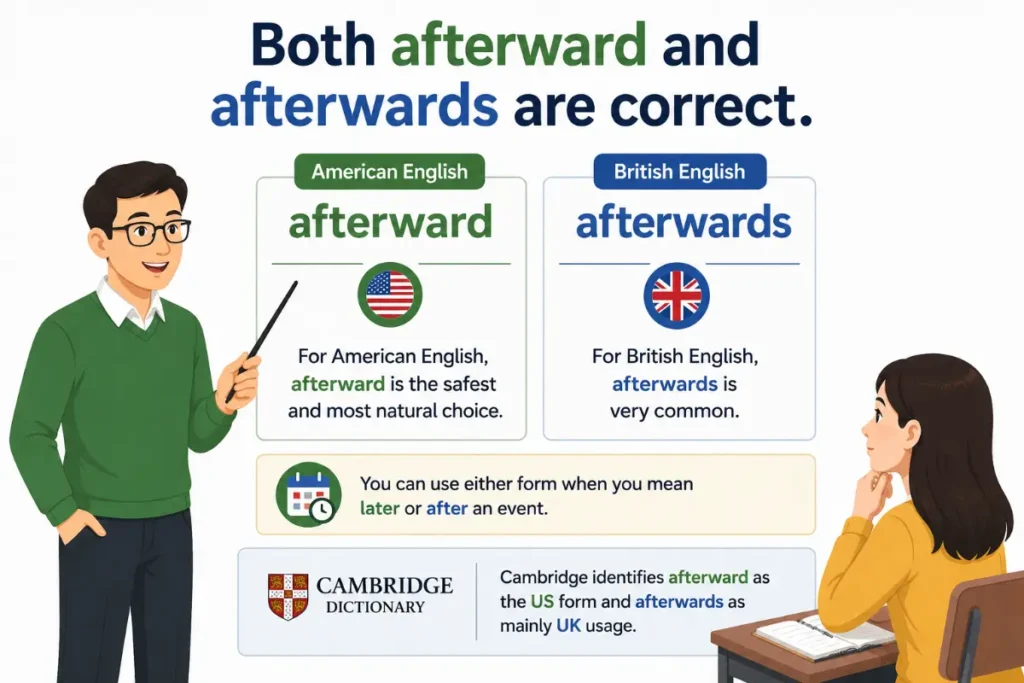
Afterward and afterwards are both correct adverbs. They mean the same thing: at a later time or after something has happened. American English generally favors afterward while afterwards is also widely understood and standard. British English commonly uses afterwards. Neither form is a spelling mistake.
Table Of Contents
- What afterward and afterwards mean.
- The main difference.
- Comparison table.
- How the words work in sentences.
- American English usage.
- British English usage.
- Canadian and Australian usage.
- Formal and informal writing.
- Sentence examples.
- Common mistakes.
- Pronunciation guide.
- Word origin.
- Similar words.
- How to choose the right form.
- Memory tips.
- Professional editing advice.
- Frequently asked questions.
- Key takeaways.
- Conclusion.
What The Two Words Mean
Both words are adverbs of time.
They tell readers that one action or event happens after another.
Consider this sentence:
We went to dinner afterward.
The word tells us that dinner happened after something mentioned earlier.
Now consider:
We went to dinner afterwards.
The meaning is unchanged.
You can think of both words as meaning later or after that.
For example:
She finished her work and went home afterward.
The person finished her work first. She went home later.
You could also write:
She finished her work and went home afterwards.
Again the sequence stays exactly the same.
This is why the difference rarely causes trouble in meaning. The real issue is style and regional preference.
The Main Difference
The biggest difference is simple.
Afterward is especially common in American English.
Afterwards is especially common in British English.
Both forms are standard.
That means you don’t need to treat the final s as an error.
American writers often choose afterward in everyday writing news writing academic prose and professional communication. British writers commonly choose afterwards in the same kinds of situations.
The distinction resembles other regional preferences in English where both forms are accepted but one feels more natural in a particular variety.
For an American audience afterward will usually sound more natural.
For a British audience afterwards may feel more natural.
If you’re writing for an international audience either form will normally be understood.
Comparison Table
| Feature | Afterward | Afterwards |
|---|---|---|
| Part of speech | Adverb | Adverb |
| Meaning | At a later time or after that | At a later time or after that |
| Core function | Shows a later event | Shows a later event |
| American English | Very common | Standard but less preferred in many contexts |
| British English | Standard | Very common |
| Pronunciation | Usually the same | Usually the same |
| Formal writing | Appropriate | Appropriate |
| Informal writing | Appropriate | Appropriate |
| Meaning difference | None in ordinary use | None in ordinary use |
| Example | We talked afterward. | We talked afterwards. |
The table shows the key point. You’re not choosing between a correct word and an incorrect word. You’re choosing between two accepted forms that differ mainly in regional preference.
How The Words Work In Sentences
Both words normally modify a verb or an entire action.
They answer a question such as When did it happen?
Consider:
He called me afterward.
The adverb tells us when he called.
You can move the word to another natural position.
Afterward he called me.
This is also grammatical.
The same applies to the longer form.
He called me afterwards.
Or:
Afterwards he called me.
The position can affect rhythm and emphasis slightly but not the basic meaning.
At The End Of A Sentence
This is one of the most common positions.
We discussed the problem afterward.
We discussed the problem afterwards.
The final position sounds natural because the adverb adds information about when the action occurred.
At The Beginning Of A Sentence
Both forms can begin a sentence.
Afterward we went back to the hotel.
Afterwards we went back to the hotel.
When the adverb begins a sentence it creates a clear transition from one event to the next.
Writers often use this structure in storytelling because it helps readers follow a sequence.
In The Middle Of A Sentence
The word can also appear before a main verb in some sentence structures.
She afterward regretted her decision.
This is grammatical but can sound formal or literary.
In ordinary American English a writer would often choose:
She regretted her decision afterward.
The second version sounds more natural in everyday prose.
This is a useful style lesson. A sentence can be grammatically correct and still feel less natural because of word placement.
Afterward In American English
American English generally prefers the form without the final s.
You’ll often see it in ordinary conversation and writing.
For example:
I’ll call you afterward.
We went out for coffee afterward.
She apologized afterward.
He realized his mistake afterward.
This preference doesn’t mean Americans never use the longer form. Afterwards remains a legitimate English word and American readers understand it easily.
Still if you’re writing an article for a primarily American audience afterward is usually the more natural default.
It works well in casual messages professional emails essays reports and formal documents.
Afterwards In British English
British English commonly favors afterwards.
For example:
We went home afterwards.
She spoke to him afterwards.
They discussed the issue afterwards.
The extra s doesn’t create a different meaning. It simply reflects a common British preference.
British English has several adverbs that commonly use an s ending where American English may favor another form.
That doesn’t make British usage more formal or American usage more correct. They are simply different conventions within standard English.
Canadian English
Canadian English can show both forms.
Canadian usage sits between several English traditions because Canadian English contains influences from both British and American English.
You may encounter afterward and afterwards in Canadian writing.
For a Canadian publication or organization the best approach is to follow its established editorial style. If you’re writing independently and have no house style afterward is a clear and widely understood choice.
The important point is that the difference does not create a change in meaning.
Australian English
Australian English commonly uses afterwards.
This fits a broader pattern in which Australian spelling and usage often share features with British English.
However afterward is still recognizable and can appear in Australian English.
If you’re writing specifically for an Australian audience consistency matters more than trying to treat one form as universally correct.
Formal And Informal Writing
Both forms are appropriate in formal and informal writing.
You can use afterward in a research paper.
The participants completed the survey and were interviewed afterward.
You can use afterwards in a formal British document.
The participants completed the survey and were interviewed afterwards.
Neither form is slang.
Neither form is grammatically weak.
Neither needs to be avoided in professional writing.
The choice mainly depends on the English variety and the style of the publication.
For American professional writing afterward is often the cleanest default.
Sentence Examples
Here are natural examples showing how the word works in different situations.
- We went home afterward.
The sentence says that going home happened after an earlier event. - She called her mother afterward.
The call happened later. - I felt much better afterward.
The writer describes a later emotional state. - He apologized afterward.
The apology came after something that had already happened. - They talked about the meeting afterward.
The discussion happened after the meeting. - We grabbed lunch afterward.
Lunch happened after another activity. - She regretted the decision afterward.
Her regret came later. - The students stayed after class and talked afterward.
The word connects the later conversation with the earlier event. - He realized what had happened only afterward.
The realization occurred later rather than immediately. - Afterward we returned to the office.
The word introduces the next event in the sequence.
You can replace afterward with afterwards in these examples without changing their basic meaning.
Common Mistakes
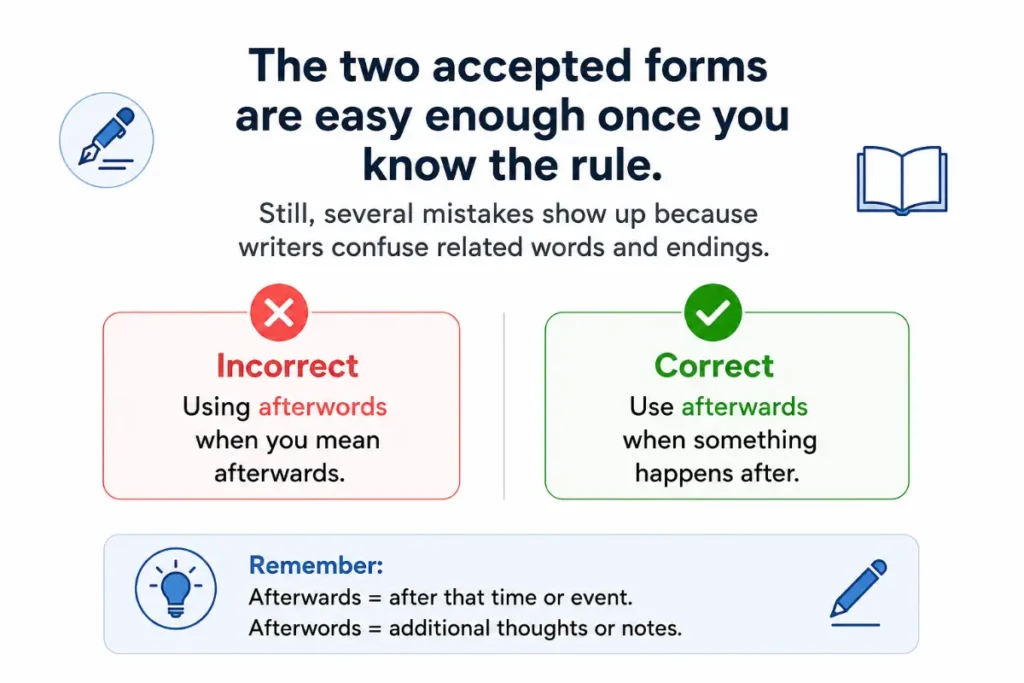
The most common errors involve treating the two forms as if one were wrong.
Calling Afterwards Incorrect
This is not accurate.
Afterwards is a standard English adverb.
It is especially common in British English.
A sentence such as:
We talked afterwards.
is grammatically correct.
Calling Afterward Incorrect
This is also incorrect.
Afterward is a standard form and is especially common in American English.
For example:
We talked afterward.
is completely natural American English.
Mixing Regional Styles
A document can feel inconsistent if it uses different regional conventions without a reason.
For example an American article might use afterward throughout most of the text and suddenly switch to afterwards.
That isn’t necessarily a grammar error but it can make the editorial style feel uneven.
Choose one form and stay consistent when regional style matters.
Assuming The Final S Changes The Meaning
It doesn’t.
The extra letter doesn’t create a different time relationship.
Both words refer to something happening later.
Using After Instead
Another common issue is confusing afterward with the preposition or conjunction after.
Consider:
We went home after the meeting.
Here after introduces the noun phrase the meeting.
Now consider:
We went home afterward.
Here afterward functions as an adverb and stands on its own.
The difference is grammatical.
Afterward And After
These words are closely related but they don’t always perform the same grammatical job.
After can function as a preposition.
We left after dinner.
Here after is followed by the noun dinner.
After can also function as a conjunction.
We left after dinner ended.
Here it introduces a clause.
Afterward is an adverb.
We left afterward.
It doesn’t normally take a noun directly after it to create the same structure.
This distinction is worth remembering because it prevents awkward constructions.
Incorrect:
We went afterward the meeting.
Better:
We went after the meeting.
Or:
We went afterward.
The choice depends on what information you want to include.
Afterward And Later
Later is one of the closest alternatives to afterward.
Both can refer to a future or subsequent time.
For example:
I’ll call you later.
This means the call will happen at some time after now.
I called you afterward.
This means the call happened after another event already mentioned.
That difference is subtle but useful.
Later often refers to a time that comes after the current moment or after a stated point.
Afterward more strongly connects one event to another.
Compare:
We went to the restaurant later.
This simply places the restaurant visit at a later time.
We went to the restaurant afterward.
This suggests the restaurant visit followed a specific event.
Afterward And Then
Then can also show sequence.
We finished dinner and then went home.
We finished dinner and went home afterward.
Both sentences show that going home happened after dinner.
The word then can be more direct when describing a series of actions.
Afterward puts more emphasis on the fact that the later action followed something else.
Both are useful.
Afterward And Subsequently
Subsequently has a similar meaning but sounds more formal.
For example:
The company changed its policy subsequently.
This is grammatically correct but more formal than:
The company changed its policy afterward.
In ordinary American writing afterward is usually simpler and more natural.
Use subsequently when the formal tone genuinely serves a purpose. Don’t replace ordinary words with longer ones just to make prose sound academic.
Clear writing usually wins.
Pronunciation Guide
The two words are usually pronounced very similarly.
Afterward is commonly represented in American English as:
/ˈæftərwərd/
Afterwards is commonly represented as:
/ˈæftərwərdz/
The main stress falls on the first syllable.
The final sound differs because afterwards contains the additional s ending. In connected speech the difference may be subtle.
For ordinary learners the most useful point is this: pronunciation usually won’t help you choose the spelling.
If you hear the word in conversation you may not immediately know which written form the speaker would use.
Context and regional style provide the better clues.
Word Origin
Both words developed from the older English word after combined with the suffix ward or wards.
The suffix ward has long been associated with direction or movement toward something. English uses related forms in words such as forward, backward, homeward, and toward.
In afterward, the construction developed the sense of moving or progressing to a later point.
Afterwards uses the same basic word formation with the plural looking s ending that appears in several English adverb forms.
Over time both forms became established.
The modern difference is therefore not a case of one word being a shortened version that somehow lost a necessary letter. Both forms have their own history and both are standard.
Why The Extra S Causes Confusion
The final s can make afterwards look like a plural noun.
It isn’t.
The word is an adverb.
The same general confusion can happen with other adverbs that have endings people associate with nouns.
English spelling doesn’t always provide a perfect visual clue to grammatical function.
The safest approach is to learn the word as a complete adverb rather than trying to analyze the final letter every time you see it.
Regional Usage And Style
Regional English is one of the most useful ways to understand the distinction.
American English tends to favor afterward.
British English tends to favor afterwards.
Australian English commonly uses afterwards.
Canadian English uses both.
These are preferences rather than strict rules.
A British writer using afterward hasn’t suddenly made a grammar mistake. An American writer using afterwards hasn’t broken an English rule.
However regional consistency matters in polished writing.
If you’re writing for a US audience choose afterward as your default.
If you’re writing for a British publication follow its preferred style and use afterwards when that matches the publication’s conventions.
When To Use Afterward
Choose afterward when you want a natural American English form meaning later or after that.
It works especially well when the earlier event has already been mentioned.
For example:
We had dinner and went for a walk afterward.
The word clearly points back to dinner.
You can also use it when the connection is understood from context.
She was tired afterward.
The reader understands that something happened before the tiredness.
This makes the word useful in storytelling.
When To Use Afterwards
Choose afterwards when you’re following British or another variety of English that commonly prefers the form.
For example:
We went for a walk afterwards.
It has the same meaning as the American preferred version.
There’s no need to avoid it simply because your American English dictionary or spell checker tends to favor the shorter form.
The important question is consistency.
How To Choose The Right Form
If you’re writing for a US audience the simplest rule is:
Use afterward.
If you’re writing for a British audience:
Use afterwards.
If you’re writing for a mixed international audience either is generally clear.
When you edit an article or essay check your other regional spelling choices too. A document feels more polished when its spelling follows one consistent variety of English.
You can also ask yourself a practical question:
Who will read this?
If the answer is primarily American readers afterward is usually the better stylistic choice.
If the answer is primarily British readers afterwards may sound more natural.
This approach is more useful than memorizing an absolute rule because there is no universal rule declaring one form correct and the other wrong.
Memory Tips
A simple memory trick is to associate the shorter form with American English.
Think:
American English often uses afterward.
For British English remember the extra s.
British English often uses afterwards.
You can also remember the meaning rather than the spelling.
Both forms mean:
later
or:
after that
If you can replace the word with later without changing the basic meaning then you’re probably dealing with one of these adverbs.
Another useful trick is to connect afterward with a completed event.
We finished the game afterward.
Something came first. The action connected with afterward came later.
Related Grammar And Usage Notes
Understanding this word becomes easier when you know what kind of word it is.
It Is An Adverb
Both forms are adverbs.
They describe when an action occurs.
She left afterward.
The adverb modifies the timing of left.
It Does Not Need A Noun After It
You can say:
We talked afterward.
You don’t need to add another noun.
If you want to name the event that came first you can use after.
We talked after the meeting.
This is one of the clearest grammatical differences between the two structures.
It Can Refer To A Past Event
He apologized afterward.
The apology happened after another past event.
It Can Refer To A Future Event
We can discuss it afterward.
Here the later action hasn’t happened yet.
The meaning depends on the sentence timeline.
It Can Refer To A General Sequence
Finish your work first and rest afterward.
The word establishes the order of two actions.
Real Life Usage Examples
Daily Conversation
I’ll tell you about it afterward.
This sounds natural when someone plans to explain something after another event.
We grabbed coffee afterward.
This shows that coffee came after another activity.
Workplace Communication
The team reviewed the results afterward.
The review happened after the earlier activity.
We can discuss the details afterward.
The word helps keep a sentence concise while showing sequence.
Academic Writing
The participants completed the task and answered questions afterward.
The adverb clearly establishes the order of the research activities.
The researchers examined the responses afterward.
The sentence shows that examination happened after another stated event.
Journalism
The mayor spoke to reporters afterward.
The word points to an earlier event already established in the report.
The two teams met afterwards to discuss the incident.
This form may fit a publication using British conventions.
Storytelling
She closed the door and stood quietly afterward.
The word creates a clear movement from one action to the next.
He remembered the conversation only afterward.
The placement of only emphasizes that the realization came later.
Common Questions About Grammar
A frequent question is whether the final s changes the grammatical category.
It doesn’t.
Both forms are adverbs.
Another question is whether one sounds more formal.
Not really.
Regional preference is a better explanation.
Some writers may personally prefer one form in formal prose but that doesn’t create a general grammar rule.
The best practice is to choose the form that matches your audience and maintain consistency.
Professional Editing Advice
A professional editor would normally treat both words as valid. The first check would be context and audience rather than spelling correction.
For American copy afterward is often the natural house style choice. For British copy afterwards may be preferred.
Editors also look at consistency across a document. If a writer uses American spelling throughout an article then switching to a British preference without a reason can make the copy look uneven.
One more useful point is worth remembering. Automated grammar tools may suggest one form because of regional dictionary settings. That doesn’t automatically mean the other form is wrong. A good editor checks the intended variety of English before accepting a suggested replacement.
Key Takeaways
- Afterward and afterwards are both correct.
- Both words are adverbs.
- Both mean later or after that.
- American English generally prefers afterward.
- British English commonly prefers afterwards.
- Australian English commonly uses afterwards.
- Canadian English uses both forms.
- The final s does not change the basic meaning.
- Neither form is inherently more formal.
- Use after when you need to introduce a noun or clause such as after the meeting.
- Use afterward or afterwards when the earlier event is already clear from context.
- For American readers afterward is usually the best default.
Conclusion
Afterward vs afterwards is not a battle between a correct spelling and an incorrect one. Both are standard English adverbs with the same basic meaning. They tell readers that something happens later or after another event.
The main distinction is regional preference. American English generally favors afterward while British English commonly uses afterwards. Other varieties such as Canadian and Australian English can use both forms depending on context and style.
If you’re writing for an American audience remember the shorter form as your default. If you’re following British English afterwards will often sound more natural. Most importantly don’t treat the final s as a grammar test. Check your audience and keep your style consistent.
FAQs
Is afterward or afterwards correct?
Both are correct. They are adverbs that mean at a later time or after something has happened. American English generally favors afterward while British English commonly favors afterwards. The choice is mainly a matter of regional preference and editorial style rather than correctness.
Is afterward more common in American English?
Yes. Afterward is generally the more common choice in American English. It works naturally in conversation professional writing academic prose and everyday messages. Americans also understand afterwards and may use it. Still afterward is usually the safest default for standard American English writing.
Is afterwards more common in British English?
Yes. British English commonly favors afterwards. A British writer might naturally write We went home afterwards where an American writer might prefer We went home afterward. The meaning is identical. The difference reflects a regional preference rather than a grammar rule.
Does afterward mean later?
Yes. Afterward can mean later or after that. It usually refers to a time that follows an event or action already mentioned or understood. For example We finished the meeting and went to lunch afterward means lunch happened after the meeting.
Can afterward begin a sentence?
Yes. Afterward can appear at the beginning of a sentence. For example Afterward we returned to the hotel is grammatical. Starting with the adverb can help readers follow the order of events. The same sentence can use afterwards when that form matches the writer’s preferred variety of English.
Is afterwards a spelling mistake?
No. Afterwards is a standard English word. It is especially common in British English and also appears elsewhere. You shouldn’t automatically change it to afterward during proofreading. First consider the intended audience and the regional English style used throughout the document.
Can you use afterward in formal writing?
Yes. Afterward is appropriate in formal writing. You can use it in academic papers reports professional documents and other serious contexts. It is not slang or an informal shortcut. The main consideration is consistency with the English variety used by your audience or publication.
What is the difference between after and afterward?
After can function as a preposition or conjunction and often introduces another word or clause. Afterward is an adverb meaning later or after that. Compare We left after dinner with We left afterward. The first identifies the event that came first while the second relies on context.
Is afterward one word?
Yes. Afterward is normally written as one word. It isn’t written as two separate words in standard English. The same applies to afterwards. Keeping the word closed is part of its standard spelling.
Which form should Americans use?
For most American writing afterward is the simplest choice. It is natural and widely accepted across casual and formal contexts. Afterwards is also understandable and legitimate but may feel less typical in American English. If you’re writing for a US audience and need one default form choose afterward.

English Grammar & Usage
Nathan Holloway is an American grammar writer and language researcher who specializes in English grammar, sentence structure, verb usage, and common writing mistakes. He enjoys breaking down confusing grammar rules into practical explanations with clear examples, making English easier for students, professionals, and everyday writers.