
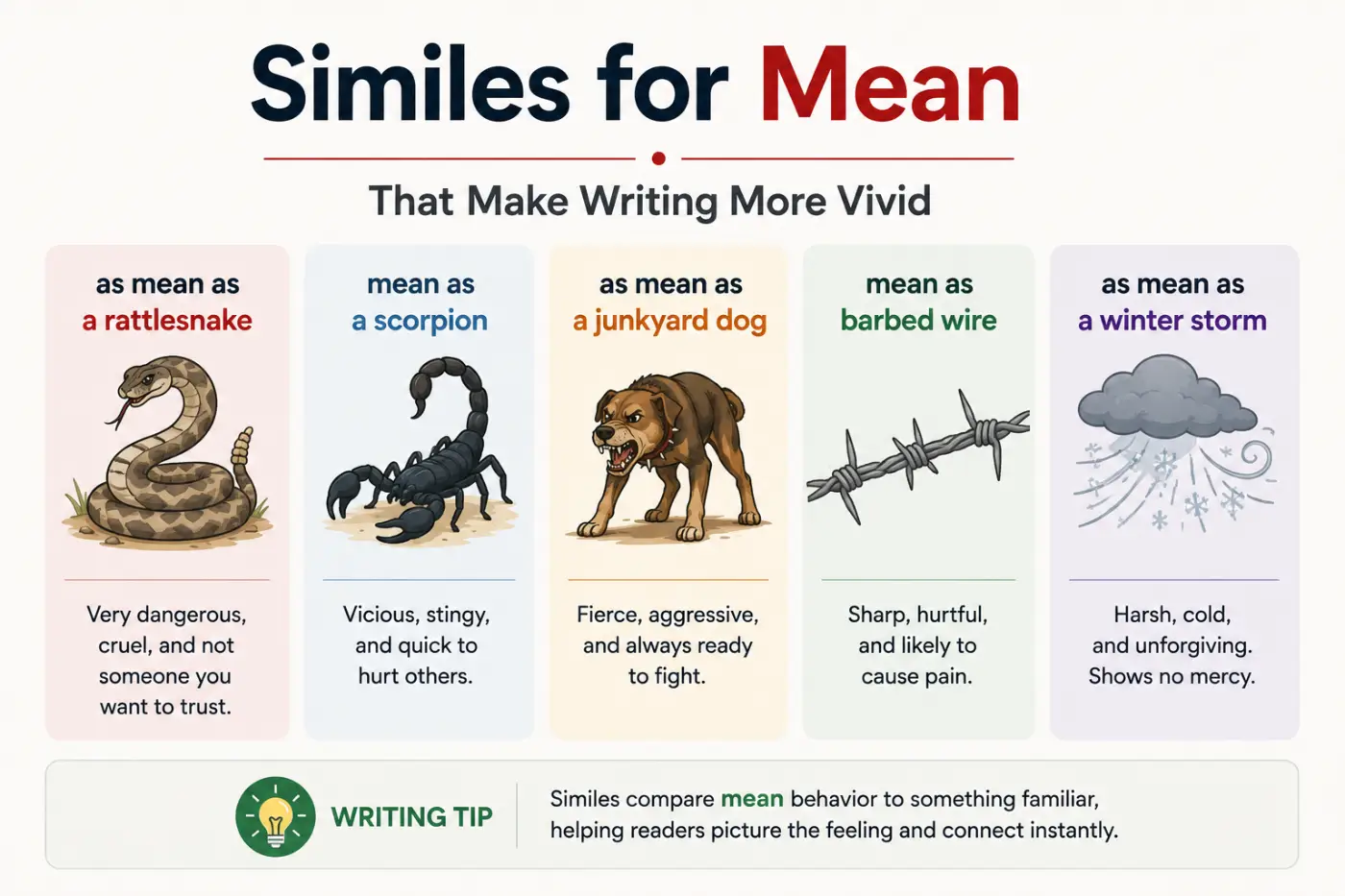
Similes for Mean can turn a plain description into something readers can see and feel. Saying someone is mean tells us very little. Saying someone is as cold as winter stone creates a clearer picture of that person’s behavior and emotional distance.
The word mean covers several ideas. It can describe cruelty, rudeness, selfishness, spite, harshness, or an unwillingness to help. Because of that, one simile won’t fit every situation. A child who teases classmates needs a different comparison from a character who deliberately hurts people.
The collection below gives you more than 120 original and useful comparisons grouped by meaning. You’ll find similes for cruel people, rude behavior, angry personalities, cold attitudes, bullying, selfishness, harsh words, unpleasant characters, and milder forms of meanness. Each comparison includes a short explanation and an example so you can choose language that fits your exact context.
Short Answer
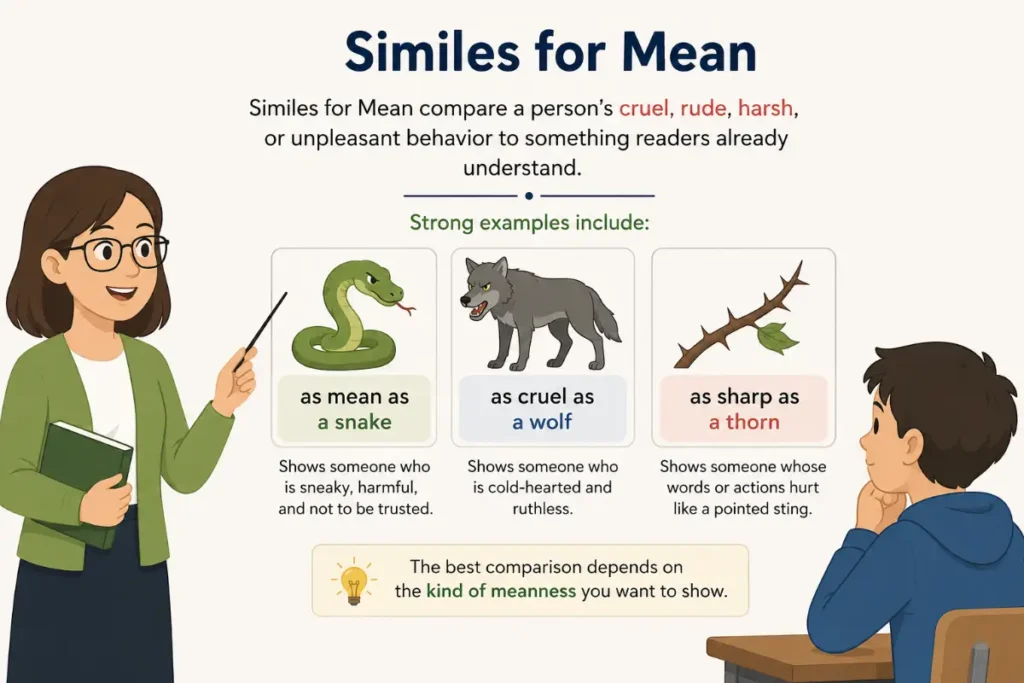
Similes for Mean compare a person’s cruel, rude, harsh, or unpleasant behavior to something readers already understand. Strong examples include as mean as a snake, as cruel as a wolf, and as sharp as a thorn. The best comparison depends on the kind of meanness you want to show.
Table Of Contents
- Quick Guide To Choosing The Right Simile.
- Similes For A Mean Person.
- Similes For Cruel Behavior.
- Similes For Rude Behavior.
- Similes For An Angry Person.
- Similes For A Cold Personality.
- Similes For Bullying Behavior.
- Similes For Mean Words.
- Similes For A Selfish Person.
- Similes For A Spiteful Person.
- Similes For A Mean Look.
- Similes For Mean Actions.
- Similes For A Mean Character In Stories.
- Common Mistakes With These Similes.
- Memory Tips For Better Simile Writing.
- Related Words And Expressions.
- FAQs.
- Key Takeaways.
- Conclusion.
Quick Guide To Choosing The Right Simile
A good simile does more than replace the word mean. It adds a specific quality. If you want to show cruelty use an image that suggests danger or harm. If you want to show emotional coldness choose an image associated with ice, winter, stone, or distance.
Here are a few quick choices.
- As mean as a snake suggests someone who behaves in a sly or unpleasant way.
- As cruel as a wolf suggests someone dangerous or merciless.
- As cold as a frozen window suggests emotional distance.
- As sharp as a thorn suggests hurtful behavior or words.
- As bitter as unsweetened coffee suggests resentment.
- As harsh as a winter wind suggests severe treatment or speech.
- As spiteful as a wasp suggests someone who deliberately hurts others.
- As rough as sandpaper suggests unpleasant treatment or manners.
The strongest choice depends on the exact feeling you want readers to experience.
Similes For A Mean Person
These comparisons work well when you need to describe someone whose personality is unpleasant, cruel, unfriendly, or difficult.
1. As mean as a snake
This familiar comparison suggests someone who behaves in a sly, unpleasant, or untrustworthy way.
Example: He was as mean as a snake whenever someone challenged him.
2. As mean as a wasp
This gives the person an image of quick irritation and aggression.
Example: She became as mean as a wasp when anyone touched her things.
3. As mean as a thorn bush
A thorn bush suggests a person who hurts others simply by getting close.
Example: The old man seemed as mean as a thorn bush at first.
4. As mean as a storm cloud
This comparison creates the image of a person who brings tension into every room.
Example: He walked into the office as mean as a storm cloud.
5. As mean as a cornered cat
A cornered cat can become defensive and aggressive.
Example: The child looked as mean as a cornered cat after being embarrassed.
6. As mean as a barking dog
This suggests loud and intimidating behavior.
Example: The coach sounded as mean as a barking dog during practice.
7. As mean as a cracked whip
This comparison suggests harshness and severity.
Example: Her voice was as mean as a cracked whip.
8. As mean as a winter morning
A winter morning can feel dark, cold, and unwelcoming.
Example: His greeting was as mean as a winter morning.
9. As mean as a sour lemon
This creates a lighter and sometimes humorous image.
Example: He looked as mean as a sour lemon when he lost the game.
10. As mean as a hungry wolf
A hungry wolf suggests aggression and danger.
Example: The bully stared at him as mean as a hungry wolf.
11. As mean as a nettle
A nettle can sting when touched.
Example: Her personality was as mean as a nettle.
12. As mean as a dark alley
This comparison suggests someone who feels threatening or unsafe.
Example: The stranger looked as mean as a dark alley at midnight.
13. As mean as a rusty nail
A rusty nail suggests something unpleasant that can cause harm.
Example: His comment was as mean as a rusty nail.
14. As mean as a biting frost
This suggests a personality that feels painfully cold.
Example: Her attitude was as mean as a biting frost.
15. As mean as a porcupine
A porcupine gives the image of someone who keeps others away with sharp defenses.
Example: He was as mean as a porcupine whenever guests arrived.
Similes For Cruel Behavior
Use these when mean behavior goes beyond simple rudeness and causes real emotional or physical harm.
16. As cruel as a wolf in winter
This creates an image of harsh survival and danger.
Example: The villain was as cruel as a wolf in winter.
17. As cruel as a blade
A blade suggests deliberate harm.
Example: Her decision felt as cruel as a blade.
18. As cruel as a fire without control
This comparison suggests destruction that keeps spreading.
Example: His anger became as cruel as a fire without control.
19. As cruel as a storm at sea
A storm at sea suggests danger and helplessness.
Example: The ruler was as cruel as a storm at sea.
20. As cruel as a trap
A trap suggests intentional harm that someone cannot easily escape.
Example: His plan was as cruel as a trap.
21. As cruel as winter without shelter
This creates a strong image of hardship.
Example: Her treatment of the workers was as cruel as winter without shelter.
22. As cruel as a locked door
A locked door can symbolize rejection and denial.
Example: His response was as cruel as a locked door.
23. As cruel as a thorn under the skin
This suggests pain that continues after the first moment.
Example: Her words were as cruel as a thorn under the skin.
24. As cruel as a sudden frost
A sudden frost can destroy something delicate.
Example: His criticism was as cruel as a sudden frost on young flowers.
25. As cruel as a wolf at the gate
This suggests a direct and threatening presence.
Example: The enemy looked as cruel as a wolf at the gate.
Similes For Rude Behavior
Not every mean person is cruel. Sometimes mean behavior is simply rude, disrespectful, or unpleasant.
26. As rude as a slammed door
A slammed door communicates rejection without words.
Example: His reply was as rude as a slammed door.
27. As rude as a barking alarm
This suggests behavior that is loud and irritating.
Example: Her voice was as rude as a barking alarm.
28. As rude as a stone thrown through glass
This gives rude behavior a sudden and destructive quality.
Example: His joke was as rude as a stone thrown through glass.
29. As rude as a wet handshake
A wet handshake creates an uncomfortable image.
Example: His greeting felt as rude as a wet handshake.
30. As rude as a door in your face
This suggests blunt rejection.
Example: The receptionist was as rude as a door in your face.
31. As rude as sand in your shoes
This suggests a small but persistent annoyance.
Example: His comments were as rude as sand in your shoes.
32. As rude as a mosquito at midnight
This creates a humorous image of irritating behavior.
Example: His interruptions were as rude as a mosquito at midnight.
33. As rude as an uninvited shout
This suggests unnecessary loudness.
Example: Her comment landed as rude as an uninvited shout.
34. As rude as cold soup
This creates an awkward and unpleasant image.
Example: His welcome was as rude as cold soup.
35. As rude as a chair pulled away
This suggests behavior that embarrasses or excludes someone.
Example: His prank was as rude as a chair pulled away at dinner.
Similes For An Angry Person
Anger often makes a person seem mean even when cruelty isn’t their main trait. These comparisons emphasize heat, intensity, and aggression.
36. As angry as a thunderstorm
A thunderstorm suggests loud and powerful anger.
Example: Dad was as angry as a thunderstorm after seeing the broken window.
37. As angry as a boiling kettle
A boiling kettle suggests pressure building toward an outburst.
Example: She looked as angry as a boiling kettle.
38. As angry as a volcano
This is useful for explosive anger.
Example: He became as angry as a volcano when he heard the accusation.
39. As angry as a hornet
A hornet suggests quick and aggressive anger.
Example: The manager was as angry as a hornet after the mistake.
40. As angry as a summer storm
This creates a vivid image of sudden emotional force.
Example: Her reaction was as angry as a summer storm.
41. As angry as a firecracker
A firecracker suggests a sudden burst.
Example: He became as angry as a firecracker when someone laughed at him.
42. As angry as a bear disturbed from sleep
This gives the comparison a familiar and slightly humorous tone.
Example: I was as angry as a bear disturbed from sleep.
43. As angry as a red kettle
This creates a simple visual image of heat and pressure.
Example: His face looked as angry as a red kettle.
44. As angry as a storm trapped in a bottle
This suggests powerful emotion that has been held inside.
Example: She seemed as angry as a storm trapped in a bottle.
45. As angry as sparks in dry grass
This suggests anger that spreads quickly.
Example: His temper was as angry as sparks in dry grass.
Similes For A Cold Personality
Some people appear mean because they seem distant, emotionless, or unwilling to connect.
46. As cold as ice
This classic comparison suggests a lack of warmth or sympathy.
Example: Her response was as cold as ice.
47. As cold as a frozen window
A frozen window creates an image of emotional separation.
Example: His expression was as cold as a frozen window.
48. As cold as winter stone
Stone and winter together create a strong sense of emotional distance.
Example: His greeting felt as cold as winter stone.
49. As cold as a snow covered roof
This suggests someone who seems distant and unreachable.
Example: She remained as cold as a snow covered roof.
50. As cold as a moonlit road
This creates a quiet and lonely image.
Example: His smile was as cold as a moonlit road.
51. As cold as a locked cellar
A locked cellar suggests darkness and isolation.
Example: His personality felt as cold as a locked cellar.
52. As cold as morning frost
This suggests emotional chill without extreme cruelty.
Example: Her reply was as cold as morning frost.
53. As cold as a winter shadow
A shadow suggests distance and lack of warmth.
Example: He gave her a look as cold as a winter shadow.
54. As cold as metal in snow
This gives a physical sense of harshness.
Example: His handshake felt as cold as metal in snow.
55. As cold as a dark room
This suggests emotional emptiness.
Example: The character’s voice was as cold as a dark room.
Similes For Bullying Behavior
Bullying often combines cruelty, intimidation, mockery, and a desire to make another person feel small.
56. As intimidating as a guard dog
This comparison emphasizes fear.
Example: The bully stood as intimidating as a guard dog.
57. As cruel as a thorn fence
A thorn fence suggests barriers that hurt people who get too close.
Example: His behavior was as cruel as a thorn fence.
58. As loud as a siren
This works for bullying that relies on shouting or public humiliation.
Example: His insults were as loud as a siren.
59. As sharp as broken glass
Broken glass suggests words that can hurt.
Example: Her insults were as sharp as broken glass.
60. As heavy as a falling stone
This suggests bullying that leaves an emotional weight.
Example: His words felt as heavy as a falling stone.
61. As relentless as dripping water
This comparison works for repeated teasing.
Example: The teasing was as relentless as dripping water.
62. As cruel as a trapdoor
A trapdoor suggests sudden embarrassment or danger.
Example: The prank was as cruel as a trapdoor.
63. As harsh as a whistle in silence
This gives the behavior an unpleasant and disruptive quality.
Example: His mocking laugh was as harsh as a whistle in silence.
64. As threatening as thunder overhead
Thunder can create fear before anything actually happens.
Example: His warning sounded as threatening as thunder overhead.
65. As mean as a dog guarding a bone
This suggests possessiveness and hostility.
Example: He acted as mean as a dog guarding a bone.
Similes For Mean Words
Words can be mean without the speaker being physically aggressive. These comparisons focus on emotional impact.
66. As sharp as a needle
A needle suggests precise pain.
Example: Her words were as sharp as a needle.
67. As bitter as black coffee
This suggests resentment and unpleasantness.
Example: His reply was as bitter as black coffee.
68. As cutting as a razor
This suggests words that hurt deeply.
Example: Her criticism was as cutting as a razor.
69. As cold as a winter draft
This suggests words that leave someone feeling rejected.
Example: His message was as cold as a winter draft.
70. As sour as spoiled milk
This suggests unpleasant language or attitude.
Example: Her comment was as sour as spoiled milk.
71. As rough as sandpaper
This suggests words that feel abrasive.
Example: His tone was as rough as sandpaper.
72. As heavy as a stone
This suggests words that stay with someone.
Example: The insult was as heavy as a stone in her memory.
73. As bitter as a green apple
This gives a milder image of unpleasantness.
Example: His complaint sounded as bitter as a green apple.
74. As harsh as a winter wind
This suggests words that feel severe and painful.
Example: Her criticism was as harsh as a winter wind.
75. As dark as a storm cloud
This suggests words filled with anger or negativity.
Example: His message was as dark as a storm cloud.
Similes For A Selfish Person
Mean behavior can come from selfishness. These comparisons work when someone puts personal wants above everyone else.
76. As selfish as a child guarding candy
This suggests someone unwilling to share.
Example: He was as selfish as a child guarding candy.
77. As greedy as a crow near crumbs
This gives selfish behavior a vivid image.
Example: The man was as greedy as a crow near crumbs.
78. As possessive as a dog with a bone
This suggests someone unwilling to give up what they have.
Example: She was as possessive as a dog with a bone.
79. As hungry for attention as a spotlight
This suggests someone who always wants attention.
Example: He was as hungry for attention as a spotlight.
80. As unwilling to share as a locked pantry
This creates a playful image of selfishness.
Example: He was as unwilling to share as a locked pantry.
81. As greedy as a squirrel before winter
A squirrel gathering food provides a familiar image.
Example: He grabbed the treats as greedily as a squirrel before winter.
82. As possessive as a child with a favorite toy
This suggests childish selfishness.
Example: She was as possessive as a child with a favorite toy.
83. As hungry for praise as dry soil for rain
This suggests someone who constantly wants approval.
Example: He was as hungry for praise as dry soil for rain.
84. As self centered as a mirror
A mirror reflects attention back toward the person looking at it.
Example: His behavior was as self centered as a mirror.
85. As greedy as a shopkeeper counting every coin
This suggests an intense focus on personal gain.
Example: The character was as greedy as a shopkeeper counting every coin.
Similes For A Spiteful Person
Spite involves deliberate efforts to hurt or annoy someone because of resentment.
86. As spiteful as a wasp
A wasp provides a strong image of quick hostility.
Example: He was as spiteful as a wasp after losing the argument.
87. As bitter as an old grudge
This directly connects bitterness with resentment.
Example: Her attitude was as bitter as an old grudge.
88. As sharp as a hidden thorn
A hidden thorn suggests harm that isn’t obvious at first.
Example: His kindness was as sharp as a hidden thorn.
89. As poisonous as a whispered rumor
This suggests damage that spreads quietly.
Example: Her words were as poisonous as a whispered rumor.
90. As sour as a forgotten apology
This gives resentment a human and emotional image.
Example: His smile was as sour as a forgotten apology.
91. As cold as a grudge kept for years
This suggests resentment that has hardened over time.
Example: His heart seemed as cold as a grudge kept for years.
92. As sneaky as a shadow
A shadow suggests something difficult to detect.
Example: Her spite was as sneaky as a shadow.
93. As sharp as a whispered insult
This suggests quiet but deliberate cruelty.
Example: His remark was as sharp as a whispered insult.
94. As bitter as ashes
Ashes create an image of something left after destruction.
Example: Her response was as bitter as ashes.
95. As cold as a door shut in anger
This suggests deliberate rejection.
Example: His silence was as cold as a door shut in anger.
Similes For A Mean Look
Sometimes you need to describe facial expression rather than personality.
96. As fierce as a wolf’s stare
This creates a threatening image.
Example: He gave me a look as fierce as a wolf’s stare.
97. As sharp as a hawk’s eye
A hawk suggests intense focus.
Example: She gave him a look as sharp as a hawk’s eye.
98. As dark as a storm cloud
This suggests anger or displeasure.
Example: His expression was as dark as a storm cloud.
99. As cold as a frozen lake
This suggests emotional distance.
Example: Her eyes looked as cold as a frozen lake.
100. As hard as stone
This suggests a face without warmth or softness.
Example: His expression was as hard as stone.
101. As threatening as thunder
Thunder can signal danger before the storm arrives.
Example: His stare was as threatening as thunder.
102. As bitter as a sour grape
This creates a lighter image of displeasure.
Example: She gave him a look as bitter as a sour grape.
103. As fierce as a guard dog
This suggests someone ready to challenge another person.
Example: The teacher gave the students a look as fierce as a guard dog.
104. As cold as moonlight
Moonlight can create a distant and detached mood.
Example: Her expression was as cold as moonlight.
105. As hard as a locked gate
A locked gate suggests refusal and emotional resistance.
Example: His face looked as hard as a locked gate.
Similes For Mean Actions
These comparisons focus on what a person does rather than what the person is like.
106. As cruel as kicking a fallen branch
This suggests needless harm.
Example: His prank was as cruel as kicking a fallen branch.
107. As harsh as shutting a door on someone
This suggests deliberate rejection.
Example: Ignoring her request was as harsh as shutting a door on someone.
108. As careless as dropping glass
This suggests actions that can cause harm.
Example: His treatment of the team was as careless as dropping glass.
109. As cold as walking past a crying child
This emphasizes a lack of compassion.
Example: His response was as cold as walking past a crying child.
110. As sharp as throwing a thorn
This suggests intentional emotional pain.
Example: Her joke was as sharp as throwing a thorn.
111. As rough as dragging a chair across stone
This creates an unpleasant sensory image.
Example: His treatment of the customer was as rough as dragging a chair across stone.
112. As unfair as moving the finish line
This suggests deliberate unfairness.
Example: Changing the rules at the last minute was as unfair as moving the finish line.
113. As hurtful as tearing a letter
This suggests emotional rejection.
Example: His reaction was as hurtful as tearing a letter in front of its writer.
114. As spiteful as hiding the last umbrella
This creates a playful image of deliberate inconvenience.
Example: His little prank was as spiteful as hiding the last umbrella.
115. As mean as locking someone outside in the rain
This gives the action a strong emotional image.
Example: Refusing to help her was as mean as locking someone outside in the rain.
Similes For A Mean Character In Stories
Writers often need comparisons that reveal personality without directly explaining it.
116. As mean as a villain guarding a secret
This suggests suspicion and hostility.
Example: The stranger was as mean as a villain guarding a secret.
117. As cold as a castle wall
A castle wall suggests distance and emotional hardness.
Example: The queen was as cold as a castle wall.
118. As sharp as a sword
A sword gives the character a dangerous quality.
Example: His smile was as sharp as a sword.
119. As dark as a moonless forest
This creates a mysterious and threatening mood.
Example: His intentions seemed as dark as a moonless forest.
120. As fierce as a dragon at its cave
A dragon creates a classic image of danger and aggression.
Example: The guard was as fierce as a dragon at its cave.
121. As bitter as a defeated king
This suggests pride mixed with resentment.
Example: He spoke as bitter as a defeated king.
122. As cold as an abandoned castle
This creates an isolated and unfriendly image.
Example: Her heart seemed as cold as an abandoned castle.
123. As dangerous as a wolf in the dark
This suggests hidden danger.
Example: The stranger seemed as dangerous as a wolf in the dark.
124. As cruel as a ruler without mercy
This directly emphasizes power and cruelty.
Example: The villain was as cruel as a ruler without mercy.
125. As sharp as a villain’s grin
This creates an immediate storytelling image.
Example: His smile was as sharp as a villain’s grin.
How To Choose The Best Simile
A strong simile should match the exact kind of behavior you want to describe. Don’t choose an image simply because it sounds dramatic.
Start by identifying the emotion.
If the person is cruel choose an image that suggests harm. If the person is angry choose something powerful and explosive.
The subject also matters.
A playful story for children may benefit from a comparison such as as mean as a sour lemon. A serious novel may need something darker such as as cold as a locked cellar.
Tone matters just as much as meaning.
A simile can make a character seem frightening, funny, pathetic, mysterious, childish, or dangerous. That emotional effect should fit the surrounding scene.
Common Mistakes With These Similes
Using A Simile That Does Not Match The Emotion
A comparison should support the meaning rather than fight against it.
If you’re describing someone who is emotionally distant, an image of a volcano may suggest the wrong feeling because a volcano represents explosive energy rather than coldness.
Choose the image that carries the emotion you need.
Making Every Simile About Animals
Animal comparisons are useful because readers understand them quickly. Still, using animals for every description can make writing predictable.
Mix animal images with objects, weather, food, places, and sensory experiences.
Using The Same Comparison Too Often
A familiar simile can work well. Repeating it throughout the same piece makes the writing feel flat.
Instead of describing every cruel character as a snake, vary the image based on the situation.
Making The Comparison Too Complicated
A simile should clarify an idea.
If readers need several sentences to understand the comparison, it may be doing too much.
Simple images often hit harder.
Confusing Mean With Angry
Anger and meanness overlap but they aren’t identical.
Someone can be angry without being cruel. Someone can also be mean while remaining calm.
Use a heat based comparison for anger and a cruelty or hostility based comparison for meanness.
Memory Tips For Better Simile Writing
One useful method is to divide meanness into five basic types.
- Cruel. Think thorns, blades, wolves, traps, and storms.
- Rude. Think slammed doors, sand, alarms, and uncomfortable situations.
- Angry. Think volcanoes, thunder, fire, sparks, and boiling water.
- Cold. Think ice, frost, stone, winter, and frozen windows.
- Spiteful. Think hidden thorns, wasps, old grudges, rumors, and locked doors.
This approach gives you a small mental toolbox instead of one memorized phrase.
Another useful trick is to ask what the behavior feels like.
Does it sting?
Does it spread?
Your answer can point you toward the right image.
For example, if someone’s words sting, you might compare them to needles or thorns. If their anger explodes, a volcano or firecracker may work better. If their attitude freezes people out, ice or winter provides a stronger image.
Related Words And Expressions
The word mean has several related terms. Choosing the right one can make your writing more precise.
Cruel
Cruel suggests a willingness to cause pain or suffering.
Rude
Rude usually describes behavior that lacks respect or good manners.
Harsh
Harsh suggests severity or a lack of gentleness.
Unkind
Unkind is broader and often softer than cruel.
Spiteful
Spiteful suggests that someone wants to hurt or annoy another person because of resentment.
Bitter
Bitter often describes resentment or anger that has lasted over time.
Hostile
Hostile suggests open opposition or aggression.
Malicious
Malicious suggests an intention to cause harm.
These words are related but they aren’t identical. Using the precise word first can make the simile stronger because the comparison then has a clear target.
Using Similes In School Writing
Similes can make descriptive writing more memorable. They work especially well in personal narratives, creative writing, character descriptions, and literary analysis.
Avoid filling every sentence with a comparison. One strong simile can do more work than five weak ones.
For example:
The bully’s voice was as sharp as broken glass.
That sentence gives readers a sound and a physical feeling at the same time.
You could then follow it with plain description.
Everyone in the hallway went quiet.
The combination works because the simile carries the image while the next sentence moves the story forward.
Using Similes In Creative Writing
Creative writers can use similes to reveal character indirectly.
Instead of saying:
Marcus was cruel.
You could write:
Marcus smiled as sharp as a hidden thorn whenever someone made a mistake.
The second version gives the reader something to picture.
That difference matters because good descriptive writing lets readers experience a character instead of simply receiving a label.
A useful rule is to make the comparison earn its place. If removing the simile makes the sentence stronger then you probably didn’t need it.
Using Similes In Everyday Writing
You don’t need to write fiction to use similes.
People use comparisons in casual conversation all the time.
You might say:
He was as grumpy as a bear this morning.
Or:
Her reply was as cold as ice.
These expressions add personality without making the language difficult.
For professional writing use them more carefully. A vivid comparison can work in a speech, presentation, personal essay, or creative workplace message. A formal report may need direct language instead.
Key Takeaways
- A simile compares one thing with another to create a clearer image.
- The best comparison depends on the specific type of meanness.
- Cruel behavior works well with images such as thorns, blades, wolves, and traps.
- Rude behavior can be compared with slammed doors, sand, alarms, and other irritating things.
- Anger works well with volcanoes, storms, fire, sparks, and boiling objects.
- Cold personalities can be described with ice, frost, stone, winter, and frozen images.
- Spiteful behavior often works with hidden thorns, wasps, rumors, and old grudges.
- Avoid repeating the same comparison too often.
- Match the tone of the simile with the tone of the writing.
- The strongest similes make readers feel the quality you’re describing rather than simply naming it.
Conclusion
Similes for Mean give ordinary descriptions more color, emotion, and personality. Instead of simply telling readers that someone is mean, you can show the exact kind of behavior through an image that feels familiar. A thorn can suggest hurt, ice can suggest coldness, and a storm can suggest anger.
The key is to choose the comparison carefully. Mean can describe cruelty, rudeness, selfishness, bitterness, spite, or anger, and each quality deserves its own image. A good simile should make the intended feeling clearer rather than simply make the sentence sound dramatic.
When you’re stuck, ask what the person’s behavior feels like. Does it sting, freeze, burn, scrape, or crash? That simple question can lead you to a strong
FAQs
What are good similes for mean people?
Good choices include as mean as a snake, as mean as a wasp, as mean as a thorn bush, and as mean as a cornered cat. The best choice depends on the kind of behavior you want to show. Snake suggests slyness, wasp suggests irritation, thorns suggest hurt, and a cornered cat suggests defensive aggression.
What is a simile for someone who is very mean?
A strong comparison is as mean as a hungry wolf. It creates an image of danger and aggression. For a more emotional description you could use as cold as winter stone. For a more playful tone you could use as mean as a sour lemon.
What are similes for a cruel person?
Useful comparisons include as cruel as a wolf in winter, as cruel as a blade, as cruel as a trap, and as cruel as a storm at sea. Each creates a different shade of meaning. Choose a comparison based on the kind of cruelty involved and the tone of your writing.
What are similes for a rude person?
Try comparisons such as as rude as a slammed door, as rude as sand in your shoes, or as rude as a mosquito at midnight. These images work because they turn an abstract personality trait into something readers can imagine feeling. The first feels rejecting, the second feels irritating, and the third feels persistently annoying.
What is a simile for mean words?
For hurtful language try as sharp as a needle, as cutting as a razor, as sharp as broken glass, or as harsh as a winter wind. These comparisons focus on the emotional sting of language. They work especially well in narratives and character descriptions where you want readers to feel the impact of spoken words.
What is a simile for a mean look?
You could say someone looked as fierce as a wolf’s stare, as cold as a frozen lake, as dark as a storm cloud, or as hard as stone. The best choice depends on the expression. Fierce suggests aggression, cold suggests distance, dark suggests anger, and hard suggests emotional toughness.
Can I use these similes in academic writing?
You can use similes in some forms of academic writing, but they need to fit the purpose and style. Creative assignments, personal essays, literary analysis, and speeches can benefit from vivid comparisons. Highly technical or research focused writing usually works better with direct and precise language.
What is the difference between mean and cruel?
Mean is a broad word that can describe rude, unpleasant, selfish, spiteful, or hurtful behavior. Cruel is stronger and usually suggests causing pain or suffering. A person can be mean by making an insulting comment. A cruel person may deliberately cause serious emotional or physical harm.
How can I create my own similes for mean?
Start by deciding what kind of meanness you want to show. Then choose something from everyday life that creates the same feeling. For cold behavior think of ice. For explosive anger think of a volcano. Connect the two with like or as and make sure the comparison feels natural.
Are animal similes good for describing mean people?
Yes. Animal comparisons can quickly suggest traits that readers recognize. A wolf can suggest danger, a wasp can suggest aggression, and a porcupine can suggest defensiveness. Still, don’t rely on animals every time. Objects, weather, food, places, and physical sensations can create fresher comparisons. comparison that feels natural and memorable.

Idioms, Expressions & Figurative Language
Mason Ellsworth is an American language writer with a passion for English expressions, figurative language, and everyday communication. He explains idioms, similes, popular phrases, and commonly misunderstood expressions in a straightforward, engaging style that helps readers improve both their writing and spoken English.