
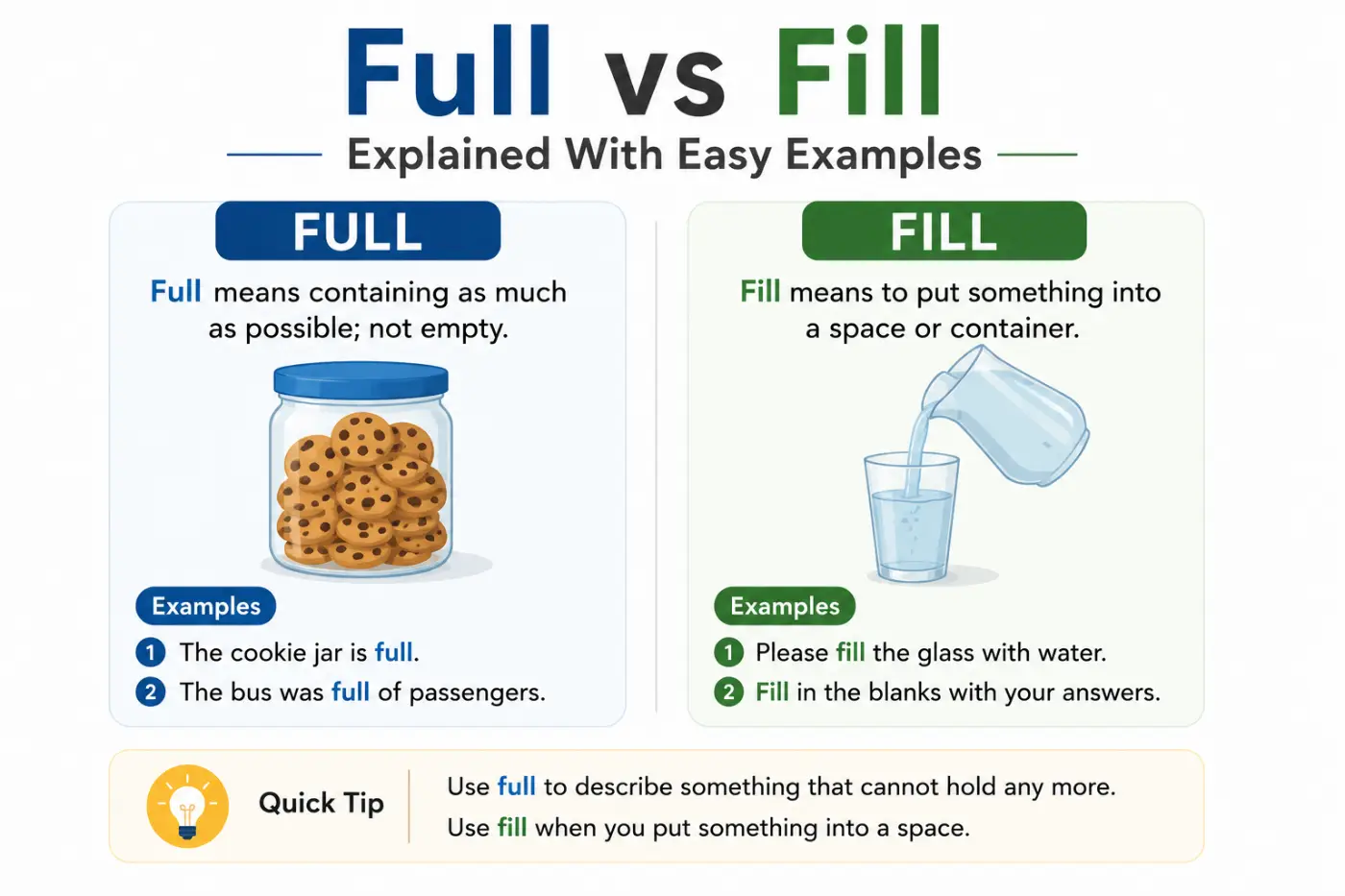
Full vs Fill can be confusing because the two words look and sound closely related. They both connect with the idea of something containing an amount of something else. Still their grammar and meaning are different. Full usually describes a state. If a bottle contains no more space for liquid you can say the bottle is full. Fill usually describes an action. If you pour water into that bottle you fill it.
The difference becomes much easier once you ask one simple question. Are you describing the condition of something or the action that makes it reach that condition? Full describes the condition. Fill describes the action. This distinction matters in everyday conversation as well as school writing workplace communication and formal English. A small change in the word can change the entire structure of a sentence.
This guide explains the meanings grammar pronunciation word origins common expressions spelling patterns and practical differences between these two useful words. You’ll also see natural examples that show exactly how native English speakers use them.
Short Answer
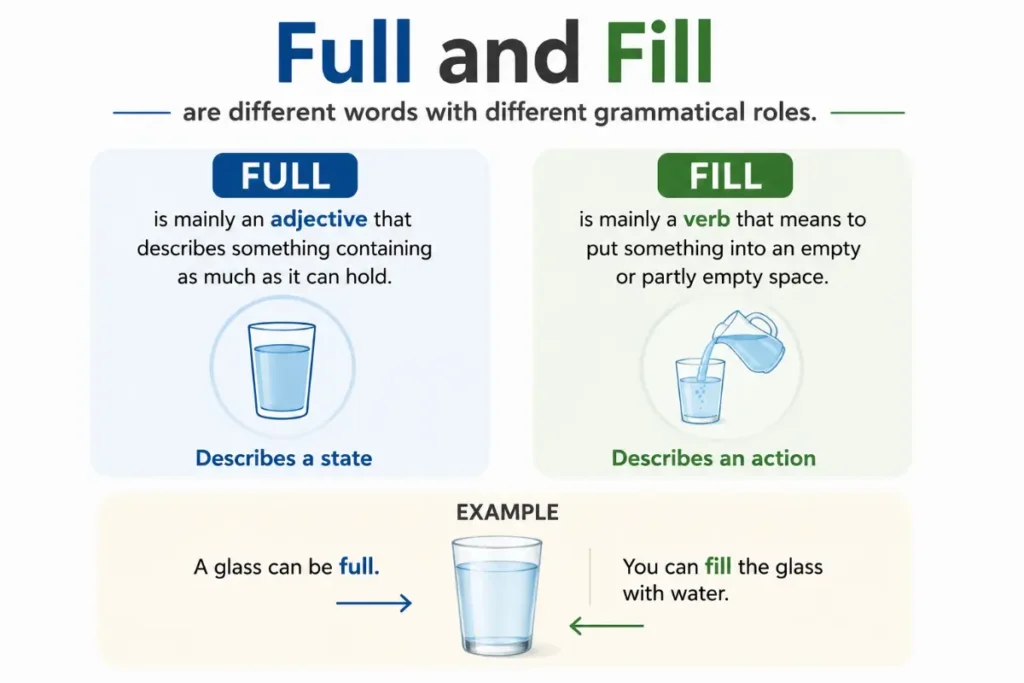
Full and fill are different words with different grammatical roles. Full is mainly an adjective that describes something containing as much as it can hold. Fill is mainly a verb that means to put something into an empty or partly empty space. For example a glass can be full and you can fill the glass with water.
Table Of Contents
- Short Answer.
- Introduction.
- Full vs Fill Comparison.
- Meaning Of Full.
- Meaning Of Fill.
- The Main Difference.
- Grammar And Parts Of Speech.
- Common Sentence Patterns.
- Full vs Fill In Everyday English.
- Pronunciation Guide.
- Word Origins.
- Common Mistakes.
- Real Life Usage.
- Related Words And Expressions.
- Memory Tips.
- Professional Writing Tips.
- Frequently Asked Questions.
- Key Takeaways.
- Conclusion.
Full vs Fill Comparison
The easiest way to understand the difference is to compare their basic jobs in a sentence.
| Feature | Full | Fill |
|---|---|---|
| Main role | Adjective | Verb |
| Basic meaning | Containing as much as possible | Put something into a space or container |
| Main idea | State or condition | Action |
| Example | The glass is full. | Fill the glass with water. |
| Past form | Full does not have a past tense form | Filled |
| Present participle | Full remains full | Filling |
| Common opposite | Empty | Empty or drain depending on context |
| Pronunciation | /fʊl/ | /fɪl/ |
| Formality | Standard in all major varieties of English | Standard in all major varieties of English |
The table reveals the central distinction. Full describes something. Fill tells us what someone does.
A glass can be full.
Someone can fill a glass.
That same relationship works in many other situations.
The room is full.
People fill the room.
The parking lot is full.
Drivers fill the parking lot.
The form is full of information.
You fill out the form.
The grammar changes because the words perform different jobs.
Meaning Of Full
Full is mainly an adjective.
An adjective describes a person place thing or idea. When you use full you usually describe something that contains a large amount or has reached its capacity.
For example:
The cup is full.
The bus is full.
The box is full.
The room is full.
In each sentence full describes the condition of the subject.
Full can also mean complete.
For example:
I need your full name.
She gave a full explanation.
We watched the full movie.
Here full does not mean that something contains liquid or physical objects. It means complete or entire.
The word also has several figurative meanings.
For example:
My schedule is full.
Her day was full of surprises.
He has a full understanding of the problem.
These uses show why context matters. Full often carries the basic idea of completeness or abundance but the exact meaning depends on the sentence.
Full As A Description Of Capacity
One of the most common meanings relates to capacity.
A container is full when it has reached its available capacity.
The bottle is full.
The tank is full.
The refrigerator is full.
The bag is full.
The exact amount depends on the object. A full cup and a full truck obviously hold very different quantities.
The important point is that the available space has been used to a substantial or complete degree.
Full As A Description Of Quantity
Full can also describe a large amount.
For example:
The report contains full details.
She gave me a full account of what happened.
We need a full explanation.
Here the word suggests completeness rather than physical capacity.
Full As A Description Of People
Full can describe a person after eating.
For example:
I’m full after dinner.
This means the person no longer feels hungry.
Full can also appear in descriptions of body shape. That use is more context dependent and should be chosen carefully because some descriptions can sound personal or insensitive.
Full As A Description Of Time
Full can describe an entire period.
For example:
We spent a full week there.
It took a full hour.
She waited for a full month.
In these sentences full emphasizes the complete amount of time.
Meaning Of Fill
Fill is mainly a verb.
It means to put something into a container space area or position until it contains the desired amount.
For example:
Fill the glass with water.
Fill the box with books.
In each sentence fill describes an action.
Fill can also mean to occupy a place.
For example:
People filled the stadium.
The audience filled every seat.
In these examples the subject is causing a space to become occupied.
Fill has many figurative uses too.
For example:
Music filled the room.
She filled the position successfully.
The smell of coffee filled the kitchen.
The word does not always involve a physical container. It can describe anything that occupies a space or satisfies a need.
Fill As A Form Completion Verb
One especially common use appears with forms and documents.
You fill out a form.
You fill in a blank.
These expressions are important because English uses different prepositions with different contexts.
For example:
Please fill out this application.
Fill in your name.
Fill in the missing information.
In American English fill out is very common for completing a form. Fill in can also be used and is especially common when referring to individual spaces or pieces of missing information. Fill can mean taking the place of someone or something.
For example:
She filled the position after the manager left.
He filled in for his coworker.
The new employee filled a vacant role.
Here the idea is not physical space. Fill means occupying a role or position. Fill can also describe satisfying a need.
For example:
The meal filled me up.
The experience filled her with confidence.
The news filled him with hope.
These uses are figurative but very common.
The Main Difference
The simplest way to remember the distinction is this.
Full describes the result or condition.
Fill describes the action.
Consider a glass.
You fill the glass with water.
After you do that the glass becomes full.
That relationship is the heart of the difference.
The same pattern works in many situations.
You fill a tank.
The tank becomes full.
You fill a box.
The box becomes full.
You fill a room with people.
The room becomes full.
You fill out a form.
The form becomes complete.
Full and fill can appear together in the same idea but they do not perform the same grammatical job.
This is why replacing one with the other can create a grammar error even if the general meaning seems connected.
Grammar And Parts Of Speech
Understanding the parts of speech makes the distinction much easier.
Full As An Adjective
Full is normally an adjective.
An adjective describes a noun or subject.
The glass is full.
The room is full.
The box looks full.
The adjective can appear after linking verbs such as is looks seems and feels.
For example:
The bag feels full.
The theater looks full.
The bottle seems full.
Full can also come before a noun.
For example:
We waited for a full hour.
She gave a full report.
He needs a full explanation.
Fill As A Verb
Fill is normally a verb.
It describes an action.
Fill the cup.
She filled the bucket.
They are filling the pool.
The verb changes form depending on tense.
Present:
I fill the bottle.
Past:
I filled the bottle.
Present participle:
I am filling the bottle.
Third person singular:
She fills the bottle.
These forms follow regular verb patterns.
The Past Form Of Fill
The past tense of fill is filled.
For example:
She filled the glass.
They filled the room.
He filled out the application.
The spelling uses two l letters before the ed ending.
This can create another spelling question for learners. The final consonant is doubled because fill ends in a consonant and follows the spelling pattern used for many short stressed words.
The forms are therefore:
Fill.
Fills.
Filled.
Filling.
Comparative Forms Of Full
Full normally uses fuller and fullest for comparison.
For example:
This box is fuller than that one.
That room is the fullest in the building.
These forms describe different degrees of fullness.
Fill does not work in the same way because it is a verb rather than an adjective.
Common Sentence Patterns
Learning sentence patterns is often more useful than memorizing definitions.
The Subject Is Full
This pattern describes a state.
The bottle is full.
The room is full.
The parking lot is full.
The schedule is full.
Someone Fills Something
This pattern describes an action.
She fills the bottle.
He fills the tank.
They fill the boxes.
We fill the seats.
Something Is Filled With Something
This passive structure focuses on the thing that receives the contents.
The bottle is filled with water.
The room was filled with smoke.
The box was filled with books.
Someone Fills Something With Something
This active structure identifies the person doing the action.
She filled the bottle with water.
They filled the box with clothes.
He filled the basket with apples.
These four patterns cover a large part of everyday usage.
Full vs Fill In Everyday English
The distinction appears constantly in ordinary conversation.
Imagine someone asks you about a water bottle.
You could say:
The bottle is full.
That describes its current condition.
If someone asks what you did with the bottle you could say:
I filled the bottle.
That describes your action.
The same contrast appears with food.
I’m full.
I filled my plate.
The first sentence describes your condition. The second describes an action involving a plate.
It also appears with rooms.
The room is full.
The guests filled the room.
Again the first sentence describes the state while the second describes the action.
This simple pattern can help you make the right choice quickly.
Full And Fill In American English
Both words are standard in American English.
There is no major American spelling difference that changes these forms.
American speakers commonly use full to describe capacity completeness hunger schedules rooms and many other situations.
They also commonly use fill for putting things into containers completing forms occupying positions and satisfying needs.
For example:
The tank is full.
Please fill the tank.
I’m full.
Fill the bowl.
The theater is full.
People filled the theater.
The words are equally normal in casual and formal American English.
Full And Fill In British English
British English also uses both words in the same basic way.
The central grammatical distinction remains unchanged.
Full describes a condition.
Fill describes an action.
Some expressions can vary slightly between American and British English. For example the preferred wording around forms may differ in frequency. British speakers commonly use fill in when talking about completing forms while American speakers frequently use fill out.
However the basic verbs themselves remain the same.
A British speaker can say:
The form is full.
Fill in the form.
An American speaker can say:
The form is full.
Fill out the form.
The exact expression depends on context.
Pronunciation Guide
Fill and full are pronounced differently even though the spelling looks similar.
Full
Full is pronounced /fʊl/.
A simple pronunciation guide is:
fool with a shorter vowel sound.
The vowel is the same general vowel sound found in words such as book and good for many American English speakers.
Fill
Fill is pronounced /fɪl/.
A simple pronunciation guide is:
fill.
The vowel is the short i sound found in words such as sit and big.
The distinction is small but important.
Full uses the /ʊ/ sound.
Fill uses the /ɪ/ sound.
This means they are not homophones.
A useful listening comparison is:
Full.
Fool.
Fill.
Feel.
The vowel sounds help distinguish the words.
Word Origins
Full and fill are historically related.
Full comes from Old English full and has Germanic roots. Related forms appear in several Germanic languages.
Fill also has Old English roots and developed from an older verb connected with making something full.
Their historical relationship makes sense because the meanings are closely connected. One word describes a state while the other describes the action that creates that state.
English contains many word pairs that share historical roots but develop different grammatical roles over time.
That is exactly what happened here.
The modern speaker does not need to know the history to use the words correctly. Still the connection explains why the meanings feel naturally related.
Common Mistakes
Using Fill Instead Of Full
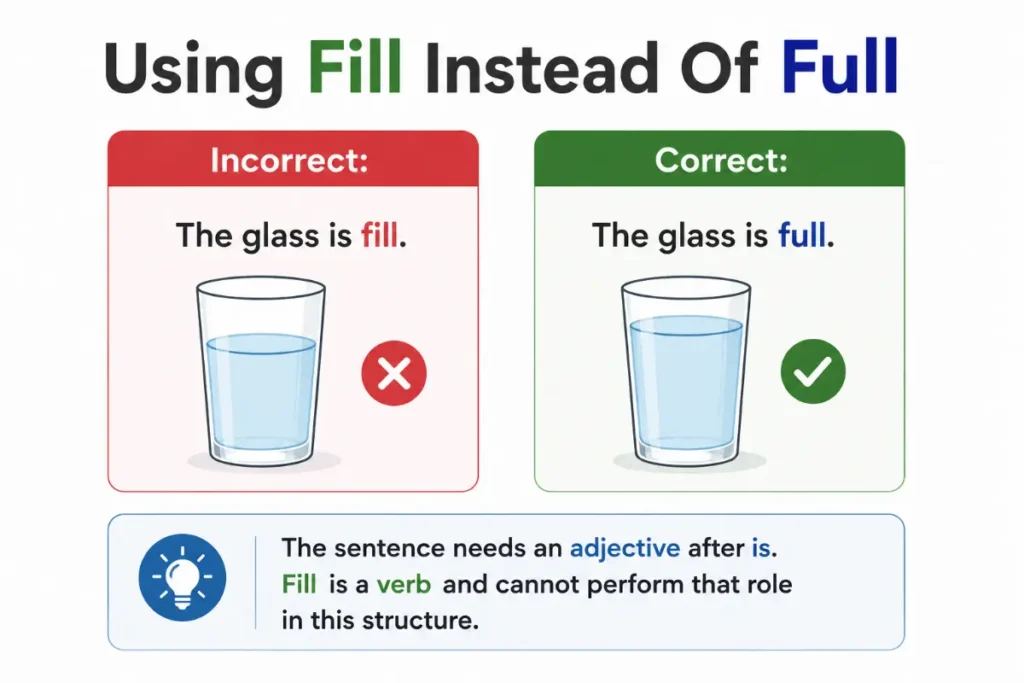
Incorrect:
The glass is fill.
Correct:
The glass is full.
The sentence needs an adjective after is. Fill is a verb and cannot perform that role in this structure.
Using Full Instead Of Fill
Incorrect:
Please full the bottle.
Correct:
Please fill the bottle.
The sentence needs a verb because it tells someone to perform an action.
Confusing Filled And Full
Filled and full are related but they are not identical.
The bottle is full.
The bottle is filled with water.
Both can be correct but the emphasis changes.
Full describes the condition of the bottle.
Filled describes the action or the resulting state involving what was put inside.
Using Full In Place Of Fill Out
Incorrect:
Please full out this form.
Correct:
Please fill out this form.
The phrase is fill out in standard American English.
Writing Filling Incorrectly
The present participle of fill is filling.
Incorrect:
She is fillling the tank.
Correct:
She is filling the tank.
The word has one l in the base form but doubles the l before ing.
Real Life Usage Examples
At Home
The refrigerator is full.
Please fill the water bottle.
The trash can is full.
I need to fill the ice tray.
These sentences show the condition and action distinction clearly.
At School
The classroom is full.
Please fill in the missing answer.
The teacher filled the board with examples.
My notebook is full.
The grammar remains simple even when the context changes.
At Work
The meeting room is full.
Please fill out the application.
The position has been filled.
Our schedule is full this week.
Here fill can refer to physical space documents positions and schedules.
In Restaurants
The restaurant is full tonight.
Please fill my glass with water.
I’m already full.
The waiter filled the cups.
The same two words can describe both physical capacity and personal satisfaction.
In Travel
The hotel is full.
We need to fill the car with fuel.
The parking lot is full.
The bus quickly filled with passengers.
These examples show how common the distinction is in practical situations.
Related Words And Expressions
Several words connect naturally with full and fill.
Empty
Empty is one of the clearest opposites of full.
The glass is full.
The glass is empty.
Filled
Filled is the past participle of fill.
She filled the cup.
The cup was filled with water.
Completely Full
This phrase emphasizes that something has reached capacity.
The tank is completely full.
Fill Up
Fill up usually means to make something full.
Please fill up the tank.
It can also describe eating until you are no longer hungry.
The meal filled me up.
Fill In
Fill in can mean providing missing information.
Please fill in your address.
It can also mean temporarily replacing someone.
Can you fill in for me tomorrow?
Fill Out
Fill out is commonly used in American English for completing a form.
Please fill out this application.
Full Of
Full of means containing a large amount of something.
The room was full of people.
Her speech was full of useful ideas.
Fuller
Fuller is the comparative form of full.
This box is fuller than the other one.
These expressions give you a wider understanding of how the words work beyond their basic definitions.
When Full Means Complete
One of the most useful things to remember is that full does not always mean physically filled to capacity.
It can mean complete.
For example:
Please give me your full name.
She gave a full answer.
We need the full story.
He watched the full episode.
In each case full means the entire amount rather than a container reaching capacity.
It can also emphasize time.
I waited a full hour.
They spent a full week there.
The meeting lasted a full day.
Here full adds emphasis to the complete duration.
When Fill Does Not Involve A Container
Fill is also broader than physical containers.
For example:
Music filled the room.
Laughter filled the house.
The audience filled the theater.
She filled the vacant position.
The experience filled him with joy.
None of these examples requires someone to pour a physical substance into a container.
The basic idea remains the same. Something occupies a space or satisfies a role or emotional need.
Understanding this broader meaning helps you recognize fill in more advanced writing.
Full In Figurative Language
Full often appears in expressions that have nothing to do with physical capacity.
For example:
My calendar is full.
Her life is full of adventure.
The report is full of useful information.
His heart was full of gratitude.
These expressions use physical fullness as a metaphor for abundance.
The idea is easy to picture. If a container can hold no more then it is full. In the same way a schedule can have no more available time or a story can contain a large amount of information.
This is one reason English speakers use full so often.
Fill In Figurative Language
Fill also appears in many figurative expressions.
For example:
The experience filled her with confidence.
The news filled him with hope.
The speech filled the audience with excitement.
These sentences describe emotions rather than physical objects.
Fill can also describe a role.
She filled the position after the manager retired.
The word therefore moves easily from physical action to abstract ideas.
Memory Tips
The easiest memory trick is to remember the grammar.
Full describes. Fill does.
If you are describing something you will often need full.
The cup is full.
The room is full.
The schedule is full.
If you are describing an action you will often need fill.
Fill the cup.
Fill the form.
Another useful trick is to connect full with empty.
Full and empty are both adjectives.
Fill is an action.
Empty can also be a verb.
For example:
The bottle is empty.
Empty the bottle.
The bottle is full.
Fill the bottle.
This comparison gives you a practical mental picture.
Professional Writing Tips
A good editor looks at the grammatical job a word performs before choosing it.
If the word follows a linking verb and describes a condition full is often the right choice.
The room is full.
The schedule seems full.
The box looks full.
If the sentence calls for an action fill is usually the correct choice.
Fill the box.
They filled the room.
She filled the application.
Another useful editing trick is to ask what happens next.
If someone fills something the result may be that the thing becomes full.
She filled the glass.
The glass became full.
That cause and result relationship can help you distinguish the words quickly.
Also pay attention to common phrases. Native speakers do not normally say full out a form. They say fill out a form in American English.
Similarly they do not say the glass is fill. They say the glass is full.
Learning these natural patterns will make your writing sound more fluent.
Key Takeaways
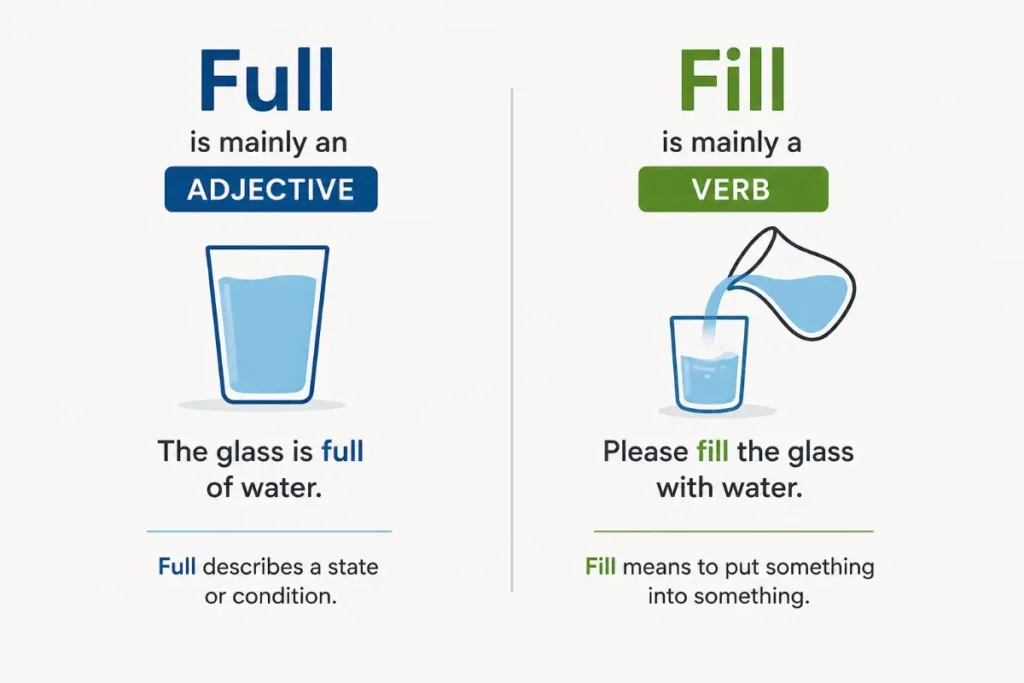
- Full is mainly an adjective.
- Fill is mainly a verb.
- Full describes a condition.
- Fill describes an action.
- A glass can be full.
- You can fill a glass.
- Filled is the past form of fill.
- Filling is the present participle of fill.
- Full can mean complete or abundant.
- Fill can describe physical actions and abstract ideas.
- Fill out is especially common in American English for completing forms.
- Full and fill have different vowel sounds.
- Empty is the most direct opposite of full.
- The easiest memory rule is full describes while fill does.
Conclusion
Full vs Fill becomes much easier once you focus on the job each word performs. Full is mainly an adjective that describes a state or condition. Fill is mainly a verb that describes an action. A container can be full and a person can fill that container.
Remember the simple relationship. You fill something and it can become full. You can also use full for complete amounts such as a full hour or a full explanation. Fill has wider uses too and can describe forms positions spaces and emotions.
When you’re unsure choose based on grammar first. If you are describing a condition use full. If you are describing an action use fill. That small distinction will keep your writing clear and natural.
Frequently Asked Questions
What Is The Difference Between Full And Fill?
Full is mainly an adjective that describes a condition while fill is mainly a verb that describes an action. A glass can be full because it contains as much as it needs to hold. You can fill the glass by putting water into it. The words are closely related in meaning but they serve different grammatical roles.
Is Full A Verb Or An Adjective?
Full is mainly an adjective. It describes something that contains a large amount or has reached capacity. It can also describe completeness or abundance. For example the bottle is full uses full as an adjective. In some specialized contexts full can have other grammatical uses but its ordinary role is adjectival.
Is Fill A Verb Or An Adjective?
Fill is mainly a verb. It describes putting something into a space or container or occupying a position or satisfying a need. For example please fill the glass uses fill as a verb. The word has several related uses but its most common grammatical role is as a verb.
Can Full And Fill Be Used In The Same Sentence?
Yes. They can naturally appear together because they describe related parts of an action. For example you can fill a glass until it is full. In that sentence fill describes the action while full describes the resulting condition. This is one of the easiest ways to understand their relationship.
What Is The Past Tense Of Fill?
The past tense of fill is filled. For example you can say I filled the bottle this morning. The word follows the regular English pattern for past tense verbs. Its present participle is filling. The forms are fill fills filled and filling.
Is Fill Out Or Fill In Correct?
Both expressions are standard but their use can depend on the variety of English and the context. American English commonly uses fill out for completing a form. Fill in is also common especially for entering information into a particular blank or space. In British English fill in is especially common for completing forms.
Are Full And Fill Pronounced The Same?
No. They have different vowel sounds. Full is commonly pronounced /fʊl/ while fill is pronounced /fɪl/. The difference is similar to the vowel contrast in book and bit. They may look similar but they are not homophones and should not be pronounced identically.
What Is The Opposite Of Full?
The most direct opposite of full is empty. For example a full glass contains liquid while an empty glass does not. The exact opposite can depend on context. Full can also mean complete so incomplete may be a better opposite in some sentences. Context determines the best choice.
What Does Full Of Mean?
Full of means containing a large amount of something or showing a strong presence of something. For example the room was full of people means many people were in the room. The speech was full of useful ideas means the speech contained many useful ideas. The phrase works in both physical and figurative contexts.
What Does Fill Up Mean?
Fill up usually means to make something full. You can fill up a bottle with water or fill up your car with fuel. It can also describe eating enough food to remove hunger. For example the meal filled me up means the meal made the speaker feel completely satisfied.

Confusing Words, Spelling & Word Choice
Claire Whitmore is a U.S.-based English editor who writes about commonly confused words, spelling differences, and word choice. Her work helps readers understand subtle distinctions between similar-looking words through simple definitions, practical examples, and modern usage guidance in both American and British English.