
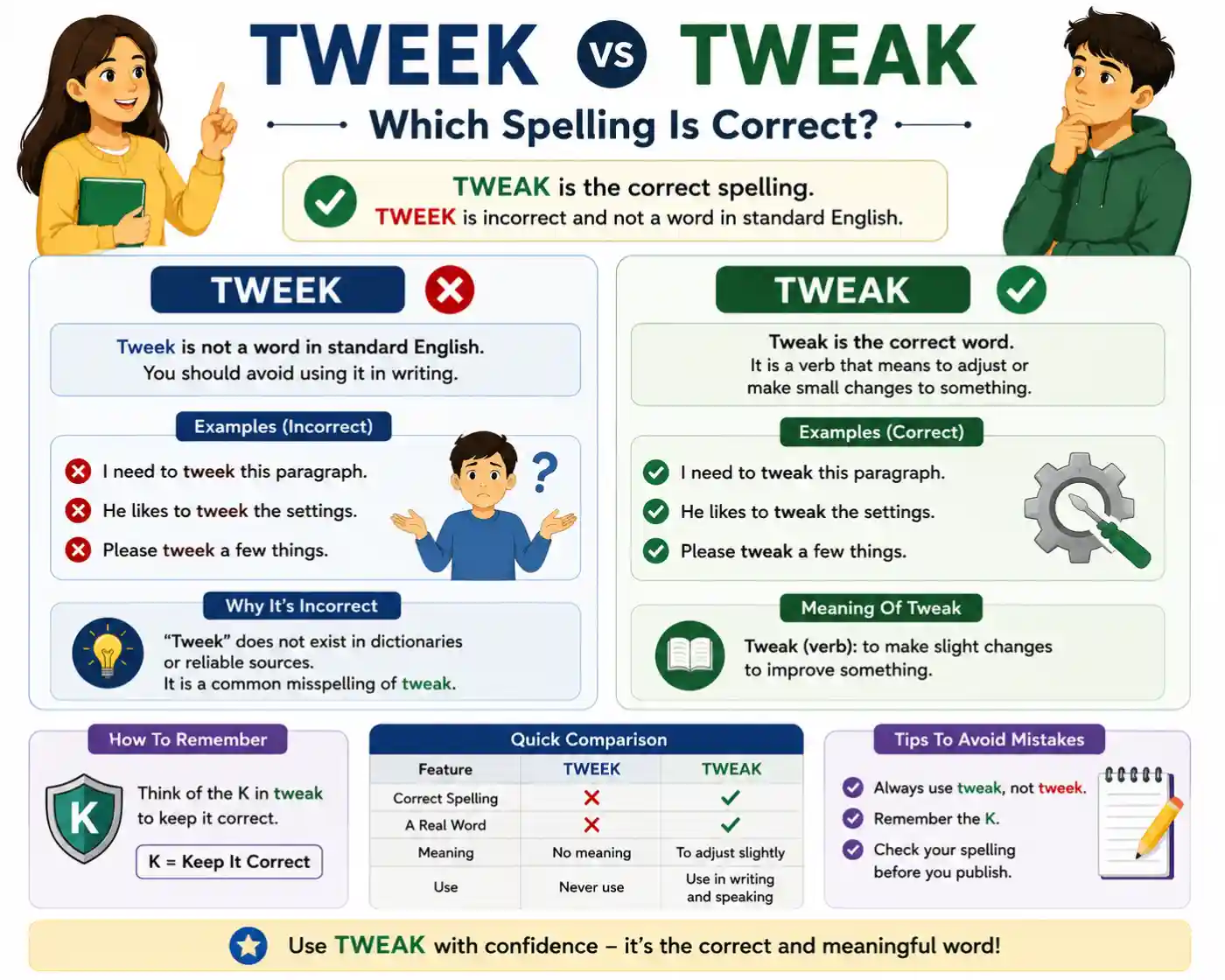
Tweek vs Tweak is a common spelling question because both forms sound alike. The correct word for making a small adjustment is tweak. You can use it when editing a sentence, refining a recipe, changing software settings, or making a minor improvement to a plan. Tweak works as both a verb and a noun.
The confusion comes from familiar English spelling patterns. Words like week, seek, and speak use the same long e sound, so some people assume that tweak should follow the same pattern. However, English spelling doesn’t always match pronunciation in a predictable way, which makes this mistake easy to understand.
This guide explains the correct spelling, meaning, pronunciation, grammar, and word history of tweak. You’ll also learn how to use it in everyday sentences, recognize common mistakes, and understand its usage in American and British English. By the end, you’ll know why tweak is the standard spelling and why tweek is usually incorrect.
Short Answer
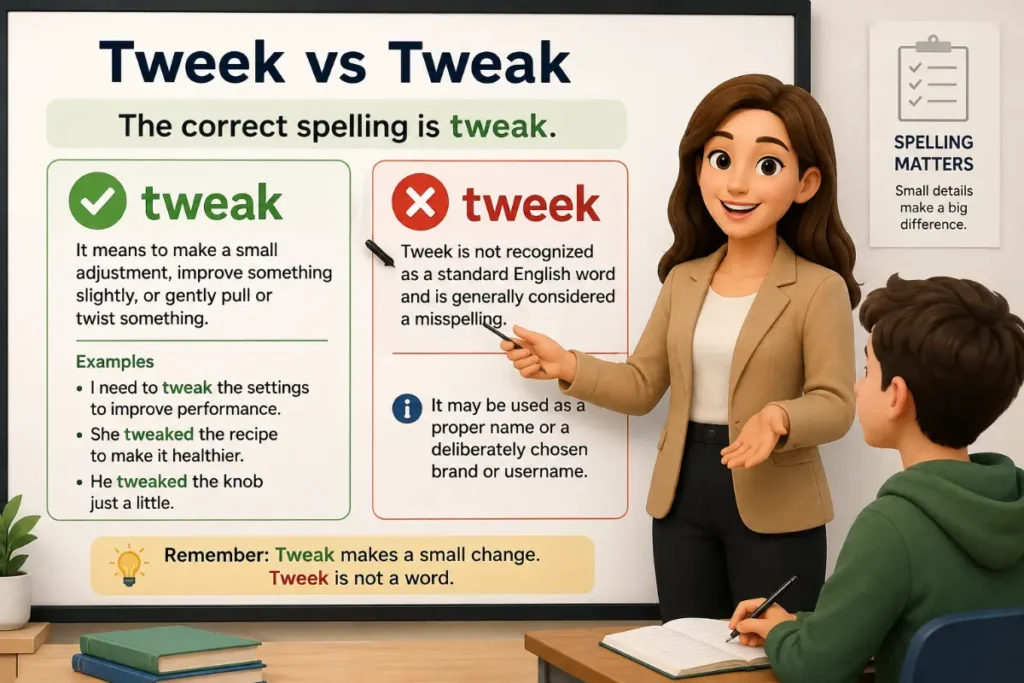
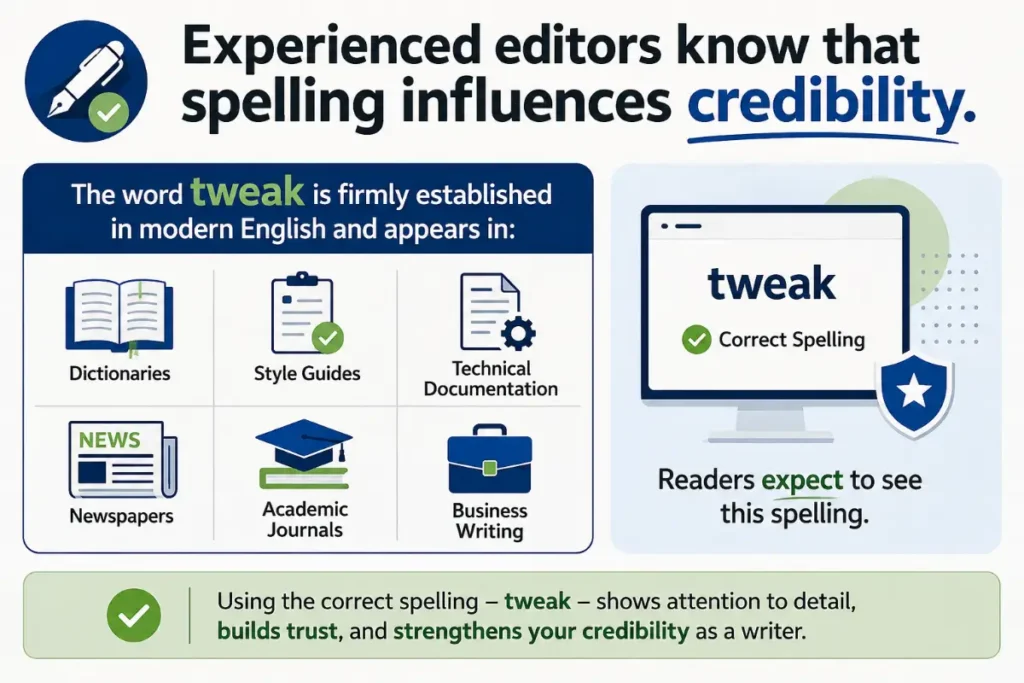
Tweak is the correct spelling when you mean to make a small change or adjustment. Tweek is usually a misspelling caused by the way tweak sounds. Tweak works as both a verb and a noun and appears in everyday English as well as technical professional and academic writing.
Table of Contents
- The Correct Spelling.
- What Tweak Means.
- What Tweek Means.
- Tweek vs Tweak Comparison.
- Why People Spell Tweak as Tweek.
- How To Pronounce Tweak.
- Tweak As A Verb.
- Tweak As A Noun.
- Real Life Examples.
- Common Mistakes.
- Tweak In Professional Writing.
- Tweak In Technology.
- Tweak In Everyday English.
- American And British English.
- The Origin Of Tweak.
- Synonyms For Tweak.
- How To Remember The Spelling.
- Related Words And Expressions.
- Frequently Asked Questions.
- Key Takeaways.
- Conclusion.
The Correct Spelling
The standard spelling is tweak.
When you want to describe a small adjustment or minor improvement you should write tweak. Major dictionaries recognize the word and give it several related meanings. Merriam Webster defines it as making small adjustments as well as pinching or pulling with a sudden movement. Oxford also lists tweak as a noun for a slight change made to improve a machine or system.
The form tweek is generally a misspelling when the intended meaning is a small adjustment.
| Word | Standard English | Main meaning | Example |
|---|---|---|---|
| Tweak | Yes | Make a small adjustment | I need to tweak the design. |
| Tweek | Usually no | Usually a misspelling of tweak | I need to tweak the design. |
There are a few situations where Tweek can appear as a name or specialized term. For example Tweek Tweak is the name of a fictional character from South Park. Wiktionary also records tweek as a specialized English noun referring to a form of radio interference. Those uses don’t make tweek the standard spelling of the ordinary verb meaning to make a small adjustment.
For normal writing the rule is simple. If you mean a small change use tweak.
What Tweak Means
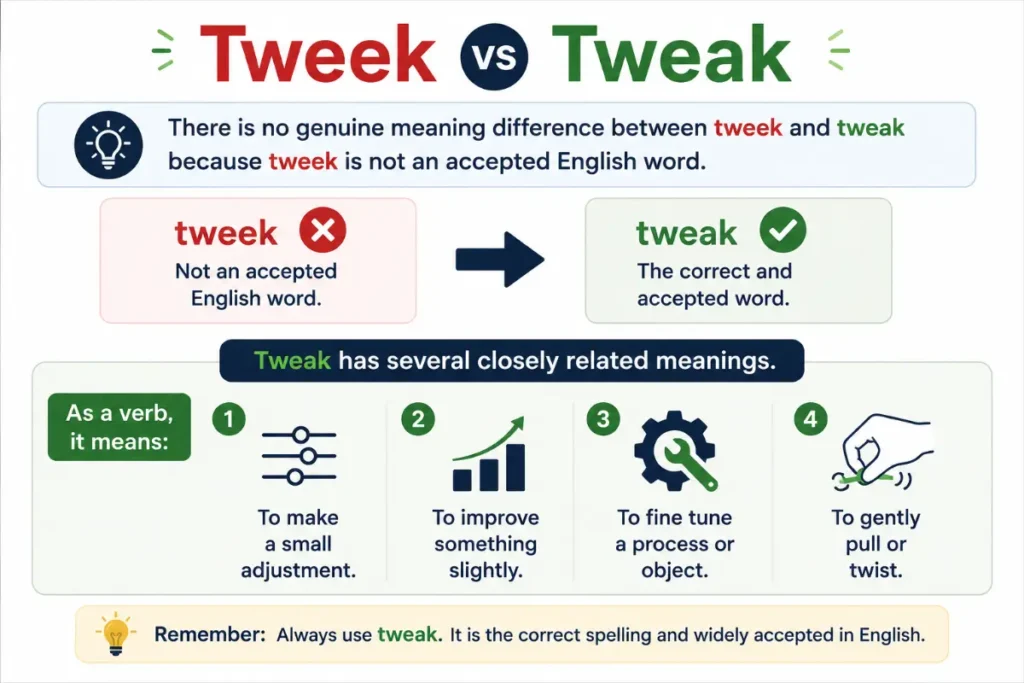
Tweak usually means to make a small change to something.
The change is normally limited rather than dramatic. You aren’t replacing the entire thing. You’re adjusting one part so the result works better.
For example:
I need to tweak the wording of this sentence.
The sentence already works. The writer simply wants to make a small improvement.
You could also say:
The designer tweaked the colors before publishing the page.
Again the design isn’t being rebuilt from scratch. A small adjustment is being made.
Tweak can describe physical actions too. Its older sense involves pinching pulling or twisting something with a quick movement. Modern English often uses the word in the broader sense of making a minor adjustment.
That distinction matters because the word isn’t limited to computers or business. You can tweak almost anything that can be adjusted.
What Tweek Means
In ordinary English writing tweek is usually a misspelling of tweak.
If someone writes:
I need to tweek the settings.
They almost certainly mean:
I need to tweak the settings.
The error happens because the pronunciation does not clearly reveal the spelling. Tweak is pronounced /twiːk/ in both American and British English. The sound is the same long e sound found in words such as week and speak.
Tweek can still appear in special contexts. A proper name may use Tweek intentionally. A specialized term may also appear in a particular field. Wiktionary records an English noun tweek connected with a form of radio interference and also identifies tweek as a misspelling of tweak.
So the practical rule for everyday writing remains straightforward.
Use tweak when you mean a small adjustment.
Tweek vs Tweak Comparison
The easiest way to understand Tweek vs Tweak is to focus on standard English usage.
| Feature | Tweak | Tweek |
|---|---|---|
| Standard English word | Yes | Usually no |
| Common dictionary entry | Yes | No for the ordinary adjustment meaning |
| Can be a verb | Yes | Not as the standard form |
| Can be a noun | Yes | Not as the standard form |
| Meaning small adjustment | Yes | No |
| Used in professional writing | Yes | No for the adjustment meaning |
| Used in American English | Yes | No for the adjustment meaning |
| Used in British English | Yes | No for the adjustment meaning |
| Pronunciation | /twiːk/ | Usually intended to represent /twiːk/ |
| Common reason for appearance | Correct spelling | Misspelling |
The most important difference isn’t pronunciation. Both forms are often intended to represent the same sound.
The difference is spelling and standard usage.
If you’re writing an email report article essay instruction manual or business document choose tweak.
Why People Spell Tweak As Tweek
English spelling can create some strange traps. This is a good example.
The first reason is pronunciation.
Tweak sounds like many familiar words that contain ee.
Think about these words:
Week.
Seek.
Peek.
Freak.
Speak.
When people hear tweak they may automatically connect the sound with that spelling pattern. The brain often relies on familiar patterns when producing a word from memory.
The second reason is visual familiarity.
Tweek looks plausible. It isn’t an obviously strange combination of letters. Someone can type it quickly and still feel that the word looks right.
The third reason is limited exposure.
A person who mostly hears the word in conversation may know the meaning without ever seeing it written. When they eventually type it they have to guess the spelling.
The fourth reason is fast digital communication.
Text messages social media posts comments and casual notes often receive less proofreading. Once an incorrect spelling appears repeatedly it can start to look familiar.
That familiarity can be misleading.
A spelling can appear frequently online and still be incorrect in standard English.
How To Pronounce Tweak
Tweak is pronounced /twiːk/.
It has one syllable.
It sounds like:
tweek.
That pronunciation explains much of the spelling confusion. The written form contains ea but the sound is the same long e sound found in words such as speak and week. Cambridge gives both US and UK pronunciation as /twiːk/.
Try saying it slowly.
Tweak.
The word begins with the consonant sound in tea. The middle has the long e sound. The final sound is the k in keep.
You can think of the pronunciation as:
T plus weak.
That isn’t an explanation of the spelling. It is simply a useful pronunciation guide.
The spelling still remains tweak.
Tweak As A Verb
Tweak is commonly used as a verb.
As a verb it means to make a small change or adjustment.
For example:
I tweaked the settings on my laptop.
The developer tweaked the code before the update.
She tweaked the recipe by adding less salt.
We need to tweak the schedule.
He tweaked the wording to make the message clearer.
Each sentence describes a limited change.
The original object remains recognizable. The person is simply making a small adjustment.
This makes tweak especially useful when you want to show that a change isn’t major.
Compare these ideas:
We changed the entire website.
We tweaked the website.
The first sentence suggests a broad or substantial change. The second suggests a smaller adjustment.
That difference in scale gives tweak much of its usefulness.
Tweak As A Noun
Tweak can also work as a noun.
As a noun it refers to a small adjustment.
For example:
The design needs a small tweak.
The engineer made a few tweaks to the system.
One final tweak should improve the layout.
The noun often appears with words such as small minor final simple or slight.
You may also see the plural form tweaks.
For example:
The latest tweaks made the app easier to use.
The team made several tweaks before publication.
Notice the difference between the verb and noun forms.
Verb:
We need to tweak the settings.
Noun:
The settings need a few tweaks.
The word keeps the same spelling in both forms.
Real Life Examples
Tweak appears in many areas of everyday life.
Writing
I tweaked the introduction before submitting the article.
The writer made a few tweaks to improve the sentence.
The editor asked me to tweak the final paragraph.
In writing tweak usually means changing wording structure tone or details without rewriting everything.
Cooking
I tweaked the recipe by adding more garlic.
This soup needs a small tweak.
She made a few tweaks to the sauce.
Cooking is a perfect example because recipes often improve through small adjustments.
Technology
Try tweaking the display settings.
The developer tweaked the software to reduce loading time.
I made a small tweak to the configuration.
Technology uses tweak frequently because software settings can often be adjusted without replacing the entire system.
Design
The designer tweaked the layout.
We need to tweak the font size.
A few small tweaks made the page easier to read.
Designers often use the word when describing fine adjustments.
Business
The company tweaked its pricing strategy.
The manager made a few tweaks to the schedule.
We should tweak the plan before presenting it.
Business writers use tweak to describe modest changes that refine an existing approach.
Daily Conversation
I just need to tweak this chair.
Can you tweak the volume?
I tweaked my routine after noticing the problem.
These examples show that tweak isn’t limited to formal or technical language.
Common Mistakes
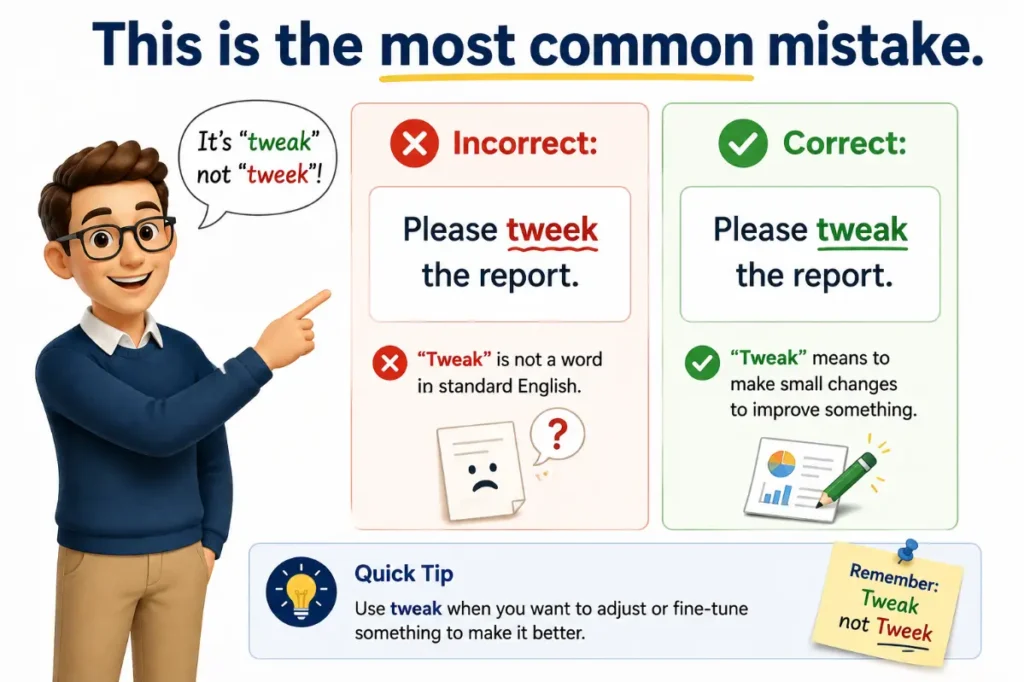
The most common mistake is writing tweek when you mean tweak.
Incorrect:
I need to tweek the settings.
Correct:
I need to tweak the settings.
Another common mistake involves adding an unnecessary extra letter.
Incorrect:
I need to tweek the design.
Correct:
I need to tweak the design.
Some writers also confuse tweak with words such as twerk or twirl because the words share a similar beginning. Their meanings are completely different.
Tweak means to make a small adjustment or to pinch or pull something.
Twerk refers to a type of dance movement.
Twirl means to turn or spin around.
Keeping the meanings separate makes the spelling easier to control.
Tweak In Professional Writing
Tweak is completely acceptable in professional English when the context calls for a small adjustment.
You can use it in reports emails presentations technical documentation marketing copy and workplace communication.
For example:
We need to tweak the proposal before the client meeting.
The engineering team tweaked the configuration.
I made a few tweaks to the report.
The designer tweaked the layout after reviewing the feedback.
The word can sound less formal than adjust or modify. That doesn’t make it incorrect. It simply gives the sentence a more conversational tone.
Consider this comparison.
We need to modify the proposal.
We need to tweak the proposal.
The first sounds more formal and technical. The second sounds more natural in everyday workplace conversation.
Choose the word based on the tone you need.
For highly formal legal academic or regulatory writing you may prefer adjust or modify when precision and formality matter more than conversational style.
Tweak In Technology
Technology is one of the areas where tweak appears most often.
You can tweak:
Software settings.
Display options.
Code.
Performance.
Audio levels.
Security settings.
A configuration.
A website.
A database setup.
A user interface.
For example:
The developer tweaked the code to fix the issue.
I tweaked the display settings to make the text easier to read.
The technician made a few tweaks to the network configuration.
The team tweaked the algorithm after testing the results.
The meaning stays consistent. Each example describes a small adjustment rather than a complete replacement.
This technical use also explains why the word has become so familiar in modern English. It works well when someone wants to describe fine tuning without suggesting a major redesign.
Tweak In Everyday English
You don’t need to work in technology to use tweak naturally.
Imagine you’re adjusting a chair.
You might say:
I need to tweak the position a little.
If you’re changing a recipe:
I tweaked the recipe after trying it once.
If you’re editing a message:
I’ll tweak the wording before I send it.
If you’re adjusting a schedule:
We may need to tweak the timing.
The word fits these situations because the change is usually small.
Think of tweak as turning a small dial rather than rebuilding the machine.
That mental picture captures the basic idea nicely.
American And British English
The spelling tweak is standard in both American and British English.
There is no American spelling such as tweek and no British spelling such as tweek for the ordinary meaning of making a small adjustment.
Cambridge lists the pronunciation /twiːk/ for both UK and US English. Oxford also lists tweak as a standard English word and gives its noun pronunciation as /twiːk/.
The word can therefore be used confidently in American writing.
For example:
I need to tweak the settings.
The same sentence works naturally in British English.
This is not a regional spelling issue. It is mainly a spelling error caused by the sound of the word.
The Origin Of Tweak
The history of tweak helps explain why the spelling looks unusual.
Merriam Webster traces the verb to Middle English twikken meaning to pull sharply and connects it with Old English twiccian meaning to pluck. Its first known use is recorded as 1601. The noun appears in the early seventeenth century.
Etymonline gives a similar history. It describes the older sense as pinching plucking or twisting with a sharp jerk. The modern sense of making fine adjustments developed much later and is attested from 1966.
Oxford also connects the word with an older dialect form meaning to pull sharply and relates it to twitch.
The modern meaning makes sense when you think about the older physical action. A person might tweak something with a small quick movement. Over time the word developed a broader figurative meaning.
Today we can tweak software a sentence a recipe a plan or a design.
The physical idea of a small adjustment remains at the heart of the word.
Synonyms For Tweak
The best synonym depends on the context.
Adjust is the broadest choice.
Example:
I adjusted the settings.
Modify suggests making a change to something that already exists.
Example:
We modified the original plan.
Refine often suggests improving quality or precision.
Example:
She refined the wording.
Fine tune emphasizes careful small adjustments.
Example:
The engineer fine tuned the system.
Alter can describe a change but may sound broader.
Example:
We altered the schedule.
Revise works especially well for writing plans documents and ideas.
Example:
I revised the paragraph.
Improve focuses on making something better rather than simply changing it.
Example:
We improved the design.
Tweak is useful because it sits between simple adjustment and improvement. It often suggests that the original version is already close to what you want.
How To Remember The Spelling
A good memory trick is to connect tweak with speak.
Both words contain ea and both have the long e sound.
Think:
Tweak and speak.
Another useful connection is the meaning.
When you make a small adjustment you tweak something.
You don’t need to change the whole thing.
Picture a small control knob. You turn it slightly and stop.
That is a tweak.
You can also remember this sentence:
I tweak the setting.
The repeated visual pattern can help reinforce the spelling.
Avoid thinking of tweak as a version of week with a t added at the front. That mental shortcut can push you toward tweek.
Instead remember the pattern:
T W E A K.
The ea is the part worth memorizing.
Related Grammar And Usage Notes
Tweak is a regular verb.
The main forms are:
Present:
tweak.
Past:
tweaked.
Present participle:
tweaking.
Third person singular:
tweaks.
For example:
I tweak the settings.
She tweaks the settings.
We tweaked the settings.
They are tweaking the settings.
The noun also has a regular plural:
tweak.
tweaks.
For example:
The design needs a tweak.
The design needs several tweaks.
The word can take an object when used as a transitive verb.
Example:
She tweaked the recipe.
Here the recipe receives the action.
It can also appear in expressions such as tweak the settings tweak the design tweak the plan and tweak the wording.
These combinations are natural because they describe things that can be adjusted in small ways.
When Tweak Is Better Than Change
The difference between tweak and change is often a matter of scale.
Change is broad.
Tweak is narrow.
Consider:
I changed the website.
This sentence doesn’t tell us how much changed.
Now consider:
I tweaked the website.
The listener will usually understand that the website stayed mostly the same and received some minor adjustments.
That distinction can make your writing more precise.
If you’re describing a complete redesign use change redesign rebuild replace or another stronger word.
If you’re describing a small improvement use tweak.
When Tweak Is Better Than Fix
Tweak and fix aren’t always interchangeable.
Fix usually suggests that something is broken wrong or not working properly.
Example:
I fixed the broken link.
Tweak suggests that something already works but could be improved.
Example:
I tweaked the layout.
A website can work perfectly and still need a tweak.
A recipe can taste good and still benefit from a tweak.
A paragraph can be grammatically correct and still need a tweak for clarity.
This is why tweak often sounds less dramatic than fix.
Is Tweak Formal Or Informal
Tweak is neither slang nor incorrect. It is a standard English word. Its tone can feel conversational because people commonly use it in everyday speech. That makes it especially useful in friendly workplace communication.
For a formal report you might choose adjust modify or revise if those words communicate the exact idea more clearly.
For an ordinary email you can comfortably write:
I made a few tweaks to the document.
That sentence sounds natural and professional.
The important point is not to avoid tweak simply because it feels conversational. Standard English includes many everyday words that work perfectly well in professional communication.
Is Tweak A Verb Or A Noun
It is both.
As a verb:
I tweaked the settings.
Here tweak describes an action.
As a noun:
I made a small tweak to the settings.
Here tweak names the adjustment itself.
This dual use is common in English.
Other words such as change adjustment and update can also function in related ways.
Understanding the grammatical role helps you build sentences correctly.
Tweak And Its Related Forms
The base word is tweak.
The past tense is tweaked.
The present participle is tweaking.
The third person singular form is tweaks.
Examples:
I tweak the design every Friday.
She tweaks the design every Friday.
We tweaked the design yesterday.
They are tweaking the design now.
The designer made several tweaks.
Notice that adding endings doesn’t change the core spelling.
The word always begins with tweak.
That makes the spelling easier to recognize across different sentence forms.
Tweak In Editing And Writing
Editors use tweak when describing small improvements.
A writer might tweak:
A headline.
A sentence.
A paragraph.
A transition.
A word choice.
A tone.
A title.
A description.
A conclusion.
For example:
I tweaked the headline to make it clearer.
The editor tweaked the sentence for a more natural tone.
We made a few tweaks to the introduction.
These examples show an important feature of the word. A tweak doesn’t necessarily fix an error.
Sometimes it simply makes something better.
That difference is useful for writers because editing isn’t always about correcting mistakes. Good editing often involves small choices that improve clarity rhythm tone and precision.
Tweak In Recipes And Cooking
Cooking gives us another natural use.
Imagine a recipe that tastes good but needs a little more flavor.
You might say:
I tweaked the recipe by adding more garlic.
The recipe wasn’t necessarily wrong. You simply adjusted it to suit your taste.
You can also say:
The chef made a few tweaks to the sauce.
This use captures the word’s basic meaning perfectly.
A tweak is often small enough that the original remains recognizable.
Tweak In Design
Designers often work through small adjustments.
A page may already look good but the spacing could be better.
A designer might say:
I need to tweak the spacing.
A logo may need a slight adjustment.
We can say:
The designer tweaked the logo.
A layout may need a small change.
We can say:
I made a few tweaks to the layout.
This language helps communicate that the project is close to finished.
It doesn’t suggest starting again.
Common Search Questions About Tweak
People often ask the same practical questions about this word. The answer to the spelling question is straightforward.
Use tweak for the standard English word.
The pronunciation is also straightforward.
Say tweak as one syllable with the long e sound.
The word works as both a verb and a noun.
Its common modern meaning involves a small adjustment or improvement. Its history reaches back to English forms connected with pulling and plucking. Once you understand those points the word becomes much easier to use.
Key Takeaways
- The correct standard spelling is tweak.
- Tweek is usually a misspelling when the intended meaning is a small adjustment.
- Tweak is pronounced /twiːk/ in both American and British English.
- Tweak works as both a verb and a noun.
- As a verb it means to make a small adjustment or improvement.
- As a noun it means a small adjustment.
- Tweak can describe changes to writing technology recipes designs plans settings and many other things.
- Tweak is acceptable in both everyday and professional English.
- Tweek can appear in special contexts such as proper names or specialized terminology.
- A simple memory trick is to remember tweak alongside speak because both contain the spelling pattern ea.
Conclusion
Tweek vs Tweak is easy to understand when you focus on the spelling rather than the sound. Tweak is the correct standard English word for making a small adjustment or improvement. It works as both a noun and a verb and is commonly used in everyday conversation, professional writing, technology, cooking, design, and editing.
The spelling may seem confusing because tweak sounds like a word spelled with ee. However, English spelling doesn’t always match pronunciation. A simple way to remember the correct form is to connect tweak with speak and keep the letters ea in the middle.
When describing a small change, use tweak. In ordinary writing, tweek is usually a misspelling unless it appears as a specific name or specialized term. Learning this simple difference will help you spell the word correctly without second guessing yourself.
Frequently Asked Questions
Is Tweek a Correct Spelling?
Tweek is not the standard spelling when you mean to make a small adjustment. The correct word is tweak. Although tweek may appear in names or specialized contexts, it should not replace tweak in everyday writing.
Is Tweak a Real English Word?
Yes. Tweak is a standard English word that can function as both a noun and a verb. As a noun, it means a small adjustment or change. As a verb, it means to make a minor change or pull or twist something slightly.
What Is the Difference Between Tweek and Tweak?
Tweak is the correct spelling for a small adjustment, while tweek is generally a misspelling when used with this meaning. Both forms may sound the same, but only tweak is the standard spelling in ordinary English.
For example, I need to tweak the design is correct.
How Do You Spell Tweak?
The correct spelling is T W E A K. Remember that the middle letters are ea, not ee. A helpful way to remember this is to connect tweak with words such as break and speak, which also contain ea.
How Do You Pronounce Tweak?
Tweak is pronounced /twiːk/. It has one syllable and rhymes with week. The spelling can be confusing because the vowel sound is represented by ea rather than ee.
Is Tweak American or British English?
Tweak is used in both American and British English. There is no separate British spelling with ee. The standard spelling remains tweak in both varieties.
Can Tweak Be a Noun?
Yes. As a noun, tweak refers to a small change or adjustment made to improve something. For example, The recipe needs a small tweak means that a minor change could make the recipe better.
Can Tweak Be a Verb?
Yes. As a verb, tweak means to make a small adjustment. You can tweak a recipe by changing an ingredient, tweak a sentence to improve its meaning, or tweak a software setting to get a better result.
What Is a Simple Synonym for Tweak?
Adjust is one of the simplest synonyms for tweak. Other alternatives include modify, refine, revise, fine tune, and alter. The best choice depends on the context. For example, adjust works well for settings, while refine often suggests improving something that is already good.
Why Is Tweak Spelled With EA?
English spelling has developed over many centuries, so the letters in a word do not always match its pronunciation in an obvious way. Tweak has historical connections with words describing pulling or twisting. Its modern spelling became established through usage and is now the standard form.
Does Tweak Mean Fix?
Not exactly. Fix usually means to repair something or correct a problem. Tweak generally means to make a small adjustment to something that already exists. For example, you might fix a broken computer but tweak its settings to improve performance.
Can Tweek Ever Be Used Intentionally?
Yes. Tweek can appear as a proper name or in specialized contexts. For example, Tweek Tweak is a fictional character from the animated series South Park. The spelling has also been recorded in specialized terminology. These uses do not make tweek a standard alternative to tweak when referring to a small adjustment.

Confusing Words, Spelling & Word Choice
Claire Whitmore is a U.S.-based English editor who writes about commonly confused words, spelling differences, and word choice. Her work helps readers understand subtle distinctions between similar-looking words through simple definitions, practical examples, and modern usage guidance in both American and British English.