
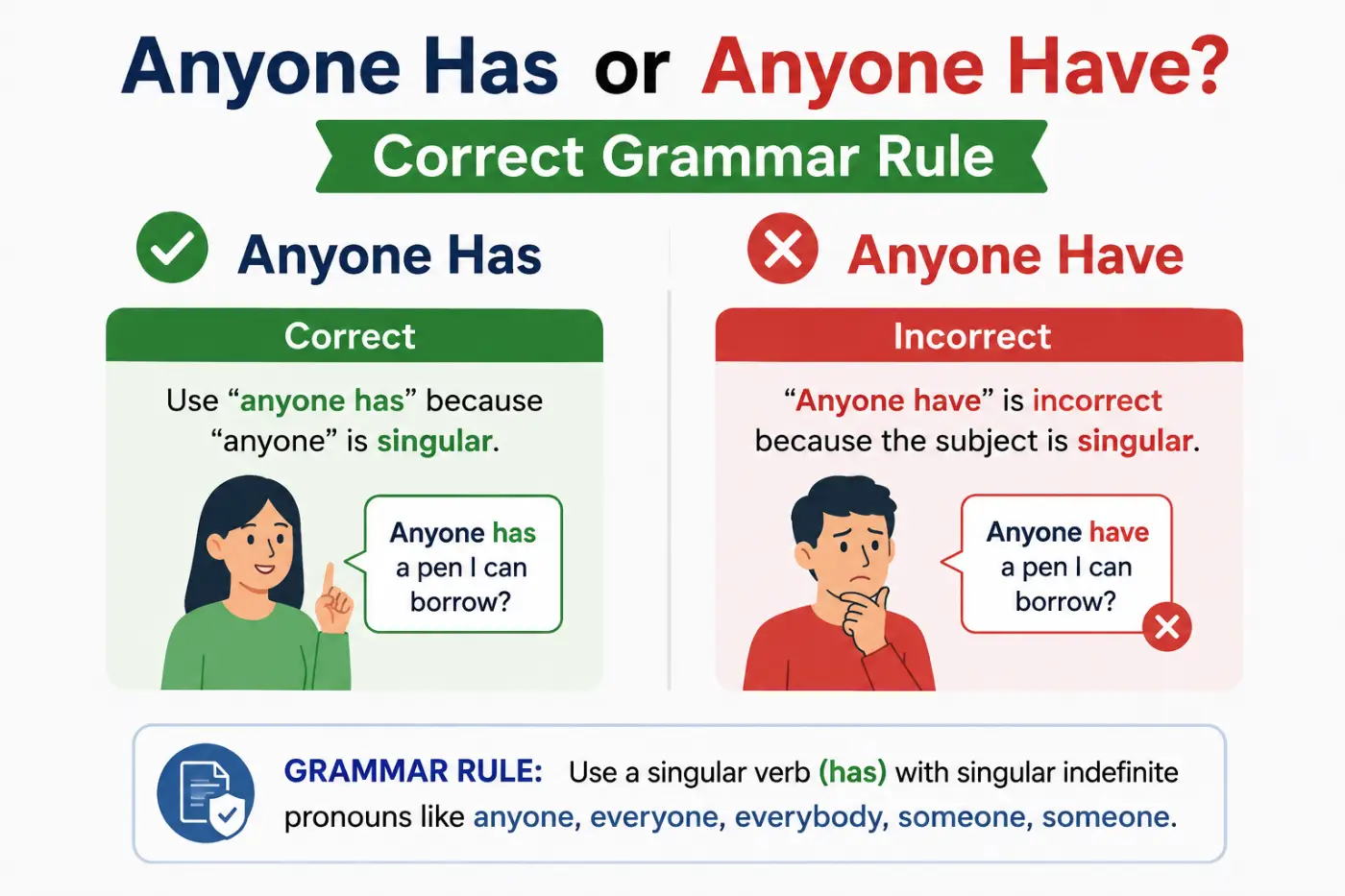
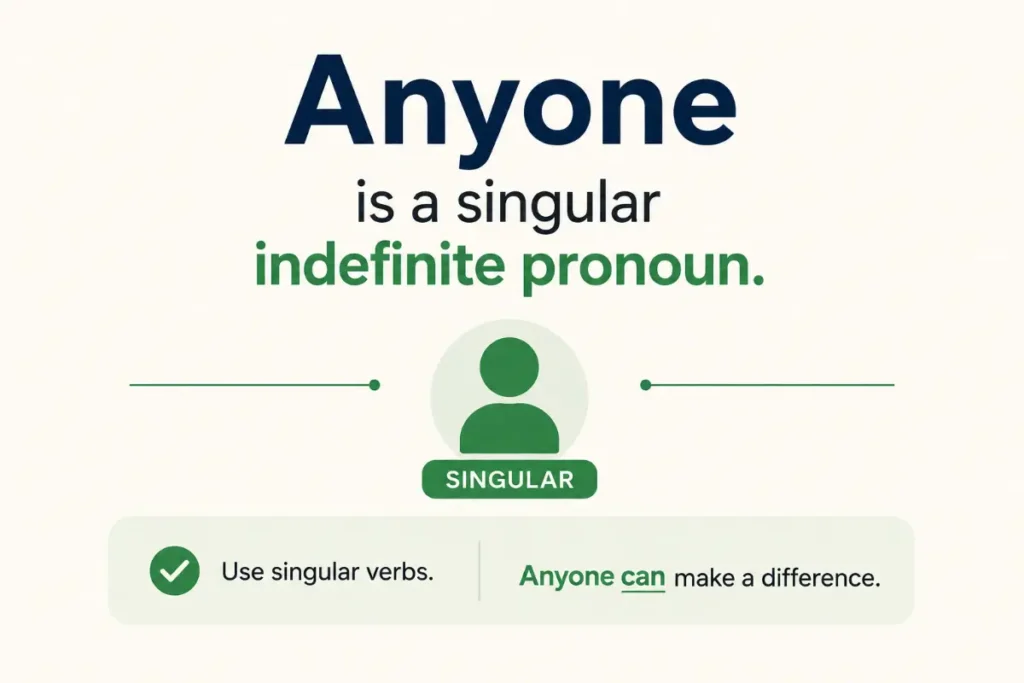
Anyone Has or Anyone Have is a common grammar question because anyone can refer to any person, but it may seem to represent several people. In standard English, however, anyone is a singular indefinite pronoun, so it generally takes a singular verb.
The basic rule is straightforward. When anyone is the subject of a statement, use has rather than have. For example, “Anyone has the opportunity to apply” uses the singular verb has, although a more natural sentence in many contexts would be “Anyone can apply.” In questions with the helping verb does, however, use have. For example, “Does anyone have a pen?” is correct because does already marks the singular form, leaving the main verb in its base form.
Understanding this difference makes English grammar easier because verb forms depend on sentence structure, not simply on how many people a pronoun might refer to. The same principle applies to anybody, somebody, everyone, and nobody.
This guide explains when to use has and have, with clear examples of statements, questions, and negative sentences. It also covers everyday usage, common grammatical mistakes, and practical tips to help you choose the correct verb with confidence.
Short Answer
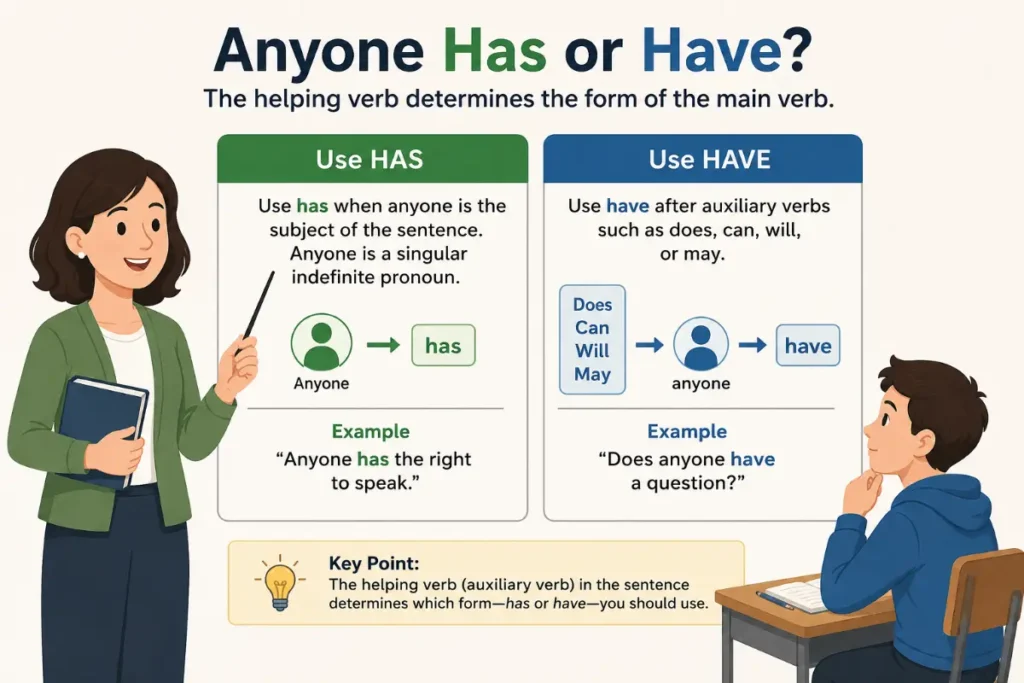
Anyone has is correct when anyone is the subject of a sentence because anyone is a singular indefinite pronoun. Use has in statements such as “Anyone has the right to speak.” However, use have after auxiliary verbs such as does, can, will, or may, as in “Does anyone have a question?” The helping verb determines the form of the main verb.
Table of Contents
- The basic grammar rule
- Why anyone is singular
- When to use has with anyone
- When to use have with anyone
- Anyone has or anyone have in questions
- Anyone has or anyone have in negative sentences
- Anyone with modal verbs
- Anyone with auxiliary verbs
- Comparison with similar indefinite pronouns
- Common mistakes
- Real life examples
- Formal and informal usage
- American and British English
- Pronunciation and grammar
- Memory tips
- Related grammar notes
- Frequently Asked Questions
- Key Takeaways
- Conclusion
The Basic Grammar Rule
The central rule is straightforward.
Anyone is singular, so it takes a singular verb when it functions as the subject.
Consider these examples.
“Anyone has the right to ask questions.”
“Anyone knows that good communication matters.”
The verbs has, is, and knows are singular forms. They agree with the singular pronoun anyone.
Compare that with a plural subject.
“They have the right to ask questions.”
“They know that good communication matters.”
The difference comes from subject verb agreement. English requires the verb to match the grammatical number of the subject in structures where agreement applies.
This leads to an important point. Anyone can refer to one person out of many possible people, but grammatically it behaves as singular.
That is why these sentences are correct.
“Anyone has access to the building.”
“Anyone knows how difficult that can be.”
In ordinary modern English, though, some of these statements may sound unnatural because of meaning or context. The grammar can be correct while the sentence itself may not express the intended idea naturally. This distinction becomes important when choosing between has and have.
Why Anyone Is Singular
The word anyone is an indefinite pronoun. It refers to an unspecified person rather than naming a particular individual.
Words ending in one and body often function as singular indefinite pronouns. These include anyone, anybody, someone, somebody, everyone, everybody, no one, and nobody. Even though everyone can refer to many people, grammar treats it as singular.
For example:
“Everyone has a responsibility.”
Not:
“Everyone have a responsibility.”
The same principle applies to anyone.
“Anyone has a chance to succeed.”
Not:
“Anyone have a chance to succeed.”
The apparent contradiction comes from the difference between meaning and grammatical form. Anyone can represent any individual from a larger group, but the word itself is grammatically singular.
You can think of anyone as meaning “any one person.” The word one provides a useful clue to its grammatical behavior.
When to Use Has With Anyone
Use has when anyone is the subject and there is no auxiliary verb that changes the structure.
For example:
“Anyone has the right to express an opinion.”
Here, anyone is the subject, and has is the main verb. Because anyone is singular, has is the correct form.
Another example is:
“Anyone has access to this information.”
The sentence uses anyone as the subject and has as the main verb.
More examples include:
“Anyone has the ability to learn a new language.”
“Anyone has enough time to reconsider the decision.”
In each example, anyone is grammatically singular.
However, there is a practical issue worth understanding. Although anyone has can be grammatically correct, native speakers often choose a different construction depending on the intended meaning.
For example, instead of saying:
“Anyone has the right to apply.”
A more natural version may be:
“Anyone can apply.”
The second sentence expresses permission or possibility more directly.
Likewise, instead of:
“Anyone has access to the file.”
You might say:
“Anyone can access the file.”
So grammar and natural style are not always identical. Has can be grammatically correct, but the surrounding meaning determines the most natural expression.
When to Use Have With Anyone
Use have when another verb or auxiliary requires the base form of the verb.
This is especially common in questions.
“Does anyone have a pen?”
“Does anyone have an answer?”
“Can anyone have access to this information?”
“Will anyone have enough time?”
In these examples, have is correct because the preceding auxiliary or modal controls the verb structure.
The most important example is:
“Does anyone have a question?”
Many learners see anyone and instinctively think that the sentence should contain has because anyone is singular. That would produce:
“Does anyone has a question?”
This is incorrect.
The correct sentence is:
“Does anyone have a question?”
Why?
Because does is the auxiliary verb that carries the present tense and singular agreement. After does, the main verb must appear in its base form.
The same pattern appears with other subjects.
“Does she have a question?”
Not:
“Does she has a question?”
“Does he have a car?”
Not:
“Does he has a car?”
“Does anyone have a car?”
Not:
“Does anyone has a car?”
The rule is consistent.
Anyone Has or Anyone Have in Questions
This is where the confusion becomes most common. In a direct question, anyone frequently appears after an auxiliary verb.
For example:
“Does anyone have a suggestion?”
“Does anyone have experience with this software?”
All four sentences use have, not has.
The reason is not that anyone suddenly becomes plural. It remains singular. The reason is that does carries the grammatical information.
The pattern is:
Does + anyone + have
Not:
Does + anyone + has
This is an example of do support, a grammatical structure used to form many questions and negative statements in English.
The same principle applies to somebody, everybody, and nobody.
“Does somebody have a pen?”
“Does nobody have an answer?”
Notice that have remains in the base form after does.
This is one of the most useful patterns to memorize.
Anyone Has or Anyone Have in Negative Sentences
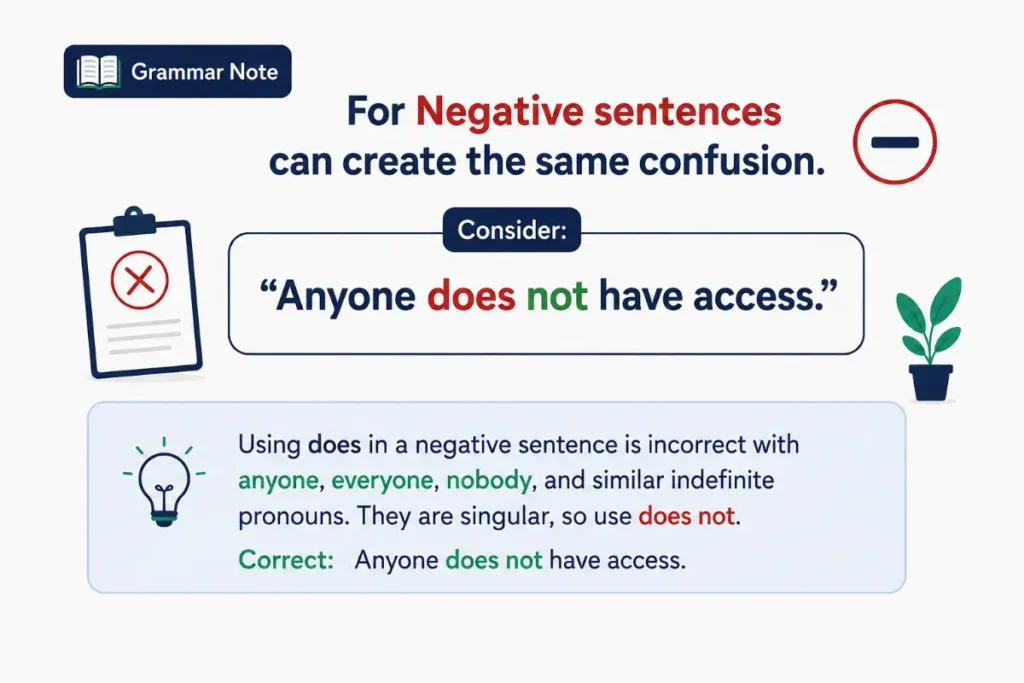
Negative sentences can create the same confusion.
Consider:
“Anyone does not have access.”
Although this sentence can be grammatically structured in certain contexts, it often sounds unnatural because the intended meaning is usually expressed with not everyone, nobody, or another construction.
A natural sentence is:
“Not anyone has access to the file.”
However, in everyday American English, people are more likely to say:
“Not everyone has access to the file.”
Or:
“Not just anyone has access to the file.”
The important grammatical point is that has agrees with anyone when anyone remains the subject of the main verb.
Now consider a question or negative structure with does.
“Does anyone have access?”
“Doesn’t anyone have access?”
The main verb is have, because does or doesn’t carries the tense and agreement.
Compare these forms:
“Anyone has access.”
“Does anyone have access?”
“Anyone does not have access.”
“Does anyone not have access?”
The wording and meaning differ, but the verb pattern follows the grammatical structure.
Anyone With Modal Verbs
Modal verbs are another major reason you will see have after anyone. Common modal verbs include can, could, may, might, must, shall, should, will, and would. After a modal verb, use the base form of the main verb.
Therefore:
“Can anyone have a second chance?”
Not:
“Can anyone has a second chance?”
Similarly:
“Will anyone have enough time?”
Not:
“Will anyone has enough time?”
Other examples include:
“Could anyone have predicted this result?”
“Would anyone have the courage to object?”
“Might anyone have another explanation?”
“Should anyone have access to these records?”
In all these examples, have is correct because the modal verb is followed by the base form.
The same rule applies to other verbs.
“Can anyone go?”
Not:
“Can anyone goes?”
“Will anyone know?”
Not:
“Will anyone knows?”
“Could anyone help?”
Not:
“Could anyone helps?”
Once you understand this pattern, choosing between has and have becomes much easier.
Anyone With Auxiliary Verbs
Auxiliary verbs are helping verbs that work with a main verb to form questions, negatives, tenses, and other grammatical structures. Common auxiliary verbs include do, does, did, has, have, had, be, and related forms. After does and did, use the base form of the main verb.
“Does anyone have a question?”
“Did anyone have a problem?”
Not:
“Does anyone has a question?”
Not:
“Did anyone had a problem?”
This is a crucial distinction.
The word does already marks the present tense and singular agreement. The word did marks the past tense. The following main verb therefore stays in its base form.
Compare:
“She has a car.”
“Does she have a car?”
“She had a car.”
“Did she have a car?”
The same structure applies to anyone.
“Anyone has a car.”
“Does anyone have a car?”
“Anyone had a car.”
“Did anyone have a car?”
The auxiliary changes the form of the sentence.
Comparison Table
| Sentence Pattern | Correct Form | Reason |
|---|---|---|
| Anyone has a chance. | Has | Anyone is singular. |
| Does anyone have a chance? | Have | Does requires the base form. |
| Can anyone have a chance? | Have | A modal takes the base form. |
| Anyone has access. | Has | Anyone is the subject of the main verb. |
| Did anyone have access? | Have | Did requires the base form. |
| Anyone had access. | Had | Had is the past form of have. |
| Will anyone have access? | Have | Will takes the base form. |
| Has anyone had access? | Had | Has is auxiliary and had is the participle form. |
The table shows why looking only at the word anyone is not enough. You must examine the entire verb phrase.
The Difference Between Has and Have
Has and have are different forms of the verb to have. In the present tense, has is normally used with third person singular subjects.
Examples include:
“He has a car.”
“She has a question.”
“It has a problem.”
“Anyone has a choice.”
“Someone has an answer.”
“Everyone has responsibilities.”
The form have is used with plural subjects and with I and you.
Examples include:
“I have a question.”
“You have a choice.”
“They have responsibilities.”
“We have enough time.”
But have is also used after auxiliary verbs and modal verbs, even when the subject is singular.
“Does she have a car?”
“Can he have another chance?”
“Will anyone have enough time?”
This is why memorizing only “anyone is singular, so always use has” can lead to mistakes.
The better rule is:
Anyone takes singular agreement, but the verb form depends on the grammatical structure.
Anyone and Other Indefinite Pronouns
Understanding anyone becomes easier when you compare it with similar pronouns.
Anyone
“Anyone has the right to speak.”
“Does anyone have a question?”
Someone
“Someone has left a message.”
“Does someone have the key?”
Everyone
“Everyone has a responsibility.”
“Does everyone have a ticket?”
Nobody
“Nobody has the answer.”
“Does nobody have an explanation?”
Anybody
“Anybody has the ability to learn.”
“Does anybody have a suggestion?”
The same principle applies throughout the group.
These pronouns are grammatically singular even when they refer to an unspecified person among many people.
Real Life Examples
Real conversations often use anyone in questions, which is why have appears so frequently.
Imagine a teacher addressing a classroom.
“Does anyone have a question?”
The teacher is not saying that anyone is plural. The word does creates the question, so the main verb is have.
Now imagine a manager asking a team for information.
“Does anyone have the latest report?”
Again, have is correct because of does.
At a meeting, someone might ask:
“Can anyone have access to this folder?”
Here, can is a modal, so have remains in the base form.
Now consider a statement:
“Anyone has the right to request a review.”
Here, anyone is the subject and has is the main verb.
Another example:
“Anyone has the ability to improve their writing.”
The singular subject takes has.
However, a more natural sentence in many contexts would be:
“Anyone can improve their writing.”
This example highlights the difference between grammatical possibility and idiomatic preference.
Common Mistakes
Mistake One
“Does anyone has a question?”
This is incorrect.
The correct form is:
“Does anyone have a question?”
The auxiliary does already carries the singular present tense. The main verb must remain in its base form.
Mistake Two
“Can anyone has a solution?”
This is incorrect.
The correct form is:
“Can anyone have a solution?”
After can, use the base form have.
Mistake Three
“Anyone have a question.”
In standard written English, this is incomplete as a statement.
The complete question is:
“Does anyone have a question?”
In casual speech, people sometimes use shortened or elliptical structures, but formal writing should use the complete grammatical construction.
Mistake Four
“Anyone have the right to enter.”
The standard statement is:
“Anyone has the right to enter.”
However, depending on the intended meaning, a more natural version may be:
“Anyone can enter.”
Mistake Five
“Did anyone had a problem?”
This is incorrect.
The correct sentence is:
“Did anyone have a problem?”
After did, use the base form have.
Mistake Six
“Everyone have a responsibility.”
This is incorrect in standard English.
The correct sentence is:
“Everyone has a responsibility.”
The same singular pronoun rule applies to everyone.
Why Questions Usually Use Have
If you frequently see have after anyone, that is because questions commonly use the auxiliary does.
The structure is:
Does + singular subject + base verb
Examples:
“Does she have a ticket?”
“Does someone have the answer?”
This pattern is so common that Does anyone have…? is one of the most natural question structures in English.
That explains why learners may begin to associate anyone with have. The association is understandable, but it is incomplete.
The word anyone does not determine the form by itself. The entire verb phrase determines the correct form.
When Anyone Has Sounds Less Natural
A sentence can follow a grammatical rule and still sound unusual.
For example:
“Anyone has the ability to learn.”
The sentence is grammatically possible, but many native speakers would prefer:
“Anyone can learn.”
Why?
The verb has expresses possession or a state of having something. The verb can expresses ability or possibility. The second sentence matches the intended meaning more directly.
Similarly:
“Anyone has permission to enter.”
A more natural alternative may be:
“Anyone can enter.”
Or:
“Anyone is allowed to enter.”
This does not mean anyone has is always wrong. It means you should choose the verb based on the meaning you want to express.
Consider this sentence:
“Anyone has the right to request a refund.”
Here, has the right is a recognized English expression, so has fits naturally.
The key is to understand the complete phrase rather than making a decision based on one word.
Formal and Informal Usage
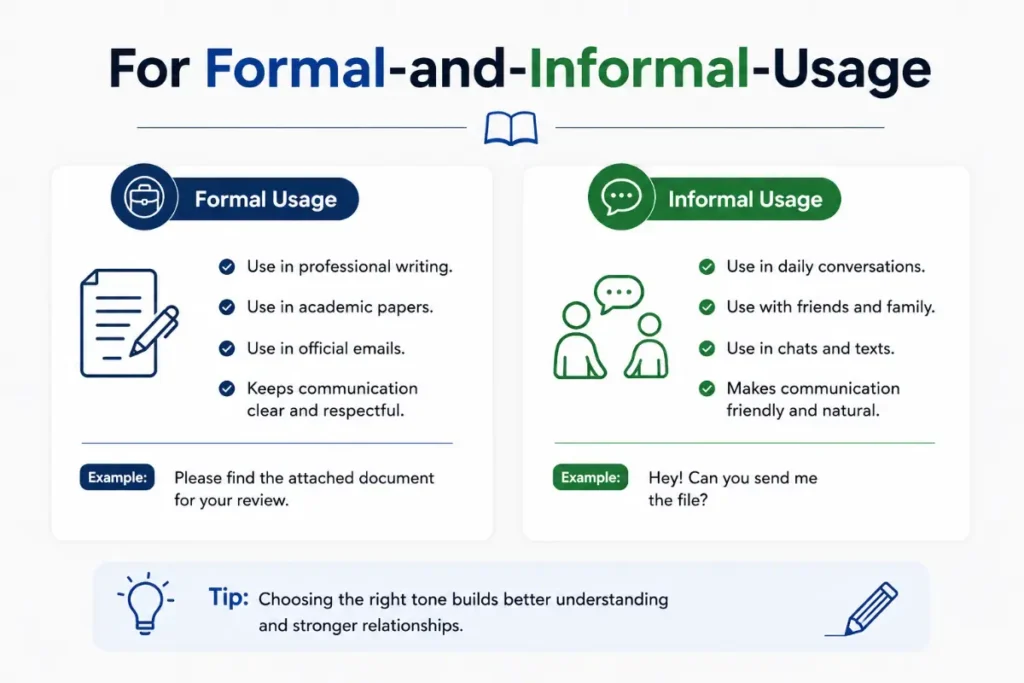
In formal writing, subject verb agreement should follow standard grammar.
Use:
“Anyone has the right to submit an appeal.”
Use:
“Does anyone have additional information?”
Avoid:
“Anyone have the right to submit an appeal.”
Avoid:
“Does anyone has additional information?”
Informal spoken English can contain shortened expressions. For example, a person might say:
“Anyone got a pen?”
This is common conversational English. It is an abbreviated form of:
“Has anyone got a pen?”
or:
“Does anyone have a pen?”
The informal version is understandable and natural in conversation, but it is not the best choice for formal writing.
For essays, reports, business documents, academic writing, and professional communication, use the complete structure.
American and British English
The core subject verb agreement rule is the same in American and British English.
Anyone is grammatically singular in both varieties.
Both varieties use:
“Does anyone have a question?”
Both also use:
“Anyone has the right to object.”
However, British English sometimes uses have got in situations where American English more commonly uses have.
For example:
“Has anyone got a pen?”
This construction is common in British English.
American English often prefers:
“Does anyone have a pen?”
Both are standard, but the preferred wording can vary by region and context.
The main grammar principle does not change. Anyone remains singular.
Pronunciation and Grammar
The pronunciation of anyone does not determine the verb form.
Anyone is generally pronounced with the stress on the first syllable:
AN ee wun
The word contains three syllables in common pronunciation.
The important point for grammar is not pronunciation but grammatical classification. Anyone functions as a singular indefinite pronoun.
This is similar to:
“Someone has arrived.”
“Everyone is ready.”
“Nobody knows.”
The ending one does not mean the word refers to a specific individual. It indicates an unspecified person.
Word Formation
The word anyone combines any with one.
The word any can suggest an unrestricted or unspecified choice from a group, while one identifies a person in this construction.
This helps explain why anyone behaves as singular.
Compare:
“Any student has the right to ask.”
“Anyone has the right to ask.”
In the first sentence, student is singular. In the second, anyone itself functions as a singular pronoun. The same concept appears in someone, everyone, and no one.
A Simple Way to Test the Sentence
For example:
“Does anyone have a question?”
Replace anyone with she:
“Does she have a question?”
That sounds correct.
Now test:
“Does anyone has a question?”
Replace anyone with she:
“Does she has a question?”
The problem becomes obvious.
The same test works with statements.
“Anyone has a question.”
Replace anyone with she:
“She has a question.”
The singular form has makes sense.
This substitution method is especially useful for learners who find subject verb agreement confusing.
Another Useful Test
Look for a helping verb before have.
If you see does, did, can, could, may, might, must, shall, should, will, or would, the following verb should normally be in its base form.
Therefore:
“Does anyone have…?”
“Did anyone have…?”
“Can anyone have…?”
“Will anyone have…?”
“Could anyone have…?”
But if anyone directly takes the main verb in a simple present statement:
“Anyone has…”
This quick check solves many common errors.
Has Anyone or Does Anyone Have
Another important distinction is between has anyone and does anyone have. Both structures can be correct, but they occur in different grammatical constructions. Has anyone…? can be used when has functions as an auxiliary verb, especially in the present perfect.
For example:
“Has anyone seen my phone?”
“Has anyone called the office?”
Here, has is helping form the present perfect.
The structure is:
Has + anyone + past participle
Now compare:
“Does anyone have my phone?”
Here, does is the auxiliary, and have is the main verb.
These sentences look similar but follow different grammar patterns.
“Has anyone seen the report?”
“Does anyone have the report?”
The first asks about an action that has happened. The second asks about possession.
Has Anyone Had
You may also encounter the structure has anyone had.
For example:
“Has anyone had this problem before?”
This is correct.
Here, has is the auxiliary verb, and had is the past participle of have.
Another example is:
“Has anyone had a chance to review the document?”
Again, has is helping form the present perfect.
This is different from:
“Does anyone have a chance to review the document?”
The first sentence asks about a completed or experienced situation up to the present. The second asks about current opportunity or possibility.
Understanding these verb forms helps prevent the mistaken idea that anyone always requires either has or have in isolation.
Memory Tips
A simple memory trick is:
Anyone is one, so use has when anyone directly takes the verb.
Think:
“Anyone has.”
But add a helping verb, and the main verb may change:
“Does anyone have?”
“Can anyone have?”
“Did anyone have?”
“Will anyone have?”
Another useful phrase to memorize is:
Does anyone have?
This is one of the most common question patterns in English.
If you remember that does is followed by the base form, you will avoid the common mistake does anyone has.
You can also remember this rule:
Helping verb first, base verb next.
Examples:
“Does anyone have?”
“Did anyone have?”
“Can anyone have?”
“Will anyone have?”
Related Grammar Notes
Anyone and Their
Modern standard English commonly uses singular they to refer back to an indefinite singular person when gender is unknown or irrelevant.
For example:
“Anyone can bring their own lunch.”
This is standard and natural in contemporary English.
The pronoun their does not change the fact that anyone is grammatically singular.
You still say:
“Anyone has the right to speak.”
Not:
“Anyone have the right to speak.”
The verb agrees with anyone, while their is used later as a gender neutral pronoun.
Everyone and Anyone and
Anyone and everyone are both singular indefinite pronouns, but their meanings differ.
Anyone generally refers to any person or an unspecified person.
Everyone refers to all members of a group.
“Everyone can apply.”
The grammatical rule remains the same:
“Anyone has…”
“Everyone has…”
Anyone and Anybody
Anyone and anybody usually have the same basic meaning and follow the same grammatical rules.
“Does anybody have a question?”
“Does anyone have a question?”
Both are correct.
In many contexts, the choice is mainly a matter of style and personal preference.
Anyone and Any People
Do not automatically replace anyone with any people.
For example:
“Does anyone have questions?”
is natural.
“Do any people have questions?”
is grammatically possible but usually changes the emphasis and sounds less natural in ordinary conversation.
The singular pronoun anyone is often the cleaner choice when referring to people individually.
Professional Writing Tips
When writing professionally, focus on the complete verb phrase instead of selecting has or have based only on anyone.
Before choosing the form, identify the subject and look for an auxiliary or modal.
Consider:
“Does anyone have an update?”
This is correct because does is the auxiliary.
Now consider:
“Anyone has the authority to approve this request.”
This is grammatically correct, although the meaning may make another construction more natural.
For example:
“Anyone with the required authority can approve this request.”
The revised sentence is clearer because it expresses permission or ability with can.
Professional writing benefits from both grammatical accuracy and natural phrasing. A technically possible construction is not always the strongest choice.
How to Choose the Most Natural Form
Ask yourself three questions.
First, is anyone the direct subject of a simple present verb?
If yes, a singular verb such as has, is, or knows may be required.
Second, is there an auxiliary such as does or did?
If yes, the main verb should usually be in its base form.
Third, is there a modal such as can, will, or could?
If yes, use the base form after the modal.
For example:
“Anyone has the right to complain.”
“Does anyone have the right to complain?”
“Can anyone have the right to complain?”
The verb form changes because the grammatical structure changes.
Quick Grammar Checklist
When checking a sentence with anyone, identify the subject first.
If the sentence is:
“Anyone has a choice.”
Use has.
If the sentence is:
“Does anyone have a choice?”
Use have.
If the sentence is:
“Can anyone have a choice?”
Use have.
If the sentence is:
“Did anyone have a choice?”
Use have.
If the sentence is:
“Has anyone had a choice?”
Use had, because has is the auxiliary and had is the past participle.
This method is more reliable than trying to memorize isolated examples.
Key Takeaways
- Anyone is a singular indefinite pronoun.
- Use has when anyone directly functions as the subject of a simple present main verb.
- Use have after does, did, and modal verbs such as can, could, may, might, must, should, and will.
- “Does anyone have a question?” is correct.
- “Does anyone has a question?” is incorrect.
- “Anyone has the right to speak” can be grammatically correct, although another construction may sound more natural depending on the intended meaning.
- Has anyone had…? is correct because has is the auxiliary and had is the past participle.
- The same singular rule applies to someone, somebody, everyone, everybody, nobody, and no one.
- The best way to choose the correct form is to examine the entire verb phrase rather than looking at anyone alone.
- In professional writing, choose the grammatically correct structure and the wording that communicates the intended meaning naturally.
Conclusion
The correct choice between Anyone Has or Anyone Have depends on the sentence structure. Anyone is a singular pronoun, so it takes has when used as the subject with a simple present main verb. However, use have after auxiliary verbs and modal verbs because they determine the form of the main verb.
For example, say “Anyone has the right to speak” when has is the main verb. In a question, use “Does anyone have a question?” because does is the auxiliary verb. After a modal verb such as can, use have, as in “Can anyone have another opportunity?”
The key rule is that anyone remains singular, even when it refers to people in a group. To choose the correct verb, identify the sentence structure and look for auxiliary or modal verbs such as does, did, can, and will. This makes it easier to know when to use has and when to use have.
Frequently Asked Questions
Is “Anyone Has” or “Anyone Have” Correct?
Anyone has is correct when anyone is the subject of a simple present statement and has is the main verb. However, use have when an auxiliary or modal verb requires the base form. For example, “Does anyone have a question?” and “Can anyone have another opportunity?” are both grammatically correct.
Is It “Does Anyone Has” or “Does Anyone Have”?
The correct form is “Does anyone have?” When using does to form a question, the main verb must remain in its base form. Therefore, “Does anyone has a question?” is incorrect, while “Does anyone have a question?” is correct.
Why Does Anyone Take “Has”?
Anyone is a singular indefinite pronoun. When it directly serves as the subject of a simple present statement, it takes a singular verb form, such as has. For example, “Anyone who has a question can ask” follows standard subject-verb agreement.
Can I Say “Anyone Have”?
Yes, but the grammatical structure matters. In questions such as “Does anyone have a pen?”, the word have follows the auxiliary does.
Is “Anyone Has” Grammatically Correct?
Yes, anyone has can be grammatically correct when anyone is the subject of the main verb. However, the phrase may sound unnatural without additional context. For example, “Anyone who has a ticket can enter” sounds more natural than “Anyone has a ticket” when describing a general rule.
Is “Anyone” Singular or Plural?
Anyone is grammatically singular, even though it can refer to any person in a group. Therefore, standard English uses expressions such as “Anyone is welcome” and “Anyone has the right to ask.” The verb must agree with the singular pronoun.
Should I Say “Does Anyone Have” or “Does Anyone Has”?
Always use “Does anyone have?” in standard English. The auxiliary does already carries the present-tense and third-person singular marking, so the main verb remains in its base form, have.
Is “Has Anyone Have” Correct?
No, “has anyone have” is generally incorrect in standard English. When has functions as an auxiliary verb, it must be followed by a past participle. For example, “Has anyone had lunch?” and “Has anyone seen the report?” are correct. When asking about possession, use “Does anyone have…?”
Is “Has Anyone Had” Correct?
Yes, “Has anyone had?” is grammatically correct when the context makes the meaning clear. Here, has is the auxiliary verb, and had is the past participle of have. For example, “Has anyone had a chance to review the document?” is correct.
Do “Does Anyone Have” and “Has Anyone Got” Sound Different?
Both expressions are correct, but they follow different grammatical structures and may vary in regional preference. “Does anyone have a pen?” is common in American English, while “Has anyone got a pen?” is particularly common in British English. Both ask whether someone has a pen.
Is “Does Anyone Have a Question?” Correct?
Yes. “Does anyone have a question?” is completely correct. The word does functions as the auxiliary verb, while have is the main verb in its base form. This is the standard way to ask whether anyone has a question.
Why Is “Does Anyone Has” Wrong?
“Does anyone has” is incorrect because does already marks the third-person singular present tense. In this question structure, the main verb does not take an additional third-person singular ending. Therefore, use “Does anyone have?” rather than “Does anyone has?”

English Grammar & Usage
Nathan Holloway is an American grammar writer and language researcher who specializes in English grammar, sentence structure, verb usage, and common writing mistakes. He enjoys breaking down confusing grammar rules into practical explanations with clear examples, making English easier for students, professionals, and everyday writers.