
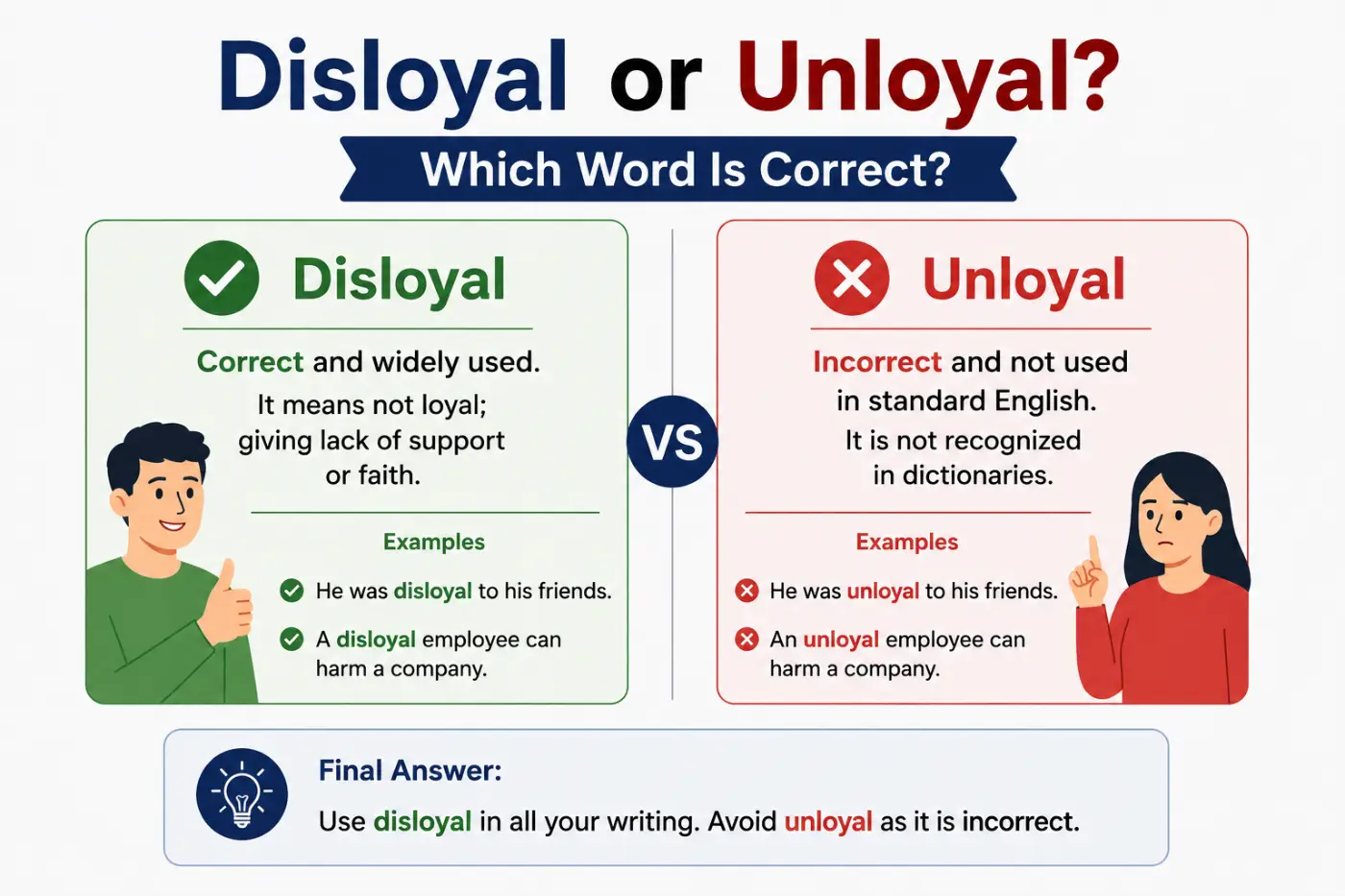
Disloyal or Unloyal is a common word choice question because English uses several prefixes to create negative adjectives. Since loyal means faithful and supportive, it may seem logical to form the opposite by adding un and writing unloyal. However, standard modern English strongly favors disloyal for the opposite of loyal.
The difference matters most in polished writing. You might see unloyal occasionally, especially in older texts or less common varieties of English, but disloyal is the form recognized and regularly used by major modern dictionaries. Oxford defines disloyal as not loyal to or not supportive of friends, family, a country, or similar people and groups. Cambridge likewise defines it as not supporting someone you should support.
This guide explains the meaning, pronunciation, grammar, word history, regional usage, common mistakes, and practical examples so you can choose the right word confidently.
Short Answer
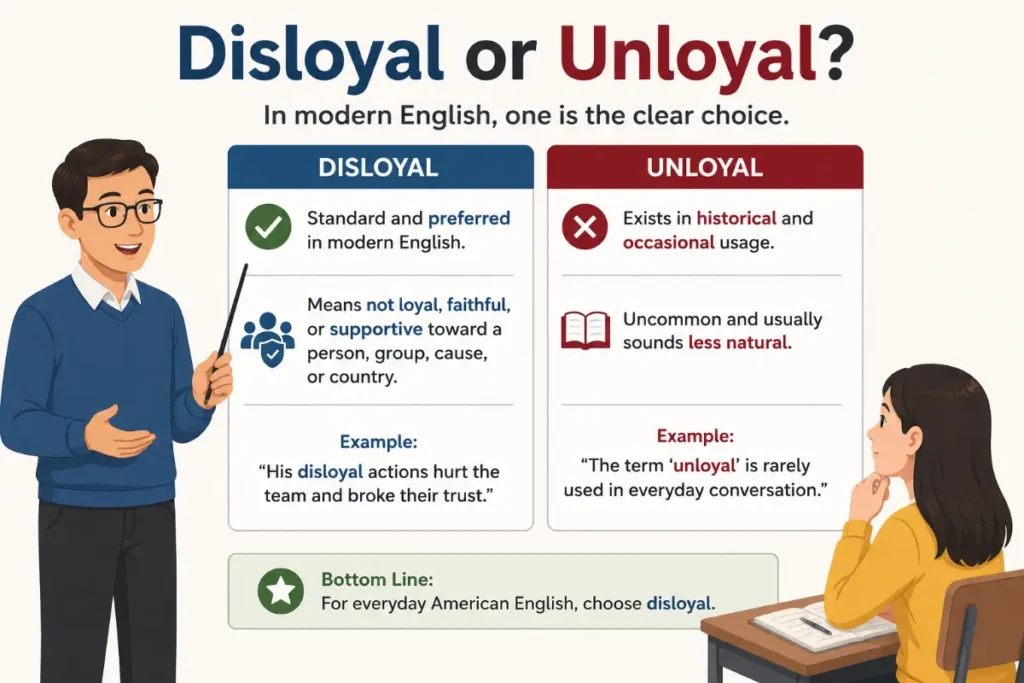
Disloyal or Unloyal can look like a simple spelling choice, but disloyal is the standard and preferred word in modern English. It means not loyal, faithful, or supportive toward a person, group, cause, or country. Unloyal exists in historical and occasional usage, but it is uncommon and usually sounds less natural. For everyday American English, choose disloyal.
Table of Contents
- Which Word Is Correct
- Meaning of Disloyal
- Meaning of Unloyal
- Disloyal or Unloyal in Modern English
- Why Disloyal Is Preferred
- Pronunciation Guide
- Grammar and Word Forms
- How to Use Disloyal Correctly
- Real Life Examples
- Common Mistakes
- Disloyal Compared With Similar Words
- Formal and Informal Usage
- American and British English
- Word Origin
- Memory Tips
- Related Grammar Notes
- Frequently Asked Questions
- Key Takeaways
- Conclusion
Which Word Is Correct
The standard choice is disloyal.
Use disloyal when you mean that someone is not loyal, faithful, supportive, or dependable toward a person, group, organization, cause, or country.
For example:
She felt that her friend had been disloyal.
The sentence means that the friend had failed to show the expected loyalty or support.
Another example is:
The employee was accused of being disloyal to the company.
Here, disloyal describes an employee who is believed to have acted against the interests or expectations of the company.
Major dictionaries recognize disloyal as a standard adjective. Oxford lists it as an adjective meaning not loyal or not supportive, while Cambridge gives the sense of failing to support someone who should receive your support.
Unloyal is not the usual modern choice. It can be found in some historical writing and occasional contemporary usage, but it is far less common and generally not the form you should choose in careful American English.
The safest rule is simple:
Use disloyal as the normal opposite of loyal.
Meaning of Disloyal
Disloyal is an adjective describing a person, action, statement, decision, or behavior that fails to show loyalty. Loyalty involves continuing to support someone or something. Oxford defines loyal in terms of remaining constant in support, and it identifies disloyal as its opposite.
A person can be disloyal to a friend, family member, employer, team, organization, country, political group, or cause.
Consider these examples:
He was disloyal to his closest friend.
The adjective describes his behavior toward his friend.
She considered the criticism disloyal.
The criticism itself is being judged as a failure to show appropriate support.
The player was accused of being disloyal to the team.
The word describes an alleged lack of commitment to the team.
The meaning depends on the relationship involved. Disloyalty is not simply disagreement. A person can disagree with a friend, employer, political party, or organization without being disloyal.
That distinction is important.
If an employee respectfully points out a serious problem at work, that does not automatically make the employee disloyal. If the employee deliberately betrays confidential information or acts against the organization after making a commitment to protect it, disloyal may be appropriate.
Meaning of Unloyal
Unloyal is understandable because English commonly uses un to create negative forms.
For example, English has:
- unhappy
- unfair
- unkind
- uncertain
- unfaithful
- unreliable
That pattern can make unloyal appear perfectly logical.
However, logical formation does not always determine standard usage. English has developed many pairs in which one negative form became established while another possible form remained rare.
Unloyal is an example of a form that can be understood but is not normally preferred in contemporary standard English.
If you write:
He was unloyal to his friends.
Most readers will understand your meaning immediately. The problem is not comprehension. The problem is naturalness and standard usage.
A more polished version is:
He was disloyal to his friends.
The second sentence uses the established modern form.
This distinction is useful for students, editors, writers, and anyone preparing formal English. A word does not have to be impossible or meaningless to be a poor choice. Some forms are simply much less conventional than others.
Disloyal or Unloyal in Modern English
Disloyal or Unloyal is best resolved by looking at actual modern usage rather than relying only on prefix rules.
Modern dictionaries consistently give disloyal as the normal adjective. Oxford provides its pronunciation, definition, examples, and word origin. Cambridge also lists it as an established adjective in both British and American dictionary material.
The noun related to the adjective is disloyalty.
For example:
The betrayal was an act of disloyalty.
Oxford defines disloyalty as the fact of not showing support for people or groups who should receive it.
The related forms create a useful word family:
| Word | Part of Speech | Meaning |
|---|---|---|
| loyal | adjective | faithful and supportive |
| disloyal | adjective | not loyal or supportive |
| loyalty | noun | the quality of being loyal |
| disloyalty | noun | the quality or act of being disloyal |
| loyally | adverb | in a loyal manner |
| disloyally | adverb | in a disloyal manner |
This established family is another practical reason to choose disloyal.
Why Disloyal Is Preferred
The preference for disloyal is partly historical.
The prefix dis has long been used to express separation, reversal, opposition, or negation. English has many established words using this prefix, including dishonest, disrespectful, disobedient, and disloyal.
Oxford traces disloyal to late fifteenth century Old French desloial, formed with a negative prefix and the word meaning loyal.
This history helps explain why English did not simply settle on unloyal as the ordinary opposite.
English vocabulary is shaped by history, borrowing, pronunciation, frequency, and convention. It is not a perfectly predictable system in which every adjective has exactly one negative form based on a fixed prefix rule.
That is why learners should avoid assuming that every adjective ending in a particular pattern can be negated with un.
The correct form often depends on established usage.
Pronunciation Guide
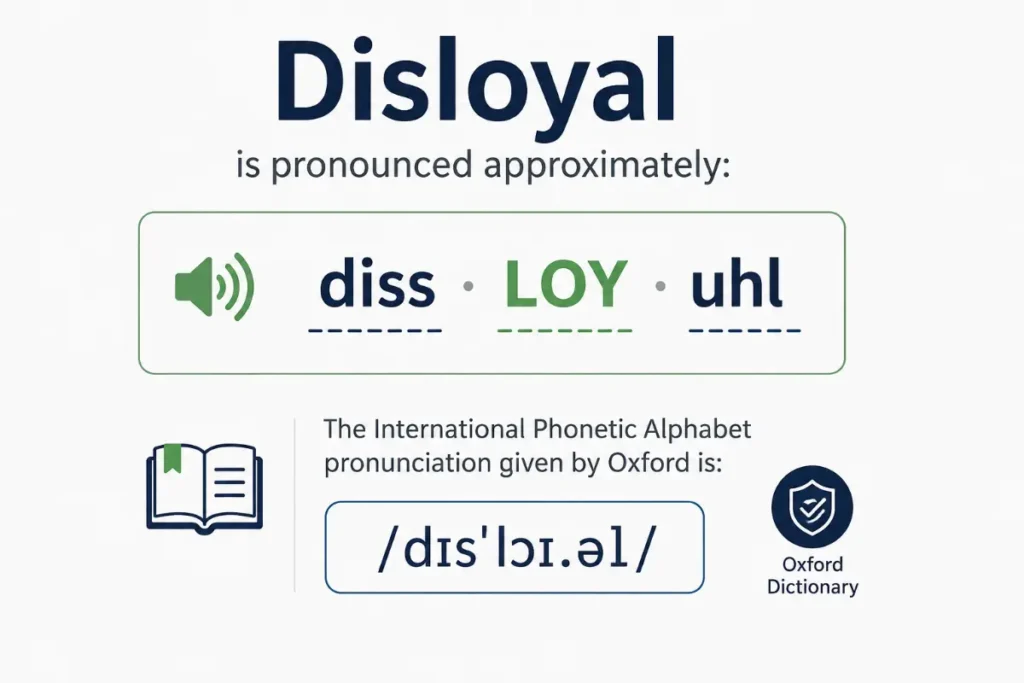
Disloyal is pronounced approximately:
diss LOY uhl
The International Phonetic Alphabet pronunciation given by Oxford is:
/dɪsˈlɔɪəl/
Cambridge gives the same general pronunciation pattern for both British and American English.
The main stress falls on the second syllable.
You can divide the word mentally like this:
dis + loyal
The loy sound is the same sound you hear in loyalty.
Do not pronounce it as if the word were dis low ull. The middle sound contains the familiar loy sound.
The noun disloyalty is pronounced approximately:
diss LOY uhl tee
Oxford gives the pronunciation as /dɪsˈlɔɪəlti/.
Grammar and Word Forms
Disloyal is an adjective.
It can appear before a noun:
He made a disloyal remark.
It can also appear after a linking verb:
His behavior was disloyal.
A particularly common construction is disloyal to.
For example:
She was disloyal to her friend.
He was disloyal to the organization.
They believed the decision was disloyal to the people who had supported them.
The preposition to is important because English normally uses disloyal to someone or something.
Avoid replacing to with with simply because the relationship involves another person.
Less natural:
He was disloyal with his brother.
Natural:
He was disloyal to his brother.
The adjective can also modify abstract ideas and groups.
The article was disloyal to the principles the author once defended.
Here, the word describes a perceived failure to remain faithful to certain principles.
How to Use Disloyal Correctly
The most common structure is:
subject + be + disloyal + to + person or thing
Examples include:
Mark was disloyal to his friend.
The politician was accused of being disloyal to his party.
She felt disloyal to her family after revealing the secret.
The player was not disloyal to the team.
The word can describe behavior rather than a permanent character trait.
For example:
He made one disloyal decision.
This sentence does not necessarily mean that the person is always disloyal. It identifies one action as a failure of loyalty.
Compare it with:
He is a disloyal employee.
This statement makes a broader judgment about the employee’s character or repeated behavior.
That difference matters because adjectives can sometimes turn a description of an action into a judgment about a person.
Good professional writing should make that distinction clear.
Real Life Examples
Example 1
Sarah felt that her coworker had been disloyal.
The sentence describes Sarah’s perception. It does not prove that the coworker actually acted disloyally.
Example 2
The manager considered the employee’s decision disloyal to the team.
Here, the adjective describes the decision rather than directly labeling the employee.
Example 3
He remained loyal to his friend despite strong criticism from others.
This sentence uses the positive form loyal. The opposite would be:
He became disloyal to his friend after the disagreement.
The contrast makes the relationship between the two adjectives easy to remember.
Example 4
The newspaper was accused of being disloyal to its readers.
The word describes a perceived failure to act in accordance with the trust or support expected from the publication.
Example 5
She thought leaving the organization would be disloyal.
This sentence shows that disloyal can describe an action someone considers a betrayal.
Example 6
His disloyal behavior damaged the friendship.
Here, the adjective modifies behavior.
Example 7
The coach rejected the claim that the player was disloyal.
The sentence demonstrates that the word can appear in reported judgments and accusations.
Example 8
Revealing the private conversation would have been disloyal.
The adjective describes the proposed action.
Example 9
The company accused the former employee of disloyal conduct.
The adjective modifies conduct and gives the phrase a formal tone.
Example 10
She remained loyal to her principles even when doing so was difficult.
This example is useful because loyalty is not limited to people. It can involve principles, beliefs, causes, organizations, or ideals.
Common Mistakes
One frequent mistake is assuming that unloyal must be correct because un commonly expresses negation.
For example:
He was unloyal to his friends.
The meaning is clear, but disloyal is the standard modern choice.
Better:
He was disloyal to his friends.
Another mistake is confusing disloyal with dishonest.
A person can be dishonest without being disloyal. Dishonesty concerns truthfulness or deception, while disloyalty concerns support, faithfulness, or allegiance.
For example:
The employee lied about the report.
That is dishonest.
The employee secretly worked against the company after promising to support it.
That may be described as disloyal.
A third mistake is assuming that disagreement equals disloyalty.
I disagree with my manager’s decision.
This sentence does not mean:
I am disloyal to my manager.
Disagreement and disloyalty are not synonyms.
Another mistake is using disloyal when unfaithful is more precise in a romantic context.
For example:
He was unfaithful to his wife.
This specifically communicates sexual or romantic infidelity. Cambridge defines unfaithful in this relationship sense.
Disloyal is broader. It can describe betrayal or lack of support in many different relationships.
Disloyal Compared With Similar Words
Several words overlap with disloyal, but they are not identical.
Disloyal and Unfaithful
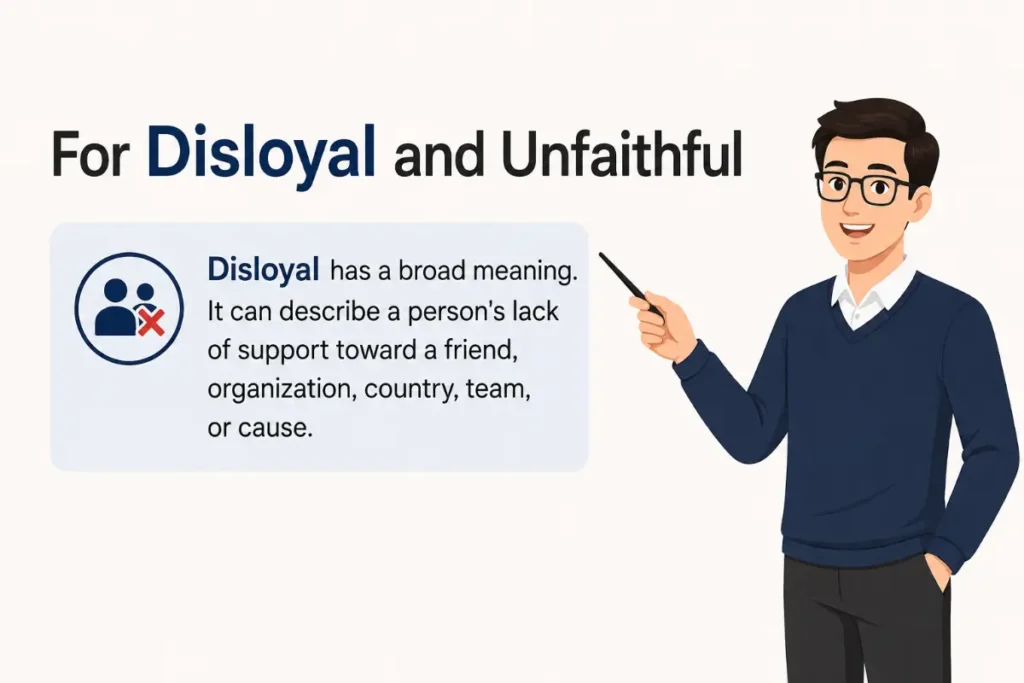
Disloyal has a broad meaning. It can describe a person’s lack of support toward a friend, organization, country, team, or cause.
Unfaithful can also mean not loyal, but in ordinary modern usage it is strongly associated with romantic or marital infidelity.
He was disloyal to his business partner.
This focuses on loyalty.
He was unfaithful to his wife.
This normally focuses on sexual or romantic betrayal.
Disloyal and Untrustworthy
Untrustworthy means not deserving trust.
A person can be untrustworthy because they lie, break promises, misuse confidential information, or behave unpredictably.
Disloyalty specifically involves a failure of allegiance or support.
She is untrustworthy because she repeatedly lies.
She was disloyal to her longtime friend.
The first sentence focuses on trust. The second focuses on loyalty.
Disloyal and Betraying
Betraying describes an act of betrayal.
His actions were disloyal.
His actions betrayed his friend.
The words overlap, but they function differently grammatically and can carry different shades of meaning.
Disloyal and Treacherous
Treacherous is much stronger.
It can suggest serious betrayal, danger, or deliberate deception.
His disloyal behavior damaged their relationship.
The treacherous act put everyone at risk.
The second sentence carries a much more severe tone.
Disloyal and Faithless
Faithless is another related adjective, but it often sounds literary, formal, or emotionally strong.
The king considered the servant faithless.
Modern everyday American English generally favors disloyal when simply describing a lack of loyalty.
Formal and Informal Usage
Disloyal works in casual conversation, journalism, professional writing, academic prose, and formal documents.
In conversation, you might say:
I thought he was disloyal.
In professional writing:
The board regarded the conduct as disloyal to the organization.
For journalism:
Critics accused the former official of being disloyal to the party.
In literary writing:
The ruler feared that his advisers had become disloyal.
The word itself does not sound excessively formal. Its tone depends mainly on the context.
The noun disloyalty can sound more formal:
The company investigated allegations of disloyalty.
That construction is common in serious discussions of workplace relationships, politics, organizations, and personal betrayal.
American and British English
The preferred word is the same in American and British English: disloyal.
Oxford provides American dictionary information for disloyal and gives the same basic meaning and pronunciation pattern. Cambridge also lists the word in its English and American dictionary material.
There is no important American versus British spelling difference here.
You do not normally need to change disloyal depending on the country.
The same applies to the noun:
disloyalty
and the adverb:
disloyally
The main difference you may encounter is not regional spelling but variation in how often uncommon alternatives such as unloyal appear in older or less standard texts.
For modern professional writing, disloyal is the safer choice in both varieties.
Word Origin
The history of disloyal helps explain its modern form.
Oxford traces the adjective to late fifteenth century Old French desloial. The word combines a negative element with the older form related to loyal.
The word loyal itself entered English through French and ultimately has a connection with Latin legalis, related to lex, meaning law. Oxford dates loyal to the mid sixteenth century in English.
This history demonstrates an important fact about English vocabulary. Modern spelling is often the result of centuries of development rather than a simple mathematical rule.
You cannot always predict the standard opposite of an adjective merely by choosing un or dis.
Established usage matters.
Memory Tips
The easiest memory trick is to pair the words:
loyal → disloyal
Think of disloyal as the established opposite of loyal.
Another useful method is to remember the noun family:
loyal → loyalty
disloyal → disloyalty
If you know disloyalty is the standard noun for a lack of loyalty, disloyal becomes easier to remember as the adjective.
You can also connect the word with familiar dis words:
loyal → disloyal
honest → dishonest
respectful → disrespectful
obedient → disobedient
This does not mean every opposite must use dis. It simply helps you remember the established form in this particular case.
A final memory sentence is:
A loyal person supports you; a disloyal person fails to show that support.
Related Grammar Notes
Use To After Disloyal
The most natural construction is disloyal to.
She was disloyal to her friend.
He was disloyal to his employer.
They accused him of being disloyal to the organization.
This pattern is worth memorizing because learners sometimes choose the wrong preposition.
Disloyal Does Not Always Mean Evil
Calling someone disloyal is a judgment about loyalty. It does not automatically mean that the person is dishonest, cruel, immoral, or dangerous.
A person might be considered disloyal simply because they stopped supporting a group.
For example:
The manager viewed her resignation as disloyal.
That does not establish that she did anything unethical. It only reports the manager’s judgment.
Disloyal Can Describe Actions
You can describe a person as disloyal:
He was disloyal to his friend.
You can also describe an action, statement, remark, decision, or behavior:
That was a disloyal remark.
Her decision was seen as disloyal.
His behavior was disloyal.
This flexibility makes the word useful in many contexts.
Disloyalty Is a Noun
When you need a noun, use disloyalty.
His disloyalty hurt the team.
She was accused of disloyalty.
The company investigated allegations of disloyalty.
Oxford and Cambridge both recognize disloyalty as the noun related to disloyal.
Disloyally Is the Adverb
The adverb is disloyally.
He acted disloyally toward his former employer.
This means he acted in a manner that showed a lack of loyalty.
The form is less common in everyday speech than the adjective disloyal, but it is grammatically valid.
Professional Writing Tips
When editing formal English, replace unloyal with disloyal unless you have a specific reason to preserve an unusual historical quotation or source wording.
This small change can make writing sound more natural and conventional.
For example:
The report describes him as unloyal to the organization.
A cleaner version is:
The report describes him as disloyal to the organization.
Another example:
Her unloyal behavior caused concern.
Preferred:
Her disloyal behavior caused concern.
In professional writing, familiar vocabulary usually communicates more effectively than an uncommon alternative.
This is especially useful in resumes, reports, essays, business communication, journalism, and educational material.
When You Should Not Use Disloyal
Do not automatically use disloyal whenever someone changes their mind.
Changing an opinion is not necessarily disloyal.
She changed her political opinion.
That statement says nothing about loyalty.
Likewise, leaving a company is not automatically disloyal.
He left the company for a better opportunity.
The adjective becomes appropriate only when the context involves a perceived failure of loyalty or support.
This distinction prevents overly emotional or inaccurate word choices.
The same principle applies to relationships.
A friend who disagrees with you is not automatically disloyal. A family member who makes an independent decision is not necessarily disloyal. A worker who criticizes an employer is not automatically disloyal.
Context determines the appropriate description.
Why Unloyal Sounds Unnatural to Many Readers
The word unloyal follows a pattern that looks familiar, but frequency and convention affect how natural a word feels.
English speakers encounter disloyal regularly enough for it to be immediately recognized as the standard opposite of loyal. The form unloyal is much less familiar.
This is similar to other vocabulary choices where a theoretically possible construction is not the preferred conventional form.
Language learners often try to create words logically. That strategy can work sometimes, but English contains many established forms that must simply be learned.
For this reason, vocabulary learning should include common word partnerships rather than isolated definitions.
Learning loyal and disloyal together is more useful than learning loyal alone and trying to construct its opposite later.
Quick Comparison
| Feature | Disloyal | Unloyal |
|---|---|---|
| Standard modern English | Yes | No, not normally preferred |
| Meaning | Not loyal or supportive | Intended to mean not loyal |
| Common in modern writing | Yes | Rare |
| Appropriate for professional writing | Yes | Usually avoid |
| Common dictionary form | Yes | Not the normal modern choice |
| Opposite of loyal | Yes | Sometimes encountered |
| Best choice for American English | Yes | Usually no |
The central point is simple: disloyal is the established modern choice.
Key Takeaways
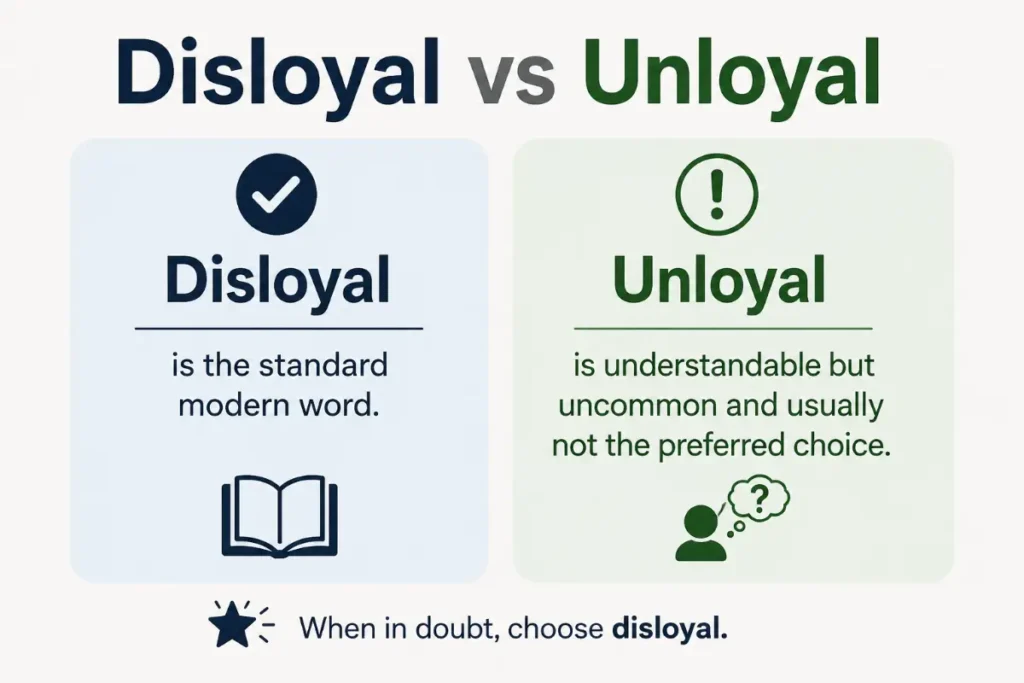
- Disloyal is the standard modern word.
- Unloyal is understandable but uncommon and usually not the preferred choice.
- Use disloyal as the normal opposite of loyal.
- The most common grammar pattern is disloyal to someone or something.
- Disloyal can describe people, actions, remarks, decisions, behavior, and statements.
- The noun form is disloyalty.
- The adverb form is disloyally.
- Disloyal does not automatically mean dishonest, evil, or untrustworthy.
- Disagreement does not automatically equal disloyalty.
- Unfaithful can be more precise when the context specifically involves romantic or marital infidelity.
- American and British English both favor disloyal.
- For professional, academic, and polished everyday writing, choose disloyal.
Conclusion
Disloyal or Unloyal is not a difficult choice once standard modern usage is clear. Disloyal is the established and preferred adjective for someone or something that is not loyal, faithful, or supportive. Unloyal may appear occasionally, but it is uncommon and generally not the best choice for contemporary American English.
Remember the simplest pair: loyal and disloyal.
Use disloyal to when describing a lack of loyalty toward a person, group, organization, country, cause, or principle. Use disloyalty when you need the noun and disloyally when you need the adverb. When your goal is clear, natural, standard English, choose disloyal.
Frequently Asked Questions
Is Disloyal or Unloyal Correct?
Disloyal is the standard and preferred word in modern English. Unloyal can be found occasionally, but it is uncommon and usually sounds less natural. For everyday American English and professional writing, choose disloyal.
Is Unloyal a Real Word?
Unloyal can be encountered in English, so it is understandable rather than meaningless. However, it is not the normal modern form used to express the opposite of loyal. Standard contemporary writing generally uses disloyal.
What Does Disloyal Mean?
Disloyal means not loyal, faithful, or supportive toward a person, group, organization, country, cause, or other object of loyalty. Cambridge defines it as not supporting someone whom you should support.
What Is the Opposite of Loyal?
The standard opposite of loyal is disloyal. Oxford explicitly identifies disloyal as the opposite of loyal.
What Is the Noun Form of Disloyal?
The noun form is disloyalty.
For example:
His disloyalty damaged their friendship.
Disloyalty refers to the quality, behavior, or act of failing to show loyalty.
Is Disloyal a Formal Word?
Disloyal works in both everyday and formal English. You can use it in conversation, professional writing, journalism, academic writing, and literary contexts.
Is Disloyal the Same as Unfaithful?
Not always. Disloyal has a broad meaning related to loyalty and support. Unfaithful is often used specifically for romantic or marital infidelity. The correct choice depends on the context.
What Preposition Follows Disloyal?
The standard construction is disloyal to.
For example:
He was disloyal to his friend.
Avoid using disloyal with when you mean a lack of loyalty toward a person.
Can Disloyal Describe an Action?
Yes. You can describe a person, action, remark, decision, statement, or behavior as disloyal.
For example:
The remark was disloyal.
The sentence describes the remark as failing to show appropriate support or loyalty.
Is Disloyal Used in American English?
Yes. Disloyal is standard in American English. Oxford’s American dictionary lists the word with the same basic meaning and pronunciation pattern.

Confusing Words, Spelling & Word Choice
Claire Whitmore is a U.S.-based English editor who writes about commonly confused words, spelling differences, and word choice. Her work helps readers understand subtle distinctions between similar-looking words through simple definitions, practical examples, and modern usage guidance in both American and British English.