
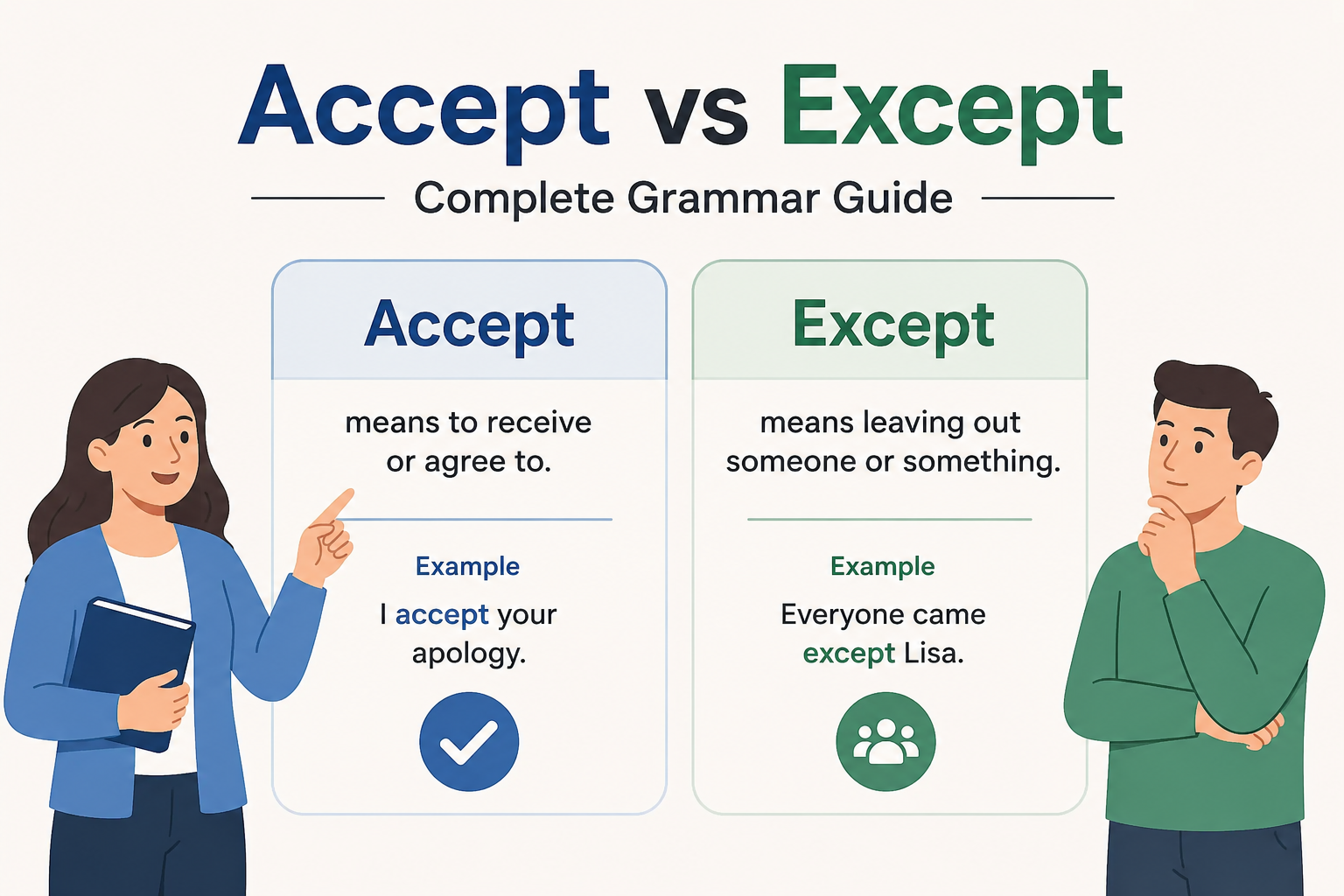
Have you ever typed a sentence and stopped because you weren’t sure if you needed Accept vs Except? These words cause confusion because they look similar and sound almost identical in many varieties of English. Their meanings, however, are clearly different. The easiest way to separate them is to connect each word with one central idea. Accept means to receive, agree to, approve, or acknowledge something. Except means to leave something or someone out.
For example, you can accept an invitation, accept a gift, or accept responsibility. You can also say that everyone came to the meeting except Maria. In the first examples, something is being received or acknowledged. In the second, one person is excluded from a group.
This distinction matters in school assignments, emails, business writing, applications, reports, and everyday conversations. A single wrong word can change the meaning of a sentence.
Short Answer
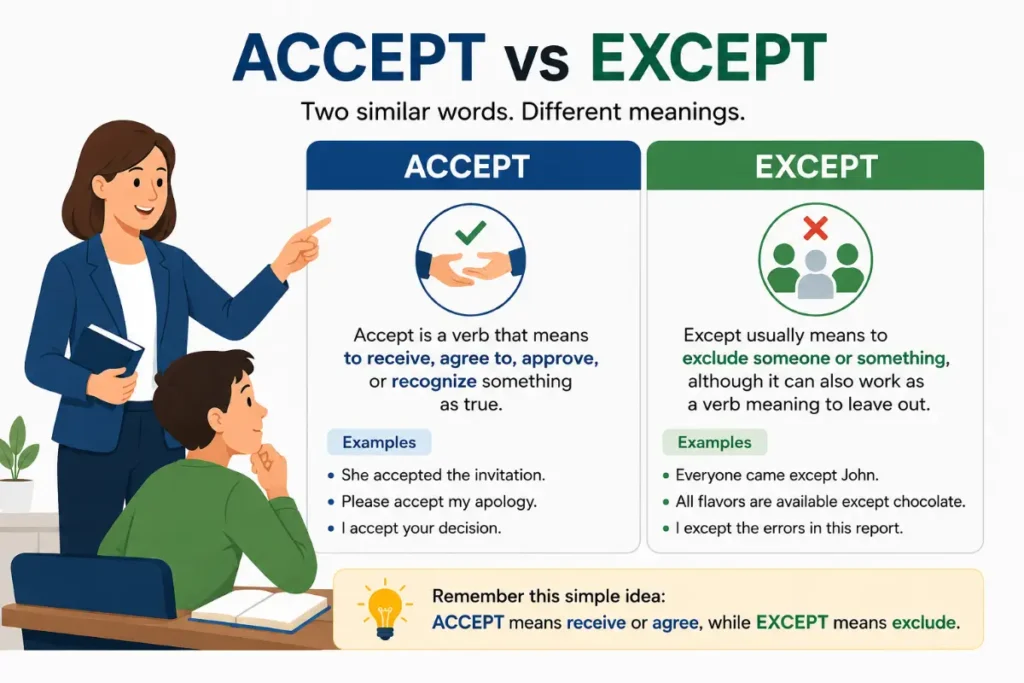
Accept is a verb that means to receive, agree to, approve, or recognize something as true. Except usually means to exclude someone or something, although it can also work as a verb meaning to leave out. The two words sound similar but have different meanings and grammatical roles. Remember this simple idea: accept means receive or agree, while except means exclude.
Table of Contents
- The Basic Difference
- What Accept Means
- What Except Means
- Accept As A Verb
- Except As A Preposition
- Except As A Verb
- Accept And Except In Sentence Patterns
- Pronunciation
- Word Origins
- Comparison Table
- Real Life Examples
- Common Mistakes
- Memory Tricks
- Formal And Informal Usage
- American And British English
- Related Words
- Related Expressions
- Professional Writing Tips
- Key Takeaways
- Frequently Asked Questions
- Conclusion
The Basic Difference
The central distinction in Accept vs Except is simple.
Accept means to receive something, agree to something, approve something, or recognize something as true or valid.
Except means to exclude something or someone from a group, statement, rule, or action.
Consider these two sentences:
- I accepted the job offer.
The speaker agreed to take the job. The word accepted shows agreement or willingness to receive the offer.
- Everyone accepted the invitation except John.
The verb accepted means the people agreed to the invitation. The word except identifies John as the person who was excluded from the group of people who accepted it.
This example shows why the words can appear in the same sentence while performing completely different jobs.
A useful mental shortcut is:
Accept = receive or agree.
Except = exclude or leave out.
The difference becomes even clearer when you replace each word with a simpler phrase.
If receive, agree, approve, or acknowledge makes sense, you probably need accept.
If excluding, leaving out, or with the exception of makes sense, you probably need except.
What Accept Means
Accept is primarily a verb. It describes an action involving receiving, agreeing, approving, acknowledging, or recognizing something.
The exact meaning depends on the context.
Accept Means To Receive
You can accept something that someone offers, gives, sends, or presents to you.
For example:
- She accepted the award.
She received the award.
- He accepted the package from the delivery driver.
He received the package.
- The restaurant accepts credit cards.
The restaurant allows customers to use credit cards as a form of payment.
In each example, accept involves receiving something or allowing something to be received.
Accept Means To Agree
Accept can also mean agreeing to an offer, proposal, invitation, request, or arrangement.
- We accepted the invitation.
We agreed to attend the event.
- The company accepted her proposal.
The company approved or agreed to her proposal.
- He accepted the terms of the contract.
He agreed to the stated conditions.
This meaning appears frequently in professional and academic writing.
Accept Means To Approve
Someone can accept an idea, plan, application, proposal, or suggestion.
- The committee accepted the proposal.
The committee approved the proposal.
- The editor accepted the article.
The editor approved the article for publication.
- The university accepted her application.
The university approved her application for admission.
Accept Means To Acknowledge
Accept can also mean acknowledging something as true, valid, real, or unavoidable.
- She accepted the fact that she had made a mistake.
She acknowledged the truth of the situation.
- He finally accepted responsibility for the accident.
He acknowledged that he was responsible.
- We must accept the results.
We must acknowledge the results instead of denying them.
This meaning is common in personal, professional, academic, and legal contexts.
What Except Means
Except most commonly works as a preposition. It introduces a person or thing that is excluded from a larger group.
For example:
- Everyone was invited except Tom.
Tom was the only person excluded from the invitation.
- I eat all vegetables except mushrooms.
Mushrooms are excluded from the group of vegetables the speaker eats.
- The store is open every day except Sunday.
Sunday is excluded from the days when the store is open.
In these sentences, except can often be replaced with excluding or with the exception of.
Except As An Exclusion Word
Think about except as drawing a boundary around something.
If you say:
Everyone passed except James.
You mean that everyone passed, but James did not.
If you say:
I like every flavor except chocolate.
You mean that chocolate is the one flavor you are excluding from the group you like.
This makes except especially useful when describing exceptions to general statements.
Except As A Verb
Although except is commonly used as a preposition, it can also function as a verb.
As a verb, except means to exclude or leave out.
For example:
- The rule excepts employees with special authorization.
The rule excludes those employees from its general application.
- The contract excepts certain expenses.
The contract leaves certain expenses outside the stated arrangement.
This verb use is grammatically correct but less common in ordinary conversation. Most speakers are more likely to say exclude.
For everyday writing, exclude is often clearer when you want to express the action directly.
Compare these sentences:
- The policy excepts temporary workers.
- The policy excludes temporary workers.
The second sentence sounds more natural to most modern readers.
Accept As A Verb
Unlike except, accept is extremely common as a verb in everyday English.
It can appear with many different objects.
You can accept:
- An invitation.
- An offer.
- A gift.
- An apology.
- Responsibility.
- A decision.
- A proposal.
- A payment.
- A challenge.
- A fact.
- A request.
- A condition.
- A result.
- A compliment.
- A job.
The meaning changes slightly with context, but the basic idea remains connected to receiving, agreeing, approving, or acknowledging.
Accept With An Object
A common grammatical structure is:
Subject + accept + object.
For example:
- Maria accepted the offer.
Maria is the subject. Accepted is the verb. The offer is the object.
- The manager accepted my request.
The manager performed the action of accepting. My request is the object.
- They accepted the terms.
They agreed to the terms.
This structure makes accept easy to recognize in many sentences.
Except As A Preposition
A common structure with except is:
General statement + except + excluded person or thing.
Examples include:
- Everyone attended except David.
- The museum is open every day except Monday.
- I finished all the questions except number seven.
- She likes every subject except chemistry.
- The entire team agreed except one member.
In each sentence, except identifies an exception. Another useful test is to replace except with excluding. Everyone attended excluding David. The museum is open every day excluding Monday. I finished all the questions excluding number seven. The replacement may sound slightly formal or unnatural in some cases, but the basic meaning remains clear.
Accept And Except In Sentence Patterns
Understanding common sentence patterns can prevent mistakes.
Pattern One With Accept
Accept + object
- She accepted the gift.
- We accepted the offer.
- He accepted the apology.
- The school accepted the application.
Pattern Two With Accept
Accept + noun phrase + as
This pattern can express recognition or classification.
- The court accepted the document as evidence.
- The committee accepted the explanation as valid.
- Scientists accepted the finding as reliable after further testing.
The word as helps show the role or status given to something.
Pattern Three With Except
Everyone or everything + except + noun
- Everyone came except Sarah.
- Everything was ready except the printer.
- Every seat was occupied except one.
Pattern Four With Except
General statement + except for + noun
- The trip was excellent except for the weather.
- The report was complete except for a few missing details.
- The room was perfect except for the noise.
Except for often introduces a specific condition or detail that prevents a general statement from being completely true.
Pronunciation
The pronunciation of accept and except is one reason learners confuse them. In standard American English, accept is commonly pronounced approximately like:
uhk SEPT
The stress falls on the second syllable.
Except is commonly pronounced approximately like:
ik SEPT
Again, the second syllable receives the main stress.
The final part of both words sounds very similar. The main difference appears at the beginning.
Accept begins with an unstressed sound similar to the beginning of about.
Except begins with a sound similar to the beginning of exact.
Listening carefully to the first syllable can help you distinguish them in speech.
Word Origins
The two words have related historical roots, which helps explain their similar appearance. Accept comes through French from Latin roots connected with taking or receiving. Except also comes through French from Latin and is connected with taking out or excluding. The historical relationship is interesting because their meanings developed in different directions.
You can think of the historical idea behind accept as taking something in. You can think of the historical idea behind except as taking something out. That distinction provides another useful memory aid.
Comparison Table
| Feature | Accept | Except |
|---|---|---|
| Main grammatical role | Verb | Preposition, sometimes verb |
| Core meaning | Receive, agree, approve, acknowledge | Exclude or leave out |
| Common replacement | Receive, approve, agree | Excluding, excluding from, with the exception of |
| Example | I accepted the offer. | Everyone came except Mike. |
| Main idea | Taking something in | Leaving something out |
| Common use | Offers, gifts, requests, responsibility | Exceptions and exclusions |
| Pronunciation | uhk SEPT | ik SEPT |
The easiest distinction remains:
Accept brings something in.
Except leaves something out.

Real Life Examples
The best way to master these words is to see them in situations you might actually encounter.
School And Education
- The teacher accepted my late assignment.
The teacher agreed to receive the assignment even though I submitted it after the deadline.
- Everyone completed the homework except Ben.
Ben is the only student excluded from the group that completed the homework.
- The university accepted her application.
The university approved her application.
- We studied every chapter except Chapter Six.
Chapter Six is excluded from the chapters studied.
Workplace Communication
- The manager accepted the proposal.
The manager approved the proposal.
- Everyone attended the meeting except the director.
The director did not attend.
- The company accepted my resignation.
The company acknowledged and approved the resignation.
- The policy applies to all employees except contractors.
Contractors are excluded from the policy.
Shopping And Payments
- This store accepts cash and credit cards.
The store allows customers to use those payment methods.
- They accept returns within thirty days.
They allow customers to return eligible products within the stated period.
- The discount applies to every item except clearance products.
Clearance products are excluded.
- The cashier accepted my coupon.
The cashier allowed the coupon to be used.
Social Situations
- She accepted my invitation.
She agreed to the invitation.
- Everyone was at the party except Daniel.
Daniel was not there.
- He accepted the apology.
He acknowledged the apology.
- We invited all our neighbors except the family next door.
That family was intentionally left out.
Everyday Conversation
- I accept your explanation.
I acknowledge or believe your explanation.
- I can’t accept this gift.
I don’t want to receive the gift.
3. She accepted the challenge.
She agreed to take on the challenge.
Common Mistakes
Many mistakes happen because the words look and sound similar. The following errors are especially common.
Mistake One
Incorrect:
Everyone was invited accept John.
Correct:
Everyone was invited except John.
The sentence identifies John as an exception. It does not describe someone receiving or agreeing to something.
Mistake Two
Incorrect:
I except your apology.
Correct:
I accept your apology.
The speaker is acknowledging the apology. The correct verb is accept.
Mistake Three
Incorrect:
She excepted the job offer.
Correct:
She accepted the job offer.
The person agreed to the offer, so accepted is correct.
Mistake Four
Incorrect:
Everyone accept Maria finished the test.
Correct:
Everyone except Maria finished the test.
Maria is excluded from the group of people who finished the test.
Mistake Five
Incorrect:
The company excepted our proposal.
Correct:
The company accepted our proposal.
The company approved the proposal.
Mistake Six
Incorrect:
I accept everyone from the meeting.
Correct:
I except everyone from the meeting.
This sentence is grammatically possible if the intended meaning is exclusion, but exclude would normally be clearer:
I excluded everyone from the meeting.
The distinction shows why context matters. Accept and except don’t simply differ by one letter. They express opposite ideas in many situations.
How To Choose The Correct Word
When you’re unsure, don’t focus only on spelling. Focus on the meaning of the sentence.
Ask yourself:
Am I talking about receiving, agreeing, approving, or acknowledging something?
If yes, use accept.
Ask yourself:
Am I identifying someone or something that is left out?
If yes, use except.
Consider:
Everyone finished the assignment ___ Tom.
Tom is left out, so use except.
I ___ the assignment.
If the meaning is that you received or agreed to the assignment, accept may be correct depending on the context.
This meaning based approach works better than trying to remember the spelling alone.
Memory Tricks
A good memory trick can make these words much easier.
Accept Has An A
Think:
A = Accept = Agree.
Both accept and agree begin with the letter A.
You can accept an invitation because you agree to it.
Except Excludes
Think:
EX = out.
The beginning of except can remind you of something being outside or excluded.
So:
Accept = take in.
Except = leave out.
Think About The Action
Imagine someone offering you a gift. You accept the gift. Now imagine a group photo where one person isn’t included. That person is excepted from the group in the technical verb sense, although excluded is more natural in everyday English. These visual associations make the difference easier to remember.
Formal And Informal Usage
Both words appear in formal and informal English, but they perform different jobs.
Accept is common in professional communication.
You might see:
The company accepted the proposal.
The client accepted the revised terms.
The editor accepted the manuscript.
The applicant accepted the position.
Except is also common in formal writing.
You might see:
The policy applies to all employees except temporary staff.
All applications must be submitted by Friday except those covered by an approved extension.
The rule applies to every department except Finance.
Both words are ordinary English words. Neither one is inherently more formal than the other.
American And British English
The distinction between accept and except is essentially the same in American and British English. American English uses accept for receiving, agreeing, approving, and acknowledging.
British English uses it in the same basic ways. Likewise, except functions primarily as an exclusion word in both varieties. The spelling does not normally change between American and British English. This means you don’t need a separate American rule and British rule for these two words. The key issue is meaning and grammatical function.
Accept And Except In Professional Writing
Accuracy matters in professional writing because these words can completely change a sentence.
Consider:
All employees must attend except those on approved leave.
This means employees on approved leave don’t have to attend.
Now consider:
All employees must attend accept those on approved leave.
The second version contains a spelling error and can distract readers or reduce confidence in the document.
In business emails, reports, applications, contracts, instructions, and formal notices, always proofread sentences containing these words.
A useful editing technique is to search for accept and except separately when reviewing an important document. Check the meaning of every occurrence rather than relying only on spell check.
Spell check may not catch the error because both words are correctly spelled English words.
Why Spell Check May Not Catch The Error
This is an important point for writers.
Suppose you write:
I except your offer.
The sentence contains a correctly spelled word. A basic spell checker may not identify it as a spelling mistake.
The real problem is word choice.
The intended sentence is probably:
I accept your offer.
This is a usage error, not necessarily a spelling error.
The same problem occurs here:
Everyone accept James arrived early.
The word accept is spelled correctly, but the sentence needs except.
This is why proofreading requires attention to meaning, not just spelling.
Similar Words That Cause Confusion
Several other English words can create confusion around this topic.
Accept And Approve
Accept can mean to receive or agree to something.
Approve specifically emphasizes official agreement or permission.
For example:
The manager accepted the proposal.
The manager approved the proposal.
The two sentences can have similar meanings, but approve often emphasizes authorization.
Except And Exclude
Except commonly introduces the person or thing left out.
Exclude is a verb meaning to leave someone or something out.
Compare:
Everyone came except Sarah.
The organizer excluded Sarah from the list.
The words are closely related but have different grammatical roles.
Except And Expect
Except means excluding.
Expect means to think something will happen or to anticipate something.
For example:
Everyone came except John.
I expect John to arrive soon.
These words are easy to confuse in speech because they look similar, but their meanings are completely different.
Accept And Excepted
Accepted is the common past tense and past participle of accept.
Excepted is the past tense and past participle of except when except is used as a verb.
Examples:
The proposal was accepted.
The item was excepted from the rule.
The first sentence means the proposal was approved or received.
The second means the item was excluded.
In ordinary modern writing, excluded is often a clearer alternative to excepted.
Related Expressions With Accept
Several common expressions use accept.
Accept An Offer
To agree to an offer.
She accepted the job offer.
Accept Responsibility
To acknowledge responsibility for something.
He accepted responsibility for the mistake.
Accept An Apology
To acknowledge an apology and indicate that you are ready to move forward.
She accepted his apology.
Accept The Consequences
To acknowledge that you must deal with the results of an action.
He accepted the consequences of his decision.
Accept A Challenge
To agree to take on a difficult task.
They accepted the challenge.
Accept The Facts
To recognize something as true.
Eventually, she accepted the facts.
These expressions reinforce the core idea of accept as receiving, agreeing, or acknowledging.
Related Expressions With Except
Except For
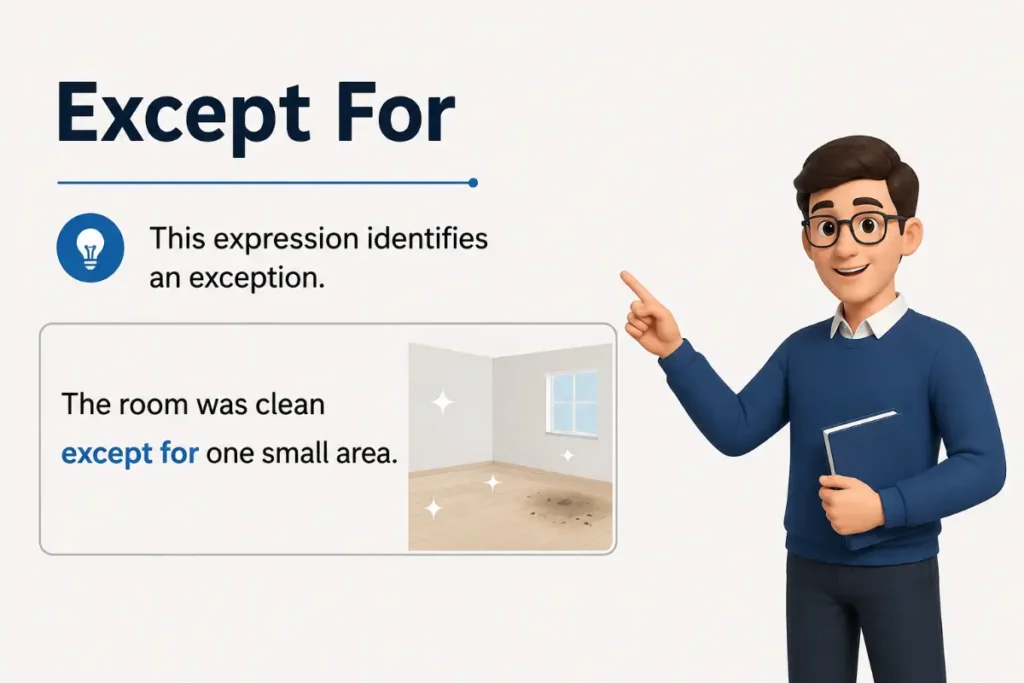
This expression identifies an exception.
The room was clean except for one small area.
Everyone Except
This structure identifies one or more excluded people.
Everyone except Mark agreed.
Anything Except
This means something is not included in a category.
The task was anything except easy.
Nothing Except
This means only the stated thing or things.
The box contained nothing except old papers.
These structures are useful because they appear frequently in everyday and professional English.
Professional Writing Tips
When writing an important document, use the following approach.
Check The Meaning
Don’t ask only, “Is this word spelled correctly?”
Ask, “Does this word express the meaning I intend?”
This catches errors that ordinary spell checking misses.
Replace The Word
Try replacing accept with receive, agree, or approve.
If the sentence still makes sense, accept may be correct.
Try replacing except with excluding or with the exception of.
If the meaning remains the same, except is probably correct.
Read The Sentence Aloud
Pronunciation can help you notice the difference, especially when the context is clear.
If the sentence describes receiving or agreeing, listen for accept.
If it identifies something left out, think except.
Watch For High Risk Phrases
Pay special attention to phrases such as:
I accept your offer.
I accept your apology.
Everyone except John.
All students except those absent.
The policy applies to everyone except contractors.
These patterns occur often enough that recognizing them can speed up proofreading.
Key Takeaways
- Accept is mainly a verb.
- Accept means to receive, agree to, approve, or acknowledge something.
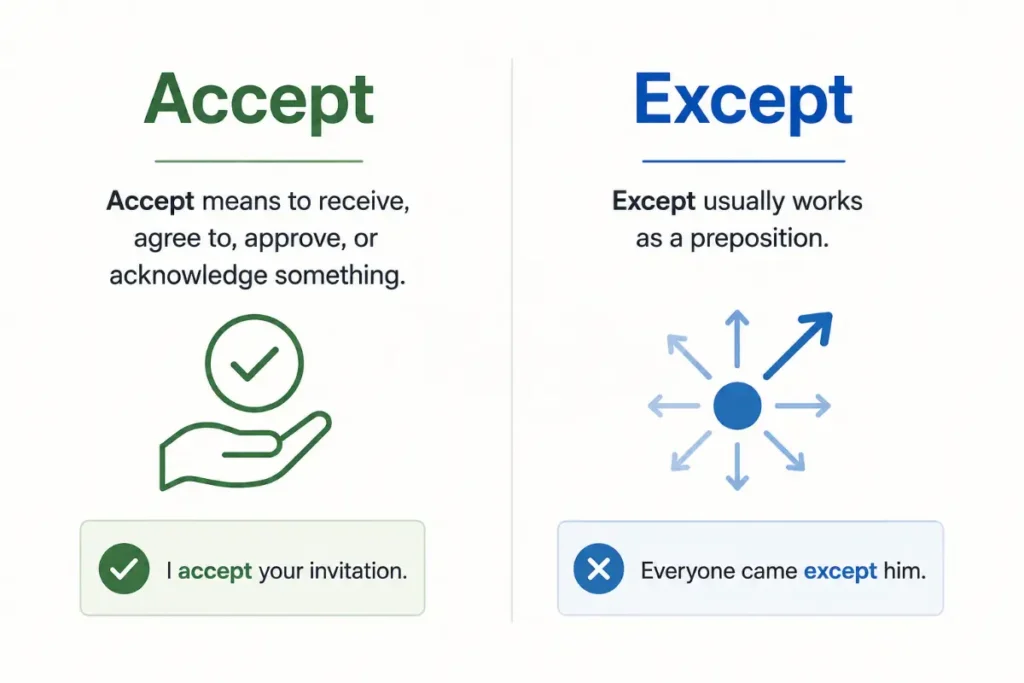
- Except usually works as a preposition.
- Except means excluding or leaving someone or something out.
- Except can also function as a verb, although exclude is usually more natural in everyday writing.
- Use accept in sentences such as “I accepted the offer.”
- Use except in sentences such as “Everyone came except John.”
- Accept and except are pronounced similarly, which contributes to their confusion.
- American and British English use the two words in essentially the same way.
- Spell check may not catch a mistake because both words are correctly spelled.
- The fastest memory trick is accept means take in, except means leave out.
Conclusion
The difference between Accept vs Except becomes simple once you connect each word with its main idea. Accept means to receive, agree, approve, or acknowledge. You can accept a gift, accept an invitation, accept an offer, accept responsibility, or accept an apology. Except means to exclude or leave out. You can say that everyone attended except Sarah, that a store is open every day except Sunday, or that a rule applies to everyone except certain people.
The fastest memory trick is accept means take in, while except means leave out. When you’re proofreading, focus on the meaning rather than spelling alone. If you’re receiving or agreeing, choose accept. If you’re identifying an exception, choose except.
Once you learn that simple distinction, these two commonly confused words become much easier to use accurately in everyday conversation, academic writing, emails, and professional documents.
Frequently Asked Questions
What is the difference between accept and except?
Accept means to receive, agree, approve, or acknowledge something. Except means to exclude or leave someone or something out. For example, “She accepted the offer” means she agreed to it, while “Everyone came except James” means James was not included.
Is it accept or except an apology?
Use accept.
The correct sentence is:
I accept your apology.
The verb means that you acknowledge and receive the apology.
Is it accept or except an invitation?
Use accept.
The correct sentence is:
She accepted the invitation.
The sentence means that she agreed to the invitation.
Is everyone accept or everyone except?
Use everyone except when you want to identify someone who is excluded.
For example:
Everyone except Maria attended the meeting.
Maria did not attend, so she is the exception.
Can except be a verb?
Yes. Except can function as a verb meaning to exclude or leave out. However, this use is less common in everyday English. Writers often choose exclude because it is clearer.
Are accept and except homophones?
They are not exact homophones in standard American English because their first syllables differ. However, their pronunciation is very similar, especially in fast speech, which makes them easy to confuse.
Which is correct accept responsibility or except responsibility?
The correct phrase is accept responsibility.
It means acknowledging that you are responsible for something.
For example:
He accepted responsibility for the error.
Which is correct accept for or except for?
Both can be correct, but they have different functions. Except for introduces an exception. The house was perfect except for the small kitchen. Accept for is not normally used as the same kind of expression. If you mean an exception, use except for.
Can I use except as a synonym for accept?
No. The two words do not have the same meaning.
Accept relates to receiving, agreeing, approving, or acknowledging.
Except relates to excluding or leaving out.
Replacing one with the other can change the meaning of a sentence completely.
Why do people confuse accept and except?
People confuse them because they look similar and sound similar. Both contain the same final syllable, and both begin with an unstressed vowel sound in many pronunciations. Their different meanings and grammatical roles are the best way to tell them apart.

English Grammar & Usage
Nathan Holloway is an American grammar writer and language researcher who specializes in English grammar, sentence structure, verb usage, and common writing mistakes. He enjoys breaking down confusing grammar rules into practical explanations with clear examples, making English easier for students, professionals, and everyday writers.