
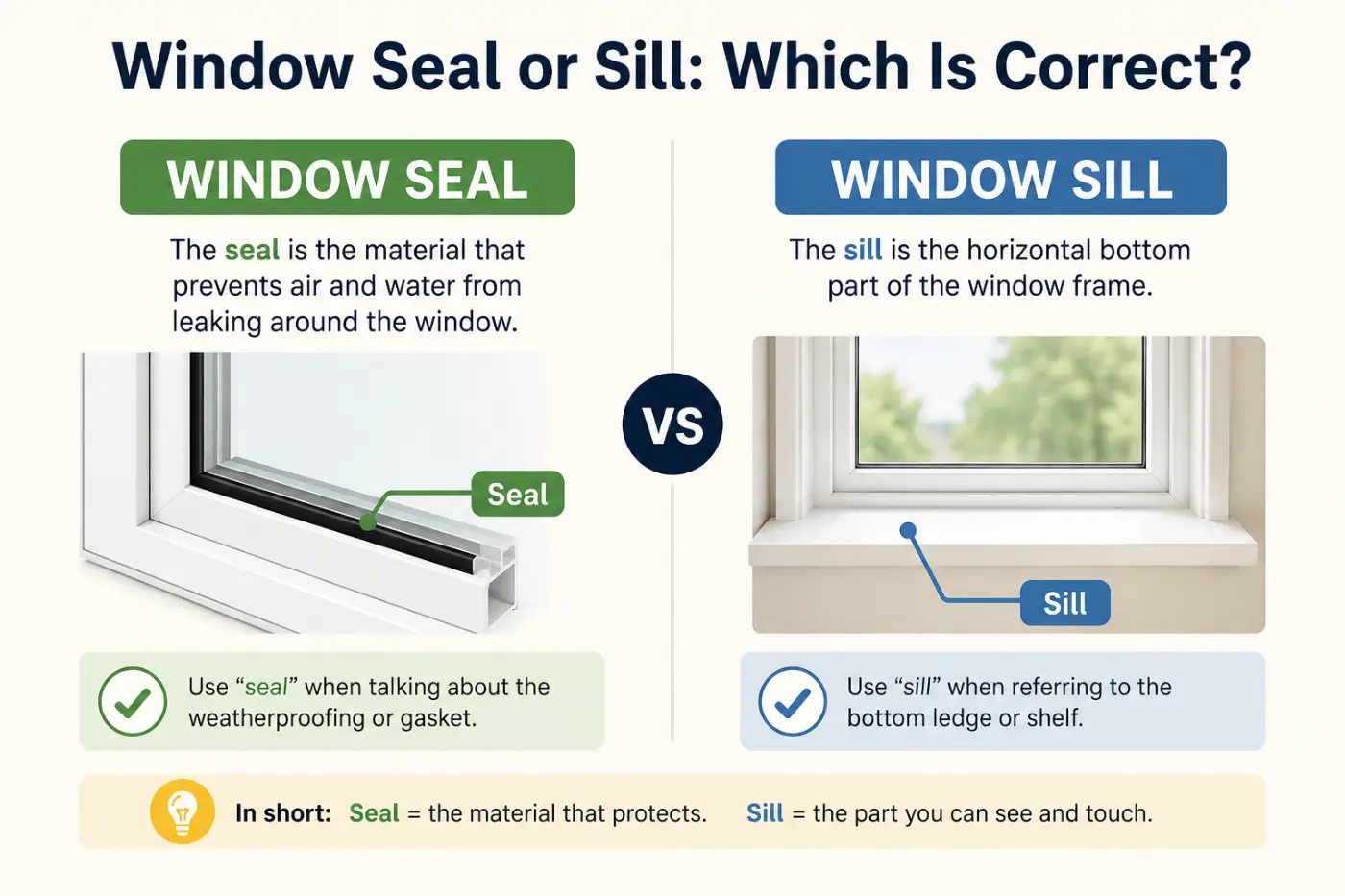
Window Seal or Sill can be confusing because both terms are connected to the same part of a building. People often hear them during home repairs window installation or conversations about leaks and assume they refer to the same thing. They do not. A seal helps close a gap while a sill forms the lower ledge or structural edge of a window opening.
The confusion becomes stronger because a window can have both a seal and a sill at the same time. A sill may sit at the bottom of the window while a seal can be installed around the frame. If water appears near the bottom of a window someone might mention the sill when the actual problem is a damaged seal. Knowing the difference makes conversations with contractors homeowners landlords and repair professionals much clearer.
This guide explains the meaning of both terms in simple American English. You will learn how each word works how to pronounce it where the terms come from how they are used in American and British English what common mistakes to avoid and how to choose the right term in everyday writing.
Short Answer
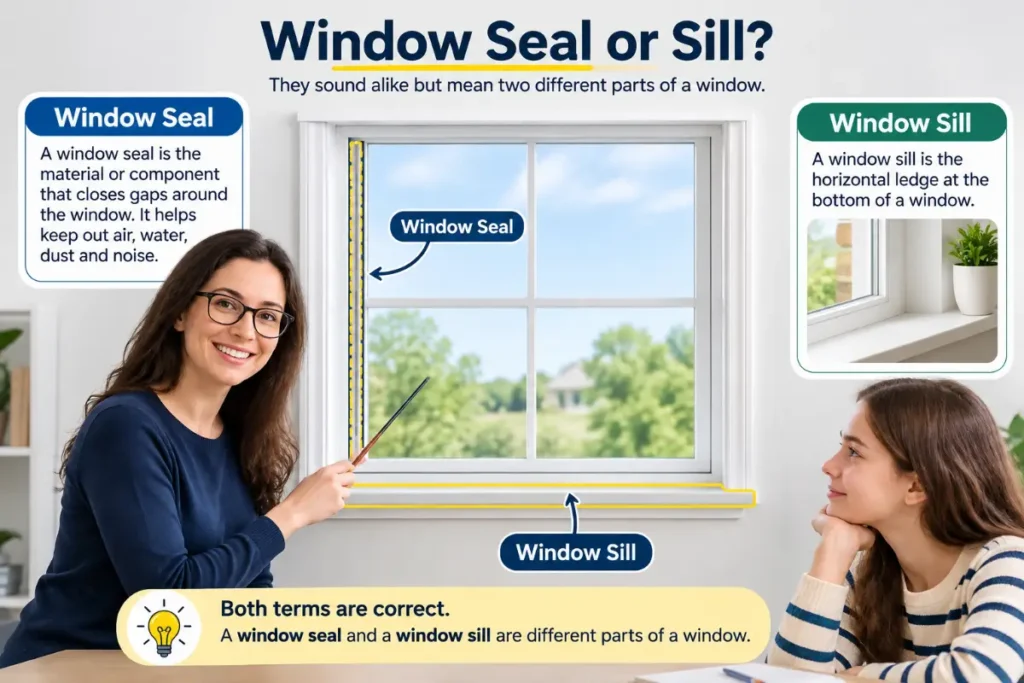
Window Seal or Sill refers to two different parts of a window. A window seal is a material or component that closes gaps around the window to help prevent air water dust and noise from passing through. A window sill is the horizontal ledge at the bottom of a window. They are both correct terms but they describe different things.
Table of Contents
- What Does Window Seal or Sill Mean?
- What Is a Window Seal?
- What Is a Window Sill?
- Window Seal vs Window Sill
- Why People Confuse These Terms
- How Window Seals Work
- How Window Sills Work
- Types of Window Seals
- Types of Window Sills
- Examples in Real Life
- Common Mistakes
- Pronunciation Guide
- Word Origins
- American and British English
- Grammar and Usage Notes
- Professional Writing Tips
- Memory Tricks
- Related Window Terms
- Frequently Asked Questions
- Key Takeaways
- Conclusion
What Does Window Seal or Sill Mean?
The easiest way to understand the difference is to focus on function.
A seal closes or protects a space. In window construction a seal is usually a flexible or adhesive material that helps prevent unwanted movement of air water dust or sound through a gap.
A sill is a ledge. In a window it normally refers to the horizontal part at the bottom of the window opening. Depending on the design it may be part of the window unit itself or part of the surrounding structure.
This creates a simple distinction.
| Term | Meaning | Main purpose |
|---|---|---|
| Window seal | Material or component that closes gaps | Helps block air water dust and noise |
| Window sill | Horizontal lower ledge of a window | Supports the window and helps direct water away |
| Window frame | Structure surrounding the glass | Holds the window components together |
| Window sash | Moving or fixed framework holding the glass | Supports the glass and may allow the window to open |
| Window glass | Transparent panel | Allows light and visibility |
| Window casing | Trim around the window opening | Covers the joint between the window and wall |
The terms describe different parts or functions. A sill can have a seal near it. A seal can protect the joint around a sill. That does not make the two words interchangeable.
What Is a Window Seal?
A window seal is a component designed to create a barrier between two surfaces. The goal is to reduce unwanted movement through a joint or opening.
A seal can be made from materials such as rubber plastic foam silicone or other compounds designed for sealing applications. The exact material depends on the type of window and the location of the seal.
Modern windows often contain several sealing points. A seal may sit around the edge of the glass. Another may be placed between moving parts of the window. Exterior joints can also use sealant to reduce water and air infiltration.
The basic idea remains simple. A seal seals.
When a seal works properly it can help improve comfort and energy efficiency. It may reduce drafts and help keep rainwater outside. It can also help reduce the amount of outdoor noise entering the room.
A damaged seal can cause several noticeable problems.
- You may feel cold or warm air around the window.
- Rainwater may enter through a joint.
- The room may become less comfortable near the window.
- Outdoor noise may become more noticeable.
- Condensation may appear in some situations.
- Heating or cooling systems may need to work harder.
Not every window problem comes from a failed seal. Poor installation damaged flashing drainage problems wall damage and condensation can produce similar symptoms. A proper inspection is needed before deciding what component needs repair.
What Is a Window Sill?
A window sill is the horizontal ledge at the bottom of a window.
In a traditional window design the sill extends across the lower part of the window opening. It can provide support and may be shaped or sloped so water moves away from the building.
Interior and exterior sills can have different appearances and functions.
An interior sill may form a small ledge inside the room. People sometimes place plants decorations or other small objects on it. An exterior sill may be designed to shed rainwater away from the wall.
The sill is therefore mainly a physical part of the window area. It is not simply a substance used to fill a gap.
The word sill also appears in other construction terms. For example a door sill is the lower horizontal part at the entrance of a door. The general idea remains a base or threshold.
A window sill may be made from wood stone metal vinyl composite material or another suitable building material. The choice depends on the window design climate construction method and desired appearance.
Window Seal vs Window Sill
The clearest difference between the two terms is function.
A window seal is used to create a barrier.
A window sill is a horizontal ledge.
Consider these examples.
- The window seal is damaged.
This means the sealing material or sealing component is no longer performing its job properly.
- The window sill is cracked.
This means the physical ledge at the bottom of the window has a crack.
- Water is collecting on the window sill.
This describes where the water is located. It does not automatically identify the cause.
- The contractor replaced the window seal.
The contractor replaced a sealing component.
- The carpenter repaired the wooden window sill.
The carpenter repaired the physical ledge.
These examples show why choosing the correct term matters. A person describing a repair needs to identify the actual component rather than simply naming the general area.
Why People Confuse These Terms
People often confuse these words because a window sill and a window seal can be close together.
Imagine standing beside a window after heavy rain. You notice water near the bottom of the glass. You might naturally call that area the sill because the sill is visible. However the water may have entered because a seal or another exterior component failed.
The visible location and the actual cause are not always the same.
Another reason for confusion is casual speech. Homeowners may use broad descriptions such as window edge window trim or window bottom without knowing the technical name of each part. That is perfectly understandable in everyday conversation.
The distinction becomes more important during repair work.
If you tell a contractor that the sill is leaking they may need more information. A sill itself may not be the source of the leak. The problem could involve a seal joint flashing drainage channel or installation detail.
Clear vocabulary can save time and prevent misunderstandings.
How Window Seals Work
A seal works by reducing the open space between two surfaces.
Windows need seals because many components meet at joints. Glass meets a frame. A movable sash meets a frame. The window unit meets the wall opening. Each joint can create a path for air or water if it is not properly sealed.
A good seal needs to remain effective under normal conditions. Temperature changes can cause materials to expand and contract. Sunlight moisture movement and age can also affect sealing materials.
Different window designs use different sealing methods.
Some windows use flexible gaskets. Others use weatherstripping. Exterior joints may use sealants. Certain insulated glass units use specialized edge seals between panes.
The word seal therefore has a broad meaning. It does not always refer to one specific product.
A useful rule is this.
If the component exists mainly to close a gap or prevent unwanted passage then seal is usually the right word.
This applies beyond windows too. We talk about door seals pipe seals rubber seals mechanical seals and seals around building joints.
How Window Sills Work
A sill provides a base at the bottom of a window.
Its design can affect drainage. Exterior sills are often shaped or angled so rainwater can move away from the wall rather than collect against the building.
The sill can also support parts of the window assembly. In some construction systems the sill is integrated into the window unit. In others the surrounding building structure contributes to the sill.
Interior sills are often more decorative. They can create a finished transition between the window and the interior wall.
The exact construction varies widely. A modern vinyl replacement window does not necessarily have the same sill construction as an older wood window.
Still the central meaning remains stable.
A sill is a ledge or base.
That meaning is also why the term appears in architecture and construction beyond windows.
Types of Window Seals
Not every seal performs exactly the same job.
Weatherstripping
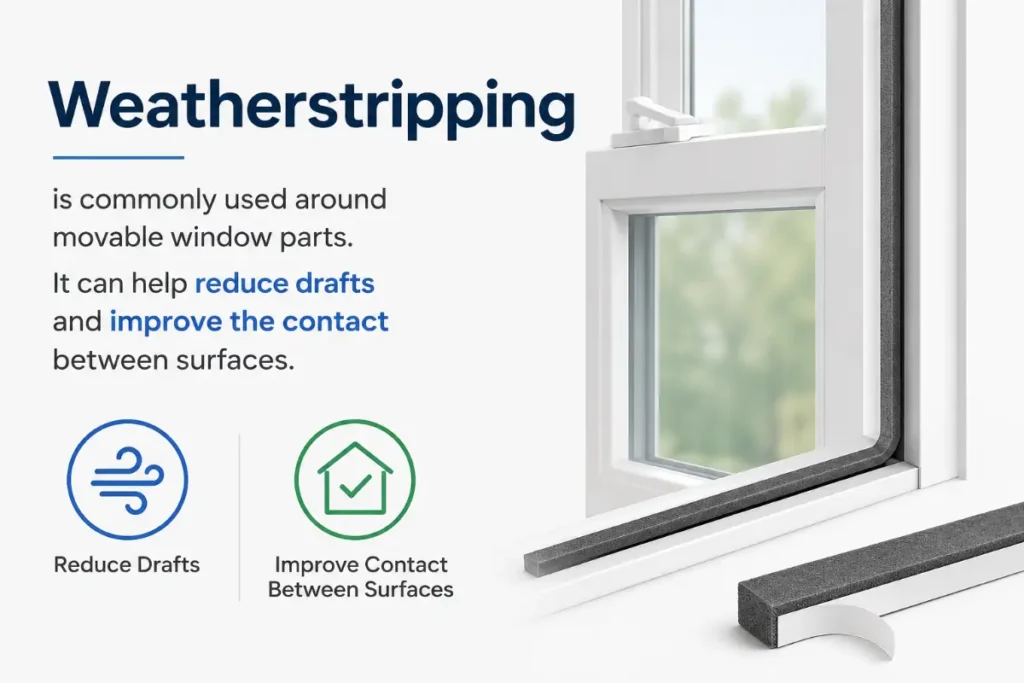
Weatherstripping is commonly used around movable window parts. It can help reduce drafts and improve the contact between surfaces.
Gaskets
A gasket is a shaped sealing component placed between surfaces. Window systems may use gaskets around glass or other joints.
Sealant
Sealant is a material applied to a joint to reduce the passage of water air or other substances. Silicone is one familiar example of a sealant used in some window applications.
Insulated Glass Edge Seals
Insulated glass units use seals around the edges of the glass panes. These seals help maintain the space between panes and protect the insulating system.
Compression Seals
Some window systems use materials that compress when the window closes. The compressed material forms a tighter barrier.
These terms overlap in everyday discussion but they are not always exact synonyms. A gasket is not automatically the same thing as sealant. Weatherstripping is not identical to every kind of seal. The general term depends on the component being discussed.
Types of Window Sills
Window sills also come in different forms.
Interior Sills
Interior sills are visible inside the room. They may provide a finished ledge below the window.
Exterior Sills
Exterior sills face the outside environment. Their shape often supports water drainage.
Sloped Sills
A sloped sill is designed with an angle that helps water move away from the window and wall.
Stone Sills
Stone can be used for durable and visually distinctive window sills. Natural and manufactured stone products are both used in construction.
Wooden Sills
Wooden sills are common in traditional and older window designs. They require appropriate protection from moisture and weather exposure.
Vinyl Sills
Vinyl window systems may have integrated sill components made from the same general material as the window frame.
The name of the material does not change the basic meaning of sill. It remains the lower ledge or base of the window.
Real Life Examples
Understanding the terms becomes easier when you see them in natural sentences.
- The window seal needs to be replaced because cold air is coming through the frame.
The sentence identifies the seal as the component responsible for controlling the unwanted air movement.
- She wiped the rainwater from the window sill.
Here sill refers to the horizontal ledge where the water collected.
- The contractor inspected the seal around the window frame.
The focus is on a gap or joint that needs to remain closed.
- The old wooden sill has started to rot.
The problem affects the physical ledge rather than simply a sealing material.
- The new window has a rubber seal around the glass.
The sentence describes a flexible sealing component.
- He placed a small plant on the interior window sill.
The sill acts as a ledge inside the room.
- The technician checked the window seal after the homeowner reported a draft.
The seal is being inspected because it may be connected to the draft.
- Water was sitting on the exterior window sill after the storm.
The sentence identifies the location of the water without claiming that the sill caused the leak.
- The damaged seal allowed air to pass around the closed window.
The seal is responsible for controlling the gap.
- The contractor repaired the cracked sill before finishing the window installation.
The repair concerns the physical base of the window.
Common Mistakes
The most common mistake is using sill when you mean seal.
For example:
Incorrect for a sealing problem: The window sill needs to be replaced because air is leaking around the frame.
Better: The window seal needs to be replaced because air is leaking around the frame.
The second common mistake is using seal when you mean the physical ledge.
Incorrect: Put the plant on the window seal.
Better: Put the plant on the window sill.
There is another subtle mistake worth understanding. People sometimes assume that water on a sill proves that the sill itself is leaking.
That conclusion is too quick.
The sill may simply be where the water becomes visible. The source could be a damaged seal or another part of the window installation.
A more accurate sentence is:
Water is collecting on the sill and the window needs to be inspected for the source of the leak.
This wording separates the location from the cause.
Pronunciation Guide
The words seal and sill are pronounced differently.
Seal is pronounced like seel. It rhymes with words such as feel and wheel.
The phonetic pronunciation is commonly represented as /siːl/.
Sill sounds like sil. It rhymes with words such as fill and hill.
The phonetic pronunciation is commonly represented as /sɪl/.
This difference is easy to hear when the words are said clearly.
Try these pairs.
- Seal and feel.
- Sill and hill.
- Seal and wheel.
- Sill and fill.
Because the two words have similar spellings and both relate to windows they can still cause confusion even though they do not sound the same.
Word Origins
The history of these words helps explain why their meanings developed in different directions.
Seal has a long history connected with the idea of closing or fastening something. English inherited the word through French from Latin roots associated with sealing or marking something securely.
The modern verb seal can mean to close something tightly. It can also mean to make an agreement final or secure. The physical idea of closing or securing remains at the heart of these meanings.
Sill is an old English construction word. It is related to older Germanic words referring to a foundation beam or threshold. Over time the term became strongly associated with the horizontal base beneath a window.
The historical paths are different even though both words are now common in building vocabulary.
American and British English
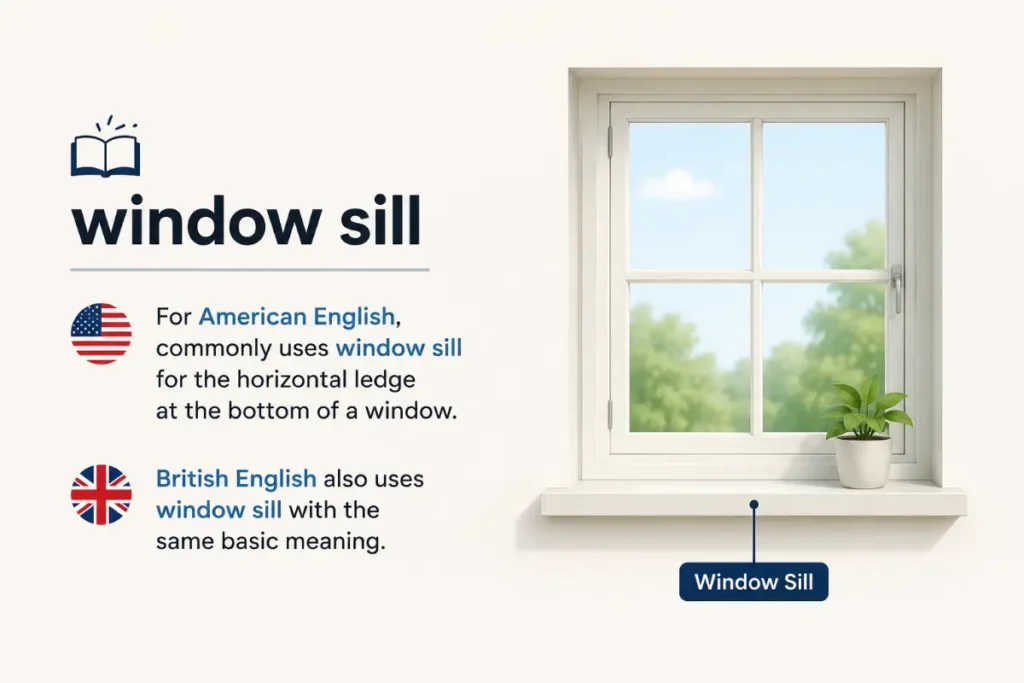
American and British English both use window sill and window seal.
The meanings are generally the same.
American English commonly uses window sill for the horizontal ledge at the bottom of a window. British English also uses window sill with the same basic meaning.
The word windowsill may also appear as a closed compound form. Window sill is widely recognized as a two word form in American writing. Both forms can be found in English usage depending on style and dictionary preference.
For the sealing component the term window seal is also widely understood in both varieties of English.
Other construction vocabulary can vary between regions. A specific type of trim weatherproofing material or window component may have different names in different markets. The core distinction between seal and sill remains stable.
Grammar and Usage Notes
Both seal and sill can function as nouns.
In The seal is damaged the word seal is a noun.
In The sill is cracked the word sill is also a noun.
The word seal can also function as a verb.
For example:
The installer sealed the gap around the frame.
Here sealed describes the action of closing or protecting the gap.
The word sill normally does not function as a verb in standard everyday English.
This difference provides another useful clue. If you are describing an action involving closing a gap then seal may be the word you need.
Consider these sentences.
Please seal the opening around the window.
The word seal is a verb.
Please clean the window sill.
The word sill is a noun referring to the physical ledge.
The plural forms are straightforward.
seal becomes seals.
sill becomes sills.
Examples include:
- The windows need new seals.
- The house has deep exterior sills.
- Several seals have deteriorated with age.
- The wooden sills need repair.
Professional Writing Tips
Technical writing benefits from precise terms.
If you are writing a maintenance report do not describe every problem near the bottom of a window as a sill problem. Identify the actual component when you can.
For example:
The exterior sill shows signs of moisture damage.
This describes a physical condition.
The seal around the lower frame appears damaged.
This identifies a sealing issue.
Water was observed on the interior sill after rainfall. Further inspection is recommended.
This reports an observation without making an unsupported conclusion.
That distinction is valuable in inspection reports property listings repair estimates and construction documents.
A professional writer should also avoid using technical terminology simply to sound sophisticated. Use the most accurate word that ordinary readers can understand.
If the audience is homeowners then plain language often works best.
For example:
The rubber seal around the window has worn out and may need replacement.
That sentence is clearer than using a specialized material term that the reader may not understand.
Memory Tricks
A simple memory trick can help you remember the difference.
Think of seal as a shield.
A seal creates a barrier that helps keep unwanted air or water out.
Think of sill as a shelf.
A sill is a ledge at the bottom of a window.
Another useful association is sound.
Seal rhymes with feel.
Sill rhymes with hill.
You can also remember the basic action.
Seal closes.
Sill supports.
This is not a technical definition for every construction system but it works well as an everyday vocabulary shortcut.
Related Window Terms
Understanding nearby vocabulary makes the distinction even easier.
Window Frame
The frame is the structure around the window. It can hold the glass sash and other components.
Window Sash
A sash is the framework that holds the glass. In many windows the sash moves when the window opens.
Weatherstripping
Weatherstripping is material used around moving parts or joints to reduce drafts and improve sealing.
Sealant
Sealant is a material applied to a joint to create a barrier against water air or other substances.
Casing
Casing is trim around a window opening. It often provides a finished appearance where the window meets the wall.
Glazing
Glazing can refer to the glass installed in a window or the process and materials used to secure glass in place.
Flashing
Flashing is a material or system used to direct water away from vulnerable building joints.
These terms are related but they should not be treated as interchangeable.
When To Use Seal
Use seal when you are talking about a barrier or component that closes a gap.
Good examples include:
- The window seal is worn.
- Replace the damaged seal.
- The seal around the glass has failed.
- The technician inspected the seal for air leakage.
- A new seal may improve the window’s resistance to drafts.
The key idea is closure and protection.
When To Use Sill
Use sill when you are talking about the horizontal ledge or base beneath the window.
Good examples include:
- The sill needs cleaning.
- Water collected on the sill.
- The wooden sill has cracked.
- She placed a vase on the window sill.
- The exterior sill directs water away from the wall.
The key idea is a ledge or base.
How To Describe A Window Leak Correctly
A window leak can create confusion because several parts may be involved.
Instead of saying:
The sill is leaking.
You can say:
Water is appearing on the sill.
This statement reports what you can see.
If an inspection confirms a damaged seal you can say:
The window seal is allowing water to enter around the frame.
That statement identifies the suspected cause.
This distinction is useful because it separates observation from diagnosis. It also prevents a common communication problem in repair work.
The same principle applies to many other areas of home maintenance. The place where you see a problem is not always the component causing it.
Is A Window Seal The Same As Caulk?
Not exactly.
Caulk is a type of material used to fill and seal joints. A window seal can refer to a broader category of sealing components.
Some window seals are flexible gaskets. Some joints use sealant. Caulk may be used in certain applications but it is not a universal replacement for every window seal.
The correct product depends on the window design the location of the joint and the manufacturer’s installation requirements.
Using the wrong material can cause problems. A material that works well in one joint may not be suitable for a moving component or a location exposed to constant moisture.
Can A Window Have Both A Seal And A Sill?
Yes.
A typical window can have a sill and several seals.
The sill provides the lower ledge. Seals can be installed around the glass frame sash or other joints.
This is one of the easiest ways to remember that the terms are not opposites. They describe different aspects of the same window assembly.
If you stand inside a room and look at a window you may see the sill immediately. You may not see the seal because sealing materials are often hidden inside joints.
That difference between visible structure and hidden function explains much of the confusion.
Why Precise Vocabulary Matters
Precise language is not just about passing a grammar test. It helps people solve practical problems.
Imagine telling a contractor that your window sill is damaged when the real problem is a failed seal. The contractor may ask follow up questions because the two problems require different repairs.
Using the right term can make the conversation faster.
The same principle applies to writing. A maintenance report that distinguishes between a damaged sill and a failed seal gives the reader more useful information.
Clear vocabulary builds trust because it shows that the writer understands the difference between a symptom a location and a cause.
Key Takeaways
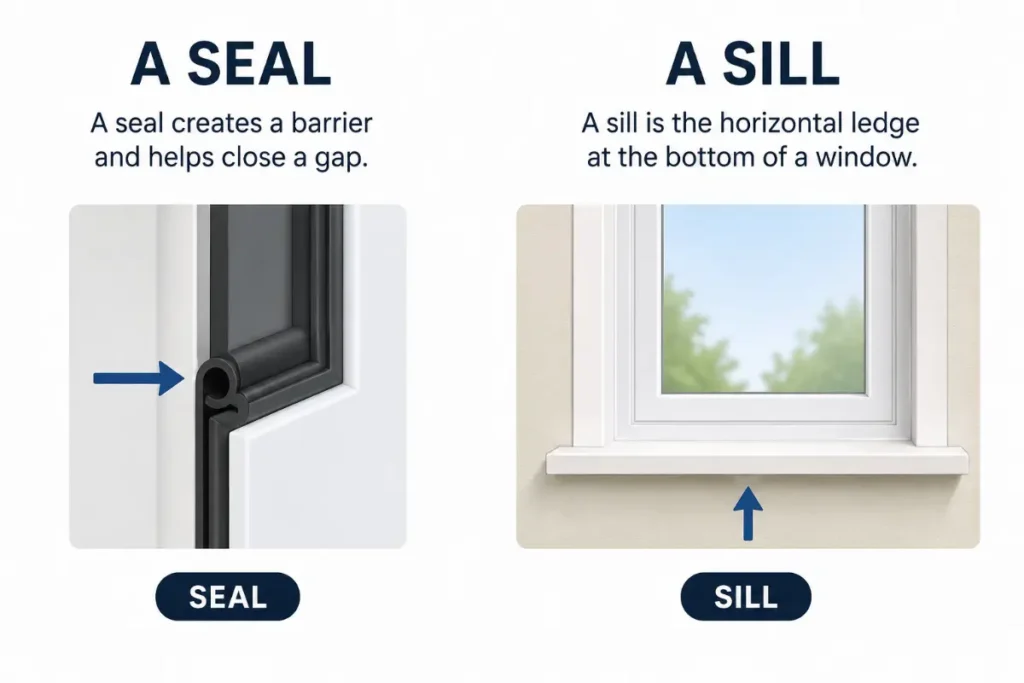
- A seal creates a barrier and helps close a gap.
- A sill is the horizontal ledge at the bottom of a window.
- A window can have both a seal and a sill.
- Water on a sill does not automatically mean the sill caused the leak.
- Weatherstripping gaskets and sealants are related to sealing but can describe different components.
- Seal can function as both a noun and a verb.
- Sill is normally used as a noun in standard English.
- Seal rhymes with feel.
- Sill rhymes with hill.
- Precise terminology is especially useful in construction repair inspection and maintenance writing.
Conclusion
Window Seal or Sill becomes much easier to understand once you separate the ideas of barrier and ledge. A seal helps close a gap and reduce unwanted movement of air water dust or sound. A sill is the horizontal base or ledge at the bottom of a window. They can exist together but they do different jobs.
The simplest memory trick is seal closes and sill supports. When you are describing a damaged barrier or a component that prevents drafts or water movement use seal. When you are talking about the physical ledge beneath the window use sill. This distinction also helps you describe repair problems more accurately.
Good word choice makes practical communication clearer. If water appears on a sill you can describe the location without assuming the cause. If an inspection finds a damaged sealing component you can identify the seal specifically. Once you understand that difference you can use both terms confidently in everyday conversation professional writing home maintenance discussions and technical descriptions.
Frequently Asked Questions
What is the difference between a window seal and a window sill?
A window seal is a component or material that helps close gaps and prevent air water or other unwanted movement. A window can have both parts.
Is window sill one word or two words?
Window sill is commonly written as two words in American English. Windowsill is also an established form. The two forms refer to the same basic part of a window.
Is Window Seal or Sill the correct term?
Window Seal or Sill contains two correct terms but they have different meanings. Use seal for the barrier that closes a gap. Use sill for the horizontal ledge at the bottom of the window.
Is the sill the part that seals the window?
Not necessarily. A sill can contribute to the window’s structure and drainage but it is not automatically the sealing component. Seals are specifically designed to close gaps and limit air or water movement.
Can a window sill leak?
People often describe water appearing around a sill as a sill leak. However the actual source may be elsewhere. A damaged seal flashing joint or drainage problem can allow water to reach the sill.
What is another word for a window sill?
Depending on the context you may hear terms such as window ledge or window stool. These terms are not always exact substitutes because construction terminology can vary by design and region. In ordinary English window sill is the clearest general term.
What is another word for a window seal?
The exact alternative depends on the type of seal. Terms such as gasket weatherstripping and sealant can describe particular sealing components. They should not automatically be treated as perfect synonyms.
How do you use window seal in a sentence?
You can say The window seal is damaged and needs replacement. Here seal refers to the component that helps prevent unwanted air or water movement around the window.
How do you use window sill in a sentence?
You can say She placed a small plant on the window sill. Here sill refers to the horizontal ledge at the bottom of the window.
Does seal rhyme with sill?
No. Seal rhymes with feel while sill rhymes with hill. The different vowel sounds can help you remember the distinction.

Confusing Words, Spelling & Word Choice
Claire Whitmore is a U.S.-based English editor who writes about commonly confused words, spelling differences, and word choice. Her work helps readers understand subtle distinctions between similar-looking words through simple definitions, practical examples, and modern usage guidance in both American and British English.