
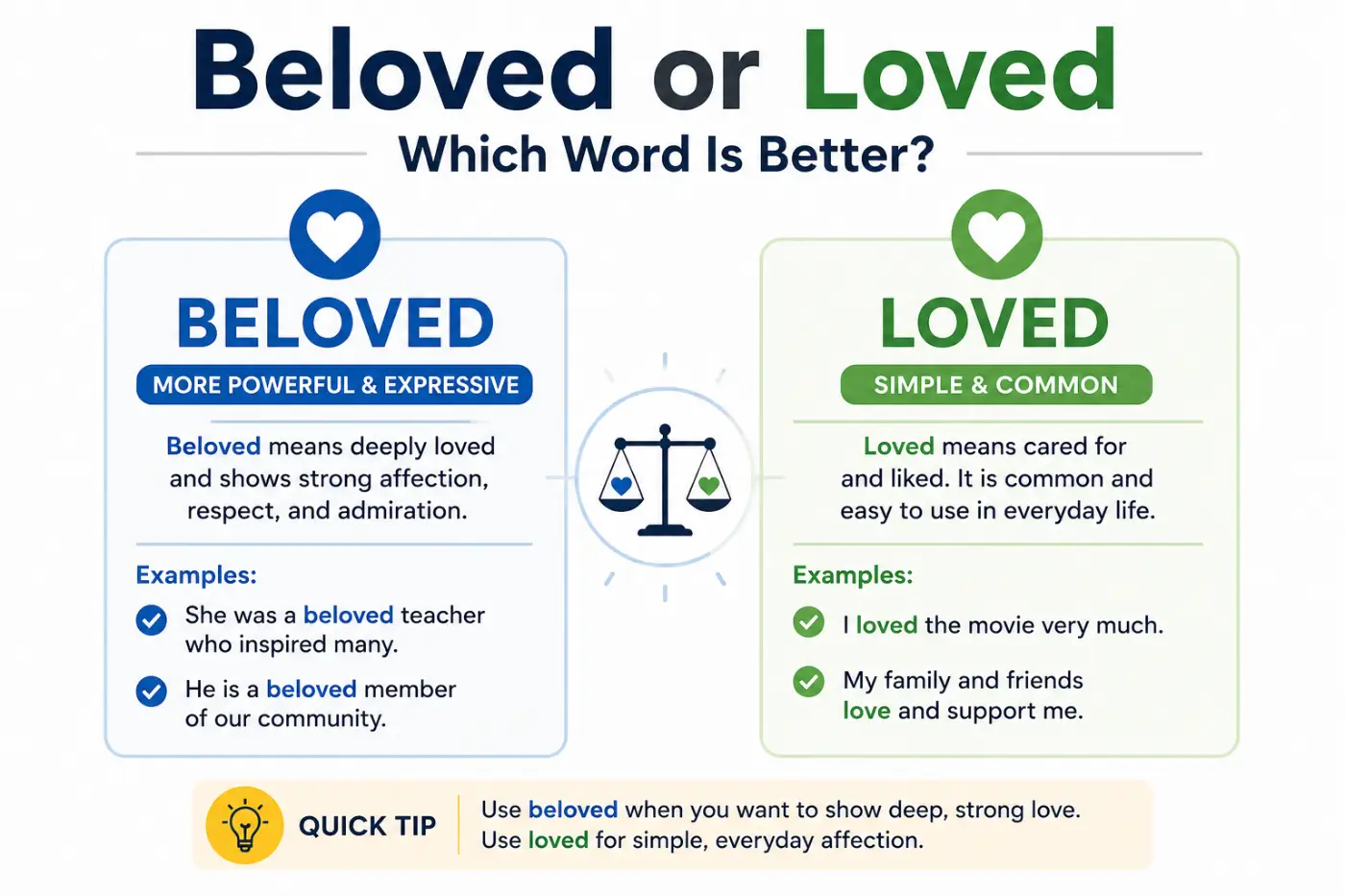
Beloved or Loved is a common word choice question because both words express affection, but they carry slightly different tones. Loved is simple, direct, and common in everyday American English. Beloved often conveys deeper emotional warmth, admiration, or a special place in someone’s heart.
For example, English speakers commonly say “a beloved friend” rather than “a loved friend.” However, “a loved one” is a familiar and widely accepted expression. These differences show that choosing the right word involves more than understanding its basic meaning. Grammar, context, and natural usage also matter.
This guide explores the meaning, pronunciation, grammar, history, tone, and common usage patterns of both words. You’ll also learn from practical examples and discover common mistakes to avoid. By the end, you’ll understand when to use beloved or loved and how to choose the word that sounds most natural in your sentence.

Short Answer
Beloved or Loved can both describe someone or something that is deeply cared for. Loved is the everyday and more common choice. Beloved carries a warmer, stronger, and often more emotional or literary tone. You can say “my loved family” only in limited contexts, but “my beloved family” sounds natural and affectionate. The best choice depends on tone and context.
Table of Contents
- Quick comparison.
- What beloved means.
- What loved means.
- The main difference.
- Grammar and sentence structure.
- Tone and emotional strength.
- Real life examples.
- When beloved is the better choice.
- When loved is the better choice.
- Pronunciation.
- Word origin.
- American and British usage.
- Common mistakes.
- Memory tips.
- Related expressions.
- Professional writing guidance.
- Frequently asked questions.
- Key takeaways.
- Conclusion.
Quick Comparison
| Word | Basic meaning | Tone | Common use | Example |
|---|---|---|---|---|
| Beloved | Dearly loved or greatly cherished | Warm and emotional | People, places, traditions, things | She was a beloved teacher. |
| Loved | Cared for deeply or treated with affection | Neutral to warm | People, relationships, things, actions | He felt loved by his family. |
The most important point is simple. Loved is the broader and more flexible word. Beloved is more expressive and often emphasizes how deeply someone or something is cherished.
What Beloved Means
Beloved means greatly loved, deeply cherished, or very dear to someone. It often communicates affection that feels especially strong or lasting.
Consider this sentence.
- “She was a beloved grandmother.”
This means that many people cared deeply for her and held her in special affection. The word does more than state that people loved her. It presents that love as a meaningful part of how people viewed her.
Another example is:
- “The town’s beloved library closed after many decades.”
Here, beloved describes more than personal affection. The library has a special emotional place in the community.
Beloved can describe people, places, objects, traditions, animals, institutions, and even ideas. It often suggests that the subject has earned affection over time.
For example:
- My beloved dog always waited by the door.
- The restaurant became a beloved part of the neighborhood.
- She returned to her beloved hometown.
- The author created a beloved fictional character.
- The festival remains a beloved local tradition.
In each sentence, beloved adds emotional weight.
What Loved Means
Loved is the past participle and past tense form of the verb love. As a verb, it tells us that someone experienced or expressed love.
For example:
- “Her parents loved her very much.”
Here, loved is clearly a verb. It tells us what her parents felt.
Loved can also work as an adjective.
- “He was surrounded by loved ones.”
In this expression, loved describes people who are deeply cared for.
The word can also appear in passive constructions.
- “She felt loved by everyone in the room.”
In this sentence, loved describes the emotional experience of receiving affection.
Unlike beloved, loved doesn’t automatically sound poetic or formal. It usually feels direct and natural.
Compare these sentences.
- “I loved that movie.”
- “It was a beloved movie.”
The first sentence simply tells us about the speaker’s strong positive feeling. The second suggests that many people have developed affection for the movie or that it has a special place in popular culture.
The Main Difference Between Beloved and Loved
The central difference is tone and emphasis.
Loved usually communicates the fact of affection.
Beloved emphasizes deep affection, cherished status, or emotional significance.
Think of the difference this way.
Loved tells you that affection exists.
Beloved suggests that the subject is especially dear.
For example:
- “He is a loved teacher.”
- “He is a beloved teacher.”
The second sentence sounds much more natural in standard English. A beloved teacher is someone students and colleagues deeply appreciate and remember fondly.
Now consider another pair.
- “She loved her hometown.”
- “Her beloved hometown was surrounded by mountains.”
The first sentence focuses on her personal feeling. The second presents the hometown as something especially precious to her.
This distinction is why Beloved or Loved cannot always be treated as a simple substitution exercise.
Is Beloved Stronger Than Loved
In many contexts, yes.
Beloved often carries greater emotional intensity than loved. It can suggest affection that is profound, cherished, enduring, or widely shared.
However, beloved isn’t simply a stronger grammatical form of loved. The two words have different patterns and stylistic effects.
You can say:
- “I loved the book.”
You normally wouldn’t replace loved with beloved and say:
- “I beloved the book.”
That sentence is incorrect because beloved isn’t used as the ordinary past tense of love.
Instead, you could say:
- “The book became beloved by readers.”
Here, beloved functions as an adjective describing the book’s cherished status.
This grammatical distinction is essential.
Beloved as an Adjective
Beloved is most commonly used as an adjective when it appears before a noun.
Examples include:
- “Her beloved sister lives nearby.”
- “The beloved actor died peacefully.”
- “They returned to their beloved home.”
- “The beloved tradition continues each year.”
- “He was a beloved member of the community.”
In these examples, beloved modifies a noun.
Beloved can also appear after linking verbs.
- “She was beloved by her students.”
- “The old park remains beloved by local residents.”
- “The character became beloved around the world.”
The passive construction beloved by is especially common when describing a person or thing that many people admire or cherish.
Loved as a Verb
Loved is commonly used as the past tense of love.
Examples:
- “I loved the concert.”
- “She loved her grandmother.”
- “They loved the new restaurant.”
- “He loved playing baseball as a child.”
- “We loved the way the house looked.”
Here, loved describes an action or emotional state in the past.
The grammar is straightforward.
The basic structure is:
Subject + loved + object
For example:
“She loved the painting.”
The subject is she. The verb is loved. The object is the painting.
Loved as an Adjective
Loved can also function as an adjective, especially in established expressions.
The best known example is loved one.
A loved one is a person who is close to you and deeply cared for. The phrase commonly refers to family members, partners, close friends, or other people with strong emotional connections.
Examples include:
- “She called her loved ones after the storm.”
- “He spent the weekend with his loved ones.”
- “The ceremony honored those who had lost loved ones.”
You can also see loved used in phrases such as:
- “a much loved teacher”
- “a dearly loved child”
- “a well loved character”
In these constructions, loved communicates affection without necessarily carrying the elevated tone of beloved.
Beloved and Loved in Everyday English
For ordinary conversation, loved is usually the safer choice when you are describing the feeling itself.
For example:
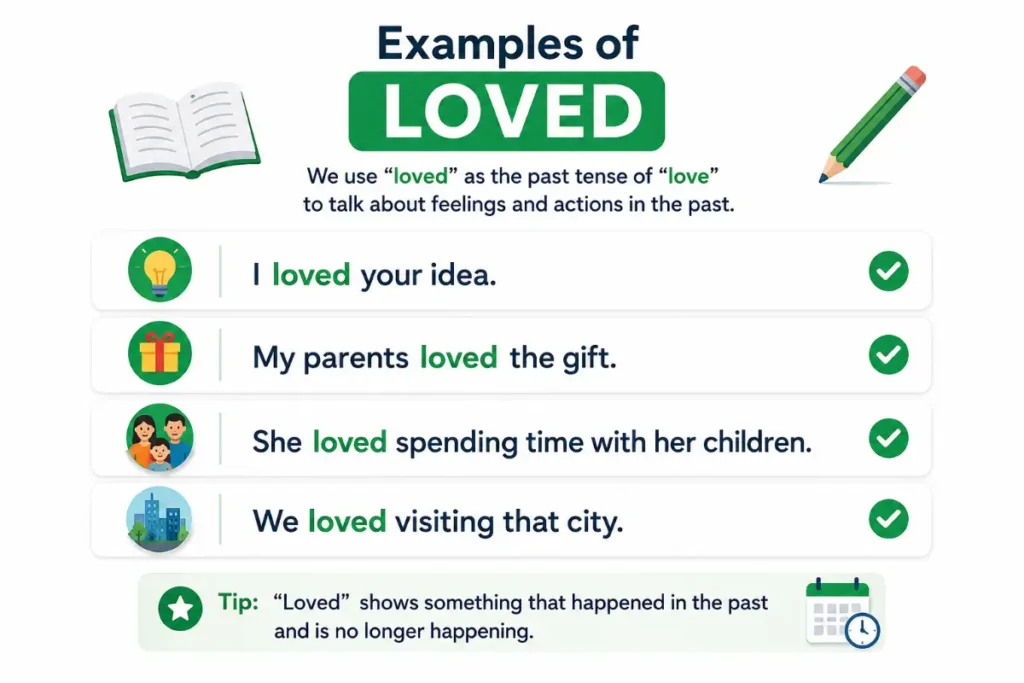
- “I loved your idea.”
- “My parents loved the gift.”
- “She loved spending time with her children.”
- “We loved visiting that city.”
These sound completely natural.
Beloved appears less often in casual conversation. It can sound more affectionate, ceremonial, literary, or emotionally deliberate.
For example:
- “She returned to her beloved hometown.”
This is perfectly natural, but it sounds more expressive than:
- “She returned to her hometown.”
The first sentence tells us that the hometown has deep personal significance.
When Beloved Is the Better Choice
Beloved works particularly well when you want to communicate admiration, affection, or lasting emotional value.
Describing A Person
Use beloved when a person is deeply cherished by others.
- “He was a beloved coach.”
This suggests that his players and community held him in high regard.
- “She became a beloved teacher.”
This implies lasting affection from students and perhaps colleagues.
Describing A Place
Beloved is also common with places that have emotional significance.
- “They returned to their beloved hometown.”
- “The park remains a beloved gathering place.”
- “He wrote about his beloved city.”
The adjective adds personal or collective attachment.
Describing Traditions
Beloved is useful for traditions that people value deeply.
- “The beloved holiday tradition continues.”
- “The family revived a beloved recipe.”
- “The ceremony has become a beloved annual event.”
Describing Creative Works
A movie, book, song, character, or television show can become beloved.
- “The novel introduced a beloved character.”
- “The film remains a beloved classic.”
- “The character became beloved among young readers.”
This usage often appears in journalism, reviews, biographies, and cultural writing.
When Loved Is the Better Choice
Loved is usually better when you are describing an actual act or experience of loving.
- “She loved her parents.”
- “I loved the movie.”
- “They loved their new home.”
- “He loved helping children.”
- “We loved every minute of the trip.”
Replacing loved with beloved would either be impossible or change the grammatical structure.
For example, “I beloved the movie” is incorrect.
You could instead write:
“I loved the movie.”
Or:
“The movie became beloved by audiences.”
The first sentence describes a person’s feeling. The second describes the movie’s status among audiences.
Real Life Examples
The difference becomes easier to understand when you see the words in realistic contexts.
Family
- “She loved her grandmother deeply.”
This tells us about her personal feeling.
- “Her grandmother was beloved by the entire family.”
This emphasizes how deeply the family cherished the grandmother.
Friendship
- “I loved my old friend dearly.”
Here, loved is part of the verb phrase.
- “He was a beloved friend to everyone who knew him.”
Beloved describes his special place in people’s lives.
Work
- “Employees loved working with their manager.”
Loved functions as a verb.
- “Their manager was beloved by the staff.”
Beloved works as an adjective describing the manager.
Literature
- “Readers loved the novel.”
The sentence reports a reaction.
- “The novel became a beloved classic.”
The sentence emphasizes the novel’s lasting cultural affection.
Community
- “Residents loved the old theater.”
This describes what residents felt.
- “The old theater was a beloved landmark.”
This presents the theater as a cherished community institution.
Common Mistakes
Understanding the most frequent errors can help you avoid awkward sentences.
Mistake 1 Using Beloved as a Past Tense
Incorrect:
“I beloved that song.”
Correct:
“I loved that song.”
Beloved doesn’t normally function as the simple past tense of love in modern standard English.
Mistake 2 Treating Beloved and Loved as Exact Synonyms
They overlap in meaning, but their grammar and tone differ.
“I loved the restaurant.”
This tells us about your reaction.
“The restaurant was beloved by locals.”
This tells us about the restaurant’s cherished status.
The sentences communicate related ideas but use different grammatical structures.
Mistake 3 Using Loved Before Every Noun
Some combinations are grammatically possible but don’t sound natural.
For example:
“He was a loved teacher.”
This isn’t necessarily impossible, but beloved teacher is much more idiomatic when you mean that students and colleagues deeply cherished him.
A natural version would be:
“He was a beloved teacher.”
Mistake 4 Assuming Beloved Always Means Romantic Love
Beloved can describe romantic partners, but it has a much broader range.
You can have:
- a beloved grandmother.
- a beloved teacher.
- a beloved dog.
- a beloved hometown.
- a beloved tradition.
- a beloved author.
The word communicates deep affection rather than specifically romantic affection.
Mistake 5 Confusing Loved One With Beloved One
Loved one is a standard and extremely common expression.
“Please call your loved ones.”
Beloved one is grammatically possible in unusual literary contexts, but it isn’t the normal replacement for loved one.
Pronunciation Guide
Beloved has two common pronunciations in English.
One common pronunciation is approximately:
bih LUV id
Another pronunciation is approximately:
bih LUVD
The first pronunciation is especially common when beloved is used as an adjective before a noun in American English.
Examples:
- beloved teacher.
- beloved child.
- beloved tradition.
Loved is pronounced:
LUVD
The ending sounds like the final sound in words such as moved and saved.
The pronunciation of loved doesn’t change based on its meaning.
Word Origin
Beloved comes from the verb love and the older participial formation associated with being loved. Its history reaches back through Middle English and Old English forms connected with affection and love.
The word developed into a familiar adjective meaning dearly loved or greatly cherished.
Loved has a more straightforward grammatical history because it is simply the regular past tense and past participle form of love.
The shared origin explains why the words are closely related in meaning. Their modern usage, however, has developed distinct grammatical roles.
American And British Usage
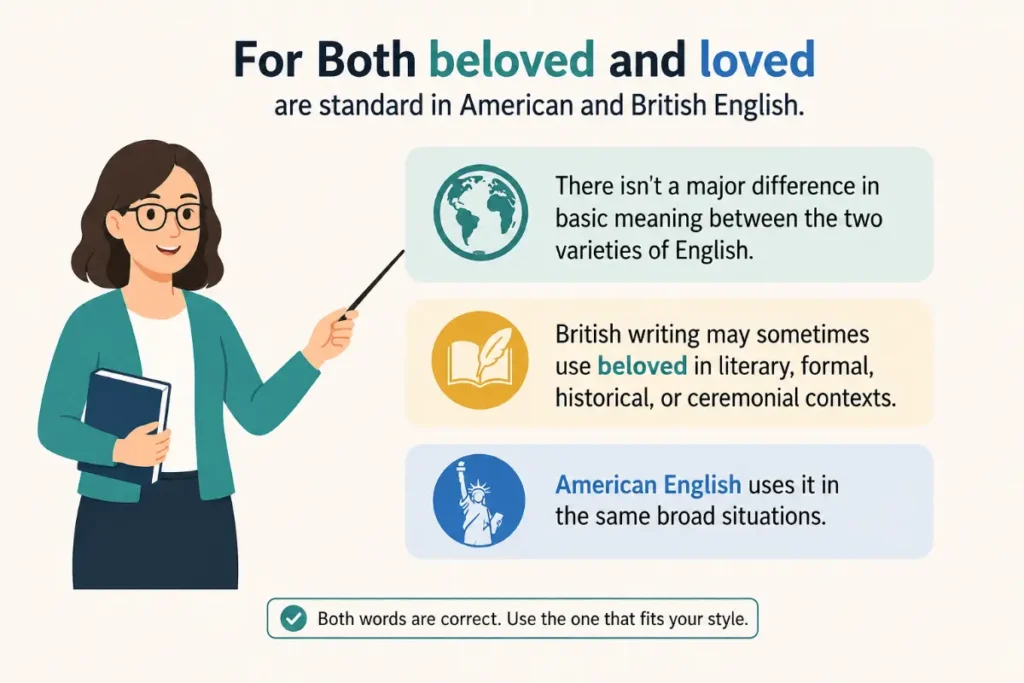
Both beloved and loved are standard in American and British English.
There isn’t a major difference in basic meaning between the two varieties of English.
British writing may sometimes use beloved in literary, formal, historical, or ceremonial contexts. American English uses it in the same broad situations.
For example:
- “a beloved family member.”
- “a beloved author.”
- “a beloved local tradition.”
The main difference is not regional grammar. It is tone, context, and frequency.
Loved remains the more ordinary choice for describing the experience of loving something or someone.
Beloved tends to appear when the writer wants to emphasize affection or cherished status.
Formal And Informal Usage
Loved works naturally in almost every level of English.
You can use it in:
- casual conversation.
- personal messages.
- academic writing.
- professional writing.
- journalism.
- fiction.
Beloved has a slightly more elevated feel, although it isn’t necessarily formal.
It can sound warm and personal:
“My beloved dog is getting older.”
It can sound ceremonial:
“She was a beloved member of the organization.”
It can sound literary:
“He returned to his beloved homeland.”
It can also sound affectionate and intimate:
“My beloved daughter.”
The surrounding context determines the effect.
Beloved In Romantic Language
Beloved has a long history of romantic use.
For example:
- “My beloved wife.”
- “His beloved partner.”
- “She wrote a letter to her beloved.”
These expressions communicate strong affection and can sound poetic or formal.
Loved can also describe romantic relationships, but its construction is different.
- “She loved her husband.”
- “He felt loved by his partner.”
- “They loved each other deeply.”
These sentences sound natural and direct.
If you want a romantic adjective, beloved often creates a more expressive tone.
Beloved In Professional Writing
Beloved can work well in professional writing when the subject has strong public affection.
For example:
“The beloved community center has served residents for decades.”
This works in a newspaper article, organizational announcement, or community history.
However, writers should avoid using beloved simply to make every sentence sound emotional. If the evidence doesn’t support the idea that people deeply cherish something, a more neutral adjective may be better.
Instead of:
“Our beloved new software platform solved the problem.”
A professional writer might say:
“Our new software platform solved the problem.”
The second version is clearer and more objective.
Loved In Professional Writing
Loved is often preferable when you need direct and neutral language.
For example:
“Customers loved the new design.”
This is clear and concise.
“Customers were beloved by the new design” would be incorrect.
You could write:
“The new design became beloved by customers.”
But that sentence has a stronger emotional implication and may sound less precise in a business report.
Professional writing benefits from choosing the word that accurately reflects the intended meaning rather than choosing the more emotional word.
Memory Tips
A simple memory trick can make the difference easy to remember.
Think of loved as the action or feeling.
Think of beloved as the cherished status.
For example:
“I loved the book.”
The person experienced love or strong affection.
“The book is beloved.”
The book has a cherished place among readers.
Another useful trick is to remember the phrase loved one.
If you are describing a person you care about, loved one is the standard expression.
If you are describing someone or something as especially cherished, beloved often fits better.
Related Expressions
Several expressions are closely connected to these words.
Loved One
A loved one is someone you care about deeply.
Example:
“She spent the holiday with her loved ones.”
Dearly Loved
Dearly loved means loved very deeply.
Example:
“He was dearly loved by his family.”
Deeply Loved
Deeply loved emphasizes the strength of affection.
Example:
“She was deeply loved by her children.”
Much Loved
Much loved means widely or strongly loved.
Example:
“The actor was much loved by his fans.”
Dear To Someone
If someone or something is dear to you, you care about it deeply.
Example:
“The old house was dear to her.”
This expression is often a good alternative when beloved sounds too formal or poetic.
Synonyms For Beloved
Several words can express a similar idea, but each has its own shade of meaning.
Cherished emphasizes something precious and deeply valued.
Adored emphasizes strong affection and admiration.
Dear can express affection in a simple and natural way.
Treasured emphasizes value and emotional importance.
Precious emphasizes special personal value.
Favorite expresses preference rather than necessarily deep emotional attachment.
For example, a favorite teacher isn’t automatically a beloved teacher. A favorite teacher may simply be the teacher someone enjoyed most. A beloved teacher usually carries a stronger emotional sense.
Related Grammar Notes
The verb love follows normal English verb patterns.
Present tense:
“I love music.”
Past tense:
“I loved the concert.”
Present participle:
“I am loving the experience.”
Past participle:
“I have loved this place for years.”
Adjective:
“She is beloved by her students.”
This distinction helps prevent one of the most common errors.
Beloved can look like a verb form because it ends with a familiar participial pattern. In modern English, however, it is frequently used as an adjective.
How To Choose The Right Word
When you aren’t sure which word to use, ask what you are trying to communicate.
If you mean someone felt affection, use loved.
- “I loved the book.”
- “She loved her family.”
- “They loved the new house.”
If you mean someone or something is deeply cherished, use beloved.
- “It became a beloved book.”
- “She was a beloved member of the family.”
- “The house was beloved by generations of residents.”
This simple test works in most situations.
Which Word Sounds More Natural
In everyday speech, loved usually sounds more natural when you’re talking about your own feelings.
“I loved it.”
“I loved your idea.”
Beloved sounds more natural when describing a person, place, tradition, or thing that holds a special emotional position.
“She was a beloved teacher.”
“It is a beloved tradition.”
“He returned to his beloved hometown.”
This is one of the clearest practical distinctions between the two words.
Can Beloved Describe Objects
Yes.
Beloved doesn’t have to describe a living person.
Examples include:
- “Her beloved piano stood in the corner.”
- “He still owns his beloved bicycle.”
- “The restaurant serves a beloved family recipe.”
- “The book became a beloved classic.”
- “The old theater is a beloved landmark.”
The object has emotional value because someone or a group of people deeply cherishes it.
Can Loved Describe Places
Yes, but the construction matters.
You can say:
“The city is loved by millions of people.”
You can also say:
“She loved the city.”
However, beloved city often sounds more natural when you want an adjective expressing deep personal attachment.
For example:
“He wrote a poem about his beloved city.”
This is more emotionally expressive than simply saying:
“He wrote a poem about his loved city.”
The second version sounds unnatural to many English speakers.
Can Beloved Describe A Dead Person
Yes.
Beloved is commonly used in obituaries, memorials, biographies, and tributes.
For example:
“She was a beloved mother, teacher, and friend.”
This tells readers that the person was deeply cherished.
Loved can also appear:
“He was deeply loved by his family.”
Both are correct. Beloved simply gives the description a more commemorative tone.
Why Some Combinations Sound Better Than Others
English word choice depends on more than dictionary meaning. Natural combinations develop through repeated use by native speakers.
For example, beloved teacher, beloved friend, beloved child, and beloved tradition are familiar combinations.
By contrast, loved teacher can sound less natural when used as a simple adjective phrase.
This doesn’t mean loved is grammatically wrong in every such construction. Context can make it perfectly acceptable.
For example:
“She was a much loved teacher.”
This sounds natural because much loved is an established descriptive phrase.
The problem usually comes from treating loved and beloved as identical adjectives in every context.
Expert Language Insight
The most useful way to understand the distinction is through lexical meaning plus grammatical function.
Loved is closely tied to the verb love. It can tell us that an individual or group experienced affection.
Beloved has developed a more independent adjectival identity. It often describes the resulting status of being deeply cherished.
That difference explains why these sentences behave differently.
“People loved the singer.”
“The singer was beloved by people.”
The first sentence centers on the people’s action or feeling.
The second centers on the singer’s status as someone deeply cherished.
Both communicate affection, but they organize the information differently.
Key Takeaways
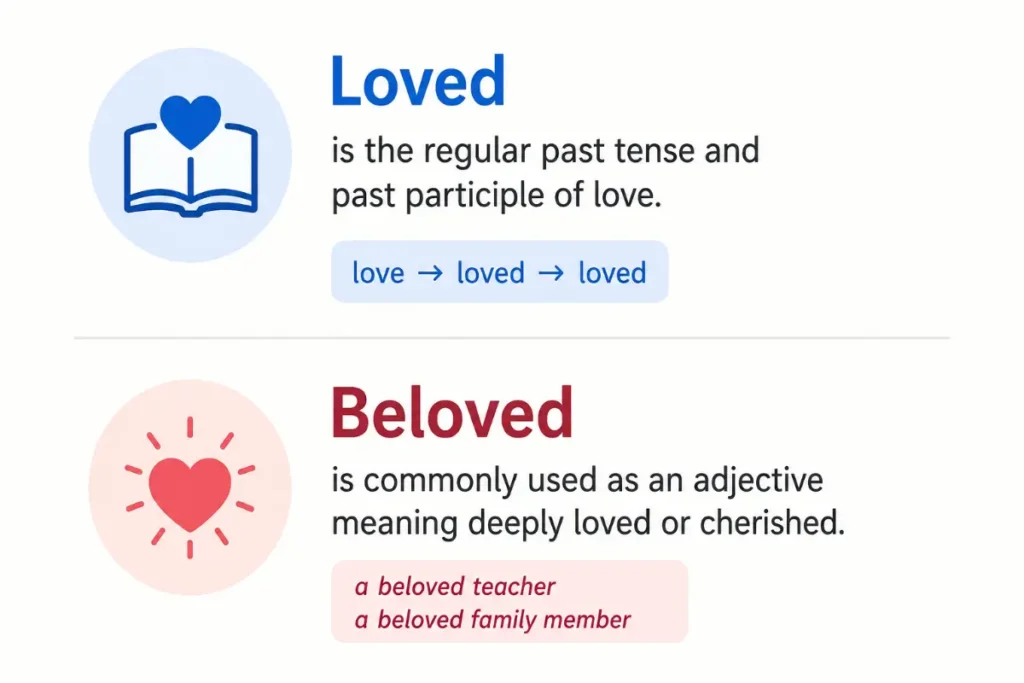
- Loved is the regular past tense and past participle of love.
- Beloved is commonly used as an adjective meaning deeply loved or cherished.
- Loved is usually more natural for describing an actual feeling or action.
- Beloved is often better for describing someone or something as deeply cherished.
- Loved one is a standard and very common expression.
- Beloved can describe people, animals, places, traditions, books, characters, and institutions.
- Beloved often sounds warmer, more emotional, literary, or commemorative.
- Loved is generally more neutral and flexible.
- “I loved it” is correct.
- “I beloved it” is incorrect in standard modern English.
- “She was a beloved teacher” sounds natural.
- Context should determine the final choice.
Conclusion
Beloved vs. Loved have similar meanings, but they aren’t always used in the same way. Loved often describes a feeling of affection, while beloved describes someone or something that is deeply cherished. The difference influences grammar, tone, and word choice.
Use loved to express affection or describe a personal experience. For example, “I loved the movie,” “She loved her hometown,” and “They loved the new house.” Use beloved to describe someone or something that holds a special place in people’s hearts, as in “a beloved teacher,” “a beloved tradition,” or “a beloved hometown.”
The simplest rule is this. Loved usually expresses love as a feeling or action, while beloved emphasizes being deeply cherished. Understanding this distinction makes it easier to choose the right word for your sentence.
Frequently Asked Questions
What is the difference between beloved and loved?
Loved generally describes the feeling or expression of love, while beloved describes someone or something that is deeply cherished. Loved is more common in everyday conversation, whereas beloved often conveys greater emotional warmth, affection, or a literary tone.
Is beloved stronger than loved?
Beloved often sounds more emotionally expressive than loved, but it is not simply a stronger form of the word. It emphasizes how deeply someone or something is cherished rather than the act of loving itself.
Is beloved a verb?
In modern standard English, beloved is most commonly used as an adjective. It is not the ordinary past tense of love. The correct past tense and past participle are loved.
Can I say “I beloved you”?
No. “I beloved you” is not standard English. Use “I loved you” to describe affection in the past or “I love you” to express affection in the present.
Is beloved formal or informal?
Beloved often has a formal, literary, ceremonial, or emotional tone, but it is not limited to formal writing. It can be used naturally to describe cherished family members, friends, pets, places, traditions, and cultural figures.
Is “loved one” the same as “beloved”?
The expressions are related, but they are used differently. A loved one is a noun phrase that refers to someone you care deeply about. Beloved is usually an adjective that describes a person or thing that is greatly cherished.
Can beloved describe a place?
Yes. Beloved can describe a place that holds special meaning for an individual or community. Common examples include a beloved hometown, a beloved city, a beloved park, and a beloved neighborhood.
Can I use beloved for a pet?
Yes. Beloved is often used to describe pets that have a special place in their owners’ hearts. For example: “Her beloved dog was part of the family for many years.”
Which word is more common in everyday English?
Loved is generally more common because it serves as the regular past tense and past participle of love and is also used in various adjective constructions. Beloved has a more specific use and often conveys a deeper sense of affection or emotional attachment.
Is beloved romantic?
Beloved can have a romantic meaning, but it is not exclusively associated with romance. It can describe relatives, friends, teachers, pets, places, traditions, books, fictional characters, and well-known public figures that people deeply cherish.

Confusing Words, Spelling & Word Choice
Claire Whitmore is a U.S.-based English editor who writes about commonly confused words, spelling differences, and word choice. Her work helps readers understand subtle distinctions between similar-looking words through simple definitions, practical examples, and modern usage guidance in both American and British English.