
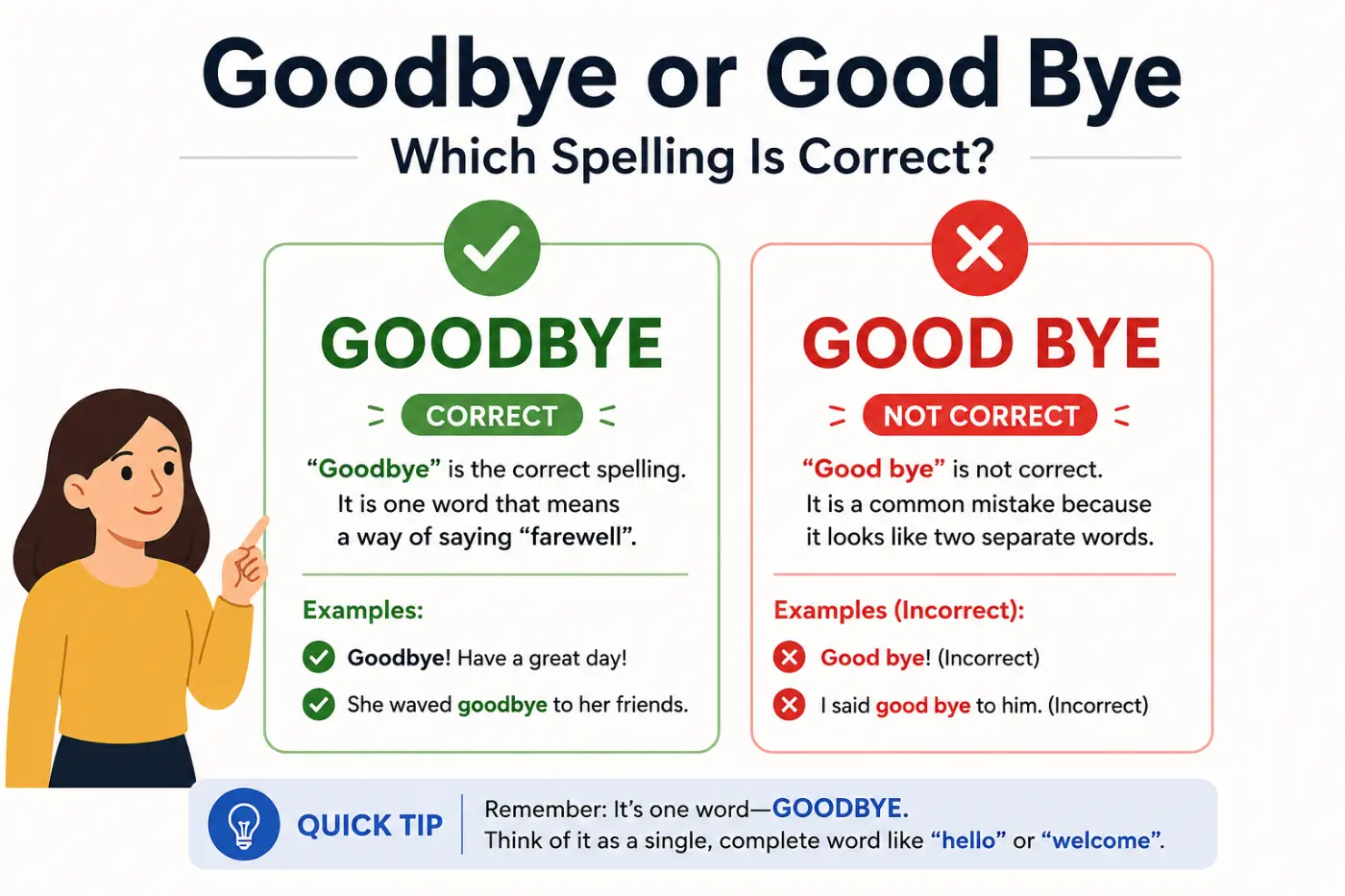
Goodbye or Good Bye is a common spelling question because the expression sounds like two ordinary words. English has many expressions that began as separate words and later developed into a single word, and this expression followed that path. Today, goodbye is the standard spelling in modern English.
If you are writing a message, ending an email, preparing a school assignment, or checking a sentence before publishing it, goodbye is the safe choice. The same form works as a noun and as an interjection. You can say goodbye to someone, say goodbye, or write Goodbye at the end of a note.
This guide explains why the spelling changed, how the word is pronounced, how it works grammatically, and when different forms may appear. You will also see real examples, common mistakes, memory tips, regional notes, and answers to the questions people ask most often.
Short Answer
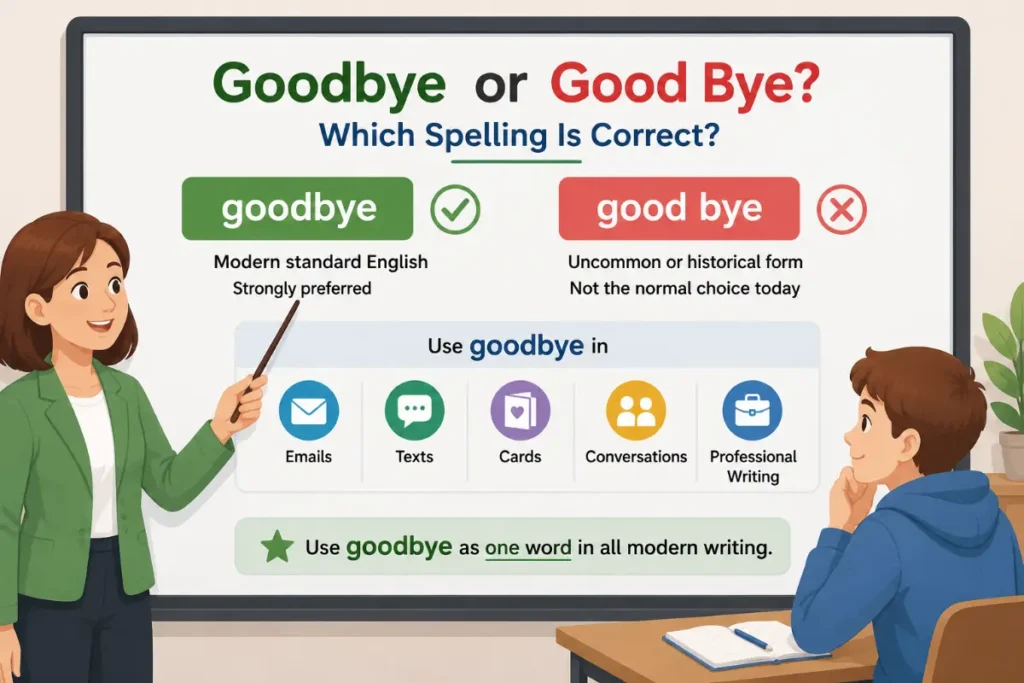
Goodbye or Good Bye can look like two acceptable spellings, but modern standard English strongly prefers goodbye as one word. Good bye appears mainly as an uncommon or historical form and is not the normal choice in current American English. Use goodbye in emails, texts, cards, conversations, and professional writing.
Table of Contents
- Which Spelling Is Correct.
- Why Goodbye Is Written As One Word.
- What Goodbye Means.
- How To Use Goodbye In A Sentence.
- Goodbye As An Interjection.
- Goodbye As A Noun.
- Goodbye In Formal Writing.
- Goodbye In Informal Writing.
- Is Good Bye Ever Correct.
- Pronunciation Guide.
- Word Origin And Historical Development.
- American And British English.
- Common Spelling Mistakes.
- Goodbye Compared With Similar Expressions.
- Memory Tips.
- Professional Writing Tips.
- Related Usage Notes.
- Why The Confusion Persists.
- When To Use Bye Instead.
- When To Use Farewell.
- Goodbye In Different Contexts.
- Grammar Patterns Worth Learning.
- Expert Language Insight.
- A Quick Editing Checklist.
- Key Takeaways.
- Frequently Asked Questions.
- Conclusion.
Which Spelling Is Correct
Goodbye or Good Bye is ultimately a question about modern spelling and usage. The standard modern spelling is goodbye. It is written as one word without a space. This is the form you should normally choose in American English and in general modern English writing.
The form good bye is uncommon in present day standard usage. You may still encounter it in older writing, historical material, quoted language, stylized text, or occasional nonstandard writing. Its appearance does not make it the preferred modern spelling.
The form good-bye also has historical use. Older dictionaries and texts record it as a spelling that appeared during the development of the expression. Modern readers will usually expect goodbye as one word.
The simplest rule is this.
- Use goodbye as the normal modern spelling.
- Avoid good bye in ordinary modern writing.
- Recognize good-bye as an older or historical form rather than the standard choice today.
If you are unsure while proofreading, choose the single word goodbye. That choice will be understood naturally by modern English readers.
Why Goodbye Is Written As One Word
The history of English contains many expressions that started as combinations of separate words and later became established as single words. Goodbye is one of them.
The expression developed from the phrase God be with you. Over time, the phrase was shortened in speech and writing. Forms such as God be with ye, God b’w’y, and similar shortened expressions appeared in historical sources. The modern word eventually settled into the form goodbye.
This history explains why the spelling can feel unusual. The word is not simply a random combination of good and bye. Its history is connected to an older farewell expression associated with a blessing or wish for divine protection.
The first part also changed over time. The modern spelling contains good, but the word is not normally interpreted as meaning that something is good. In modern English, goodbye functions as a conventional farewell.
That distinction matters for learners. You do not need to analyze the expression as good plus bye every time you use it. Treat goodbye as an established word with its own meaning and grammatical behavior.
Language often works this way. A phrase may begin with a transparent meaning, become frequent in speech, and eventually develop into a fixed expression whose modern meaning is understood as a whole.
What Goodbye Means
Goodbye is used when someone is leaving or when two people are ending an interaction. It can mark a temporary parting or a final separation.
For example, a person leaving a room might say Goodbye. A friend ending a phone call might say Goodbye. A writer may finish a personal note with Goodbye or use a longer closing such as Goodbye for now.
The word can carry different emotional tones depending on context.
- A simple farewell can sound neutral.
- A warm farewell can express affection.
- A final farewell can suggest permanent separation.
- A dramatic farewell can appear in stories, films, speeches, or emotional conversations.
The surrounding words usually provide the emotional meaning. Goodbye itself does not automatically mean permanent separation.
Compare these examples.
- Goodbye. I will see you tomorrow.
- Goodbye for now. Take care.
- She said goodbye to her coworkers before leaving.
- They knew it was time to say goodbye.
In the first sentence, the separation is temporary because the speaker expects to meet the listener again. In the fourth sentence, the context suggests a more meaningful or final parting.
This is one reason the word works so well across different situations. The basic meaning stays stable while the surrounding language adds emotional or practical information.
How To Use Goodbye In A Sentence
Goodbye can appear in several common grammatical structures. Learning these patterns makes the word easier to use naturally.
One common structure is say goodbye. This treats goodbye as the name of the farewell action.
- I said goodbye before I left.
- We said goodbye to our guests.
- She stopped at the door to say goodbye.
- He called to say goodbye.
Another common structure is say goodbye to someone or something. The preposition to identifies the person, place, period, habit, or thing being left behind.
- She said goodbye to her old apartment.
- He said goodbye to his friends at the station.
- The team said goodbye to its longtime coach.
- I finally said goodbye to that broken laptop.
Goodbye can also appear as a direct expression.
- Goodbye.
- Goodbye for now.
- Goodbye and take care.
- Goodbye. See you next week.
The punctuation depends on the sentence. A standalone farewell can take a period or an exclamation point. An exclamation point adds stronger emotion, while a period keeps the tone neutral.
Goodbye can also occur in noun phrases.
- A final goodbye.
- A heartfelt goodbye.
- A quick goodbye.
- An emotional goodbye.
These combinations show that the word has grammatical flexibility beyond its familiar use as a spoken farewell.
Goodbye As An Interjection
Goodbye often works as an interjection because it can stand alone as a farewell.
An interjection is a word or expression that can communicate a feeling, reaction, or social action without functioning as a normal part of a larger grammatical clause. Farewells are a good example of this use.
Consider these examples.
- Goodbye.
- Goodbye. Have a safe trip.
- Goodbye. I hope you get home safely.
- Goodbye. See you on Monday.
In each example, goodbye performs a social function. It signals that the speaker is ending the interaction.
The word does not need a subject or verb when used this way. You do not need to write I say goodbye every time. A simple Goodbye is a complete and natural farewell.
This is especially common in speech. Tone of voice can make the same word sound cheerful, affectionate, formal, sad, annoyed, or final.
The punctuation can reinforce that tone. A period creates a calm ending, while an exclamation point can make the farewell more energetic or emotional.
Goodbye As A Noun
Goodbye can also function as a noun. In this use, it refers to the act or occasion of parting. The phrase say goodbye is especially common because the noun refers to the farewell itself.
- We said our goodbyes after dinner.
- She gave him a quick goodbye.
- The family gathered for a final goodbye.
- He left without saying goodbye.
Notice the plural form goodbyes. When you are talking about multiple farewell moments, goodbyes is the normal plural spelling.
This form is useful because it demonstrates that goodbye behaves like an ordinary noun in many contexts. It can take an article, a possessive, or a plural ending depending on the sentence.
Compare these structures.
- Goodbye is difficult.
- The goodbye was emotional.
- Her goodbye was brief.
- Their goodbyes lasted for several minutes.
The first example treats goodbye as a general concept. The others refer to a specific farewell.
A useful test is to replace goodbye with another noun such as farewell. If the sentence still works grammatically, goodbye is probably functioning as a noun.
Goodbye In Formal Writing
Goodbye is grammatically correct in formal writing, but the best choice depends on the type of document.
In a professional email, for example, writers often use closings such as Best, Sincerely, Kind regards, or Thank you rather than simply Goodbye. These alternatives can sound more appropriate because they match the conventions of business correspondence.
Still, goodbye itself is not grammatically informal. It can appear in formal prose when the context calls for a direct farewell.
For example.
- The director said goodbye to the staff after the final meeting.
- The ceremony marked the community’s goodbye to the retiring principal.
- The speaker offered a final goodbye before leaving the stage.
In these sentences, goodbye describes a real farewell event. It is perfectly acceptable.
The key distinction is between grammatical correctness and register. A word can be correct English while still being less suitable for a particular professional situation.
That distinction helps prevent a common mistake in language learning. Not every formal writing decision is a grammar rule. Sometimes the issue is simply tone, audience, or convention.
Goodbye In Informal Writing
In texts, chats, notes, and casual conversations, goodbye is extremely flexible.
You can write a short farewell.
- Goodbye.
- Bye.
- Bye for now.
- See you later.
- Take care.
You can also combine goodbye with another expression.
- Goodbye for now. Talk to you tomorrow.
- Goodbye. Thanks for everything.
- Goodbye and good luck.
- Goodbye. Have a great weekend.
In casual communication, context controls the tone. A plain Goodbye may sound serious in one conversation and completely ordinary in another.
The shorter form bye is also very common. Bye is an informal shortening of goodbye and is often used in everyday speech and writing.
A useful distinction is that goodbye has a broader register range. It can sound casual, neutral, warm, serious, or emotional. Bye usually sounds more relaxed.
Is Good Bye Ever Correct
Good bye is not the normal modern spelling, but it can appear in historical texts and in unusual stylistic contexts.
English spelling does not always change at the same speed across dictionaries, books, newspapers, personal writing, and speech. Older forms can survive for decades or appear in quotations. That does not mean they are the best choice for current standard writing.
If you are proofreading modern American English, changing good bye to goodbye will usually improve the spelling.
There is one important distinction. A writer may intentionally separate words for creative effect. A poem, advertisement, song title, fictional character, or stylized design may use unusual spacing. That is a stylistic decision rather than evidence that good bye is the standard spelling.
For ordinary writing, use goodbye.
The same principle applies to good-bye. You may encounter the hyphenated form in older sources, but modern general writing normally uses the closed form.
Pronunciation Guide
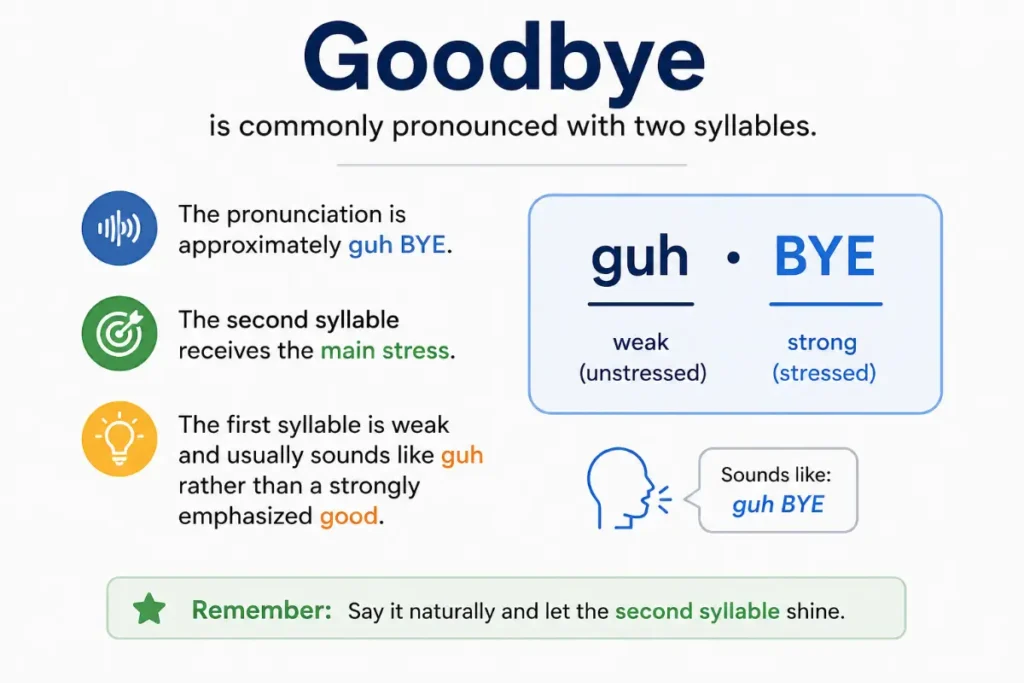
Goodbye is commonly pronounced with two syllables.
The pronunciation is approximately guh BYE.
The second syllable receives the main stress. The first syllable is weak and usually sounds like guh rather than a strongly emphasized good.
This pronunciation can help explain why spelling the expression as good bye feels intuitive. The word began as a longer phrase and later developed into a compact expression. Modern speakers generally hear it as one established word.
A simple pronunciation guide is.
- Goodbye sounds like guh BYE.
- The stress falls on BYE.
- The final sound is the same vowel sound found in buy and bye.
The pronunciation is broadly consistent in major varieties of English, although individual accents can change the exact vowel quality.
The ending also connects goodbye with the word bye in sound. That relationship can make the spelling seem logical once you remember that goodbye is the established longer form.
Word Origin And Historical Development
The origin of goodbye is one of the most interesting parts of the word because the modern spelling hides its earlier form.
Most historical explanations connect goodbye with the farewell phrase God be with you. That expression was used as a blessing when parting from someone. Over time, frequent spoken use encouraged shortening and sound changes.
Historical forms included expressions that abbreviated the longer farewell. Eventually, the modern form goodbye became established.
This development is not unique to English. Frequently used expressions often become shorter, more fixed, and easier to produce. Speakers do not consciously perform the entire historical transformation. Language changes gradually through repeated use across generations.
The spelling goodbye therefore represents a long process of lexicalization. Lexicalization happens when a group of words becomes established as a fixed expression or a single lexical item.
The modern word should not be interpreted literally as good plus bye. Its present meaning is a conventional farewell.
That is also why learners should not try to reconstruct the grammar of the original phrase every time they write the word. Historical origin can explain a spelling, but current usage determines the modern rule.
It is also worth separating historical evidence from modern recommendation. An older spelling can be completely authentic for its period while still being unsuitable for contemporary prose.
American And British English
The spelling goodbye is standard in both American and British English.
You may see differences in punctuation, surrounding expressions, or preferred email closings between different English speaking communities, but the basic spelling of goodbye remains the same.
American English commonly uses goodbye in everyday conversation, text messages, professional writing, books, journalism, and educational material. British English also uses goodbye as the normal modern form.
The alternative good bye is not a standard regional spelling that you should choose for British English. A British writer does not normally need to separate the word simply because the spelling traditions differ in other areas.
This is useful because some English learners assume that unusual spellings must belong to another major variety of English. In this case, that assumption does not help. Goodbye is the safe standard form across major English varieties.
Regional vocabulary can differ greatly across English speaking communities, but this particular spelling does not create a major American versus British distinction.
Common Spelling Mistakes
The most common mistake is separating the word into good bye.
- Incorrect in normal modern writing: I said good bye to my teacher.
- Standard modern form: I said goodbye to my teacher.
Another mistake is adding a hyphen.
- Older or historical form: good-bye.
- Standard modern form: goodbye.
A third mistake is confusing goodbye with bye. Both are correct words, but they have different levels of formality.
- Goodbye is neutral and widely usable.
- Bye is shorter and more informal.
A fourth mistake is using an apostrophe. Some learners may write good-bye’s when they mean the plural noun. The correct plural is goodbyes without an apostrophe.
- She said her goodbyes.
- They exchanged quick goodbyes.
An apostrophe would only be needed for a possessive construction, such as the goodbye’s emotional impact, although that structure is less common and can often be rewritten more naturally.
Goodbye Compared With Similar Expressions
Goodbye has several close alternatives, but they do not always carry exactly the same tone.
| Expression | Main use | Typical tone |
|---|---|---|
| goodbye | General farewell | Neutral |
| bye | Short everyday farewell | Informal |
| farewell | Parting or final departure | Formal or literary |
| see you | Expected future meeting | Casual |
| see you later | Future meeting or casual departure | Informal |
| take care | Friendly parting | Warm |
| so long | Farewell expression | Informal or old fashioned |
| cheerio | Farewell in some British contexts | Informal |
| goodbye for now | Temporary separation | Warm or neutral |
Farewell deserves special attention. It can sound more formal, literary, dramatic, or final than goodbye. In everyday American conversation, many speakers would choose goodbye or bye instead.
See you carries an additional meaning because it often suggests another meeting. Goodbye does not necessarily make that promise.
Take care is also different. It can function as a farewell, but it expresses a wish for the other person’s well being.
These distinctions matter when choosing the best word for a specific situation. Correct grammar is only part of effective communication. Tone and context matter too.
Memory Tips
A simple memory trick is to remember that the standard modern form is a single word.
Think of goodbye as one complete farewell unit.
If you are writing a text, email, article, essay, or card and you pause over the spelling, choose goodbye.
Another useful trick is to connect the word with the common phrase say goodbye.
- Say goodbye.
- Said goodbye.
- Saying goodbye.
- Goodbyes.
Seeing the word in these common grammatical patterns helps reinforce the spelling.
You can also remember that bye is already a separate short word. The longer form is goodbye, not good bye.
The historical connection with God be with you can provide an additional memory aid. Although the modern word no longer carries that literal structure, remembering its origin helps explain why the spelling evolved into a single word.
A final memory trick is visual. Imagine the word as one closed unit. Once you see goodbye as a single block of letters, the space in good bye starts to look unusual.
Professional Writing Tips
Professional writers should choose the spelling that readers expect. In standard modern English, that means goodbye.
If you are editing a business document, academic paper, website, newsletter, or public announcement, use the standard form unless you have a specific reason to preserve an older spelling.
Context can also affect the choice of farewell expression.
A business email might end with Best regards rather than Goodbye. A speech about retirement might refer to a final goodbye. A novel might use Goodbye as dialogue. A text message might simply say Bye.
These are not spelling differences. They are choices about register and purpose.
Editors should also watch for consistency. If a document uses goodbye in one section and good bye in another, the variation may look like an accidental spelling error. Standardizing the modern form usually makes the writing cleaner.
When quoting historical material, however, preserve the original wording when accuracy requires it. An old text may contain good-bye or another historical form. Editing a historical quotation into modern spelling can change the source.
Related Usage Notes
One useful point is the difference between goodbye and goodbye’s. The apostrophe belongs to possessive constructions, not to ordinary plurals.
The plural noun is goodbyes.
- We exchanged goodbyes.
- Their goodbyes were emotional.
- Several goodbyes were said before the train left.
Do not write goodbye’s simply because there is more than one farewell.
Another point concerns capitalization. When goodbye begins a sentence, capitalize it normally.
- Goodbye was the last word she said.
- Goodbye. See you tomorrow.
When it appears in the middle of a sentence, lowercase it unless another capitalization rule applies.
- He whispered goodbye and walked away.
- She wanted to say goodbye before dinner.
Goodbye can also be part of a compound expression such as goodbye party. In that phrase, goodbye remains one word.
- We planned a goodbye party for our coworker.
- They held a goodbye dinner before the move.
The same spelling applies when goodbye modifies another noun.
Why The Confusion Persists
The confusion comes partly from pronunciation and partly from the structure of English.
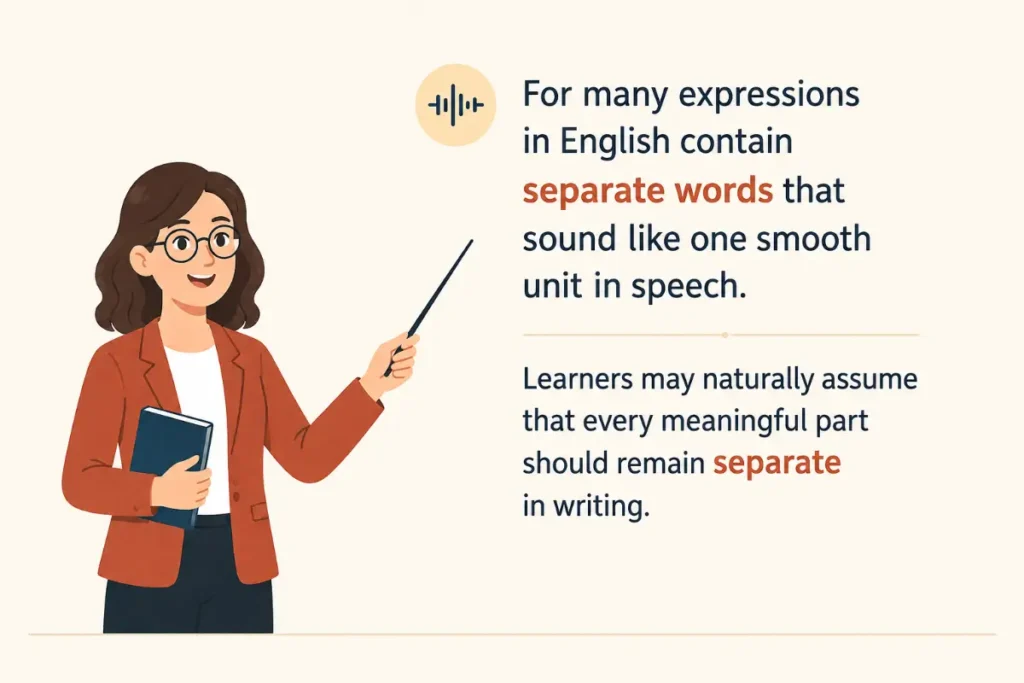
Many expressions in English contain separate words that sound like one smooth unit in speech. Learners may naturally assume that every meaningful part should remain separate in writing.
The words good and bye also exist independently. Good is a common adjective, while bye is a common informal farewell. That makes good bye look grammatically plausible even though goodbye has become the established spelling for the standard expression.
Historical spelling adds another layer. Readers can find good-bye and good bye in older sources, which may make the modern rule seem less certain.
Dictionary evidence and current usage settle the issue. Modern standard English uses goodbye as the normal spelling.
For writers checking Goodbye or Good Bye, this history explains why both forms may appear during research even though only one should normally be chosen for current prose.
When To Use Bye Instead
Bye is often the best choice when the setting is relaxed.
You might say bye to a friend at the end of a phone call. A child might say bye to a parent at school. A coworker might write Bye in a casual chat.
The shorter word has a lighter and more conversational feel.
Goodbye is more neutral. It can sound warm, serious, formal, emotional, or ordinary depending on context.
Consider these examples.
- Bye. See you tomorrow.
- Goodbye. Thank you for your help.
- She waved and said bye.
- He stood at the door and said goodbye.
The first and third sentences sound especially casual. The second and fourth can fit a wider range of situations.
Neither form is automatically better. The right choice depends on the relationship and setting.
When To Use Farewell
Farewell is another useful alternative. It is grammatically correct and often carries a more formal or literary tone.
You might see it in speeches, ceremonies, books, historical writing, or emotionally serious contexts.
- The mayor gave a farewell speech.
- The ceremony marked her farewell to the organization.
- They exchanged a final farewell.
In everyday American conversation, farewell can sound more dramatic than goodbye. That does not make it wrong. It simply gives the sentence a different style.
This is a good example of why vocabulary choice should consider tone. Two words can share a basic meaning while creating different impressions.
Goodbye In Different Contexts
The meaning of goodbye can shift slightly with the surrounding words.
Goodbye for now normally suggests that the separation is temporary.
Goodbye forever suggests permanence and is much stronger.
A final goodbye can describe a last farewell.
A tearful goodbye highlights emotion.
A quick goodbye describes a brief farewell.
A friendly goodbye signals warmth.
The base word stays the same. The modifiers provide additional information.
This flexibility makes goodbye useful across many forms of communication. It can appear in ordinary conversation, journalism, fiction, speeches, personal letters, social posts, and professional prose.
The same principle helps with other farewell expressions. See you later emphasizes another meeting. Take care expresses concern for someone’s well being. Farewell can emphasize the act of parting itself.
Grammar Patterns Worth Learning
Several patterns occur frequently enough to memorize.
The first is say goodbye to someone.
- I said goodbye to my sister.
- We said goodbye to our neighbors.
The second is say goodbye to something.
- She said goodbye to her old routine.
- He said goodbye to his childhood home.
The third is say your goodbyes.
- It is time to say your goodbyes.
- They gathered to say their goodbyes.
The fourth is a goodbye.
- She gave him a quick goodbye.
- Their goodbye was emotional.
The fifth is goodbye as a standalone interjection.
- Goodbye.
- Goodbye and good luck.
Learning these patterns is more useful than memorizing an isolated spelling rule because it shows how the word behaves in real sentences.
The expression can also occur after verbs other than say.
- She waved goodbye.
- He shouted goodbye from the doorway.
- They whispered goodbye before the train departed.
These examples show that goodbye can participate naturally in several verb patterns.
Expert Language Insight
From a modern lexical perspective, goodbye is best treated as an established lexical item rather than a freely created phrase. Its historical source explains its development, but speakers today do not normally interpret the word through the original phrase God be with you.
This distinction between etymology and synchronic meaning is important in language study. Etymology describes where a word came from. Synchronic grammar and usage describe how speakers use it now.
The modern form is therefore straightforward. Goodbye is the conventional noun and interjection used for parting.
The older variants are useful mainly when reading historical texts or studying the history of English spelling. They are not needed for ordinary modern writing.
The distinction also explains why spelling rules can change over time. A historical source can document a form that is no longer preferred. Modern usage guides writers based on the conventions of current English rather than requiring them to reproduce every earlier spelling.
A Quick Editing Checklist
When you proofread a sentence containing a farewell, check four things.
- Is the modern spelling written as one word.
- Is the word being used as a noun or an interjection in a way that fits the sentence.
- Is the tone suitable for the audience.
- Is the plural written as goodbyes rather than goodbye’s.
These checks catch most problems quickly.
If you are writing for a general American audience, the safest standard choice is goodbye.
For academic or professional work, also consider the surrounding vocabulary. A sentence can be grammatically correct while still sounding too casual for its setting. Choosing the right farewell expression helps the entire sentence feel natural.
Key Takeaways
- The standard modern spelling is goodbye.
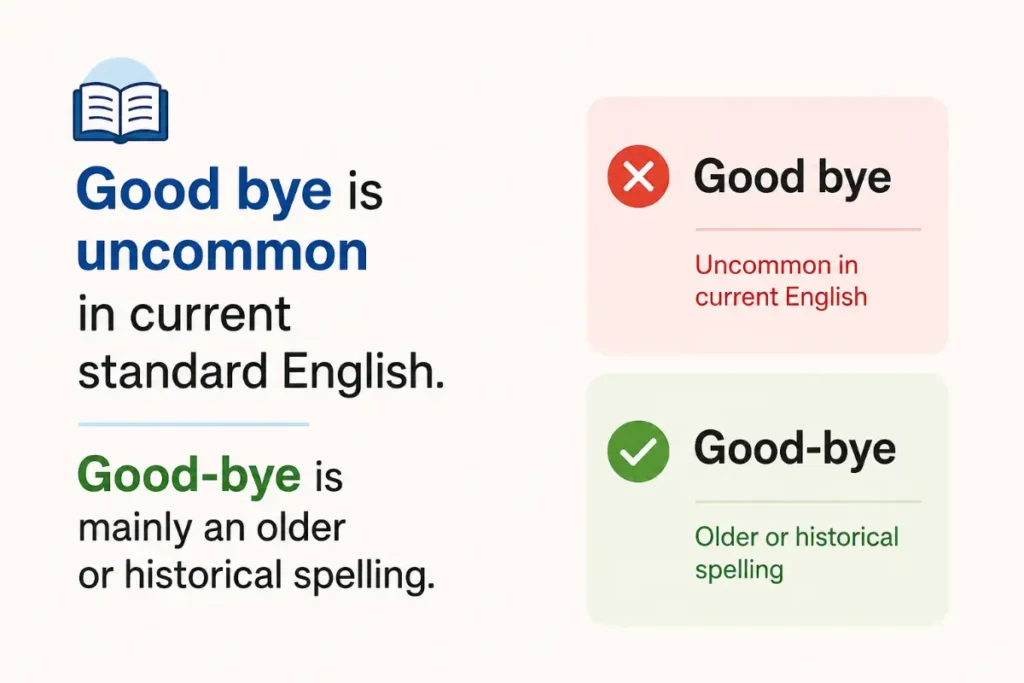
- Good bye is uncommon in current standard English.
- Good-bye is mainly an older or historical spelling.
- Goodbye can work as an interjection or noun.
- The plural form is goodbyes.
- Bye is a shorter and more informal alternative.
- Farewell often sounds more formal or literary.
- The word developed historically from a longer farewell expression connected with God be with you.
- American and British English both use goodbye as the standard modern spelling.
- For ordinary modern writing, use goodbye as one word.
Conclusion
Goodbye or Good Bye can be confusing because the expression has a long history and older spellings still appear in books and historical sources. Modern standard English has settled on goodbye as the normal one word spelling. That is the form to choose for everyday writing, professional communication, academic work, and general published English.
The word can function as both an interjection and a noun. You can say goodbye to someone, say your goodbyes, give a goodbye, or use Goodbye as a complete farewell. The shorter bye is more casual, while farewell often sounds more formal or literary.
If you remember only one rule, remember this: write goodbye as one word in modern English. Once that spelling becomes familiar, you will rarely need to stop and question it again.
Frequently Asked Questions
Is Goodbye Or Good Bye Correct?
Goodbye or Good Bye is best resolved by looking at modern standard usage. Goodbye is the standard modern spelling. Good bye may appear in older or unusual writing, but it is not the normal form to use in current standard English.
Is Good Bye Two Words?
Historically, the expression appeared in forms with separate words, but modern standard English normally writes the established word goodbye as one word.
Is Good Bye Ever Acceptable?
It can appear in historical material, quotations, or intentional stylistic writing. For ordinary modern prose, goodbye is the preferred spelling.
Is Good Bye A Grammar Mistake?
In current standard writing, separating the word is generally treated as a spelling error or nonstandard form. The preferred form is goodbye.
Is Goodbye One Word Or Two Words?
Goodbye is one word. This is the standard modern spelling used in American and British English.
What Is The Plural Of Goodbye?
The plural is goodbyes. Do not use an apostrophe to form the plural.
What Is The Difference Between Goodbye And Bye?
Goodbye is a neutral farewell that works across many settings. Bye is shorter and usually more casual.
What Is The Difference Between Goodbye And Farewell?
Both can signal parting, but farewell often sounds more formal, literary, ceremonial, or final than goodbye.
How Do You Pronounce Goodbye?
Goodbye is generally pronounced guh BYE with the main stress on the second syllable.
Is Goodbye Formal Or Informal?
Goodbye can work in both formal and informal contexts. The surrounding sentence and situation determine its tone.
Why Is Goodbye Spelled As One Word?
The word developed from a longer farewell expression and gradually became a fixed lexical item. Modern English therefore treats goodbye as one word.
Can Goodbye Be A Noun?
Yes. Goodbye can refer to a farewell or the act of parting. Its plural form is goodbyes.

Confusing Words, Spelling & Word Choice
Claire Whitmore is a U.S.-based English editor who writes about commonly confused words, spelling differences, and word choice. Her work helps readers understand subtle distinctions between similar-looking words through simple definitions, practical examples, and modern usage guidance in both American and British English.