
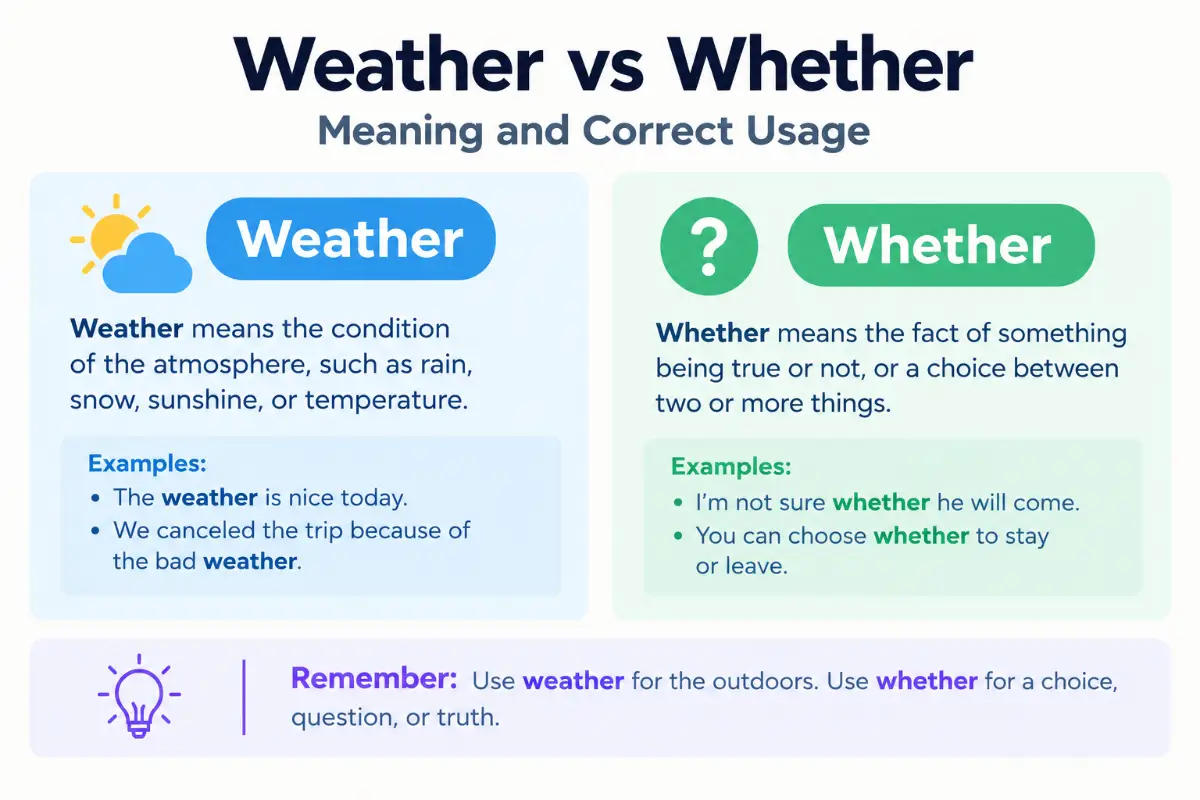
Weather vs whether is a common English spelling and usage problem because both words usually sound identical when spoken. However, they serve different purposes in a sentence. Weather describes conditions outside, while whether helps express a choice, uncertainty, or possibility.
The easiest way to tell them apart is to look at the meaning of the sentence. If you’re talking about rain, snow, sunshine, wind, or temperature, use weather. If you’re discussing alternatives, making a decision, or expressing uncertainty about something, use whether. This simple distinction will help you choose the correct word in emails, school assignments, professional documents, and everyday conversations.
Although these words share the same pronunciation in most American English speech, you can’t use them interchangeably in writing. One names a familiar part of nature, and the other connects ideas in a sentence. Once you understand their meanings and grammatical roles, you’ll find it much easier to avoid this common mistake.
Short Answer
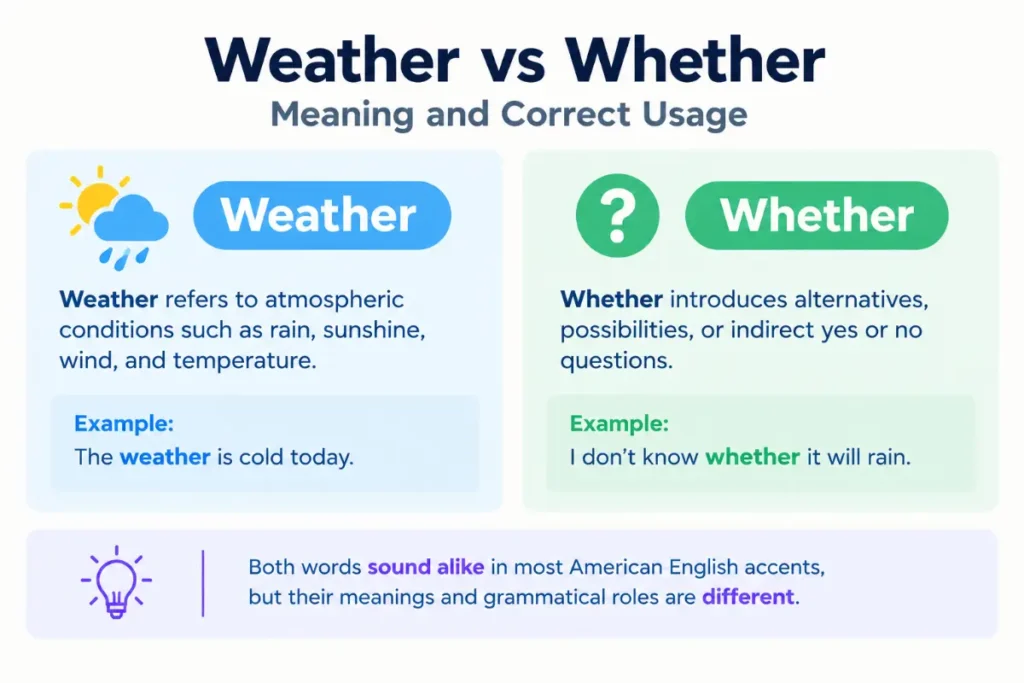
Weather refers to atmospheric conditions such as rain, sunshine, wind, and temperature. Whether introduces alternatives, possibilities, or indirect yes or no questions. For example, “The weather is cold today” describes outdoor conditions, while “I don’t know whether it will rain” expresses uncertainty. Both words sound alike in most American English accents, but their meanings and grammatical roles are different.
Table of Contents
- What Weather Means.
- What Whether Means.
- The Difference Between Weather and Whether.
- How to Use Weather Correctly.
- How to Use Whether Correctly.
- Weather vs Whether Comparison Table.
- Real Life Examples.
- Common Mistakes to Avoid.
- Weather and Whether in American English.
- Pronunciation and Word Origins.
- Memory Tricks to Remember the Difference.
- Related Grammar and Usage Rules.
- Frequently Asked Questions.
- Key Takeaways.
- Conclusion.
What Weather Means
Weather is a noun that describes the condition of the atmosphere at a particular time and place. It includes temperature, rainfall, snowfall, humidity, wind, cloud cover, and other atmospheric conditions.
When someone asks about the weather, they’re usually asking about what it’s like outside or what conditions are expected later. Weather can change within minutes or remain stable for several days.
For example, consider this sentence.
“The weather is beautiful today.”
This sentence describes pleasant outdoor conditions. The speaker might mean that the sky is clear, the temperature is comfortable, and there’s little wind.
Here are more examples of how to use weather.
- “The weather looks cloudy this morning.” This sentence describes the appearance of the sky.
- “We canceled our picnic because of the bad weather.” This sentence explains that unpleasant atmospheric conditions caused a change of plans.
- “The weather forecast predicts heavy rain tonight.” This sentence refers to a prediction about future atmospheric conditions.
- “Cold weather can make driving more difficult.” This sentence explains how low temperatures can affect road conditions and travel.
- “The weather changed suddenly after lunch.” This sentence describes a change in outdoor conditions.
In each example, weather refers to something happening in the atmosphere. It doesn’t introduce a question or present two alternatives.
Weather as a Noun
In ordinary English, weather is usually an uncountable noun. That means you generally don’t use the article a directly before it when referring to atmospheric conditions.
For example, say “The weather is pleasant” rather than “The weather is a pleasant.”
You can use expressions such as “a spell of bad weather,” “a period of warm weather,” or “a weather forecast.” In these phrases, the words spell, period, and forecast provide the countable nouns.
You can also use weather as a modifier before another noun.
Examples include:
- Weather forecast.
- Weather conditions.
- Weather report.
- Weather station.
- Weather warning.
These expressions appear frequently in news reports, travel updates, school materials, and everyday conversation.
Weather as a Verb
Weather can also function as a verb. As a verb, it means to withstand or survive something difficult, or to undergo the effects of exposure to the elements.
For example, “The old wooden fence has weathered years of heavy rain.”
This sentence means that the fence has endured prolonged exposure to rain and other outdoor conditions.
Another example is “The company weathered a difficult financial period.” Here, weathered means survived or endured a challenging situation. The sentence uses a figurative meaning rather than a literal reference to the atmosphere.
The verb form appears in several common expressions.
- “Weather the storm.” This means to endure a difficult period or situation.
- “Weather the crisis.” This means to survive a serious challenge.
- “Weather the criticism.” This means to withstand negative comments without giving up or being seriously harmed by them.
These expressions show that weather can describe both physical exposure and the experience of overcoming hardship.
What Whether Means
Whether is a conjunction that introduces alternatives, uncertainty, or indirect yes or no questions. It helps connect ideas when someone needs to consider two or more possibilities.
For example, consider this sentence.
“I don’t know whether she will attend the meeting.”
The sentence expresses uncertainty about her attendance. The speaker doesn’t know if she will attend or not.
Here are additional examples.
- “We need to decide whether to stay or leave.” This sentence presents two possible actions.
- “She asked whether I had finished the report.” This sentence introduces an indirect yes or no question.
- “I’m not sure whether the store is open.” This sentence expresses uncertainty about the store’s status.
- “He wondered whether his answer was correct.” This sentence describes uncertainty about an answer.
- “The manager will approve the request whether we agree or not.” This sentence means the approval will happen regardless of our agreement.
Notice that none of these sentences describes rain, sunshine, or atmospheric conditions. Whether helps organize ideas and express relationships between possibilities.
Whether for Two or More Alternatives
One of the most common uses of whether is to introduce a choice between alternatives. These alternatives may involve actions, opinions, plans, or outcomes.
For example, “I can’t decide whether to buy the blue shirt or the black one.”
The speaker is choosing between two shirts. The word whether introduces the alternatives and makes the decision clear.
You can use the same structure in many situations.
- “We’re discussing whether to move to another city.” This sentence introduces a decision about relocation.
- “She hasn’t decided whether to study biology or chemistry.” This sentence presents two possible fields of study.
- “They must determine whether the proposal is practical or unrealistic.” This sentence presents two possible assessments.
- “I’m considering whether to accept the offer.” This sentence expresses uncertainty about a possible decision.
Whether can also introduce more than two possibilities. For example, “We need to determine whether the package should be delivered today, tomorrow, or next week.”
The word doesn’t limit you to a simple pair of choices. It can introduce a broader set of alternatives.
Whether in Indirect Questions
An indirect question reports or embeds a question inside another sentence. Unlike a direct question, it usually follows the word order of a statement.
Compare these sentences.
Direct question: “Is the office open?”
Indirect question: “I don’t know whether the office is open.”
The second sentence embeds the question inside a statement about the speaker’s knowledge. The word whether connects the main clause with the indirect question.
More examples help clarify this pattern.
- “She asked whether the train had arrived.” This sentence reports her question about the train.
- “Can you tell me whether the payment went through?” This sentence politely asks for information about a completed transaction.
- “We need to find out whether the equipment is working.” This sentence identifies something that needs to be checked.
- “He wondered whether anyone had called.” This sentence reports his uncertainty about a phone call.
In these examples, whether introduces information that the speaker wants to know or confirm.
Whether With or Not
Whether often appears with or not. This construction can emphasize uncertainty or show that a result will remain the same despite different circumstances.
For example, “I don’t know whether or not he received the message.”
The speaker is uncertain about the message’s delivery. The phrase whether or not makes both possible outcomes explicit.
Consider another example.
“We’ll finish the project whether or not it rains.”
This sentence means the team will finish the project in either case. Rain won’t change the stated intention.
You don’t always need to include or not. In many sentences, whether alone already communicates the intended meaning.
For example, “I don’t know whether he received the message” is correct and natural. The missing words don’t make the sentence incomplete.
Whether Before an Infinitive
Whether can appear before to plus a base verb. This structure often expresses uncertainty about a possible action.
For example, “She couldn’t decide whether to call her friend.”
The speaker is describing a decision about making a phone call. The phrase whether to call presents the action under consideration.
Other examples include:
- “I’m trying to determine whether to renew my lease.” This sentence describes a decision about continuing a rental agreement.
- “He hasn’t decided whether to apply for the position.” This sentence expresses uncertainty about submitting an application.
- “We must consider whether to postpone the event.” This sentence presents postponement as a possible action.
- “They discussed whether to hire another employee.” This sentence describes a discussion about a staffing decision.
This construction is useful in professional writing because it expresses decisions clearly and efficiently.
The Difference Between Weather and Whether
The central difference is straightforward. Weather names atmospheric conditions, while whether introduces alternatives or uncertainty.
The two words sound alike in most American English accents, so pronunciation alone usually won’t help you choose the spelling. Instead, look at the role the word plays in the sentence.
If the sentence discusses rain, wind, heat, cold, or a forecast, weather is probably correct. If it introduces a decision, an indirect question, or two possible outcomes, whether is generally the right choice.
Consider these contrasting examples.
- “The weather may delay our flight.” This sentence refers to atmospheric conditions that could affect air travel.
- “We don’t know whether our flight will be delayed.” This sentence expresses uncertainty about the flight.
- “The weather is too cold for swimming.” This sentence describes low outdoor temperatures.
- “I can’t decide whether to swim today.” This sentence describes uncertainty about a choice.
The context determines which spelling you need. Although the words sound alike, their meanings are different enough that substituting one for the other can change the sentence’s meaning or make it grammatically incorrect.
How to Use Weather Correctly
Use weather when you need to describe atmospheric conditions or discuss the effects of exposure to the elements. It works in casual conversation, formal reports, forecasts, travel updates, and figurative expressions.
Describing Current Conditions
Weather is the correct choice when discussing what the atmosphere is like at a particular moment.
Examples:
- “The weather is warm and sunny.” This sentence describes current outdoor conditions.
- “Bad weather has affected traffic across the city.” This sentence explains how atmospheric conditions have influenced road travel.
- “The weather feels cooler near the coast.” This sentence compares temperatures or perceived conditions in two locations.
Talking About Forecasts
Weather also appears when discussing predictions about future conditions.
Examples:
- “Check the weather before leaving home.” This sentence recommends checking current conditions and forecasts before traveling.
- “The weather forecast calls for thunderstorms.” This sentence reports an expected weather event.
- “We may need to postpone the game because of the weather.” This sentence identifies atmospheric conditions as a possible reason for delaying an outdoor activity.
Using Weather Figuratively
Weather can describe enduring difficulties even when the sentence has nothing to do with the atmosphere.
Examples:
- “The team weathered a difficult season.” This sentence means the team endured a challenging period.
- “She weathered the public criticism with patience.” This sentence means she endured criticism without giving up.
- “The business weathered the economic downturn.” This sentence means the business survived a period of economic difficulty.
These figurative uses are common in journalism, business writing, biographies, and everyday speech.
How to Use Whether Correctly
Use whether when you want to express uncertainty, report an indirect question, or introduce alternatives. It often follows verbs such as know, ask, wonder, decide, determine, and consider.
After Verbs That Express Uncertainty
Whether often follows a verb that describes a person’s uncertainty or need for information.
Examples:
- “I wonder whether the package has arrived.” This sentence expresses uncertainty about the package’s arrival.
- “She doesn’t know whether the answer is correct.” This sentence describes a lack of certainty.
- “We need to determine whether the plan will work.” This sentence describes a need to evaluate a possible outcome.
When Making Decisions
Whether is useful when someone must choose an action or compare possibilities.
Examples:
- “He must decide whether to accept the promotion.” This sentence describes a career decision.
- “We’re considering whether to buy a new car.” This sentence presents a possible purchase.
- “They debated whether the policy should change.” This sentence describes a discussion about a possible change.
When Reporting Questions
Use whether to report a question without repeating it as a direct question.
Examples:
- “She asked whether I was available.” This sentence reports her question about availability.
- “The teacher wanted to know whether we understood the lesson.” This sentence reports the teacher’s request for confirmation.
- “He asked whether the meeting had been canceled.” This sentence reports his question about the meeting’s status.
The key is to preserve normal statement word order in the indirect question. Say “She asked whether he was ready,” not “She asked whether was he ready.”
Weather vs Whether Comparison Table
The following table summarizes the main differences between the two words and shows how to recognize the correct spelling in context.
| Feature | Weather | Whether |
|---|---|---|
| Main meaning | Atmospheric conditions | Alternatives or uncertainty |
| Part of speech | Usually a noun and sometimes a verb | Conjunction |
| Typical use | Describing rain, wind, heat, or cold | Expressing a choice or an indirect question |
| Pronunciation | Usually /ˈwɛðər/ in American English | Usually /ˈwɛðər/ in American English |
| Common expressions | Weather forecast, bad weather, weather report | Whether or not, decide whether, ask whether |
| Example | The weather is pleasant. | I wonder whether she is home. |
| Memory clue | Think of rain and sunshine. | Think of a choice or question. |
A Quick Test for Choosing the Right Word
When you’re unsure which spelling to use, read the entire sentence and ask what the word contributes to its meaning.
If the sentence refers to atmospheric conditions, choose weather. If it introduces uncertainty, a question, or a choice, choose whether.
Try these examples.
- “I hope the _____ stays sunny for our trip.” The correct answer is weather because the sentence refers to outdoor conditions.
- “She asked _____ the tickets were available.” The correct answer is whether because the sentence reports an indirect question.
- “The stormy _____ forced us to stay home.” The correct answer is weather because the sentence describes atmospheric conditions.
- “We haven’t decided _____ to leave early.” The correct answer is whether because the sentence presents a possible decision.
- “The company managed to _____ the crisis.” The correct answer is weather because the verb means to endure or survive a difficult situation.
The fifth example is especially useful because it shows that weather can be a verb. You don’t have to be discussing rain or sunshine to use it correctly.
Real Life Examples
Seeing the words in everyday situations makes the difference easier to remember. The examples below cover school, work, travel, family conversations, and common writing situations.
Examples From Everyday Conversation
- “What’s the weather like outside?” This is a direct question about current atmospheric conditions.
- “I’m not sure whether I should bring an umbrella.” This sentence expresses uncertainty about a practical decision.
- “The weather was perfect for a picnic.” This sentence describes favorable conditions for an outdoor activity.
- “Let me know whether you’re coming to dinner.” This sentence asks someone to confirm a plan.
- “We stayed indoors because the weather was terrible.” This sentence explains why people avoided going outside.
These examples show how naturally the words appear in ordinary conversation. The surrounding words usually make the intended meaning clear.
Examples From School and Education
- “The teacher asked us to describe the weather in our science journals.” This sentence refers to recording atmospheric observations.
- “I don’t know whether my answer is correct.” This sentence expresses uncertainty about an answer.
- “Our class studied how weather patterns affect agriculture.” This sentence discusses the relationship between atmospheric conditions and farming.
- “The student had to decide whether to revise the essay.” This sentence describes a decision about improving written work.
- “The weather delayed the school’s outdoor sports event.” This sentence explains that atmospheric conditions caused a delay.
Students can use this distinction in essays, examinations, reading comprehension exercises, and grammar assignments.
Examples From Work and Professional Writing
- “The weather may affect deliveries this afternoon.” This sentence identifies atmospheric conditions as a possible cause of delivery delays.
- “Please confirm whether the client has approved the proposal.” This sentence requests confirmation about a business decision.
- “Our team weathered several unexpected challenges.” This sentence uses weather as a verb meaning endured.
- “The supervisor asked whether the report was ready.” This sentence reports an indirect question.
- “We must determine whether the new schedule is practical.” This sentence identifies a decision that requires evaluation.
In professional writing, the wrong word can distract readers or weaken the clarity of a message. A quick review of the sentence’s meaning can prevent the error.
Examples From Travel and Outdoor Activities
- “We checked the weather before booking the hiking trip.” This sentence refers to reviewing atmospheric conditions before making travel plans.
- “I can’t decide whether to travel by train or bus.” This sentence presents two transportation options.
- “Severe weather forced the airline to cancel several flights.” This sentence explains that dangerous atmospheric conditions affected air travel.
- “Call the hotel to find out whether it offers airport transportation.” This sentence asks for information about a service.
- “The hikers weathered a sudden snowstorm.” This sentence means the hikers endured the storm.
Travel situations are especially useful for practicing these words because both can appear in the same conversation while serving entirely different purposes.
Examples Using Both Words Together
You can use weather and whether in the same sentence. This is one of the best ways to understand their difference.
- “We don’t know whether the weather will improve tomorrow.” Whether introduces uncertainty, while weather refers to atmospheric conditions.
- “Check the weather before deciding whether to go hiking.” Weather refers to outdoor conditions, while whether introduces the decision about hiking.
- “The weather was so bad that we couldn’t decide whether to drive home.” Weather describes the conditions, while whether introduces a choice.
- “She asked whether the weather would affect the outdoor wedding.” Whether introduces her question, while weather identifies the subject of that question.
- “We’ll play outside whether the weather is sunny or cloudy.” Whether introduces alternatives, while weather describes the conditions in each alternative.
These sentences are useful because the meaning of each word becomes clear from its grammatical role. If you can explain why both words work in the same sentence, you understand the distinction well.
Common Mistakes to Avoid
Even experienced English speakers sometimes confuse words that sound alike. Most mistakes happen because people rely on pronunciation instead of meaning.
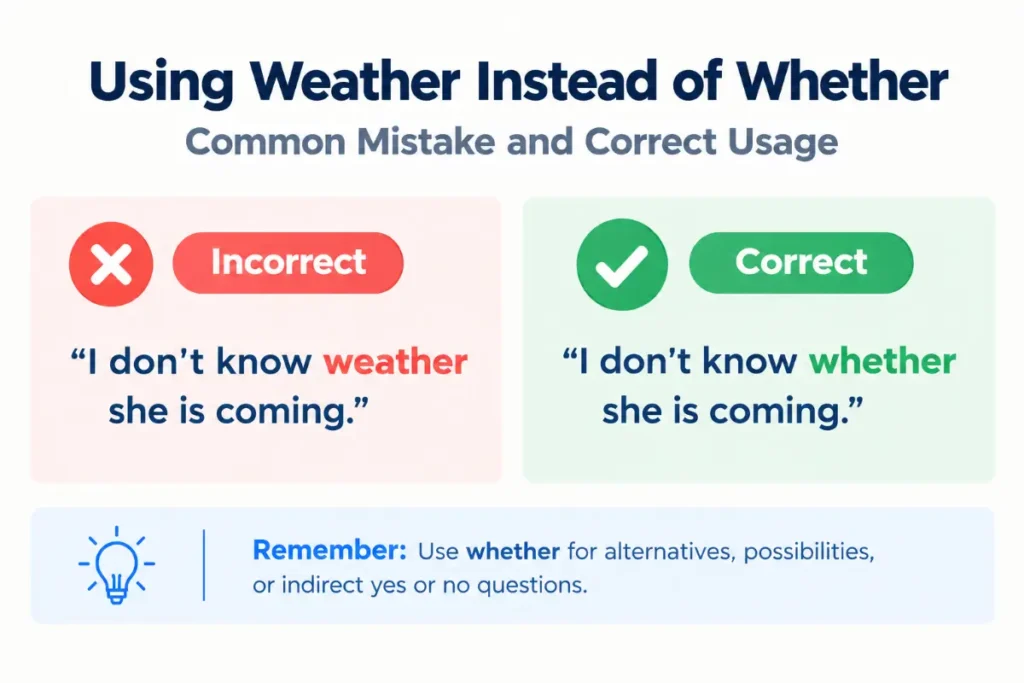
Using Weather Instead of Whether
Incorrect: “I don’t know weather she is coming.”
Correct: “I don’t know whether she is coming.”
The sentence expresses uncertainty about someone’s attendance. It doesn’t describe atmospheric conditions, so whether is the correct choice.
Using Whether Instead of Weather
Incorrect: “The whether is cold today.”
Correct: “The weather is cold today.”
The sentence describes low temperatures. Since weather refers to atmospheric conditions, it belongs in this sentence.
Confusing Whether With the Phrase Or Not
Incorrect: “I don’t know weather or not the store is open.”
Correct: “I don’t know whether or not the store is open.”
The phrase whether or not expresses uncertainty about the store’s status. Weather cannot introduce this kind of alternative.
You can also write “I don’t know whether the store is open.” Both versions are correct.
Using Whether With Incorrect Word Order
Incorrect: “She asked whether was he ready.”
Correct: “She asked whether he was ready.”
An indirect question normally uses statement word order. The subject comes before the verb, just as it does in an ordinary statement.
Compare the direct question “Was he ready?” with the indirect version “She asked whether he was ready.” The question structure changes because the question is now part of a larger sentence.
Adding Unnecessary Words After Whether
Incorrect: “We must decide whether or not to whether we should leave.”
Correct: “We must decide whether to leave.”
The incorrect sentence repeats the structure unnecessarily and creates a grammatical problem. The corrected version expresses the decision directly.
When writing, choose the simplest construction that communicates your meaning. You don’t need to add extra words merely to make a sentence sound formal.
Trusting Spell Check Too Much
A spelling checker may not flag weather when you intended to write whether because both are correctly spelled English words. The software can recognize spelling, but it may not understand the intended meaning of every sentence.
For example, “Please tell me the weather the package arrived” contains the wrong word in context. A grammar checker might identify the issue, but a basic spell checker may not.
Read your writing carefully, especially in emails, reports, applications, and school assignments. If the sentence sounds unusual, check the meaning rather than relying entirely on automatic corrections.
Weather and Whether in American English
In American English, weather and whether are usually pronounced alike. Both typically have the same vowel sound and the voiced consonant represented by th.
This makes them homophones. Homophones are words that sound the same but have different meanings and often different spellings.
American speakers use weather in expressions such as “What’s the weather like?” and “The weather forecast looks promising.” They use whether in sentences such as “I wonder whether he’ll call” and “We need to decide whether to go.”
The spelling distinction remains the same across standard American and British English. British speakers also use weather for atmospheric conditions and whether for alternatives or uncertainty. The main difference is pronunciation, which can vary by regional accent, rather than the meaning of the words.
In formal American writing, both words are appropriate when used correctly. Weather appears in scientific reports, forecasts, travel advisories, and figurative expressions. Whether appears in academic essays, business correspondence, legal writing, and everyday questions.
The choice isn’t a matter of formality or personal preference. Each word has its own meaning and grammatical function.
Pronunciation and Word Origins
How to Pronounce Weather and Whether
In most American English accents, weather and whether have the same pronunciation: /ˈwɛðər/.
The first syllable carries the stress. Both words begin with the voiced th sound heard in words such as this and that. To make this sound, place your tongue lightly between your teeth and let your voice vibrate as air passes through.
Because the spoken forms are usually identical, listening alone may not reveal which word someone means. The sentence’s context provides the clue.
For example, if someone says, “I don’t know whether it will rain,” the surrounding words indicate uncertainty. If someone says, “The weather will improve,” the sentence refers to atmospheric conditions.
Where the Words Come From
Weather developed from older Germanic language forms associated with wind, air, and atmospheric conditions. Its history reflects the long-standing human need to describe the conditions that affect travel, farming, shelter, and daily life.
Whether comes from Old English forms associated with alternatives and choices. Its history connects with the idea of considering one possibility against another.
Although the words developed along different paths, their pronunciation eventually became identical in many varieties of modern English. Their spellings still reflect their distinct histories and meanings.
Understanding their origins can be interesting, but you don’t need to memorize historical details to use them correctly. Their present day meanings provide the most practical guide.
Memory Tricks to Remember the Difference
A simple memory trick can help you choose the correct word quickly, especially when writing under time pressure.
Connect Weather With Rain
Think of rain, sunshine, snow, wind, and temperature whenever you see weather.
The word appears in familiar expressions such as weather report, weather forecast, and bad weather. If the sentence describes conditions outside, weather is usually the right choice.
For example, “The weather looks perfect for a beach day.” The sentence describes atmospheric conditions, so weather fits.
Connect Whether With a Choice
Think of whether as a word that introduces a question or a decision.
For example, “I can’t decide whether to stay home or go out.” The sentence presents two possible actions, so whether is correct.
A useful reminder is to associate whether with which option. This isn’t its literal definition, but it can help you remember its role in sentences about alternatives.
Use the Replacement Test
When you’re uncertain, replace the word with a short explanation of its meaning.
If you can replace it with “atmospheric conditions,” use weather.
If you can replace it with “if” without changing the intended meaning, whether may be appropriate.
For example, “I don’t know whether the store is open” can become “I don’t know if the store is open.” Both sentences express uncertainty, so whether is correct.
However, this replacement test has limits. Whether is often more suitable than if when a sentence explicitly presents alternatives or when formal grammar calls for whether. The test helps you identify the likely meaning, but you should still check the complete sentence.
Remember the Letter Pattern
Weather contains the familiar word heat in a different arrangement of letters. Although this isn’t a precise spelling rule, you can use the association to connect weather with temperature and outdoor conditions.
For whether, remember the phrase whether or not. This common expression appears in sentences about possibilities, uncertainty, and outcomes that remain unchanged.
Choose whichever memory trick feels natural. The best method is the one you can recall quickly when writing.
Related Grammar and Usage Notes
Understanding related grammar rules will help you use whether more confidently and avoid other common English mistakes.
Whether and If
Whether and if can both introduce indirect yes or no questions in many sentences.
For example, “I don’t know whether she is available” and “I don’t know if she is available” are both natural and correct.
However, they aren’t interchangeable in every construction. Whether is generally preferred when presenting explicit alternatives, before an infinitive, and in certain formal structures.
Consider these examples.
- “We need to decide whether to stay or leave.” This is a standard construction using whether before an infinitive.
- “The question is whether we have enough time.” Whether introduces the issue under consideration.
- “Call me if you need help.” If introduces a condition rather than an indirect question.
- “I’ll attend if the meeting starts on time.” If introduces a condition that must be met for the action to occur.
In the first two examples, whether is the natural choice. In the final two, if expresses a condition.
Whether and Weather Conditions
Weather conditions are the circumstances that describe the atmosphere at a particular place and time. These include temperature, wind speed, humidity, precipitation, and visibility.
For example, “The weather conditions are dangerous for small aircraft.” This sentence explains that atmospheric factors may create risks for flying.
Whether doesn’t describe those conditions. Instead, it can introduce a question about them.
For example, “The pilot must determine whether the weather conditions are safe.” Here, whether introduces the question the pilot needs to answer, while weather identifies the atmospheric conditions being evaluated.
Whether in Formal Writing
Whether is particularly useful in formal writing because it expresses uncertainty and alternatives precisely.
For example, “The committee will determine whether the application meets the requirements.”
This sentence clearly identifies the decision that the committee needs to make. It works well in reports, academic writing, policy documents, and professional emails.
Weather is equally appropriate in formal writing when discussing atmospheric conditions or describing how someone has endured a difficult situation.
For example, “The agency issued a warning about severe weather.” This sentence uses weather in its literal sense.
The important point is to choose the word that communicates the intended meaning. Neither word is inherently more formal than the other.
Weather Related Expressions
Several common expressions use weather figuratively or literally.
- Under the weather. This informal expression means feeling ill or unwell. For example, “I’m feeling under the weather today” means the speaker doesn’t feel well.
- Weather the storm. This means to endure a difficult situation. For example, “The family weathered the storm after losing their home” describes their ability to survive a challenging period.
- Fair weather friend. This describes someone who remains supportive during good times but disappears when difficulties arise. For example, “He turned out to be a fair weather friend when the business struggled” suggests that his support wasn’t dependable.
- Come rain or shine. This means something will happen regardless of the weather or other difficulties. For example, “She walks every morning come rain or shine” means she keeps the routine in different conditions.
- Whether or not. This expression presents alternatives or emphasizes that a result will remain the same. For example, “We’ll continue whether or not they approve” means their approval won’t change the decision.
These expressions show how English uses familiar words in both literal and figurative ways. Learning them can also improve reading comprehension and everyday communication.
A Note on Punctuation
Neither weather nor whether requires special punctuation. The punctuation depends on the sentence structure.
For example, “I don’t know whether she’ll attend” is a statement and normally ends with a period.
“What’s the weather like?” is a direct question and ends with a question mark.
If a sentence contains a direct question followed by additional information, use punctuation that reflects the complete structure. Correct word choice and correct punctuation work together to make your writing clear.
Key Takeaways
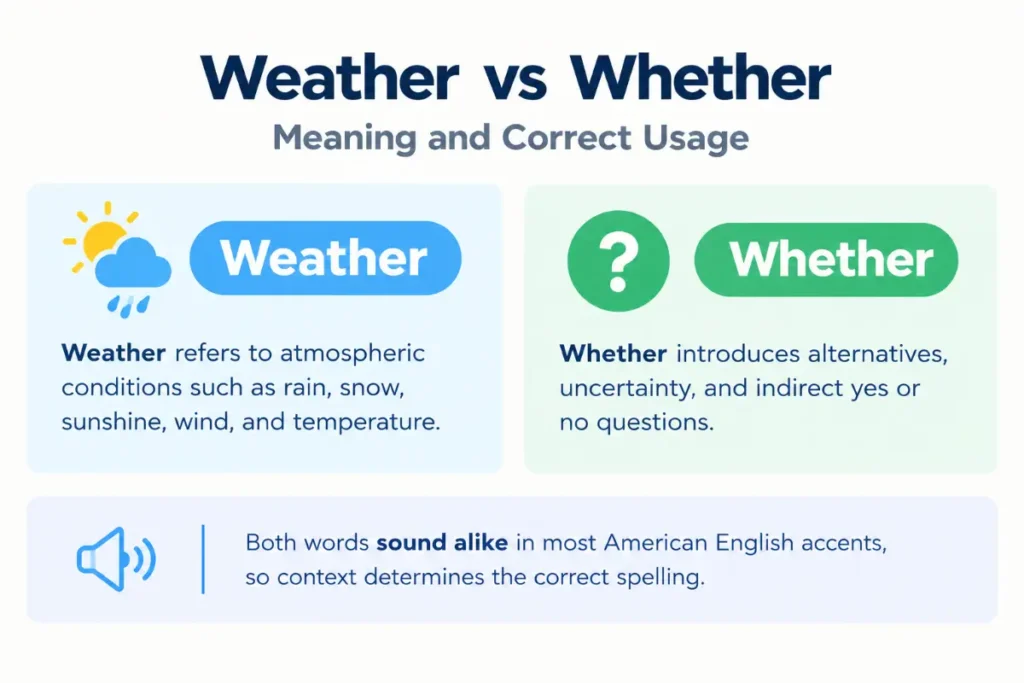
- Weather refers to atmospheric conditions such as rain, snow, sunshine, wind, and temperature.
- Whether introduces alternatives, uncertainty, and indirect yes or no questions.
- Both words sound alike in most American English accents, so context determines the correct spelling.
- Weather can function as both a noun and a verb.
- Whether often appears with words such as decide, know, ask, wonder, and determine.
- Whether or not is a common expression that introduces alternatives or emphasizes an outcome that remains unchanged.
- If can replace whether in many indirect questions, but not in every grammatical construction.
- The quickest memory trick is to associate weather with atmospheric conditions and whether with choices.
Conclusion
Weather vs whether becomes easy to understand once you focus on meaning rather than sound. Weather describes atmospheric conditions or means to endure something difficult, while whether introduces alternatives, uncertainty, or indirect questions. Although both words sound alike in most American English accents, they serve different purposes in writing.
Remember to use weather when discussing rain, sunshine, temperature, forecasts, or difficult situations someone has endured. Use whether when expressing uncertainty, reporting a question, or considering possible actions. For example, “The weather looks pleasant” describes outdoor conditions, while “I’m unsure whether we should go outside” expresses uncertainty about a decision.
With regular practice, you’ll recognize the correct word more quickly and write with greater confidence. Read each sentence for meaning, use the replacement test when necessary, and check the grammatical structure before choosing a spelling. These simple habits will help you avoid common mistakes in emails, essays, reports, and everyday conversations.
Frequently Asked Questions
1. What is the difference between weather vs whether?
Weather refers to atmospheric conditions such as rain, sunshine, wind, and temperature. Whether introduces alternatives, uncertainty, or indirect yes or no questions. For example, “The weather is cold” describes conditions outside, while “I wonder whether it will snow” expresses uncertainty.
2. How do you remember the difference between weather and whether?
Connect weather with rain, sunshine, and temperature. Connect whether with choices and questions. If you’re discussing conditions outside, use weather. If you’re deciding between options or expressing uncertainty, use whether.
3. Do weather and whether sound the same?
Yes. They sound the same in most American English accents. Both are generally pronounced /ˈwɛðər/. Because pronunciation usually doesn’t distinguish them, you must rely on the sentence’s meaning and grammatical structure to choose the correct spelling.
4. Can I use if instead of whether?
Yes. In many indirect yes or no questions, if and whether are interchangeable. For example, “I don’t know if she’s home” and “I don’t know whether she’s home” are both correct. However, whether is generally preferred before an infinitive and when explicitly presenting alternatives.
5. Is weather a noun or a verb?
Weather is usually a noun referring to atmospheric conditions. However, it can also function as a verb meaning to endure or survive something difficult. For example, “The weather is changing” uses weather as a noun, while “The company weathered the crisis” uses it as a verb.
6. What does whether or not mean?
Whether or not introduces alternatives or emphasizes that something will happen regardless of a particular condition. For example, “I’ll attend whether or not it rains” means the speaker plans to attend in either situation. The phrase can also express uncertainty, as in “I don’t know whether or not she’ll attend.”
7. Is whether more formal than if?
Not always. Both words are standard English and work in many of the same sentences. Whether is often preferred in formal writing when presenting alternatives or introducing certain indirect questions. If is especially common when expressing conditions, such as “I’ll call if I need help.”
8. Can weather and whether appear in the same sentence?
Yes. For example, “We haven’t decided whether the weather will allow us to play outside.” Whether introduces uncertainty about the decision, while weather refers to atmospheric conditions. Using both words in one sentence is grammatically correct when each serves its proper function.
9. Why do people confuse weather and whether?
People confuse these words because they are homophones in most American English accents. They sound alike but have different meanings and grammatical roles. Since pronunciation doesn’t usually reveal the correct spelling, writers need to consider the sentence’s context.
10. Which word should I use when talking about rain?
Use weather when talking about rain as an atmospheric condition. For example, “The weather forecast predicts rain tomorrow.” Use whether when expressing uncertainty about rain, as in “I don’t know whether it will rain tomorrow.”

Confusing Words, Spelling & Word Choice
Claire Whitmore is a U.S.-based English editor who writes about commonly confused words, spelling differences, and word choice. Her work helps readers understand subtle distinctions between similar-looking words through simple definitions, practical examples, and modern usage guidance in both American and British English.