
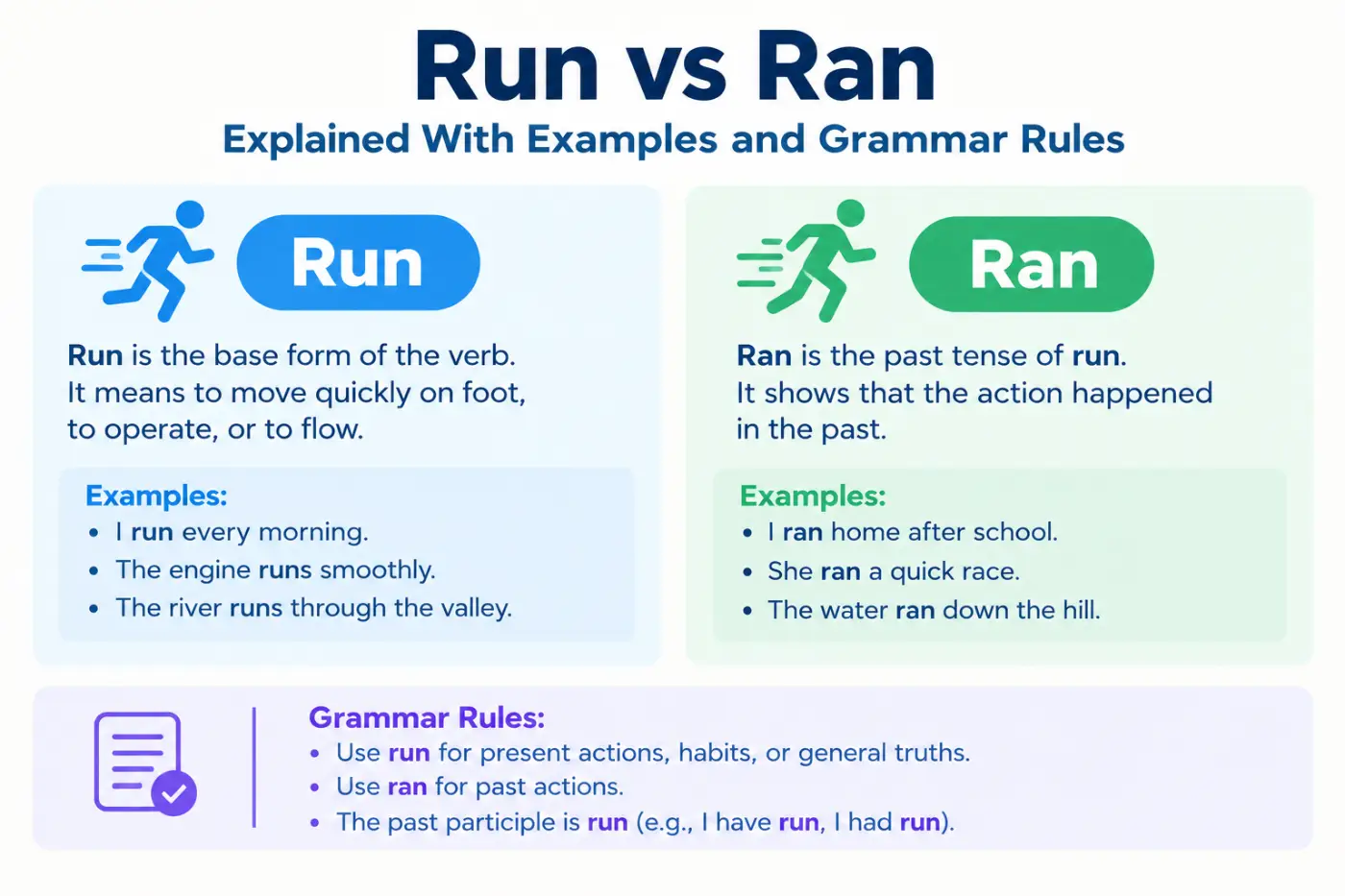
Run vs ran is a common English grammar question because both words describe the same action but fit different sentences. The main difference is time and verb structure. Run usually refers to a present habit or an action in its base form, while ran describes an action that happened in the past.
For example, you might say, I run three miles every morning, when describing your exercise routine. If you completed the same activity yesterday, you would say, I ran three miles yesterday. If you want to describe your experience or an action that has a connection to the present, you might say, I have run three miles every morning this week.
The good news is that you don’t need to memorize dozens of complicated rules to use these words correctly. Once you understand the simple past tense, the past participle, and the role of helping verbs, you’ll know which form belongs in most sentences. This guide explains the differences, shows common mistakes, and gives you practical examples you can use in everyday conversations, school assignments, emails, and professional writing.
Short Answer
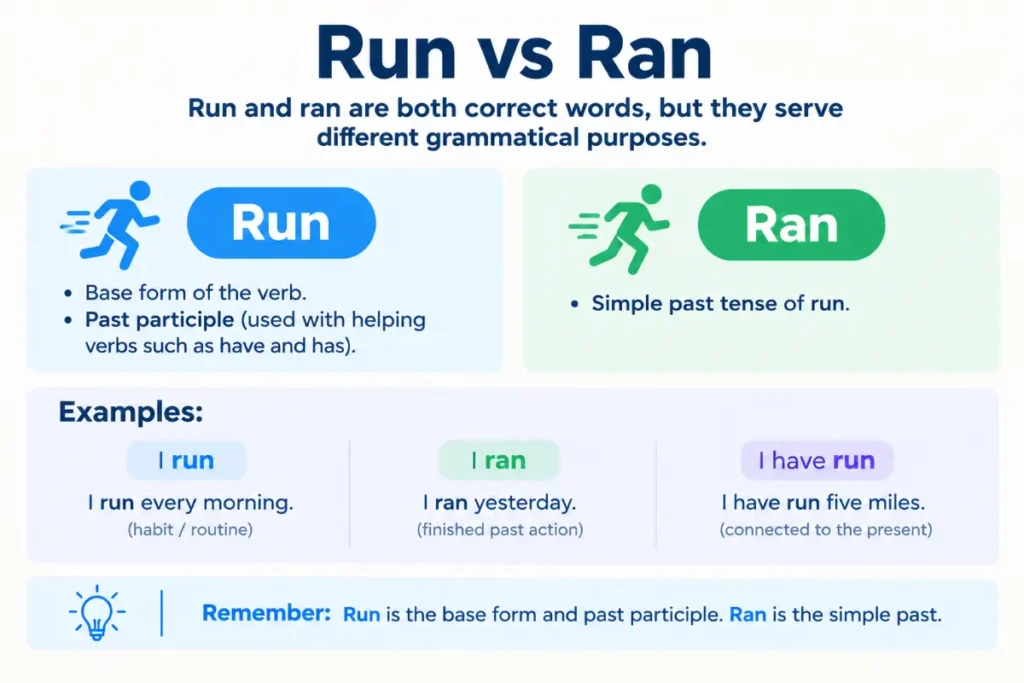
Run and ran are both correct words, but they serve different grammatical purposes. Run is the base form of the verb and also the past participle used with helping verbs such as have and has. Ran is the simple past tense of run. Say I run every morning to describe a habit, I ran yesterday to describe a finished past action, and I have run five miles to describe an action connected to the present.
Table of Contents
- What Run Means.
- What Ran Means.
- The Main Difference Between Run and Ran.
- The Different Forms of the Verb Run.
- When to Use Run.
- When to Use Ran.
- Run vs Ran in Different Tenses.
- Run vs Ran Comparison Table.
- Real Life Examples.
- Common Mistakes to Avoid.
- Memory Tips for Remembering Run and Ran.
- Related Grammar Rules.
- Frequently Asked Questions.
- Key Takeaways.
- Conclusion.
What Run Means
Run is an irregular verb that commonly means to move quickly on foot. However, English speakers also use it to describe operating a machine, managing a business, flowing water, organizing an event, and continuing a process.
The exact meaning depends on the context. For example, a person can run across a field, run a company, run a computer program, or run out of time. In all these cases, run expresses an action or process.
Run as a Base Form
The base form is the basic form of a verb before it changes to express tense or agrees with a subject. Run is the base form of this verb.
Consider these examples.
- I run every morning before work.This sentence describes a regular habit. The speaker uses run because the subject is I and the action occurs regularly.
- They run a small family business.Here, run means manage or operate. The subject they takes the base form in the simple present tense.
- We need to run faster to catch the bus.The word to comes before run because the sentence uses an infinitive. The verb stays in its base form after to.
- Please run the report before the meeting.In this example, run means execute or produce a report. The sentence uses an imperative, so the base form is appropriate.
Run in the Simple Present Tense
In the simple present tense, run works with I, you, we, and they. It also works with plural subjects.
Examples include these sentences.
- I run five miles on Saturdays.The speaker describes a repeated activity.
- You run a tight schedule.The sentence describes how someone organizes or manages time.
- We run the same software at both offices.Run means operate or use the software.
- The athletes run around the track.The plural subject athletes takes run in the simple present tense.
With he, she, it, and singular third person subjects, the verb changes to runs.
For example, she runs every evening. The s ending is required because she is a third person singular subject in the simple present tense.
Run as a Past Participle
Run also serves as the past participle of the verb. A past participle is a verb form commonly used with helping verbs to create perfect tenses and passive constructions where applicable.
For example, I have run five miles today. The helping verb have combines with run to form the present perfect tense.
Other examples include these sentences.
- She has run this route before.Has combines with run to describe a past experience that matters to the present.
- They had run out of supplies before the delivery arrived.Had combines with run to show that one past event happened before another past event.
- We will have run ten miles by noon.Will have combines with run to form the future perfect tense.
The important point is that run does not always indicate the present. Its grammatical role depends on the helping verb and the overall sentence.
What Ran Means
Ran is the simple past tense of run. Use it when you describe an action that happened and finished in the past.
For example, I ran to the store yesterday. The word yesterday establishes a past time, so ran is the correct verb form.
Unlike regular verbs such as walked and played, run does not form its simple past tense by adding ed. It changes to ran instead. This makes run an irregular verb.
Ran in the Simple Past Tense
Use ran for completed actions at a past time. The subject can be singular or plural.
Examples include the following.
- I ran five miles yesterday.The action happened and finished yesterday.
- She ran to catch the train.The sentence describes a completed past action. She is the subject, and ran is the simple past form.
- They ran around the park after lunch.The plural subject they uses ran because the sentence describes a past event.
- Our computer program ran without errors.Here, ran means the program operated successfully during a past period.
- The river ran through the valley.In this example, ran describes the flow of water in the past.
These examples show that ran applies to more than physical movement. It works with several meanings of run.
Ran With Past Time Expressions
Past time expressions often help you recognize when to use ran. Common examples include yesterday, last night, last week, two days ago, in 2024, and earlier this morning when the morning is over.
Consider these examples.
- We ran a charity event last weekend.Last weekend establishes the past time, so ran is correct.
- He ran three miles two hours ago.The phrase two hours ago identifies a completed past period.
- The engine ran all night.Ran describes an operating engine during the previous night.
- I ran into an old friend yesterday.Ran into is a phrasal verb meaning met by chance. The past tense of the expression is ran into.
However, a past time expression is a useful clue rather than the only rule. The sentence’s meaning and verb structure still matter.
The Main Difference Between Run and Ran
The main difference is that run is the base form and past participle, while ran is the simple past tense.
Use run after modal verbs such as can, could, may, might, must, should, and will. Use ran for a completed past action without a helping verb that requires the base form or past participle.
Compare these sentences.
- I run every morning.This sentence describes a habit in the present.
- I ran yesterday morning.This sentence describes a completed action in the past.
- I have run every morning this week.Have requires the past participle run, creating the present perfect tense.
- I can run five miles without stopping.Can is a modal verb, so the base form run follows it.
- I had run five miles before breakfast.Had requires the past participle run, creating the past perfect tense.
The easiest way to choose the correct form is to look at the words around the verb. If the sentence uses a helping verb such as have, has, or had to form a perfect tense, use run. If the sentence describes a completed past action in the simple past tense, use ran.
The Different Forms of the Verb Run
Learning all the main forms of run makes it easier to use the verb accurately in conversation and writing.
| Verb form | Word | Example |
|---|---|---|
| Base form | Run | I run every day. |
| Third person singular present | Runs | She runs every day. |
| Simple past | Ran | She ran yesterday. |
| Past participle | Run | She has run today. |
| Present participle | Running | She is running now. |
| Infinitive | To run | She wants to run. |
Why Run Is an Irregular Verb
Regular English verbs usually form their simple past tense by adding ed or d. For example, walk becomes walked, and live becomes lived.
Run follows a different pattern. Its simple past form is ran, and its past participle returns to run. English has many irregular verbs with patterns that don’t follow the standard ed ending.
Other examples include these verbs.
| Base form | Simple past | Past participle |
|---|---|---|
| Begin | Began | Begun |
| Drink | Drank | Drunk |
| Sing | Sang | Sung |
| Swim | Swam | Swum |
| Run | Ran | Run |
Notice that the past participles in this table differ from the simple past forms. The same distinction explains why I ran yesterday is correct but I have ran is not standard English.
Why the Three Forms Matter
Each form has a different grammatical job.
The base form appears after modal verbs and in infinitives. The simple past describes a completed past action. The past participle works with helping verbs to form perfect tenses.
If you learn these roles instead of memorizing each sentence separately, you can apply the same principle to many irregular verbs.
When to Use Run
Use run in several common grammatical situations. The most important ones involve habits, modal verbs, infinitives, commands, and perfect tenses.
Use Run for Habits and General Facts
The simple present tense describes routines, repeated actions, and general truths.
Examples.
- I run before breakfast.The sentence describes a regular routine.
- We run a neighborhood food pantry.The word run means manage, and the simple present describes an ongoing responsibility.
- Most computers run on electricity.The sentence describes a general fact about how computers operate.
Remember that third person singular subjects usually require runs rather than run in the simple present tense.
For example, he runs a restaurant. The subject he requires the s ending.
Use Run After Modal Verbs
Modal verbs express ability, possibility, permission, advice, or necessity. They include can, could, may, might, must, shall, should, will, and would.
A modal verb is followed by the base form of the main verb.
Examples.
- I can run five miles.Can expresses ability, so run remains in its base form.
- You should run the test again.Should gives advice and takes the base form run.
- They will run the meeting tomorrow.Will expresses a future action, and run follows it in the base form.
- She might run for office next year.Might expresses possibility, so run is correct.
Do not use ran directly after a modal verb. The standard forms are can run, should run, and will run, not can ran, should ran, or will ran.
Use Run After To
When to introduces an infinitive, the verb stays in its base form.
Examples.
- I want to run a marathon.The infinitive to run completes the meaning of want.
- She plans to run the company herself.The base form run follows to.
- We need to run another test.Run completes the infinitive phrase that follows need.
Be careful because to does not always introduce an infinitive. In a sentence such as I look forward to running, the word to is a preposition and is followed by the gerund running. That is a different grammatical construction.
Use Run in Commands
Commands usually begin with the base form of a verb.
Examples.
- Run to the nearest exit.The sentence gives a direct instruction.
- Run the program again.Run means execute the program.
- Please run a quick check before submitting the form.The sentence politely requests an action.
Ran does not work in these commands because the speaker is telling someone what to do rather than describing a completed past action.
Use Run With Have Has and Had
Use run after have, has, and had when forming perfect tenses.
Examples.
- I have run three miles today.Have and run form the present perfect tense.
- She has run this business for ten years.Has and run describe an ongoing situation that began in the past and continues into the present.
- We had run out of food before the guests arrived.Had and run form the past perfect tense, showing that one past event occurred before another.
- They will have run the final test by noon.Will have and run form the future perfect tense.
This rule is especially useful because many speakers mistakenly use ran after have or has. In standard English, the correct forms are have run and has run.
When to Use Ran
Use ran when the verb describes a completed past action in the simple past tense.
Use Ran for Completed Actions
Examples.
- I ran to the pharmacy yesterday.Ran describes a finished action at a specific past time.
- The children ran across the playground.The sentence describes an action that happened in the past.
- Our team ran several experiments last month.Ran means conducted or carried out the experiments.
- The machine ran for six hours before it stopped.Ran describes the machine’s operation during a completed past period.
Use Ran in Stories and Narratives
Writers often use ran to describe events in stories, reports, personal accounts, and news summaries.
Examples.
- She ran through the rain and reached the station just before the doors closed.Ran describes the movement that occurred in the past.
- The company ran a promotion during the holiday season.Ran means organized or operated the promotion.
- He ran into trouble after missing the deadline.Ran into means encountered or experienced a problem.
The simple past helps readers follow a sequence of events. It makes the timing clear without requiring a helping verb in every sentence.
Use Ran With Did in Questions and Negatives Carefully
When you use did to form a question or negative statement in the simple past tense, the main verb returns to its base form.
Correct examples.
- Did you run yesterday?Did marks the past tense, so the main verb stays run.
- I did not run yesterday.Did not establishes the past tense, and run remains in the base form.
- Did she run the meeting?The helping verb did carries the past tense.
Incorrect examples include Did you ran yesterday? and I did not ran yesterday. These forms use two past tense markers in the same verb construction.
Run vs Ran in Different Tenses
The difference becomes easier to understand when you see how each word works across several tenses.
Simple Present
Use run or runs for habits and general facts.
Example: I run every weekend.
The sentence describes a repeated activity rather than one finished event.
Simple Past
Use ran for a completed past action.
Example: I ran last weekend.
The sentence describes an activity that took place in the past.
Present Continuous
Use am, is, or are with running for an action happening now or around the present period.
Example: I am running in the park.
Running is the present participle, and am is the helping verb.
Past Continuous
Use was or were with running to describe an action in progress at a past time.
Example: I was running when it started to rain.
Was running describes an action already in progress when another event occurred.
Present Perfect
Use have or has with run.
Example: I have run five miles today.
The present perfect connects a past action to the present. The time period may still be open, or the experience may matter now.
Past Perfect
Use had with run.
Example: I had run five miles before breakfast.
Had run shows that the running happened before another past reference point.
Future Simple
Use will with run.
Example: I will run tomorrow.
Will is followed by the base form run.
Future Perfect
Use will have with run.
Example: By noon, I will have run five miles.
The future perfect describes an action expected to be completed by a specified future time.
Run vs Ran Comparison Table
This table summarizes the most useful patterns.
| Situation | Correct form | Example |
|---|---|---|
| Present habit with I | Run | I run every day. |
| Present habit with she | Runs | She runs every day. |
| Completed past action | Ran | I ran yesterday. |
| After can | Run | I can run fast. |
| After did | Run | Did you run? |
| After have | Run | I have run today. |
| After has | Run | She has run today. |
| After had | Run | They had run earlier. |
| After will | Run | We will run tomorrow. |
| Ongoing action | Running | I am running now. |
| Infinitive | To run | I want to run. |
The pattern is consistent. Ran belongs to the simple past tense, while run appears in the base form and past participle positions.
Real Life Examples
Everyday situations provide a useful way to practice these forms. The examples below show how the correct choice changes with the meaning and structure of a sentence.
Everyday Activities
- I run before work.This sentence describes a regular habit, so the simple present uses run.
- I ran before work yesterday.The word yesterday identifies a completed past action, so ran is correct.
- I have run before work every day this week.Have run describes repeated actions during a period connected to the present.
School and Education
- The students ran to class when the bell rang.Ran describes the students’ movement in the past.
- The students have run the experiment twice.Have run describes an experiment that has been conducted twice up to the present.
- The teacher asked us to run the experiment again.The infinitive to run is correct after the phrase asked us.
Business and Work
- She runs a marketing agency.Runs is the simple present form for the third person singular subject she.
- She ran the agency before joining the larger company.Ran describes her past role.
- She has run the agency for eight years.Has run describes an activity that began in the past and continues into the present.
Technology
- This application runs on most modern computers.Runs describes how the application operates, with the third person singular subject application.
- The application ran slowly after the update.Ran describes its operation during a past period.
- The application has run without errors since Monday.Has run connects the application’s past performance to the present.
Travel and Emergencies
- We ran to the gate because boarding had started.Ran describes a completed action in the past.
- You should run to the designated exit during an emergency if it is safe to do so.Should takes the base form run.
- The emergency generator has run for several hours.Has run describes the generator’s operation over a period connected to the present.
Sports and Fitness
- He runs five miles every morning.Runs describes his regular exercise routine.
- He ran a marathon last year.Ran describes a completed event in the past.
- He has run three marathons so far.Has run describes his experience up to the present.
Common Mistakes to Avoid
The most common errors happen when speakers confuse the simple past with the past participle or forget how helping verbs work.
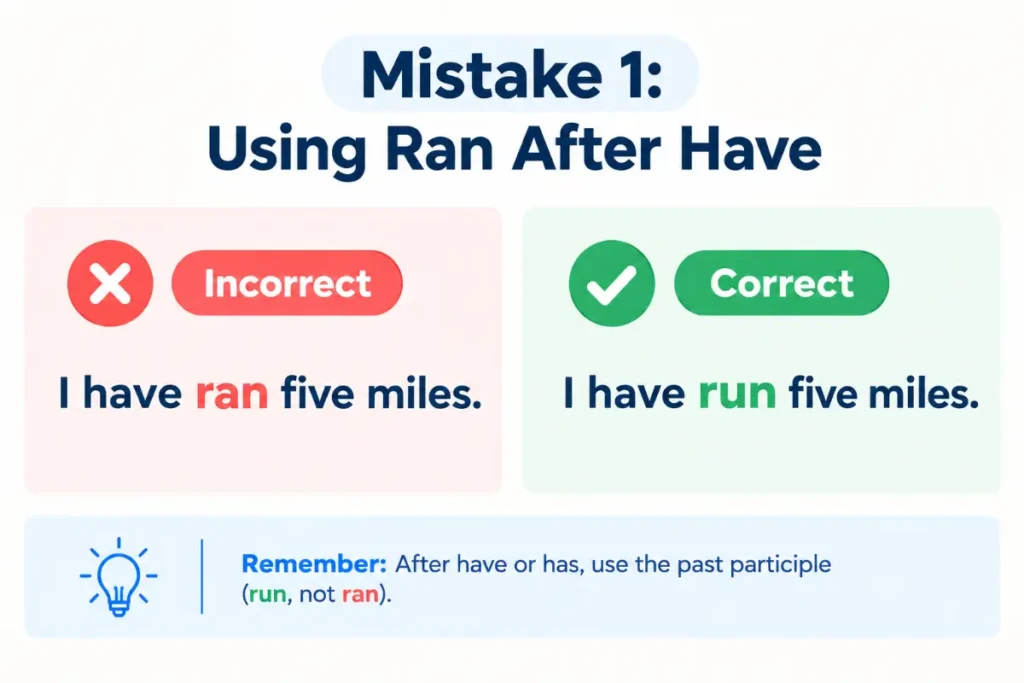
Mistake 1 Using Ran After Have
Incorrect: I have ran five miles.
Correct: I have run five miles.
Have requires the past participle in the present perfect tense. The past participle of run is run, not ran.
Mistake 2 Using Ran After Has
Incorrect: She has ran the company for years.
Correct: She has run the company for years.
Has must be followed by the past participle run. The sentence describes a situation that began in the past and continues into the present.
Mistake 3 Using Ran After Had
Incorrect: They had ran out of time before the meeting ended.
Correct: They had run out of time before the meeting ended.
Had requires the past participle run to form the past perfect tense.
Mistake 4 Using Ran After Did
Incorrect: Did you ran to the store?
Correct: Did you run to the store?
Did already marks the question as past tense. The main verb must return to its base form.
Mistake 5 Using Ran After a Modal Verb
Incorrect: I can ran five miles.
Correct: I can run five miles.
Modal verbs take the base form of the main verb. This rule applies to can, could, should, would, might, must, and will.
Mistake 6 Using Run for a Simple Past Event
Incorrect: I run to the store yesterday.
Correct: I ran to the store yesterday.
The word yesterday establishes a past time, so ran is the correct simple past form.
Mistake 7 Confusing Ran and Running
Incorrect: I am ran in the park.
Correct: I am running in the park.
The present continuous tense uses am, is, or are with the present participle running. Ran cannot replace running in this structure.
Mistake 8 Using Run Instead of Runs
Incorrect: He run every morning.
Correct: He runs every morning.
In the simple present tense, a third person singular subject such as he, she, or it normally takes runs.
Memory Tips for Remembering Run and Ran
A few simple tricks can help you choose the right form without stopping to think about every grammar rule.
Remember the Three Main Forms
Think of the verb as a three part pattern.
Run, ran, run.
The first form is the base form. The second is the simple past. The third is the past participle.
Say the pattern aloud a few times. Then use each form in a sentence to reinforce the difference.
Use the Yesterday Test
If you’re describing a completed action that happened yesterday, last week, or at another finished time, ran will usually be the correct simple past form.
For example, I ran yesterday.
However, don’t rely on the time word alone. Questions and negatives with did use run, even when they refer to yesterday.
Did you run yesterday? is correct.
Use the Helping Verb Test
Look for have, has, or had. When these verbs form a perfect tense with run, use the past participle run.
For example, she has run, they had run, and I have run.
If you see can, should, will, or did, use run as the main verb.
For example, I can run, you should run, and did they run?
Think of Ran as the Standalone Past Form
In a simple past statement, ran usually stands on its own without a tense helping verb.
For example, I ran home after work.
The sentence needs no additional helping verb because ran already expresses the past tense.
This memory trick works well for statements. In questions and negatives, remember that did carries the past tense, so the main verb changes back to run.
Related Grammar and Usage Notes
Understanding run and ran also helps you learn other parts of English grammar. These related rules are useful for writing clearly and avoiding mistakes with irregular verbs.
The Difference Between Simple Past and Present Perfect
The simple past describes a completed action at a past time. The present perfect connects a past action to the present or describes an experience within a period that remains relevant.
Compare these examples.
- I ran five miles yesterday.The sentence identifies a completed action at a specific past time.
- I have run five miles today.The sentence connects the completed run to the current day. The day may still be in progress.
- She ran the business for five years before selling it.The sentence describes a past period that has ended.
- She has run the business for five years.This sentence normally means she started five years ago and still runs it.
The choice depends on the time frame and intended meaning. American English generally uses the simple past with specific finished time expressions such as yesterday and last week.
The Difference Between Run and Runs
Run and runs are both used in the present tense, but the subject determines the correct form.
Use run with I, you, we, they, and plural subjects. Use runs with he, she, it, and singular third person subjects.
Examples.
- They run a local store.They takes the base form run.
- He runs a local store.He takes runs in the simple present tense.
- The dogs run around the yard.The plural subject dogs takes run.
- The dog runs around the yard.The singular subject dog takes runs.
The Difference Between Run and Running
Run is the base form and past participle. Running is the present participle and gerund form.
Use running after forms of be to make continuous tenses.
Examples.
- I am running now.Am running describes an action in progress.
- She was running when I called.Was running describes an ongoing past action.
- Running helps me clear my mind.Running acts as a noun in this sentence and names an activity.
- They enjoy running together.Running follows enjoy because the verb enjoy is normally followed by a gerund.
Phrasal Verbs With Run
Run appears in many common phrasal verbs. The meaning often changes when another word follows it.
| Expression | Meaning | Example |
|---|---|---|
| Run into | Meet unexpectedly or encounter a problem | I ran into an old friend. |
| Run out of | Have none left | We ran out of milk. |
| Run away | Escape or leave quickly | The dog ran away. |
| Run over | Hit with a vehicle or review quickly | She ran over the main points. |
| Run across | Find or encounter by chance | I ran across an old photograph. |
| Run through | Rehearse or review | We ran through the presentation. |
| Run up | Accumulate a bill or debt | He ran up a large bill. |
| Run for | Seek election to a position | She ran for mayor. |
These expressions can also appear in other tenses. For example, I have run into this problem before uses the past participle run, while I ran into this problem yesterday uses the simple past ran.
Run in American and British English
The main verb forms are the same in standard American and British English. Both varieties use run as the base form and past participle and ran as the simple past tense.
For example, an American speaker might say, I ran to the store yesterday, and a British speaker can use the same grammatical structure.
Differences in pronunciation, vocabulary, or everyday expressions may occur across regions, but the standard tense pattern remains the same.
Pronunciation of Run and Ran
Run and ran have different vowel sounds in standard American English.
Run has the vowel sound heard in words such as sun and fun. Ran has the vowel sound heard in words such as man and plan.
The final n sound is the same in both words. Practicing the vowel contrast can help you distinguish them when speaking and listening.
Formal and Informal Usage
Both run and ran are standard English forms. Neither word is inherently more formal than the other.
The choice depends on the sentence’s tense and structure. In a formal report, you might write, The system ran successfully during the test. If the report describes a result connected to the present, you might write, The system has run successfully since the update.
Correct tense matters more than formality in this case.
Professional Writing Tips
When writing emails, reports, academic assignments, or business documents, identify the time frame before choosing a verb form.
Use ran for a completed past event. Use run after have, has, and had when forming perfect tenses.
For example, The team ran the analysis yesterday is clear and grammatically correct. The team has run the analysis three times this week is also correct, but it emphasizes the work completed during the current week.
If a sentence feels awkward, identify the main verb and any helping verbs. That small check can prevent many common grammar errors.
Key Takeaways
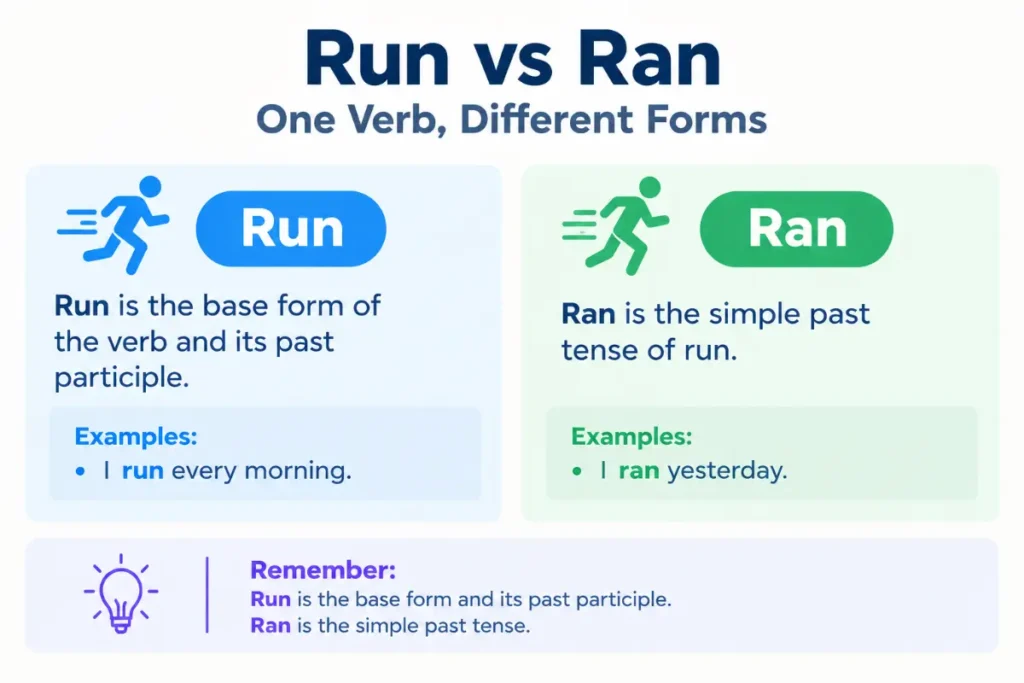
- Run is the base form of the verb and its past participle.
- Ran is the simple past tense of run.
- Use run for present habits with I, you, we, and they.
- Use runs with he, she, it, and singular third person subjects in the simple present tense.
- Use ran for completed past actions, such as I ran yesterday.
- Use run after have, has, and had when forming perfect tenses.
- Use run after modal verbs such as can, should, and will.
- Use run after did in past tense questions and negatives.
- Use running with forms of be to create continuous tenses.
- Remember the three main forms: run, ran, run.
Conclusion
Run vs ran becomes much easier once you understand the difference between the simple past tense and the past participle. Run is the base form and past participle, while ran is the simple past form. That distinction helps you choose the correct word in everyday conversations, schoolwork, emails, and professional writing.
Use ran when you describe a completed past action, such as I ran five miles yesterday. Use run after helping verbs in constructions such as I have run five miles, I can run five miles, and I will run tomorrow. Pay attention to the words around the verb, especially have, has, had, did, and modal verbs, because they often reveal the correct form.
With regular practice, you’ll recognize the pattern naturally. Remember the simple sequence run, ran, run, and apply each form according to its grammatical role. Once you learn that pattern, you’ll be able to use this irregular verb with confidence and avoid one of the most common English verb mistakes.
Frequently Asked Questions
1. What Is the Difference Between Run and Ran?
Run is the base form and past participle of the verb. Ran is the simple past tense. Say I run every day, I ran yesterday, and I have run today.
2. Is Run or Ran Correct in a Sentence?
Both words are correct when used in the right grammatical structure. Use run for present habits, after modal verbs, and with have, has, or had in perfect tenses. Use ran for a completed action in the simple past.
3. Is It I Have Run or I Have Ran?
I have run is correct in standard English. Have requires the past participle, and the past participle of run is run. I have ran is a common mistake.
4. Is It She Ran or She Has Run?
Both are correct, but they express different meanings. She ran describes a completed past action. She has run uses the present perfect tense to connect the action or experience to the present.
5. Is Ran the Past Tense of Run?
Yes. Ran is the simple past tense of run. For example, I run every morning describes a habit, while I ran yesterday describes an action that happened in the past.
6. Is It Did You Run or Did You Ran?
Did you run is correct. The helping verb did marks the past tense, so the main verb stays in its base form. Did you ran is not standard English.
7. Is It Has Ran or Has Run?
Has run is correct. Has must be followed by the past participle run when forming the present perfect tense. For example, she has run the business for five years.
8. What Is the Past Participle of Run?
The past participle is run. The three main forms are run, ran, and run. Use the past participle with helping verbs such as have, has, and had.
9. Can I Say I Ran Every Day?
Yes. I ran every day is correct when describing a regular activity during a past period. For example, I ran every day last summer describes a routine that took place during a finished period.
10. Is Run an Irregular Verb?
Yes. Run is an irregular verb because its simple past tense does not follow the regular pattern of adding ed. Its simple past is ran, and its past participle is run.
11. Is It I Was Ran or I Was Running?
I was running is correct when describing an action in progress in the past. Was running is the past continuous tense. I was ran is not the standard form for this meaning.
12. How Can I Remember Run and Ran?
Remember the pattern run, ran, run. Use ran for a simple past statement, such as I ran yesterday. Use run after helping verbs such as have, has, had, can, should, and will, according to the tense structure.

Confusing Words, Spelling & Word Choice
Claire Whitmore is a U.S.-based English editor who writes about commonly confused words, spelling differences, and word choice. Her work helps readers understand subtle distinctions between similar-looking words through simple definitions, practical examples, and modern usage guidance in both American and British English.