
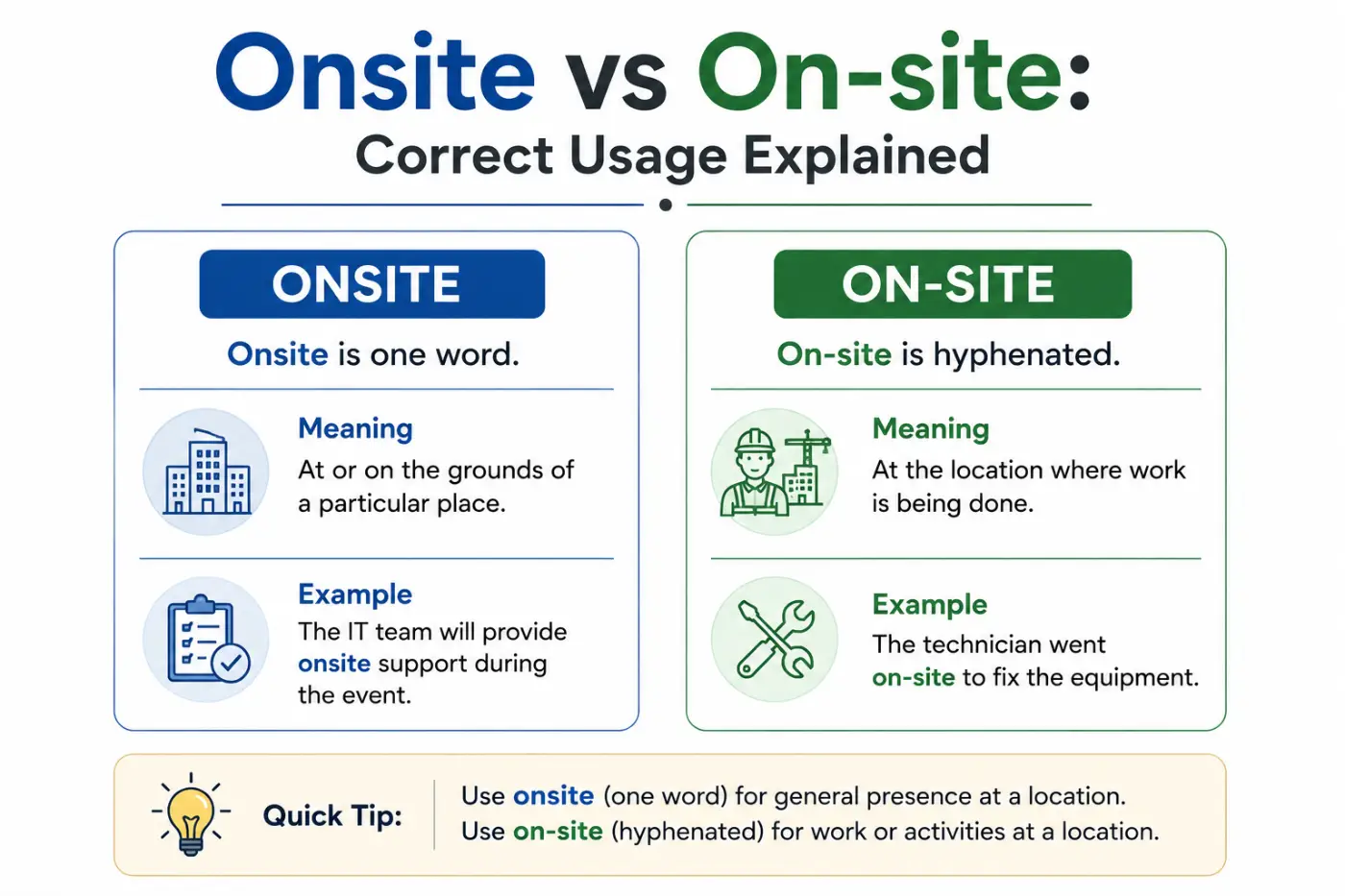
Onsite vs on site can confuse writers because both forms describe the same basic idea. They refer to something happening at a specific location rather than somewhere else. The main difference comes from how writers use the expression in a sentence and which spelling style they follow.
In American English onsite often appears before a noun to describe a service or feature. You might read about onsite parking onsite support or an onsite interview. The two word form on site also appears in professional writing especially when the phrase follows a verb or explains where an action takes place. For example a technician may work on site or a manager may meet a client on site.
The safest approach is to focus on meaning grammar and consistency. Both forms appear in real world writing and the preferred choice can vary by organization industry and style guide. Once you understand the common patterns you can choose the form that reads naturally and fits your sentence.
Quick Answer
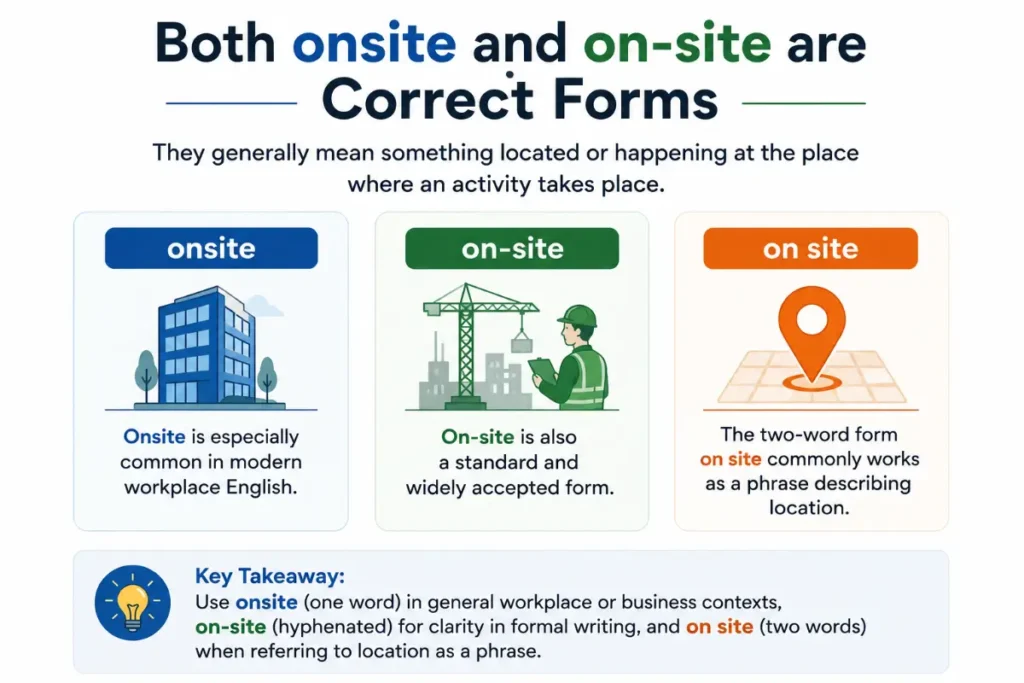
Onsite vs on site comes down to spelling style and sentence structure. Both forms describe something located at or happening at a particular place. In American English the closed form onsite is common as an adjective while on site is often used as a phrase. For example a company may offer onsite training or provide training on site. Follow your organization’s style guide and stay consistent.
Table of Contents
- What Onsite and On Site Mean.
- The Main Difference Between Onsite and On Site.
- When to Use Onsite.
- When to Use On Site.
- Onsite vs On Site Comparison Table.
- Examples in Everyday English.
- Examples in Business and Professional Writing.
- Common Mistakes to Avoid.
- Is Onsite One Word in American English.
- Is On Site One Word or Two Words.
- Onsite vs On Site in British English.
- Onsite vs On Site in Different Industries.
- Memory Tips for Choosing the Correct Form.
- Related Words and Expressions.
- Frequently Asked Questions.
- Key Takeaways.
- Conclusion.
What Onsite and On Site Mean
Both forms refer to a particular location where an activity takes place or where a person or service is available. The location depends on the context. It might be an office a school a construction project a hospital a factory or a customer’s property.
The meaning of onsite
Onsite is a compound word that generally works as an adjective. It describes a person service facility activity or feature available at a particular location.
For example consider this sentence.
The company provides onsite technical support.
The word onsite describes the type of technical support the company provides. Customers can receive help at the relevant location rather than relying only on remote assistance.
Here is another example.
Our school has an onsite nurse.
The word onsite describes where the nurse is available. The nurse works at the school rather than serving students exclusively from another location.
Writers also use onsite in phrases such as onsite parking onsite childcare onsite training and onsite interviews. In each case the word helps readers understand where the service or activity is available.
The meaning of on site
On site is a two word phrase that commonly functions as an adverbial expression. It tells readers where someone performs an action or where something happens.
Consider this example.
The engineer will inspect the equipment on site.
The phrase on site explains where the engineer will inspect the equipment. The inspection will happen at the relevant location.
Now consider another sentence.
The contractor arrived on site early Monday morning.
The phrase identifies the place where the contractor arrived. In a construction context that location might be the building project or work area.
The phrase can also appear after a form of the verb be.
The project manager is on site today.
In this sentence on site describes the manager’s location. It tells readers that the manager is physically present at the relevant workplace or project.
Why the meaning can overlap
The two forms often communicate almost the same idea. The difference usually involves grammar and editorial preference rather than a major change in meaning.
Compare these sentences.
- We provide onsite repairs.
- We provide repairs on site.
Both sentences tell readers that repairs are available at the relevant location. The first uses onsite to describe the repairs. The second uses on site to explain where the repairs take place.
The wording changes slightly but the central message stays the same.
The Main Difference Between Onsite and On Site
The most useful distinction is grammatical function. Onsite commonly acts as an adjective before a noun while on site often acts as an adverbial phrase that tells readers where an action happens.
Onsite before a noun
Writers frequently place onsite directly before a noun.
Examples include the following.
- The company offers onsite consultations.
- We scheduled an onsite inspection.
- The hospital provides onsite medical services.
- The school hired an onsite counselor.
- Our office has onsite parking.
In each example onsite describes the noun that follows it. It tells readers what kind of consultation inspection service counselor or parking the sentence refers to.
This pattern is common in advertisements job descriptions company websites and workplace policies. It also keeps phrases compact and easy to scan.
On site after a verb
The two word form often appears after a verb when the writer wants to explain location.
Examples include the following.
- The technician will arrive on site at noon.
- The inspector examined the building on site.
- Our team is on site this morning.
- The contractor stayed on site until the work finished.
- The manager met the customer on site.
In these examples the phrase tells readers where a person arrived worked stayed or met someone. It adds information about location rather than directly modifying a noun.
A practical grammar test
Ask yourself what job the expression performs in the sentence.
If it describes a noun that follows it then onsite is a natural choice.
For example the team arranged an onsite meeting.
Here onsite describes the meeting.
If it tells readers where an action occurs then on site is a natural choice.
For example the team held the meeting on site.
Here on site explains where the team held the meeting.
This test works well for many everyday sentences. However it is a useful guideline rather than an absolute rule. Some organizations prefer one spelling across all uses while dictionaries and editorial guides may differ in their treatment of compound words.
When to Use Onsite
Use onsite when you want a concise adjective that describes a service person facility event or activity available at a particular location. This spelling is common in American business and workplace writing.
Before service names
Onsite works naturally before names of services that people receive at a physical location.
Examples include onsite support onsite repairs onsite training and onsite consultations.
Consider this sentence.
The software company offers onsite training for new customers.
The word onsite describes the training. It tells customers that an instructor can provide the training at the relevant location.
This wording can also distinguish a service from remote training. Readers can understand the difference without needing a long explanation.
Before job titles and roles
Companies often use onsite to describe workers who perform their duties at a particular location.
Examples include onsite technician onsite supervisor onsite coordinator and onsite nurse.
Consider this sentence.
An onsite coordinator will help visitors check in.
The word onsite describes the coordinator’s role and suggests that the person will be available at the location.
For clarity use a more specific location when readers might not know which site you mean. A sentence such as An onsite coordinator will help visitors at the downtown office gives readers a clearer picture.
In job descriptions
Employers frequently use onsite to describe positions that require employees to work at a physical workplace.
For example a job posting might say the position requires onsite attendance five days a week.
Here onsite describes the kind of attendance expected. It helps applicants distinguish the position from remote or hybrid work.
Writers should explain the actual work arrangement rather than rely on the label alone. An onsite role might involve a company office a factory a school or a customer location. The job description should identify the expected workplace and schedule.
In facilities and amenities
Onsite also works well for facilities and amenities available at a location.
Examples include onsite parking onsite childcare onsite dining and onsite fitness facilities.
Consider this sentence.
The conference center offers onsite parking for registered guests.
The word onsite tells guests that parking is available at the conference center rather than at a separate property.
This usage is common in hospitality event planning education and property descriptions because readers often want to know which amenities they can access without traveling elsewhere.
In technical and customer support
Businesses use onsite to distinguish in person assistance from support delivered remotely.
For example a service agreement might include onsite equipment maintenance.
The word onsite describes the type of maintenance. It signals that a technician will visit the relevant location instead of handling the entire task through remote tools.
For contracts and service agreements be precise about what onsite service includes. The word alone does not establish response times travel fees coverage areas or the exact work a technician will perform.
In marketing and customer communication
Onsite can make short descriptions easier to read in brochures service pages and promotional materials.
For example a company might advertise onsite consultations for homeowners.
The phrase communicates that customers can receive consultations at a relevant physical location. However the company should explain the service area and appointment process if those details affect the customer’s decision.
Use onsite because it fits the sentence rather than because it appears more modern or professional. Clear wording matters more than choosing the shortest possible form.
When to Use On Site
Use on site when you want to emphasize where an action happens or where a person is present. The phrase is especially natural after verbs that describe arrival work attendance inspection or physical presence.
To describe a person’s location
The phrase on site often appears with forms of be and other verbs that describe a person’s location.
Examples include the following.
- The project manager is on site today.
- Two electricians are on site.
- The safety officer remained on site throughout the inspection.
- Our representative will be on site during the event.
Each sentence identifies where someone is present. The phrase usually refers to a location already known from the surrounding conversation.
If the reader does not know the location mention it directly. For example the safety officer remained on site at the new warehouse throughout the inspection.
To explain where work happens
Use on site when the location of an action matters to the sentence.
For example the technicians repaired the equipment on site.
The phrase explains where the technicians performed the repairs. This information may matter because the equipment was too large to move or the customer needed the work completed at the facility.
Another example is the sentence The team completed the installation on site.
The phrase tells readers that the installation took place at the project location. It does not necessarily tell readers how long the work took or what equipment the team used.
With inspections and assessments
Inspections often require people to examine a physical location. The phrase on site can make that location clear.
For example the inspector conducted an assessment on site.
The wording indicates that the assessment happened at the relevant property or facility. It distinguishes the visit from a review conducted entirely through photographs documents or video.
A more specific version might read The inspector conducted the assessment on site at the manufacturing plant. That wording helps readers identify the exact location.
With meetings and visits
On site is also common when people meet or visit someone at a workplace or project location.
For example the sales representative met the client on site.
The phrase explains where the meeting occurred. It may distinguish the meeting from a phone call or a meeting at the company’s own office.
Similarly a sentence such as We will meet on site at 10 a.m. tells readers to gather at the relevant location. If several locations are possible include the address or name of the property.
When location is the main point
Sometimes a sentence focuses on physical presence rather than the type of service or activity.
For example the manager needs to be on site before the inspection begins.
The phrase emphasizes the manager’s presence at the location. In a safety sensitive environment that presence might be necessary to coordinate access or answer questions.
The sentence does not automatically create a legal or contractual requirement. Such requirements depend on the relevant agreement policy or regulation.
Onsite vs On Site Comparison Table
The table below summarizes the most common patterns in American English.
| Feature | Onsite | On site |
|---|---|---|
| Form | One word | Two words |
| Common role | Adjective | Adverbial phrase |
| Main purpose | Describes a noun | Explains location |
| Typical position | Before a noun | Often after a verb |
| Example | Onsite training is available. | Training takes place on site. |
| Workplace use | Onsite employee | Employee is on site. |
| Service use | Onsite support | Support is provided on site. |
| Location focus | Describes a service or feature associated with a location | Emphasizes the place where something happens |
| American English | Common in professional writing | Also common in professional writing |
| Best practice | Follow the relevant style guide | Follow the relevant style guide |
The table shows common patterns rather than strict rules that apply to every sentence. Both forms can describe the same service or activity.
For example onsite inspection and inspection on site can communicate the same basic idea. The best choice depends on the sentence structure and the style you want to maintain.
Examples in Everyday English
Everyday examples make the difference easier to recognize. The following sentences show how each form works in common situations.
Examples with onsite
- The hotel offers onsite laundry services.
Explanation. Onsite describes the laundry services and tells guests that the hotel provides them at the property.
- We hired an onsite tutor for the summer program.
Explanation. Onsite describes the tutor’s role and indicates that the tutor will work at the program location.
- The office provides onsite childcare for employees.
Explanation. Onsite describes the childcare service and tells employees that the facility is available at the workplace.
- The clinic has onsite laboratory testing.
Explanation. Onsite describes the testing service and indicates that testing is available at the clinic.
- The company scheduled an onsite interview for Friday.
Explanation. Onsite describes the interview and suggests that it will take place at a physical location associated with the employer.
- Our apartment complex has onsite maintenance staff.
Explanation. Onsite describes the maintenance staff and indicates that the staff are available at the property.
- The school arranged onsite counseling for students.
Explanation. Onsite describes the counseling service and tells readers that students can receive assistance at the school.
- The event package includes onsite registration.
Explanation. Onsite describes the registration service and indicates that attendees can register at the event location.
Examples with on site
- The plumber arrived on site at 8 a.m.
Explanation. On site tells readers where the plumber arrived.
- Our team is on site until the installation is complete.
Explanation. The phrase describes the team’s location and physical presence during the work.
- The photographer took the pictures on site.
Explanation. On site explains where the photographer took the pictures.
- The inspector will remain on site during the repair.
Explanation. The phrase indicates that the inspector will stay at the location while the repair takes place.
- We met the supplier on site.
Explanation. On site identifies the place where the meeting happened.
- The workers found the damaged pipe on site.
Explanation. The phrase tells readers where the workers found the pipe.
- A supervisor must be on site before work begins.
Explanation. The phrase emphasizes the supervisor’s presence at the workplace before the work starts.
- The crew finished the cleanup on site.
Explanation. On site tells readers that the crew performed the cleanup at the relevant location.
Examples that show both forms
The following pairs demonstrate how writers can express similar ideas with different sentence structures.
- The company provides onsite consultations.The company provides consultations on site.Explanation. Both sentences describe consultations at a particular location. The first uses an adjective while the second emphasizes where the consultations occur.
- We offer onsite equipment repairs.We repair equipment on site.Explanation. The first sentence describes the type of repair service. The second explains where the technicians perform the repairs.
- The school has an onsite nurse.The nurse is on site during school hours.Explanation. The first sentence describes the nurse’s role. The second tells readers when the nurse is present at the school.
- The hotel offers onsite dining.Guests can dine on site.Explanation. The first describes a hotel amenity. The second explains where guests can eat.
- The company arranged onsite training.The instructor will conduct the training on site.Explanation. The first sentence describes the training arrangement. The second identifies the location of the instruction.
These examples show that sentence structure often provides the clearest guide to the correct form.
Examples in Business and Professional Writing
Professional writing benefits from consistent spelling because small differences can distract readers. The best choice also depends on the document’s purpose.
Business emails
In an email you might write We can arrange an onsite consultation next week.
The adjective onsite describes the consultation. The sentence works well when you are offering a service at the customer’s location.
You might instead write Our consultant can meet you on site next Tuesday.
The phrase on site emphasizes where the meeting will take place. It sounds natural when the location is already clear to both people.
Both sentences are appropriate. Choose the one that best expresses the intended meaning.
Job advertisements
A company might write This is an onsite position based in our Chicago office.
The word onsite describes the position’s work arrangement. The reference to the Chicago office makes the location more precise.
Another job description might say Employees must be on site by 9 a.m.
Here the phrase emphasizes physical presence at the required time. This wording may suit an attendance policy or a schedule.
Employers should explain the actual arrangement clearly. The label onsite does not by itself tell applicants how often they must attend the workplace or if remote work is permitted.
Contracts and service agreements
A contract might state The provider will supply onsite technical assistance.
The adjective onsite describes the assistance included in the service.
Another clause might say The provider’s technician must remain on site while the system is tested.
The phrase on site emphasizes the technician’s physical presence during testing.
In legal and contractual documents clarity matters more than stylistic preference. Define the location if needed and spell out the service obligations response times fees and exceptions. Do not rely on the spelling of onsite or on site to establish obligations that the agreement does not explain.
Reports and project updates
A project report might state The team completed an onsite assessment of the facility.
The adjective onsite describes the assessment and helps readers understand the type of evaluation performed.
A progress update might say The engineering team remains on site while the final checks continue.
The phrase describes the team’s current location.
Reports often discuss both services and physical presence. Using the appropriate form can make those distinctions easier to follow.
Website content
A business website might promote onsite installation services.
The word onsite describes the installation services and gives visitors a quick sense of what the company offers.
A separate service description might say Our technicians install approved equipment on site.
The phrase explains where the work takes place.
Website writers should also avoid vague location claims. If service is available only within a specific area or for certain products say so directly. A clear description helps readers understand the offer before contacting the business.
Common Mistakes to Avoid
Writers often treat onsite and on site as interchangeable in every context. Although the forms overlap in meaning they do not always serve the same grammatical role.
Mistake 1. Assuming one form is always correct
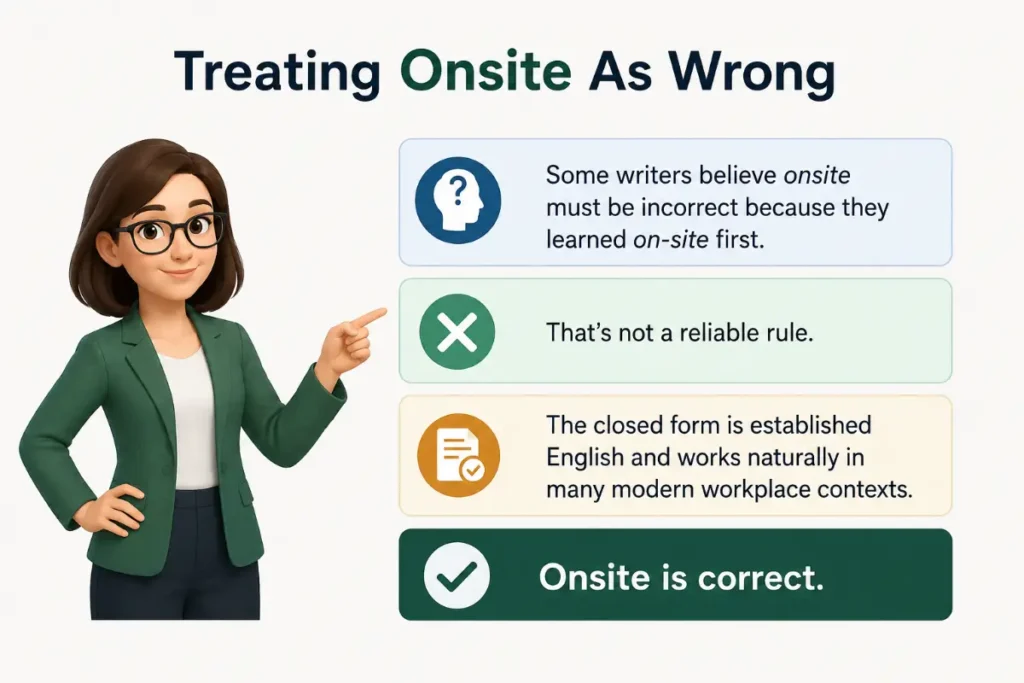
A common mistake is to claim that onsite is always correct or that on site is always correct.
In practice both forms appear in standard English. Their use depends on grammar editorial style and the preferences of the organization.
For example onsite training is a natural adjective phrase while the instructor is on site is a natural location phrase.
Use the form that fits the sentence and follow any required style guide.
Mistake 2. Using two words before every noun
Some writers use on site before a noun even when a concise adjective would read more naturally.
For example the company provides on site support.
This form may appear in some style systems but many American business writers prefer onsite support.
The key is consistency. If your company style guide uses onsite support then use the same spelling throughout the document.
Mistake 3. Forcing one word into every sentence
The opposite mistake is using onsite whenever the idea involves a location.
For example the technician is onsite today.
Some organizations accept this spelling in that position. Others prefer the technician is on site today.
If the purpose is to describe someone’s location the two word form is a familiar and clear choice. Check the style guide when exact consistency matters.
Mistake 4. Confusing onsite with remote
Onsite and remote often describe contrasting work arrangements or service methods.
An onsite technician visits the relevant location while a remote technician may provide assistance from another place.
However the distinction depends on the service. A remote support team might also arrange an onsite visit when a problem requires physical work.
Use the words accurately and explain the arrangement when customers or employees need specific details.
Mistake 5. Leaving the location unclear
The phrase on site usually depends on context. Readers need to know which site you mean.
For example the contractor will arrive on site tomorrow.
This sentence works if the project location is already known. If several locations are involved write the contractor will arrive on site at the new warehouse tomorrow.
Adding a specific location prevents confusion.
Mistake 6. Changing spellings without a reason
A report that uses onsite support in one section and on site support in another may look inconsistent.
The difference might not change the meaning but it can make the document appear poorly edited.
Choose a preferred form and apply it consistently unless the sentence structure or an established style rule calls for a different form.
Mistake 7. Treating the spelling as a legal definition
The spelling alone does not define what a service includes or where a worker must be present under a contract.
For example an agreement that mentions onsite support might still need to specify the service location hours and response requirements.
Use clear contractual language to define obligations. Do not assume the compound word settles every detail.
Is Onsite One Word in American English
Yes. Onsite is widely used as one word in American English especially when it functions as an adjective before a noun.
Common examples include onsite services onsite interviews onsite training and onsite parking.
The closed spelling is practical because it keeps familiar workplace phrases compact. It also fits the general pattern of English compounds that develop a closed form through regular use.
However American English also uses the phrase on site. For example a project manager can be on site or a repair can take place on site.
The fact that onsite is common in American English does not make the two word form incorrect. Writers should consider grammar and follow the style guide that applies to their work.
Is On Site One Word or Two Words
On site is written as two words. It commonly functions as an adverbial phrase that identifies the location of an action or a person’s presence.
For example the engineer is on site.
The phrase tells readers where the engineer is located.
Another example is the crew performed the repairs on site.
Here the phrase explains where the crew performed the repairs.
Some editors use onsite as a one word form in more contexts than others. This variation means writers may encounter both forms in published material. When editing for a specific organization use its preferred spelling rather than changing every occurrence based on personal preference.
Onsite vs On Site in British English
British English also uses both onsite and on site. Usage can vary across publishers organizations and industries so a simple rule that assigns one spelling to all British writing would be misleading.
In British workplace writing you may encounter phrases such as onsite facilities and staff working on site. Both express the idea of something being available at or happening at a particular location.
American and British English sometimes differ in spelling conventions. For example American English generally uses color while British English generally uses colour. The onsite distinction does not follow such a clear national divide.
If you are writing for a British audience check the relevant publication’s house style. If you are writing for an American audience use the form that fits the sentence and keep your usage consistent.
Onsite vs On Site in Different Industries
The same basic distinction applies across industries but the most useful examples vary by field.
Construction and engineering
Construction professionals often use onsite to describe services or resources available at a project location.
Examples include onsite supervision onsite storage and onsite safety training.
The phrase on site commonly describes the presence or activity of workers.
For example the engineer remained on site until the structural inspection finished.
In construction documents the exact location may matter for safety scheduling and responsibility. Name the project or work area when readers could confuse one site with another.
Healthcare
Healthcare organizations may use onsite to describe services provided at a clinic workplace school or other facility.
For example a company may offer onsite health screenings.
The word onsite describes the screening service.
A report might instead state The medical team was on site during the event.
The phrase explains where the medical team was present.
Healthcare communications should identify the facility and the scope of a service when those details affect access or patient expectations.
Education
Schools and training centers may describe onsite tutoring onsite counseling and onsite workshops.
For example the district provides onsite support for new teachers.
The word onsite describes the support available at the relevant school or district location.
A schedule might say The trainer will be on site throughout the workshop.
Here the phrase describes the trainer’s presence.
Technology
Technology companies use onsite to describe support installation maintenance and training that require physical attendance.
For example the service plan includes onsite hardware repairs.
The word onsite describes the repair service.
A project update might say The technician will be on site to replace the damaged component.
The phrase identifies where the technician will work.
Technology companies should explain the difference between remote troubleshooting and physical service visits so customers know what to expect.
Hospitality and events
Hotels and event venues often promote onsite restaurants onsite parking and onsite event coordinators.
For example the venue provides onsite catering.
The word onsite describes the catering service available at the venue.
An event organizer might write Our team will be on site two hours before the doors open.
The phrase tells readers when the team will be physically present.
Real estate and property management
Property listings may mention onsite management onsite laundry facilities and onsite maintenance.
For example the apartment building offers onsite management.
The word onsite describes the management arrangement and suggests that management is available at the property.
A maintenance report might say The repair team was on site throughout the afternoon.
The phrase explains where the team worked.
Property descriptions should be specific if the location of an amenity or service could affect a renter’s decision.
Memory Tips for Choosing the Correct Form
A simple memory trick can help you choose the right spelling without pausing over every sentence.
Think of onsite as a label
Onsite often works like a label attached to a noun.
Examples include onsite training onsite support and onsite parking.
The word describes the service or feature. If you can naturally ask what kind of training support or parking the sentence describes then onsite may be a good fit.
Think of on site as a location answer
On site often answers the question where.
For example the technician worked on site.
Ask where the technician worked. The answer is on site.
This method works well with verbs such as arrive work remain meet inspect and perform.
Read the full sentence aloud
Reading a sentence aloud can reveal awkward wording.
Compare these examples.
The company offers onsite installation.
The company performs installations on site.
Both sound natural because each form fits its sentence structure.
Now compare the alternatives with the rest of your paragraph. If one spelling changes unexpectedly check the style guide and revise the document for consistency.
Use a simple editing rule
For everyday American business writing use onsite before a noun when it acts as an adjective. Use on site when the phrase explains where a person or action is located.
Treat this as a practical guide rather than an unbreakable rule. Some organizations prefer one form across most contexts.
Related Words and Expressions
Onsite and on site belong to a wider group of expressions that describe location or the way people work. Understanding these related terms helps writers explain arrangements more precisely.
Onsite vs remote
Onsite usually describes a service or role associated with a physical location. Remote describes work or assistance performed from another location without requiring the person to be physically present at the main workplace.
For example onsite technical support may involve a technician visiting a customer while remote support may involve troubleshooting through a phone call or computer connection.
The two terms describe different arrangements. Some jobs and services combine both.
Onsite vs in person
Onsite focuses on a specific location. In person emphasizes direct physical interaction rather than communication through a screen or phone.
For example an onsite training session takes place at a particular location. An in person training session emphasizes that participants meet face to face.
An event can be both onsite and in person. The terms are related but do not mean exactly the same thing.
Onsite vs on location
On location often refers to work performed at a specific place rather than in a usual studio office or central facility. The phrase is common in film production photography broadcasting and fieldwork.
For example a film crew may shoot on location at a historic building.
Onsite is broader and appears in many industries. It can describe services facilities workers and activities associated with a particular place.
Onsite vs at the site
At the site is another phrase that clearly identifies a location.
For example the inspector arrived at the site before the crew.
This sentence emphasizes arrival at a particular place. The phrase may sound more precise than on site when the writer needs to identify a specific project location.
Onsite can be more compact before a noun. For example onsite inspection is a concise way to describe an inspection associated with the location.
Onsite vs in house
In house generally describes work or services handled within an organization rather than outsourced to an outside provider. It does not necessarily mean that the work happens at the company’s physical location.
For example a company might use an in house legal team that works remotely.
The term onsite describes location while in house describes who performs the work or how the organization manages it. Keep these meanings separate when writing policies or service descriptions.
Professional Writing Tips for Clear and Consistent Usage
Good writing depends on more than selecting the right spelling. The sentence should tell readers what happens where it happens and what they need to know next.
Follow the house style
A house style is a set of writing rules used by a company publication or organization. It may specify onsite as the preferred spelling or require on site in certain grammatical contexts.
If your organization has a style guide follow it. This approach prevents unnecessary editing differences across reports emails job postings and web pages.
If no guide exists choose a consistent approach that reflects ordinary usage and the needs of your audience.
Make the location clear
Readers should not have to guess which location a sentence describes.
Instead of writing The supervisor will be on site tomorrow you could write The supervisor will be on site at the Austin warehouse tomorrow.
The revised sentence gives readers a clear location and a specific time reference.
Avoid vague service descriptions
A phrase such as onsite support tells readers where support may be available but it does not explain the full service.
If customers need more detail identify the type of support the location the service hours and any relevant limitations.
For example Our technicians provide onsite equipment repairs at company facilities from Monday through Friday. This sentence gives readers more practical information than the phrase onsite support alone.
Keep related wording consistent
If you use onsite training in a heading then use the same form in nearby descriptions when the grammatical structure supports it.
However do not force identical wording into every sentence. A phrase such as the trainer will be on site may be more natural when the sentence focuses on physical presence.
Consistency should improve clarity rather than make the writing stiff.
Edit for the reader’s needs
Readers usually care more about the location service and schedule than the spelling distinction itself.
Choose the wording that communicates those details quickly. If a sentence feels unclear revise its structure instead of relying on a spelling change to solve the problem.
Expert Editor Insight
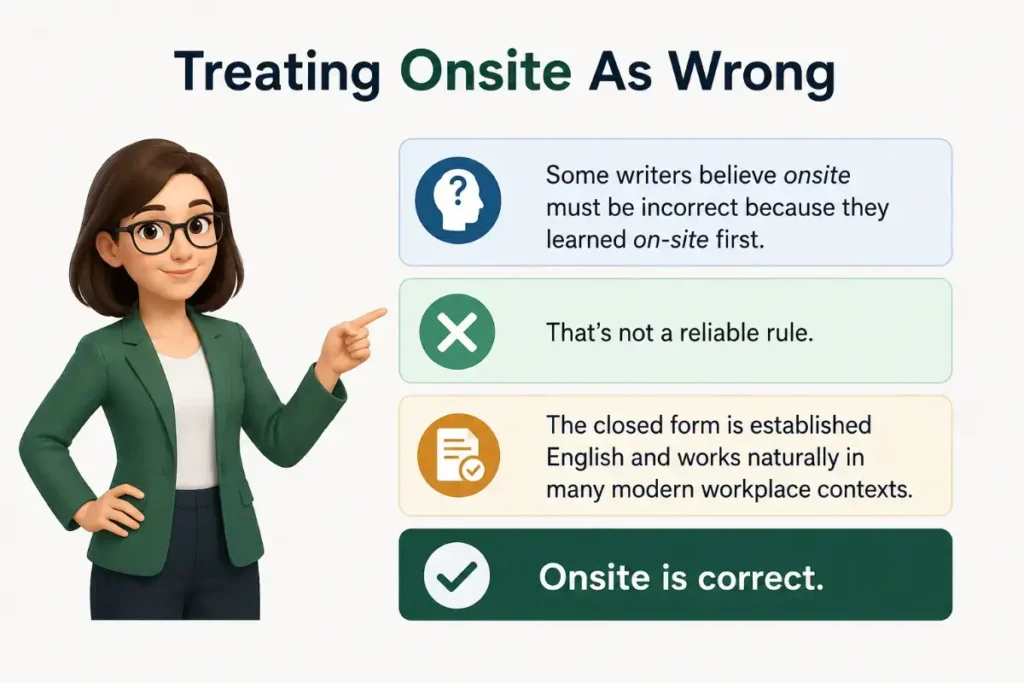
An experienced editor won’t automatically change onsite to on-site because both forms are established. The editor first checks the grammatical role of the expression and then considers the publication’s preferred style. Consistency matters too. If a document uses onsite for workplace services then switching randomly to on-site can make the writing look poorly edited. Good editing focuses on clarity context and consistency rather than changing words just to make them look different.
Conclusion
Onsite vs on-site comes down to spelling style rather than meaning. Both forms describe something that happens at or is located at a particular site. Onsite is written as one word, while on-site uses a hyphen. Both are accepted in modern English.
For formal writing, reports, business emails, and professional documents, on-site is a reliable choice. However, onsite is also common in modern American English, especially in job descriptions, workplace policies, and company websites. Your organization’s style guide can help you choose the preferred form.
The key is consistency. Pick onsite or on-site and use that spelling throughout your document. Avoid switching between the two forms without a clear reason. This simple approach keeps your writing clear, professional, and easy to read.
FAQs About Onsite vs On-Site
Is onsite or on-site correct?
Both onsite and on-site are accepted spellings in modern English. On-site is the more traditional form and remains common in formal writing. Onsite is also widely used, especially in business communication and job descriptions. Follow your organization’s style guide and use the same spelling throughout your writing.
Should I write onsite or on-site in American English?
Both forms appear in American English. However, on-site is a safe choice for formal documents, reports, and professional writing. Onsite is also common in company websites, job listings, and workplace communication. Consistency matters more than switching between the two forms.
Is onsite one word or two words?
Onsite is written as one word, while on-site is written as a hyphenated word. Both forms can describe something located at or taking place at a particular site. For example, you might write onsite support or on-site support. Choose the form that matches your preferred style guide.
Is onsite hyphenated when used as an adjective?
Onsite can be used as an adjective without a hyphen, as in onsite training. The hyphenated form on-site is also correct, as in on-site training. Many writers use on-site in formal or edited content because it clearly connects the words. Follow the spelling used by your publication or employer.
Is onsite written as one word in British English?
British English uses both onsite and on-site. The hyphenated spelling remains familiar in formal writing, while the closed form onsite appears in modern workplace and business content. Usage can vary by publication and organization, so there is no single spelling rule that applies to every British English context.
What does onsite mean in a job description?
In a job description, onsite means that employees must work at a specified physical location, such as an office, school, hospital, or company facility. For example, an onsite position may require employees to attend the workplace instead of working remotely. Job advertisements may use onsite or on-site to express this requirement.
Is onsite the same as in person?
Onsite and in person are related, but they are not always interchangeable. Onsite means something happens at a particular location or site. In person means someone attends physically rather than communicating remotely. For example, an onsite meeting takes place at a specific workplace, while an in-person meeting emphasizes physical attendance.
Should I use onsite or on-site in professional emails?
Both spellings work in professional emails. If your company follows a style guide, use its preferred form. Otherwise, on-site is a clear and conventional choice for formal communication. Onsite is also suitable, especially if your workplace commonly uses it. The most important rule is to use one spelling consistently.

Confusing Words, Spelling & Word Choice
Claire Whitmore is a U.S.-based English editor who writes about commonly confused words, spelling differences, and word choice. Her work helps readers understand subtle distinctions between similar-looking words through simple definitions, practical examples, and modern usage guidance in both American and British English.