
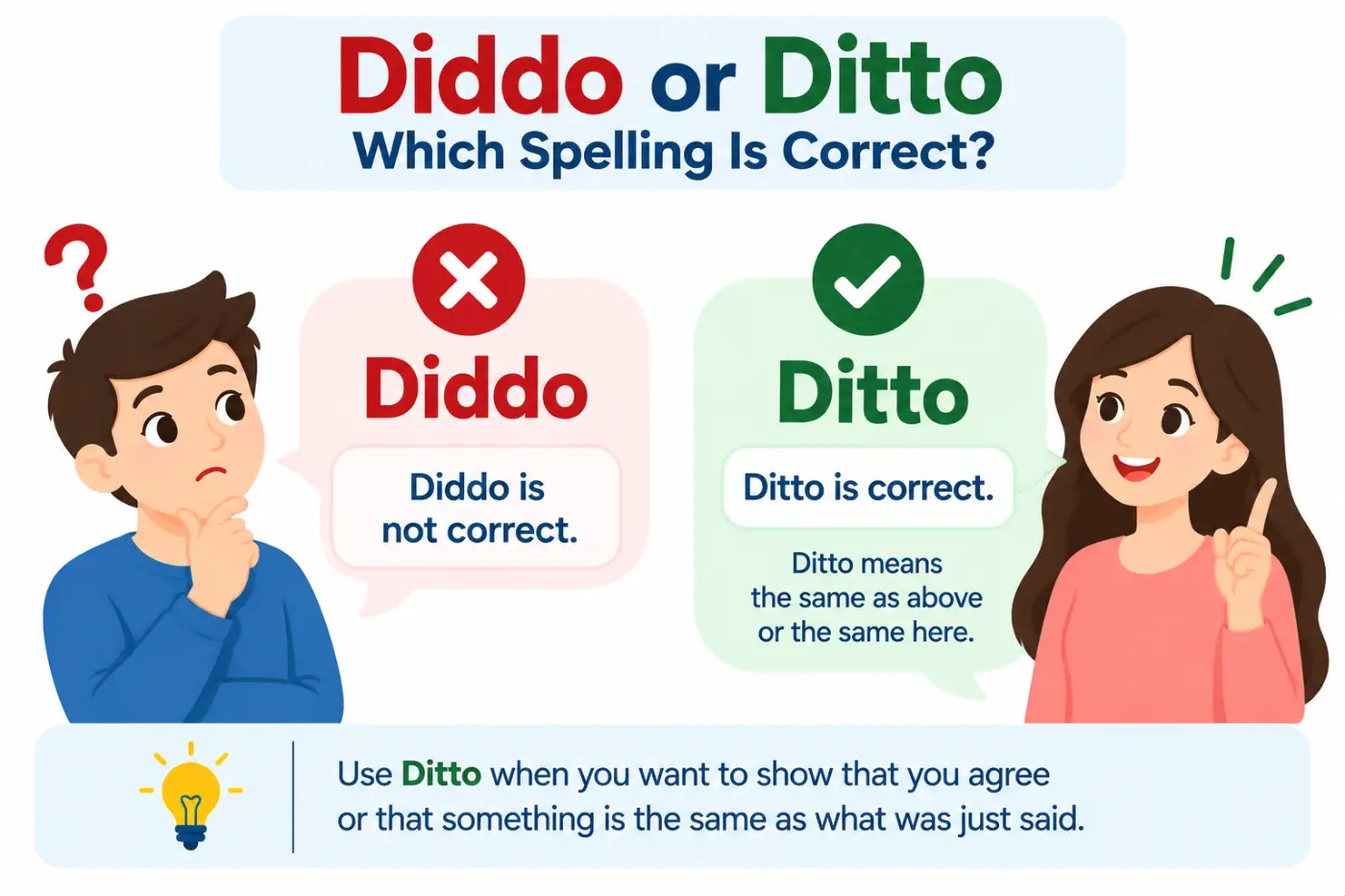
Diddo or ditto is a common spelling question because people sometimes remember how a word sounds but spell it incorrectly. The correct spelling is ditto, with two t’s and an o at the end. The word is used to express agreement, repeat information, or indicate that something is the same as what came before.
You might hear someone say ditto during a conversation, see it in a text message, or find it in notes and lists. In everyday American English, it often serves as a quick way to say me too, same here, or the same applies to me. Its exact meaning depends on the context, but the central idea remains the same.
Learning this spelling is simple once you connect the word with its meaning. Ditto is a real English word with established uses, while diddo is generally a misspelling when someone intends to write ditto. Understanding the difference will help you write more clearly in school assignments, emails, messages, and professional documents.
Short Answer
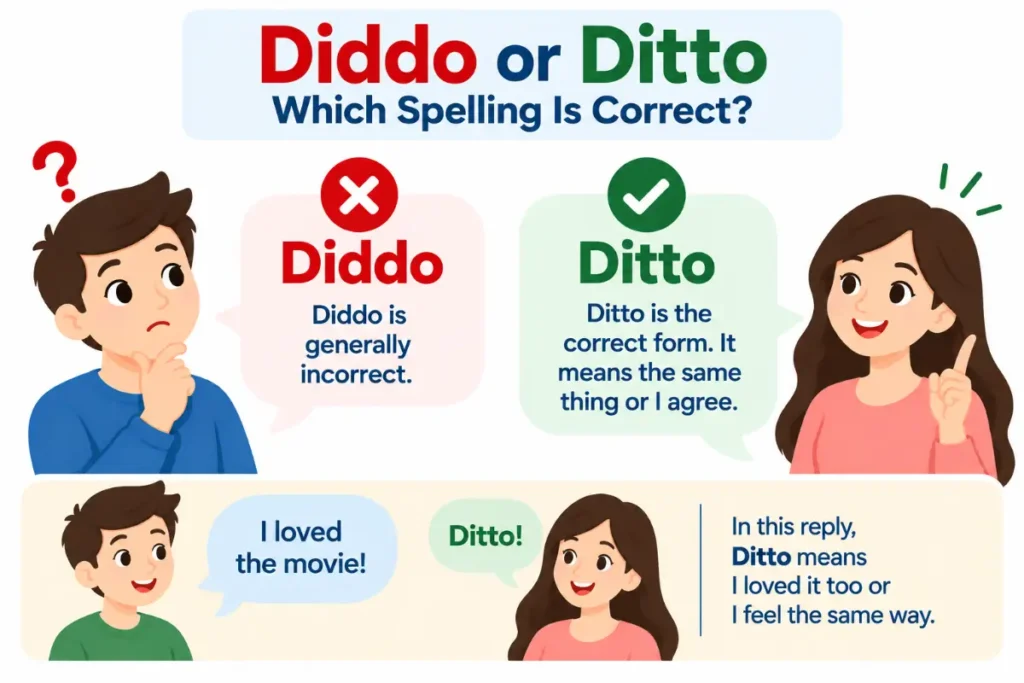
Ditto is the correct standard English spelling. Diddo is a common misspelling of ditto and should be corrected in formal writing. Ditto means the same thing as something already mentioned. People often use it in casual conversation to agree with someone or show that the same statement applies to them. For example, if a friend says, I love this song, you can reply, Ditto.
Table of Contents
- The Correct Spelling of Ditto
- What Ditto Means
- Why People Misspell Ditto
- How to Use Ditto in a Sentence
- Ditto vs Diddo Comparison
- Different Meanings and Uses of Ditto
- Is Ditto Formal or Informal
- Is Ditto Used in American and British English
- Common Spelling and Usage Mistakes
- Easy Ways to Remember Ditto
- Similar Words and Expressions
- Professional Writing Tips
- Frequently Asked Questions
- Key Takeaways
- Conclusion
The Correct Spelling of Ditto
The correct spelling is ditto. It contains five letters and follows the spelling pattern D I T T O. The word has two consecutive t’s, not a d followed by two d’s.
The spelling diddo isn’t the standard form when you want to express agreement or indicate that something is repeated. Although people may type it by mistake, dictionaries recognize ditto as the established English word for these meanings.
Here is the correct way to write it.
- Correct: Ditto.
- Incorrect: Diddo.
For example, imagine your coworker says, I really enjoyed the presentation. You can reply, Ditto, to communicate that you enjoyed it too. The word makes your response short and clear without repeating the entire sentence.
Why Ditto Is the Standard Form
Ditto has a long history in English and comes from an Italian word associated with something that has been said or stated. English adopted the term and developed several uses for it, including repetition and agreement.
Its established spelling has remained ditto. Writing diddo changes the internal consonants and produces a nonstandard spelling for the intended word.
This distinction matters because spell checkers and professional editors generally expect the recognized form. A reader may understand diddo from context, but understanding a misspelling doesn’t make it correct.
How to Spell Ditto Correctly
Remember these three details when writing the word.
- Begin with D.
- Write two t’s in the middle.
- Finish with O.
The complete spelling is ditto.
You can also remember the word as two parts for practice. Start with dit and add to. Reading and writing the correct form several times can help you recognize it automatically.
What Ditto Means
Ditto means the same thing as something already stated, written, or shown. It allows you to avoid repeating information that your audience already knows.
The word can express agreement, indicate repetition, or show that an earlier entry applies again. Its function depends on how the speaker or writer uses it.
Ditto as a Way to Agree
In everyday conversation, ditto often means me too or I feel the same way.
For example:
- Alex says, I am excited about the concert.
- Jordan replies, Ditto.
Jordan is expressing the same feeling as Alex. Instead of saying I am excited about the concert too, Jordan uses one word to communicate agreement.
This use is common in casual conversations, text messages, and friendly exchanges. It works best when the previous statement makes the intended meaning clear.
Consider another example.
My sister says, I could eat pizza every day. I smile and reply, Ditto.
My response means that I share her preference. The word doesn’t repeat the exact sentence, but it communicates the same general idea.
Ditto as a Way to Repeat Information
Ditto can also indicate that information should be repeated from an earlier entry.
Imagine a list containing three employees and their departments.
| Employee | Department |
|---|---|
| Maria | Marketing |
| James | Ditto |
| Olivia | Finance |
In this example, ditto indicates that James belongs to the same department listed for Maria. The intended meaning is Marketing.
However, this method depends on the reader understanding the list’s layout. In an important business record, repeating Marketing may be clearer than using ditto.
Ditto as a Sign of the Same Result
The word can describe something that produces the same result or follows the same pattern as a previous example.
For instance, a teacher might explain one mathematical problem and say that the next problem follows the same method. In informal notes, a student might write ditto beside a similar problem to remember that the same process applies.
Here, the word refers to repetition of a method rather than agreement with a personal opinion.
Ditto as a General Expression of Sameness
Ditto can refer to a similar condition, experience, preference, or situation.
Consider these examples.
1. The first team finished the task early, and the second team did ditto.
This sentence uses ditto to suggest that the second team did the same thing. A more natural version in many contexts would be, The second team did the same.
2. My brother loves science fiction, and I am ditto about those movies.
The meaning is understandable, but the wording sounds unnatural. A better sentence is, My brother loves science fiction, and I do too.
3. The first report received positive feedback, and the second received ditto.
This is understandable in some informal settings, but the sentence sounds awkward. The second report received the same feedback is clearer.
These examples show that knowing a word’s meaning isn’t enough. You also need to understand the sentence patterns in which it sounds natural.
Why People Misspell Ditto
People often misspell familiar words because spelling and pronunciation don’t always match perfectly. A person may know a word from conversation without having seen it written frequently.
Ditto can be especially confusing for people who remember the word by sound rather than by its written form.
Confusion Between D and T
The most obvious difference between ditto and diddo is the consonant sequence in the middle.
Ditto uses two t’s. Diddo replaces those letters with two d’s.
Because the words look similar, a typist may accidentally choose the wrong consonant. Someone who hasn’t learned the standard spelling may also assume that the alternative form is acceptable.
The solution is to remember the written word rather than rely only on how it sounds.
Familiarity With Spoken English
People learn many expressions by hearing friends, relatives, coworkers, or television characters use them. They may understand the meaning long before they learn the spelling.
For example, someone who hears ditto in conversations might use it correctly for years without writing it. When that person finally types the word, the spelling may not come to mind immediately.
Reading the word in books, articles, and everyday messages helps build a stronger connection between its sound, meaning, and spelling.
Fast Typing and Autocorrect
Typing quickly can create errors even when you know the correct form. Your fingers may hit the wrong letters, or autocorrect may fail to identify an unusual entry.
A simple proofreading habit can catch these mistakes before you send a message or submit a document.
Read the sentence once for meaning and again for spelling. If a word looks unfamiliar, check it rather than assuming that a spell checker has caught every error.
Incorrect Spellings Shared Online
A misspelling can spread when people repeat it in comments, messages, or social media posts. Seeing the same form several times may make it appear familiar.
Familiarity, however, isn’t proof of correctness. The standard spelling remains ditto, even if a reader encounters diddo in informal online writing.
How to Use Ditto in a Sentence
The best way to learn a word is to see how it works in real sentences. Ditto is relatively easy to use once you understand the relationship between the word and the statement that comes before it.
Use Ditto to Express Agreement
This is one of the most familiar uses in American English.
1. I love spending time outdoors. Ditto.
The second speaker shares the first speaker’s preference for outdoor activities.
2. That was an excellent movie. Ditto.
The reply communicates the same opinion about the movie.
3. I am ready for the weekend. Ditto.
The speaker agrees that they are also ready for the weekend.
4. This coffee tastes amazing. Ditto.
The reply indicates that the second person likes the coffee too.
5. I can’t wait to see everyone again. Ditto.
The speaker shares the same feeling of anticipation.
In each example, the preceding statement provides the meaning. Without that context, ditto may leave the reader wondering what the speaker means.
Use Ditto in Text Messages
Text messages often favor short replies because the participants already understand the conversation.
For example:
Taylor: I am exhausted after that workout.
Morgan: Ditto.
Morgan means that the workout left them exhausted too.
Another exchange might look like this.
Taylor: We should try that new restaurant.
Morgan: Ditto.
Here, Morgan agrees with the suggestion. The word expresses support, although it doesn’t provide additional details about the restaurant or the plan.
This short reply works because both people understand the previous message. In a conversation with several unrelated topics, a fuller answer may prevent confusion.
Use Ditto in Everyday Conversation
People also use the word when they want to respond quickly without repeating a long statement.
For example, a friend might say, I think we should leave early to avoid traffic. You could answer, Ditto, to show agreement with the plan.
However, ditto doesn’t always mean complete agreement with every detail. The context and tone matter. If the original statement contains several opinions, a simple ditto may communicate general agreement without clarifying which parts you support.
When the distinction matters, explain your position directly.
Use Ditto in Notes and Lists
Ditto has a traditional role in lists and records. It can indicate that an item matches an earlier entry.
For example, handwritten notes might look like this.
| Item | Color |
|---|---|
| Shirt | Blue |
| Jacket | Ditto |
| Shoes | Black |
Ditto means that the jacket is blue too.
This practice can save space when recording repeated information. Still, the reader must know which earlier entry the word refers to.
In spreadsheets, forms, and databases, copying the actual value is often better. A spreadsheet cell containing Blue is easier to sort, search, and analyze than a cell containing ditto.
Use Ditto in Informal Writing
Ditto can appear in personal notes, casual emails, social media posts, and friendly messages.
For example, you might write, I enjoyed working with this team. Ditto for the next project.
The intention is understandable, but the second sentence may sound awkward because ditto doesn’t fit every grammatical structure. A more natural version would be, I enjoyed working with this team, and I feel the same about the next project.
Use the word when it makes your meaning shorter and clearer. Don’t force it into a sentence simply because you know what it means.
Ditto vs Diddo Comparison
The distinction is straightforward. Ditto is the standard spelling, while diddo is generally a spelling error when the intended word means the same thing as something previously mentioned.
| Feature | Ditto | Diddo |
|---|---|---|
| Standard spelling | Correct | Incorrect for the intended meaning |
| Dictionary status | Established English word | Not the standard form of this word |
| Meaning | The same thing or the same applies | No standard equivalent meaning in this context |
| Common use | Agreement and repetition | Usually an accidental misspelling |
| Formal writing | Correct when suitable | Should be corrected |
| Text messages | Acceptable in casual conversation | Avoid as a misspelling |
| Memory clue | Two t’s in the middle | Incorrect consonant pattern |
Is Diddo Ever Correct
If you intend to express agreement or repetition, use ditto.
The spelling diddo may appear as a personal name, a username, a brand name, or a deliberately invented expression. In those cases, it may serve a specific purpose, but that doesn’t make it an accepted spelling of the standard English word.
Context matters when evaluating unfamiliar words. A person’s chosen name shouldn’t automatically be treated as a misspelling, but ordinary English writing should use the established form.
Which Spelling Should You Use in School
Use ditto in school assignments, essays, worksheets, and written answers when the word fits the context.
Even though the spelling is easy to remember, teachers may mark diddo as an error. If you are unsure how to express an idea, writing the same or me too may be clearer.
For example, instead of writing, I like reading, diddo, you could write, I like reading too.
The second version is more natural because it connects the two ideas clearly.
Which Spelling Should You Use at Work
In professional writing, choose ditto only when it communicates your meaning clearly. Correct spelling is necessary, but word choice also affects how polished your writing sounds.
In an email, replying ditto to a coworker’s statement may be perfectly understandable in a friendly conversation. In a formal report, however, repeating the relevant information is usually more precise.
For example, if a colleague confirms that a deadline works for them, replying, Same here, may sound more natural than ditto. If you are completing an official form, enter the required information instead of using an informal shortcut.
Different Meanings and Uses of Ditto
Ditto has more than one practical use. Understanding these uses helps you recognize the word in different situations and choose the right expression for your own writing.
Ditto Means Me Too
When someone shares a preference, feeling, or opinion, ditto can mean that you share it as well.
For example, someone says, I am happy that the project is finally finished. You reply, Ditto.
Your response means that you feel the same way about the project’s completion.
This use is especially common in relaxed conversation. It can sound friendly, brief, and direct.
Ditto Means the Same Thing
Ditto can also refer to something identical or similar to a previous item.
For example, a handwritten list might use ditto to indicate that two products have the same manufacturer. The word points the reader back to information already provided.
In this sense, it doesn’t necessarily express an emotion or opinion. It simply signals repetition.
Ditto as an Adverb
In traditional dictionary descriptions, ditto can function as an adverb meaning the same or likewise.
For example, someone might say, The first group completed the assignment, and the second group did ditto.
Although the meaning is understandable, this construction may sound unnatural to many speakers. The second group did the same is generally more idiomatic.
In casual replies, the single word Ditto is often more natural because it directly responds to another person’s statement.
Ditto as a Noun
Ditto can also function as a noun that refers to something repeated or identical to another thing.
For example, someone might say, I ordered another ditto of the same item.
The intended meaning is another copy or an identical item. However, this wording is less common in everyday American English than another one or another copy.
A clearer sentence would be, I ordered another copy of the same item.
Ditto as a Verb
Ditto can also be used as a verb meaning to repeat or copy something already stated or recorded.
For example, a writer might say, I will ditto the previous entry.
This means the writer will repeat the earlier entry. The verb form is valid, but it may sound informal or specialized depending on the context.
In most professional documents, write repeat, copy, or use the same information when those words express your meaning more precisely.
Ditto in Music and Popular Culture
The word appears in everyday entertainment and popular culture as a quick way to express agreement. Characters may use it to respond to a statement without repeating the same words.
The expression can also convey humor, warmth, impatience, or a sense of shared understanding. Its effect depends on the situation and the speaker’s tone.
A brief reply can feel friendly among close friends but dismissive in a serious discussion. If someone shares a personal problem, for example, responding with ditto may seem too casual or may fail to acknowledge the details of their experience.
Use judgment when choosing short expressions. The right response should fit both the conversation and the relationship.
Is Ditto Formal or Informal
Ditto is correct English, but its suitability depends on the setting. In casual conversation, it can sound natural and efficient. In formal writing, a more specific expression may communicate the intended meaning better.
When Ditto Works Well
Ditto is usually appropriate in situations such as these.
- Friendly text messages.
- Informal conversations with coworkers.
- Personal notes and reminders.
- Casual online discussions.
- Simple lists where the repeated value is obvious.
For example, if your friend says, I really enjoyed our trip, you can reply, Ditto. The context makes your agreement clear.
The word also works when you want a brief response and don’t need to add an explanation.
When You Should Choose Another Word
In academic, legal, technical, or business writing, precision often matters more than brevity.
Consider a report that records the safety status of several machines. Writing ditto in a status field may force readers to look elsewhere to understand the entry. Repeating the actual status would be clearer.
Similarly, a formal email might benefit from a complete response rather than a one word reply. If your manager says the team needs to finish the project by Friday, replying, Ditto, may sound vague. A better response would be, I agree that Friday should be our target.
Does Ditto Sound Rude
Ditto isn’t inherently rude. However, it can sound dismissive when someone expects a thoughtful or personal response.
Imagine a friend tells you about a difficult experience and you answer only with ditto. The reply may seem as though you’re rushing past the person’s feelings.
On the other hand, if a friend says, I need a vacation, and you reply, Ditto, the word may create a friendly moment of shared understanding.
Tone, context, and the importance of the conversation all influence how the response is received.
Is Ditto Used in American and British English
Ditto is an established English word used in both American and British English. The spelling doesn’t change between the two varieties.
American speakers use ditto to express agreement or indicate repetition. British speakers use it for the same general purposes.
The main differences involve style, context, and personal preference rather than spelling.
American English Usage
In the United States, ditto often appears in casual conversations, short messages, and informal writing. People may use it as a quick equivalent of me too or same here.
For example, someone might say, I love the fall weather. Another person replies, Ditto.
The response is brief and natural when the speakers share the same opinion.
In formal American writing, however, repeating the actual information can be more effective. Clear wording helps readers understand a message without guessing what an earlier statement contained.
British English Usage
British English also uses ditto to express sameness and repetition. The word may appear in conversation, personal notes, lists, and other informal contexts.
For example, a person might agree with a friend’s opinion by replying, Ditto.
The same spelling and general meaning apply in both varieties. There is no separate British spelling such as diddo.
Is Ditto an American Slang Word
Ditto isn’t exclusively American slang. It is a recognized English word with uses that extend beyond informal American conversation.
Its brief conversational use may sound casual, but the word also appears in written records and other contexts involving repetition.
The distinction is between the word’s meaning and its tone in a particular sentence. A dictionary word can be informal in one use and perfectly appropriate in another.
Common Spelling and Usage Mistakes
Learning the standard spelling is only the first step. You should also understand how to avoid using the word in ways that confuse your reader.
Writing Diddo Instead of Ditto
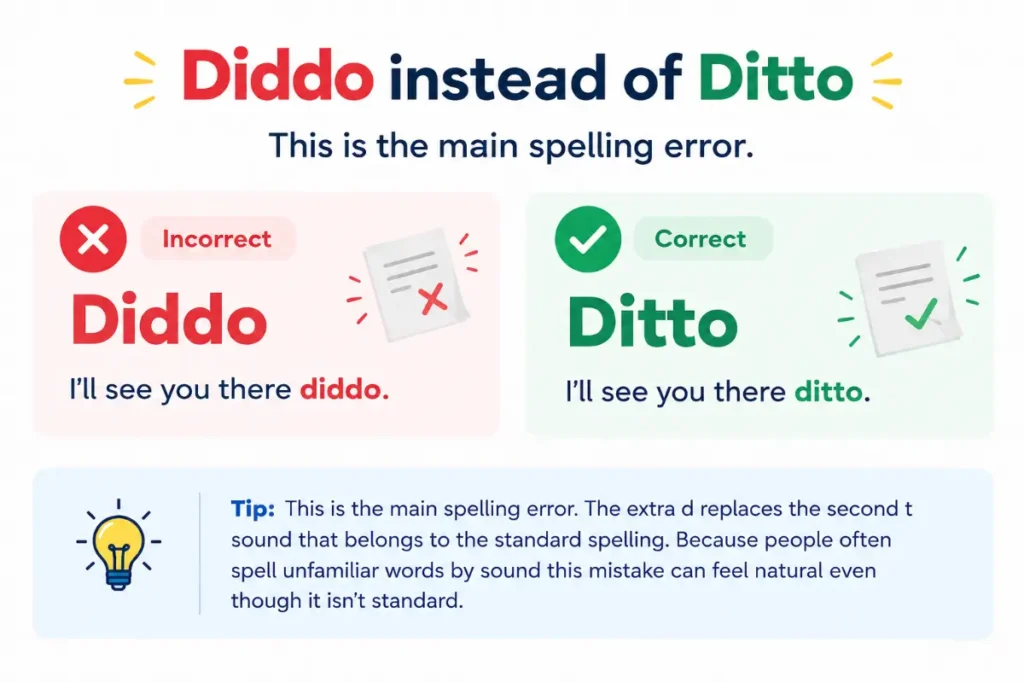
The most direct mistake is replacing the two t’s with two d’s.
Incorrect: I agree with you, diddo.
Correct: I agree with you, ditto.
The correct spelling uses two t’s. In this example, the writer intends to agree with another person, so ditto is the appropriate form.
Using Ditto Without Clear Context
Ditto refers back to an earlier statement or entry. If the reader can’t identify that reference, the word may cause confusion.
Unclear: The meeting was productive. Ditto.
The second sentence could mean that another meeting was productive or that the speaker shares the opinion. The intended meaning isn’t fully clear.
Clearer: The meeting was productive, and I feel the same way.
The revised version explains the relationship between the ideas.
Using Ditto in Every Agreement
Ditto is useful, but it shouldn’t replace every possible response.
For example, if someone says, I believe we should postpone the event because of the weather, a simple ditto may not communicate enough information.
A more helpful response could be, I agree that postponing the event is the safest choice.
This answer makes the agreement specific and shows that you understand the reason behind the suggestion.
Confusing Ditto With Same
Ditto and same can communicate similar ideas, but they don’t always fit the same sentence structures.
Ditto often works as a short response or as a reference to repeated information. Same is more flexible and appears in many ordinary sentence patterns.
For example:
- Alex says, I am hungry. Sam replies, Ditto.
- Alex says, I am hungry. Sam replies, Same here.
Both responses communicate a similar feeling. The second expression may sound more conversational in some situations.
Using Ditto in Formal Records Without Checking
Ditto can save space, but it may create problems in records that require independent entries.
Suppose a spreadsheet lists the mailing address for several customers. Entering ditto in repeated address fields may make the data harder to process or verify.
Repeating the full address is usually better. It keeps each record complete and makes it easier to search, sort, or export the information.
Treating Every Unfamiliar Form as a Valid Variant
Not every spelling that appears online is an accepted alternative. A word can appear frequently because of typing mistakes, informal habits, or repeated copying.
When you are unsure, consult a reliable dictionary or a trusted editorial reference. For standard English writing, choose the established spelling rather than assuming that two similar forms are interchangeable.
Easy Ways to Remember Ditto
A memory trick works best when it connects spelling with meaning. You don’t need to memorize a complicated rule for this word. A simple visual pattern is enough.
Remember the Two T’s
The easiest trick is to picture the word with two t’s in the middle.
D I T T O.
Write it a few times while saying the letters to yourself. The repeated consonants make the correct spelling easier to recognize.
Connect Ditto With Repetition
Think of ditto as a word that repeats something already mentioned. The repeated idea can remind you of the double t’s in the spelling.
For example, if your friend says, I love this book, and you respond, Ditto, you repeat the same general opinion without repeating the entire sentence.
The connection between repetition and the word’s meaning gives you a useful memory cue.
Practice With Short Sentences
Write three simple sentences using the word correctly.
- Ditto, I enjoyed the show too.
- My brother loves hiking, and ditto for me.
- The second item has the same size as the first, so the note says ditto.
The second and third examples are understandable but may sound less natural than alternatives in everyday American English. You could improve them by writing, I enjoyed the show too, and My brother loves hiking too. In a list, you can use ditto when the repeated information is clear.
The goal is to recognize the spelling and learn when it sounds natural.
Use a Quick Self Test
Before submitting a piece of writing, ask yourself three questions.
- Does the word contain two t’s.
- Am I using it to express agreement or repetition.
- Would a more specific phrase make my meaning clearer.
If you answer these questions, you can catch the common spelling error and improve the sentence at the same time.
Similar Words and Expressions
Several English expressions can replace ditto. The best choice depends on the meaning you want to communicate.
Me Too
Me too expresses agreement with a person’s statement about themselves.
Example: I love chocolate. Me too.
The reply means that the second person also loves chocolate. This expression is very common in everyday American English.
Same Here
Same here means that the same situation or feeling applies to the speaker.
Example: I am ready to go home. Same here.
The second speaker communicates the same feeling. Same here often sounds natural and friendly in casual conversation.
Likewise
Likewise means in the same way or similarly. It can sound more polished than ditto in some exchanges.
Example: It was a pleasure working with you. Likewise.
The response means that the speaker also found the experience pleasant. Likewise is useful in professional conversations, although the exact tone depends on the context.
The Same
The same refers to something identical or matching a previously mentioned item or situation.
Example: I ordered the same meal as my friend.
Here, the phrase describes a matching choice. Unlike ditto, the same can fit naturally into many sentence structures.
As Well
As well means also or in addition.
Example: She enjoys swimming, and I enjoy it as well.
The expression connects two similar facts. It works in casual and formal writing.
Similarly
Similarly means in a comparable way. It is often useful when comparing situations, actions, or results.
Example: The first department reduced its expenses. Similarly, the second department lowered its costs.
The word links related actions without claiming that every detail is identical.
Identical
Identical describes things that are exactly alike in the relevant respects.
Example: The two documents are identical.
This word is more precise than ditto when you need to describe matching objects, records, or information. It is especially useful in technical or professional writing.
Repeat
Repeat means to say, write, or do something again.
Example: Please repeat the final instruction.
This is the better choice when you want someone to reproduce information rather than simply agree with it.
Copy
Copy means to reproduce something or make a version of an existing item.
Example: Please copy the address into the form.
Copy is useful for practical tasks involving documents, text, images, and records. It describes an action more clearly than ditto in most instructions.
Professional Writing Tips
Professional writing requires more than correct spelling. A word must also fit the purpose, audience, and level of detail.
Ditto is acceptable English, but it isn’t always the clearest option for a professional message.
Choose Clarity Over Brevity
Short replies can save time, but excessive brevity may leave the reader guessing.
For example, if a colleague proposes a new deadline, replying, Ditto, doesn’t clearly explain your position. You might agree with the deadline, the reason for it, or the proposed schedule in general.
A clearer reply would be, I agree with the proposed Friday deadline.
This sentence identifies the exact point you support and gives the reader a clear record of your response.
Repeat Important Information
In reports, contracts, instructions, and official records, repeating information can be better than using a reference word.
A reader should be able to understand an important section without searching through several earlier paragraphs.
For example, a form that requires an emergency contact’s phone number should contain the actual number in the designated field. Writing ditto may create confusion or make the record incomplete.
The same principle applies to technical documents. Include the necessary information directly when accuracy matters.
Match the Tone to the Audience
Ditto can sound warm and friendly among people who know one another. In a formal exchange, it may seem too casual or incomplete.
Before using it, consider what the other person expects from your response. A friend may appreciate a quick agreement, while a client may expect a clear confirmation.
For example, a friend says, I am looking forward to the game. Ditto is a natural response.
A client says, Please confirm that the revised schedule works for your team. A better response is, I confirm that the revised schedule works for our team.
The second example provides a specific confirmation instead of relying on an informal expression.
Proofread Similar Looking Words
Spelling errors often survive proofreading because the writer reads what they intended to write rather than what appears on the screen.
When checking a document, pay attention to familiar words that contain repeated letters or similar consonants. A quick review can catch mistakes that spell checkers miss.
If a word seems questionable, check its spelling in a reliable reference. This habit helps you build accuracy over time.
Don’t Overuse Short Replies
A brief expression can make a conversation flow naturally, but repeating the same response in every exchange can sound mechanical.
Instead of replying ditto to every opinion, vary your responses according to the situation. You might use I agree, Same here, Me too, or That makes sense.
Each phrase communicates a slightly different attitude. Choosing the right one helps you sound engaged rather than simply echoing another person.
Related Grammar and Usage Notes
Understanding the grammar of ditto can help you decide when to use it and when another expression would be better.
Does Ditto Need a Complete Sentence
No. Ditto can stand alone as a short response when the context makes its meaning clear.
For example:
Chris: I love this song.
Riley: Ditto.
Riley’s response is a complete conversational turn even though it isn’t a traditional sentence with an explicit subject and verb. Everyday conversation often includes short replies of this kind.
In formal writing, however, a complete sentence may communicate the idea more clearly.
Should Ditto Begin With a Capital Letter
Capitalize ditto when it begins a sentence or appears as a standalone reply.
Example: Ditto. I enjoyed the performance too.
Use lowercase when it appears within a sentence, unless another capitalization rule applies.
Example: The note says ditto for the next entry.
Capitalization follows ordinary sentence rules. The word doesn’t require special capitalization simply because it expresses agreement.
Does Ditto Need a Period
Punctuation depends on how you use the word.
If ditto forms a standalone response, you can write Ditto. with a period. In a text message, the punctuation may vary with the tone and style of the conversation.
Within a longer sentence, use punctuation according to the sentence structure.
Example: The first record lists the product as blue, and the second uses ditto.
The period belongs at the end of the complete sentence, not immediately after ditto.
Can Ditto Replace a Whole Sentence
Sometimes. In conversation, ditto can communicate the same general meaning as an earlier statement.
However, it doesn’t always reproduce every detail of the original sentence. If someone makes several claims at once, a single ditto may leave it unclear which claims you agree with.
For example, I like the new office, the location, and the flexible schedule contains several ideas. A reply of ditto may suggest agreement with all three, but it doesn’t identify your individual preferences.
If the details matter, explain your response more fully.
Is Ditto a Synonym for Agree
Not exactly. Ditto can express agreement, but it also refers to repeated information or sameness.
Agree is a verb that describes sharing an opinion or accepting a point. Ditto is often used as a short response or reference to something already mentioned.
For example, I agree with your recommendation states the action directly. Ditto communicates a similar idea only when the surrounding context supplies the intended meaning.
Can Ditto Be Used in Academic Writing
Yes, but its usefulness depends on the type of academic writing.
In personal study notes, ditto may help indicate repeated information. In essays, research papers, or formal reports, it is usually better to write the relevant idea explicitly.
Academic readers need clear references and complete explanations. A word that saves a few seconds while writing notes may make a final paper less precise.
Choose the expression that supports the reader’s understanding rather than the one that simply uses the fewest words.
Real Life Examples of Ditto
The following examples show how ditto works in familiar situations and how you can replace it when a more precise expression is needed.
In a Conversation With a Friend
Example: I could spend all afternoon reading. Ditto.
Explanation: The second speaker shares the first person’s enjoyment of reading. Ditto works as a short conversational reply.
In a Group Chat
Example: Everyone seems ready for the holiday. Ditto.
Explanation: The speaker indicates that the same feeling or condition applies to them. Depending on the group, same here might sound more natural.
In a Personal Notebook
Example: The first recipe uses two cups of flour. The next recipe uses ditto.
Explanation: The writer intends to indicate the same quantity. A clearer note would say two cups of flour again, especially if someone else needs to use the notebook.
In a Work Email
Example: Your suggestion about moving the meeting to Tuesday makes sense. Ditto.
Explanation: The intended meaning is agreement with the suggestion. However, the message would sound more professional as, I agree with moving the meeting to Tuesday.
In a Shopping List
Example: Apples, local farm. Pears, ditto.
Explanation: Ditto indicates that the pears come from the same farm as the apples. This shorthand works if the list is for personal use and the reference is obvious.
In a Classroom
Example: The first question requires the past tense. The next question is ditto.
Explanation: The student means that the same grammatical requirement applies to the next question. A more precise note would be, The next question also requires the past tense.
In a Family Conversation
Example: I think we should visit Grandma this weekend. Ditto.
Explanation: The reply shows that the second person shares the suggestion. It is brief and appropriate when the context is clear.
In a Project Discussion
Example: We should review the final draft before sending it to the client. Ditto.
Explanation: The speaker agrees with the proposed action. In a professional meeting, I agree that we should review the final draft may sound more direct.
Expert Editor Insight
A native English speaker will usually recognize ditto immediately, especially in informal conversation. The main spelling problem comes from the close relationship between sound and spelling in the reader’s mind. An editor will correct diddo to ditto, but may also replace ditto with the same, likewise, or I agree if the surrounding writing is formal. The strongest choice is not always the shortest word. Good editing considers meaning, audience, tone, and clarity together.
Key Takeaways
- Ditto is the correct standard spelling for the intended meaning.
- Diddo is a common misspelling of ditto.
- Ditto can mean me too, the same thing, or a repeated entry.
- The word is used in both American and British English.
- Ditto works well in casual conversation and personal notes.
- In formal writing, repeat the relevant information when precision matters.
- Remember the two t’s in ditto to avoid the spelling mistake.
Conclusion
Diddo or ditto has a simple answer. Ditto is the correct spelling when you want to express agreement or indicate that something is the same as what came before. The alternative spelling diddo is generally incorrect for this meaning, so use ditto in standard English writing.
The word is useful because it lets you communicate an idea without repeating an entire statement. In casual conversation, it can mean me too or same here. In notes and lists, it can refer to information that matches an earlier entry. Context determines how clearly the word communicates your meaning.
Remember the two t’s in ditto, and check that the word fits your sentence. For friendly conversations, it can be a natural and efficient response. For academic work, business documents, and official records, choose the wording that gives your reader the clearest possible information.
Frequently Asked Questions
Is diddo or ditto correct?
Ditto is the correct standard spelling when you mean the same thing as something previously mentioned. Diddo is a common misspelling in this context. Use ditto in schoolwork, emails, messages, and other standard English writing.
What does ditto mean in simple words?
Ditto means the same thing, me too, or the same applies. People use it to express agreement or indicate that information repeats an earlier statement. The exact meaning depends on the context.
Is diddo a real English word?
Diddo isn’t the standard spelling of ditto. It may appear as a name, username, or invented expression, but standard English uses ditto for agreement and repetition.
How do you spell ditto correctly?
Spell it D I T T O. The word starts with D, contains two consecutive t’s, and ends with O. Remember the double t’s to avoid the common misspelling.
Is ditto slang?
Ditto is an established English word rather than exclusively slang. Its use as a short reply is informal and conversational, but the word also appears in written notes and other contexts involving repetition.
Can I use ditto in a formal email?
You can, but a more specific expression may sound more professional. Use I agree, the same applies, or I confirm when you need to communicate a precise position or record an important decision.
Does ditto mean the same as me too?
Often, yes. In conversation, ditto can mean me too when someone expresses a feeling, preference, or opinion. However, ditto also indicates repeated information in lists and records.
Is ditto spelled the same in American and British English?
Yes. American and British English both use the spelling ditto. There is no standard regional spelling difference for this word.
Can ditto be used in a sentence?
Yes. For example, I enjoyed the concert, and my sister said ditto. The sentence means that the sister enjoyed the concert too. In everyday conversation, Ditto can also stand alone as a reply.
What is a good alternative to ditto?
Me too, same here, likewise, and I agree can replace ditto in many conversations. For written records, repeat the relevant information or use the same when that wording makes the meaning clearer.

English Grammar & Usage
Nathan Holloway is an American grammar writer and language researcher who specializes in English grammar, sentence structure, verb usage, and common writing mistakes. He enjoys breaking down confusing grammar rules into practical explanations with clear examples, making English easier for students, professionals, and everyday writers.