
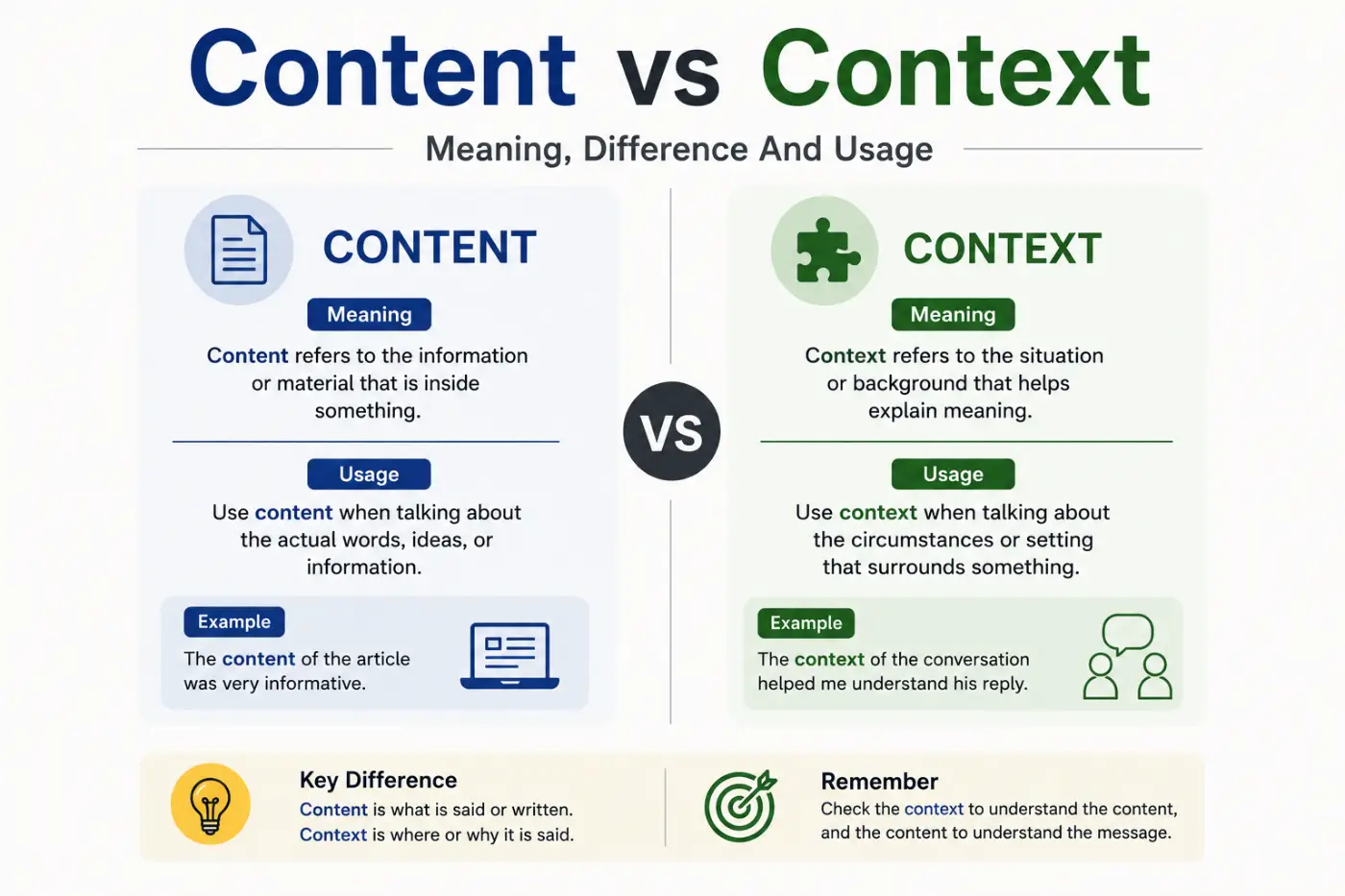
Content vs Context is one of those word comparisons that looks simple until you need to use the two terms in a real sentence. Content refers to the information or material inside something. Context refers to the surrounding details that help you understand that information correctly. If you remember one basic idea, think of content as what is being communicated and context as what helps explain it.
The confusion happens because the two concepts often appear together. A news article has content but its date, location, speaker, historical background, and surrounding events provide context. A text message has content in the words themselves but the relationship between the people, their previous conversation, and their tone can change how that content should be understood.
Once you see that relationship, the difference becomes much easier. This guide explains the meanings of both words, their grammar, pronunciation, origins, common uses, differences in academic and professional writing, everyday examples, related terms, common mistakes, and practical memory tricks. You’ll also learn how a single sentence can contain content that seems clear on its own but takes on a completely different meaning when you add context.
Short Answer
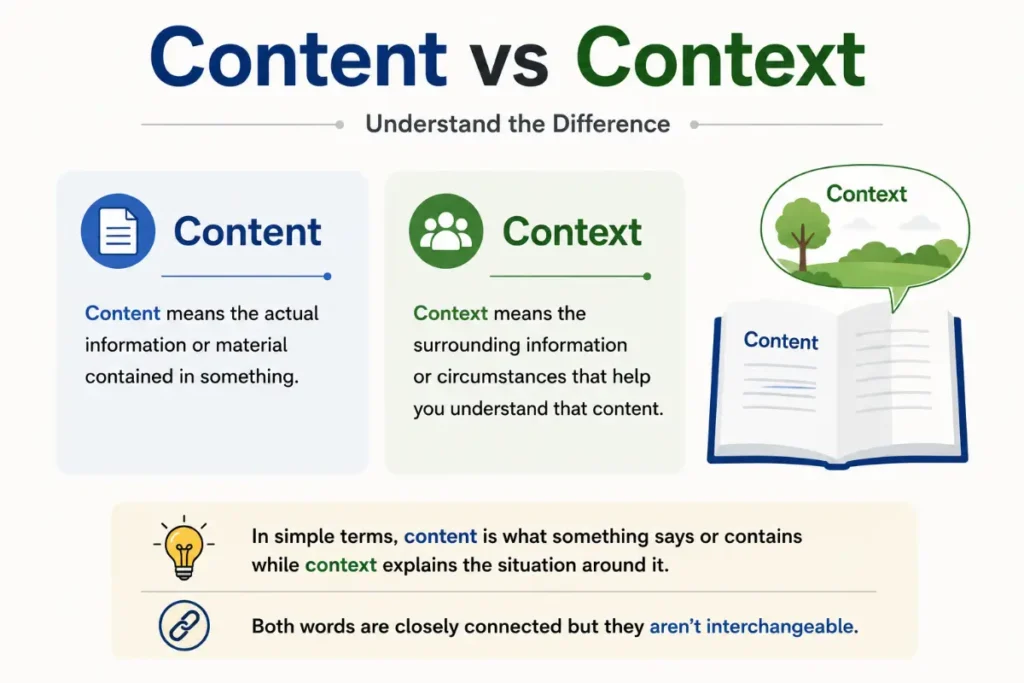
Content means the actual information or material contained in something. Context means the surrounding information or circumstances that help you understand that content. In simple terms, content is what something says or contains while context explains the situation around it. Both words are closely connected but they aren’t interchangeable.
Table Of Contents
- The Core Difference.
- What Content Means.
- What Context Means.
- Content vs Context In Simple Terms.
- Detailed Comparison.
- How Content And Context Work Together.
- Examples In Everyday Communication.
- Examples In Academic Writing.
- Examples In Business And Professional Writing.
- Examples In Media And Journalism.
- Content And Context In Social Media.
- Grammar And Word Usage.
- Pronunciation Guide.
- Word Origins.
- Common Mistakes.
- Memory Tips.
- Related Words And Expressions.
- Expert Editor Advice.
- Key Takeaways.
- FAQs.
- Conclusion.
The Core Difference
The easiest distinction is this:
Content is the information itself. Context is the information around it.
Suppose you receive a message that says:
I’m fine.
Those two words are the content.
Now imagine the person sends the message after an argument. You know they normally use long messages and suddenly give you a short reply. You also know they sounded upset earlier.
That surrounding information is context.
The words haven’t changed. Your understanding of the words has.
This distinction appears everywhere.
A book has content.
The historical period in which the book was written provides context.
A photograph has content.
The location and circumstances surrounding the photograph provide context.
A speech has content.
The audience, occasion, speaker, and political or social circumstances provide context.
The two ideas work together but perform different jobs.
What Content Means
Content refers to the information, ideas, material, or substance contained in something.
The word has several related uses.
A book has content.
A website has content.
A video has content.
A speech has content.
A conversation has content.
A storage device contains digital content.
In each case, content refers to what is actually present or communicated.
For example:
The article contains useful content about personal finance.
Here, content refers to the information presented in the article.
You can also use the word in a broader sense.
The course content includes five major topics.
Here, content refers to the material taught in the course.
In digital communication, content can include text, images, audio, video, graphics, and other forms of information.
For example:
The website publishes educational content for students.
The word can also refer to the substance of a particular statement or discussion.
The content of the conversation was difficult to understand.
This means the information or ideas expressed during the conversation were difficult to understand.
Content As A Noun
The noun content is usually pronounced differently from the adjective content meaning satisfied.
When content means material or information, American English commonly uses the pronunciation KON tent.
For example:
The content of the report was accurate.
Here, content is a noun.
Content As An Adjective
Content can also be an adjective meaning satisfied or pleased.
For example:
She felt content after finishing the project.
In this use, the pronunciation is commonly kun TENT.
The meaning has nothing to do with information or material.
That distinction matters because English has several words that change pronunciation when their grammatical role changes.
Content In Digital Media
Today, content commonly describes material published through digital channels.
That can include:
- Blog articles.
- Videos.
- Podcasts.
- Social media posts.
- News stories.
- Images.
- Online courses.
- Product descriptions.
- Educational resources.
- Audio recordings.
When someone says a website needs better content, they usually mean the information or material published on that website needs improvement.
What Context Means
Context refers to the circumstances, background, surrounding information, or situation that helps you understand something.
For example:
The quote sounds harsh without context.
This means the words alone may create one impression, but additional information could change how readers interpret them.
Imagine someone says:
Leave now.
The content is simple.
But context changes the meaning.
If a parent says it to a child standing near a dangerous road, it may be an urgent warning.
If a friend says it jokingly before surprising someone, it may have a completely different tone.
The words are the content.
The situation provides context.
Context In Writing
Writers often provide context before presenting important information.
For example:
The company announced major changes.
That sentence gives content but little context.
A stronger version might say:
After three years of declining sales, the company announced major changes to its business strategy.
The additional information provides context.
Now the reader knows why the announcement happened.
Context In Conversation
Context plays an enormous role in spoken communication because people don’t always explain every detail.
If someone says:
That was interesting.
The content is straightforward.
But their tone, facial expression, previous conversation, and relationship with the listener can change the meaning.
They might mean genuine praise.
They might be sarcastic.
Context helps the listener interpret the statement.
Content vs Context In Simple Terms
A useful way to remember the difference is to ask two questions.
What is being said or presented?
That’s content.
What information helps me understand it?
That’s context.
Imagine a photograph of a person standing outside a building.
The person and the building are part of the photograph’s content.
The date of the photograph, the reason the person was there, the event taking place, and the historical circumstances can provide context.
The same principle applies to language.
A sentence is content.
The surrounding sentences can provide context.
A statistic is content.
The source, date, population, and circumstances surrounding that statistic provide context.
A quotation is content.
The speaker, audience, situation, and full passage provide context.
Detailed Comparison
| Feature | Content | Context |
|---|---|---|
| Basic meaning | The information or material itself | The surrounding information or circumstances |
| Main question | What is being said or presented? | What helps explain it? |
| Common use | Writing media education communication | Interpretation analysis communication |
| Example | The words in a message | The conversation surrounding the message |
| In a book | The ideas and information | Historical and cultural background |
| In journalism | The facts and statements presented | Events and circumstances surrounding those facts |
| In communication | The actual message | Tone relationship situation and background |
| In education | The material being taught | Circumstances that help students understand it |
| In media | Text images audio and video | Social historical and cultural circumstances |
| Main purpose | Deliver information | Help people interpret information accurately |
The table shows why the two words are related but not interchangeable.
How Content And Context Work Together
Strong communication usually needs both.
Content gives the audience something to understand.
Context gives the audience the information needed to interpret it.
Consider this sentence:
The president rejected the proposal.
That is content.
Now add:
The president rejected the proposal after months of negotiations over its cost.
The second version gives more context.
The reader now understands that the decision followed a long negotiation process and involved financial concerns.
Context can also prevent misunderstanding.
Suppose a headline says:
Company cuts 500 jobs.
The content is the announcement.
But readers need context to understand why the jobs were cut, which locations are affected, when the changes will happen, and how the company reached the decision.
Without that background, readers may form conclusions based on incomplete information.
This is why professional writers often ask themselves not only what information they need to provide but also what background their audience needs.
Examples In Everyday Communication
Text Messages
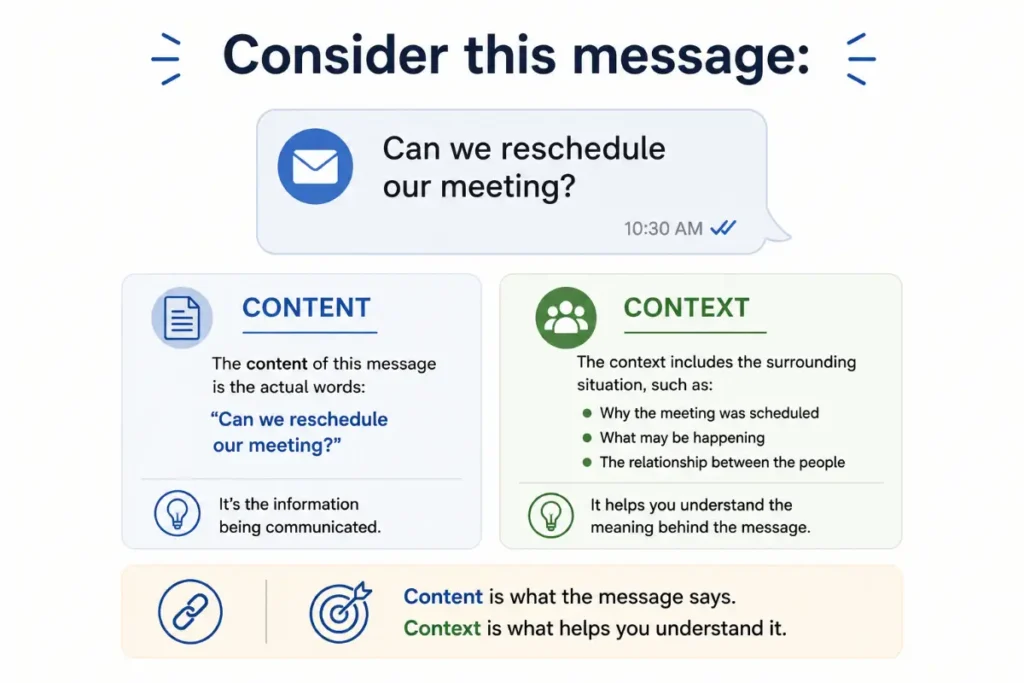
Consider this message:
Fine.
The content is one word.
The context could include the previous conversation, the relationship between the people, and the tone used when the message was sent.
A short response might mean genuine agreement. It might also suggest irritation.
Context helps you interpret the content.
Conversations
Imagine someone says:
You’re early.
The content is clear.
But the context could change the meaning.
A manager might say it as a compliment.
A friend might say it with surprise.
Someone waiting for you might say it sarcastically because you’re usually late.
The words alone don’t tell the entire story.
Instructions
Consider:
Take the left door.
The content is an instruction.
Context tells you which building you’re in, where the doors are, and why you need to take the left one.
Without context, the instruction may be technically correct but practically useless.
Examples In Academic Writing
Academic writing depends heavily on context.
A researcher might present a statistic showing that a particular group experienced a certain outcome.
The statistic is content.
The study design, sample size, location, time period, methodology, and limitations provide context.
This distinction matters because a number without context can easily mislead.
For example:
The program increased test scores by 20 percent.
That statement gives content.
But readers need more information.
Did the researchers compare the students with a control group?
How many students participated?
How long did the program last?
What type of test did students take?
Was the increase measured as a percentage or percentage points?
Those details provide context.
Good academic writing doesn’t simply present information. It gives readers enough background to interpret that information accurately.
Examples In Business And Professional Writing
Business communication also depends on the relationship between content and context.
Suppose an employee receives this email:
Please send the report today.
The content is an instruction.
The context might include a deadline, a client meeting, a previous agreement, or an urgent problem.
Without that context, the employee may not know why the request matters.
A professional writer can improve clarity by adding relevant background.
For example:
The client meeting has been moved to tomorrow morning, so please send the report today.
The first sentence provides context.
The second sentence gives the request.
This structure makes the message easier to understand and act on.
Examples In Media And Journalism
Journalism provides one of the clearest examples of the difference.
A news story contains content such as facts, quotes, statistics, descriptions, and statements from sources.
Context explains the circumstances surrounding those facts.
For example, a report might say:
The city increased the tax rate by 2 percent.
That is content.
Context could explain:
- Why the city changed the rate.
- When the previous rate was introduced.
- How much revenue the change is expected to generate.
- Who will be affected.
- What officials said about the decision.
- How residents responded.
Without context, a factual statement can still leave readers with an incomplete understanding.
Good journalism therefore balances information with relevant background.
Examples In Social Media
Social media makes context especially important because short posts often remove background information.
A person might post:
I can’t believe they did that.
The content is clear enough at a basic level.
But the context is missing.
Who are they?
What did they do?
What happened before the post?
Is the writer angry, amused, shocked, or excited?
A reader who doesn’t know the background may interpret the post incorrectly.
Screenshots create a similar problem.
A screenshot may show the exact content of a message while leaving out the conversation before and after it.
That missing material can change how the message should be interpreted.
This is one reason people often say that something was taken out of context.
When Something Is Taken Out Of Context
The phrase taken out of context means that information has been separated from the surrounding circumstances that help explain its meaning.
For example, imagine a speaker says:
I don’t recommend this approach for beginners.
Someone quotes only:
I don’t recommend this approach.
The quoted words may appear to express a much broader rejection than the speaker intended.
The content of the quotation is technically real.
The problem is the missing context.
This distinction is useful when reading news stories, social media posts, interviews, academic studies, and public statements.
Before judging a statement, look at the surrounding information.
Grammar And Word Usage
Both content and context are nouns in their most common uses.
Using Content
You can use content to refer to information inside something.
For example:
The content of the book is educational.
The website contains valuable content.
The course content is easy to follow.
You can also use content in phrases such as:
Content creation.
Content analysis.
These expressions all relate to information or material being produced, organized, studied, or distributed.
Using Context
You can use context to refer to background or surrounding circumstances.
For example:
The statement makes sense in context.
We need more context before making a decision.
The historical context changes how we understand the event.
Common expressions include:
Historical context.
Social context.
Cultural context.
Political context.
Economic context.
Linguistic context.
The word often appears with verbs such as provide, add, understand, consider, and interpret.
Pronunciation Guide
The noun content meaning information is commonly pronounced KON tent.
The adjective content meaning satisfied is commonly pronounced kun TENT.
That difference can surprise learners.
For example:
The content of the article was useful.
Here the noun receives the first syllable stress.
She was content with the result.
Here the adjective receives the second syllable stress.
Context is commonly pronounced KON tekst.
It has two syllables with the main stress on the first syllable.
A simple pronunciation guide is:
Content meaning information: KON tent.
Content meaning satisfied: kun TENT.
Context: KON tekst.
The words sound different enough in normal speech that native speakers usually understand which meaning is intended from pronunciation and sentence structure.
Word Origins
The history of content helps explain its broad meaning.
The English noun comes through Old French and Latin roots associated with the idea of something contained. The Latin verb continere means to hold together or contain.
That connection remains visible in modern English. The content of a container is what it holds. Over time, the meaning expanded from physical things to information and ideas.
Context also has Latin roots.
It comes from Latin contextus, related to the idea of joining or weaving things together. The root is connected with the Latin verb contexere, meaning to weave together.
That history fits the modern meaning well. Context consists of surrounding pieces of information that connect to the thing you’re trying to understand.
The two words therefore have different historical paths but share an important conceptual relationship.
Content is what is contained.
Context is what surrounds and connects.
Common Mistakes
Treating The Words As Synonyms
One of the most common mistakes is assuming that content and context mean roughly the same thing.
They don’t.
You can have plenty of content but very little context.
For example:
The report contains hundreds of statistics but gives little context.
The sentence would lose its meaning if the two words were interchangeable.
Using Context When You Mean Information
Incorrect:
The article has useful context about personal finance.
If you mean the article contains useful information, content may be the better word.
Better:
The article has useful content about personal finance.
Context would be appropriate if you’re referring to background that helps readers understand the financial information.
Using Content When You Mean Background
Incorrect:
The historical content helps us understand the author’s decision.
If you mean the historical circumstances surrounding the decision, context is usually better.
Better:
The historical context helps us understand the author’s decision.
Confusing Content With Quality
Content doesn’t automatically mean good information.
A website can have a large amount of content and still provide poor information.
The word describes what is contained or communicated. It doesn’t automatically tell us that the material is accurate, useful, original, or valuable.
Assuming More Context Is Always Better
Context should be relevant.
Too little context can cause confusion.
Too much unnecessary background can bury the main point.
Strong writing gives readers the context they need without drowning the central message in details.
Memory Tips
The simplest memory trick is:
Content is what. Context is why and around it.
Ask yourself:
What information am I talking about?
Use content.
What background helps me understand that information?
Use context.
Another easy comparison is a movie.
The movie itself is the content.
The time period, culture, director’s purpose, historical events, and circumstances surrounding the movie provide context.
You can also think about a photograph.
What appears in the photograph is content.
Where it was taken, when it was taken, who took it, and what was happening at the time can provide context.
This mental picture makes the distinction easier to remember.
Related Words And Expressions
Several words connect closely with these concepts.
Information
Information refers to facts or knowledge communicated to someone.
Content can contain information.
Material
Material refers to the substance or resources being presented or used.
A course can contain educational material.
Background
Background refers to information that helps explain a subject or event.
Circumstances
Circumstances are the conditions surrounding an event or situation.
Setting
Setting refers to the time, place, and circumstances in which something happens.
Meaning
Meaning is the idea or significance communicated by a word, statement, event, or action.
Context often helps determine meaning.
Interpretation
Interpretation is the way someone understands or explains something.
Context can influence interpretation significantly.
Background Information
This phrase refers to information supplied to help someone understand the main subject.
It is often another way to describe contextual information.
Content And Context In Language
Linguists use context to explain how people understand language beyond the literal words.
Consider the sentence:
It’s cold here.
The content is a statement about temperature.
But the intended meaning may depend on context.
Someone sitting beside an open window might be indirectly asking you to close it.
Someone entering a refrigerated warehouse may be describing the environment.
The words remain the same.
The context changes the practical meaning.
This is one reason communication can’t always be understood by examining individual words alone.
The surrounding situation matters.
Content And Context In Literature
Literary analysis frequently separates what a text contains from the circumstances surrounding it.
The content of a novel includes its characters, events, dialogue, themes, descriptions, and ideas.
The context can include:
- The author’s historical period.
- The culture in which the work was created.
- Political events of the time.
- Social attitudes.
- The author’s intended audience.
- Literary traditions.
For example, a novel written during a major period of social change may contain themes that become clearer when readers understand the historical circumstances surrounding its publication.
The text remains the content.
The surrounding historical information provides context.
Content And Context In Education
Teachers use both concepts constantly.
The content of a lesson is what students are expected to learn.
The context explains why the material matters and how it connects to existing knowledge.
For example, students learning about a historical law may memorize the date and main provisions.
That’s content.
Learning about the social conditions that led to the law provides context.
Students who understand both are more likely to understand the subject rather than simply memorize isolated facts.
This distinction is useful for students preparing essays and presentations.
Don’t just present facts.
Explain the background that makes those facts meaningful.
Content And Context In Search And Online Writing
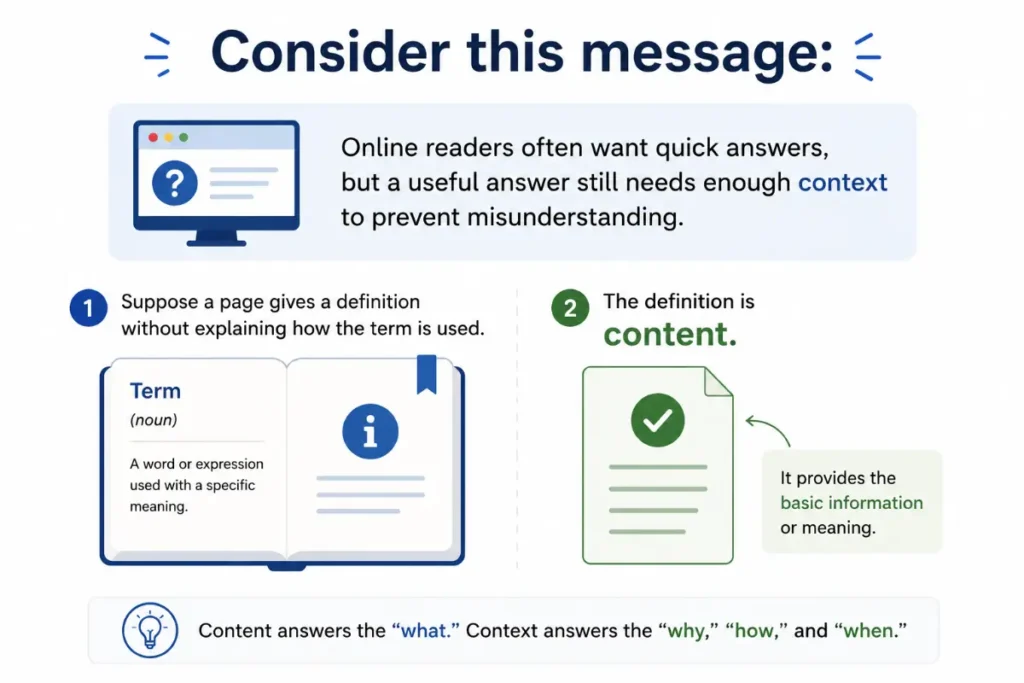
Online readers often want quick answers, but a useful answer still needs enough context to prevent misunderstanding.
Suppose a page gives a definition without explaining how the term is used.
The definition is content.
Usage examples and surrounding explanations provide context.
Good informational writing combines both.
A strong answer should state the direct answer early and then provide the background readers need to apply it correctly.
That approach works especially well for grammar, vocabulary, technical subjects, history, and educational topics.
Expert Editor Advice
A professional editor usually asks two questions when reviewing a sentence. First, does the reader have the information they need? Second, does the reader have enough background to interpret that information correctly? The first question concerns content. The second concerns context. Strong writing balances both instead of assuming that readers already know the surrounding circumstances.
A useful editing test is to remove a sentence from its surrounding paragraph and read it alone. If the statement becomes misleading or unclear, the paragraph may need more context. If the paragraph contains several background sentences but never delivers the main information, it may need stronger content. Good editing keeps the two in proportion.
Key Takeaways
- Content means the information or material contained in something.
- Context means the surrounding information or circumstances that help explain something.
- Content answers the question what.
- Context helps answer questions such as why, how, when, where, and under what circumstances.
- A message can have clear content but still be misunderstood without enough context.
- Content and context are closely related but aren’t synonyms.
- In academic writing, facts and statistics are content while methodology and background can provide context.
- In journalism, statements and facts are content while surrounding events and circumstances provide context.
- In conversation, words are content while tone, relationships, timing, and previous discussion can provide context.
- The best writing provides enough context to make the content clear without burying the main point.
Conclusion
Content vs Context is easier to understand when you separate the information from the circumstances surrounding it. Content is what a message, article, book, speech, image, or other source actually contains. Context is the background and surrounding information that helps you understand that material accurately. One gives you the substance while the other gives you the situation.
The distinction matters in everyday conversation as well as academic, professional, literary, and journalistic writing. A statistic without context can mislead. A quotation without context can sound different from its intended meaning. A short message can also take on a completely different tone when you know what happened before it.
When you’re unsure which word to use, ask yourself one simple question: am I talking about the information itself or the circumstances surrounding it? If you mean the information, choose content. If you mean the surrounding details that help explain it, choose context. That simple test will keep the difference clear in your writing.
FAQs
What Is The Difference Between Content And Context?
Content is the actual information, material, words, ideas, or substance being communicated. Context is the surrounding information or circumstances that help you understand that material. A simple way to remember the difference is that content tells you what something contains or says while context explains the situation around it and helps you interpret it accurately.
What Is An Easy Way To Remember Content And Context?
Think of a message. The words in the message are the content. The conversation that came before it, the relationship between the people, the tone, and the situation are part of the context. Another useful shortcut is this: content answers what while context helps answer why, how, when, and where.
Can Content And Context Be Used Interchangeably?
No. The two words describe different ideas. Content refers to the information itself while context refers to the surrounding circumstances or background that help explain it. A report can contain useful content but provide very little context. Replacing one word with the other can therefore change the meaning of a sentence and make your writing less precise.
What Is An Example Of Content And Context?
Imagine a news report stating that a city increased taxes by two percent. The tax increase is content because it is the information being reported. The reason for the increase, the city’s financial situation, the previous tax rate, and the expected effect on residents provide context because those details help readers understand the announcement.
Why Is Context Important?
Context helps people interpret information accurately. Without it, a statement can be technically correct but still misleading or confusing. A quotation can sound different when you read the surrounding conversation. A statistic can appear significant until you learn how the study was designed. Context supplies the background needed to understand content in a fair and complete way.
What Does Content Mean In Writing?
In writing, content refers to the information and material presented to the reader. It can include facts, arguments, examples, descriptions, explanations, stories, opinions, and other forms of communication. In digital publishing, the term can also include articles, videos, images, podcasts, and other media. Content describes what the publication actually contains.
What Does Context Mean In Writing?
In writing, context refers to information surrounding a statement or subject that helps the reader understand it. It can include historical background, previous events, definitions, circumstances, audience information, cultural details, or information from nearby sentences and paragraphs. Writers use context to prevent readers from interpreting information in an incomplete or misleading way.
Is Content More Important Than Context?
Neither one automatically matters more. Good communication needs useful content and enough context to make that content understandable. A piece of writing with strong information but no relevant background can confuse readers. A piece with extensive background but very little useful information can also fail. The strongest writing gives readers the main information and the context required to understand it.
What Does Taken Out Of Context Mean?
Taken out of context means that a statement or piece of information has been separated from the surrounding circumstances that help explain its intended meaning. For example, quoting only part of a long statement can make the speaker appear to mean something broader than they actually meant. The words may be genuine content, but the missing context changes the reader’s interpretation.
What Is The Difference Between Context And Background?
The words overlap but aren’t identical in every situation. Background usually refers to earlier information or circumstances that help explain a subject. Context is broader and can include the immediate situation, surrounding words, historical conditions, cultural factors, and other details that affect interpretation. Background can therefore be part of context, but context isn’t limited to background information.
How Do Content And Context Work Together?
Content gives people the information they need while context helps them understand that information correctly. Consider a statement in a news report. The statement itself is content. The events leading to it, the people involved, the timing, and the reasons behind it provide context. When both are present, readers can understand not only what happened but also why it matters.
Why Do People Confuse Content And Context?
People often confuse the words because they frequently appear together and both relate to understanding information. The distinction becomes clearer when you focus on their jobs. Content is the material being communicated. Context is the surrounding information that helps explain or interpret that material. Once you separate those roles, the words become much easier to use accurately.

Confusing Words, Spelling & Word Choice
Claire Whitmore is a U.S.-based English editor who writes about commonly confused words, spelling differences, and word choice. Her work helps readers understand subtle distinctions between similar-looking words through simple definitions, practical examples, and modern usage guidance in both American and British English.