
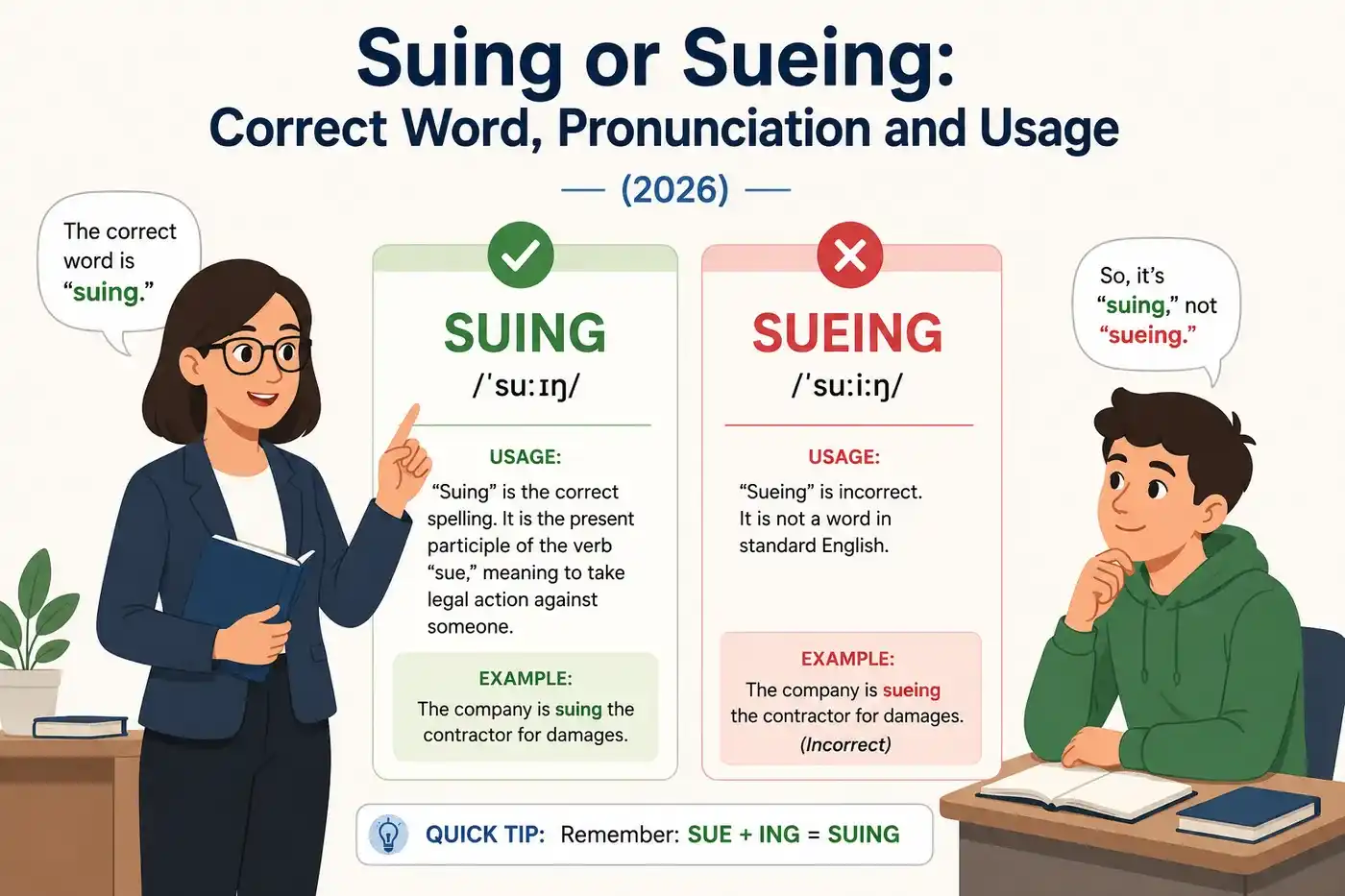
Suing or sueing is a common spelling problem because the base word is sue and adding ing seems as simple as putting the ending directly onto the original word. At first glance, sueing looks logical. However, standard English spelling removes the final silent e before adding ing, giving us suing.
The confusion comes from the way English spelling and pronunciation work together. The e in sue helps establish the spelling and sound of the base word, but it does not remain when the verb takes the ing form. You can see the same general pattern in words such as make becoming making and use becoming using. The exact spelling rule has some exceptions, but sue follows the regular pattern.
The word also appears often in legal and everyday contexts. Someone may be suing a company for damages, suing a person over an alleged injury, or simply talking about the possibility of taking legal action. This guide explains the spelling rule, meaning, grammar, pronunciation, word history, regional usage, common mistakes, sentence patterns, and practical ways to remember the correct form.
Short Answer
Suing is the correct spelling. Sueing is a misspelling in standard English. The verb sue ends in a silent e, and that e is normally removed before the ending ing is added. Therefore, sue becomes suing, not sueing. The word usually means taking legal action against a person or organization.
Table of Contents
- Quick Answer
- Meaning and Definition
- Comparison of the Two Forms
- Why the Correct Form Drops the E
- Grammar and Word Forms
- Pronunciation
- Sentence Examples
- Common Spelling Mistakes
- Legal Usage and Context
- Regional and Formal Usage
- Word Origin
- Related Words and Expressions
- Memory Tips
- Expert Editor Insight
- FAQs
- Key Takeaways
- Conclusion
Quick Answer
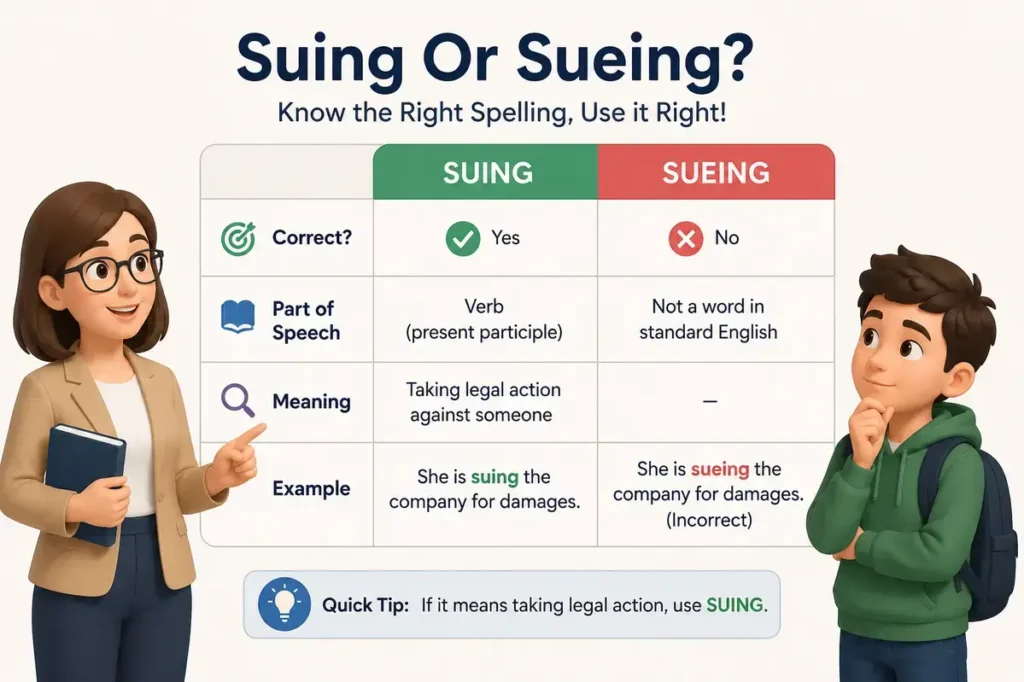
The correct form is suing.
The incorrect form is sueing.
The spelling changes because the verb sue ends in a silent e. When the verb takes the ing ending, the final e is dropped.
The pattern is:
sue + ing = suing
The pattern is not:
sue + ing = sueing
Oxford lists suing as the ing form of sue and gives its pronunciation as /ˈsuːɪŋ/. American Heritage also lists sue with the form suing.
Meaning and Definition
What Sue Means
Sue is a verb. In modern English, its most common legal meaning is to take legal action against a person or organization.
For example:
The customer decided to sue the company.
This means the customer decided to bring a legal claim against the company.
The verb can also appear with for.
She sued the company for damages.
Here for introduces the reason or remedy connected with the legal action.
Sue can also appear with over.
The family sued over the property dispute.
This construction identifies the matter that led to the legal action.
Oxford describes sue as a verb used when someone makes a claim against a person or organization in court. Cambridge similarly defines it in terms of taking legal action against someone or an organization.
What Suing Means
Suing is the present participle form of sue. It can appear in continuous verb forms.
She is suing the contractor.
They are suing the manufacturer.
The company is suing its former supplier.
In these sentences, suing describes an action that is in progress or developing.
The word can also work as a gerund. A gerund is an ing form that functions as a noun.
Suing can be expensive.
In that sentence, suing is the subject of the sentence.
Another example is:
They discussed suing the landlord.
Here suing follows discussed and refers to the possible action of bringing a legal claim.
The meaning stays connected to the base verb. Suing means taking legal action or engaging in the act of bringing a lawsuit.
What Sueing Means
Sueing is not the standard spelling of the ing form of sue. It usually appears because a writer keeps the final e from sue and then adds ing directly.
That produces:
sue + ing = sueing.
Standard English instead removes the final e:
sue + ing = suing.
The extra e does not create a different meaning. It is simply an incorrect spelling in ordinary modern English.
Comparison of the Two Forms
| Form | Status | Meaning | Grammar | Example |
|---|---|---|---|---|
| Suing | Standard | Taking legal action or using the ing form of sue | Present participle or gerund | She is suing the company. |
| Sueing | Nonstandard spelling | Intended to mean suing | Incorrect spelling of the ing form | She is sueing the company. |
The distinction is straightforward. There is no separate standard meaning that makes sueing a legitimate alternative. Standard dictionaries list the ing form as suing.
Why the Correct Form Drops the E
The main spelling rule is simple.
When many English verbs end in a silent e, the e is removed before the ing ending is added.
For example:
- Make becomes making.
- Write becomes writing.
- Drive becomes driving.
- Take becomes taking.
- Use becomes using.
- Move becomes moving.
- Hope becomes hoping.
- Sue becomes suing.
The base word keeps its main identity while the spelling changes to fit the new grammatical form.
The final e in sue is part of the spelling of the base verb. It helps represent the pronunciation of the word. Once the ing ending is added, the e is no longer needed in the spelling.
This gives us:
sue → suing
The important point is that you should not think of the process as simply attaching letters to the complete base word. English inflection sometimes changes the spelling of the base form.
Why Sue Looks Tricky
Sue is especially easy to misspell because the word is very short.
If you start with sue and mechanically add ing, your eyes see:
sueing.
That looks reasonable because the base word remains completely visible.
However, English spelling does not work like a simple letter addition system. The final e is removed before the ending is added.
Compare these forms:
use → using
value → valuing
pursue → pursuing
argue → arguing
sue → suing
This family of examples makes the pattern easier to remember.
The Role of the Silent E
The e at the end of sue is not pronounced as a separate sound. The base word is pronounced with a long u sound.
When the word changes to the ing form, the spelling becomes suing while the main vowel sound remains.
This is one reason spelling and pronunciation can feel disconnected. The written e disappears, but the basic pronunciation of sue remains recognizable.
English has many spelling patterns like this. A letter can have an important role in one grammatical form without appearing in another.
Grammar and Word Forms
Suing is an ing form of the verb sue. It can serve more than one grammatical purpose.
Present Progressive
The most familiar use appears in the present progressive.
She is suing the company.
They are suing their former employer.
I am suing the contractor.
The structure is:
subject + be + suing
The form of be changes according to the subject and tense, but suing stays the same.
Past Progressive
Suing can also appear in the past progressive.
She was suing the company when the settlement was announced.
They were suing the manufacturer at the time.
The structure becomes:
subject + was or were + suing
Again, the spelling does not change.
Perfect Progressive
Suing can also appear after have or had in progressive constructions.
They have been suing the company for several months.
The lawyers had been discussing suing the contractor.
These examples show that the ing form remains stable across different grammatical structures.
Gerund Use
Suing can function as a noun.
Suing someone can take a great deal of time.
The sentence does not describe someone currently performing the action through a progressive verb phrase. Instead, suing names an activity.
Another example is:
They considered suing for damages.
Here suing acts as the object of considered.
Infinitive Use
After certain verbs, the base form sue is used instead.
They decided to sue.
She plans to sue.
He threatened to sue.
Notice that you do not write to suing after to in these examples. The infinitive uses the base form.
This gives you a useful comparison:
They are suing the company.
They decided to sue the company.
The first sentence uses the ing form. The second uses the base verb.
Common Grammar Patterns
The verb sue commonly appears in several useful patterns.
Sue Someone
This means to bring legal action against someone.
The customer sued the contractor.
Sue Someone for Something
This identifies the reason or requested remedy.
They sued the company for damages.
Sue Someone Over Something
This identifies the dispute or issue.
The residents sued the developer over the property dispute.
Sue for Something
This construction can have a more formal meaning.
The parties sued for peace.
In modern everyday American English, the legal sense is much more common.
Consider Suing Someone
After consider, the gerund form is natural.
She considered suing the company.
Threaten to Sue
After threaten, the infinitive is used.
He threatened to sue.
These patterns matter because good grammar is not only about spelling. The form you choose also depends on the words around it.
Pronunciation
Suing is commonly pronounced /ˈsuːɪŋ/. Oxford gives this pronunciation for the ing form of sue.
The word contains two main sound parts. The first is the sound of sue and the second is the ing ending.
The stress falls on the first part.
The pronunciation can feel slightly unusual because the vowel sound of sue is followed directly by the vowel sound in ing. In careful speech, the two parts remain clear.
You can think of the structure as:
sue + ing
The pronunciation does not require you to pronounce the written e from the base form. That e disappears in the spelling and does not become an extra sound.
Common Pronunciation Mistake
Some learners try to pronounce the word as if it contained an extra syllable because they see the spelling sueing.
That spelling itself is incorrect, so it can lead learners toward an unnecessary sound pattern.
The standard form is suing.
Sentence Examples
Here are natural examples from different settings.
Everyday Conversation
- She is suing her former landlord.
This sentence describes an ongoing legal action.
- Are they really suing the company?
The speaker is asking about a possible lawsuit.
- He said he was thinking about suing.
Here suing functions as a gerund after thinking about.
Workplace Communication
- The employee is suing the company over the dismissal.
This sentence describes legal action connected with an employment dispute.
- The business is facing a lawsuit after a former customer began suing for damages.
The word describes legal action within a business context.
News Writing
- The family is suing the manufacturer over the alleged defect.
This style is common in reporting about legal disputes.
- Several residents are suing the developer over the proposed construction project.
The sentence identifies both the people bringing the action and the dispute.
Academic Writing
- The study examines the economic consequences of suing for damages.
Here suing is used as a gerund.
- Researchers considered how legal costs can affect people who are suing large organizations.
The form appears inside a longer academic sentence.
Formal Writing
- The company is suing the supplier for breach of contract.
This is a direct and professional legal construction.
Informal Writing
- She says she’s suing them.
The contraction makes the sentence natural in conversation.
- He keeps saying he’s going to sue.
This example uses the base form because going to is followed by an infinitive.
Common Spelling Mistakes
Sueing
The most common mistake is keeping the final e before adding ing.
Incorrect: She is sueing the company.
Correct: She is suing the company.
The reason is simple. The final silent e is removed before ing is added.
Suingg
Some writers remove the e correctly but then add an unnecessary extra g.
Incorrect: They are suingg the company.
Correct: They are suing the company.
This usually comes from typing quickly or accidentally repeating the final consonant.
Suing Used After To
This is a grammar error rather than a spelling error.
Incorrect: They decided to suing the company.
Correct: They decided to sue the company.
After to in an infinitive construction, use the base verb.
Sue Used in a Progressive Form
Another error is using the base verb after be.
Incorrect: She is sue the company.
Correct: She is suing the company.
The progressive construction requires the ing form.
Sued Confused With Suing
Sued is the past tense and past participle of sue.
They sued the company last year.
Suing is the ing form.
They are suing the company now.
Keeping these forms separate makes tense and aspect much clearer.
Legal Usage and Context
The verb sue has a strong connection with legal English. In its main modern sense, it refers to taking legal action against a person or organization. Oxford, Cambridge, Collins, and American Heritage all recognize this legal meaning and list suing among the standard forms of the verb.
In everyday American English, people also use sue outside formal legal documents.
For example:
They threatened to sue.
That sentence does not necessarily mean a lawsuit has already been filed. It says that someone threatened legal action.
This distinction is useful because everyday speakers sometimes use legal vocabulary loosely. A person can say someone is suing another person when referring to an actual lawsuit or legal claim. However, the exact procedural status of a legal case depends on the relevant legal system and facts.
In professional legal writing, precision matters. Writers may use terms such as file a lawsuit, bring a claim, commence an action, litigate, or sue depending on the situation.
Suing is therefore a normal English word, but the exact legal meaning depends on the sentence and jurisdiction.
Formal and Informal Usage
Suing works in both formal and informal English.
In conversation:
She’s suing them.
In a professional email:
The client is considering suing the contractor.
In formal legal writing:
The claimant is suing the defendant for damages.
The spelling remains the same in every setting.
What changes is the surrounding vocabulary. Formal writing may use more specific legal terms, while everyday speech tends to use simpler expressions.
For example, someone might say:
They are suing him.
A formal document may use a more specific description of the claim.
The key lesson is that the word itself is not too informal for professional writing.
American English and British English
American and British English both use suing as the standard ing form of sue.
There is no major spelling difference between the two varieties here. The form sueing is not a standard American alternative or a standard British alternative.
Pronunciation can vary slightly between English varieties. Dictionary sources give the core pronunciation as /suː/ for sue and /ˈsuːɪŋ/ for the ing form.
The spelling remains stable.
This is useful for writers who work with international audiences. You do not need to switch between suing and another regional spelling.
Australian and Canadian English
Australian English also uses suing as the standard spelling.
Canadian English follows the same pattern.
There is no established regional rule that changes suing to sueing.
This means the same spelling works across the major varieties of standard English.
If you are writing an international article, school assignment, professional document, or business message, use suing.
Word Origin
The history of sue is older than its modern legal meaning.
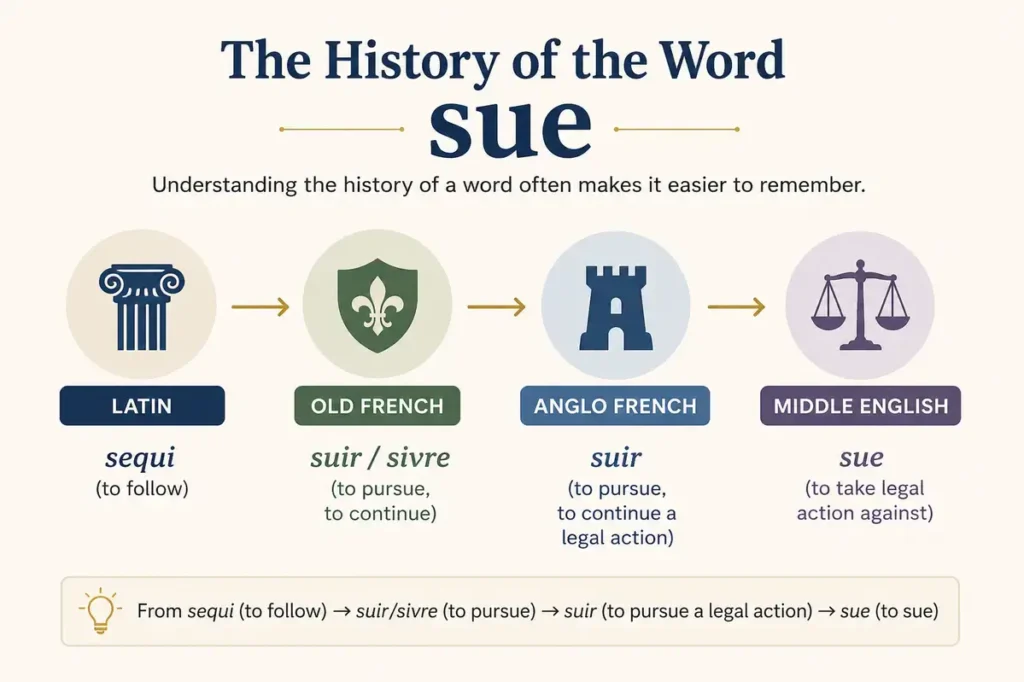
The verb traces back through Middle English and Anglo Norman French to Latin. Etymological sources connect it with the Latin verb sequi meaning to follow. Early meanings were associated with following or pursuing. Over time the word developed a legal sense connected with pursuing a matter through court.
The legal meaning became established in English many centuries ago. The modern verb can now refer to bringing legal proceedings or making a legal claim.
Sue has also had older meanings connected with asking, pleading, petitioning, and courtship. Those meanings are largely historical or restricted in modern usage. Collins and other dictionary sources preserve some of these older senses.
The modern legal meaning is by far the most familiar in ordinary American English.
The spelling change from sue to suing is much more straightforward than the history of the word itself. The modern ing form follows the established English pattern of dropping the final silent e before adding ing.
Related Words and Expressions
Several words and phrases are closely connected with sue and suing.
Lawsuit
A lawsuit is a legal case brought before a court. It is a noun rather than a verb.
They filed a lawsuit against the company.
Sue
Sue is the base verb.
They may sue the company.
Sued
Sued is the past tense and past participle.
They sued the company last year.
Plaintiff
A plaintiff is the person or party that brings a civil legal action in court.
The plaintiff sued the manufacturer.
Defendant
A defendant is the person or organization responding to a legal claim.
The defendant denied the allegations.
Litigate
Litigate means to take part in legal proceedings. It is more specialized and formal than sue.
The parties decided to litigate the dispute.
Legal Claim
A legal claim is an assertion of a right or demand that can form the basis of legal proceedings.
The company faced a legal claim for damages.
Damages
Damages are money awarded or sought as compensation for harm or loss in a civil case.
The plaintiff sued for damages.
These terms belong to the same legal vocabulary, but they do not mean exactly the same thing.
Similar Spelling Patterns
Understanding related spelling patterns can make the correct form easier to remember.
Consider these examples:
- Make becomes making.
- Bake becomes baking.
- Drive becomes driving.
- Use becomes using.
- Move becomes moving.
- Write becomes writing.
- Sue becomes suing.
The common idea is that the final silent e is removed before ing is added.
However, English has exceptions and special cases. That means you should not blindly apply one rule to every word ending in e.
For example, verbs ending in certain letter combinations may follow different spelling patterns. The safest approach is to learn common forms as complete words and use the spelling rule as a guide.
For sue, the standard form is clear.
Sue becomes suing.
Memory Tips
Use the Drop the E Rule
The simplest memory trick is:
Sue loses e before ing.
So:
sue → suing
This is the fastest rule to remember.
Compare It With Use
Use and sue have a similar spelling pattern.
Use becomes using.
Sue becomes suing.
You can remember them as a pair.
Think About the Base Word
Start with sue.
Now remove the final e.
You get su.
Add ing.
You get suing.
This mental process is useful when proofreading.
Do Not Add the Ending Mechanically
Avoid thinking:
sue + ing = sueing.
Instead think:
remove silent e + add ing = suing.
That small change in thinking can prevent the error.
Check the First Four Letters
When proofreading, look at the beginning of the word.
The correct form starts:
s u i n g.
The incorrect form starts:
s u e i n g.
If you see e immediately before ing, stop and check the word.
Professional Writing Tips
In professional writing, spelling accuracy matters because small errors can distract readers from the actual message.
This is especially true when discussing legal topics. A typo in a legal email, report, article, or document can make the writing look less polished.
A useful proofreading technique is to check verb forms separately from general spelling.
Look for common endings such as:
- ing.
- ed.
- s.
- er.
- ly.
Then check the base word before the ending.
For suing, ask yourself:
What is the base verb?
The answer is sue.
What happens when ing is added?
The final silent e disappears.
That gives you the correct form.
Expert Editor Insight
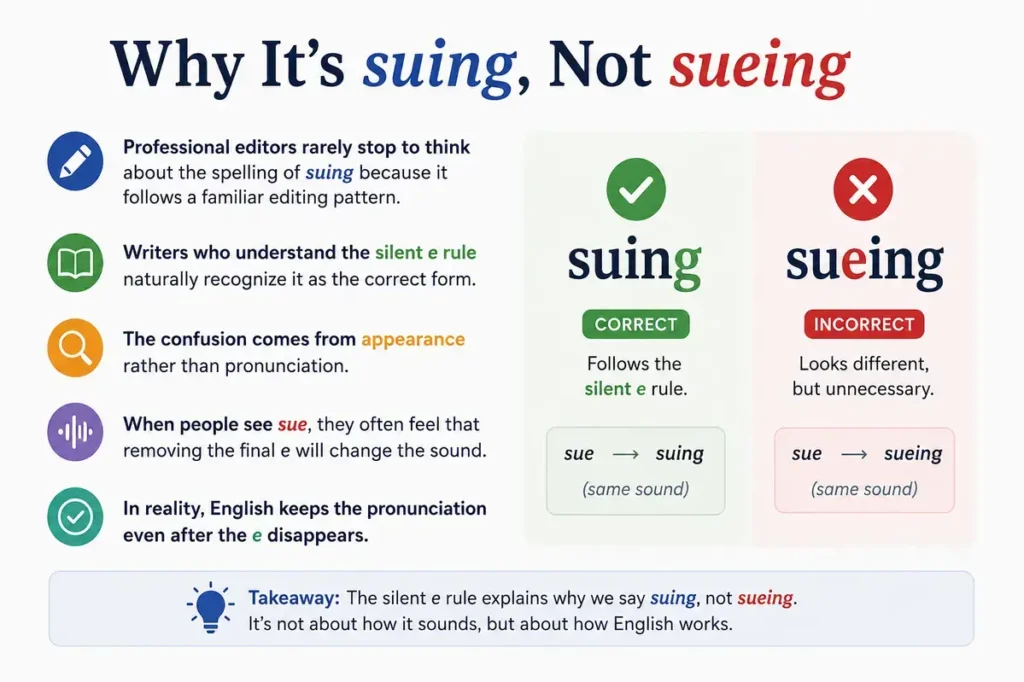
An experienced editor would correct sueing immediately because the extra e reflects a predictable spelling error rather than a meaningful variation. The mistake often happens when writers treat English inflection as simple letter addition. A stronger editing habit is to identify the base verb first and then check how that verb behaves when an ending is added. Spellcheckers can catch many instances, but understanding the rule is more reliable because it helps you recognize similar patterns in words such as using, making, driving, and pursuing.
Key Takeaways
- Suing is the standard spelling.
- Sueing is a common spelling error.
- The base verb is sue.
- The final silent e is removed before ing is added.
- The correct formation is sue → suing.
- Suing can function as a present participle.
- Suing can also function as a gerund.
- The word usually relates to taking legal action.
- The standard spelling is the same in American and British English.
- A simple memory trick is to remove the e before adding ing.
Conclusion
Suing or sueing has a straightforward answer. Suing is the correct standard form, while sueing is a spelling error. The word comes from the verb sue and usually refers to taking legal action against a person or organization. It can also function as a gerund when the activity itself becomes the subject or object of a sentence.
The spelling follows a familiar English pattern. The final silent e in sue disappears before the ing ending is added. That gives us suing rather than sueing. The same basic idea appears in words such as making, using, and driving.
The easiest editing tip is to start with the base verb. Write sue, remove the final e, and then add ing. Once you remember that simple sequence, the correct spelling becomes much easier to recognize and use.
FAQs
Is sueing ever correct?
Sueing is not the standard spelling of the ing form of sue in modern English. The accepted form is suing. The final silent e in sue is removed before the ing ending is added. If you are writing a school assignment, professional email, article, legal document, or other standard English text, use suing.
Why is it spelled suing instead of sueing?
The spelling changes because English normally removes a final silent e from many verbs before adding ing. The base verb is sue. Remove the final e and add ing, and the result is suing. The same general pattern appears in words such as make becoming making and use becoming using.
What does suing mean?
Suing means taking legal action against a person or organization. It is the present participle form of sue and can describe an action in progress. It can also function as a gerund, as in They discussed suing the company. The exact legal meaning depends on the claim and the relevant legal system.
Is suing a noun or a verb?
Suing can function as part of a verb phrase or as a gerund. In She is suing the company, it is part of the present progressive verb phrase. In Suing can be expensive, it functions as a noun. The grammatical role depends on how the word is used in the sentence.
How do you pronounce suing?
Suing is commonly pronounced /ˈsuːɪŋ/. The word begins with the same main sound as sue and then moves into the ing ending. The written e from sue is removed when the word changes form. The spelling therefore looks different from the base verb while the main vowel sound remains recognizable.
Can I use suing in formal writing?
Yes. Suing is standard English and can appear in formal writing. It is common in legal discussions, news reports, professional communication, academic writing, and ordinary conversation. The word itself is not too informal. In highly technical legal documents, writers may choose a more specific term based on the exact legal procedure being described.
What is the difference between suing and litigating?
Suing generally means bringing legal action against someone or an organization. Litigating is broader and more specialized. It refers to taking part in legal proceedings or handling a dispute through the court process. The two words overlap, but they are not always interchangeable. Suing is usually more familiar in everyday English.
What is the past tense of sue?
The past tense is sued. For example, you can write The company sued the contractor last year. The present participle is suing, as in The company is suing the contractor now. The base form is sue. Learning all three forms together makes the verb easier to use correctly.
Does American English use a different spelling?
No. American English uses suing as the standard spelling. British, Canadian, and Australian English also use suing. There is no major regional spelling difference that changes the word to sueing. The main distinction is simply between the standard form and the common misspelling.
Can suing be used after about?
Yes. About can be followed by the gerund form suing. For example, They talked about suing the company is grammatically correct. This is different from an infinitive construction such as They decided to sue the company. The word after about should fit the grammatical pattern required by the sentence.

Confusing Words, Spelling & Word Choice
Claire Whitmore is a U.S.-based English editor who writes about commonly confused words, spelling differences, and word choice. Her work helps readers understand subtle distinctions between similar-looking words through simple definitions, practical examples, and modern usage guidance in both American and British English.