
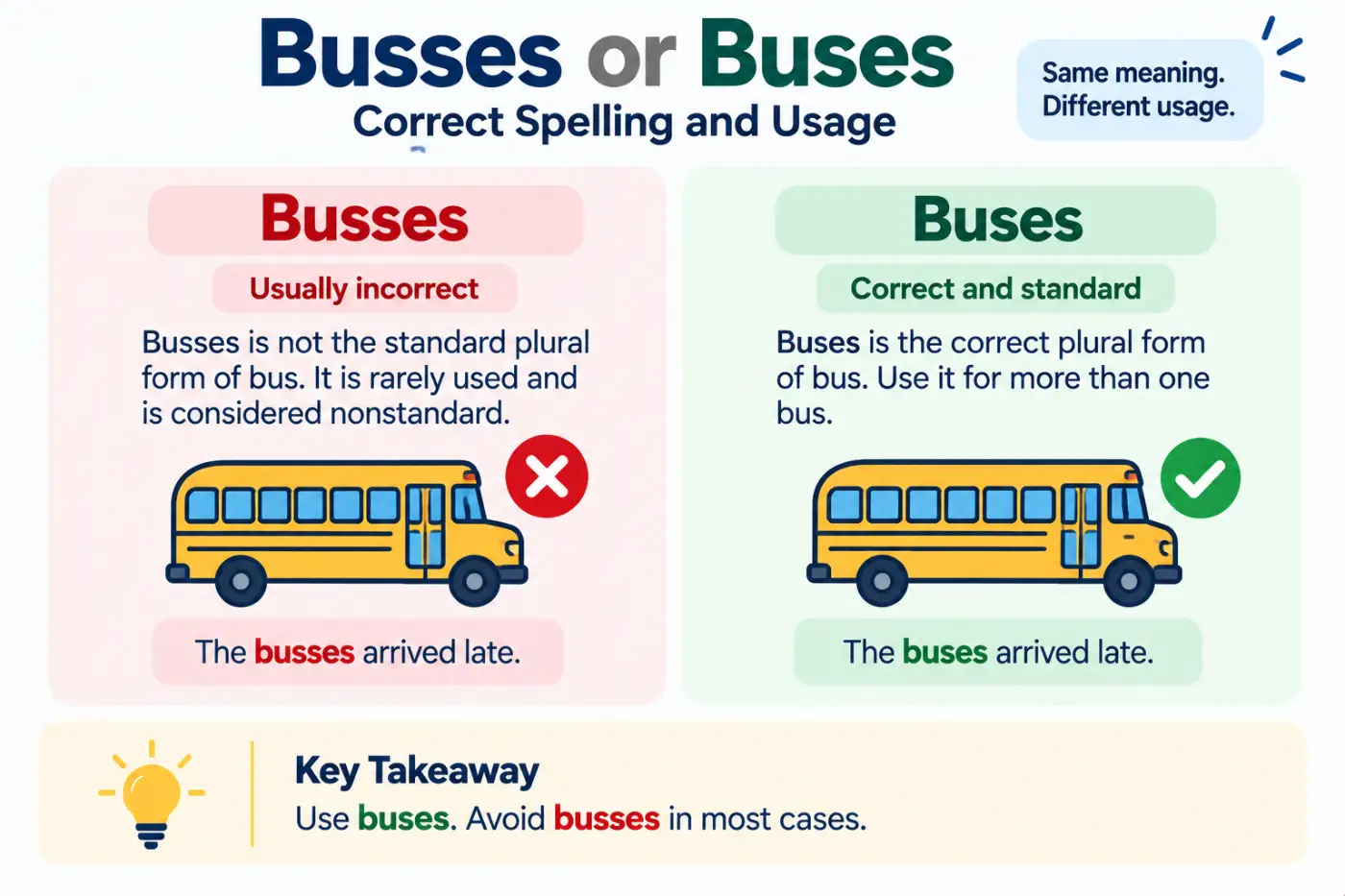
The choice between busses or buses can be confusing because both spellings appear in English. If you mean more than one vehicle used to carry passengers the standard form is buses. For example you would write Three buses arrived at the station. The spelling busses can also be found in dictionaries but it may represent an older or less common plural spelling or the plural of the verb buss.
The confusion comes from English plural spelling rules. Many nouns ending in s take es in the plural. Since bus already ends in s it seems natural to write busses. That reasoning makes sense at first glance. However modern English has settled on buses as the usual plural form of the transportation noun.
This distinction matters in school assignments professional writing news articles websites and everyday messages. You’ll learn the meaning of each form how to pronounce them why buses is preferred in American English and when busses can appear legitimately. You’ll also see clear examples that make the difference easy to remember.
Short Answer
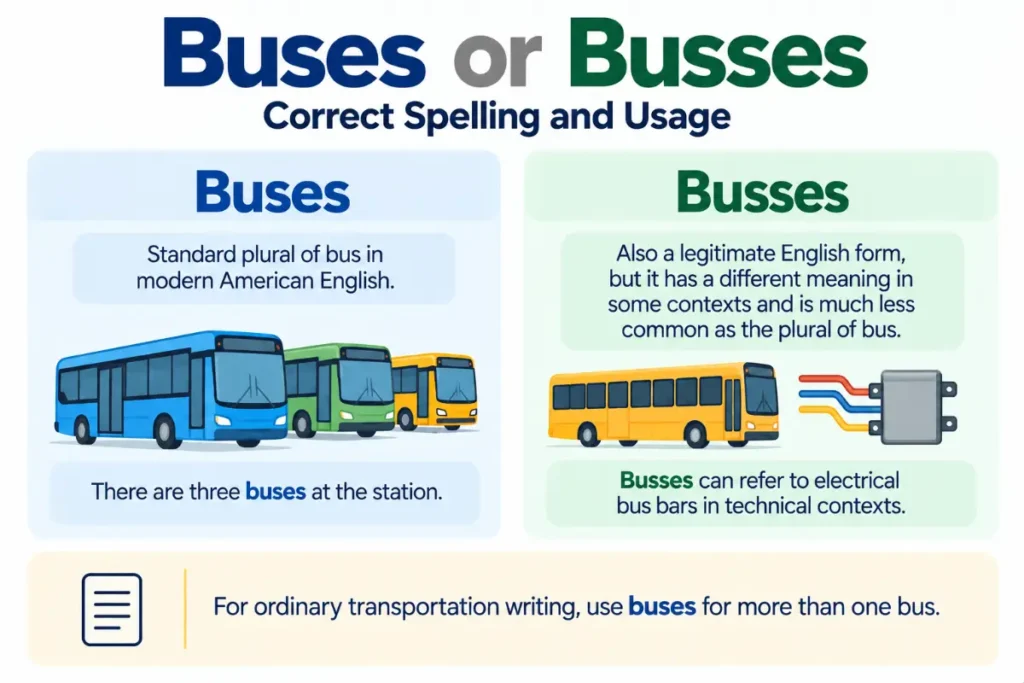
Buses is the standard plural of bus in modern American English. Busses is also a legitimate English form but it has a different meaning in some contexts and is much less common as the plural of bus. For ordinary transportation writing use buses for more than one bus.
Table Of Contents
- The direct answer.
- The meaning of bus.
- Why buses is the standard plural.
- When busses can be correct.
- The spelling rule behind the difference.
- Pronunciation and syllables.
- Examples in everyday English.
- Common spelling mistakes.
- American and British usage.
- Grammar patterns with bus.
- Related words and expressions.
- Memory tips.
- Expert editor insight.
- FAQs.
- Key takeaways.
- Conclusion.
Quick Answer
For ordinary transportation writing use buses. It is the standard plural form of bus in contemporary English.
Busses is not simply a random spelling error. It can occur as a variant plural spelling of bus and can also be the plural form of the verb buss, meaning to kiss. Context tells you which word the writer intends.
Meaning Of Bus
A bus is a large road vehicle designed to carry multiple passengers. People commonly use buses for public transportation school transportation airport travel tours and other forms of group travel.
The noun can also have specialized meanings. In computing and electronics a bus is a system or pathway that carries data or signals between components. That technical meaning also has the plural buses.
For example:
- The city added ten new buses to its public transportation system.
- The school operates several buses for students.
- The computer uses a data bus to transfer information between components.
The plural simply tells the reader that more than one bus is involved.
Why Buses Is The Standard Plural
The standard plural of bus is buses. This is the form you should normally choose in American English and in most general English writing.
At first the spelling may look slightly unusual. You might expect a word ending in s to form its plural with es and produce busses. English spelling has developed several patterns though and not every word ending in s follows the exact visual pattern you might expect.
Modern dictionaries generally list buses as the ordinary plural of bus. Major style guides and educational materials also use this form for transportation vehicles.
The reason is partly historical and partly based on established usage. Once a spelling becomes widely accepted and consistently used by educated speakers and writers it becomes the normal convention.
So you don’t need to invent a special rule every time you write the word. If you mean two or more passenger vehicles use buses.
When Busses Can Be Correct
The form busses deserves a little more attention because it isn’t always wrong.
One use comes from the verb buss. Buss means to kiss and has a long history in English. Its third person singular form is busses and its present participle is bussing in some style systems.
For example:
- He busses his child on the forehead before leaving.
In that sentence busses is a verb. It has nothing to do with public transportation.
Busses can also appear as a variant plural spelling of bus. Some dictionaries record the form as an alternative. However contemporary writers usually prefer buses when referring to multiple transportation vehicles.
This distinction is useful because it prevents an overly simple rule. Saying that busses is always wrong would be inaccurate. Saying that busses and buses are equally common would also mislead readers.
For everyday writing the practical choice is simple. Use buses for multiple vehicles.
The Spelling Rule Behind The Difference
The spelling of English plurals can create this exact problem.
Many nouns ending in s form their plurals with es.
- Class becomes classes.
- Glass becomes glasses.
- Dish becomes dishes.
- Box becomes boxes.
Because bus ends in s it is easy to assume the plural must be busses. Yet English has words that follow different patterns because spelling conventions depend on pronunciation history and established usage.
The modern plural buses is pronounced with an extra syllable. The singular bus has one syllable while the plural buses normally has two.
That pronunciation difference helps distinguish the forms when speaking.
The key point is that you shouldn’t create the plural simply by looking at the final letter. Learn the accepted plural form as part of the vocabulary word.
Buses And Other Plural Forms
The plural pattern becomes clearer when you compare bus with related words.
Bus becomes buses.
Class becomes classes.
Glass becomes glasses.
Kiss becomes kisses.
Gas commonly becomes gases although gas can have specialized pronunciation and usage considerations.
These words demonstrate why English learners often expect bus to become busses. The visual pattern feels logical. However spelling conventions don’t always follow a single mechanical formula.
Another useful point is that buses has a clear pronunciation pattern. The plural ending creates an additional syllable.
This is different from words where the plural ending does not add a full syllable.
Pronunciation Guide
The singular bus is usually pronounced with one syllable.
The plural buses has two syllables.
In American English the plural is commonly pronounced with a final sound similar to the vowel and consonant combination in words such as boxes and houses.
The stress remains on the first syllable.
The word busses can be pronounced differently depending on which word it represents. When it is treated as the plural of bus the pronunciation can resemble buses in ordinary speech. When it comes from the verb buss the pronunciation may also depend on the grammatical form and dialect.
This similarity explains part of the spelling problem. Spoken language doesn’t always provide enough information to tell you which written form someone intends.
If you’re learning English as a second language it helps to learn the singular and plural together rather than guessing the plural from the spelling.
Examples Using Buses
Here are natural examples showing the standard plural in different situations.
- Two buses stopped outside the school.
The sentence refers to two transportation vehicles.
- The city plans to add more buses next year.
The plural identifies multiple vehicles in a public transportation system.
- Several buses were waiting near the airport.
The word refers to more than one airport transport vehicle.
- We missed the last two buses home.
The speaker means two separate scheduled vehicles.
- School buses usually arrive before the first bell.
The phrase refers to the general category of buses used by schools.
- The new buses use less fuel than the older models.
The sentence compares multiple vehicles.
- Tourists lined up beside the buses.
The group of tourists is waiting near more than one vehicle.
- The company operates buses between the two cities.
The noun describes a transportation service.
- Drivers checked the buses before the morning routes began.
Several vehicles received safety checks.
- The buses were crowded after the concert.
The plural tells us that multiple vehicles were full.
These examples reflect normal modern usage. In transportation contexts buses is the form readers expect.
Examples Showing Busses
The following examples demonstrate situations where the form can appear.
- He busses his daughter on the cheek before school.
Here busses is a verb meaning kisses.
- The character busses his partner goodbye.
Again the word functions as a verb rather than a transportation noun.
- Some older texts use busses as a plural of bus.
Here the form represents a variant spelling.
- The editor changed busses to buses in the transportation article.
The sentence discusses the spelling distinction itself.
- The textbook explains why buses is now the preferred plural.
The word busses is being mentioned as an alternative form rather than used as the ordinary plural.
These examples show why context matters. A spelling can have a legitimate historical or grammatical role without being the best choice for everyday modern writing.
Busses Or Buses In A Sentence
When you write about transportation vehicles choose buses.
Here are a few quick comparisons.
Correct: The buses are late.
Less common variant: The busses are late.
Correct: Five buses arrived.
Less common variant: Five busses arrived.
Different word: She busses her baby before bedtime.
The first two pairs refer to transportation. The third example uses busses as a verb related to kissing.
For school essays business writing news content and general web writing the standard form will usually give you the clearest result.
Common Mistakes
Writing Busses For Every Plural
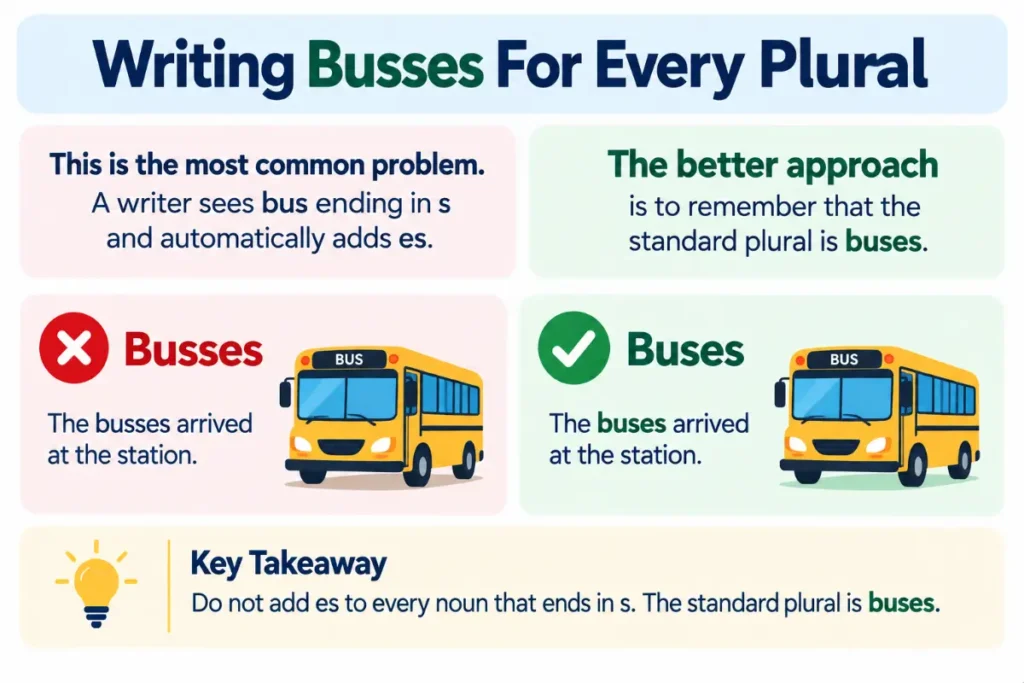
This is the most common problem. A writer sees bus ending in s and automatically adds es.
The better approach is to remember that the standard plural is buses.
Treating Busses As Completely Wrong
This creates the opposite problem. Busses can have legitimate uses, particularly as a form connected to the verb buss. It can also appear as a variant plural spelling.
The important distinction is standard modern usage versus less common or context specific usage.
Confusing Bus With Buss
These are different words.
A bus is commonly a vehicle.
A buss is an old fashioned word meaning a kiss or a verb meaning to kiss.
The double s changes the word itself rather than simply changing its plural.
Adding An Apostrophe
Do not write bus’s when you mean more than one bus.
Bus’s is normally a possessive form.
For example:
The bus’s door was open.
Here the door belongs to or is associated with one bus.
For a plural you need buses.
The buses’ doors were open.
Now the apostrophe comes after the plural ending because the doors belong to multiple buses.
Using Buses And Bussing Incorrectly
The transportation noun uses buses.
The verb buss is a different word and can produce forms such as busses and bussing.
Keeping the two word families separate prevents confusion.
American English Usage
American English strongly favors buses as the plural of bus.
You’ll see this spelling in transportation departments school systems newspapers textbooks workplace documents and everyday conversation.
American English also uses bus as a verb in contexts such as to bus tables. That verb has a different history and meaning from the transportation noun. Its forms can create another layer of confusion because buses can sometimes appear as a third person singular verb meaning clears dishes from tables.
For example:
The server buses the tables after each customer leaves.
Here buses is a verb.
Compare that with:
The restaurant has three buses outside.
Here buses is a noun referring to vehicles.
Context determines the grammatical role.
British English Usage
British English also uses buses as the normal plural of bus.
There is no major British spelling difference that requires writers to use busses for transportation vehicles. You may encounter busses in older writing or in contexts where an alternative spelling has been retained.
For modern general writing buses is the natural choice.
The same applies to common compounds such as school buses city buses double decker buses and bus routes.
Australian English Usage
Australian English follows the same general pattern. Buses is the standard plural form for multiple passenger vehicles.
The spelling appears naturally in public transportation discussions school settings travel writing and everyday communication.
Busses may appear as a variant or in historical material but it isn’t the form most writers need for ordinary modern Australian English.
Canadian English Usage
Canadian English also uses buses as the normal plural of bus.
Canadian English shares many spelling conventions with both American and British English but this particular word does not create a major regional split.
If you are writing for a Canadian audience and mean multiple transportation vehicles use buses.
Grammar Rules For Bus
Bus is a countable noun when it refers to a vehicle.
That means you can use numbers and determiners with it.
- One bus.
- Two buses.
- Several buses.
- Many buses.
- The buses.
- These buses.
The plural form is especially common after numbers.
Five buses are waiting outside.
Notice that the verb is plural because buses is plural.
Compare:
The bus is waiting outside.
Five buses are waiting outside.
This subject verb agreement pattern is straightforward but useful for learners.
Possessive Forms
A singular possessive uses an apostrophe and s.
The bus’s engine is noisy.
A plural possessive places the apostrophe after the plural ending.
The buses’ engines are noisy.
This difference is worth learning because bus already ends in s. Writers sometimes add or remove apostrophes based on appearance instead of grammar.
Compound Expressions
Buses appear in many common compound phrases.
- School buses.
- City buses.
- Tour buses.
- Airport buses.
- Public buses.
- Electric buses.
- Shuttle buses.
- Double decker buses.
These expressions follow the ordinary plural pattern.
Real Life Usage
Daily Conversation
I missed the buses this morning.
Several buses were packed after the game.
In casual speech buses is completely natural and needs no special explanation.
Workplace Communication
The transportation team inspected all buses before the morning schedule.
The company added three buses to the employee shuttle service.
Professional communication benefits from using the familiar standard form because readers can understand the message immediately.
Academic Writing
The study examined fuel consumption across several city buses.
Researchers compared electric buses with traditional diesel models.
Academic writing often uses buses in technical or transportation research.
News Writing
Several buses were delayed after heavy traffic blocked the main road.
The city announced plans to replace older buses with electric models.
News writing normally uses the established plural because clarity matters to a broad audience.
Storytelling
The buses disappeared around the corner as the rain began.
By sunset the buses had carried everyone safely home.
In narrative writing the same standard plural works naturally.
Bus As A Verb
Another source of confusion is the verb bus.
In American English bus can mean to transport someone by bus.
For example:
The school buses students to the museum.
In another context bus can mean to clear dishes from tables in a restaurant.
For example:
The waiter buses the tables after each meal.
The form buses therefore isn’t always a plural noun. Grammar tells you what role the word plays.
Compare these sentences.
The buses are waiting outside.
Here buses is a plural noun.
The driver buses children to school.
Here buses is a verb.
The restaurant worker buses the tables.
Here buses is also a verb.
This is a useful example of why spelling alone doesn’t always reveal meaning. The surrounding words provide the information.
Bus And Buss
The words bus and buss look almost identical but have separate histories and meanings.
A bus commonly refers to a passenger vehicle.
A buss means a kiss or to kiss. It is less common in modern everyday American English but remains a recognized English word.
The verb can produce busses.
That gives you a useful distinction.
Buses is the standard plural of the transportation noun bus.
Busses can be associated with the verb buss and can also occur as an alternative plural spelling of bus.
This is why a blanket statement such as busses is never a word would be too strong.
Memory Tips
The easiest memory trick is to connect the spelling with the sound.
Think:
One bus. Two buses.
The plural adds another syllable. This helps separate buses from the singular form.
Another useful trick is to remember that the transportation noun normally uses one s in the middle and es at the end.
Bus becomes buses.
You can also memorize a simple sentence:
The buses are full.
Once this pattern becomes familiar you won’t need to reason through the spelling every time.
For formal writing use the standard form automatically. If a spellchecker highlights busses in a transportation sentence check the context before changing it. The tool may be reacting to a less common form rather than detecting a completely impossible word.
Why The Mistake Is So Common
The spelling busses looks logical because many English nouns ending in s form plurals with es.
Consider classes and glasses. Learners naturally apply the same pattern to bus.
The issue is that spelling conventions develop through usage rather than pure mathematics. English contains many words whose accepted forms need to be learned individually.
Pronunciation also contributes to the confusion. When spoken naturally buses and busses can sound very similar. If you only hear the word you don’t receive a reliable spelling signal.
Typing habits add another layer. Writers often produce the form that feels visually logical rather than the form they have seen most often.
This is a normal language learning problem. The solution isn’t to memorize dozens of complicated rules. It is to learn the common form through repeated exposure and use.
Formal And Informal Writing
Buses works in every normal register.
You can use it in:
- School essays.
- College assignments.
- Business reports.
- Emails.
- News articles.
- Travel guides.
- Government documents.
- Casual text messages.
There is no need to replace buses with a more formal alternative.
Busses is less suitable as the default in polished transportation writing because many readers expect buses. An uncommon spelling can distract readers from the actual point.
Good editing often means choosing the familiar form when it communicates the same idea clearly.
Related Words And Expressions
Bus Stop
A bus stop is a designated place where passengers wait for a bus.
Example:
The next bus stop is two blocks away.
Bus Route
A bus route is the path or scheduled service followed by a bus.
Example:
The new bus route connects three neighborhoods.
Bus Driver
A bus driver operates a bus and transports passengers.
Example:
The bus driver waited for the passenger.
School Bus
A school bus transports students to and from school or related activities.
Example:
The school buses arrive before eight o’clock.
Shuttle Bus
A shuttle bus transports people between specific locations.
Example:
The hotel provides a shuttle bus to the airport.
Public Transportation
Public transportation includes shared services such as buses trains and subways.
Example:
Buses are an important part of public transportation in many cities.
Transit
Transit refers broadly to the movement of people or goods and can also describe public transportation systems.
Example:
The city is improving its transit network.
Coach
Coach can refer to a bus designed for longer distance travel in some varieties of English.
Example:
We traveled by coach during the tour.
The exact use of coach varies by region and context.
A Note On Other Plural Spelling Patterns
English learners often want one rule that explains every plural. Unfortunately English doesn’t work that neatly.
Many nouns add s.
Book becomes books.
Some add es.
Box becomes boxes.
Some change spelling.
Child becomes children.
Person becomes people.
Some have identical singular and plural forms.
Sheep remains sheep.
The plural of bus belongs to a group where established usage matters more than simply copying the final letter pattern.
That is why learning common vocabulary as complete forms is valuable. You don’t need to understand every historical reason behind a spelling before you can use it correctly.
Professional Editing Tip
When you encounter a word with two plausible spellings don’t judge it only by appearance. Check three things: the meaning the grammatical role and the established form used in the type of writing you are producing.
For transportation writing buses is the clear default. If the sentence contains busses examine the surrounding words. It may be an unusual plural variant or it may be a form of the verb buss. Context should guide the final edit.
Key Takeaways
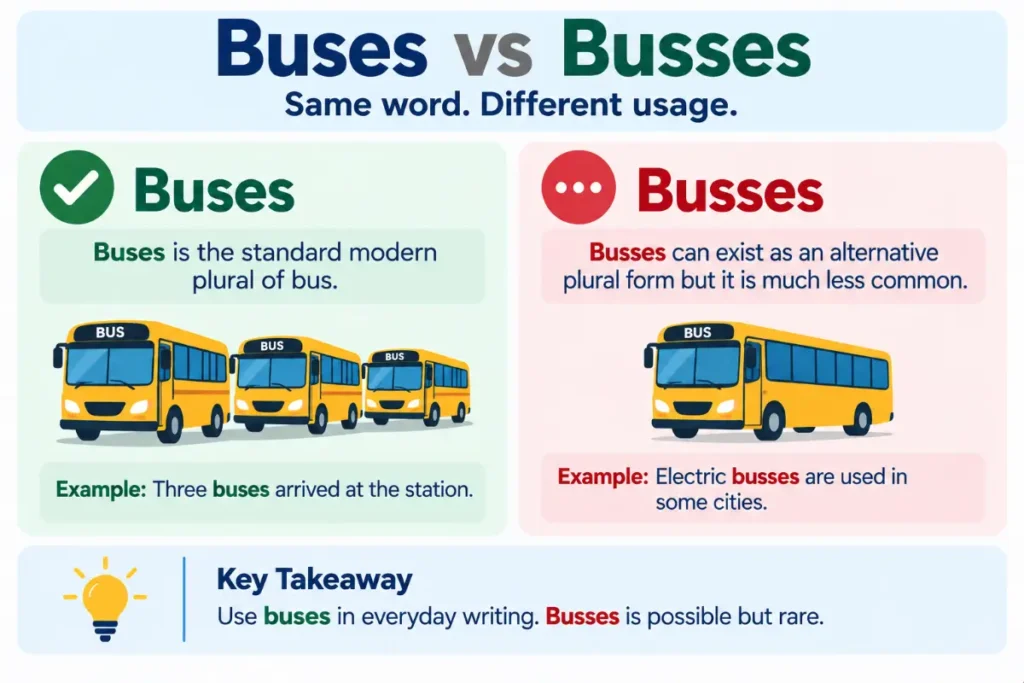
- Buses is the standard modern plural of bus.
- Busses can exist as an alternative plural form but it is much less common.
- Busses can also come from the verb buss meaning to kiss.
- Use buses for school transportation public transportation tour vehicles and similar contexts.
- Do not use an apostrophe to create the plural.
- Bus’s normally shows singular possession.
- Buses’ shows plural possession.
- The spelling difference is easy to remember through the pattern one bus and two buses.
- American British Australian and Canadian English all generally favor buses for the ordinary plural.
- Context determines the meaning when a form such as busses appears.
Conclusion
The choice between busses or buses is easiest when you focus on meaning and modern usage. For two or more transportation vehicles the standard form is buses. It is the spelling you should use in school work professional writing everyday communication and most published content.
Busses can still appear in English. It may function as a form of the verb buss meaning to kiss and it can also occur as an alternative plural spelling. That doesn’t make it the best default for transportation writing.
A simple memory trick is one bus and two buses. Learn that pair together and the spelling becomes much easier to recall. When you see busses in a sentence don’t automatically call it wrong. Check the context first and then choose the form that matches the intended meaning.
FAQs
Is busses a correct spelling?
Busses can be a legitimate English form but it is not the usual modern plural spelling for transportation vehicles. It can also be the third person singular form of the verb buss meaning to kiss. For ordinary writing about multiple buses use buses. That is the form most readers expect and the safest choice for school professional and general writing.
Is buses the plural of bus?
Yes. Buses is the standard plural of bus in modern English. If one vehicle is a bus then two or more vehicles are buses. For example you can write The buses arrived at seven. The same plural form works for school buses city buses tour buses shuttle buses and other types of passenger vehicles.
Why is busses sometimes used instead of buses?
The form busses looks natural because English often uses es to create plurals after words ending in s. It can also appear as an alternative plural spelling of bus. In addition busses is a form of the verb buss meaning to kiss. Despite these uses buses is the normal choice for transportation writing.
How do you pronounce buses?
Buses has two syllables in standard English pronunciation. The first syllable contains the same basic vowel sound found in bus and the plural ending adds another syllable. The final sound is similar to the ending heard in words such as roses and houses. The extra syllable is a useful clue that you are saying the plural rather than the singular.
Should I write busses or buses in American English?
Use buses for ordinary American English. This spelling is standard in transportation writing and works in casual communication as well as formal documents. Busses can appear in specialized or historical contexts and can also represent a form of the verb buss. If you are talking about multiple vehicles there is normally no reason to choose the less common spelling.
Is busses a spelling mistake?
Not always. If someone writes busses while referring to several transportation vehicles the form is generally treated as a less common variant rather than an entirely meaningless spelling. If the word means kisses it can be a legitimate verb form. Still buses is the preferred modern plural for the transportation noun and should be your normal choice.
What is the difference between bus and buss?
Bus commonly refers to a passenger vehicle and can also function as a verb with other meanings. Buss is a separate word associated with kissing. The difference becomes especially noticeable in forms such as buses and busses. If you mean multiple transportation vehicles choose buses. If you mean a form of the verb buss the double s may be appropriate.
Is buses correct in British English?
Yes. British English normally uses buses as the plural of bus. There is no major British spelling rule that changes the transportation plural to busses. You may encounter busses in older texts or as a variant spelling but modern British writing generally uses buses. The same basic convention applies across American British Canadian and Australian English.
Should I use buses in a school essay?
Yes. Buses is the correct standard choice for a school essay when you mean more than one bus. For example you can write Many students travel to school by buses although Many students travel to school by bus is often more natural when speaking about transportation generally. Use buses when the sentence clearly refers to multiple vehicles.
What is the possessive form of buses?
The plural possessive form is buses’. For example The buses’ doors were locked means the doors of several buses were locked. For one bus the singular possessive is bus’s as in The bus’s door was locked. The apostrophe position changes because one form refers to one vehicle and the other refers to several.

Confusing Words, Spelling & Word Choice
Claire Whitmore is a U.S.-based English editor who writes about commonly confused words, spelling differences, and word choice. Her work helps readers understand subtle distinctions between similar-looking words through simple definitions, practical examples, and modern usage guidance in both American and British English.