
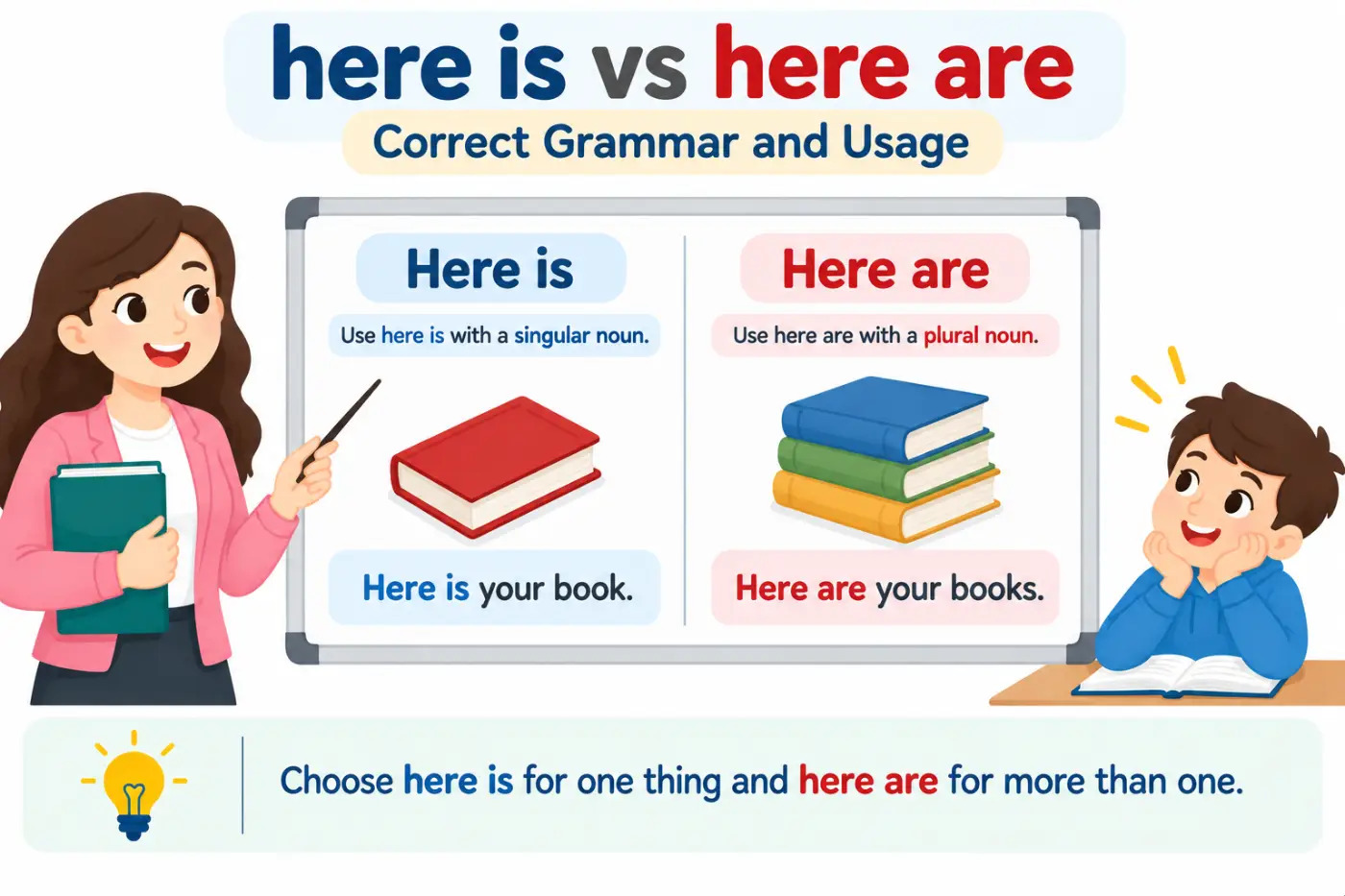
here is vs here are can cause a surprisingly common grammar problem. The choice depends mainly on the noun or noun phrase that follows. Use here is with a singular noun or an uncountable noun and use here are with a plural noun. Once you identify the real subject of the sentence the choice becomes much easier.
The confusion often comes from the word here. Because here points to a place or introduces something that is being presented it can feel like it should control the verb. It doesn’t. The noun that follows usually determines the number of the verb in standard English. This becomes especially noticeable when the sentence begins with here and the subject comes after the verb.
You’ll often hear these structures in everyday conversation. People use them when handing someone something showing a person where something is or introducing information. They also appear in emails instructions presentations stories and formal writing. Understanding the agreement rule helps you choose the natural form without stopping to second guess yourself.
Quick Definition
Use here is before a singular noun or an uncountable noun. Use here are before a plural noun. For example Here is your book uses a singular noun while Here are your books uses a plural noun. The choice comes from subject verb agreement rather than from the word here.
Quick Answer
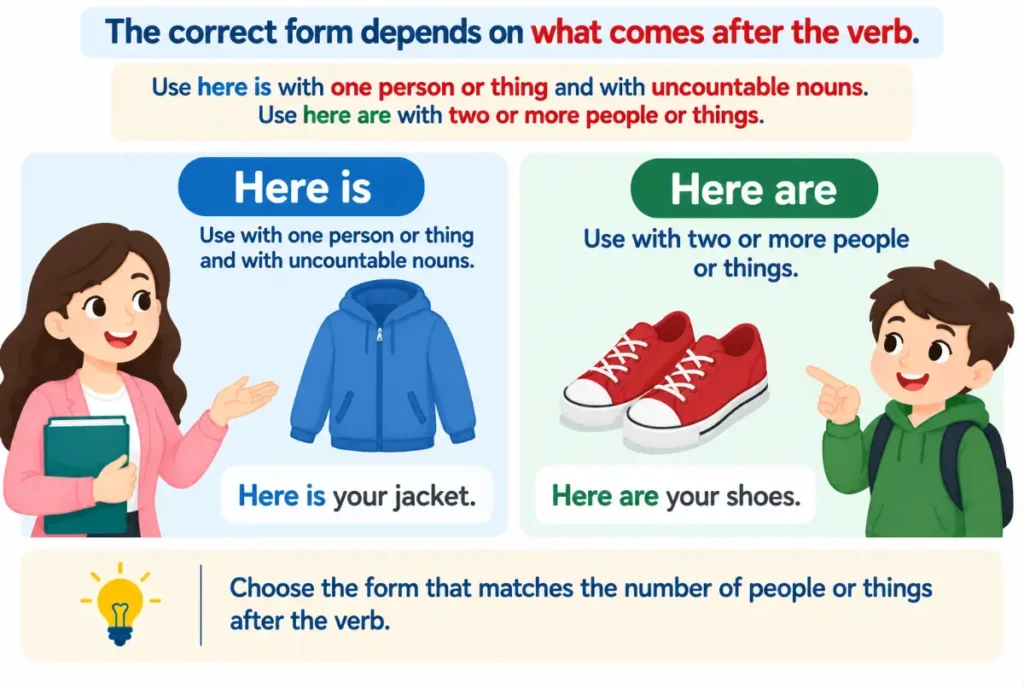
The correct form depends on what comes after the verb.
Use here is with one person or thing and with uncountable nouns. Use here are with two or more people or things.
Here is your jacket.
Here are your shoes.
The key is to look past here and identify the subject.
Comparison Table
| Form | Main Use | Grammar Pattern | Number | Common Context | Example |
|---|---|---|---|---|---|
| Here is | Introduces one person or thing | Here is + singular noun | Singular | Conversation writing directions presentations | Here is your key. |
| Here is | Introduces an uncountable noun | Here is + uncountable noun | Singular in grammar | Information materials advice | Here is some information. |
| Here are | Introduces more than one person or thing | Here are + plural noun | Plural | Conversation writing instructions presentations | Here are your keys. |
| Here are | Introduces a plural noun phrase | Here are + plural noun phrase | Plural | Lists explanations descriptions | Here are the documents you requested. |
Meaning and Definition
What Here Means
Here is an adverb that normally refers to a place close to the speaker or the place being discussed. It can also work as a presentational word that directs attention to something.
For example:
Here is your coffee.
The speaker may be physically handing the coffee to someone. The word here draws attention to the item being presented.
Here can also refer to a location.
Your bag is here.
That sentence has a different structure because here comes after the verb. The grammar question becomes more straightforward because the subject your bag appears before the verb.
In presentational constructions the word here often appears at the beginning. This creates the familiar pattern that causes many learners to hesitate.
Meaning of Here Is
The expression here is introduces a singular person thing or uncountable noun.
Here is the answer.
Here is some useful advice.
The first two examples contain singular countable nouns. Advice is uncountable in standard English so it takes the singular verb is.
The construction can sound especially natural when you are presenting something to another person. You might use it while giving someone a document showing them an object or introducing a particular point.
Here is the report you asked for.
Here is the information you need.
The phrase can also introduce a person.
Here is Sarah.
Here is our new teacher.
In these examples the word here draws attention to someone who has arrived or is now being introduced.
Meaning of Here Are
The plural construction introduces two or more people or things.
Here are the keys.
Here are the results.
The noun following the verb is plural so the verb agrees with that plural subject.
This structure is very common in spoken English. You might use it when giving someone several items or presenting a group of things.
Here are the files you requested.
Here are the questions we need to answer.
The construction can also introduce people.
Here are the students from my class.
Here are John and Maria.
The rule remains the same. A plural subject requires the plural form are.
Key Differences Explained
- Number. The singular form goes with one item or an uncountable noun. The plural form goes with multiple items.
- Subject verb agreement. The verb must agree with the grammatical subject. The word here doesn’t determine singular or plural agreement.
- Meaning. Both structures can present or point to something. The basic meaning changes very little. The grammatical number changes.
- Context. Both forms work in casual conversation professional communication academic writing instructions and other settings.
- Pronunciation. Here is is commonly pronounced naturally as two connected words and may sound like heres in fast speech. Here are can also become closely connected in ordinary conversation.
- Formality. Neither form is inherently informal. Both are standard English constructions.
- Regional usage. American British Canadian and Australian English all use both forms.
- Sentence structure. The most useful question is not Which form sounds right? Instead ask What noun am I introducing?
That final question solves most problems.
Which Form Is Correct?
Both forms are grammatically correct. The right choice depends on the number of the subject.
Use here is when the subject is singular.
Here is my friend.
Use here are when the subject is plural.
Here are my friends.
Use the singular form with an uncountable noun.
Here is some water.
Here is useful information.
The important grammar principle is subject verb agreement. English verbs change according to grammatical number in the present tense of be. The singular form is is and the plural form is are.
The word here does not act as the subject in these constructions. It functions as a place or presentational element. That distinction matters because learners sometimes assume that the first word in a sentence controls the verb.
Consider this sentence:
Here are three reasons.
The first word is here but the subject is three reasons. Since reasons is plural the sentence uses are.
Now change the noun.
Here is one reason.
The subject is one reason so the sentence uses is.
This is a simple example of how looking at the noun rather than the opening word can remove confusion.
Sentence Examples
Here are natural examples with a singular subject.
- Here is your coffee.
- Here is the book you wanted.
- Here is my brother.
- Here is the answer to your question.
- Here is some information about the meeting.
Now compare them with plural subjects.
- Here are your shoes.
- Here are the books you ordered.
- Here are my parents.
- Here are the answers to the questions.
- Here are the documents for tomorrow’s meeting.
The difference becomes clearer when you place similar sentences side by side.
Here is the key.
Here are the students.
The meaning pattern stays almost identical. Only the number of the subject changes.
You can also use these structures with longer noun phrases.
Here is the report from our research team.
Here are the people who called earlier.
The length of the noun phrase doesn’t change the rule. Find the head noun and determine its number.
Common Mistakes and Confusion
Using Is With a Plural Noun
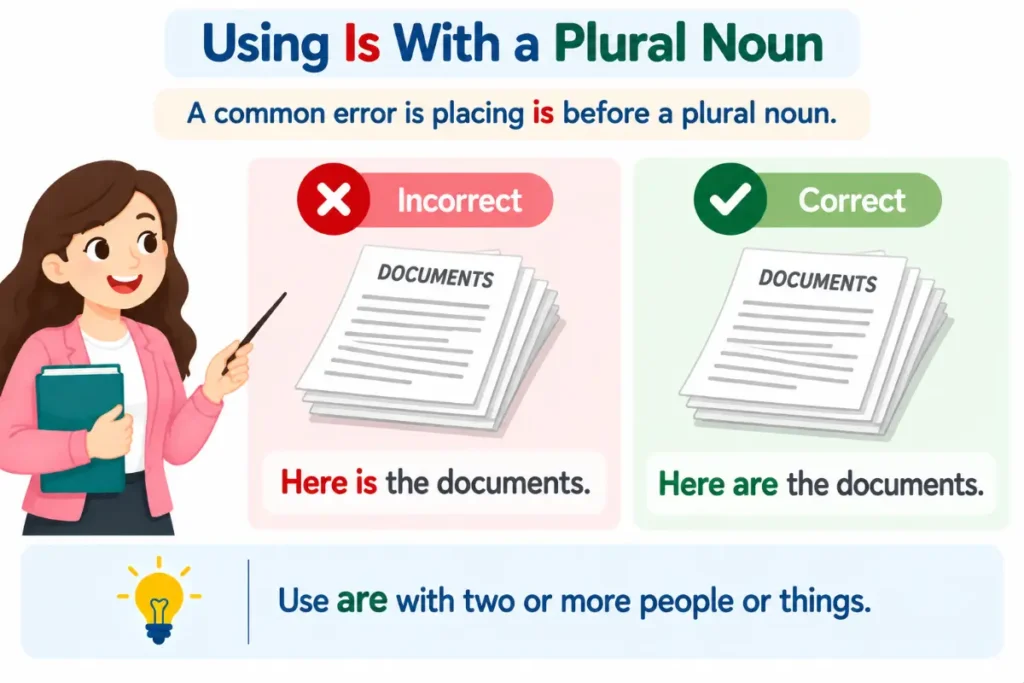
A common error is placing is before a plural noun.
Incorrect:
Here is the documents.
Correct:
Here are the documents.
Documents is plural so it needs are.
Using Are With a Singular Noun
The opposite error happens too.
Incorrect:
Here are the answer.
Correct:
Here is the answer.
Answer is singular so it needs is.
Letting Here Control the Verb
Some learners assume that because here comes first it must determine the verb. That isn’t how subject verb agreement works in this structure.
Look at the noun being introduced instead.
Here are five books.
The subject is five books.
Getting Confused by Long Noun Phrases
Long phrases can hide the actual number of the subject.
Here are the new books from the school library.
The important noun is books. The phrase from the school library gives additional information but doesn’t change the number.
Matching the Verb With the Nearest Noun
Another common error occurs when a phrase contains several nouns.
Here are the results of the test.
Results is the subject. Test appears later but doesn’t control the verb.
This is a useful editing principle. Don’t automatically match the verb with the nearest noun. Identify the grammatical head of the subject phrase first.
Pronunciation Guide
The word here is commonly pronounced /hɪr/ in American English.
The word is rhotic in most American accents so the r sound is normally heard.
The phrase here is is commonly pronounced with the words connected in natural speech. It can sound close to heer iz.
Here are can sound close to heer ar in careful speech. In fast conversation the sounds may blend together.
The pronunciation difference between is and are is usually clear enough in careful speech but connected speech can make both expressions sound faster.
For learners the main issue isn’t pronunciation. It’s grammar. You should choose the verb based on the noun rather than choosing it based on which phrase feels easier to say.
Try saying these pairs aloud.
Here is the book.
Here are my friends.
The repeated pattern helps connect singular nouns with is and plural nouns with are.
Etymology and Word Origin
The grammar of these expressions comes from the long history of the English verb be and the development of presentational constructions.
Here has Germanic roots and is related to words found in other Germanic languages. Its basic sense has long been associated with location or a place close to the speaker.
Is and are are forms of the verb be. Be is one of the oldest and most irregular verbs in English. Its forms have developed through major changes in the English language over many centuries.
The modern distinction between is and are is part of standard subject verb agreement.
Presentational sentences using words such as here and there are also an established part of English grammar. They allow speakers to draw attention to something before identifying it.
For example:
Here is the problem.
Here are the problems.
The construction feels natural because English speakers often want to direct the listener’s attention first and identify the object second.
Regional Usage
American English
Both forms are standard in American English. Native speakers use them constantly in conversation and writing.
Here is your seat.
Here are your tickets.
American English speakers also commonly use these expressions when presenting information.
Here is what we know.
Here are the main reasons.
The grammar rule remains the same. Singular subjects take is and plural subjects take are.
British English
British English uses the same basic distinction.
Here is your coat.
Here are your coats.
There is no major British spelling or grammar variation that changes this subject verb agreement rule.
British speakers also use presentational here constructions in everyday speech and formal writing.
Australian English
Australian English follows the same standard pattern. Singular subjects take is and plural subjects take are.
The expressions are natural in conversation workplace communication education and general writing.
Canadian English
Canadian English also follows the same standard agreement pattern.
Here is the document.
Here are the documents.
There is no meaningful regional difference that makes one form preferred simply because of Canadian usage.
Across these major English varieties the grammar remains stable.
Grammar Rules and Part of Speech
The grammar becomes much easier once you understand the roles of the individual words.
Here is usually contains three basic elements.
Here directs attention or refers to a location.
Is is the singular present form of be.
The following noun phrase identifies the person thing or idea being presented.
Consider:
Here is the package.
The package is singular so the verb is agrees with it.
Now consider:
Here are the packages.
Packages is plural so the verb changes to are.
This relationship is called subject verb agreement.
Singular Countable Nouns
Use is with one countable item.
Here is a pen.
Here is the teacher.
Plural Countable Nouns
Use are with multiple countable items.
Here are some pens.
Here are the teachers.
Uncountable Nouns
Uncountable nouns normally take the singular form.
Here is some advice.
Here is enough water.
You wouldn’t normally say Here are some information because information is uncountable in standard English.
Proper Names
A single person usually takes is.
Here is Michael.
A group of people takes are.
Here are Michael and David.
The same principle applies to names of places organizations or other entities when the grammatical subject is singular or plural.
Pronouns
Pronouns can also affect the choice.
Here is one.
Here are several.
The number is still the deciding factor.
Negative Forms
The same agreement principle applies in negative sentences.
Here isn’t the document you requested.
Here aren’t the documents you requested.
In ordinary American English however speakers often restructure some negative sentences to sound more natural.
There isn’t the document you requested.
There aren’t the documents you requested.
The choice depends on the intended construction and context.
Questions
These expressions can also appear in questions.
Is this the right place?
Are these the right documents?
Notice that questions use normal subject verb agreement.
Sentence Position and Punctuation
Here often appears at the beginning when the speaker wants to direct attention toward something.
A comma is usually unnecessary between here and the verb.
This is a common punctuation mistake.
Incorrect:
Here, is your receipt.
Correct:
Here is your receipt.
The same applies to the plural form.
Here are the results.
When here is part of a presentational construction it normally connects directly with the verb.
Punctuation may become relevant when the sentence includes a longer introductory element.
For example:
Here, after several hours of discussion, is the final decision.
That sentence has a more unusual structure and uses commas to separate the inserted phrase. In ordinary writing you usually won’t need such a construction.
Keep the punctuation simple when the sentence itself is simple.
Real Life Usage Examples
Daily Conversation
These structures are extremely common when people hand things to one another.
Here is your jacket. I left it by the door.
Here are your keys. They were on the kitchen table.
The phrases feel natural because the speaker is directing attention to an object at the moment of presentation.
Email and Workplace Communication
Professional communication uses these constructions to introduce documents information and action points.
Here is the report from yesterday’s meeting.
Here are the files you requested for the project.
They work well because they’re direct and easy to understand. You don’t need a complicated sentence when a simple one does the job.
Academic Writing
Academic writing can also use these forms when introducing information.
Here is one explanation for the observed result.
Here are three factors that may affect the outcome.
In more formal academic prose writers may sometimes choose structures such as The following factors explain the result. Still the presentational construction remains grammatically correct.
News and Journalism
Journalistic writing may use these forms when presenting key points or information to readers.
Here are the main developments from the meeting.
Here is the latest information available to investigators.
The exact style depends on the publication but the underlying grammar remains unchanged.
Literature and Storytelling
Narrative writing can use here to create a sense of immediacy.
Here is the house where I grew up.
Here are the people who changed my life.
The construction can make a scene feel immediate because it sounds like someone is pointing something out directly to the reader or another character.
Expert Editor Insight
A good editor doesn’t choose between these forms by intuition alone. The fastest method is to identify the subject and check its number. If the subject is singular or uncountable use is. If it is plural use are. Editors also watch for distracting nouns inside longer phrases because writers often match a verb with the nearest noun instead of the actual subject. Reading the sentence aloud can help but grammar should make the final decision.
A Simple Memory Trick
There’s an easy way to remember the rule.
Think of one and many.
One item takes is.
Here is one book.
Many items take are.
Here are three books.
You can also replace the opening word with the subject mentally.
Here is the book.
The book is here.
Here are the books.
The books are here.
This little transformation is especially useful because it exposes the agreement relationship.
If the transformed sentence uses is then the original presentational sentence normally needs is.
If the transformed sentence uses are then the original sentence needs are.
This works with many examples.
Here is your friend.
Your friend is here.
Here are your friends.
Your friends are here.
It’s a simple trick but it’s surprisingly effective.
When Spoken English Sounds Different
Native speakers often connect words together in natural conversation. That can make the expressions sound different from the way they look on paper.
Here is may sound like one smooth unit.
Here are can also become a quick connected phrase.
This doesn’t change the grammar.
Spoken English contains many reductions and connected sounds. Learners sometimes assume that the spoken form represents a different grammatical structure. Usually it doesn’t.
The best approach is to separate pronunciation from grammar. First identify the noun. Then select the verb. After that say the sentence naturally.
For example:
Here is your order.
The noun order is singular.
Here are your orders.
The noun orders is plural.
The sound may become quick in conversation but the underlying grammar stays the same.
Formal and Informal Usage
Both forms are acceptable in formal and informal English.
In conversation you might say:
Here is your change.
In a workplace email you might write:
Here are the documents discussed during the meeting.
In an academic setting you might write:
Here are two possible explanations for the result.
There’s no need to avoid these expressions simply because you’re writing formally. The important issue is clarity and grammatical agreement.
That said some formal writing may benefit from a more direct or precise structure. Instead of Here are the reasons for the change you might write The reasons for the change are as follows.
Both constructions can be correct. The better choice depends on the style and purpose of the sentence.
Why This Grammar Causes Confusion
The biggest source of confusion is word order.
In many simple English sentences the subject comes before the verb.
The book is here.
The books are here.
But presentational constructions can place here first and the noun after the verb.
Here is the book.
Here are the books.
That reversal makes some learners feel as though the first word should control the verb. It doesn’t.
Another source of confusion is the fact that English has several related presentational structures.
Here is the answer.
There is the answer.
This is the answer.
The words differ but the basic agreement principle remains important.
Long noun phrases create another challenge.
Here are the details of the proposal for the new office.
A reader might notice office near the end and mistakenly think the verb should be singular. But office isn’t the head noun. Details is the key noun and it is plural.
The same problem appears in many grammar questions. The solution is to identify the grammatical head instead of simply looking for the closest noun.
How to Choose the Right Form Quickly
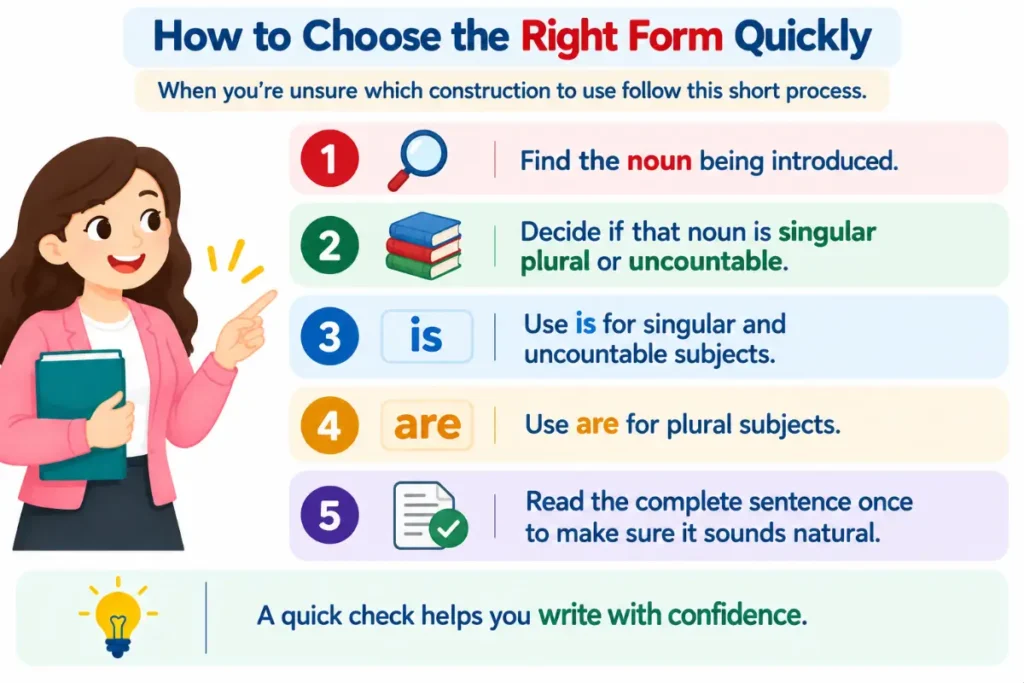
When you’re unsure which construction to use follow this short process.
- Find the noun being introduced.
- Decide if that noun is singular plural or uncountable.
- Use is for singular and uncountable subjects.
- Use are for plural subjects.
- Read the complete sentence once to make sure it sounds natural.
For example suppose you want to introduce several documents.
The key noun is documents.
Documents is plural.
Therefore the sentence becomes:
Here are the documents.
Now suppose you’re introducing one document.
Document is singular.
The sentence becomes:
Here is the document.
This method works even when the noun phrase becomes longer.
Here are the documents from yesterday’s meeting.
Here is the document from yesterday’s meeting.
The extra words don’t change the number of the head noun.
Conclusion
here is or here are becomes much easier once you focus on the subject instead of the opening word. Use is for a singular noun or an uncountable noun and use are for a plural noun. Here is the book is correct while Here are the books is correct.
Both constructions are standard English and work naturally in American English as well as British Canadian and Australian English. You can use them in conversation emails workplace writing academic work instructions journalism and storytelling. The difference isn’t about formality. It’s mainly about subject verb agreement and the number of the noun being introduced.
For a quick editing check find the main noun and ask one or many. One means is. More than one means are. If the noun is uncountable treat it as singular. That simple habit will solve most questions before they become grammar mistakes.
FAQs
Is here is vs here are correct?
Both forms are correct. The choice depends on the noun that follows. Use is with a singular or uncountable noun and use are with a plural noun. For example Here is the book uses a singular subject while Here are the books uses a plural subject. The word here doesn’t determine the verb.
Should I say here is the documents or here are the documents?
The correct sentence is Here are the documents. Documents is plural so it requires the plural verb are. The singular version would be Here is the document. A useful test is to identify the main noun and ask if it refers to one item or more than one item.
Can I use here is with an uncountable noun?
Yes. Uncountable nouns normally take the singular verb is. You can say Here is some information or Here is some advice. Information and advice are treated as uncountable nouns in standard English. You wouldn’t normally use are with them simply because they refer to many facts or suggestions.
Why does the verb come before the noun?
Presentational constructions often place here or there at the beginning to direct attention toward something. The noun then follows the verb. This word order is natural in English when someone is introducing or pointing out a person thing or idea. The unusual order can make subject verb agreement harder to notice.
Can these expressions be used in formal writing?
Yes. Both forms are standard and can appear in formal writing. They work in business communication academic explanations reports instructions and other professional contexts. Formal writing may sometimes use another structure for a more precise style but there is no grammar rule that makes these expressions informal or incorrect.
Is there a difference between here is and there is?
Yes. Here generally points toward something near the speaker or something being presented. There often introduces existence or refers to something located elsewhere. Compare Here is the book with There is a book on the table. Both are standard constructions but they organize information differently.
Why do people say here is with plural nouns?
This usually happens because here comes first and speakers momentarily focus on the opening word instead of the subject. Another cause is a long noun phrase that hides the plural noun. In careful editing identify the head noun first. If that noun is plural use are even when several other words appear between it and the rest of the sentence.
What is the easiest way to remember the rule?
Think about the number of the noun. One item takes is and multiple items take are. Here is the answer refers to one answer. Here are the answers refers to several answers. You can also reverse the sentence mentally. The answer is here shows the singular form while The answers are here shows the plural form.

English Grammar & Usage
Nathan Holloway is an American grammar writer and language researcher who specializes in English grammar, sentence structure, verb usage, and common writing mistakes. He enjoys breaking down confusing grammar rules into practical explanations with clear examples, making English easier for students, professionals, and everyday writers.