
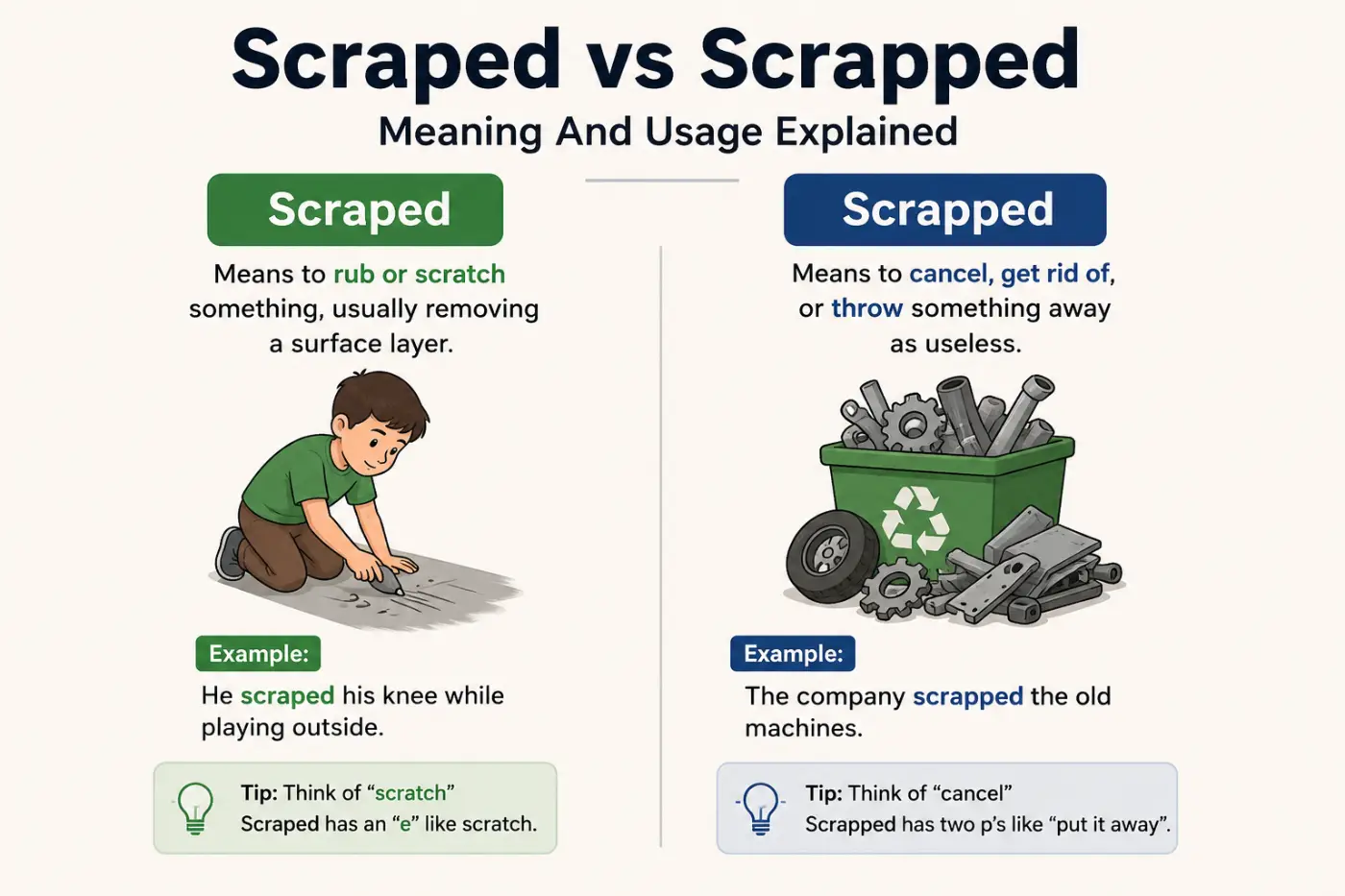
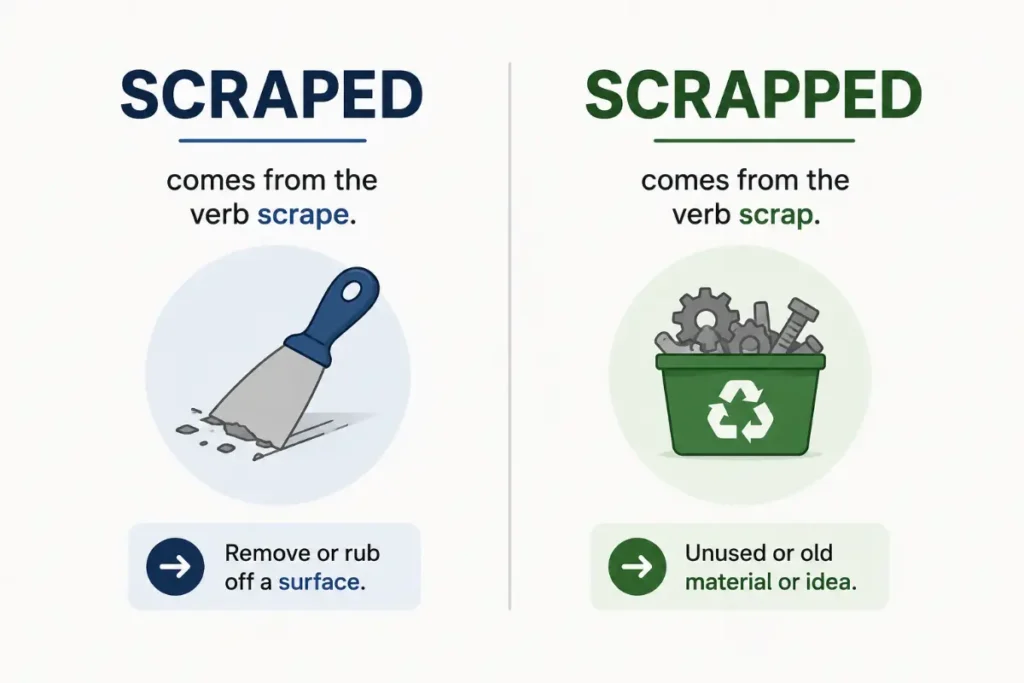
Scraped vs Scrapped is a common spelling and word choice problem because the two forms differ by only one letter. Scraped comes from scrape and usually means rubbed against a surface or removed something from a surface. Scrapped comes from scrap and usually means discarded something or abandoned a plan. That extra p changes the word and the meaning.
The confusion often appears when writers hear the words rather than see them. In many accents the pronunciation is close enough to make the distinction easy to miss. Spelling can also cause trouble because both words describe an action that has already happened. Yet the verbs follow different patterns. Scrape becomes scraped while scrap becomes scrapped.
This guide explains the difference in plain English. You’ll learn what each word means how each one works in a sentence why scrapped doubles the final consonant how scraped keeps only one p and how native speakers use both forms. You’ll also see practical examples common mistakes pronunciation guidance regional usage and simple memory tricks that make the difference stick.
Short Answer
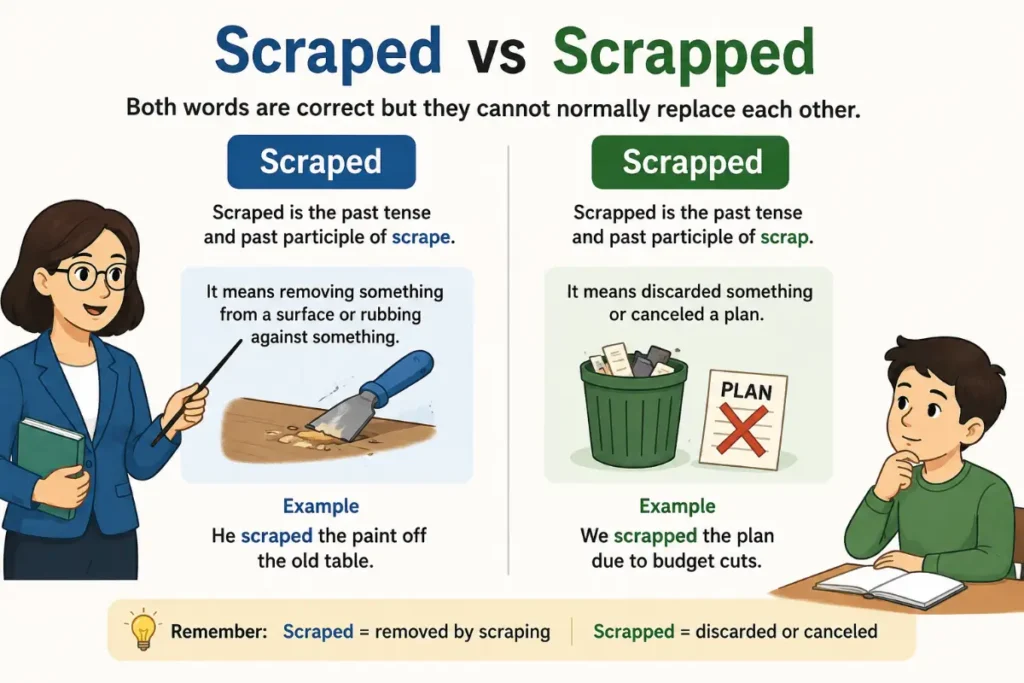
Scraped is the past tense and past participle of scrape. It means removing something from a surface or rubbing against something. Scrapped is the past tense and past participle of scrap. It means discarded something or canceled a plan. Both words are correct but they cannot normally replace each other.
Table Of Contents
- The basic difference.
- What scraped means.
- What scrapped means.
- Scraped vs Scrapped comparison.
- Why scrape becomes scraped.
- Why scrap becomes scrapped.
- Grammar rules.
- Sentence examples.
- Common spelling mistakes.
- Pronunciation.
- Word origins.
- American and British usage.
- Formal and informal usage.
- Related words.
- Memory tips.
- Professional editor advice.
- Key takeaways.
- FAQs.
- Conclusion.
The Basic Difference
The easiest way to separate these words is to look at their base verbs.
Scraped comes from scrape.
Scrapped comes from scrap.
The verb scrape usually describes rubbing something against a surface or removing something from a surface.
For example:
She scraped the paint from the wall.
The car scraped against the gate.
The verb scrap usually means to throw something away or abandon something that was planned.
For example:
The company scrapped the old policy.
They scrapped their plans for the trip.
The difference becomes clear when you connect each past form to its base verb.
Scrape becomes scraped.
Scrap becomes scrapped.
A useful rule is this:
If you mean remove by rubbing or drag against a surface use scraped.
If you mean discard or cancel use scrapped.
What Scraped Means
Scraped is the past tense and past participle of scrape.
The verb scrape has several related meanings. Most involve contact with a surface.
One common meaning is to remove something from a surface by rubbing or pressing an object against it.
For example:
I scraped the mud off my shoes.
The action involves removing mud from the shoes.
Another meaning is to rub against something and cause damage.
For example:
The truck scraped the side of the garage.
Here the truck made contact with the garage wall.
The word can also describe a minor physical injury.
For example:
He scraped his knee on the pavement.
In this sentence the skin was damaged by rubbing against a rough surface.
Scraped can also have figurative meanings.
For example:
She scraped together enough money for the repair.
This means she gathered a small amount of money with difficulty.
The word therefore has more than one meaning but its core idea often involves rubbing removing or gathering something with effort.
What Scrapped Means
Scrapped is the past tense and past participle of scrap.
As a verb scrap commonly means to discard something because it is no longer wanted needed or useful.
For example:
The manufacturer scrapped the defective product.
The product was discarded.
The word can also mean to abandon a plan idea project or proposal.
For example:
The school scrapped the old schedule.
The school decided not to continue with the schedule.
You can also use scrapped for a policy program or project.
For example:
The government scrapped the proposed tax.
The proposal was abandoned.
The verb has a strong sense of getting rid of something.
That meaning gives you a useful contrast.
You scrape something off a surface.
You scrap something you no longer want to keep or continue.
Scraped vs Scrapped Comparison
| Form | Base Verb | Main Meaning | Example | Typical Context |
|---|---|---|---|---|
| Scraped | Scrape | Removed something from a surface | She scraped the paint off the door. | Cleaning and physical contact |
| Scraped | Scrape | Rubbed against something | The car scraped the wall. | Accidents and damage |
| Scraped | Scrape | Injured the skin by rubbing | He scraped his knee. | Minor injuries |
| Scrapped | Scrap | Discarded something | They scrapped the damaged equipment. | Objects and materials |
| Scrapped | Scrap | Canceled something | The company scrapped the project. | Plans and projects |
| Scrapped | Scrap | Abandoned an idea or proposal | The committee scrapped the proposal. | Formal and professional writing |
Why Scrape Becomes Scraped
Understanding the spelling rule makes scraped easier to remember.
The base verb is scrape.
When you form the past tense you add d because the verb already ends in the letter e.
Scrape becomes scraped.
The final e remains and the d is added.
This pattern appears in many regular English verbs.
Hope becomes hoped.
Smile becomes smiled.
Bake becomes baked.
Change becomes changed.
The same pattern gives us:
Scrape becomes scraped.
The spelling is therefore not scrapped when the meaning comes from scrape.
For example:
The boy scraped his elbow.
The boy did not scrapped his elbow.
The second form uses the wrong base verb and changes the meaning.
Why Scrap Becomes Scrapped
The spelling of scrapped follows a different pattern.
The base verb scrap ends in a consonant and has a short vowel sound before that consonant.
When you add the past tense ending ed to a one syllable verb with this pattern the final consonant is doubled.
Scrap becomes scrapped.
Compare these forms:
Stop becomes stopped.
Plan becomes planned.
Drop becomes dropped.
Shop becomes shopped.
Scrap becomes scrapped.
This spelling helps preserve the short vowel sound in the base word.
If you wrote scraped you would have the base word scrape instead. The added e changes the spelling and the pronunciation pattern.
That tiny spelling difference carries a major difference in meaning.
Grammar Rules
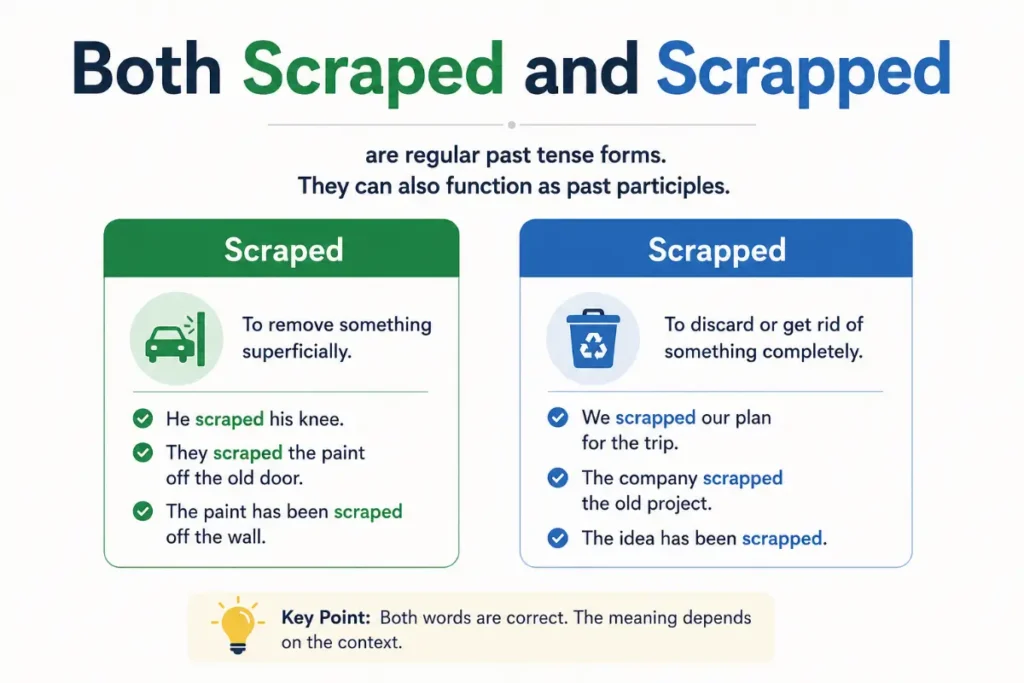
Both scraped and scrapped are regular past tense forms.
They can also function as past participles.
Scraped As A Past Tense Verb
Use scraped when the action happened in the past.
For example:
She scraped the ice from the windshield.
The action happened before the time of speaking.
Scraped As A Past Participle
Use scraped with auxiliary verbs.
For example:
The paint has been scraped from the wall.
Here scraped forms part of the passive construction.
You can also write:
He has scraped his knee.
The auxiliary verb has combines with the past participle.
Scrapped As A Past Tense Verb
Use scrapped when something was discarded or canceled in the past.
For example:
They scrapped the old system last year.
Scrapped As A Past Participle
Use scrapped with auxiliary verbs.
For example:
The project has been scrapped.
The passive construction tells us that someone canceled or abandoned the project.
Another example is:
The damaged vehicle had been scrapped.
Here the vehicle was discarded.
Sentence Examples With Scraped
Removing Something
She scraped the mud from her boots.
The action involves removing mud from a surface.
Rubbing Against Something
The bicycle scraped the fence.
The bicycle made unwanted contact with the fence.
Minor Injury
He scraped his hand on the rough wall.
The hand suffered a minor injury through contact with the wall.
Cleaning
I scraped the dried food from the plate.
The action involves removing something stuck to a surface.
Gathering With Difficulty
She scraped together enough money for a new laptop.
Here scraped together is an expression meaning gathered with difficulty.
Surface Damage
The table was scraped during the move.
The table received marks or damage through contact.
Cooking
He scraped the last bit of sauce from the pan.
The word describes removing food from a surface.
Weather Conditions
The driver scraped ice from the windshield.
The ice was physically removed.
Sentence Examples With Scrapped
Canceling A Plan
The team scrapped the original plan.
The team abandoned the plan.
Discarding Equipment
The factory scrapped the broken machine.
The machine was considered no longer useful.
Abandoning A Project
The company scrapped the project after several delays.
The project was canceled rather than continued.
Removing A Proposal
The committee scrapped the proposal.
The proposal was abandoned.
Discarding A Vehicle
The owner scrapped the damaged car.
The car was sent away as waste or for recycling.
Ending A Program
The organization scrapped the program after reviewing its costs.
The program was discontinued.
Canceling A Design
The engineers scrapped the original design.
They decided not to use it.
Discarding An Idea
She scrapped the idea after realizing it wouldn’t work.
She abandoned the idea.
Common Mistakes
Using Scrapped For Physical Scraping
Incorrect:
He scrapped his knee on the pavement.
Correct:
He scraped his knee on the pavement.
A knee can be scraped because the injury comes from rubbing against a rough surface.
Using Scraped For Cancellation
Incorrect:
The company scraped the project.
Correct:
The company scrapped the project.
A project can be scrapped because it was canceled or abandoned.
Confusing Scrape And Scrap
The base verbs are different.
Scrape focuses on rubbing removing or gathering.
Scrap focuses on discarding or abandoning.
If you identify the base verb first the spelling becomes much easier.
Writing Scraped When You Mean Discarded
A writer may type scraped because the word looks familiar.
For example:
The manufacturer scraped the old model.
That sentence can technically be interpreted as physically scraping something but it doesn’t communicate the intended meaning of canceling or discontinuing the model.
The better sentence is:
The manufacturer scrapped the old model.
Writing Scrapped When You Mean Scratched
A person may also confuse scrapped with scratched.
If something makes a mark through contact you usually need scraped or scratched depending on the action.
The car scraped the wall.
The child scratched the table.
These words overlap but aren’t identical.
Scraped And Scrapped In Context
Context usually gives you the answer.
Consider this sentence:
The workers scraped the old paint from the door.
The action involves physical removal.
Now change one word:
The workers scrapped the old painting project.
The meaning changes completely.
The first sentence describes physical work.
The second describes cancellation.
This is why spelling matters. The difference isn’t cosmetic. The two words communicate different actions.
Another useful pair is:
She scraped the label off the bottle.
She scrapped the plan to redesign the bottle.
The first action affects a physical surface.
The second action affects an idea or plan.
Pronunciation Guide
Scraped and scrapped have very similar pronunciations in many varieties of English.
Scraped is commonly pronounced with a final t sound because the past tense ending follows the voiceless sound at the end of scrape.
A simple pronunciation guide is:
skraypt
Scrapped is commonly pronounced:
skrapt
The difference between the vowel sounds is important.
Scraped has the long vowel sound associated with scrape.
Scrapped has the short vowel sound associated with scrap.
Compare:
Scrape.
Scraped.
Scrap.
Scrapped.
The spelling reflects this difference.
A common mistake is to pronounce both words as if they came from the same base verb. They don’t.
Word Origin
The history of scrape and scrap is different.
Scrape has a long history in English and is connected with words describing rubbing or removing material from a surface. The word has been used for physical actions involving rough contact for centuries.
Scrap developed around the idea of a small piece or fragment. From that noun developed the verb meaning to discard or get rid of something. The connection becomes clear in expressions involving scrap material. Something considered useless can become scrap and eventually be scrapped.
The two verbs therefore developed along different semantic paths.
Scrape is closely associated with contact and removal.
Scrap is closely associated with fragments disposal and abandonment.
Their similar spelling is largely responsible for the modern confusion.
American And British Usage
American and British English use scraped and scrapped with the same basic meanings.
This isn’t a major American versus British spelling difference.
American writers use:
The car scraped the wall.
The company scrapped the plan.
British writers use the same forms:
The car scraped the wall.
The company scrapped the plan.
The grammar and spelling remain essentially the same.
That makes this pair different from words such as color and colour or center and centre.
If you’re writing for an American audience you don’t need to change scraped or scrapped simply for regional style.
Formal And Informal Usage
Both words work in formal and informal writing.
Scraped appears naturally in technical descriptions physical instructions medical descriptions and everyday speech.
For example:
The technician scraped the residue from the surface.
Scrapped appears frequently in business journalism project management government writing and everyday conversation.
For example:
The company scrapped the proposal after reviewing the costs.
In formal writing scrapped can sound direct and efficient. In some contexts you might choose canceled, abandoned, or discontinued if you need a more specific or neutral term.
For example:
The program was scrapped.
These sentences can describe similar situations but the tone and emphasis can differ.
Scrapped As A Verb For Plans
One of the most useful meanings of scrapped is canceled.
You can scrap:
A plan.
A project.
A proposal.
A policy.
A program.
An idea.
A schedule.
A design.
A rule.
A system.
For example:
The company scrapped its expansion plans.
The city scrapped the proposed parking project.
The committee scrapped the original proposal.
In each sentence something abstract is being abandoned.
You wouldn’t normally use scraped for this meaning.
Scraped As A Verb For Surfaces
The most common physical uses of scraped involve surfaces.
You can scrape:
Paint.
Ice.
Mud.
Food.
Wax.
Dirt.
Residue.
Labels.
For example:
She scraped the ice from the windshield.
He scraped the dried glue from the table.
The worker scraped old paint from the wall.
These examples share a clear idea. Something is being removed through contact with a tool or another surface.
You can also scrape a body part.
He scraped his knee.
She scraped her elbow.
The word describes an injury caused by rough contact.
Related Words
Several words can help you understand the semantic field around these verbs.
Scrape
To rub against something or remove material from a surface.
Scratch
To mark or injure a surface with something sharp or rough.
Scuff
To damage or mark a surface through rubbing.
Rub
To move one surface against another.
Peel
To remove a layer or covering.
Remove
To take something away.
Scrap
To discard something or abandon it.
Cancel
To decide that something planned will not happen.
Abandon
To give up an idea plan or activity.
Discard
To get rid of something no longer wanted.
These related words can overlap but each carries its own shade of meaning.
Scrape Versus Scratch
Writers often confuse scrape and scratch because both involve surface damage.
A scrape usually involves rubbing across a surface.
A scratch often involves a narrow mark caused by something sharp or pointed.
For example:
The child scraped his knee on the pavement.
The cat scratched the sofa.
The first sentence describes an injury caused by rough contact.
The second describes a mark made by claws.
This distinction isn’t absolute because natural language often allows some overlap. Still it provides a useful guideline.
Scrapped Versus Canceled
Scrapped and canceled can sometimes mean nearly the same thing.
The company scrapped the plan.
The company canceled the plan.
Both sentences tell us the plan won’t continue.
However scrapped can sound more decisive. It often suggests that an idea or project has been discarded rather than simply postponed.
Canceled is broader.
A meeting can be canceled.
A flight can be canceled.
An event can be canceled.
You don’t normally say that a flight was scrapped unless you mean something more like the service or plan itself was abandoned.
Context determines the best choice.
Memory Tips
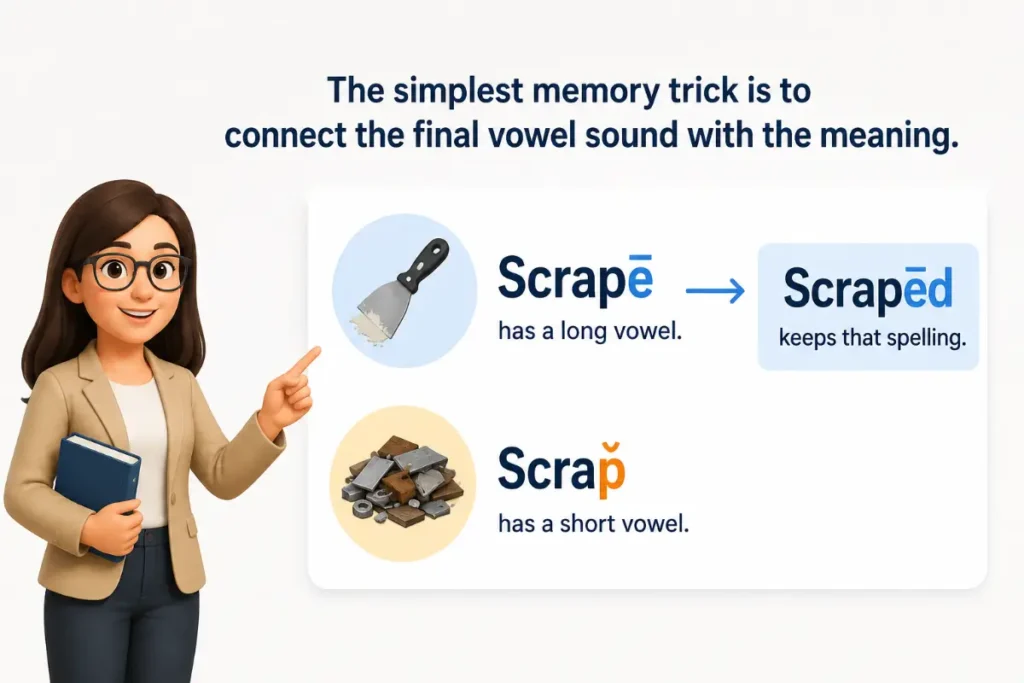
The simplest memory trick is to connect the final vowel sound with the meaning.
Scrape has a long vowel.
Scraped keeps that spelling.
Scrap has a short vowel.
Scrapped keeps that short vowel pattern.
You can also remember the meanings through two simple images.
Think of a scraper removing paint from a wall.
That gives you scraped.
Then think of an old machine being sent away as scrap.
That gives you scrapped.
Another trick is to remember these pairs:
Scrape the ice.
Scrap the plan.
Scrape the paint.
Scrap the project.
Scrape your knee.
Scrap the idea.
Once these combinations become familiar the spelling usually follows naturally.
Professional Editor Advice
A good editor doesn’t correct these words by looking only at spelling. The editor checks the intended meaning first.
If a sentence describes physical contact or removal from a surface then scraped is probably the right choice.
If the sentence describes cancellation disposal or abandonment then scrapped is probably correct.
This approach is more reliable than memorizing isolated spelling rules.
For example:
The manager scraped the proposal.
At first glance the sentence looks grammatically possible. But what did the manager actually do?
If the manager removed marks or material from a physical surface the sentence may work.
If the manager abandoned the proposal the correct word is scrapped.
Meaning controls spelling.
That’s an important editing principle for confusing word pairs.
Why Writers Confuse These Words
The confusion between scraped vs scrapped comes from several sources.
First the words look almost identical.
Second they share the same first four letters.
Third their past tense endings sound similar.
Fourth both words can describe actions that happen suddenly.
Fifth spellcheck tools may not catch the mistake because both forms are legitimate English words.
That last point matters.
A spellchecker can tell you that scraped is a valid word.
It can tell you that scrapped is also a valid word.
But it may not know which one you intended.
That’s why context and meaning matter more than spellcheck alone.
How To Choose The Right Word
Ask yourself one question.
Did something get rubbed removed or physically damaged?
If yes use scraped.
Did someone throw something away cancel it or abandon it?
If yes use scrapped.
Try the question with a few examples.
The workers ___ the old paint away.
The answer is scraped.
The company ___ the old project.
The answer is scrapped.
He ___ his knee.
The answer is scraped.
They ___ the proposal.
The answer is scrapped.
This method works because it connects the spelling to meaning instead of asking you to memorize two isolated words.
Key Takeaways
- Scraped comes from the verb scrape.
- Scrapped comes from the verb scrap.
- Scraped usually describes rubbing removing or physically damaging something.
- Scrapped usually means discarded canceled or abandoned.
- Scrape becomes scraped by adding d to the final e.
- Scrap becomes scrapped with a doubled final consonant.
- Both forms are standard in American and British English.
- Spellcheck alone may not catch a wrong choice because both words are valid.
- The best way to choose is to identify the intended meaning first.
- Remember scrape the paint and scrap the plan.
Conclusion
Scraped vs Scrapped is easier to master once you stop treating the words as simple spelling variations. Scraped comes from scrape and usually describes rubbing removing or physically damaging something. Scrapped comes from scrap and usually means discarded canceled or abandoned. The extra p in scrapped isn’t random. It follows a regular spelling pattern for the base verb scrap.
The most useful memory trick is simple. You scrape the paint but scrap the plan. You scrape your knee but scrap an old project. Those natural word combinations connect spelling with meaning and make the distinction much easier to remember.
When you’re unsure which form belongs in a sentence check the base verb first. If the base is scrape use scraped. If the base is scrap use scrapped. Once that small distinction becomes automatic you’ll rarely mix them up again.
FAQs
What Is The Difference Between Scraped And Scrapped?
The difference is mainly meaning and base verb. Scraped comes from scrape and usually means rubbed against something or removed material from a surface. Scrapped comes from scrap and usually means discarded something or canceled a plan. The two words are both correct but they describe different actions.
Is Scraped Or Scrapped Correct?
Both are correct words. The right choice depends on what you mean. Use scraped for physical rubbing removal or minor surface injury. Use scrapped for discarding something or abandoning a plan. For example She scraped the paint is correct while They scrapped the project is correct.
What Does Scraped Mean?
Scraped is the past tense and past participle of scrape. It can mean removing something from a surface or rubbing against something. You can scrape paint from a wall scrape ice from a windshield or scrape your knee. The word can also appear in expressions such as scraped together meaning gathered with difficulty.
What Does Scrapped Mean?
Scrapped is the past tense and past participle of scrap. It usually means that someone discarded something or decided not to continue with it. You can scrap a plan a project a proposal a policy or an object. For example The company scrapped the project means the company abandoned the project.
Why Does Scrap Become Scrapped?
Scrap becomes scrapped because the final consonant is doubled before the past tense ending. The base word has one syllable and follows the short vowel consonant pattern that commonly triggers consonant doubling. Similar examples include stop and stopped and plan and planned. The spelling preserves the pronunciation of the base word.
Why Does Scrape Become Scraped?
Scrape becomes scraped because the base verb already ends in silent e. The past tense ending is formed by adding d rather than ed. Similar examples include hope and hoped and bake and baked. The final e remains part of the spelling.
Is Scrapped More Common In Formal Writing?
Scrapped is completely acceptable in formal writing. It appears frequently in journalism business writing government reports and professional documents. However the best word depends on the context. In some formal sentences canceled, abandoned, or discontinued may express the intended meaning more precisely. Scrapped is not inherently informal.
Can Scraped Mean Canceled?
Normally no. Scraped does not mean canceled in standard modern English. If you mean that someone abandoned a project or plan use scrapped. For example The company scrapped the proposal means the proposal was abandoned. Using scraped in that sentence would normally be a word choice mistake.
Can Scrapped Mean Scratched?
Not normally. Scrapped comes from scrap and usually means discarded or abandoned. If you mean that something was marked or damaged through contact use scratched or scraped depending on the action. For example The car scraped the wall describes contact with a surface while The company scrapped the car describes disposal.
Is Scraped Or Scrapped Used Differently In British English?
The meanings and spellings are essentially the same in British English and American English. British writers use scraped for the past form of scrape and scrapped for the past form of scrap. This pair doesn’t have the major regional spelling difference found in words such as color and colour.
How Do You Remember Scraped And Scrapped?
Connect each word to a familiar phrase. Think scraped paint for physical removal and scrapped plans for cancellation. You can also connect scrape with a scraper removing something from a surface and scrap with discarded material. If the action involves a surface choose scraped. If it involves abandonment choose scrapped.
Why Do People Confuse Scraped And Scrapped?
The words look and sound very similar. They share the same beginning and both describe completed actions. Spellcheck can also fail to catch the error because both forms are legitimate English words. The safest method is to identify the base verb and meaning. Scraped belongs to scrape while scrapped belongs to scrap.

Confusing Words, Spelling & Word Choice
Claire Whitmore is a U.S.-based English editor who writes about commonly confused words, spelling differences, and word choice. Her work helps readers understand subtle distinctions between similar-looking words through simple definitions, practical examples, and modern usage guidance in both American and British English.