
Short Answer
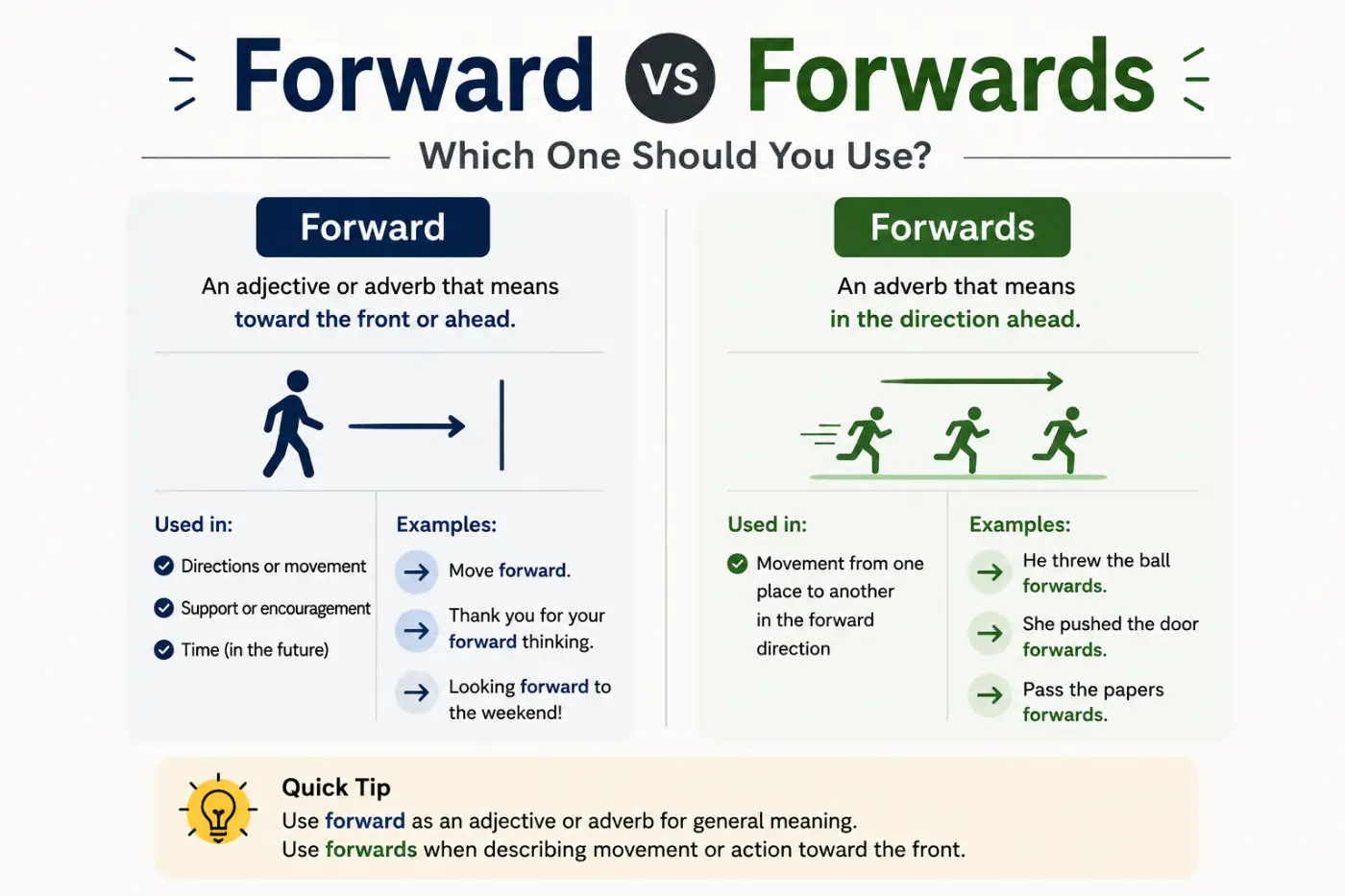
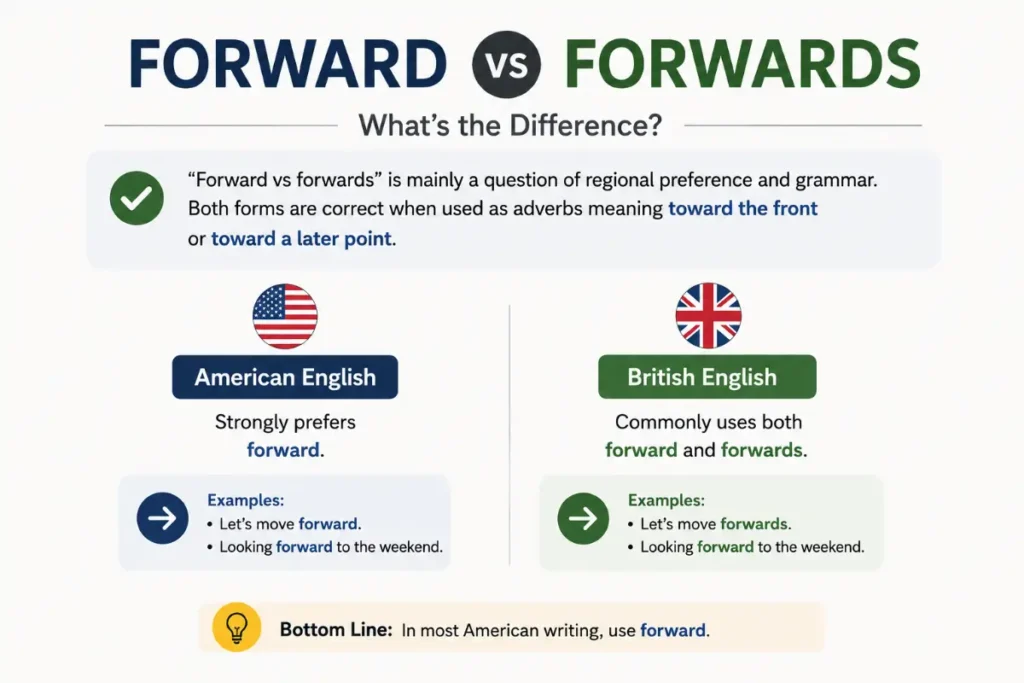
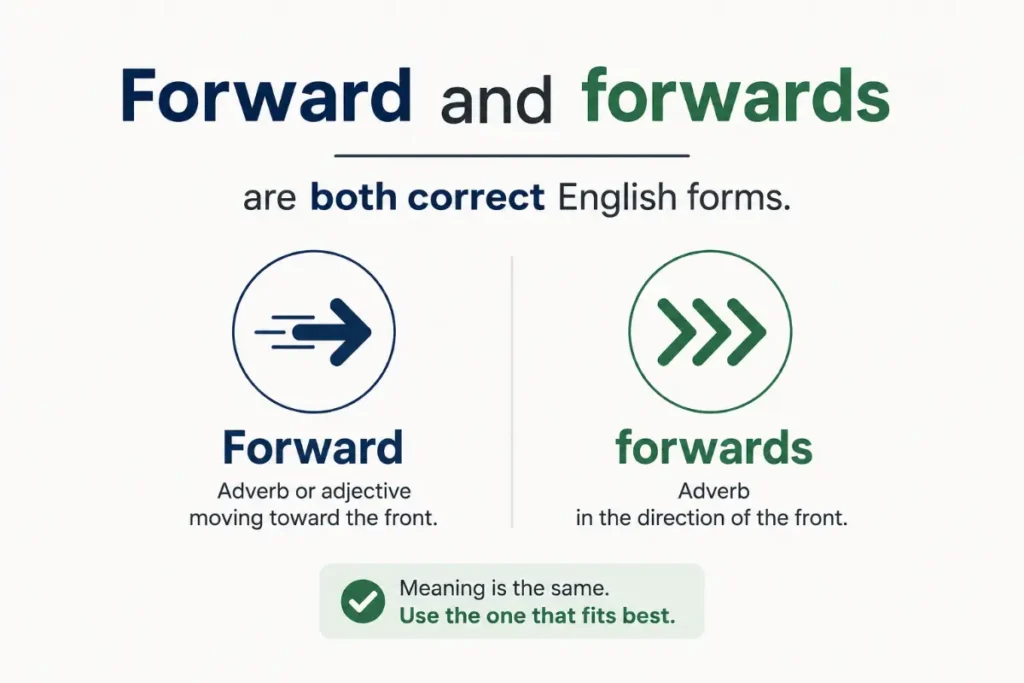
Forward vs forwards is mainly a question of regional preference and grammar. Both forms are correct when used as adverbs meaning toward the front or toward a later point. American English strongly prefers forward while British English commonly uses both forward and forwards. In most American writing use forward.
Table Of Contents
- Search intent.
- The basic difference.
- What forward means.
- What forwards means.
- Forward vs forwards in American English.
- Forward vs forwards in British English.
- Comparison table.
- Forward as an adverb.
- Forward as an adjective.
- Forward as a verb.
- Forward as a noun.
- Forwards as an adverb.
- Movement and direction.
- Time and progress.
- Figurative meanings.
- Common expressions.
- Pronunciation guide.
- Word origin.
- Common mistakes.
- Real life examples.
- Formal and informal writing.
- Memory tips.
- Related words.
- Professional editor advice.
- Key takeaways.
- FAQs.
- Conclusion.
Search Intent
The main search intent is a word comparison and grammar rule query.
Readers usually want to know three things. First they want to know if both forms are correct. Second they want to know which form sounds natural in American English. Third they want examples that show when each form works.
The dominant answer is simple. Forward is the standard and more common choice in American English. Forwards is also correct and is especially common in British English.
The Basic Difference
Forward and forwards usually have the same core meaning when they function as adverbs.
They can both describe movement toward the front.
For example:
The car moved forward.
The car moved forwards.
Both sentences can mean that the car moved toward the front.
The main difference is usage preference.
American English generally favors forward.
British English often accepts and uses forwards.
This means you shouldn’t assume that forwards is a spelling mistake. It isn’t. At the same time you don’t need to add the final s simply because you’ve seen it in British writing.
For an American audience the safest choice is usually forward.
What Forward Means
Forward has several related meanings. Its central idea involves movement toward the front or movement toward a later point.
Consider this sentence:
The child took a step forward.
The child moved toward the front.
The word can also describe progress:
We need to move forward with the project.
Here the movement is figurative. The project needs to progress.
It can also refer to future time:
Looking forward to the weekend.
In this expression the word points toward something that hasn’t happened yet.
The word has also developed several other grammatical roles. It can function as an adverb adjective verb and noun depending on the sentence.
That flexibility makes forward one of the more useful direction words in English.
What Forwards Means
Forwards is primarily an adverb.
It generally means toward the front or toward a later point.
For example:
The crowd moved forwards.
The sentence describes movement toward the front.
You may also see:
We need to look forwards and focus on the future.
This form is grammatical and is particularly natural in some varieties of British English.
The important point is that forwards doesn’t introduce a completely different meaning. In many contexts it is simply the form preferred by a particular speaker writer or regional variety.
British speakers may use forwards naturally where an American speaker would choose forward.
Forward vs Forwards In American English
American English strongly prefers forward as an adverb.
For example:
Move forward.
Step forward.
Look forward.
Go forward.
Push forward.
Move forward with the plan.
These expressions are standard and natural in American writing.
You may still encounter forwards in American English. It can appear in quoted material British writing or contexts influenced by other varieties of English. It isn’t usually the first choice for a US editor.
If you’re writing for an American audience and you’re unsure which form to choose use forward.
This is especially useful in professional writing.
For example:
We look forward to hearing from you.
That is the standard American business expression.
Using forwards here would sound unusual to many American readers.
Forward vs Forwards In British English
British English uses both forms.
Forward is fully standard.
Forwards is also common especially when the word describes physical movement.
For example:
He stepped forwards.
She leaned forwards.
The children ran forwards.
British writers can also use forward in these same contexts.
For example:
He stepped forward.
She leaned forward.
The children ran forward.
This flexibility means that the British distinction isn’t a strict grammar rule where one form is always correct and the other is always wrong.
Instead it often comes down to regional habit rhythm and style.
Some British speakers prefer the s form in movement expressions while others use the shorter form.
Comparison Table
| Feature | Forward | Forwards |
|---|---|---|
| Basic meaning | Toward the front or a later point | Toward the front or a later point |
| Main grammatical role | Adverb adjective verb and noun | Adverb |
| American English | Very common | Less common |
| British English | Very common | Common |
| Physical movement | Common | Common especially in British English |
| Figurative progress | Very common | Less common |
| Business expressions | Very common | Unusual |
| Formal writing | Standard | Standard in appropriate British usage |
| Pronunciation | Usually the same basic word | Usually the same basic word with a final z sound |
| Best choice for US readers | Yes | Usually no |
Forward As An Adverb
The adverb forward can describe physical movement.
For example:
The runner moved forward.
The chair slid forward.
The dog jumped forward.
It can also describe progress.
For example:
The team moved forward with the plan.
The negotiations are moving forward.
The company needs to move forward.
It can also describe movement through time.
For example:
We need to look forward to the next stage.
The discussion moved forward quickly.
The meaning changes slightly with context but the central idea remains movement from one point toward another.
Forward As An Adjective
Forward can also describe a person thing or position.
For example:
The forward seats were already occupied.
Here forward describes seats located toward the front.
It can also describe something positioned ahead.
The forward section of the aircraft was damaged.
In sports forward can describe a player whose position is toward the front of the team.
For example:
The forward scored two goals.
This use is especially familiar in sports such as soccer basketball and hockey.
The adjective form doesn’t normally become forwards.
You wouldn’t say:
The forwards seats were occupied.
Instead use:
The forward seats were occupied.
This is one useful way to distinguish the two forms.
Forward As A Verb
Forward can function as a verb meaning to send something onward to another person or place.
For example:
Please forward the email to me.
I’ll forward the message to the manager.
She forwarded the document to the legal team.
This use is extremely common in American English.
The verb can take several forms:
Forward.
Forwards.
Forwarded.
Forwarding.
For example:
He forwards important messages to the team.
She forwarded the report yesterday.
They are forwarding the request to another department.
Notice something important here. The s in forwards can appear because the word is functioning as a third person singular verb.
That is completely different from the adverb forwards.
Consider:
She forwards the email.
She walks forwards.
The first forwards is a verb.
The second forwards is an adverb.
Context tells you the grammatical role.
Forward As A Noun
Forward can also function as a noun in certain contexts.
In sports it can refer to a player positioned toward the attacking end.
For example:
The forward scored the winning goal.
The word can also appear in phrases connected with sending something onward.
However these noun uses are more specialized than the everyday adverb.
The plural noun in sports is commonly forwards.
For example:
The team has three talented forwards.
Here forwards is not the adverb meaning toward the front.
It is the plural of the noun forward.
This is an important distinction.
Forwards As An Adverb
When forwards functions as an adverb it describes direction movement or progress.
For example:
She stepped forwards.
The vehicle rolled forwards.
The child leaned forwards.
These forms are particularly common in British English.
The final s doesn’t normally create a new meaning. It mainly reflects an established variation in adverb formation.
In American English the equivalent sentences would more naturally use forward.
She stepped forward.
The vehicle rolled forward.
The child leaned forward.
Both patterns are grammatical.
Movement And Direction
The clearest use of these words involves physical direction.
Imagine someone standing in a line.
If that person takes a step toward the front they can step forward.
A British speaker may also say they stepped forwards.
For example:
Step forward when your name is called.
Step forwards when your name is called.
Both can work depending on the variety and style of English.
The same applies to movement.
The cyclist moved forward.
The cyclist moved forwards.
The meaning remains essentially the same.
The choice is largely regional.
Time And Progress
Forward becomes especially common when talking about progress or future time.
For example:
We need to move forward.
The project is moving forward.
I’m looking forward to the meeting.
Let’s move forward with the plan.
These expressions are deeply established in American English.
Forwards is less natural in many of these fixed expressions.
For example:
We look forward to hearing from you.
This is the standard form in professional communication.
The phrase look forward to is especially important because learners sometimes try to change it to look forwards to after seeing British usage elsewhere.
In British English you may encounter both forms in some contexts but look forward to remains a very common established expression.
Figurative Meanings
English frequently turns physical direction into an idea about progress.
That’s exactly what happens with forward.
When someone says:
We need to move forward.
They don’t mean that everyone needs to walk toward the front of a room.
They mean that a person group or project needs to make progress.
Similarly:
Let’s look forward.
This can mean focusing on the future rather than staying focused on the past.
Another example:
The discussion moved forward.
The discussion didn’t physically travel anywhere. The phrase means that the discussion progressed.
This figurative use is one reason forward is so common in professional and academic English.
Common Expressions
Several everyday expressions use forward.
Look Forward To
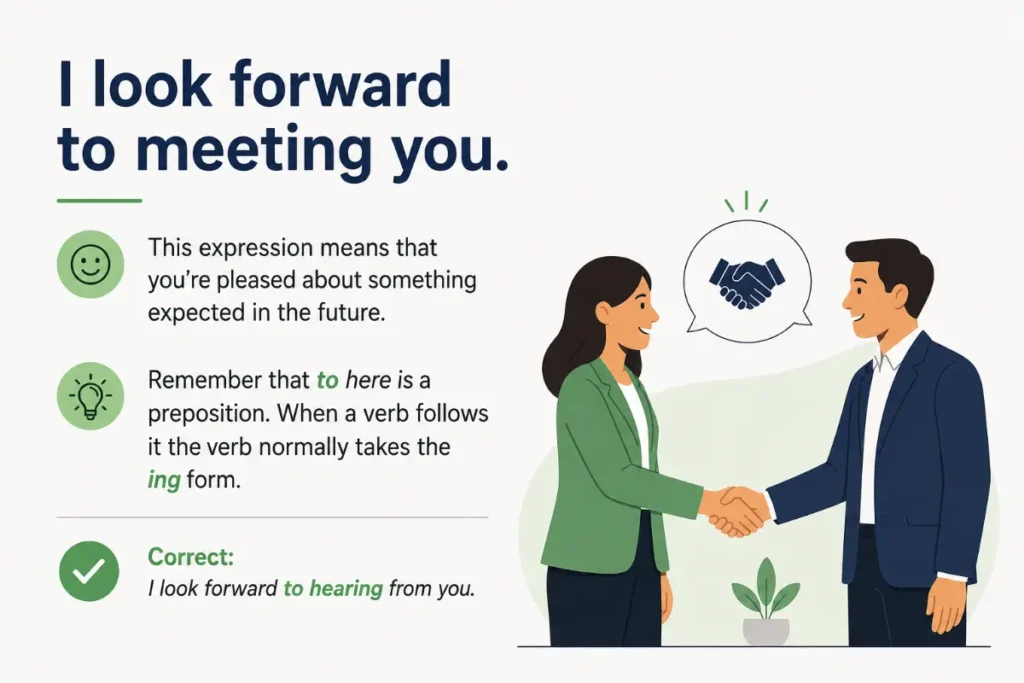
I look forward to meeting you.
This expression means that you’re pleased about something expected in the future.
Remember that to here is a preposition. When a verb follows it the verb normally takes the ing form.
Correct:
I look forward to hearing from you.
Not:
I look forward to hear from you.
Move Forward
We need to move forward.
This means to make progress.
Step Forward
Please step forward.
This means to move toward the front.
It can also have a figurative meaning:
Several employees stepped forward to help.
Here it means they volunteered or offered assistance.
Come Forward
A witness came forward.
This means the person decided to provide information or identify themselves.
Put Forward
She put forward a new idea.
This means she presented or suggested an idea.
Go Forward
The project will go forward next month.
This means the project will continue or proceed.
Pronunciation Guide
The basic pronunciation of forward is usually represented in American English as /ˈfɔrwərd/.
A simple pronunciation guide is:
FOR werd.
The first syllable carries the main stress.
The second syllable is weaker.
Forwards has the same basic pronunciation with an added final z sound:
FOR werdz.
The spelling difference is therefore more noticeable in writing than in speech.
A common pronunciation mistake is to give every syllable equal stress. Native speakers generally stress the first syllable and reduce the second.
Listening to native speech can help because the second syllable often sounds quite light.
Word Origin
The word forward has Old English roots.
It developed from elements connected with the idea of moving toward the front or ahead. The first part relates to the idea of something being ahead while the ending is connected with direction.
Over time the word developed several grammatical roles and meanings.
Its physical meaning came first. English then extended the word to describe progress future time and figurative advancement.
That semantic development is common in English.
Words connected with physical movement often gain abstract meanings.
For example:
We move forward in our careers.
The discussion moved forward.
The company is moving forward.
None of these sentences require actual physical movement.
The basic concept remains the same. Something advances from one point toward another.
Common Mistakes
Assuming Forwards Is Wrong
This is one of the biggest mistakes.
Forwards is a legitimate English word.
It is especially common in British English.
So you shouldn’t mark every instance as incorrect.
Assuming Forward Is Only American
That’s also incorrect.
British English uses forward too.
Both forms appear in British writing.
Mixing Styles
A document can sound inconsistent if it switches between regional forms without a reason.
If you’re writing for a US audience choose forward consistently.
If you’re following a British style guide you can use the form that fits the publication’s established preference.
Using Forwards In Business Phrases
American business writing strongly favors established expressions such as:
We look forward to hearing from you.
Using forwards can sound unusual in this context.
Confusing The Verb And Adverb
Consider these two sentences:
She forwards the email.
She walks forwards.
The first is a verb.
The second is an adverb.
The spelling happens to be identical but the grammatical roles are completely different.
Real Life Examples
Everyday Conversation
- Take one step forward.
This gives a direct instruction about movement. - Move forward a little.
The speaker asks someone to move toward the front. - I’m looking forward to the weekend.
The speaker is expressing positive anticipation. - We should move forward with the plan.
The speaker wants the group to proceed.
American English
- The car rolled forward slowly.
This describes physical movement. - She leaned forward to hear him.
The movement is toward the front. - We need to move forward.
This refers to progress. - I look forward to your response.
This is a standard professional expression.
British English
- He stepped forwards.
The speaker describes movement toward the front. - She leaned forwards.
The sentence describes physical movement. - The children moved forwards.
The plural form is natural in many British contexts. - The group moved forward.
The shorter form is also completely acceptable.
Academic Writing
- The study moves forward by examining the next stage of development.
The word refers to progress in the research. - The argument moves forward through several stages.
The movement is figurative.
Academic writing often favors forward because it works well for describing progress and development.
Professional Email
- We look forward to hearing from you.
This is a standard closing expression. - I look forward to discussing the proposal.
The writer expresses anticipation. - Please forward the document to the appropriate department.
Here forward is a verb meaning send onward. - The project can move forward after approval.
Here the word describes progress.
Formal And Informal Usage
Forward works comfortably in both formal and informal writing.
You can use it in:
Academic papers.
Business emails.
News reports.
Technical documents.
Personal messages.
Everyday conversation.
Forwards is also grammatical but its suitability depends more strongly on regional style.
In American formal writing forward is normally the better choice.
In British English forwards can sound completely natural especially when describing physical movement.
For example:
British:
The child leaned forwards.
American:
The child leaned forward.
Neither sentence needs correction simply because of the regional form.
Forward In Professional Communication
If you write emails for a US audience you will encounter forward constantly.
Consider:
I look forward to hearing from you.
This phrase is polite and professional.
Another common use is:
I’ll forward the details this afternoon.
Here the word means that the writer will send the information onward.
These two uses are different.
Look forward to expresses anticipation.
Forward the details means send something onward.
Context determines the meaning.
Forward In Technology
The word forward has developed several modern technical uses.
You can forward an email.
You can fast forward through a recording.
These uses all connect to the original idea of sending or moving something ahead.
For example:
Please forward the email to Sarah.
The user forwarded the message.
Fast forward to the next scene.
These forms are standard and natural in American English.
Forward In Sports
Forward has a specialized meaning in sports.
A forward is a player whose position is generally toward the attacking end of the field or court.
For example:
The forward scored the winning goal.
In basketball the word can describe a specific playing position.
In soccer it can refer to an attacking player.
The plural is forwards.
For example:
The team has two talented forwards.
This is a useful reminder that forwards can be grammatically correct even in American English when it functions as the plural noun.
That doesn’t mean American English suddenly prefers forwards as a general adverb.
The grammatical role has changed.
Memory Tips
The simplest memory trick is to remember this:
American English usually moves forward.
That short phrase captures the main regional preference.
For British English remember:
British English can move forward or forwards.
Another useful trick is to associate the longer form with physical movement.
This isn’t a strict rule but it can help.
If you’re writing for an American audience:
Move forward.
Look forward.
Step forward.
Go forward.
If you’re reading British English:
Move forwards.
Step forwards.
Lean forwards.
You may see the longer form more often.
The key is not to panic when you see forwards. It isn’t automatically a mistake.
Related Words
Several words are closely related to forward in meaning.
Ahead
Ahead often means in front or in the future.
The road ahead is clear.
Onward
Onward means continuing forward.
The travelers moved onward.
Ahead Of
This phrase can describe position or time.
She arrived ahead of schedule.
Progress
Progress refers to movement toward a goal or improved condition.
The project is making progress.
Proceed
Proceed means to continue or move forward with something.
Please proceed to the next room.
Advance
Advance can mean to move forward or make progress.
The army advanced toward the city.
Backward
Backward describes movement toward the rear or toward an earlier point.
The child took a step backward.
Backwards
Backwards is also common especially in British English.
The child fell backwards.
This creates a useful parallel with forward and forwards.
Related Usage With Backward And Backwards
The pattern becomes easier when you compare the words with backward and backwards.
American English often prefers:
Move backward.
Step backward.
Look backward.
British English can use:
Move backwards.
Step backwards.
Look backwards.
This doesn’t mean that every American speaker rejects backwards. It appears in some expressions and contexts.
Likewise British speakers don’t have to use forwards every time.
The important lesson is that English adverbs can have regional s variants.
Is One Form More Correct
No.
The forms are not ranked as correct versus incorrect in the same way as a standard spelling and a misspelling.
Forward is correct.
Forwards is also correct.
The better choice depends on grammar region context and style.
For American English forward is generally the natural default.
For British English both forms are established.
That distinction is important because learners sometimes memorize a false rule that says one form must always be wrong.
English doesn’t work that neatly here.
Expert Editor Advice
A professional editor would first identify the intended variety of English. If the publication targets American readers the editor will usually prefer forward for the adverb because it matches common US usage. If the publication follows British English the editor may retain forwards when it fits the writer’s natural style. The editor would not change a valid British form simply because American English prefers the shorter version.
The bigger editing issue is consistency.
If a document is written in American English and repeatedly uses forwards as a direction adverb the editor may change those instances to forward.
If a British article naturally uses forwards in movement descriptions there is usually no reason to remove it.
The best editing decision is the one that matches the document’s audience and style.
Key Takeaways
- Forward and forwards are both correct English forms.
- American English generally prefers forward as an adverb.
- British English commonly uses both forward and forwards.
- Forward can function as an adverb adjective verb and noun.
- Forwards is mainly an adverb when it means toward the front or onward.
- Forwards can also be the plural of the sports noun forward.
- Forward is strongly preferred in common American expressions such as look forward to.
- Forward can mean physical movement or figurative progress.
- Forwards is not an incorrect word.
- If you’re writing for a US audience and need a simple default use forward.
Conclusion
Forward vs. Forwards is a difference in usage rather than a matter of right or wrong. Both forms are correct, but regional preferences vary. American English generally favors forward, while British English commonly uses both forms. When describing movement toward a particular direction, either form can work, depending on the variety of English.
For American writing, the simplest rule is to use forward as the default. It appears in common expressions such as move forward, step forward, and look forward to. However, forwards is also correct in certain contexts, including its use as a plural noun for attacking players in sports.
When choosing between the two forms, consider your audience and how the word functions in the sentence. For US readers, forward is usually the safest choice. For British readers, both forms can sound natural. Understanding this regional difference makes it easier to choose the appropriate word.
FAQs
Is Forward or Forwards Correct?
Both forward and forwards are correct in modern English. They can describe movement toward the front or progress toward a later point. American English generally prefers forward, while British English commonly uses both forms. If you’re writing for an American audience, forward is usually the safest choice.
Is Forward or Forwards More Common in American English?
American English generally favors forward when the word functions as an adverb. Common examples include “step forward,” “move forward,” and “I look forward to hearing from you.” Although forwards is also used in American English, it is less common in these everyday expressions.
Is Forwards Wrong in American English?
No. Forwards is a valid English word that American readers readily understand. However, American English typically favors forward as an adverb. When writing for a US audience, forward is generally the preferred option unless you’re following a particular style or preserving a quotation.
Do British People Say Forward or Forwards?
British speakers use both forms. Forwards is common when describing physical movement, as in “step forwards” or “move forwards.” However, forward is equally standard in many contexts. The choice often depends on personal preference, context, and editorial style, so forwards should not be considered incorrect in British English.
Should I Write Look Forward or Look Forwards?
The standard expression is look forward to. For example, “I look forward to hearing from you” is a widely accepted phrase in professional emails and everyday communication. This construction is common in both American and British English, making it the best choice for formal writing.
What Is the Difference Between Forward and Forwards?
When used as adverbs, forward and forwards generally have the same meaning. Both can describe movement toward the front or progress toward a later stage. The main difference is regional preference: American English generally favors forward, while British English commonly accepts both forms.
Is Forward an Adverb or an Adjective?
Forward can function as an adverb, an adjective, or a verb, depending on the sentence.
- Adverb: “Please move forward.”
- Adjective: “The forward section is reserved for passengers.”
- Verb: “Please forward the email to your manager.”
Its grammatical role depends on how it is used in context.
Can Forwards Be a Noun?
Yes. Forwards can be the plural form of the sports noun forward, referring to players who occupy forward positions on a team. For example, “The team has three forwards.” This use is different from the adverb forwards, which describes movement toward the front.
Which Form Should I Use in an American Essay?
Use forward in most cases, particularly when it functions as an adverb. Expressions such as “move forward,” “step forward,” and “look forward to hearing from you” are standard choices in American English. However, forwards remains correct when used as a plural noun in sports contexts.
Is Forward Used in British English?
Yes. Forward is widely used in British English and is not exclusive to American English. British writers may use either forward or forwards, depending on the context and their preferred style. Both “move forward” and “move forwards” are acceptable in British English.
What Is the Opposite of Forward?
The most direct opposites are backward and backwards. Both describe movement toward the rear or, figuratively, a return to an earlier stage. American English generally favors backward, while British English commonly uses both forms. For example, “Take a step backward” and “Take a step backwards” are both grammatically correct.
Why Does British English Add an S to Forwards?
English has several adverbs that exist in both shorter and -s forms, including forward/forwards, backward/backwards, and toward/towards. These are accepted variants rather than a correct form and an incorrect one. British English commonly retains the longer forms in everyday usage, while American English generally favors the shorter alternatives.

Confusing Words, Spelling & Word Choice
Claire Whitmore is a U.S.-based English editor who writes about commonly confused words, spelling differences, and word choice. Her work helps readers understand subtle distinctions between similar-looking words through simple definitions, practical examples, and modern usage guidance in both American and British English.