
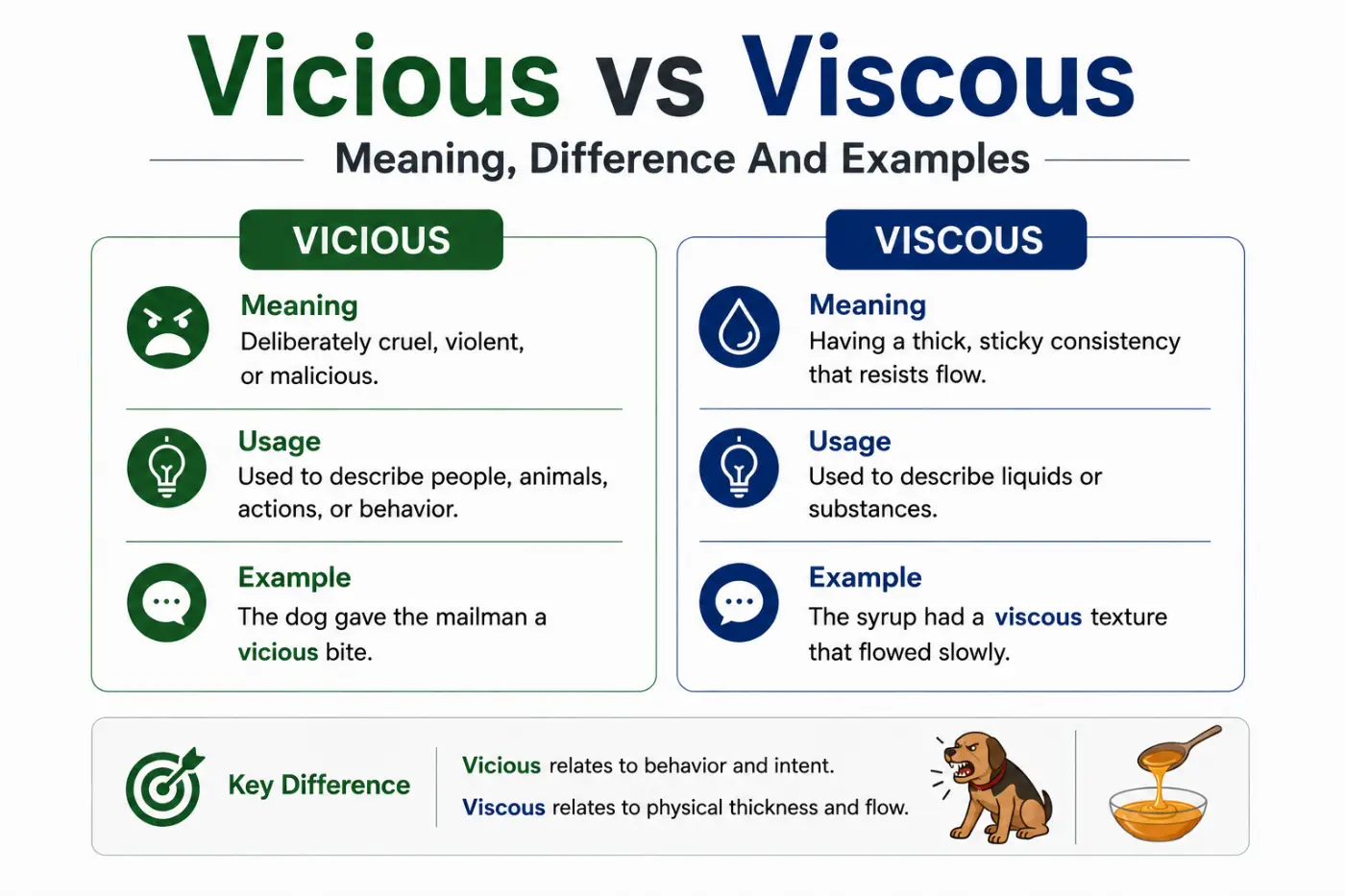
Vicious vs Viscous is one of those word pairs that can trip up even careful writers. The two words look almost identical and sound similar when spoken quickly. But their meanings are worlds apart. Vicious describes cruelty aggression or severe harm while viscous describes a liquid that has a thick consistency and flows slowly.
The confusion makes sense because both words contain similar letters and share a similar sound pattern. If you’ve only encountered one of them in conversation or you’ve heard them without seeing them written down the difference can be easy to miss. A person might hear someone describe a substance as viscous and mistakenly write vicious. Another writer might see a description of a cruel attack and accidentally choose viscous.
Once you connect each word with its core idea the distinction becomes much easier. This guide explains the meanings grammar pronunciation origins examples common mistakes and memory tricks you can use to keep the two words straight.
Short Answer
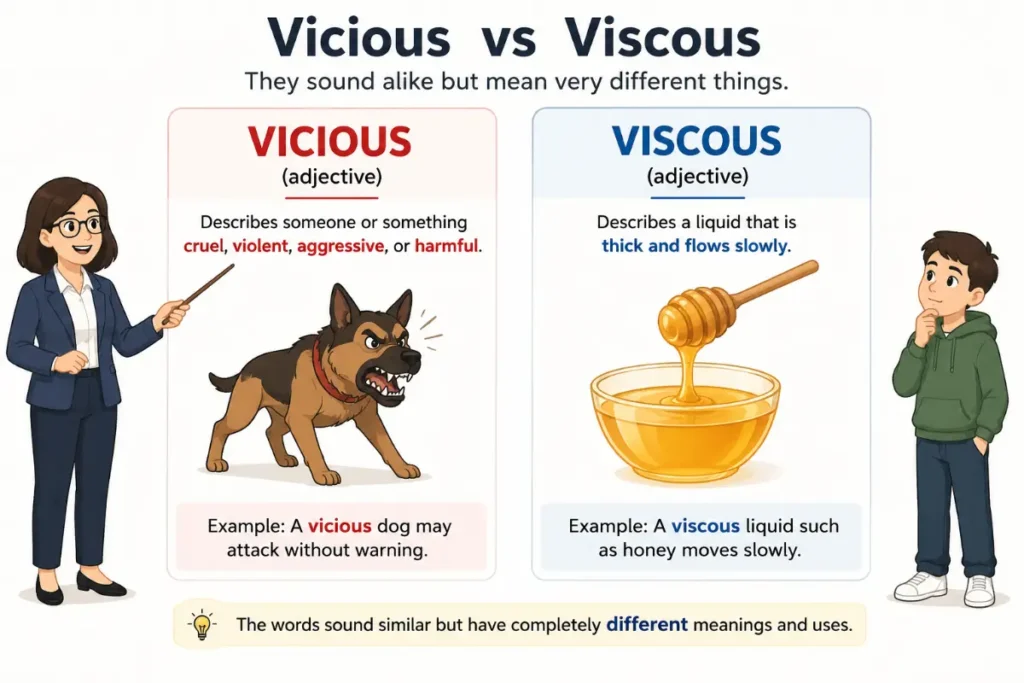
Vicious describes someone or something cruel violent aggressive or harmful. Viscous describes a liquid that is thick and flows slowly. A vicious dog may attack without warning while a viscous liquid such as honey moves slowly from one place to another. The words sound similar but have completely different meanings and uses.
Table Of Contents
- The Main Difference.
- What Vicious Means.
- What Viscous Means.
- Vicious vs Viscous In Context.
- Comparison Table.
- Grammar And Part Of Speech.
- Pronunciation Guide.
- Word Origin And Etymology.
- How To Use Vicious Correctly.
- How To Use Viscous Correctly.
- Real Life Examples.
- Common Mistakes.
- Why These Words Get Confused.
- Memory Tricks.
- Related Words And Synonyms.
- Formal And Technical Usage.
- Expert Editor Advice.
- Key Takeaways.
- FAQs.
- Conclusion.
The Main Difference
The easiest way to separate these words is to connect each one with a completely different subject.
Vicious is about behavior or character.
It can describe a person an animal an attack a cycle a rumor or an action that is cruel aggressive violent or deliberately harmful.
For example:
The dog gave a vicious growl.
The word tells you that the growl sounds threatening or aggressive.
Viscous is about physical properties.
It describes a fluid that resists flowing. Honey syrup molasses and some oils are more viscous than water.
For example:
The syrup was thick and viscous.
The word tells you that the syrup doesn’t flow easily.
A simple contrast can help:
Vicious means cruel or aggressive.
Viscous means thick and slow flowing.
If you’re talking about a person or behavior think vicious.
If you’re talking about a liquid think viscous.
What Vicious Means
Vicious is an adjective with several closely related meanings.
It can describe something cruel aggressive violent or deliberately harmful.
A vicious person may act with cruelty or hostility.
A vicious rumor can be extremely harmful or malicious.
The word doesn’t always describe physical violence. That’s an important point.
Consider these examples:
She faced a vicious attack from her opponent.
The article contained a vicious personal criticism.
A vicious rumor spread throughout the town.
The dog became vicious when it felt threatened.
In the first and fourth examples the word relates to aggressive behavior. In the second and third examples it describes harmful or cruel treatment that doesn’t necessarily involve physical violence.
The word can also describe something unpleasant or severe.
For example:
The storm brought vicious winds.
The debate turned vicious.
The economic downturn created a vicious cycle.
In vicious cycle the word has a specialized meaning. A vicious cycle is a situation in which one harmful condition causes another which then makes the original problem worse.
For example:
Stress can reduce sleep. Poor sleep can increase stress. That creates a vicious cycle.
Here the word doesn’t mean physically violent. It describes a damaging pattern that keeps feeding itself.
What Viscous Means
Viscous is an adjective used mainly to describe fluids.
A viscous liquid is thick and resists flowing.
Honey is more viscous than water.
Molasses is also highly viscous.
Motor oil can be more viscous than many thinner liquids.
The scientific concept behind the word is viscosity.
Viscosity measures a fluid’s resistance to flow. A liquid with high viscosity flows slowly. A liquid with low viscosity flows more easily.
Imagine pouring water into a glass.
Water moves quickly and easily.
Now imagine pouring honey.
Honey moves much more slowly and tends to cling to the container.
That difference is related to viscosity.
So when you see viscous in a science textbook laboratory report engineering document or technical article the word usually refers to how a fluid behaves as it flows.
The word doesn’t mean sticky in every case. A fluid can have high viscosity without being literally adhesive. The key concept is resistance to flow.
Vicious vs Viscous In Context
The easiest way to understand the difference is to place the words beside the kinds of nouns they commonly modify.
Vicious often appears with words connected to people behavior conflict harm and aggression.
Common combinations include:
Vicious cycle.
Vicious behavior.
Viscous usually appears with words connected to fluids materials science cooking medicine and engineering.
Common combinations include:
Viscous liquid.
Viscous fluid.
This vocabulary pattern gives you a useful clue. If the noun involves aggression or harmful behavior then vicious is probably the word you need. If the noun involves fluid movement then viscous is the natural choice.
Comparison Table
| Word | Part Of Speech | Main Meaning | Common Context | Example |
|---|---|---|---|---|
| Vicious | Adjective | Cruel aggressive violent or harmful | Behavior conflict animals criticism cycles | The attack was vicious. |
| Viscous | Adjective | Thick and resistant to flow | Liquids science cooking engineering | The oil is highly viscous. |
| Viciousness | Noun | Cruelty or aggressive quality | Behavior and character | The viciousness of the attack shocked everyone. |
| Viscosity | Noun | Resistance of a fluid to flow | Physics chemistry engineering | The viscosity of the liquid increased. |
The table reveals an especially useful pair.
Vicious connects with viciousness.
Viscous connects with viscosity.
Those noun forms can help you remember the spelling and meaning.
Grammar And Part Of Speech
Both vicious and viscous are adjectives.
They modify nouns.
For example:
The animal was vicious.
The liquid was viscous.
They can also appear before nouns.
A vicious attack occurred.
A viscous liquid filled the container.
They don’t function as ordinary nouns in standard everyday English.
If you need a noun related to vicious you can use viciousness.
If you need a noun related to viscous you can use viscosity.
Compare:
The viciousness of the attack was disturbing.
The viscosity of the oil was measured in the laboratory.
The endings help signal the difference.
Vicious In A Sentence
The adjective can describe a person.
He became vicious during the argument.
It can describe an animal.
The dog showed vicious behavior.
It can describe an action.
The team suffered a vicious attack.
It can describe an abstract situation.
They were trapped in a vicious cycle.
Viscous In A Sentence
The adjective usually describes a substance or fluid.
The liquid became more viscous as it cooled.
The scientist measured the viscous fluid.
The sauce has a thick viscous texture.
The engineer studied viscous flow through the pipe.
Pronunciation Guide
The two words are easy to confuse partly because their pronunciations are similar.
Vicious is commonly pronounced:
VISH us
Its pronunciation can be represented as /ˈvɪʃəs/.
It has two syllables.
The first syllable sounds like vish.
The second is a relaxed us sound.
Viscous is commonly pronounced:
VIS kus
Its pronunciation can be represented as /ˈvɪskəs/.
It also has two syllables.
The first sounds like vis.
The second sounds like kus.
The most useful pronunciation distinction is the middle consonant.
Vicious has a sh sound.
Viscous has a sk sound.
Say them slowly:
VISH us.
VIS kus.
That small sound difference carries you toward two completely different meanings.
Word Origin And Etymology
The histories of these words also point in different directions.
Vicious comes from a Latin root connected with vitium meaning fault vice or defect. The word entered English through Old French and developed meanings associated with moral wrongdoing and harmful behavior.
Over time vicious gained its modern senses involving cruelty violence hostility and severe harmfulness.
The word also developed broader figurative uses.
That’s why English can describe a vicious attack, a vicious argument, or a vicious cycle. The underlying idea is something harmful or destructive.
Viscous has a very different history.
It comes from Latin viscum which referred to birdlime or a sticky substance. The word eventually developed into a scientific term associated with the thick flowing behavior of fluids.
This history connects viscous with viscosity and the scientific study of fluid resistance.
The different roots explain why the words have no meaningful connection in modern English despite their similar spelling.
How To Use Vicious Correctly
Use vicious when you need to describe cruelty aggression violence hostility or serious harmfulness.
Describing An Animal
The dog gave a vicious bark.
This suggests that the bark sounded aggressive or threatening.
The animal made a vicious attack.
Here the adjective describes the violent nature of the attack.
Describing A Person
The criminal launched a vicious attack.
The word emphasizes the cruelty or violence involved.
You can also describe behavior:
His vicious behavior frightened the other children.
Describing Words And Communication
Vicious criticism can be extremely harsh and personally damaging.
A vicious rumor can spread harmful claims about someone.
A vicious comment can be cruel even without physical violence.
Describing A Cycle
A vicious cycle is a repeating pattern in which one negative condition strengthens another.
For example:
Lack of sleep can cause poor concentration. Poor concentration can increase stress. Stress can make sleep harder. The result is a vicious cycle.
This is one of the most common figurative uses of the word.
How To Use Viscous Correctly
Use viscous when describing a liquid or fluid that doesn’t flow easily.
In Cooking
Honey is a viscous liquid.
The sauce became more viscous as it cooled.
These sentences describe thickness and resistance to flow.
In Science
The researchers measured the viscosity of the fluid.
The viscous solution moved slowly through the tube.
The word is especially common in chemistry physics and materials science.
In Engineering
Engineers consider fluid viscosity when designing pipes pumps and other systems.
A highly viscous fluid may require different equipment or operating conditions from a low viscosity fluid.
In Everyday Description
You can use viscous outside technical writing if you need a precise description.
For example:
The mixture was thick and viscous.
However, in casual conversation many people would simply say thick.
That’s why viscous often sounds more technical than thick.
Real Life Examples
Everyday Conversation
The honey is so viscous that it barely moves.
This describes honey’s slow flow.
The dog became vicious when someone approached its food.
This describes aggressive animal behavior.
News Writing
The attack was described as vicious by witnesses.
Here the word refers to violence or cruelty.
The oil spill involved a highly viscous substance.
Here the word describes the physical behavior of the oil.
Academic Writing
The researchers examined the effect of temperature on the viscosity of the fluid.
This is a scientific use connected to fluid mechanics.
The study explored the effects of vicious political rhetoric on public debate.
Here vicious describes hostile or harmful language.
Workplace Writing
The machine must handle a highly viscous material.
The word describes a thick material that resists movement.
The discussion became vicious after the proposal was rejected.
The word describes the hostile nature of the discussion.
Literature
The wolf gave the traveler a vicious look.
The adjective creates a sense of danger and aggression.
The dark syrup moved with a viscous sluggishness.
Here the writer uses the scientific quality of viscosity to create a physical image.
Common Mistakes
Using Viscous To Mean Cruel
Incorrect:
The vicious liquid moved slowly.
This sentence could technically be grammatical if the liquid itself were behaving aggressively in a figurative context but it doesn’t communicate the ordinary meaning of thickness.
Better:
The viscous liquid moved slowly.
Using Vicious To Mean Thick
Incorrect:
The honey was vicious.
Better:
The honey was viscous.
If you’re describing a liquid’s resistance to flow use viscous.
Confusing Viscosity With Viciousness
These nouns belong to different semantic families.
Viciousness refers to cruelty or aggression.
Viscosity refers to resistance to flow.
For example:
The viciousness of the attack shocked the witnesses.
The viscosity of the oil affected its movement.
Mixing these nouns can create a sentence that sounds strange or changes the intended meaning completely.
Misspelling Viscous As Vicious
This is common because the words are visually similar.
A writer may remember the sound but not the spelling.
If the subject is a liquid check for the sc sequence in viscous.
Misspelling Vicious As Viscous
The opposite mistake can happen when someone has learned viscous in a science class but hasn’t fully connected the spelling to the meaning.
If you’re describing cruelty or aggression choose vicious.
Why These Words Get Confused
The confusion has several layers.
First, both words begin with vis.
Second, both have two syllables.
Third, their vowel sounds are similar.
Fourth, both function as adjectives.
Fifth, their written forms differ by only a small part of the word.
This creates a classic lexical confusion problem.
Your brain often recognizes words through patterns rather than reading every letter individually. When two words have similar shapes and sounds the brain can retrieve the wrong word especially during fast writing.
This is why spelling mistakes don’t always mean that a writer doesn’t know the vocabulary.
The writer may understand the meaning perfectly but retrieve the wrong orthographic form.
There is also a useful NLP distinction here.
The semantic fields are completely different.
Vicious belongs to a semantic field involving aggression cruelty harm conflict and hostility.
Viscous belongs to a semantic field involving fluids thickness viscosity flow and physical properties.
Learning those semantic groups is more effective than memorizing the spelling alone.
Memory Tricks
The best memory trick connects the word to another word from the same family.
Remember Vicious With Violence
Both vicious and violence begin with a strong connection to harmful behavior.
Think:
Vicious means violent or cruel.
This isn’t a perfect synonym in every context but it gives your memory a useful direction.
Remember Viscous With Viscosity
This is the strongest trick.
Viscous describes something with viscosity.
If you see viscosity in a science class you already know the word belongs to fluids.
Think:
Viscous means thick and slow flowing.
Remember The Middle Sound
Vicious:
VISH us.
Viscous:
VIS kus.
The sh sound belongs to vicious.
The sk sound belongs to viscous.
Picture The Meaning
Imagine an angry dog.
That dog is vicious.
Now imagine honey slowly sliding from a spoon.
That honey is viscous.
A strong mental image can make the distinction stick much faster than a spelling rule alone.
Related Words And Synonyms
Understanding nearby vocabulary gives you more control over word choice.
Words Related To Vicious
- Cruel.
- Aggressive.
- Violent.
- Brutal.
- Hostile.
- Malicious.
- Harsh.
- Ferocious.
- Harmful.
These words aren’t interchangeable in every sentence.
Brutal often emphasizes extreme violence or harshness.
Malicious focuses on an intention to cause harm.
Ferocious often describes extreme aggression or intensity.
Hostile describes opposition or unfriendliness.
Words Related To Viscous
- Thick.
- Sticky.
- Syrupy.
- Dense.
- Slow flowing.
- Gel like.
- Fluid.
- Viscosity.
- Flow resistance.
- Consistency.
Again these terms aren’t perfect substitutes.
A fluid can be viscous without being sticky.
A substance can be thick without scientists describing its viscosity as the main concern.
The most precise scientific term depends on the property being discussed.
Formal And Technical Usage
Vicious is common in everyday English.
You can use it in conversation journalism literature and formal writing.
Examples include:
A vicious attack.
A vicious cycle.
Viscous is also standard English but appears more frequently in technical contexts.
You may encounter it in:
Physics.
Chemistry.
Engineering.
Medicine.
Food science.
Materials science.
Manufacturing.
Technical writing.
The word can appear in everyday descriptions but often carries a scientific or technical tone.
If you’re writing for a general audience you may sometimes choose thick instead.
If precision matters you should use viscous when the concept involves resistance to flow.
Viscosity And Why It Matters
Viscosity is one of the most useful scientific concepts for understanding viscous.
A fluid with high viscosity resists flow.
A fluid with low viscosity flows more easily.
Water has relatively low viscosity compared with substances such as honey or molasses.
Temperature can also affect viscosity. Many liquids become less viscous when heated and more viscous when cooled.
This is why honey often pours more easily after warming.
The exact relationship depends on the substance and physical conditions. That’s why scientists measure viscosity rather than relying only on everyday descriptions such as thick or thin.
This scientific connection gives you a powerful spelling clue:
viscous → viscosity → fluid flow.
Vicious Cycles
The phrase vicious cycle deserves special attention because it is extremely common.
A vicious cycle is a pattern in which one negative condition causes another negative condition and the second condition makes the first worse.
For example:
Financial stress can reduce sleep.
Poor sleep can reduce concentration.
Poor concentration can make work harder.
Work problems can increase financial stress.
The pattern keeps feeding itself.
That’s a vicious cycle.
The phrase is figurative. Nothing has to be violent.
This is one reason you shouldn’t define vicious only as violent.
The broader idea is harmful or destructive behavior and conditions.
Vicious And Cruel
These words often overlap.
A vicious attack is cruel and aggressive.
A cruel action causes suffering or shows a lack of compassion.
However, vicious can sound stronger and more aggressive.
Compare:
He made a cruel comment.
He made a vicious comment.
The second sentence suggests a particularly harsh or malicious attack.
The exact meaning depends on context.
Viscous And Thick
These words overlap too.
In ordinary conversation you might call honey thick.
In science you might call honey or another fluid viscous.
The word thick is broader.
It can describe liquids materials crowds forests books hair and many other things.
Viscous is much more specific. It normally relates to fluid flow and resistance.
So you shouldn’t replace every instance of viscous with thick in technical writing.
Expert Editor Advice
When editing a sentence containing either word ask one question first: What kind of thing am I describing?
If you’re describing behavior aggression hostility cruelty or a harmful pattern use vicious.
If you’re describing a fluid and how easily it flows use viscous.
Then check the related noun. If viciousness makes sense you’re probably dealing with vicious. If viscosity makes sense you’re almost certainly dealing with viscous.
That quick test is more reliable than trying to remember the spelling in isolation.
Key Takeaways
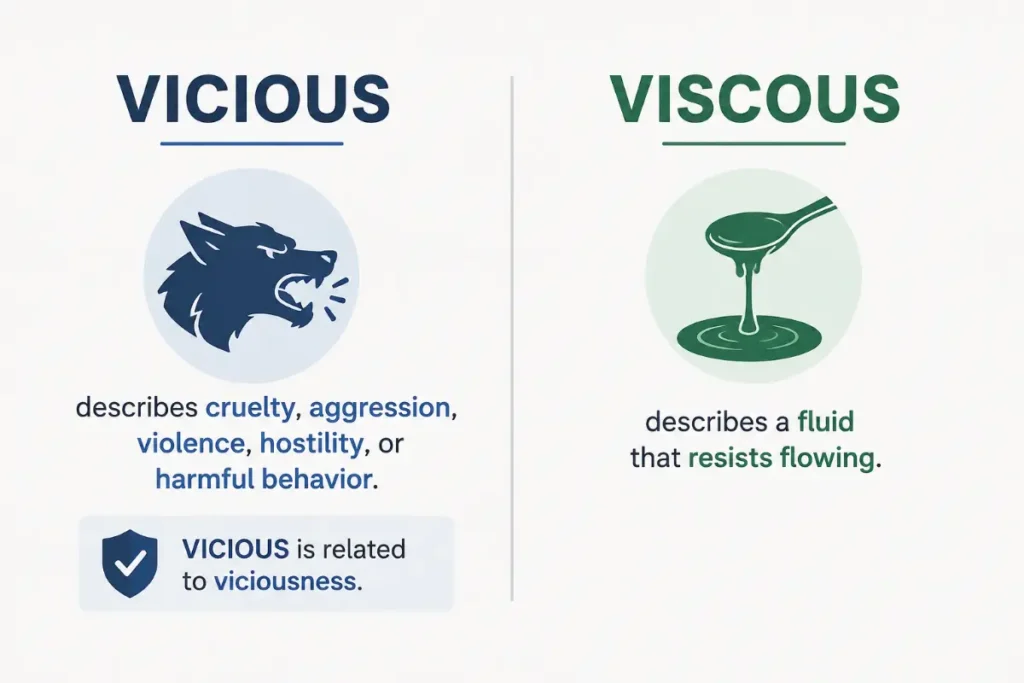
- Vicious describes cruelty aggression violence hostility or harmful behavior.
- Viscous describes a fluid that resists flowing.
- Vicious is related to viciousness.
- Viscous is related to viscosity.
- A vicious attack can be violent or cruel.
- A viscous liquid is thick and slow flowing.
- The words are pronounced differently in the middle.
- Vicious has a sh sound.
- Viscous has a sk sound.
- The two words have different histories despite their similar appearance.
- Vicious is common in everyday and formal writing.
- Viscous is especially common in science and technical writing.
Conclusion
Vicious vs Viscous becomes much easier once you connect each word to its meaning instead of focusing only on spelling. Vicious describes something cruel aggressive violent or harmful while viscous describes a fluid that flows slowly because it resists movement. One belongs to the language of behavior and harm. The other belongs to the language of fluids and physical properties.
The strongest memory trick is to connect vicious with viciousness and viscous with viscosity. If you’re talking about an attack a cruel person a hostile argument or a harmful cycle choose vicious. If you’re talking about honey oil syrup or another fluid that doesn’t flow easily choose viscous.
When you’re unsure remember the sound difference. Vicious sounds like VISH us while viscous sounds like VIS kus. That small distinction can save you from a surprisingly common word choice mistake.
FAQs
What Is The Difference Between Vicious And Viscous?
The main difference is meaning. Vicious describes something cruel aggressive violent or harmful. Viscous describes a liquid or fluid that resists flowing. A vicious dog may behave aggressively while a viscous liquid such as honey moves slowly. The words look and sound similar but belong to completely different semantic categories.
Is Honey Vicious Or Viscous?
Honey is viscous. The word describes honey’s resistance to flowing. Honey moves more slowly than water because it has greater viscosity. You might also call honey thick or syrupy in everyday conversation. Vicious would not normally describe honey because that word relates to cruelty aggression violence hostility or harmful behavior rather than fluid properties.
Is Vicious A Negative Word?
Yes. Vicious normally carries a negative meaning because it describes cruelty aggression violence hostility or harmful behavior. For example a vicious attack is severe and aggressive. A vicious rumor is deliberately harmful or extremely damaging. However the word can describe a destructive pattern such as a vicious cycle without suggesting that a person has intentionally acted cruelly.
What Does Viscous Mean In Simple Terms?
Viscous means thick and resistant to flowing. Honey is a familiar example because it moves much more slowly than water. In science the word has a more precise meaning connected to viscosity which measures a fluid’s resistance to flow. The higher the viscosity the more strongly the fluid resists movement.
How Do You Pronounce Vicious?
Vicious is commonly pronounced VISH us and can be represented as /ˈvɪʃəs/. It has two syllables. The middle sound resembles the sound in words such as mission. A useful memory cue is to focus on the sh sound. Viscous has a different middle sound and is pronounced more like VIS kus.
How Do You Pronounce Viscous?
Viscous is commonly pronounced VIS kus and can be represented as /ˈvɪskəs/. It has two syllables. The middle consonant cluster contains a sk sound. This gives you a useful contrast with vicious. Think VISH us for vicious and VIS kus for viscous.
What Is A Vicious Cycle?
A vicious cycle is a repeating pattern in which one negative condition causes another and that second condition makes the original problem worse. For example stress can cause poor sleep while poor sleep can increase stress. The two conditions reinforce each other. The phrase uses vicious figuratively rather than describing physical violence.
Is Viscous Only Used For Liquids?
Viscous is primarily used for fluids and materials that behave as fluids. It describes resistance to flow rather than simply meaning sticky. The term is especially common in physics chemistry engineering and other technical fields. In everyday conversation people often use thick instead. In scientific writing viscous provides a more precise description.
Can Vicious Describe A Person?
Yes. Vicious can describe a person whose behavior is cruel aggressive or deliberately harmful. For example you might describe someone as a vicious attacker. The word can also describe a person’s actions comments or behavior. It generally carries a strong negative meaning and often suggests more than ordinary anger or unfriendliness.
What Is The Noun Form Of Viscous?
The related noun is viscosity. Viscosity refers to a fluid’s resistance to flow. For example you can say The viscosity of the oil increased as the temperature changed. Remembering viscous and viscosity as a word family is one of the easiest ways to avoid confusing viscous with vicious.
What Is The Noun Form Of Vicious?
The related noun is viciousness. It refers to the quality or degree of being vicious. For example The viciousness of the attack shocked the witnesses. The noun can describe cruelty aggression or severe harmfulness. Remembering viciousness alongside vicious can help you keep this word separate from the scientific term viscosity.
Why Do People Confuse Vicious And Viscous?
People confuse these words because they have similar spellings similar pronunciations and the same grammatical category. Both are two syllable adjectives beginning with vis. Their meanings are completely different. Vicious belongs to the semantic field of aggression and harm while viscous belongs to the semantic field of fluids and flow.
Which Is Correct Vicious Or Viscous?
Both are correct words but they aren’t interchangeable. Use vicious for cruelty aggression violence hostility or harmful behavior. Use viscous for fluids that resist flowing. If you’re describing an aggressive animal choose vicious. If you’re describing thick honey or oil choose viscous. The context determines the correct word.

Confusing Words, Spelling & Word Choice
Claire Whitmore is a U.S.-based English editor who writes about commonly confused words, spelling differences, and word choice. Her work helps readers understand subtle distinctions between similar-looking words through simple definitions, practical examples, and modern usage guidance in both American and British English.