
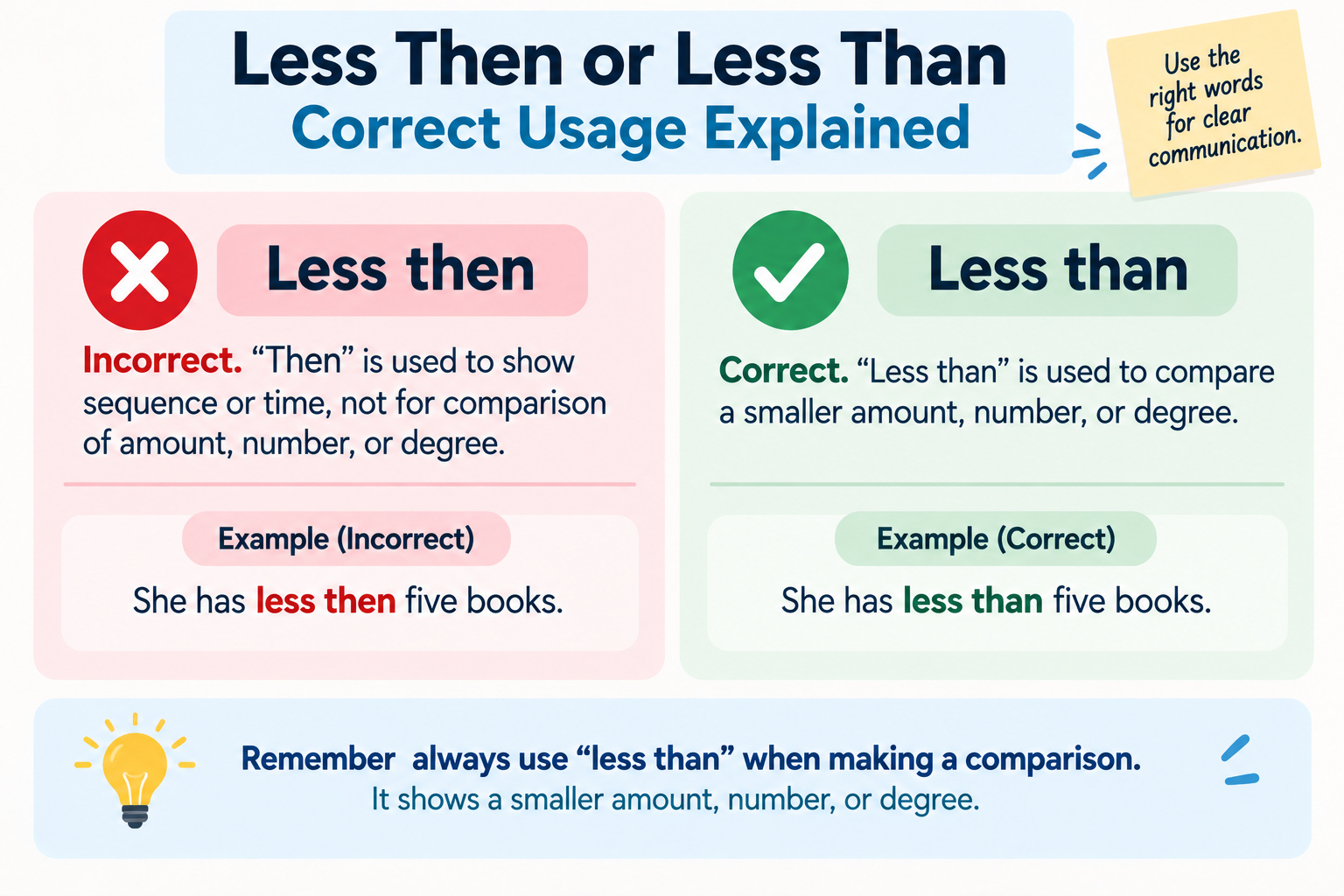
Less then or less than is a common English mistake because then and than look and sound very similar in fast speech. The correct phrase for comparisons is less than. You use it when you want to show that one amount, number, size, degree, or quantity is smaller than another.
The confusion happens because then and than are both short words with similar pronunciation. They also appear frequently in everyday writing, so a quick typing mistake can easily slip into an email, school assignment, social media post, or business document. The two words have completely different grammatical jobs, though. Than introduces a comparison, while then usually deals with time, order, or a consequence.
Once you understand that difference, the choice becomes much easier. This guide explains how each word works, why less than is correct for comparisons, how to use the phrase with numbers and countable nouns, and how to avoid common mistakes. You’ll also find pronunciation guidance, real life examples, formal writing tips, regional usage, related expressions, and simple memory tricks.
Short Answer
Less than is the correct phrase when you compare an amount, number, size, degree, or quantity. Then usually relates to time, sequence, or a result. For example, I have less than five dollars is correct, while I have less then five dollars is incorrect when you mean a quantity comparison.
Table Of Contents
- The direct difference.
- What less than means.
- What then means.
- Why the two words are confused.
- How comparisons work.
- Less than with numbers.
- Less than with nouns.
- Less than with adjectives and adverbs.
- Less than in formal writing.
- Pronunciation.
- Common mistakes.
- Real life examples.
- Memory tips.
- Related expressions.
- American and British English.
- Word origins.
- Professional editing tips.
- Frequently asked questions.
- Key takeaways.
- Conclusion.
The Direct Difference
The basic rule is simple.
Than is used for comparison.
Then is commonly used for time, sequence, or consequence.
Compare these examples.
I have less than ten dollars.
She is less than five minutes away.
The first sentence compares the amount of money with ten dollars. The second compares the distance or time with five minutes.
Now look at then.
We finished dinner and then watched a movie.
First we finished dinner. Then we watched a movie.
Here then shows the order of events. It does not compare two quantities.
This gives you a quick rule to remember:
Comparison means than.
Time or sequence means then.
What Less Than Means
Less than is a comparative expression. It tells the reader that one quantity or degree is below another.
For example:
I have less than twenty dollars.
The amount of money is below twenty dollars.
You can use the phrase with numbers.
There are less than fifty students in the room.
You can also use it with measurements.
The package weighs less than five pounds.
It works with time.
The trip takes less than an hour.
It works with age.
Children less than twelve years old may need an adult with them.
It can also describe degree.
The problem is less than serious.
That example is less common in everyday conversation, but the structure is grammatically possible.
The central idea remains the same. The phrase identifies something as being below a particular amount, level, degree, or limit.
What Then Means
Then has several common meanings, but comparison is not one of them.
One major use relates to time.
I lived there then.
Another use shows sequence.
We ate dinner and then went home.
Then can also introduce a result.
If you don’t want to go, then I’ll go alone.
It can refer to a previous period.
Back then, people communicated differently.
It can also appear in phrases such as by then and until then.
By then, the store had already closed.
Until then, we’ll keep working.
None of these uses involves a direct comparison between two quantities.
That is why then does not belong in the standard phrase used to compare amounts.
Why The Two Words Are Confused
The mistake is understandable. Then and than are visually similar and can sound close in casual speech.
The difference is just one letter.
then
than
That small spelling difference carries a major grammatical difference.
Typing speed also plays a role. When people write quickly, they may select the more familiar word automatically. Someone who frequently types then may accidentally use it in a comparison before noticing the mistake.
Another reason is pronunciation. In many varieties of American English, the vowels in unstressed speech can become less distinct. That can make the two words harder to separate by ear.
English learners can face an additional challenge because some languages use one grammatical form where English uses two separate words.
The best solution is not to rely on pronunciation alone. Look at the function of the word.
If the sentence compares two things, choose than.
If the sentence refers to time, sequence, or a result, consider then.
How Comparisons Work
Comparisons show that one person, thing, amount, or quality differs from another.
Than often introduces the second part of a comparison.
My car is older than yours.
This book is more expensive than that one.
She runs faster than I do.
The same structure appears with less.
This box is less expensive than the other one.
The new route takes less time than the old route.
The apartment is less spacious than we expected.
The word than acts as a comparison marker.
Less describes the smaller quantity or degree, while than introduces the thing being compared.
This is why less than is such a common grammatical combination.
Less Than With Numbers
One of the most common uses involves numbers.
I have less than ten minutes.
The store is less than two miles away.
The package costs less than fifty dollars.
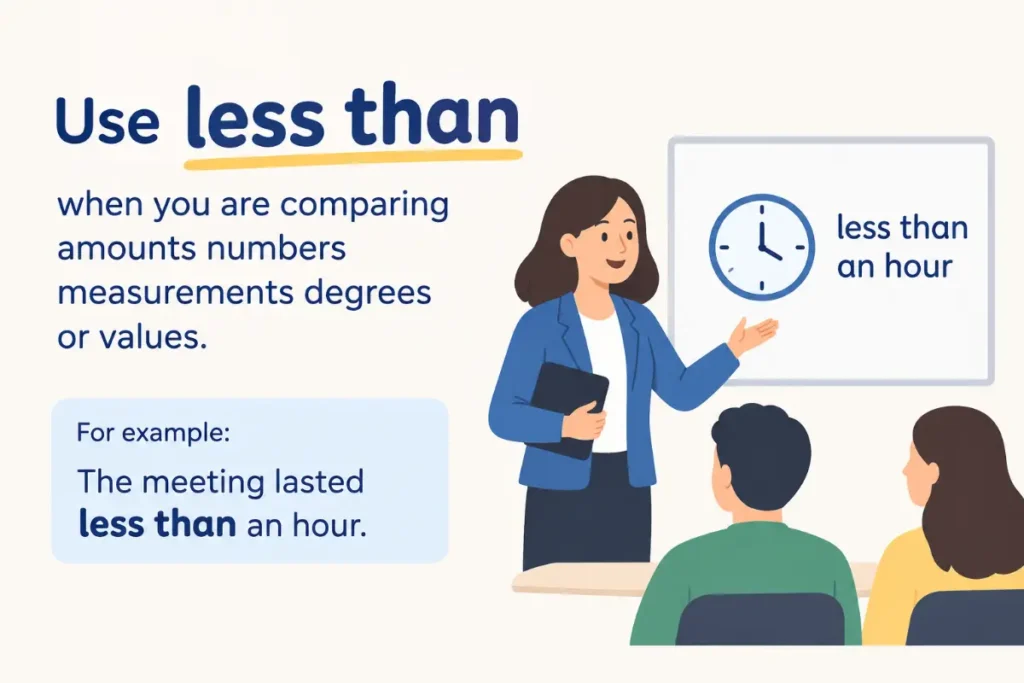
The meeting lasted less than an hour.
These sentences all express an amount below a stated number.
You can also use the phrase with percentages.
Less than ten percent of the students were absent.
The discount is less than five percent.
You can use it with measurements.
The box weighs less than three pounds.
The table is less than six feet long.
You can even use it with large quantities.
The town has less than one hundred thousand residents.
The key idea is always the same. The number establishes a comparison point, and the actual amount falls below it.
Less Than With Countable And Uncountable Nouns
Grammar becomes slightly more interesting when you use less with nouns.
Traditional grammar often distinguishes between countable and uncountable nouns.
Uncountable nouns refer to things that are not normally counted as individual units.
Examples include:
water
money
time
milk
information
traffic
For these nouns, less is standard.
I have less money than you.
We have less time than expected.
There is less traffic today.
There is less water in the tank.
Countable nouns refer to individual items that can be counted.
Examples include:
books
cars
students
people
apples
Traditional formal English generally uses fewer rather than less with plural countable nouns.
I have fewer books than you.
There are fewer students in the class this year.
However, less than is also widely used before numbers and expressions of measurement.
There were less than ten people at the event.
The event lasted less than three hours.
This distinction is worth understanding because it helps you write polished formal English. At the same time, real language use can be more flexible than a simple rule suggests.
Less Than With Time
Less than is extremely common when talking about time.
I finished the assignment in less than an hour.
She arrived in less than ten minutes.
The movie is less than two hours long.
We have less than five minutes left.
The phrase can describe duration, remaining time, or an estimated period.
You can also combine it with a noun.
The project took less than a week.
The delay lasted less than an hour.
These sentences all use than because they compare a real duration with a stated amount of time.
Less Than With Money
Money provides another common context.
The phone costs less than five hundred dollars.
I spent less than twenty dollars on lunch.
The repair should cost less than one hundred dollars.
The phrase works naturally in shopping, budgeting, business, and everyday conversation.
It also appears in advertisements and product descriptions.
The bag weighs less than two pounds.
The subscription costs less than ten dollars a month.
In all of these cases, than marks the comparison.
Less Than With Age
The phrase can also describe age.
He is less than eighteen years old.
The child is less than five years old.
The rule applies to anyone less than twenty one years old.
In everyday American English, under is often more natural in some of these situations.
He is under eighteen.
The child is under five.
Still, less than remains grammatically understandable and useful when the writer wants to emphasize a numerical comparison.
Less Than With Adjectives
Less can modify adjectives to show a lower degree of a quality.
For example:
This option is less expensive than the other one.
The second route is less convenient than the first.
The new design is less complicated than the old version.
Here less modifies an adjective.
Expensive becomes less expensive.
Convenient becomes less convenient.
Complicated becomes less complicated.
Than then introduces the comparison.
This structure is especially useful in academic and professional writing because it lets you express differences precisely.
Less Than With Adverbs
Less can also modify adverbs.
She speaks less confidently than her colleague.
He drives less carefully than his brother.
The machine operates less efficiently than expected.
Again, than introduces the comparison.
The structure is:
less + adverb + than.
This is useful when comparing how two actions happen rather than comparing two objects directly.
Less Than In Formal Writing
Less than is completely appropriate in formal English.
You can use it in academic papers, business reports, professional emails, technical documents, news writing, and official communication.
Examples include:
The study involved less than one hundred participants.
The project required less than six months to complete.
The new system uses less energy than the previous model.
The revised method produced less waste than the original process.
The expression is clear and precise. There is no reason to avoid it in formal writing.
The main concern is choosing than instead of then.
A professional editor will usually catch this error because the incorrect word changes the grammatical relationship of the sentence.
Less Then Or Less Than In Everyday Writing
In casual writing, the mistake can appear in text messages, comments, emails, and social media posts.
Someone might write:
I spent less then ten dollars.
The intended meaning is clear, but the standard form is:
I spent less than ten dollars.
Another example is:
It took less then an hour.
The correct version is:
It took less than an hour.
These errors are usually simple word choice mistakes rather than evidence that the writer does not understand the meaning of the sentence.
Still, small errors matter in professional writing. A one letter mistake can make an otherwise polished document look careless.
Pronunciation Guide
Than is commonly pronounced /ðæn/ or with a reduced vowel in connected speech.
Then is commonly pronounced /ðɛn/ in careful speech.
The first consonant sound is similar in both words. The main difference appears in the vowel.
Than has the vowel associated with words such as man and can.
Then has the vowel associated with words such as ten and when.
In rapid conversation, the distinction can become less noticeable.
For spelling purposes, it helps to connect the word with its grammatical function rather than depending entirely on pronunciation.
Think:
comparison → than
sequence → then
This method remains useful even when the spoken difference feels small.
Common Mistakes
Mistake One
Incorrect:
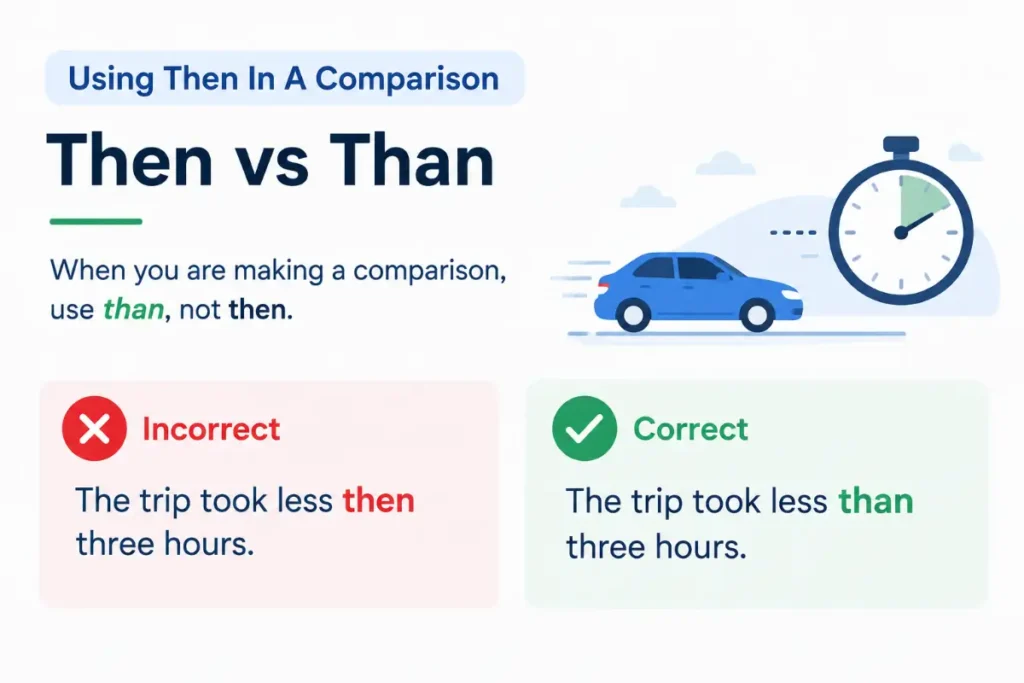
The trip takes less then two hours.
Correct:
The trip takes less than two hours.
The sentence compares the duration with two hours, so than is required.
Mistake Two
Incorrect:
I have less then five dollars.
Correct:
I have less than five dollars.
The amount is being compared with five dollars.
Mistake Three
Incorrect:
The box weighs less then ten pounds.
Correct:
The box weighs less than ten pounds.
The phrase describes a measurement below ten pounds.
Mistake Four
Incorrect:
She is less then eighteen.
Correct:
She is less than eighteen.
The sentence compares her age with eighteen.
Mistake Five
Incorrect:
We finished the work and than went home.
Correct:
We finished the work and then went home.
This time the meaning involves sequence, so then is correct.
Notice how the last example changes the problem. Then is not always wrong. It is wrong only when the sentence needs a comparison word.
Real Life Examples
Everyday Conversation
I need less than ten minutes to get ready.
The speaker says the preparation will take under ten minutes.
This restaurant is less expensive than the one downtown.
The speaker compares the prices of two restaurants.
Workplace Communication
The project should take less than three months.
The sentence gives an estimated duration below three months.
Our new system uses less energy than the previous version.
The sentence compares energy use between two systems.
Academic Writing
The survey included less than two hundred participants.
The number of participants was below two hundred.
The revised method produced less waste than the original process.
The sentence compares the amount of waste produced by two methods.
News Writing
The storm affected less than ten thousand households.
The number of affected households was below ten thousand.
The repair took less than a week to complete.
The sentence compares the actual repair period with one week.
Social Media
I spent less than twenty dollars today.
The writer is talking about an amount of money below twenty dollars.
The whole trip took less than an hour.
The writer is comparing the trip duration with one hour.
Comparison Table
| Form | Main Function | Meaning | Example | Correct In Comparison |
|---|---|---|---|---|
| Than | Comparison | Introduces the second part of a comparison | This costs less than that. | Yes |
| Then | Time or sequence | Shows what happens next or refers to a time | We ate and then left. | No |
| Less than | Quantity or degree comparison | Below a particular amount or level | It costs less than ten dollars. | Yes |
| Less then | Incorrect comparison form | Usually a spelling or word choice mistake | It costs less then ten dollars. | No |
Memory Tips
The easiest way to remember the difference is to associate than with comparison.
Think About The Letter A
Than contains an a.
Comparison often involves asking:
How does A compare with B?
This is not a formal grammar rule, but it can be a useful memory trick.
Think About Then As Time
Then often refers to what happens next.
First we ate.
Then we left.
The word fits naturally with sequence and time.
Use The Number Test
If you see a number after the phrase, check carefully.
less than five
less than ten
less than one hundred
If you are describing an amount below a number, than is almost certainly the word you need.
Use The Next Step Test
If the word means next or afterward, then is probably correct.
We finished the meeting and then went home.
That gives you a quick contrast.
Related Grammar And Usage Notes
Fewer Than
Fewer than is traditionally used with plural countable nouns.
There are fewer than ten students here.
I bought fewer than five books.
More Than
More than is the opposite comparison.
I have more than ten dollars.
She waited more than an hour.
Greater Than
Greater than is common in mathematics and technical writing.
Five is greater than three.
The measured value is greater than the expected value.
Less
Less means a smaller amount or degree.
I need less water.
The task requires less time.
Lesser
Lesser means smaller in importance, rank, size, or degree.
This is a lesser concern.
Lesser is not simply a replacement for less in every sentence.
Under
Under can sometimes express a similar numerical idea.
The package weighs under five pounds.
The child is under ten.
In everyday American English, under can sound especially natural in short statements about limits.
Below
Below can indicate a lower position, level, amount, or number.
The temperature fell below freezing.
The score was below average.
The meanings overlap in some situations, but below often focuses more strongly on position or level.
At Most
At most means no more than a particular amount.
The trip will take at most two hours.
This is useful when the upper limit matters.
American And British English
American and British English both use less than for comparisons.
I have less than ten dollars.
British speakers understand this naturally, and American speakers use it constantly.
The same applies to more formal expressions.
The project took less than six months.
There is no major regional spelling difference between American and British English for this phrase.
Canadian and Australian English also use less than in the same basic way.
The distinction between then and than is standard across major English varieties.
You do not need a different rule for American English. The grammatical function remains the same.
Word Origins
Than has a long history as a comparison word. It developed from Old English forms associated with comparison and distinction.
Then also comes from Old English and has a historical connection with time and sequence.
The two words became distinct in modern English even though their forms have remained visually similar.
Their shared history does not mean they are interchangeable today. Modern English assigns them different grammatical functions.
Understanding that difference is more useful for modern writing than memorizing the historical details.
Professional Editing Tips
A good editor does not simply look for spelling errors. The editor checks what each word is doing in the sentence.
If you see:
The service costs less then fifty dollars.
Ask what relationship the sentence expresses.
It compares the cost with fifty dollars.
That immediately points to than.
If you see:
We finished the service and then sent the invoice.
The sentence describes two actions in sequence.
That points to then.
Another useful editing trick is to substitute a clearer word.
For than, try comparison language such as compared with.
For then, try afterward or next.
If the replacement works, you can identify the intended word quickly.
This method is particularly useful when proofreading long documents because context often reveals the answer faster than spelling alone.
Exceptions And Special Cases
The phrase less than can appear in several structures that do not look like simple numerical comparisons.
For example:
He was less than honest.
This means he was not fully honest. The phrase describes degree rather than a measurable number.
Another example is:
The result was less than impressive.
Here the speaker means that the result was not very impressive.
These structures show that less than can compare degrees of qualities as well as quantities.
You may also see less than used for emphasis.
It took less than a miracle to solve the problem.
This is more expressive and depends on context. The phrase still carries the basic idea of a lower degree.
Then has its own special uses as well.
Then can refer to a past period.
Things were different back then.
It can introduce a consequence.
If that’s your decision, then I’ll respect it.
It can also show sequence.
First read the instructions, then answer the questions.
The words remain distinct even when their uses become more varied.
Why Spelling Tools May Not Catch Every Mistake
Grammar and spelling tools are useful, but context can make this particular error tricky.
Both then and than are legitimate English words. A spellchecker can recognize both as correctly spelled words.
That means a sentence containing the wrong one may not always trigger a simple spelling warning.
For example:
I have less then ten dollars.
Every individual word is spelled correctly. The problem is that the wrong word appears in the sentence.
This is a contextual grammar issue rather than a basic spelling issue.
That is why human proofreading and context aware grammar checking can be useful. You need to understand the relationship between the words rather than simply checking each word in isolation.
Expert Editor Insight
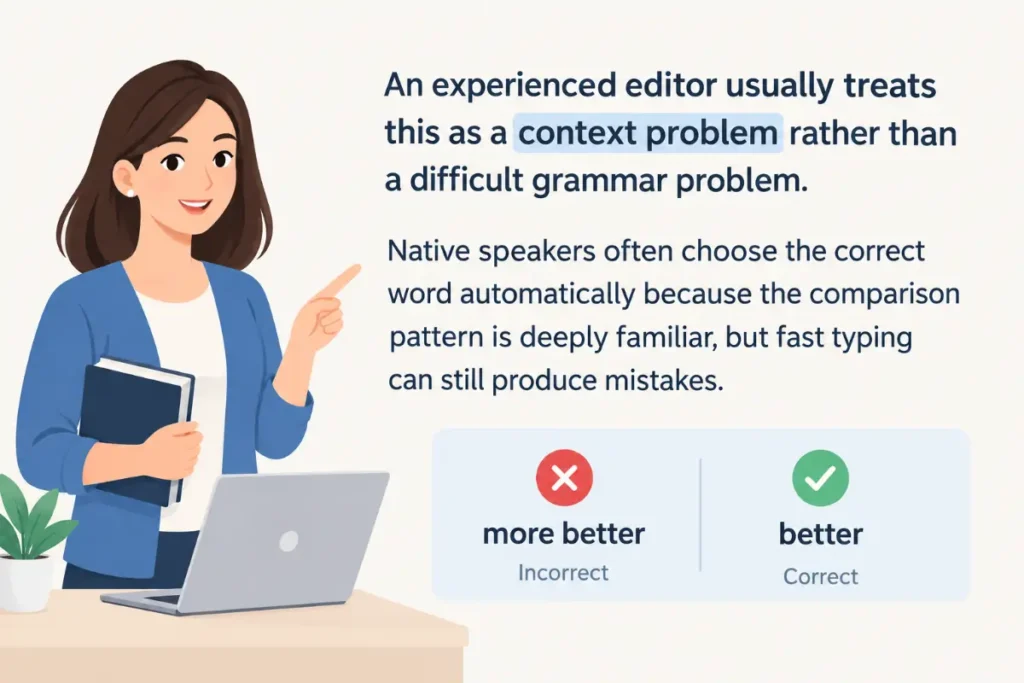
An experienced editor usually treats this as a context problem rather than a difficult grammar problem. Native speakers often choose the correct word automatically because the comparison pattern is deeply familiar, but fast typing can still produce mistakes. Professional editors look at the sentence as a whole and ask what relationship the word expresses. Grammar tools may flag the error when the surrounding sentence clearly indicates a comparison, but human review remains useful because software has to infer meaning from context. The best editing habit is to connect than with comparison and then with sequence.
Key Takeaways
- Less than is the correct phrase for comparisons.
- Than introduces the second part of a comparison.
- Then usually refers to time, sequence, or consequence.
- Use less than ten dollars for a quantity comparison.
- Use less than an hour for a time comparison.
- Use less than five miles for a distance comparison.
- Less than can also describe degree rather than a measurable amount.
- Less then is usually a word choice mistake when used in a comparison.
- Fewer than is traditionally preferred with plural countable nouns.
- Less is generally used with uncountable amounts.
- Then is correct in sentences such as We ate and then left.
- A quick editing test is to ask if the sentence compares two things.
- If it does, choose than.
- If the word means afterward or next, choose then.
Conclusion
Less then or less than has a straightforward answer. Less than is the correct form when you compare an amount, number, degree, measurement, or quantity. Then has a different job and usually refers to time, sequence, or a consequence. That is why I have less than ten dollars is correct, while I have less then ten dollars is not.
The easiest way to remember the difference is to connect than with comparison. Think of phrases such as less than five minutes, less than one hundred dollars, and less than two miles. Then belongs with sequence, as in We finished dinner and then went home.
When proofreading, ask yourself one simple question: am I comparing something? If the answer is yes, use than. That quick check can prevent one of the most common word choice mistakes in everyday English.
FAQs
Is less then or less than correct?
Less than is correct when you compare an amount, number, degree, size, or quantity. Less then is incorrect for this purpose. Then is generally used for time, sequence, or a result. For example, I have less than ten dollars is correct, while I have less then ten dollars contains the wrong comparison word.
What is the difference between less then and less than?
Less than expresses a comparison and means below a particular amount or degree. Then normally refers to time, sequence, or a consequence. For example, The package weighs less than five pounds uses than because it compares weight. We finished dinner and then left uses then because it shows the order of events.
Is less then ever correct?
Less then is not the standard phrase for expressing a comparison. In standard English, use less than when you mean below a particular amount, number, or degree. The word then can appear after less in a sentence if it has its own separate meaning, but the combination less then does not replace less than in comparison structures.
Why do people write less then instead of less than?
People often make this mistake because then and than look very similar and can sound close in rapid speech. Typing quickly can also cause the more familiar word to appear automatically. Since both words are legitimate English words, a basic spellchecker may not always identify the problem. Learning the grammatical difference is the best long term solution.
Is less than ten grammatically correct?
Yes. Less than ten means an amount below ten. You can use the phrase with many types of measurements and quantities. For example, fewer than ten students is traditional for a plural countable noun, while less than ten dollars and less than ten minutes are natural because money and time are treated as amounts.
Should I use less than or fewer than?
Use less with uncountable amounts and fewer with plural countable nouns in careful formal English. For example, less than five dollars and less than five minutes are standard. For individual countable items, fewer than five books and fewer than five students are traditionally preferred. The distinction is useful in formal writing.
Can then be used after less?
Yes, but only when then has its own meaning and is not replacing than. For example, I had less money then means I had a smaller amount of money at that earlier time. In a comparison such as I had less money than my brother, than is required because the sentence compares two amounts.
Is less than formal English?
Yes. Less than is fully acceptable in formal English. It appears naturally in academic writing, professional reports, business communication, journalism, technical documents, and everyday conversation. There is no need to replace it with a more complicated phrase. The main concern is using than correctly when the sentence expresses a comparison.
Is less then a spelling mistake?
Usually, yes. When someone writes less then while comparing an amount or degree, the problem is a word choice mistake involving two commonly confused words. Both then and than are correctly spelled words on their own. The error happens because then has been selected where the grammar requires than.
How do I remember less than?
Connect than with comparison. When you see an amount such as less than five dollars, less than ten minutes, or less than one mile, think of than as the comparison word. Then is the word to associate with time and sequence. Think first, then next. This simple contrast makes the distinction easier to remember.

Confusing Words, Spelling & Word Choice
Claire Whitmore is a U.S.-based English editor who writes about commonly confused words, spelling differences, and word choice. Her work helps readers understand subtle distinctions between similar-looking words through simple definitions, practical examples, and modern usage guidance in both American and British English.