
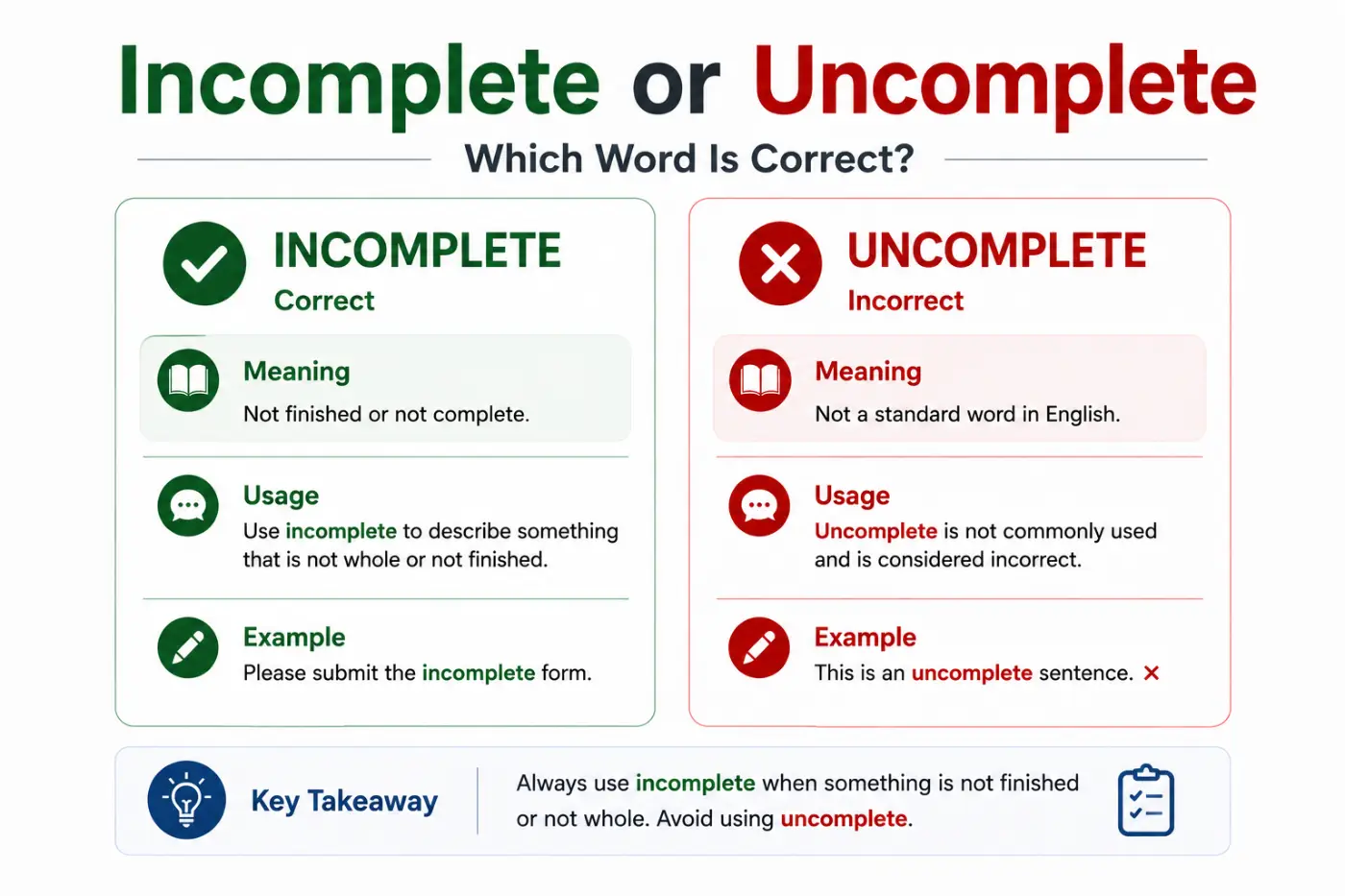
Incomplete or Uncomplete can be confusing because English often creates negative words by adding the prefix un. At first glance, uncomplete may seem logical. However, incomplete is the standard and widely accepted choice in modern English.
Use incomplete when something isn’t finished, lacks necessary information, or is missing an essential part. For example, you might write, “The application is incomplete because you didn’t provide your address.” In everyday, academic, and professional writing, uncomplete would sound unusual in this context.
The confusion makes sense because English has many familiar words that begin with un, including unfinished, unclear, unknown, unusual, and unhappy. However, English prefixes don’t follow one simple rule. Historical language changes, word origins, and established usage all influence which forms become standard.
This guide explains the difference between incomplete and uncomplete, explores the meaning and grammar of incomplete, and provides practical examples for everyday conversations, academic work, and professional communication. You’ll learn why one form is preferred and how to avoid this common word choice mistake.
Short Answer
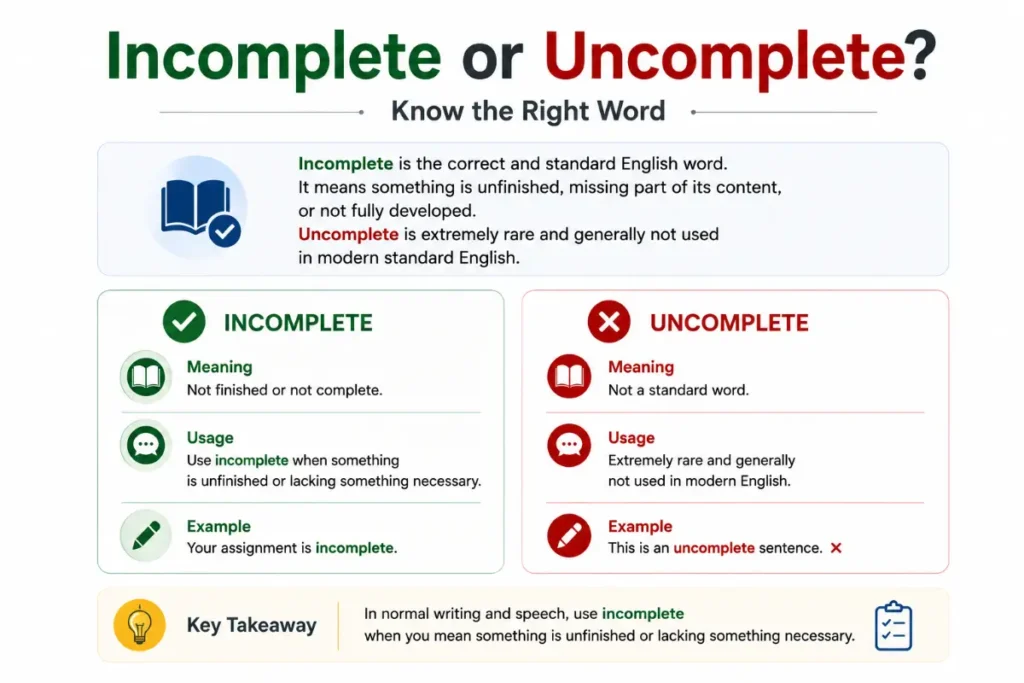
Incomplete is the correct and standard English word. It means something is unfinished, missing part of its content, or not fully developed. Uncomplete is extremely rare and generally not used in modern standard English. In normal writing and speech, use incomplete when you mean something is unfinished or lacking something necessary.
Table of Contents
- What Is Incomplete
- What Does Incomplete Mean
- Is Uncomplete a Word
- Incomplete or Uncomplete Which One Should You Use
- Why Incomplete Is the Standard Form
- Comparison Table
- How to Use Incomplete Correctly
- Incomplete in Different Contexts
- Examples of Incomplete in Sentences
- Common Mistakes
- Incomplete vs Unfinished
- Incomplete vs Uncompleted
- Pronunciation of Incomplete
- Word Origin and Formation
- Formal and Informal Usage
- Memory Tips
- Related Grammar and Usage Notes
- Frequently Asked Questions
- Key Takeaways
- Conclusion
What Is Incomplete
Incomplete is an adjective that describes something that isn’t finished, whole, or fully supplied with the information or parts it needs.
The word can describe physical objects, tasks, documents, processes, ideas, records, statements, applications, plans, and many other things.
Consider these examples.
“The report is incomplete.”
This means the report isn’t finished or doesn’t contain everything it should contain.
“Your application is incomplete.”
This means some required information or section is missing.
“The evidence is incomplete.”
This means the available evidence doesn’t provide the full picture.
“The sentence is incomplete.”
This means the sentence doesn’t form a complete grammatical or meaningful unit.
The central idea is lack of completeness.
The noun form is incompleteness.
The adverb is incompletely.
The related adjective complete has the opposite meaning.
Complete means whole, finished, or containing everything required.
Incomplete means not complete.
This relationship makes the word easy to understand once you recognize that incomplete is the established negative form of complete.
What Does Incomplete Mean
The most useful definition of incomplete is not complete or not containing everything that is required.
It can describe something that has stopped before reaching its intended end.
For example:
“The construction project is incomplete.”
The project hasn’t reached completion.
It can also describe something that is missing information.
“The customer record is incomplete.”
Some information is absent from the record.
It can describe something that lacks a necessary part.
“The set is incomplete.”
One or more pieces are missing.
It can also describe an idea or explanation that doesn’t provide the full information needed to understand something.
“His explanation was incomplete.”
The explanation didn’t cover all the relevant points.
So, incomplete doesn’t always mean that someone simply stopped working. It can also mean that something exists but lacks a necessary element.
Is Uncomplete a Word
Uncomplete can be found occasionally in historical writing, specialized contexts, or dictionaries that record rare or obsolete forms. However, it isn’t the normal modern English choice for expressing the opposite of complete.
For practical writing, treat incomplete as the standard form.
This distinction matters because a word can technically appear in English without being a good choice for everyday communication. English contains many rare, archaic, dialectal, and obsolete words that readers may encounter in old books or specialized sources. Their existence doesn’t mean they are appropriate replacements for common modern vocabulary.
If your goal is clear modern English, choose incomplete.
For example:
Correct and natural:
“The form is incomplete.”
Natural:
“The project remains incomplete.”
Natural:
“We received an incomplete application.”
Unusual and generally best avoided:
“The form is uncomplete.”
The problem with uncomplete isn’t that readers can never understand it. Most English speakers can guess what it means. The issue is that it doesn’t sound natural in standard modern usage.
Incomplete or Uncomplete Which One Should You Use
The answer is simple.
Use incomplete.
Use it in everyday conversation, school assignments, business communication, technical writing, professional documents, and formal writing.
For example:
“Please submit the incomplete sections by Friday.”
“The application was marked incomplete.”
“The data set is incomplete.”
“The story feels incomplete without the final chapter.”
“The payment information is incomplete.”
These sentences sound natural because incomplete is the established adjective.
Avoid replacing it with uncomplete simply because the prefix un often creates opposites.
English doesn’t form every opposite adjective with the same prefix.
We say:
Complete → incomplete.
Possible → impossible.
Regular → irregular.
Legal → illegal.
Honest → dishonest.
Happy → unhappy.
There is no single prefix rule that applies to every adjective.
That is one reason English learners often find word formation challenging.
Why Incomplete Is the Standard Form
The main reason is established usage. English vocabulary isn’t built only by applying mathematical rules. Historical development and long standing usage determine which forms become standard.
The adjective incomplete became the established form for describing something that isn’t complete. Speakers and writers have used it consistently across many varieties of English.
Once a form becomes firmly established, an alternative that seems logically possible doesn’t automatically become standard. This is similar to many other English word choices. A learner may construct a word that appears logical based on another pattern, but native usage may strongly prefer a different form.
For example, English speakers say unusual rather than inusual. They say impossible rather than unpossible. They say irregular rather than unregular.
The same principle applies here.
The fact that complete can take the prefix in doesn’t mean that every adjective with a similar meaning must use in. The correct form depends on the word’s established history and usage.
Comparison Table
| Feature | Incomplete | Uncomplete |
|---|---|---|
| Standard modern English | Yes | No |
| Common adjective | Yes | No |
| Meaning | Not complete | Intended to mean not complete |
| Natural in everyday English | Yes | No |
| Suitable for formal writing | Yes | Generally no |
| Common in American English | Yes | Extremely rare |
| Common in British English | Yes | Extremely rare |
| Recommended choice | Yes | No |
The key difference is not really meaning. If someone uses uncomplete, readers can usually infer the intended meaning. The real issue is standard usage and naturalness.
How to Use Incomplete Correctly
Incomplete is an adjective, so it commonly appears before a noun or after a linking verb.
Before a noun:
“Please review the incomplete application.”
“The teacher returned the incomplete assignment.”
“The company received an incomplete report.”
After a linking verb:
“The application is incomplete.”
“The report seems incomplete.”
“The information remains incomplete.”
You can also use it with nouns that describe abstract concepts.
“The evidence is incomplete.”
“The analysis is incomplete.”
“The explanation is incomplete.”
“The record is incomplete.”
“The picture is incomplete.”
The word works naturally in both simple and sophisticated sentences.
Incomplete Before A Noun
When incomplete comes before a noun, it directly describes the noun.
Examples include:
“an incomplete form”
“an incomplete answer”
In each example, the adjective tells the reader that something necessary is missing.
Incomplete After A Linking Verb
You can also place incomplete after verbs such as be, seem, remain, and appear.
Examples:
“The form is incomplete.”
“The answer seems incomplete.”
“The report remains incomplete.”
“The explanation appears incomplete.”
These constructions are especially common in professional and academic writing.
Incomplete With Very
Because incomplete is an adjective, it can be modified by adverbs such as very, partly, largely, and almost.
Examples:
“The information is very incomplete.”
“The report is partly incomplete.”
“The project remains largely incomplete.”
“The application is almost complete.”
Notice the last example. Instead of saying almost incomplete, the writer uses the positive adjective complete because the intended meaning is that only a small amount of work remains.
Incomplete in Different Contexts
The word appears in many areas of English.
Understanding those contexts helps you recognize how broad its meaning can be.
Incomplete Forms
A form is incomplete when required information hasn’t been provided.
For example:
“Your tax form is incomplete.”
This means one or more required fields haven’t been filled in.
Incomplete Applications
Schools, employers, banks, government agencies, and businesses commonly use this word for applications.
“Your application is incomplete.”
The sentence usually means that something required is missing.
Incomplete Assignments
Teachers and professors can use incomplete when a student hasn’t finished an assignment.
“The essay is incomplete because the conclusion is missing.”
The word can also describe an assignment that doesn’t contain all required sections.
Incomplete Sentences
In grammar, an incomplete sentence is a group of words that doesn’t express a complete thought or doesn’t meet the requirements of a complete sentence.
For example:
“Because I was tired.”
This may be incomplete when it stands alone because because introduces a dependent clause that normally needs an independent clause.
A complete version would be:
“Because I was tired, I went to bed early.”
The meaning becomes complete because the dependent clause is connected to an independent clause.
Incomplete Information
Information can be incomplete when some relevant facts are missing.
“The police had incomplete information about the incident.”
This doesn’t necessarily mean the information was wrong. It means the available information didn’t contain everything needed.
Incomplete Data
Researchers, analysts, and software professionals often discuss incomplete data.
“The analysis was limited by incomplete data.”
Here, incomplete means some expected data was unavailable.
Incomplete Work
A manager might say:
“The work is incomplete.”
This means the required work hasn’t been fully finished.
The word can describe both a temporary condition and a final deficiency.
Incomplete Plans
A plan can be incomplete when it lacks important details.
“The proposal is incomplete because it doesn’t include a budget.”
The plan exists, but it isn’t sufficiently developed.
Examples of Incomplete in Sentences
Here are practical examples from different situations.
Everyday Examples
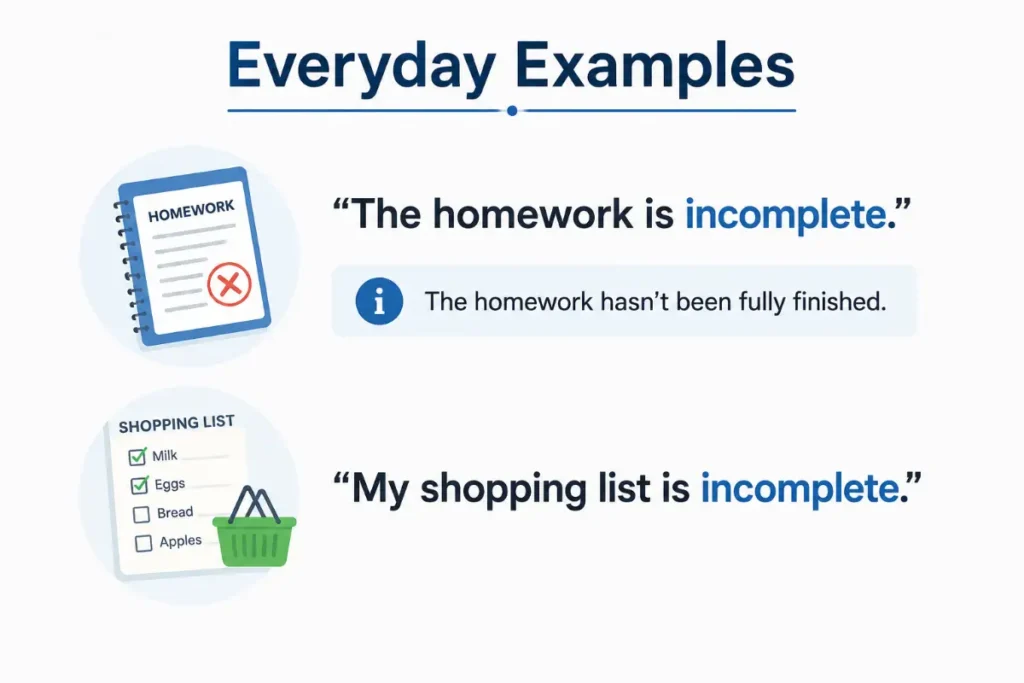
“The homework is incomplete.”
The homework hasn’t been fully finished.
“My shopping list is incomplete.”
The speaker knows that some needed items haven’t been added.
“The meal feels incomplete without dessert.”
The speaker is expressing the idea that something is missing from the overall experience.
“Your answer is incomplete.”
The answer doesn’t contain all the information required.
Workplace Examples
“The report is incomplete.”
The report needs additional information or sections.
“The employee submitted an incomplete form.”
The form didn’t contain all required details.
“The project remains incomplete.”
The project hasn’t reached its intended final state.
“The financial record is incomplete.”
Some financial information is missing from the record.
Academic Examples
“Her research is incomplete.”
The research hasn’t yet covered all necessary areas.
“The student’s answer was incomplete.”
The answer didn’t fully address the question.
“The paragraph is incomplete.”
The paragraph may lack a necessary sentence, idea, or grammatical structure.
“The study uses incomplete data.”
Some expected data wasn’t available.
Formal Examples
“The court received an incomplete record.”
The record didn’t contain all necessary material.
“The committee considered the proposal incomplete.”
The proposal lacked information needed for evaluation.
“The historical account is incomplete.”
The account doesn’t provide the full available story.
“The investigation remains incomplete.”
The investigation hasn’t reached a final stage.
Common Mistakes
One of the most common mistakes is creating uncomplete by assuming that un must be the correct negative prefix.
That assumption feels logical but doesn’t match standard usage.
Another mistake is using incomplete when unfinished would be more precise.
For example:
“The project is incomplete.”
This can mean the project isn’t finished or that some required component is missing.
“The project is unfinished.”
This more directly emphasizes that the work hasn’t been completed.
Both can be correct, but their emphasis can differ.
A third mistake is treating incomplete and uncompleted as interchangeable in every situation. They overlap, but incomplete is much more natural in many contexts.
A fourth mistake is assuming that uncomplete is automatically correct because words such as unhappy and unfinished exist.
English prefixes don’t operate with perfect consistency.
Mistake One
“The application is uncomplete.”
Better:
“The application is incomplete.”
The second sentence uses the standard adjective.
Mistake Two
“I submitted an uncomplete report.”
Better:
“I submitted an incomplete report.”
The report is missing some required information or content.
Mistake Three
“The sentence is uncomplete.”
Better:
“The sentence is incomplete.”
This is the natural grammatical description.
Mistake Four
“The work is uncomplete.”
Better:
“The work is incomplete.”
This is the standard modern form.
Incomplete vs Unfinished
Incomplete and unfinished are close in meaning, but they aren’t always identical.
Unfinished focuses more directly on something that hasn’t been completed.
Compare these examples.
“The application is incomplete.”
This suggests that required information is missing.
“The application is unfinished.”
This could suggest that the person started working on it but didn’t finish it.
“The painting is incomplete.”
The painting lacks parts needed to make it complete.
The artist hasn’t finished working on it.
The difference can be subtle.
If you’re talking about missing information or missing components, incomplete is often the better choice.
If you’re talking about work that hasn’t reached its final stage, unfinished may be more natural.
Incomplete vs Uncompleted
Uncompleted is a real adjective and can appear in English, although it is less common than incomplete in many ordinary contexts.
It usually describes something that hasn’t been completed.
For example:
“Several uncompleted tasks remained on the list.”
This is grammatically possible.
However, in many contexts, incomplete sounds more natural.
Compare:
“The application is incomplete.”
“The application is uncompleted.”
The first sentence is much more idiomatic.
The word uncompleted is often used when emphasizing an action or task that wasn’t completed.
For example:
“The employee left several tasks uncompleted.”
Here the construction naturally emphasizes tasks that someone failed to finish.
By contrast:
“The application is incomplete.”
This focuses on the state or condition of the application.
Understanding this distinction helps you choose vocabulary more precisely.
Pronunciation of Incomplete
Incomplete is pronounced approximately like:
in kuhm PLEET
The main stress falls on the final syllable.
In phonetic notation, it is commonly represented as:
/ˌɪnkəmˈpliːt/
The word contains three main syllable units:
in
com
plete
The final part sounds like the word pleat.
When speaking naturally, don’t give equal emphasis to every part. The strongest stress falls on plete.
For example:
“The report is incomplete.”
The strongest emphasis naturally falls near the end of incomplete.
Word Origin and Formation
The word incomplete comes from Latin based vocabulary that entered English through French and Latin influenced forms.
The base idea is connected with complete, which means full or finished.
The prefix in can express negation in many words derived from Latin.
English has several examples of this pattern:
accurate → inaccurate
complete → incomplete
direct → indirect
visible → invisible
dependent → independent
But this doesn’t mean that in is a universal negative prefix. English uses several different negative prefixes depending on the word and its history.
This is why learners shouldn’t try to generate every negative adjective mechanically.
Instead, learn the established form.
For complete, that established form is incomplete.
Formal and Informal Usage
Incomplete works well in virtually every level of standard English.
You can use it in casual conversation.
“My homework is incomplete.”
You can use it in professional communication.
“Your application is incomplete.”
You can use it in academic writing.
“The available evidence is incomplete.”
You can use it in technical writing.
“The data set is incomplete.”
You can use it in formal reports.
“The submitted documentation remains incomplete.”
This flexibility makes incomplete a particularly useful word.
The rare form uncomplete doesn’t offer any practical advantage. Using it may make your writing sound unusual or nonstandard.
If you’re writing an email, report, essay, application, article, or business document, choose incomplete.
Incomplete or Uncomplete in American English
American English uses incomplete as the normal form.
You will encounter it in schools, workplaces, applications, official documents, software interfaces, and ordinary conversation.
For example:
“Your application is incomplete.”
“An incomplete assignment may receive partial credit.”
“The information provided is incomplete.”
The rare form uncomplete isn’t a normal alternative in American English.
Incomplete or Uncomplete in British English
British English also uses incomplete as the standard form.
The basic meaning and grammatical behavior are the same.
Examples include:
“The form is incomplete.”
“The record is incomplete.”
“The account is incomplete.”
So this isn’t a case where American and British English normally choose different words.
Both major varieties of standard English prefer incomplete.
Why English Learners Say Uncomplete
The confusion usually comes from productive English prefixes.
English speakers regularly create negative forms with un.
Examples include:
happy → unhappy
clear → unclear
known → unknown
finished → unfinished
certain → uncertain
complete → ?
A learner naturally expects uncomplete.
The difficulty is that language doesn’t always follow a single productive pattern.
Some adjectives use in.
Others use un.
Some use im or il or ir.
And some have completely different opposites.
For example:
possible → impossible
legal → illegal
regular → irregular
complete → incomplete
happy → unhappy
This is why vocabulary learning requires attention to actual usage rather than relying only on logical word formation.
Can You Say Uncomplete
In ordinary modern English, it’s best not to use uncomplete.
A reader may understand what you mean, but the word can sound unnatural or nonstandard.
If you’re checking an essay, professional document, application, website, or formal message, replace it with incomplete.
For example:
Instead of:
“The document is uncomplete.”
Write:
“The document is incomplete.”
Instead of:
“The work remains uncomplete.”
Write:
“The work remains incomplete.”
Instead of:
“This is an uncomplete answer.”
Write:
“This is an incomplete answer.”
The correction is simple and makes the sentence sound natural.
When To Use Incomplete
Use incomplete when something doesn’t have all its required parts, information, or qualities.
A useful mental test is this:
Ask yourself, “Is something missing from this thing?”
If the answer is yes, incomplete is often appropriate.
For example:
“The form is incomplete.”
Something required is missing.
“The explanation is incomplete.”
Some necessary information is missing.
“The record is incomplete.”
Some relevant information isn’t included.
“The sentence is incomplete.”
The sentence doesn’t express a complete grammatical thought.
“The project is incomplete.”
The project hasn’t reached the required finished state.
This simple test works across many contexts.
When To Use Complete Instead
Sometimes writers accidentally use incomplete when they actually mean that something is finished.
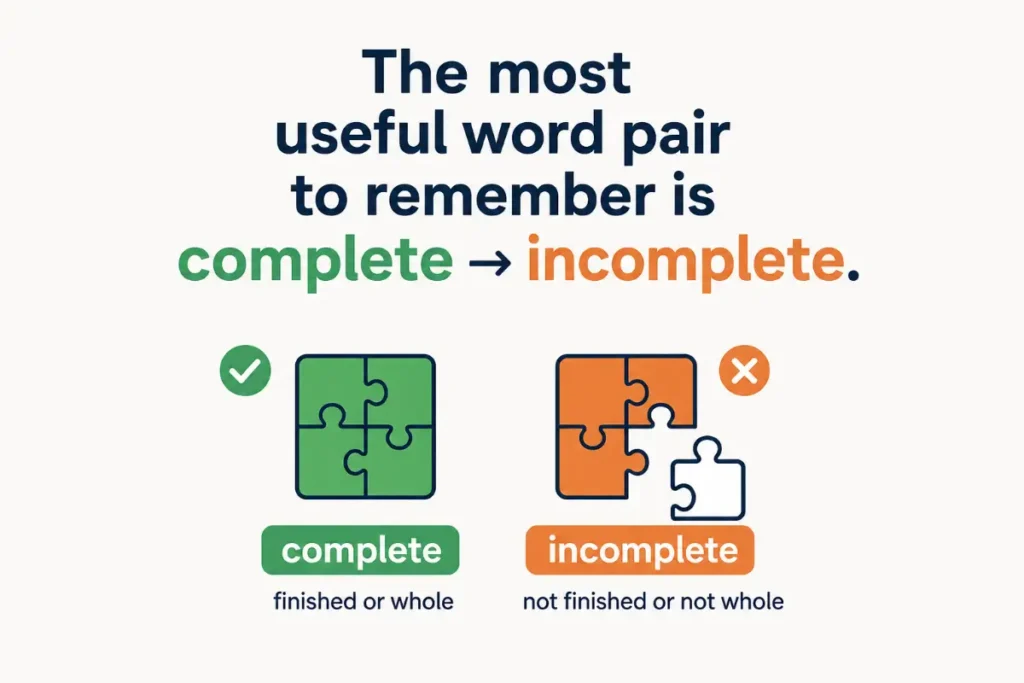
Remember the basic contrast:
Complete means whole or finished.
Incomplete means not whole or not finished.
Compare:
“The report is complete.”
Everything required is included.
“The report is incomplete.”
Something required is missing.
“The application is complete.”
All required information has been provided.
“The application is incomplete.”
Some required information is missing.
“The project is complete.”
The work has reached its intended final stage.
“The project is incomplete.”
The work still lacks something necessary.
Memory Tips
The easiest memory trick is to remember one pair:
Complete → Incomplete
Think of the phrase:
Complete has its opposite in incomplete.
Another useful trick is to remember that incomplete is the word you’ll see on forms, applications, assignments, reports, and records.
Imagine receiving a message that says:
“Your application is incomplete.”
That familiar phrase can help lock the correct form into memory.
You can also remember this short sentence:
Something missing is incomplete.
That sentence captures the central meaning.
Don’t try to create uncomplete simply because unfinished is a normal word. The two words have different histories and established usage patterns.
Related Grammar and Usage Notes
Understanding incomplete also helps with several related forms.
Complete
Complete is an adjective meaning whole, finished, or containing everything required.
“The report is complete.”
Completely
Completely is the adverb.
“The report was completely revised.”
It means fully or entirely.
Incompletely
Incompletely is the adverb related to incomplete.
“The information was incompletely recorded.”
It means in a way that isn’t complete.
Incompleteness
Incompleteness is the noun.
“The incompleteness of the record made the investigation difficult.”
It refers to the state or quality of being incomplete.
Completion
Completion is the noun related to complete.
“The project reached completion in June.”
Notice that English doesn’t use uncompletion as the normal noun for the opposite state. Depending on the context, writers usually use phrases such as lack of completion, incompleteness, or failure to complete.
Related Words You Should Know
Several words are closely connected to incomplete.
Unfinished
Something hasn’t been finished.
Partial
Something represents only part of a whole.
Fragmentary
Something consists of incomplete pieces or fragments.
Missing
Something that should be present isn’t there.
Deficient
Something lacks an expected quality or amount.
Insufficient
Something isn’t enough for a particular purpose.
These words aren’t perfect synonyms in every context.
For example, an incomplete report may contain insufficient information, but incomplete describes the report’s overall lack of completeness. Insufficient focuses on quantity or adequacy.
That distinction matters in precise writing.
Real Life Usage Examples
Imagine you’re filling out a job application online.
You leave two required fields empty. The website displays:
“Your application is incomplete.”
That is natural and standard.
Now imagine a teacher reviewing an assignment.
The student submitted the introduction and body but forgot the conclusion. The teacher might write:
“Your essay is incomplete.”
Again, incomplete is the natural word.
At work, a manager might say:
“The sales report is incomplete because last week’s figures are missing.”
In a research setting, someone might write:
“The available evidence is incomplete.”
In a technical setting:
“The data set is incomplete because several records were not imported.”
In each situation, the basic concept stays the same. Something that should be present is missing, or the work hasn’t reached a complete state.
Professional Writing Tips
Professional writing rewards familiar and precise vocabulary.
When describing missing information, use incomplete rather than inventing an alternative.
Instead of:
“The documentation is uncomplete.”
Write:
“The documentation is incomplete.”
Instead of:
“We received an uncomplete application.”
Write:
“We received an incomplete application.”
Instead of:
“The report remains uncomplete.”
Write:
“The report remains incomplete.”
The standard form reduces distraction and makes your writing sound polished.
This is especially important in resumes, cover letters, reports, academic papers, business emails, customer communication, and official documents.
A reader shouldn’t have to pause and wonder if a word is standard.
A Simple Rule To Remember
Here is the rule you can keep:
Use incomplete when you mean not complete.
Don’t use uncomplete as the ordinary opposite of complete.
If something is missing information, missing parts, unfinished, or not fully developed, incomplete is usually the correct adjective.
This rule covers most situations you’ll encounter.
Key Takeaways
- Incomplete is the standard modern English adjective.
- It means not complete, not whole, unfinished, or missing something necessary.
- Uncomplete is extremely rare and generally isn’t the form you should use in normal modern English.
- Use incomplete in American English and British English.
- Incomplete works in casual, academic, professional, technical, and formal writing.
- Unfinished is related but can place more emphasis on work that hasn’t reached completion.
- Uncompleted can be used in some contexts, especially when focusing on tasks or actions that weren’t completed, but incomplete is often more natural.
- The most useful word pair to remember is complete → incomplete.
Conclusion
The difference between incomplete and uncomplete is simple: incomplete is the correct and standard word in modern English.
Use incomplete to describe something that is unfinished, missing necessary information, lacking some of its parts, or not fully developed. It commonly appears in contexts involving applications, forms, assignments, reports, sentences, records, data, plans, projects, and explanations.
Although uncomplete may occasionally appear in older texts or unusual contexts, it is not commonly used in modern English. Using it in everyday conversations or professional writing may sound unnatural.
The easiest way to remember the correct choice is that complete becomes incomplete when you want to express the opposite meaning. Remember this word pair, and you can confidently choose the right form in your writing.
Frequently Asked Questions
Is incomplete the correct word?
Yes. Incomplete is the standard English word for something that isn’t finished, whole, or complete.
Is uncomplete grammatically correct?
Uncomplete is rare in modern English and isn’t the usual choice. In everyday, academic, and professional writing, use incomplete instead.
What is the difference between incomplete and uncomplete?
Both forms suggest a lack of completeness, but incomplete is the established standard word. Uncomplete is uncommon and generally best avoided.
Can I use uncomplete in formal writing?
It’s best to avoid uncomplete in formal writing. Incomplete is the accepted, natural choice and will be clearer to your readers.
Why is it incomplete and not uncomplete?
English doesn’t form every opposite word by adding the same prefix. Although un appears in words such as unfinished and unclear, the established opposite of complete is incomplete.
Is incomplete used in American English?
Yes. Incomplete is standard in American English and appears in everyday conversations, education, business, technology, and formal writing.
Is incomplete used in British English?
Yes. British English also uses incomplete as the standard adjective. There is no significant difference between American and British English in this case.
Is incomplete the opposite of complete?
Yes. Complete means whole, finished, or containing everything needed. Incomplete describes something that lacks a necessary part or hasn’t reached a complete state.
Is unfinished the same as incomplete?
The two words overlap, but their meanings can differ slightly. Unfinished emphasizes that something hasn’t been finished, while incomplete often highlights missing parts, information, or details.
For example, an unfinished painting still needs work, while an incomplete application may be missing required information.
Is uncompleted the same as incomplete?
The words can have similar meanings, but their usage differs. Incomplete is often more natural when describing something that lacks parts or information. Uncompleted can emphasize a task or action that hasn’t been completed.
For example, “The application is incomplete” sounds more natural than “The application is uncompleted.”
What is the noun form of incomplete?
The noun form is incompleteness.
For example, “The incompleteness of the report caused problems.”
What is the adverb form of incomplete?
The adverb form is incompletely.
For example, “The form was incompletely filled out.”
Can incomplete describe a person?
It can describe a person’s work, records, or other associated details. However, calling someone incomplete can sound unusual or overly broad unless the context clearly explains what is missing.
Is incomplete a formal word?
Yes. Incomplete is appropriate for casual conversations, academic assignments, business documents, technical writing, and formal communication.
What is an example of incomplete?
“The application is incomplete because two required sections are missing.”
This sentence shows how incomplete describes something that lacks necessary information.
What should I write instead of uncomplete?
Use incomplete in standard modern English.
For example, write “Your form is incomplete” rather than “Your form is uncomplete.” The first sentence is clear, natural, and grammatically appropriate.

Confusing Words, Spelling & Word Choice
Claire Whitmore is a U.S.-based English editor who writes about commonly confused words, spelling differences, and word choice. Her work helps readers understand subtle distinctions between similar-looking words through simple definitions, practical examples, and modern usage guidance in both American and British English.