
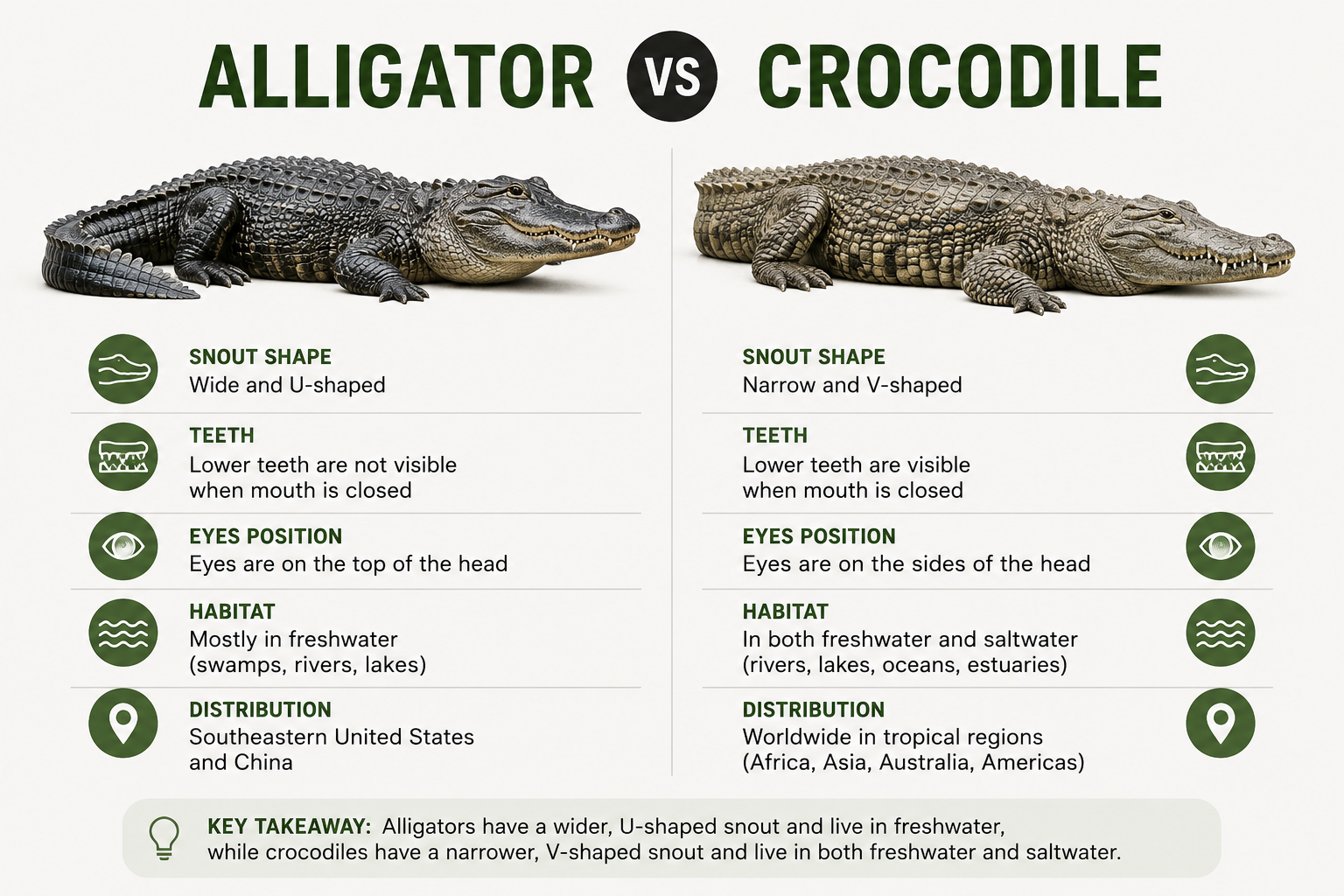
Alligator vs Crocodile is a common animal comparison because these reptiles share many physical features. Both have long bodies, powerful tails, tough armored skin, strong jaws, and spend much of their lives in or near water. Despite these similarities, alligators and crocodiles belong to different groups of reptiles and have several clear differences.
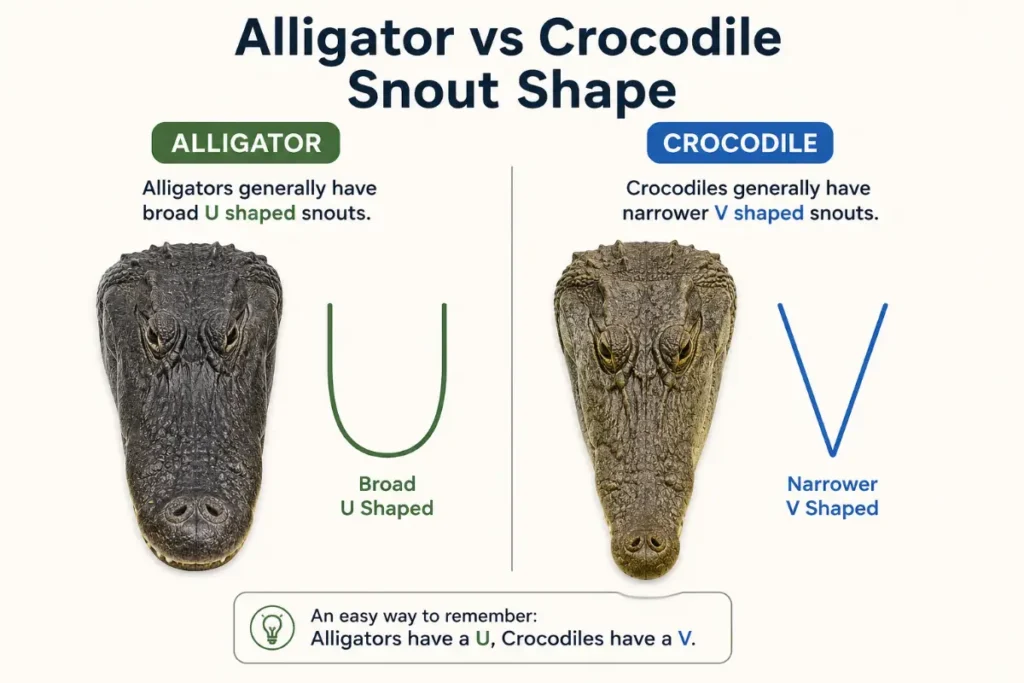
The easiest way to tell them apart is to examine their snouts and teeth. An alligator usually has a broad, rounded, U-shaped snout, while a crocodile typically has a narrower, more pointed, V-shaped snout. When an alligator closes its mouth, its large lower fourth tooth fits into a socket in the upper jaw. A crocodile’s corresponding tooth usually remains visible along the outside of the upper jaw.
Their habitats offer another helpful clue. American alligators mainly live in freshwater environments, including swamps, marshes, lakes, and slow-moving rivers. Crocodiles also inhabit freshwater, but many species tolerate brackish water and saltwater more effectively because they have specialized salt glands that help remove excess salt from their bodies.
There’s more to this comparison than appearance and habitat. Taxonomy, body size, geographic range, behavior, diet, pronunciation, and word history all help explain how these reptiles differ. This guide covers the key distinctions in clear, simple language so you can recognize an alligator, identify a crocodile, and use both terms correctly.
Short Answer
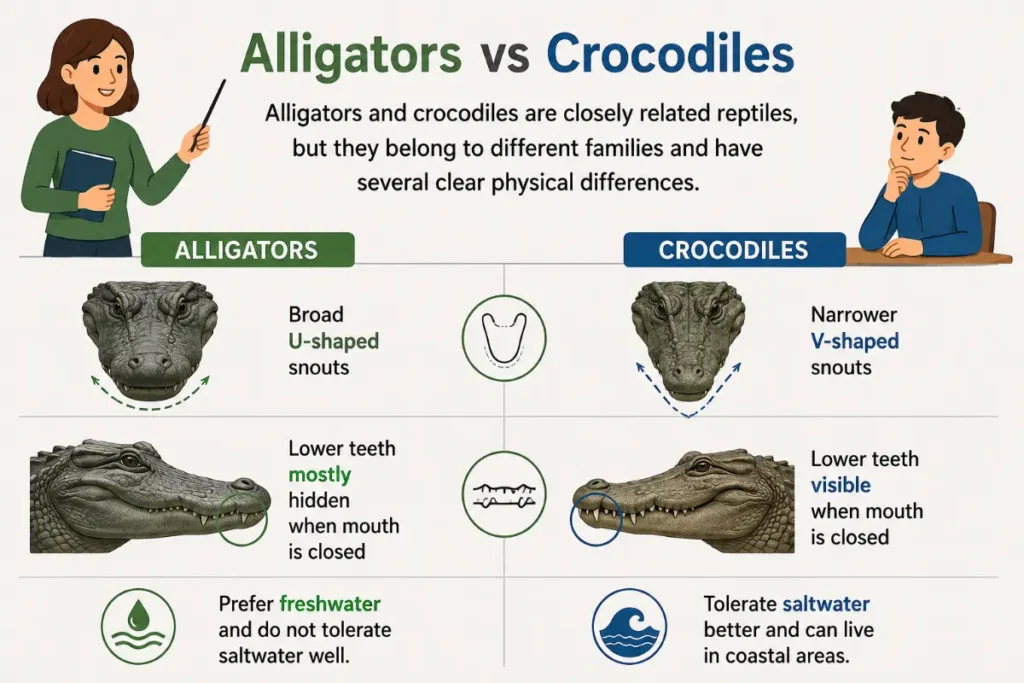
Alligators and crocodiles are closely related reptiles, but they belong to different families and have several clear physical differences. Alligators usually have broad U shaped snouts and mostly hidden lower teeth when their mouths are closed. Crocodiles usually have narrower V shaped snouts and visible lower teeth. Crocodiles also tolerate saltwater better than alligators.
Table Of Contents
- What Is An Alligator.
- What Is A Crocodile.
- Alligator vs Crocodile At A Glance.
- The Biggest Physical Difference.
- Snout Shape.
- Teeth And Jaw Shape.
- Body Size And Appearance.
- Skin Color.
- Habitat And Geographic Range.
- Freshwater And Saltwater.
- Families And Scientific Classification.
- Behavior And Temperament.
- Diet And Hunting.
- Movement And Swimming.
- Reproduction And Young.
- Alligator Species.
- Crocodile Species.
- Alligator vs Crocodile In The United States.
- How To Identify One In The Wild.
- Pronunciation.
- Word Origins.
- Common Mistakes.
- Real Life Examples.
- Memory Tips.
- Related Words And Terms.
- Frequently Asked Questions.
- Key Takeaways.
- Conclusion.
What Is An Alligator
An alligator is a large crocodilian reptile belonging to the family Alligatoridae. The two living animals commonly called alligators are the American alligator and the Chinese alligator. The American alligator has the scientific name Alligator mississippiensis, while the Chinese alligator is Alligator sinensis.
The American alligator is native to the southeastern United States. Its range includes states such as Florida, Louisiana, Georgia, Alabama, Mississippi, South Carolina, North Carolina, Texas, Arkansas, and Oklahoma. It commonly lives in freshwater habitats including swamps, marshes, ponds, lakes, and slow moving rivers.
The Chinese alligator is much smaller and lives in the lower Yangtze River region of China. It is critically endangered and has a much more restricted range than the American alligator.
Alligators have broad heads, rounded snouts, muscular tails, short legs, and heavily armored backs. Their skin contains hard structures called osteoderms or scutes that provide protection.
An adult American alligator can become very large. Males are generally larger than females, with average adult males reaching about 11.2 feet or 3.4 meters according to the Smithsonian’s National Zoo. Exceptionally large individuals can reach around 1,000 pounds.
Despite their intimidating appearance, alligators are not simply oversized predators that spend every moment hunting. They often remain motionless for long periods, conserve energy, and wait for opportunities to capture prey.
What Is A Crocodile
A crocodile is a crocodilian reptile belonging primarily to the family Crocodylidae. The word commonly refers to several species found in tropical and subtropical regions around the world. Crocodiles can live in freshwater, brackish water, and saltwater environments, depending on the species.
Crocodiles generally have longer and narrower snouts than alligators. Their heads often appear more angular, and their teeth remain visible along the sides of the jaw when the mouth is closed.
One of the best known crocodiles is the American crocodile, Crocodylus acutus. It occurs in coastal areas from southern Florida through parts of Central America, Mexico, and northern South America. It is commonly associated with mangrove lined estuaries and saltwater lagoons.
Other crocodile species live in Africa, Asia, Australia, and other tropical regions. Their habitats and physical characteristics vary considerably, so not every crocodile will look exactly like the familiar examples seen in photographs.
The term crocodile therefore describes a broader group than many people realize. Some crocodiles are strongly associated with freshwater rivers, while others regularly use coastal or saltwater environments.
Alligator vs Crocodile At A Glance
| Feature | Alligator | Crocodile |
|---|---|---|
| Scientific group | Family Alligatoridae | Family Crocodylidae |
| Snout | Usually broad and rounded | Usually longer and more pointed |
| Snout shape | U shaped | V shaped |
| Lower fourth tooth | Usually hidden when mouth is closed | Usually visible when mouth is closed |
| Saltwater tolerance | Limited compared with crocodiles | Generally much better |
| Common habitat | Freshwater wetlands, lakes, rivers, swamps | Freshwater, brackish water, estuaries, coastal areas |
| General appearance | Broader and heavier headed | More narrow and angular headed |
| Main US range | Southeastern United States | Mainly southern Florida |
| Common color | Dark gray, blackish, or dark olive | Often olive, gray, brownish, or greenish depending on species |
| Family | Alligatoridae | Crocodylidae |
The table gives the fastest identification guide, but there are important details behind each difference.
The Biggest Physical Difference
The single most useful visual clue is the combination of snout shape and teeth.
An alligator generally has a broad U shaped snout. A crocodile generally has a longer V shaped snout. This difference isn’t absolute for every individual or species, but it is an excellent general rule for identifying the two groups.
The jaw provides an even stronger clue.
When an alligator closes its mouth, the large fourth tooth on each side of the lower jaw fits into a socket in the upper jaw. Because of this arrangement, that tooth isn’t normally visible when the mouth is closed.
Crocodiles have a different jaw arrangement. Their lower fourth teeth remain visible when the mouth closes, creating the familiar appearance of teeth showing along the edge of the jaw.
If you remember only two identification clues, remember the snout and the fourth tooth.
Snout Shape
Snout shape is one of the easiest ways to distinguish these reptiles.
An alligator’s snout is usually wide and rounded at the end. From above, it tends to look like a broad U. This shape gives the head a comparatively compact and rounded appearance.
A crocodile’s snout is usually narrower and more tapered. From above, it tends to form a V like shape.
The difference becomes especially noticeable when the animals are viewed from above or from the front.
Consider these descriptions.
An animal with a wide rounded snout is more likely to be an alligator.
An animal with a narrow pointed snout is more likely to be a crocodile.
However, don’t rely on the snout alone. Different crocodile species have different head shapes, and some crocodilians can make identification harder. Use the teeth and habitat as additional clues.
Teeth And Jaw Shape
Teeth provide another powerful identification method.
American alligators have between 74 and 80 teeth at a time, and their teeth are continuously replaced throughout life. The Smithsonian reports that an individual alligator can go through roughly 3,000 teeth during its lifetime.
The important distinction isn’t simply the number of teeth. It is how the teeth fit together.
In an alligator, the lower fourth tooth fits into a pocket in the upper jaw. This creates the characteristic closed mouth appearance in which the upper jaw seems to cover the lower teeth.
In a crocodile, the fourth lower tooth remains visible when the mouth is closed.
This makes the teeth a useful field clue.
For example, imagine you’re looking at a crocodilian from a safe distance. If the mouth is closed and you can clearly see large teeth from the lower jaw along the sides, a crocodile is a strong possibility.
If the mouth is closed and the lower teeth aren’t prominently exposed, an alligator is more likely.
Body Size And Appearance
People often assume crocodiles are always larger than alligators. That’s too simple.
Size varies enormously among species, age groups, sexes, and individual animals. Some crocodile species become considerably larger than American alligators, but you can’t identify every crocodilian simply by estimating its size.
American alligators have stocky bodies and broad heads. Their tails are powerful and muscular, helping them move through water. Their backs are covered with protective scutes.
Crocodiles also have armored bodies, muscular tails, and short legs. Crocodilians share many fundamental body features because they belong to the same broader evolutionary group.
This explains why people confuse them so easily.
They aren’t unrelated animals that happen to look alike. They are close relatives within the crocodilian group.
Skin Color
Color can help, but it isn’t as reliable as snout shape or teeth.
American alligators are often very dark gray, blackish, or dark olive. Their coloration can change in appearance depending on lighting, water, mud, vegetation, age, and habitat.
Crocodile coloration varies greatly among species. Many have shades of olive, gray, brown, or greenish gray.
Young animals can also look quite different from adults.
For that reason, don’t use a simple rule such as “black means alligator” or “green means crocodile.” Nature doesn’t follow such tidy color categories.
Habitat And Geographic Range
Habitat is one of the strongest clues after physical appearance.
American alligators are strongly associated with freshwater habitats. They commonly live in swamps, marshes, lakes, ponds, and slow moving rivers. They can tolerate some saltwater exposure, but they don’t have the specialized salt glands that allow crocodiles to handle marine environments as effectively.
Crocodiles occupy a wider range of aquatic environments. Depending on the species, they may live in rivers, lakes, wetlands, estuaries, mangrove forests, coastal lagoons, and other areas containing brackish or saltwater.
The American crocodile is a good example. It commonly occurs in mangrove lined estuaries and saltwater lagoons.
This doesn’t mean that every crocodile lives in saltwater.
It also doesn’t mean that an alligator can never enter saltwater.
These are general ecological patterns, not absolute rules.
Freshwater And Saltwater
The saltwater difference is frequently oversimplified.
Crocodiles have special glands that help remove excess salt from their bodies. This adaptation allows many crocodile species to spend considerable time in salty or brackish environments.
American alligators don’t have functional salt glands. They can tolerate saltwater for short periods, but they are much better suited to freshwater environments.
A simple memory rule is this.
Alligators favor freshwater.
Crocodiles are generally more comfortable with saltwater.
Remember that this is a broad biological distinction rather than an unbreakable rule.
Families And Scientific Classification
The taxonomic relationship explains why these animals look so similar.
Alligators and crocodiles are both crocodilians. The order Crocodylia includes crocodiles, alligators, caimans, gharials, and related forms.
Alligators belong to the family Alligatoridae. This family includes the true alligators and caimans.
True crocodiles belong to the family Crocodylidae.
The American alligator is Alligator mississippiensis. The American crocodile is Crocodylus acutus.
This classification also explains why calling an alligator a crocodile can be misleading. In casual speech, people sometimes use “crocodile” broadly for crocodilian reptiles. In zoological classification, however, alligators and true crocodiles belong to different families.
Behavior And Temperament
People sometimes repeat the claim that alligators are peaceful while crocodiles are aggressive. That isn’t a safe way to identify or approach them.
Behavior varies by species, individual, season, habitat, food availability, reproductive activity, and interaction with humans.
The Smithsonian notes that alligators are generally considered calmer and less aggressive than crocodiles, but it also warns that both can be unpredictable.
A wild alligator isn’t a harmless animal simply because it may appear relaxed.
Both alligators and crocodiles are powerful predators. Their jaws can inflict severe injuries, and people should never approach, feed, touch, or deliberately provoke either animal.
A motionless crocodilian may be resting rather than displaying friendliness.
Diet And Hunting
Both groups are carnivorous predators, although their diets vary according to species, size, age, habitat, and available prey.
American alligators can eat fish, snails, other invertebrates, birds, frogs, turtles, and mammals. Their diet changes as they grow. Larger individuals can take larger prey.
Crocodile diets also vary. Depending on species and size, crocodiles can consume fish, reptiles, birds, mammals, crustaceans, and other animals.
Crocodilians are adapted for ambush hunting. Their eyes and nostrils sit high on the head, allowing them to remain partly submerged while watching and breathing near the water’s surface.
Their powerful tails and jaws help them capture and control prey.
Movement And Swimming
Both animals are excellent swimmers.
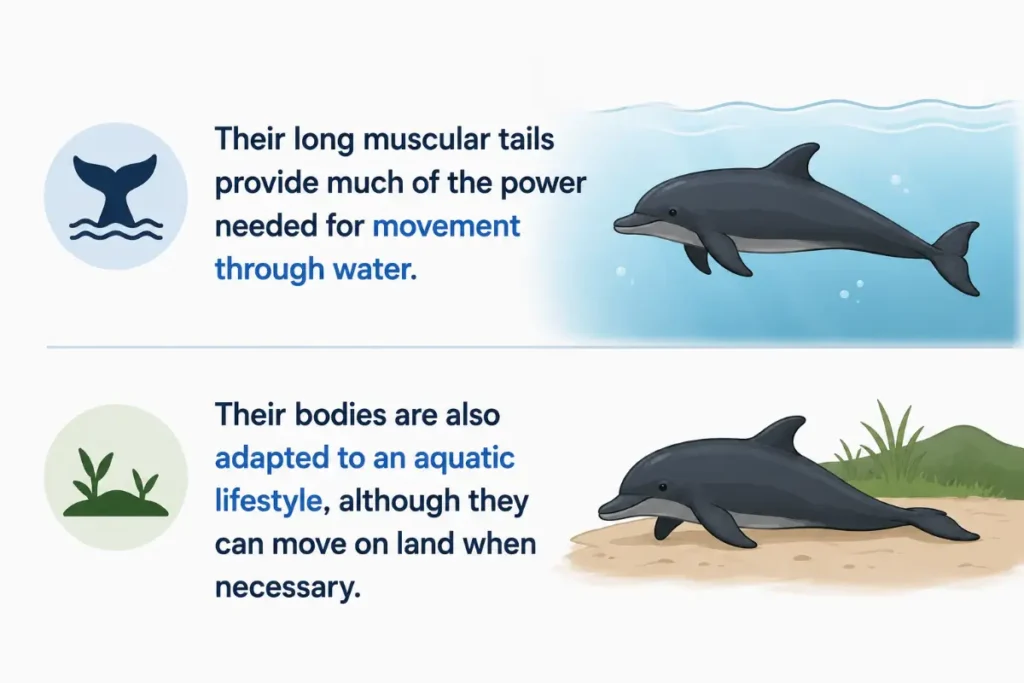
Their long muscular tails provide much of the power needed for movement through water. Their bodies are also adapted to an aquatic lifestyle, although they can move on land when necessary.
Crocodilians aren’t built for sustained high speed over long distances on land. They are better suited to short bursts, ambushes, and movement between water and nearby land.
In water, their streamlined bodies and powerful tails make them much more effective.
This is another reason that the animals can appear almost motionless before suddenly moving with surprising speed.
Reproduction And Young
Alligators and crocodiles show notable parental behavior.
Female American alligators build nests from vegetation. After the eggs hatch, the mother can protect and remain near her young. Young alligators often stay in the area where they were hatched before eventually dispersing.
Crocodilians are unusual among reptiles because several species provide substantial maternal care.
The temperature of the nest can also influence the sex of crocodilian offspring. In American alligators, incubation temperature plays a major role in determining the sex of hatchlings.
This temperature dependent sex determination is one of the most interesting biological features shared by crocodilians.
Alligator Species
When people say “alligator,” they usually mean one of two living species.
The American alligator lives in the southeastern United States. It is the larger and much more widely known of the two.
The Chinese alligator lives in the lower Yangtze River region of China. It is much smaller and critically endangered.
The broader family Alligatoridae also includes caimans. This is why the word alligator can refer specifically to certain animals while Alligatoridae represents a larger taxonomic group.
Crocodile Species
There are numerous crocodile species, and they don’t all share exactly the same appearance or habitat.
The American crocodile is found in parts of the Americas and is especially associated with coastal environments.
The saltwater crocodile is famous for its large size and ability to live in marine and coastal environments.
Nile crocodiles are associated with freshwater systems across parts of Africa.
Other crocodile species occupy different habitats across Africa, Asia, Australia, and the Americas.
This diversity is one reason a rigid visual rule can sometimes fail. The best identification approach combines several clues.
Alligator vs Crocodile In The United States
The United States has both alligators and crocodiles, but their ranges are very different.
The American alligator is widespread across the southeastern United States. Florida and Louisiana have especially large populations.
The American crocodile has a much more restricted US range. It is primarily associated with southern Florida and coastal habitats.
This means location can be a useful clue.
If you’re looking at a crocodilian in a freshwater swamp in Louisiana, an American alligator is far more likely.
If you’re in a coastal area of southern Florida and see a crocodilian with a long narrow snout, an American crocodile becomes a stronger possibility.
Location alone isn’t enough, but it can narrow the possibilities.
How To Identify One In The Wild
If you’re lucky enough to observe a crocodilian from a safe distance, use several clues rather than relying on one.
First, look at the snout.
A broad rounded U shaped snout points toward an alligator.
A narrow pointed V shaped snout points toward a crocodile.
Next, look at the teeth if the animal’s mouth is visible.
A closed mouth with a prominent lower fourth tooth showing points toward a crocodile.
A closed mouth where that lower tooth is hidden points toward an alligator.
Then consider the environment.
Freshwater wetlands strongly suggest an alligator in areas where American alligators occur.
Saltwater or brackish coastal habitat makes a crocodile more plausible.
Finally, consider geography.
Never move closer to an animal just to identify it.
A good wildlife identification rule is simple. Use your eyes, not your feet.
Pronunciation
The pronunciation of alligator is commonly given as AL uh gay ter in American English. Merriam Webster gives the pronunciation as ˈa lə gā tər.
The pronunciation of crocodile is commonly given as KRAH kuh dyle in American English. Merriam Webster gives the pronunciation as ˈkrä kə dī l.
The spelling and pronunciation are both worth learning because these words appear frequently in nature writing, documentaries, news reports, educational material, and everyday conversation.
Word Origins
The history of alligator is surprisingly interesting.
The English word came from Spanish el lagarto, meaning “the lizard.” The phrase was gradually adapted into the English form alligator.
The history of crocodile goes much further back.
English inherited the word through French and Latin from the Greek krokodeilos. Merriam Webster explains that the Greek word was associated with a lizard or crocodile and may have been formed from words connected with pebbles and a worm.
So the two English words have completely different histories even though the animals themselves are related.
Common Mistakes
Mistake 1 Calling Every Crocodilian A Crocodile
People often use crocodile as a general word for any large aquatic reptile with a long snout.
In everyday conversation, that may be understandable. In zoological writing, however, alligators, crocodiles, caimans, and gharials represent different groups within Crocodylia.
Mistake 2 Assuming Every Alligator Lives In Saltwater
American alligators are primarily freshwater animals. They can tolerate saltwater exposure for limited periods, but they don’t have the functional salt glands that help crocodiles handle salt efficiently.
Mistake 3 Thinking Crocodiles Always Have Huge Teeth Showing
The visible tooth rule is useful, but the exact appearance depends on the animal’s species, mouth position, age, and viewing angle.
Use it together with snout shape and habitat.
Mistake 4 Thinking Size Always Identifies The Animal
A large animal isn’t automatically a crocodile.
Some crocodile species become enormous, but size varies widely across crocodilians. A small crocodile can be smaller than a large alligator.
Mistake 5 Assuming Alligators Are Harmless
A calm looking alligator is still a wild predator.
Never approach or feed a wild alligator or crocodile.
Mistake 6 Using Color As The Main Test
Color changes with species, age, environment, lighting, and other factors.
Snout shape, teeth, habitat, and geographic location are more useful.
Real Life Examples
Example 1
The alligator rested beside the freshwater lake.
This sentence uses alligator because the animal is associated with a freshwater habitat and the intended animal is the American alligator.
Example 2
The crocodile moved through the coastal lagoon.
Crocodile is appropriate because crocodiles can occupy coastal and saltwater environments.
Example 3
The zoo educator explained how to distinguish an alligator from a crocodile.
This is a standard comparison sentence because the two animals have similar appearances but distinct characteristics.
Example 4
The alligator had a broad rounded snout.
The description highlights one of the most recognizable alligator traits.
Example 5
The crocodile’s lower fourth tooth remained visible when its mouth was closed.
This sentence describes the jaw feature that helps distinguish crocodiles from alligators.
Example 6
We watched the alligator from a safe distance.
This sentence uses correct wildlife terminology while also demonstrating sensible behavior around a wild animal.
Example 7
The documentary compared crocodile species from several continents.
Crocodile works here because the subject is a group of true crocodiles rather than a specific individual.
Memory Tips
The easiest memory trick is to connect the first letter of alligator with the idea of an alligator having a wider mouth.
You can also remember this simple visual rule.
Alligator equals U shaped snout.
Crocodile equals V shaped snout.
Another useful memory clue involves the teeth.
Alligator hides the fourth lower tooth.
Crocodile shows the fourth lower tooth.
For habitat, remember:
Alligator favors freshwater.
Crocodile handles saltwater better.
These aren’t perfect rules for every crocodilian species, but they are excellent starting points for identifying the two groups.
Related Grammar And Usage Notes
The words alligator and crocodile are both countable nouns.
You can say:
one alligator
two alligators
one crocodile
two crocodiles
Both words can also function as modifiers.
For example:
alligator skin
alligator habitat
crocodile teeth
crocodile habitat
When you use the names as common nouns, they normally aren’t capitalized.
Correct:
We saw an alligator near the lake.
Incorrect in ordinary usage:
We saw an Alligator near the lake.
However, scientific names follow different capitalization rules. The genus is capitalized and the species name is lowercase.
For example:
Alligator mississippiensis
and
Crocodylus acutus
Scientific names are also normally italicized in formal writing.
Formal And Informal Usage
Both words are standard English nouns and are suitable for formal writing.
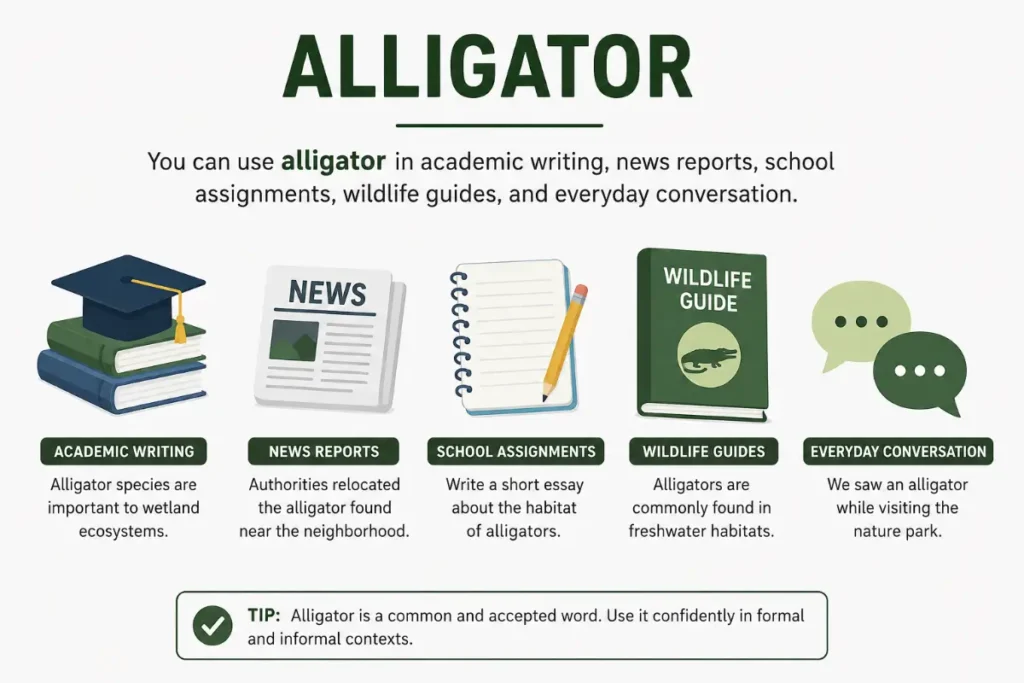
You can use alligator in academic writing, news reports, school assignments, wildlife guides, and everyday conversation.
You can use crocodile in the same settings.
The informal word croc is also used for crocodile. Merriam Webster lists croc as a noun meaning crocodile.
For professional or academic writing, however, crocodile is usually the clearer choice unless the context specifically calls for the informal term.
Why People Confuse Alligators And Crocodiles
The confusion makes sense because both animals share a basic crocodilian body plan.
Both spend substantial time around water.
Both are ambush predators.
From a distance, these similarities can make identification difficult.
The solution isn’t to memorize dozens of obscure facts.
Focus on four practical clues.
Snout.
Teeth.
Habitat.
Location.
Those four clues solve most ordinary identification questions.
When The Basic Rules Can Fail
Nature doesn’t always fit a simple comparison chart.
Some crocodile species have broader snouts than the classic image of a crocodile.
Some alligators may look narrower depending on age, angle, or individual variation.
Young crocodilians can look different from adults.
A photograph taken from an unusual angle can also make a broad snout appear narrow or a narrow snout appear broad.
Saltwater presence isn’t conclusive either. American alligators can tolerate brief exposure to saltwater, and some crocodiles spend much of their lives in freshwater.
That’s why experienced identification relies on multiple characteristics rather than one rule.
Alligator vs Crocodile In Everyday Conversation
In casual conversation, people sometimes use the words loosely.
Someone might see a crocodilian at a zoo and call it a crocodile even if it is an alligator.
That doesn’t necessarily mean the speaker is trying to make a scientific claim. Everyday language often uses familiar labels broadly.
In educational, scientific, or professional writing, precision matters more.
If the animal is an American alligator, call it an American alligator.
If the exact animal isn’t known, crocodilian can be the most accurate general term. The term crocodilian refers to the broader order that includes crocodiles, alligators, caimans, gharials, and related forms.
A Quick Identification Method
If you need an answer quickly, use this sequence.
Look at the snout first.
Broad and rounded suggests an alligator.
Long and pointed suggests a crocodile.
Look at the teeth next.
A visible lower fourth tooth with the mouth closed suggests a crocodile.
A hidden lower fourth tooth suggests an alligator.
Look at the habitat.
Freshwater strongly favors an alligator in the American context.
Brackish or saltwater habitat makes a crocodile more likely.
Then check the location.
Geography can confirm what the physical clues suggest.
This method is more reliable than trying to judge temperament or color.
Why The Difference Matters
Knowing the difference isn’t just trivia.
Accurate animal names matter in education, journalism, wildlife management, conservation, research, tourism, and professional communication.
Calling an American alligator a crocodile can create confusion when discussing habitat, conservation status, behavior, or geographic distribution.
The distinction can also matter when reading scientific information. An article about American crocodiles isn’t necessarily describing American alligators, even though both occur in parts of the same broad region.
Clear terminology helps readers understand exactly which animal is being discussed.
Key Takeaways
- Alligators and crocodiles are both crocodilians, but they belong to different families.
- Alligators belong to Alligatoridae.
- True crocodiles belong to Crocodylidae.
- Alligators generally have broad U shaped snouts.
- Crocodiles generally have narrower V shaped snouts.
- An alligator’s lower fourth tooth is normally hidden when its mouth is closed.
- A crocodile’s lower fourth tooth is normally visible when its mouth is closed.
- American alligators are strongly associated with freshwater environments.
- Crocodiles generally tolerate saltwater better because of specialized salt glands.
- The American alligator is widespread across the southeastern United States.
- The American crocodile has a much more limited US range, mainly in southern Florida.
- Color and size can help but aren’t as reliable as snout shape, teeth, habitat, and location.
- Crocodilian is the broader term for this group of reptiles.
- The word alligator comes from Spanish el lagarto, meaning “the lizard.”
- The word crocodile ultimately comes from Greek krokodeilos.
Conclusion
Telling an alligator from a crocodile becomes easier when you know a few key differences. Alligators usually have a broad, U shaped snout and a rounded head. When their mouths close, the lower fourth tooth typically fits into a socket and stays hidden. Crocodiles generally have a narrower, V shaped snout, and their lower fourth tooth remains visible.
Habitat offers another helpful clue. American alligators mostly live in freshwater environments such as swamps, lakes, ponds, and slow moving rivers. Many crocodile species can tolerate brackish water and saltwater, although their habitat preferences vary by species.
An easy way to remember the difference is to focus on the snout and teeth. Alligators usually have broad U shaped snouts and hidden lower fourth teeth, while crocodiles typically have narrower V shaped snouts and visible lower fourth teeth.
Frequently Asked Questions
What Is the Main Difference Between an Alligator and a Crocodile?
The easiest way to tell an alligator from a crocodile is to look at its snout and teeth. Alligators usually have broad, U shaped snouts, and their lower fourth tooth is hidden when the mouth is closed. Crocodiles generally have narrower, V shaped snouts, with the lower fourth tooth remaining visible. Their saltwater tolerance and habitats also differ.
Is an Alligator a Crocodile?
No. An alligator is not a true crocodile, although both belong to the same order of reptiles called Crocodylia. Alligators belong to the family Alligatoridae, while true crocodiles belong to the family Crocodylidae. They share many physical features, but differences in their anatomy, habitats, and saltwater tolerance help distinguish them.
Which Is More Dangerous an Alligator or a Crocodile?
Both alligators and crocodiles are powerful predators that can seriously injure or kill people. Some crocodile species are known for being particularly aggressive and dangerous to humans, but behavior varies by species and situation. Neither animal should be approached or treated as harmless. Always keep a safe distance and follow local wildlife safety guidance.
Can Alligators Live in Saltwater?
Alligators can tolerate saltwater for short periods, but they generally prefer freshwater habitats. American alligators lack the effective salt excretion systems found in crocodiles, which limits their ability to live in salty environments for extended periods. They are commonly found in freshwater marshes, lakes, ponds, and slow moving rivers.
Can Crocodiles Live in Freshwater?
Yes. Crocodiles can live in freshwater as well as saltwater environments. Depending on the species, they inhabit rivers, lakes, swamps, wetlands, coastal areas, and estuaries. Some species are well adapted to salty water, while others mainly live inland. Their habitat depends on the species and the local environment.
Which Has a U Shaped Snout?
Alligators generally have a broad, rounded, U shaped snout. Crocodiles typically have a narrower, more pointed, V shaped snout. This difference is one of the easiest ways to identify them, although snout shape can vary among species and individuals.
Which Has More Visible Teeth?
Crocodiles generally show more of their lower teeth when their mouths are closed. Their large lower fourth tooth remains visible along the side of the upper jaw. In alligators, the same tooth fits into a socket in the upper jaw and is usually hidden when the mouth closes. This makes tooth visibility a useful identification clue.
Is an Alligator or Crocodile Bigger?
Size depends on the species. Some crocodiles, particularly saltwater crocodiles, grow much larger than American alligators. However, alligators can also reach impressive sizes. Because body length varies widely, size alone is not a reliable way to identify these reptiles.
Where Do American Alligators Live?
American alligators are native to the southeastern United States. They commonly inhabit freshwater wetlands, swamps, marshes, lakes, ponds, and slow moving rivers. Florida and Louisiana have particularly large alligator populations. These reptiles prefer warm environments with suitable water, food, and places to rest.
Where Do American Crocodiles Live?
American crocodiles live in coastal regions of southern Florida, Mexico, Central America, and parts of northern South America. In the United States, they are mainly found in southern Florida, especially in coastal wetlands, estuaries, and mangrove habitats. Unlike alligators, they are better adapted to living in salty and brackish water.
What Is the Easiest Way to Remember Alligator and Crocodile?
Remember three main clues: snout shape, tooth visibility, and saltwater tolerance.
- Alligator: Usually has a broad U shaped snout, a hidden lower fourth tooth, and a preference for freshwater.
- Crocodile: Usually has a narrower V shaped snout, a visible lower fourth tooth, and greater tolerance for saltwater.
These clues make identification easier, but they are general patterns rather than absolute rules for every species.
Is Crocodilian the Same as Crocodile?
No. Crocodilian is the broader term for members of the reptile order Crocodylia. This group includes alligators, crocodiles, caimans, gharials, and related species. Crocodile refers specifically to members of the family Crocodylidae. In simple terms, every true crocodile is a crocodilian, but not every crocodilian is a crocodile.
How Do You Pronounce Alligator?
In American English, alligator is commonly pronounced AL uh gay ter. The word has four syllables, with the main stress on the first syllable. Pronouncing it clearly becomes easier when you say each syllable naturally without placing equal emphasis on every part.
How Do You Pronounce Crocodile?
In American English, crocodile is commonly pronounced KRAH kuh dyle. It has three syllables, with the main stress on the first. The final syllable rhymes with words such as smile and while. Pronunciation can vary slightly by accent, but this is a common American English form.

Confusing Words, Spelling & Word Choice
Claire Whitmore is a U.S.-based English editor who writes about commonly confused words, spelling differences, and word choice. Her work helps readers understand subtle distinctions between similar-looking words through simple definitions, practical examples, and modern usage guidance in both American and British English.