
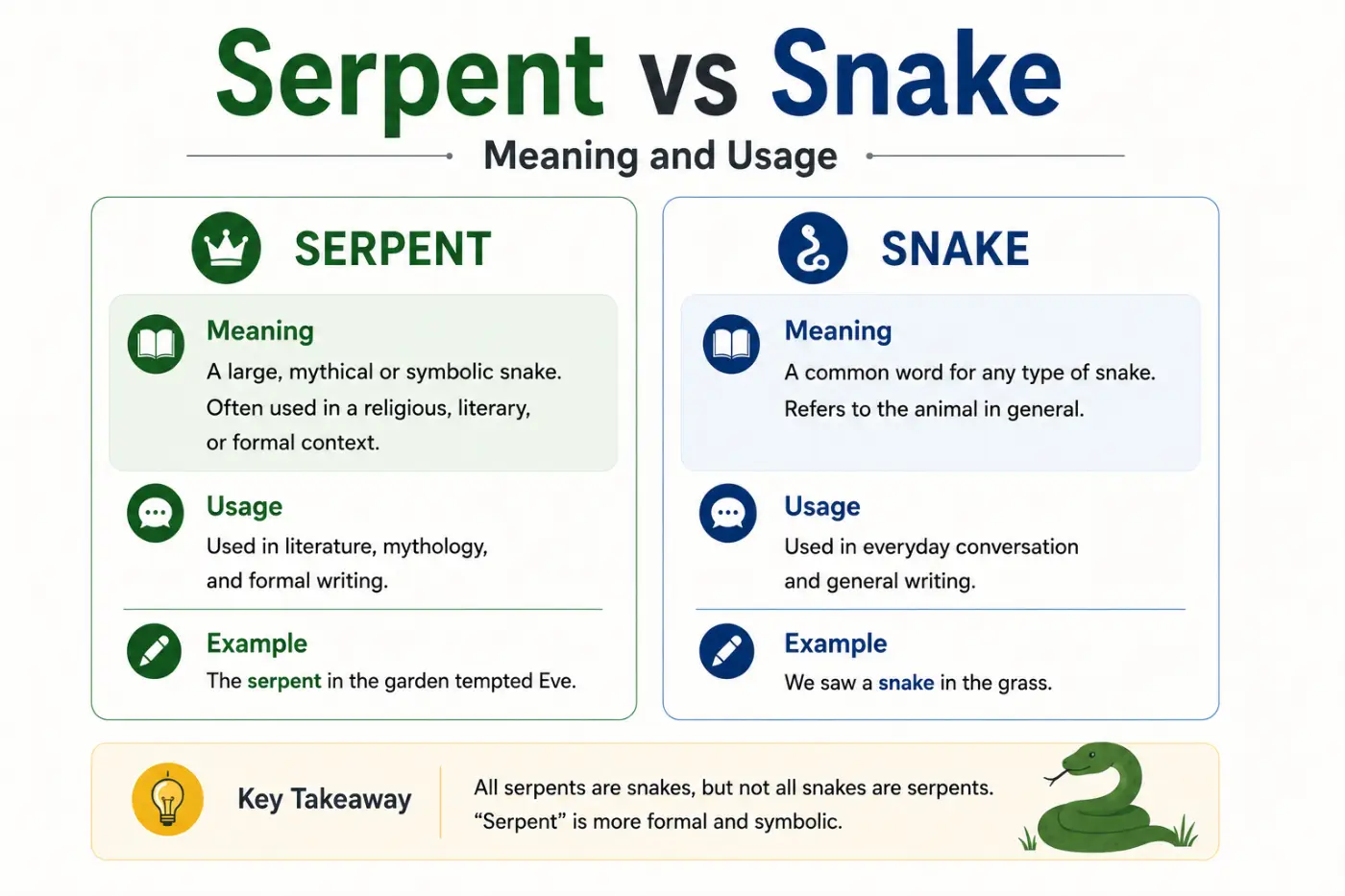
Serpent vs Snake is a comparison that often causes confusion because both words can describe the same animal. If you see a long limbless reptile moving through grass you can call it a snake. You can also call it a serpent. The animal hasn’t changed. The word choice has.
The main difference comes from tone and context. Snake is the common everyday term used in ordinary conversation writing news reports science education and general descriptions. Serpent is less common in casual American English. It often appears in literature mythology religion history poetry fantasy and formal descriptive writing. It can also create a stronger image because the word carries centuries of cultural associations.
That distinction matters when you’re choosing the right word for your sentence. A wildlife expert might write about a snake species. A novelist might describe a dark serpent coiling beneath an ancient tree. Both sentences can refer to a snake. The second simply creates a different mood.
This guide explains the meanings pronunciation origins grammar usage differences regional patterns common mistakes and practical examples. By the end you’ll know exactly when snake sounds natural and when serpent gives your writing the tone you want.
Short Answer
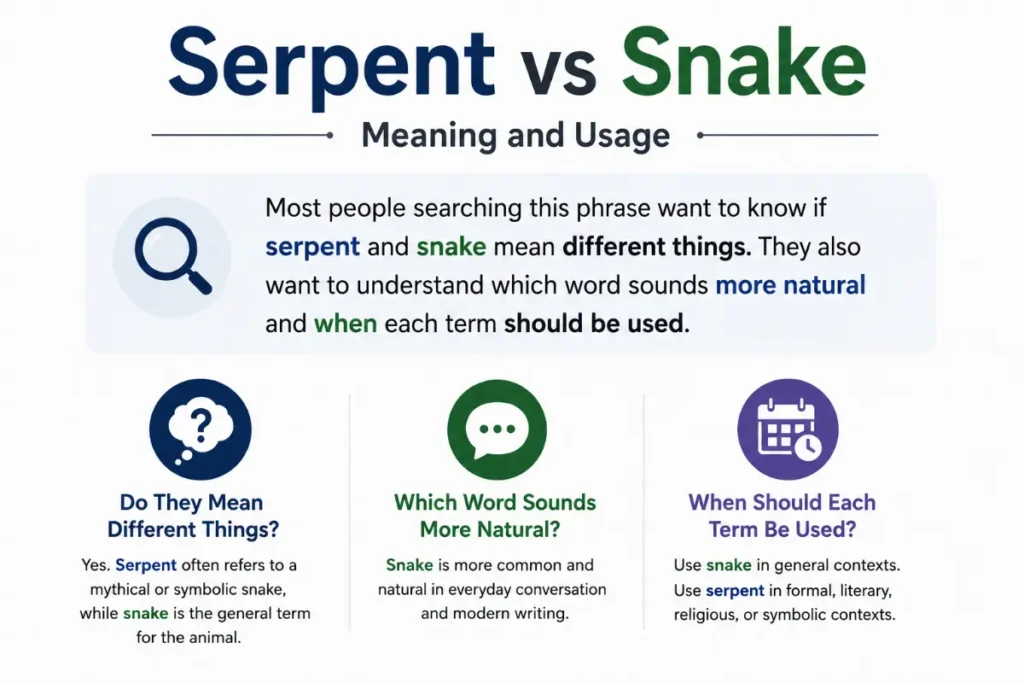
Most people searching this phrase want to know if serpent and snake mean different things. They also want to understand which word sounds more natural and when each term should be used.
The dominant search intent is usage rather than spelling. Readers need a direct distinction followed by examples pronunciation history formal usage and context.
Table Of Contents
- What snake means.
- What serpent means.
- The main difference.
- When to use snake.
- When to use serpent.
- Comparison table.
- Grammar and word usage.
- Pronunciation.
- Word origins.
- Symbolic meanings.
- Real life examples.
- Common mistakes.
- Memory tips.
- Related words.
- Regional usage.
- Professional writing advice.
- Frequently asked questions.
- Key takeaways.
- Conclusion.
What Snake Means
Snake is the standard everyday noun for a limbless reptile belonging to the suborder Serpentes. Snakes have elongated bodies and lack external limbs. They include many different species with very different sizes colors habitats and behaviors.
In ordinary English the word is broad. You don’t need to know the species before calling the animal a snake.
For example:
- I saw a snake in the garden.
This sentence simply identifies the animal. It doesn’t create a special literary mood.
- The snake disappeared under the rock.
Again the word gives straightforward information.
- We learned about snakes in science class.
Here snake works naturally in an educational setting.
The word can also be used metaphorically. Someone who behaves in a dishonest or treacherous way may be called a snake. That figurative meaning has strong negative associations in English.
For example:
- I wouldn’t trust him because he’s a snake.
The speaker isn’t claiming that the person is literally a reptile. The word describes someone considered deceitful or untrustworthy.
Snake can also appear in compound terms such as snakebite snake oil snake charmer and snakeskin. These expressions have their own meanings and cultural histories.
The everyday usefulness of snake is one reason it is normally the safest choice when you’re simply describing the animal.
What Serpent Means
Serpent means a snake or snake like creature. The word is correct standard English but its tone is different from snake.
Serpent often sounds more formal literary poetic archaic or dramatic. Writers may choose it because the word creates a particular atmosphere.
Consider these two sentences:
- A snake moved across the road.
- A serpent moved silently through the ancient forest.
The first sentence sounds ordinary and factual. The second sounds more dramatic. The word serpent gives the scene a darker or more mysterious feeling.
Serpent is also strongly connected with mythology religion folklore and literature. In these contexts the word may carry symbolic meaning beyond the physical animal.
For example a writer might use serpent when discussing a mythical creature or an ancient religious image. The term can suggest wisdom danger temptation evil power transformation or mystery depending on the context.
That doesn’t mean every serpent is mythical or symbolic. Serpent can still refer to a real snake.
For example:
- The biologist photographed the serpent in its natural habitat.
This sentence is grammatically correct. However snake would probably sound more natural in ordinary scientific communication.
The Main Difference
Serpent vs Snake becomes much easier when you focus on register.
Snake is the plain everyday term.
Serpent is a less common alternative that often carries a literary historical symbolic or dramatic tone. The two words overlap in their basic denotation. The difference is mostly in connotation.
Denotation refers to the direct dictionary meaning. Connotation refers to the feelings ideas images and associations a word can bring with it.
Snake usually feels neutral when it refers to the animal.
Serpent can feel mysterious threatening ancient majestic or poetic.
Think of them as two camera lenses aimed at the same subject. Snake gives you a clear everyday picture. Serpent can add atmosphere and emotional weight.
When To Use Snake
Use snake when you want clear natural everyday English.
Snake is usually the better choice in:
- Everyday conversation.
- General American English.
- Basic educational writing.
- News reporting.
- Wildlife discussions.
- Casual emails.
- General nonfiction.
- Simple explanations.
- Conversations with children.
- Ordinary descriptions of animals.
For example:
The snake crossed the trail.
This sounds natural and direct.
You could replace snake with serpent:
The serpent crossed the trail.
The sentence remains correct. It simply sounds more dramatic or literary.
If your goal is clarity rather than atmosphere snake is usually the better option.
When To Use Serpent
Use serpent when the tone benefits from a more elevated or evocative word.
Serpent often works well in:
- Poetry.
- Fiction.
- Mythology.
- Religious discussions.
- Historical writing.
- Folklore.
- Fantasy.
- Symbolic descriptions.
- Dramatic storytelling.
- Literary analysis.
For example:
The serpent guarded the entrance to the ruined temple.
The word creates a stronger image than snake would.
You can also use serpent when discussing a traditional symbol.
For example:
The serpent appears in many ancient stories and symbolic traditions.
Here serpent sounds appropriate because the subject involves cultural and historical associations.
Comparison Table
| Feature | Snake | Serpent |
|---|---|---|
| Basic meaning | A limbless reptile | A snake or snake like creature |
| Commonness | Very common | Less common |
| Everyday English | Natural | Less natural |
| Formal writing | Appropriate | Appropriate when context suits it |
| Literary tone | Usually neutral | Often poetic or dramatic |
| Mythology | Common | Very common |
| Religion | Common | Often preferred in traditional contexts |
| Symbolism | Strong | Often especially strong |
| American conversation | Standard choice | Uncommon |
| Emotional effect | Usually neutral | Can sound mysterious or threatening |
| Grammar | Noun | Noun |
| Pronunciation | /sneɪk/ | /ˈsɜːrpənt/ in many varieties |
| Refers to real animals | Yes | Yes |
| Can be figurative | Yes | Yes |
| Best everyday choice | Yes | Usually no |
Grammar And Word Usage
Both words are nouns when they refer to animals. You can use them as singular count nouns.
- A snake was hiding under the porch.
- A serpent appeared in the story.
You can also use plural forms.
- Snakes live in many different environments.
- Serpents appear in myths from many cultures.
The plural of snake is snakes.
The plural of serpent is serpents.
Neither word normally needs special punctuation simply because of its meaning. The main grammatical issue is not correctness. It is word choice.
A sentence can be grammatically correct while still sounding unusual because the writer chose serpent in a casual setting.
For example:
Can you move that serpent out of the garage.
The sentence is grammatically possible but sounds theatrical if the speaker is simply talking about an ordinary snake.
Can you move that snake out of the garage.
That sounds natural.
This is a useful lesson for English learners. Grammar tells you if a sentence is structurally sound. Register tells you if the vocabulary fits the situation.
Pronunciation Guide
Snake is pronounced /sneɪk/.
It has one syllable.
An easy pronunciation guide is SNAKE.
The vowel sound is the same general sound found in words such as make and take.
Serpent is commonly pronounced /ˈsɜːrpənt/ in British English and /ˈsɝːpənt/ in American English.
It has two syllables.
An easy American pronunciation guide is SUR pent.
The first syllable receives the strongest stress.
Avoid pronouncing serpent like a one syllable word. The second syllable is weak but still present.
The difference in pronunciation is clear even though the meanings overlap.
Word Origins
Snake has a long history in English and is connected to old Germanic forms. The modern word developed from earlier forms related to Old English words for a snake or serpent. Serpent entered English through Old French and Latin. Its deeper history can be traced to Latin serpens which is related to the idea of creeping or crawling.
That history is especially interesting because the Latin root connects the animal with its characteristic movement. A snake moves by creeping or gliding along the ground rather than walking on legs. The two words therefore have different linguistic histories even though their meanings overlap.
Snake developed as the ordinary native English word.
Serpent came into English through a Romance language pathway and became associated with elevated and literary vocabulary.
That history helps explain part of the difference in tone today.
English contains many pairs like this. One word may be a common everyday term while another has a more formal literary or historical flavor.
Symbolic Meanings
Snake has powerful symbolic associations in English speaking cultures.
It can represent danger deception betrayal fear or cunning. Those associations often appear in idioms and figurative language.
For example:
- He is a snake in the grass.
This means that someone appears harmless but is secretly dangerous or dishonest. Serpent can carry many of the same negative associations but often has stronger connections to mythology religion and ancient symbolism.
In some traditions the serpent represents evil or temptation. In others it can symbolize wisdom healing renewal transformation fertility or rebirth.
The meaning depends heavily on the cultural context. That is why replacing serpent with snake can sometimes change the feel of a sentence even when the literal reference stays the same.
A writer discussing mythology might deliberately choose serpent because it connects the animal with a long tradition of symbolism.
Real Life Examples
Everyday Conversation
- I saw a snake near the fence.
This is the most natural everyday choice.
- Did you see that snake on the trail.
The sentence sounds conversational and straightforward.
News Writing
- Officials warned residents about a large snake near the park.
News writing generally favors direct language. Snake communicates the information without adding dramatic emotion.
- Wildlife officers safely removed the snake.
Again the ordinary word fits the factual tone.
Scientific Writing
- The snake species lives in warm forest habitats.
Scientific writing usually favors precise species names when needed. Snake is still completely normal when the exact species isn’t the focus.
- Researchers observed the snake moving through shallow water.
The sentence is clear and factual.
Literature
- A dark serpent coiled beneath the ruined stone.
The word serpent contributes to the atmosphere.
- The hero faced a giant serpent in the underground chamber.
Serpent works naturally in fantasy and mythic storytelling.
Mythology
- The serpent became a powerful figure in the ancient tale.
The elevated word suits the subject.
- The story describes a serpent guarding a sacred place.
The term fits the traditional and symbolic context.
Common Mistakes
Assuming The Words Describe Different Animals
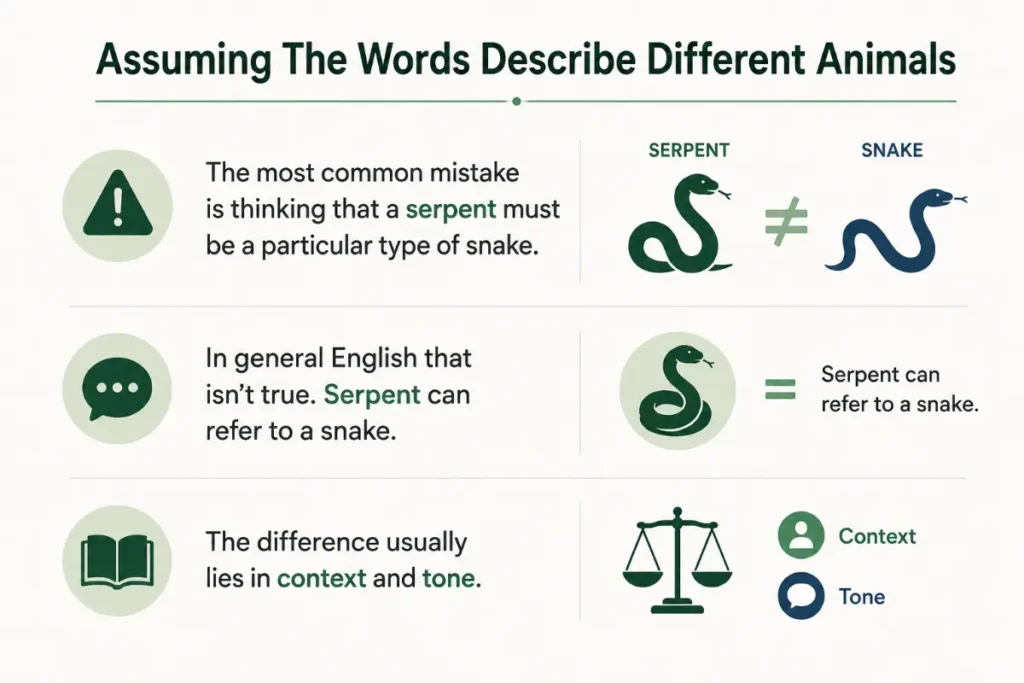
The most common mistake is thinking that a serpent must be a particular type of snake.
In general English that isn’t true. Serpent can refer to a snake.
The difference usually lies in context and tone.
Using Serpent In Every Formal Sentence
Serpent isn’t automatically better because it sounds sophisticated.
A scientific article doesn’t become more authoritative simply because it replaces snake with serpent. In many cases the ordinary word is clearer.
Good writing doesn’t use complicated vocabulary just to sound impressive.
Assuming Serpent Is Outdated
Serpent is less common than snake but it isn’t obsolete.
You can still find it in modern literature journalism religious writing mythology fantasy and descriptive prose.
Treating Snake As Informal
Snake isn’t an informal word. It is the normal standard English term.
It’s suitable for professional writing academic writing news reporting and everyday conversation.
Using Serpent When You Mean A Specific Species
If you know the exact species then use the species name when precision matters.
For example a zoologist may identify a rattlesnake rather than simply calling it a snake or serpent.
The more specific term gives readers more useful information.
Memory Tips
A simple memory trick is to associate snake with ordinary speech and serpent with stories.
Think:
Snake equals simple.
Serpent equals symbolic.
This isn’t a strict grammar rule. It’s a practical shortcut for choosing the natural word.
Another useful test is to imagine saying the sentence aloud.
If you would normally say the word while talking to a friend use snake.
If you’re writing a myth a poem a fantasy scene or a dramatic description serpent may fit better.
You can also ask yourself what effect you want.
Do you want the reader to picture an animal.
Use snake.
Do you want the reader to feel an atmosphere.
Serpent may be the stronger choice.
Related Grammar And Usage Notes
The word snake appears in many common expressions.
Snake In The Grass
A snake in the grass describes a person who is secretly dangerous or dishonest.
Example:
I thought he was friendly but he turned out to be a snake in the grass.
Snake Oil
Snake oil refers to a product or treatment claimed to have benefits that it doesn’t really provide. The expression comes from the history of supposed medicinal snake oil products and later developed into a broader term for deceptive claims.
Example:
That advertisement sounds like snake oil.
Snake Charmer
A snake charmer is a person traditionally associated with performances involving snakes.
Example:
The story featured a famous snake charmer.
Snakebite
Snakebite means a bite from a snake.
Example:
The hiker received treatment for a snakebite.
These expressions are much more common with snake than serpent.
That difference is another useful clue. If you’re dealing with an established everyday expression snake is usually the natural word.
Formal And Informal Usage
Snake works across almost every register.
You can use it in casual conversation.
You can use it in professional communication.
Serpent has a narrower stylistic range.
It works well in formal literary writing but it may sound unnecessarily grand in plain communication.
Compare:
The snake moved through the grass.
The serpent moved through the grass.
Both are correct. The second sentence sounds more dramatic.
Now compare:
The researcher recorded the serpent’s body temperature.
The researcher recorded the snake’s body temperature.
The second sentence sounds more natural for ordinary scientific prose unless serpent is specifically relevant to the study or source terminology.
Professional writing is often strongest when it uses the simplest accurate word.
US And UK Usage
American English strongly favors snake in everyday conversation.
British English also uses snake as the ordinary word.
Serpent is understood in both varieties and has broadly similar literary historical religious and symbolic associations.
There isn’t a major American versus British spelling difference here. Unlike words such as color and colour this isn’t mainly a regional spelling issue.
The distinction is stylistic.
American readers understand serpent easily but may perceive it as more literary or dramatic than snake.
British readers can make the same distinction.
That makes snake the safe choice for broad international English when you simply mean the animal.
Professional Writing Advice
A professional editor would rarely change snake to serpent just to make prose sound more sophisticated.
Clarity comes first.
If the sentence is factual use the direct word.
If you’re writing a scientific article use the species name when precision matters and use snake as a broad category when appropriate.
The best word isn’t always the most unusual one. Strong writing often comes from choosing a familiar word and putting it in a precise sentence.
Expert Tip
Here’s a useful editorial test. Remove the word and read the sentence again. Then ask what the reader needs to understand. If the reader only needs to know that the animal is a snake then snake is probably enough. If the word needs to create a mythic or threatening atmosphere then serpent may earn its place.
That small test can prevent overworked prose.
Similar Words And Their Differences
Several words can overlap with snake but aren’t perfect substitutes.
Reptile
Reptile is a broad biological category. Snakes are reptiles but many reptiles aren’t snakes.
A turtle is a reptile. A lizard is a reptile. A crocodile is a reptile.
Viper
Viper refers to a particular group of venomous snakes. It isn’t a general synonym for snake.
Cobra
Cobra refers to certain venomous snakes from several related groups. Calling every snake a cobra would be incorrect.
Python
Python refers to a group of large constricting snakes. It is much more specific than snake.
Boa
Boa refers to snakes in the boa family and related groups depending on classification.
Eel
An eel may look somewhat snake like but it is a fish rather than a snake.
This distinction matters because similar appearance doesn’t mean biological identity.
Why Context Matters
Words don’t exist in isolation. Readers interpret them through context.
The sentence:
A snake appeared in the field.
gives straightforward information.
The sentence:
A serpent appeared beneath the moonlit ruins.
does more than identify an animal. It creates a mood.
This is why vocabulary choice matters so much in good writing.
Two words can share a dictionary definition but create different reactions in the reader.
Snake is usually plain and direct.
Serpent can feel ancient mysterious threatening or majestic.
Neither is automatically better.
The strongest choice depends on the job the sentence needs to do.
Key Takeaways
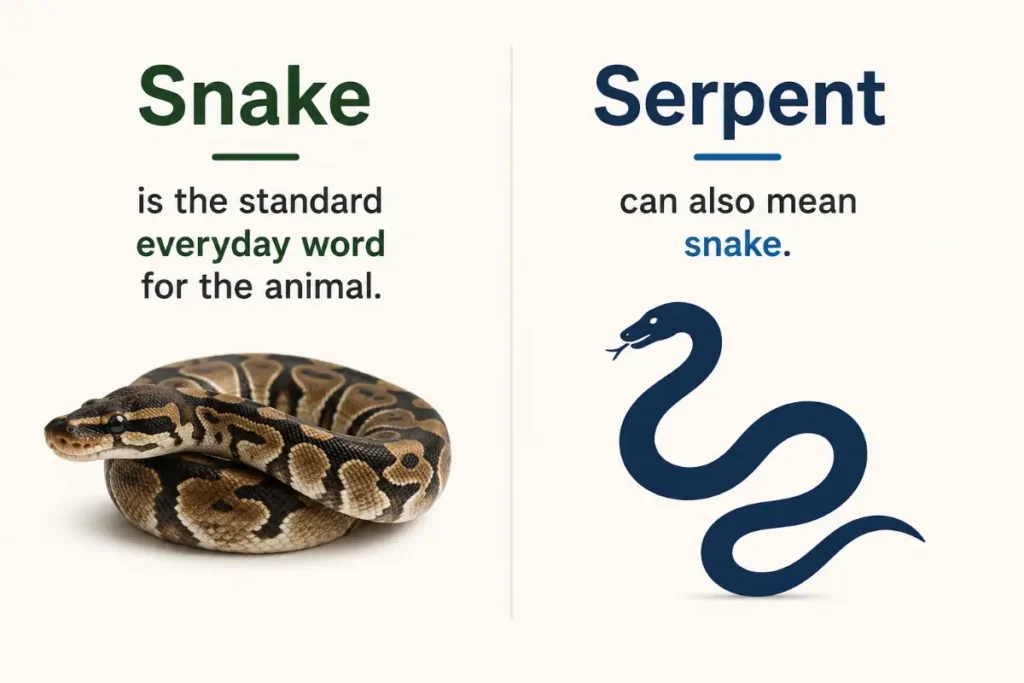
- Snake is the standard everyday word for the animal.
- Serpent can also mean snake.
- Snake is more common in American English.
- Serpent often sounds literary poetic formal historical or symbolic.
- Neither word automatically refers to a different animal.
- Scientific writing should favor precise terminology when the species matters.
- Snake works naturally in conversation news education and general nonfiction.
- Serpent works especially well in mythology literature folklore religion and dramatic writing.
- Context determines the strongest choice.
- Clear writing doesn’t require complicated vocabulary.
Conclusion
The easiest way to remember Serpent vs Snake is to connect snake with ordinary English and serpent with elevated or symbolic language. Both words can refer to the same kind of animal. Snake is the normal choice in everyday American English while serpent can give a sentence a more literary dramatic ancient or mysterious feel.
Good word choice comes down to purpose. Use snake when you want readers to understand the animal quickly and without extra stylistic weight. Choose serpent when the context involves mythology literature folklore symbolism or a deliberately dramatic tone. Neither word is inherently better. They simply do different jobs on the page.
When you’re unsure which one to use remember one simple rule. Snake is the everyday word. Serpent is the atmospheric word. That distinction will keep
Frequently Asked Questions
Is serpent another word for snake?
Yes. Serpent can mean snake and is often used as a synonym for it. The main difference is tone. Snake is the ordinary everyday term while serpent often sounds literary formal poetic historical or symbolic. In casual American English most people would naturally choose snake when simply talking about the animal.
Is serpent a specific type of snake?
No. Serpent is not normally the name of one specific snake species. It is a general word that can refer to a snake or snake like creature. Some contexts may use serpent for a particular mythical or symbolic creature but the word itself doesn’t identify one biological species.
Which is more common snake or serpent?
Snake is much more common in everyday English. It appears naturally in conversation education journalism science and ordinary descriptions. Serpent is less frequent and tends to appear in literature mythology religion folklore fantasy and symbolic writing. If you’re unsure which word sounds natural in ordinary conversation snake is usually the better choice.
Is serpent more formal than snake?
Serpent can sound more formal or elevated than snake but it isn’t simply a more formal version in every situation. Its strongest difference is stylistic. It often creates a literary dramatic or historical tone. Snake is standard English and is perfectly appropriate in formal writing when the context calls for a plain description.
Can I use serpent in scientific writing?
Yes but snake is often the more natural general term in scientific prose. Scientific writing usually values precision and clear terminology. If the exact species matters the scientific or common species name is often better than either broad term. Serpent may appear when researchers are discussing a traditional term or source that specifically uses it.
Are snakes and serpents the same animal?
In general English the terms can refer to the same animal. Snake is the standard everyday word while serpent is an alternative with stronger literary and symbolic associations. The difference is usually linguistic rather than biological. A real snake can be called a serpent without becoming a different type of animal.
Does serpent have a negative meaning?
Not always. Serpent can suggest danger or evil because of associations in mythology religion literature and folklore. However it can also represent wisdom healing transformation renewal or other ideas in different traditions. The meaning depends on context. The word itself doesn’t automatically mean something evil.
Should I use snake or serpent in everyday English?
Use snake in most everyday situations. It is simple natural and immediately clear. Serpent works when you’re intentionally using a literary dramatic historical or symbolic tone. If you tell a friend that you saw a snake in the yard the sentence sounds completely natural. Calling it a serpent would sound more dramatic.
Can serpent refer to a mythical creature?
Yes. Serpent is commonly used for mythical snake like creatures. Writers and historians may use the word when discussing legendary beings associated with ancient traditions. In these contexts serpent can carry symbolic meaning beyond the appearance of an ordinary animal. The surrounding story determines the exact meaning.
What is the difference between serpent and snake in literature?
Literary writers often choose serpent because it carries stronger atmosphere and cultural associations. Snake is more direct and familiar. Serpent can make a scene feel ancient mysterious dangerous or symbolic. The choice depends on the writer’s purpose. Neither word is automatically more correct than the other. your writing natural clear and precise in almost any context.

Confusing Words, Spelling & Word Choice
Claire Whitmore is a U.S.-based English editor who writes about commonly confused words, spelling differences, and word choice. Her work helps readers understand subtle distinctions between similar-looking words through simple definitions, practical examples, and modern usage guidance in both American and British English.